Tag Archives: Al Sergel

Absent in 2020, Nnenna Freelon Offers a Heartfelt Raincheck

Review: Jazz @ the Bechtler Presents Nnenna Freelon

 By Perry Tannenbaum
2022~Nnenna Freelon-04

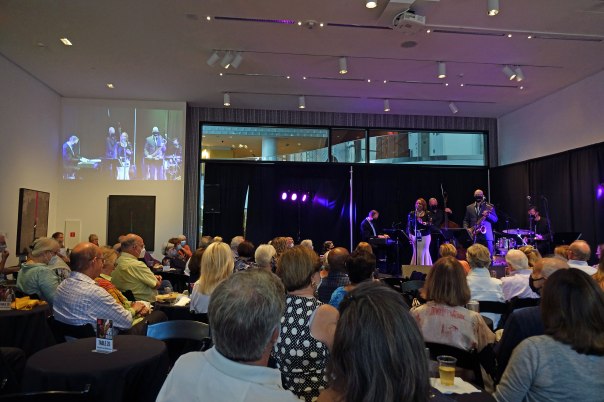
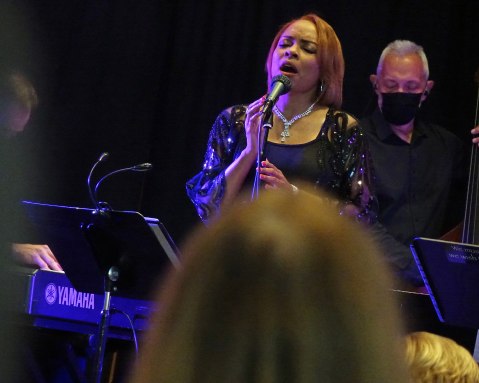
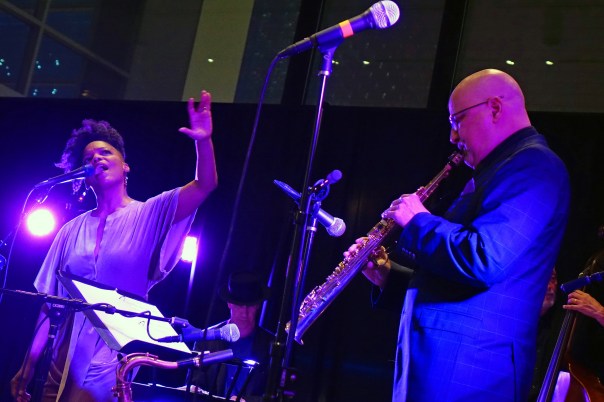
March 4, 2022, Charlotte, NC – We hadn’t seen or heard Nnenna Freelon singing in Charlotte for over four years before she returned for two shows with the Ziad Jazz Quartet last week, her latest Jazz at the Bechtler concert. The interval would have been just over two years if Freelon had appeared as scheduled at the Bechtler series’ all-star 10th anniversary celebration on January 3, 2020. While it’s tempting to assume that Freelon’s cancellation was part of her grieving process in the wake of her husband’s death of ALS the previous July, the six-time Grammy Award nominee had already gone into the recording studio in October 2019. The album that emerged from that stage of her grief processing, Time Traveler, was eventually released last May, so it could have come to us two years ago as the core of her canceled gig at the Bechtler, a nice little scoop for us.

Not to worry, after a bopping “Just Friends” warmup from his quartet, Ziad Rabie was now able to introduce Freelon as a seven-time Grammy nominee, with the outcome of her latest nomination for Time Traveler to be announced in Vegas on April 3. And there was also a scoop: Freelon will soon be inducted into the North Carolina Music Hall of Fame, alongside such greats as Nina Simone, James Taylor, John Coltrane, Thelonious Monk, Kate Smith, Loonis McGlohon, and Roberta Flack. The theme of Time Traveler was certainly evident in the concluding set we heard at 8:15, for it was doubly a time capsule, packaging songs we could have heard two years back at the originally-scheduled 10th anniversary gig alongside songs we did hear in November 2017.

There was nothing sneaky or accidental about the repeats, though Freelon didn’t point them out. As before, Freelon led off with her uptempo “Nature Boy,” rewriting the lyrics with a feminist twist the second time around after a searing soprano sax solo from Rabie. The ending was also the same, a “Moon River” that started off unusually mournful, hit a swinging midtempo, and eventually heated up to exultation. In a fascinating way, this questing read of “Moon River” merged Freelon’s time capsules together, for in 2017, she sang it as a tribute to two recently departed jazz greats, singer Al Jarreau and pianist Geri Allen, and she recorded it almost two years later as a tribute to her husband, famed architect Phil Freelon, who had designed Smithsonian Institute’s National Museum of African American History and Culture in Washington, the Museum of the African Diaspora in San Francisco, and the International Civil Rights Center and Museum in Greensboro.

2022~Nnenna Freelon-01Did the audience give Freelon and bassist Ron Brendle a standing ovation for their deep, mesmerizing duet on Hoagy Carmichael’s “Skylark” because they recalled it fondly from 2017 – or because it was so achingly lovely and poignant now? Also back from 2017 was Charlie Chaplin’s “Smile,” with drummer Al Sergel navigating the transitions back and forth from Freelon’s waltzy 3/4 time to Rabie’s break-loose solo on tenor sax in a fleet 4/4 tempo. These non-lunar reprises were all from Freelon’s Homefree album of 2010, and so was her slowed-down and bluesy “I Feel Pretty,” complete with her 2017 exhortation to the men in the audience to sing out the title line, because we needed to answer for nearly all the ugliness in our world. Notwithstanding #MeToo, probably truer in 2022 than before.

Despite its aching moments striving to reach across “Moon River,” Time Traveler remembers and celebrates love far more than it bemoans loss. Aside from versions of the title composition, two tracks address the main theme, Jim Croce’s “Time in a Bottle” and Jule Styne’s “Time After Time,” the one Freelon elected to bring to the Bechtler. Freelon repeated and obsessed over the title in a concluding cadenza that was every bit as ardent as her studio version, if not more so. Solos between the vocals, pianist Noel Freidline floating gracefully over Brendle’s bass, enhanced the soulfulness. But the album isn’t simply celebratory or sentimental, for Freelon gave Harold Arlen’s “Come Rain or Come Shine” a performance that was as down-to-earth as her spoken intro, confessing that she had no idea what she had said “I do” to at the altar when she and Phil were wed.2022~Nnenna Freelon-11

Always gorgeous, Freelon’s voice seems to be acquiring more varied textures. Up high, the Ella Fitzgerald sass is often joined with a Dinah Washington grit; and below, the Roberta Flack sensuousness occasionally gives way to a Carmen McRae worldliness and wisdom. The Freelon original, “Just You,” lost a little of its righteous gospel flavor in transitioning from the studio, where an organ and a guitar imparted a churchly tang, to the Bechtler’s lobby, where neither instrument was in attendance, though Rabie supplied superb fills on soprano sax. But a dominant motif of Freelon’s Time Traveler tribute is simply a return to songs that recapture the 1970’s, when the Phil-Nnenna romance first bloomed. Aside from “Time in a Bottle,” which serves double duty, Freelon revisits the ‘70s with Dionne Warwick’s “I Say a Little Prayer,” the Stylistics’ “You Make Me Feel Brand New,” and a Marvin Gaye medley.

Nnenna testified at the Bechtler to Phil’s adoration of “Betcha by Golly, Wow,” further evidence that he was a Stylistics fan, but he obviously wasn’t alone. Enhancing the studio version, Freelon was able to call upon the Bechtler audience to sing along with her on the refrain. Here the live instrumentation meshed almost perfectly with the studio performance as Freidline radically altered his piano timbre from acoustic to electric and Rabie more than ably substituted for Kirk Whalum in adding a smooth jazz vibe. As with “Moon River,” facets of Freelon’s concept came magnificently together. After remembering the 2017 Bechtler playlist by repeating some of it, she was giving us a raincheck on a hit she could have brought us in 2020, remembering her departed husband by singing a song they both loved. Through the mystery of music, we were singing along with Nnenna, joining her ritual of remembering Phil, while evoking memories of our own.

Originally published on 3/7 at CVNC.org

Maria Howell Torches the Triumphant Return of Jazz at the Bechtler

Review: Maria Howell and the Ziad Jazz Quartet

 By Perry Tannenbaum

2021~Jazz @ Bechtler Returns-04

Among music presenters in Charlotte, tenor saxophonist Ziad Rabie and his Jazz at the Bechtler series were among the first to swing back into action and move their concerts online, “virtually” intact, after the onset of the pandemic last March. Others, including Charlotte Symphony and JazzArts, have returned sooner to live performance, but the Bechtler has insouciantly kept chugging along, finishing its 2020-21 season of first Friday events back in May as they normally would – just before Symphony returned indoors and, like JazzArts, summered in the open air. Retaining his poise, Rabie has brought his quartet, along with popular guest artist Maria Howell, back to the Bechtler right on time for a new season. Ticketing was paperless, proofs of vaccination demanded outdoors before we entered the museum, and masks required unless you were eating or drinking. Lines to the bar, where assorted hors d’oeuvres were also offered, seemed longer than usual, clearly hinting that the audience knew an escape clause when they saw one.

2021~Jazz @ Bechtler Returns-13

Starting off with a hot blues, with pianist Noel Freidline and bassist Ron Brendle soloing zestfully after him, Rabie hardly needed to tell us how happy he was to be performing for a live audience again after 18 months. Ripping aside a flame-red mask studded with glitter or rhinestones as she stepped onstage to join the quartet, Howell seemed simpatico with the quartet’s blazing opener, launching into Cole Porter’s “Too Darn Hot” over Rabie’s obbligato. Turning up the wickedness a couple of notches from the Kinsey Report referenced in Porter’s lyric, Howell and the Ziad Quartet went for the jugular with “Hard Hearted Hannah (The Vamp of Savannah),” a crowdpleaser since 1924, with Friedline and Rabie soloing between Howell’s ornery vocals.

After such a raunchy romp, the band must have figured that this was the best moment to ease down to a ballad tempo, and “My Ship” was the most luscious in the set, its wondrous Kurt Weill melody nearly matched by Ira Gershwin’s lyric. Friedline switched to a more precious electronic cocktail-hour sound at the keyboard, and Rabie contributed an eloquent half-chorus after Howell’s vocal, ferrying her back to the bridge. None of the songs that followed would be quite so slow, but Howell modulated deftly between mid and uptempo selections, increasing the pace for Stevie Wonder’s “My Cherie Amour” to a genial lope and leaving plenty of space for Freidline and Rabie to frolic. The pianist pranced around on the keys in a manner that recalled Erroll Garner in his intro and solo, and Rabie seemed to catch the same vibe as I had, slipping a few notes from “Misty” into his solo.

2021~Jazz @ Bechtler Returns-18

With fair warning that we would need to be alert to keep up with the blur of lyrics (by Johnny Mercer, it turned out), Howell and the quartet went willfully against the grain by red-lining Jerome Kern’s “I’m Old Fashioned,” speeding through two choruses in quick order. Freidline and Rabie took two choruses apiece before Howell’s reprise, the pianist more mischievously by tossing in a snatch of “The Surrey With the Fringe on Top” to cement his old-fashioned credentials. Ably lurking behind and propelling the combo until this point, drummer Al Sergel asserted himself emphatically here, slowing the tempo for Howell’s winsome climax.

If you keep up with Howell’s discography, you know that Freidline is as much her collaborator as the Ziad Quartet’s, so it wasn’t shocking to see Rabie handing over the stage to Howell and the rhythm section for two or three songs. The first of these was customized by Freidline for Howell, a mashup of The Shirelles hit (by Carole King), “Will You Still Love Me Tomorrow,” and Chicago’s considerably less-distinguished “Love Me Tomorrow,” which the singer mercifully devoted less time to. Freidline himself seemed to be more inspired by Harold Arlen’s “A Sleepin’ Bee” after Brendle triggered the groove on bass, and Howell did full justice to the Truman Capote lyric. The wit of Freidline’s quote from “Teach Me Tonight” was only faintly apropos four songs after Howell had referenced Nancy Wilson, but the connection between his snippet from “Honeysuckle Rose” and Howell’s “Bee” was plain enough.

2021~Jazz @ Bechtler Returns-09

Rabie’s return coincided with the most orgiastic arrangement so far, a mashup of two Bill Withers hits, “Lovely Day” and “Just the Two of Us.” Here the balance was quite exquisite, for Howell clearly relished “Lovely Day,” which framed the medley, while Rabie had far more to say on “Just the Two of Us,” with two fiery rants. From here, the concert moved to higher and highest ground for Howell’s final two selections. With Freidline switching to a more organ-like sound behind his Yamaha, Howells dug into “Unchain My Heart” as a tribute to Ray Charles, adding a little gospel tang to its rhythm-and-blues. Eager to take wing, Rabie and Freidline both played fills under Howell’s vocal, the saxophonist taking the first solo before the keyboardist sermonized. After Howell revisited the lyric, her entire congregation joined in a rousing concluding riff.

Famous as a James Bond theme song popularized by Carly Simon, Marvin Hamlisch’s “Nobody Does It Better” is so closely identified with Simon’s 1977 single that the power ballad, with lyric by Carol Bayer Sager, has scarcely spawned any jazz covers. Just by being markedly different from the chart-topping hit, Howell’s version was something of a revelation as she positively torched what is usually an aching anthem. Rabie’s solo also revealed the ripeness of this melody for jazz improvisation, and the incantatory ending tacked on by Howell, her quartet jamming behind her, brought her audience spontaneously to their feet. It was an auspicious evening at the Bechtler, a triumph we could joyously cheer.

Ziad Quartet Celebrates the Middleweight Champ of the Tenor Sax

Review: Ziad Jazz Quartet’s Tribute to Hank Mobley

2020~Ziad's Mobley Tribute~8

By Perry Tannenbaum

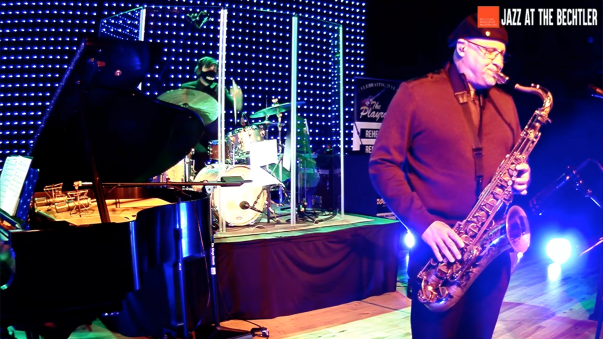
Introducing the honoree at the latest Jazz at the Bechtler concert, Ziad Rabie cited fellow saxophonist Hank Mobley as a foundational member of the hardbop stable of musicians on the Blue Note record label during the 1950s. Mobley, he further asserted, was also one of the most prolific hardbop composers of that era, at one time releasing eight albums within the space of 16 months. So there was plenty for Rabie to pick from for the Ziad Jazz Quartet’s hourlong tribute. My own collection merely includes seven albums with Mobley as the leader and stints as a sideman with Miles Davis, Art Blakey, and Horace Silver, so of the six tunes on the Ziad set list, I had only heard four before, including two title tunes from Blue Note albums of the ‘60s.

We started out with drummer Al Sergel’s cool preamble to “High and Flighty,” an uptempo gem from 1958 that I acquired in the 2008 reissue of Peckin’ Time while I was catching up with Mobley’s work five decades later. While some of the Blue Note flavor was missing when Rabie roared through the melody without a trumpeter alongside him on the bandstand matching him note for note, Rabie’s pace and energy were as compelling as the master take on the Mobley album when he launched into his solo, faster than the alternate take from Mobley and trumpeter Lee Morgan added on the reissue.

Without an intervening trumpet solo in the Ziad arrangement, pianist Sean Higgins entered the fray sooner – with an effervescent spirit that chimed well with Wynton Kelly’s work on the original session, along with some filigree that Herbie Hancock might recognize. Since there wasn’t a trumpeter in sight to join with Rabie in firing four-bar volleys back and forth with Sergel – as Morgan had alternated with Mobley in the original – Higgins replaced the trumpet in bringing the piece to a rousing climax, before Rabie played the outchorus.Screen Shot 2020-11-07 at 5.32.17 PM

Sergel didn’t quite let go at the end of “High and Flighty,” thrashing away mostly on his cymbals as he transitioned to “The Morning After,” a tumultuous 3/4 composition that appeared on Mobley’s A Caddy for Daddy in 1965. With Higgins adopting a McCoy Tyner manner as he layered on, dropping power chords in his left hand that were a hallmark of John Coltrane’s quartet recordings of 1961-65, the rhythm section sounded very much like the sound Tyner and drummer Elvin Jones pioneered on those classic sessions on Impulse.

Rabie certainly picked up on the sound, for Tyner turned out to be a key ingredient on Caddy for Daddy when I tracked it down, and the tenor saxophonist’s solo had a few licks that echoed Coltrane’s Crescent from 1964, abandoning Mobley’s less fiery style. When Higgins followed Rabie’s incendiary exploits, he let loose with more bombs in his left hand and a Tyner-like flurry in the treble. Nor was this powerful rhythm section done here, for Sergel was still thrashing when the leader returned to reprise the melody on sax, and he took over for a second drum solo afterwards with wailing support from Higgins underneath.

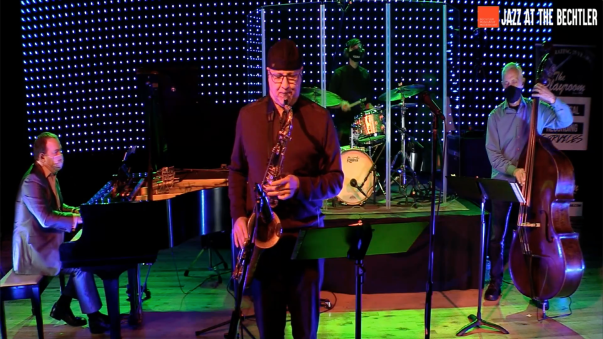
This was a perfect moment for Rabie to repeat jazz critic Leonard Feather’s judgment that Mobley was “the middleweight champion of the tenor saxophone,” for his quartet was about to turn down the heat for “Madeline,” an original recorded in Mobley’s pre-Blue Note days. Sergel switched to brushes behind his drumkit and, after lyrical solos by Rabie and Higgins, Ron Brendle finally had an opportunity to shine in the spotlight, better captured in his bass solo than in any of the previous Bechtler webcasts from The Playroom – double kudos for the sound and the music. Higgins was more distinctively his own man in his solo, maybe weaving in wisps of Hancock and Red Garland, while Rabie came closest on this tune to replicating Mobley’s smoky sound on tenor before giving way to Higgins. After the pianist took his solo, Rabie’s blowing had more of a Coltrane tang as Sergel unobtrusively switched to mallets, and the breathiness at the end of the tenor coda injected a faint hint of Ben Webster.2020~Ziad's Mobley Tribute~2Rabie’s final three selections were his most predictable, culled from two of Mobley’s most acclaimed Blue Note recordings, Soul Station (1960) and Workout (1961). “This I Dig of You,” from the earlier album, bopped more than “High and Flighty,” but the creativity flowed richly from the quartet as all the players had a chance to solo. Sergel took up his sticks to launch the merriment, pounding on his rims as well as his toms, and Rabie handed things over quickly to Higgins, who swung his first chorus on the keyboard and offered fresh new angles on each ensuing variation. Rabie was deceptively tame at first, almost cool with his bopping triplets, before he whipped up a harder sound up in the treble, getting a second wind. Brendle had a crisp, swinging take on the tune before Sergel crafted a hybrid solo at the drums, beginning with brushes in Brendle’s wake and then turning the heat back up with his drumsticks.

Weighing in at a middleweight 16 bars, “Soul Station” is as groovy and infectious a blues as you’ll hear, arguably Mobley’s signature composition, and the Ziad Quartet made sure they didn’t mess up the pulse or the tempo, leaning into its medium-paced quietude with its arrangement and obviously having fun. Rabie scorched it without rushing it, and Higgins tossed a bit “Night Train” into his flame (a 12-bar blues that can be traced back to Ellington). Brendle proved that he had been listening closely, popping a bar or two of the same train into his solo.

Inevitably, Rabie chose the title tune of Workout as part of his Mobley tribute, for Feather’s memorable pronouncement on the tenor sax great was the first sentence of his liner notes for that worthy album. Now it sounded like it was Rabie who was refusing to let go, thundering into each new improvised chorus, with Sergel in an orgiastic mode behind him. Higgins was no less dazzling, he and the drummer spurring each other on the pianist’s solo until Sergel pounced on his solo. The liquid intensity of guitarist Grant Green’s solo spot on the Blue Note recording was expunged from the Ziad arrangement, nor did Sergel gradually build to primitive ferocity as Philly Joe Jones had in the March 26, 1961, studio session. He was still roaring while Rabie reprised the Mobley melody one last time. Listening to this rousing closer, I heard more champion than middleweight in this “Workout.”