Category Archives: Theatre

Remembering in September – While Building Back Better

Review: The Fantasticks at the Palmer Building + Theatre Charlotte Update

By Perry Tannenbaum


Screenshot 2021-09-19 at 21-13-57 Fantasticks Playbill

You don’t need to try very hard to remember why Theatre Charlotte is beginning its 94th season at the Palmer Building. Built on East 7th Street in the late 1930s as part of FDR’s signature Works Progress Administration (WPA) initiative, the place itself gives you a hint. It was built and landscaped by firefighters to be the best training academy in the country and served that purpose for firemen who came after them for over 30 years.

2021~Burnt Theatre Charlotte-18

Late last December, on a slow news night, fire struck Theatre Charlotte’s beloved HQ, nicknamed “the Queens Road barn.” Ignited by the facility’s wayward HVAC system, the fire gouged a sizable trench into the right side of the auditorium. Slammed by COVID lockdowns, scrambling to reconfigure a full season without live performances and sustain their bond with actors and subscribers, Theatre Charlotte had the ground literally taken out from under them by the late-night fire.

One last indignity at the end of a grim 2020 that would already live on in infamy.

2021~Burnt Theatre Charlotte-02

When January dawned, it was clear that the initial damage estimates of $50,000 by fire officials – not trained at the Palmer Building – were far off the mark. Although the exterior at 501 Queens Road looks relatively unscathed from the street, a brief peep inside shows the full toll of the devastation.

2021~Burnt Theatre Charlotte-03

Walls that marked off the box office and administrative quarters from the lobby have been punched away, with only their wooden framework remaining. Looking across the lobby, into the auditorium, and backstage, you won’t find any ceilings, just more woodwork, metalwork and lighting fixtures that the fire’s flames and smoke failed to fry or destroy.

Cleanup took between three and four months, acting executive director Chris Timmons tells me. Not only was the HVAC toast, but so were all the theater’s precious electronics. That $50,000 estimate didn’t come close.

2021~Burnt Theatre Charlotte-07

“Our entire sound and lighting systems were lost, and those items alone total well over six figures,” Timmons reckons. “The latest number we tracked for complete restoration to the building ‘as it was pre-fire’ was in excess of $1 million. Because of some likely unknowns, such as damage not visible and county code requirements, we expect those numbers to change.”

So in recalibrating their 2021-22 season, Theatre Charlotte’s board and staff not only knew that they would need to take their productions on the road, they knew they had none of their old sound and lighting gear to bring with them.

That turns out to be okay when we see The Fantasticks, directed by the venerable Billy Ensley, at the Palmer Building. It’s a well-known title, famously the longest running show in American history. Perhaps more importantly, the show travels light.

Scenery has always been minimal since the musical, written by Tom Jones and composed by Harvey Schmidt, opened off-Broadway at the Sullivan Street Playhouse in May 1960. Instrumentation of the original score was positively gossamer, just a piano and a harp. Not the sort of thing that would work at Belk or Ovens.

Screenshot 2021-09-19 at 21-03-04 Fantasticks Playbill

As Theatre Charlotte’s admirable digital playbill points out, startlingly more informative and colorful than their printed programs from past seasons, The Fantasticks started out with nine players, but the cast was winnowed to eight – when a Handyman was no longer needed to come onstage during intermission to fix the lights. Ensley restores the original count by doubling the role The Mute.

Two are arguably better than one when it’s time for The Mute to act as the wall between the homes of lovebirds Matt and Luisa (built by their wily, matchmaking dads, Hucklebee and Bellomy). It also doubles the number of women Ensley can present onstage.

Although I haven’t reviewed a show at the Palmer since 2007, when the now-extinct Pi Productions presented The Guys there, Ensley is likely familiar with the space, since Theatre Charlotte has staged numerous soirees and fundraisers there in the intervening years. What struck me most was the strength of the voices in Ensley’s cast – exactly what is needed if you’re presenting a musical at the Palmer without microphones. Despite the sparse orchestration, there were moments that sounded like we were at the opera.

So you think that’s outlandish? Opera Carolina produced The Fantasticks during the summer of 1994, and Queens University Opera Theatre followed suit in 2004.

Screenshot 2021-09-19 at 21-02-41 Fantasticks Playbill

The score is front-loaded with its best music, two of its most familiar songs, “Try to Remember” and “Much More,” starting us off. It doesn’t take long for us to discover how fine and robust all these voices are. Matthew Howie and Jocelyn Cabaniss are the lovestruck teens, open and credulous, while Kevin Roberge and Phil Fowler handle the comedy as their manipulative dads, pretending to feud so that their kids will be all the more drawn together.

Ah, but how shall Hucklebee and Bellomy reconcile so that the two feuding households may live happily ever after? This is where that swashbuckling rogue, El Gallo, comes in. He will abduct Luisa and allow Matt, against all odds and reason, to rescue her. Actually, Mitchell Dudas as El Gallo has been there from the beginning, presiding over the action as our narrator, preening like a latter-day Fabio with flicks of his long hair when the dads hire him, and reminding us – almost exactly 19 years since CPCC brought The Fantasticks to Pease Auditorium – how perfectly suited to the season it is.

It’s El Gallo, after all, who repeatedly sings, “Try to remember the kind of September when life was slow and oh so mellow…” And it’s all the other players who chime in, “Then follow, follow, follow, follow, follow.”

Howie is likely the most familiar youngblood here, having proven his acting skills up in Davidson as the lead in The Curious Incident after an eye-opening turn at Theatre Charlotte as Seymour in Little Shop of Horrors. When Matt boasts of all his heroism in rescuing Luisa from the clutches of El Gallo and his bumbling henchmen, it isn’t nearly as irritating as Hucklebee finds it – so Howie has gauged it perfectly.

Dudas and Cabaniss have lurked more on the periphery in recent years, but Ensley directed Spring Awakening at the Queens Road barn in 2018, so he’s well aware of Cabaniss’s powers. They show out most memorably when she passionately sings “Much More.” Granted, there isn’t much special in watching a guy kiss a girl on the eyes. The magic that Jones tapped into when he wrote this song was Luisa’s aspiration to be that girl. Cabaniss also shines in her climactic duets with Howie, especially the beguiling “Soon It’s Gonna Rain” before intermission.

If Howie and Cabaniss aren’t always as carefully paced, audible, and intelligible when they speak as they are when they sing, rest assured that their elders always are. Roberge and Fowler make a nicely balanced comedy team as the dads – perfect if you conclude that a prime aim of Jones and Schmidt was to juxtapose flamboyance and bluster with simplicity and sincerity. This little stage seems far too small for Roberge and his leonine energy, yet Fowler, more physically imposing, seems perpetually inclined to shrink out of sight.

Reserve and restraint, on the other hand, seem totally alien to Geof Knight and Tim Huffman, both of whom are bluster personified as Henry and Mortimer, El Gallo’s Shakespearean thugs. Watching Huffman perform his multiple dyings, you will likely realize how much, along with Jones’s wall antics, this book leans on the mechanicals and the closing scene of A Midsummer Night’s Dream.

Yet there’s also Act 2, where all the fairytale “Happy Ending” that’s frozen at intermission is exploded – when lies, fantasies, and perfect bliss collide with the real world. Here we can see that The Fantasticks was not merely derivative but also, very likely, a prime inspiration for Stephen Sondheim’s Into the Woods.

After the rousing opening performance, Ensley consented to an email exchange where he shared his on-the-road experiences and views. Auditions and early rehearsals for The Fantasticks, he disclosed, had to be transplanted from Queens Road to Dilworth United Methodist Church. An empty Pier One store in Ballantyne subsequently became Theatre Charlotte’s “permanent” rehearsal space for the current season – which will see stops at Dilworth United, The Halton Theater at Central Piedmont, and The Great Aunt Stella Center before Love, Loss, and What I Wore hopscotches between four locations, including the Palmer, next spring.

Screenshot 2021-09-19 at 21-01-43 Fantasticks Playbill

Cast and crew arrived at the Palmer for final tech and rehearsals on Sunday, just four days before The Fantasticks opened. Ensley had indeed accounted for the special challenges of the site.

“The Palmer Building only affected casting in that we cast the strongest singers possible, which we would do as a matter of course anyway,” Ensley observes. “The primary thing was to project and enunciate. Also, to adhere to their blocking very closely for lighting purposes as we had limited equipment and flexibility. I feel our lighting designer J.P. Woodey did a great job in a very short amount of time with limited equipment.”

Kudos should likewise go out to Christine VanArsdale at the harp and musical director John Smith at the keyboard. To my great relief, we found staff and audience to be pandemic-diligent. Proof of vaccination or recent COVID testing was required outside the site before we were admitted, touchless electronic ticketing was in place, and your program is a single piece of paper with a QR Code you scan with your smartphone to access the digital playbill. Everyone in the hall (except the performers, of course) wore masks from beginning to end.

“We impressed upon the cast from the very beginning how important the success of this show was and how much Theatre Charlotte valued their talent and their personal commitment to bringing the community live theatre,” Ensley says. “Chris has been wearing a lot of hats and I have been impressed with how well he and the TC staff have been keeping everything going and in a positive and determined way.”

2021~Burnt Theatre Charlotte-21

Topping the company’s priorities are returning to Queens Road for the 2022-23 season and, ultimately building back better. The timetable is only beginning to narrow, for Timmons estimates that, once the reconstruction actually commences, it will take 6-8 months. While Timmons and his wife Jackie Timmons, who serves as director of marketing and development for Theatre Charlotte, are hoping that insurance will cover everything, donations have spontaneously poured in from across the country and through a special Save My Seat Theatre Relief Fund.

Many of the contributors who checked in from far and wide had formative, life-changing experiences at the Queens Road barn.

“Knowing how so many people in the industry were struggling because of the pandemic and receiving support from them at the time of the fire was humbling,” Chris says. Yet the disaster struck at a time when the arts were not only reeling from COVID but also undergoing a Black Lives Matter, We-See-You-White-American-Theatre reckoning.

Timmons doesn’t plan for Theatre Charlotte to be behind the curve in reacting.

“We are taking time to plan for the long-term future of the building,” he says, “how it operates and can better serve our community, and we are looking at enhanced safety and accessibility improvements that may be phased in over the next several years. We don’t want to simply put a fresh coat of paint on the walls and new carpet on the floor and call it a day. We want our facility to be better suited for community partnerships and engagement opportunities that we haven’t been able to accommodate in the past, and we want to showcase more of the creatives who need a voice in our community.”
2021~Burnt Theatre Charlotte-17

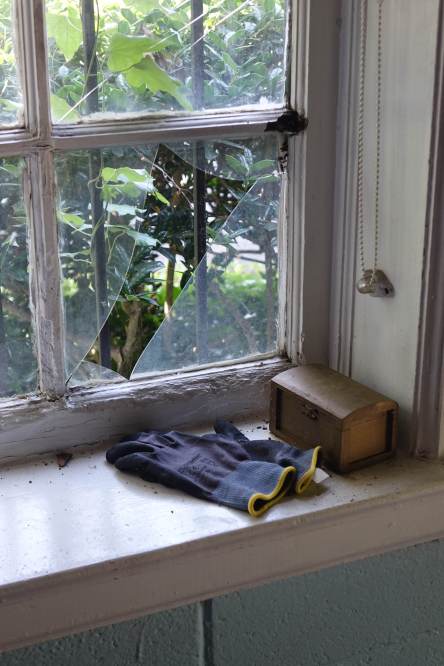
Standing about a yard from a partially broken window at 501 Queens Road, a pane framed by countless layers of cracked and gouged paint, Jackie focuses on the near-term, striking a more urgent tone. When I ask about a possible second season on the road beginning next September, she doesn’t hesitate.

“We have to open here next year,” she says. “Finding other venues is too exhausting!”


Escape… to the East Side

Preview: Actor’s Theatre of Charlotte Rock the Barn

By Perry Tannenbaum

Actors_Theatre_headshot_fenixfoto_Charlotte__-2 

After more than a year of lockdowns and social distancing, meat shortages and toilet paper shortages, wildfires and hurricanes, astonishing protests and insurrection – along with more Zoomed meetings and celebrations and religious services than anyone could ever have imagined – are we ready to ROCK? Actor’s Theatre of Charlotte and its intrepid executive director, Chip Decker, definitely think so.

They aren’t merely serving up one liberating escape to rock-and-roll heaven. They’re coming at us with a whole Rock the Barn outdoor mini-season. Three shows, hosted by Levine Properties and MoRA, at The Barn – beginning this week.

Head on out with your favorite lawn chair to 8300 Monroe Road, where Decker will direct a nine-person cast in Rock of Ages. Keyboardist Willis Hickerson, Jr., leads the five-man band that will help this motley crew of singers, dancers, slackers, and meanies to deliver more than 30 hits of the ‘80s, many of them calculated to melt our faces off with heavy metal intensity.

That shredding, mind-scrambling mix plays Wednesday through Sunday evenings for four weekends until it closes on August 21. Then the Charlotte premiere of Head Over Heels sashays over to The Barn before Labor Day weekend, an unlikely gender-bending mix of hit music by The Go-Go’s and Sir Philip Sidney’s Arcadia, running from September 1-25.

Ever unconventional, the Actor’s Theatre version of a summer season extends until Halloween, with the Queen City’s dearest cult favorite, The Rocky Horror Show, dropping its special creepshow merriment on The Barn at MoRA’s greensward with an October 6-31 run. Hint: Rocky is like Scarowinds, except it’s for people who might enjoy content, righteously rockin’ music, and not sitting in an endless car caravan on I-77 South.

Glancing at his bottom line, Decker has a bit of an oldies bent himself, bringing back two hits that grossed well for ATC in the past decade, Rocky Horror in 2011 and Rock of Ages in 2015.

“We want to help folks rediscover a sense of normality, of fun, of camaraderie and friendship,” Decker stresses. “This summer, post-COVID, I felt like we all needed a break from everything, and a chance to mentally check out and leave a horrific year behind. Finances are always a concern for a non-profit, but it is almost immeasurable the devastation the pandemic has wreaked on the performing arts organizations around the country. Hundreds of companies have closed, some short-timers, some surprisingly long-established companies that could not, for whatever reason, weather the COVID storm. I am extremely proud of ATC and the fact that we are still here to offer three ‘oldies.’”

The third oldie, Hedwig and the Angry Inch, marks the transition between Act 1 of the company’s 33rd season to an Act 2 indoor season they’re calling An American Tale. The January 2022 production will be the company’s fifth Hedwig since 2003 and their first at Queens University, where ATC is a resident company. It’s been a long time away from Hadley Theater, where the lights last went down on Lady Day at Emerson’s Bar and Grill when it closed in February 2020. The beautiful new Sarah Belk Gambrell Center, an added jewel on the Queens campus, will likely wedge its way into ATC’s future plans.

For those who vividly remember ATC’s raunchy 2015 take on Rock of Ages, a burning question might be whether they can reprise the pole-dance choreography outdoors – and how that kind of edginess might play out there on the East Side. In neighboring Matthews, Bonnie & Clyde and One Flew Over the Cuckoo’s Nest are as outré and daring as it gets.

So it’s telling that Renee Welsh Noel takes over for Tod A. Kubo, the original Rock choreographer. Kubo slides gracefully over to the director’s slot in Head Over Heels, which is more of a fairy tale in style.

While heaping praise on the support ATC has received from MoRA and businesses along the Monroe Road corridor, Decker freely acknowledges that the reprised Rock won’t be as hard.

“Our aim is to allow a slightly younger teenage crowd, 13+, to enjoy the music their parents loved and see a little naughty shenanigans to boot,” Decker explains, “an experience that both theatregoers will love and have fun at and, at the same time, an event the Summer Rock Concert attendees would get into as well. A sort of Woodstock/Theatre-in-the-Park extravaganza. The shows are silly fun but with great music, and our singers are excellent and the band is kick-ass!”

Fronting the flimsy plot and driving the action are two longtime ATC vets, Ryan Stamey as Lonny Barnett and – one of two holdovers from the 2015 production – Jeremy DeCarlos as Dennis Dupree. Owner of a sleazy, rundown club in ‘80s LA, Dennis is facing financial ruin as greedy German developers are poised to take over, not above bribing the mayor to have their way.

DeCarlos triumphed over the schlocky Chris D’Arienzo script in 2015, “zigzagging between fine hash mellow and bad trip freak-out” as Dennis, according to this reviewer. With as much range and versatility as any performer we’ve seen at ATC, does DeCarlos mess with success?

Yes…and no. He thought he had a fresh brilliant motivation for Dennis…

“Until we got to the read-thru and I realized ‘Wait, this was the idea I had LAST time…!’” DeCarlos recalls. “Part of my process as a performer compels me to find new things and new discoveries in playing a familiar character. So, I’m hoping those that know Dennis will still see familiar shades of my previous version a few years back, but layered into something a little different. I like to think of ‘Old’ Dennis as a mixture of David Lee Roth and Shaggy from Scooby Doo. I’ve been having a lot of fun finding ‘New’ Dennis’s mixture while keeping true to some shades of the ‘Old.’”

If cooped-up audiences are eager to cut loose, DeCarlos reminds us that performers feel very much the same. The ace actor and singer also plays guitar, so – counting in ATC productions that had to scrapped or delayed during the pandemic – DeCarlos estimates that four or five gigs disappeared from his docket. The effect was visceral for him. Yet with all that has happened politically, racially, and pandemically over the past 16 months, DeCarlos feels that Dennis is the right way for him to roll, rather than with heavier fare.

“I do think coming back with something fun,” he says, “definitely works a little better to release any pent-up frustrations from the pandemic. The first few nights of coming back to rehearsals made it pretty clear that this cast was ready to cut-up and fool around. After such a serious year, it’s been amazing having an opportunity to let loose and make each other laugh!”

Stamey is also one of the most versatile guys in the ATC stable, sometimes toiling behind the scenes as a music director. Since 2007, however, when he introduced the role of the volatile, Sharpie-sniffing Duke in The Great American Trailer Park Musical, singing the showstopping “Road Kill,” Stamey is best known for his trashy wildman antics. Your basic ex-boyfriend-from-hell roles.

Yet he was too young to experience the highest decibels of the ‘80s as a teen.

“The 80s were actually my elementary school years,” Stamey confesses. “Funny enough, I went to a very strict Free Will Baptist Christian school back then. In 3rd grade, our teacher thought we were old enough to teach us about the evils of heavy-metal music. He explained to a bunch of 9-year-olds about pentagrams, and upside-down crosses, and deals with the devil, and backmasking, and heads of doves being bitten off by rock singers. I remember some kids crying as he played music backwards and told us the Satanic messages he thought he heard in the music, all while having a Satanic Bible at his lectern. Needless to say, I was pretty terrified of rock music, particularly heavy-metal music, at that age.”

Until the revelations of Napster during his college years, Stamey didn’t begin to appreciate, download, or catch up on all he had missed. Now he’s catching up with Rock of Ages as Lonny, the man with the plan, the story, and the persuasive powers. Working at the Bourbon Room as Dennis’s soundman, a side-hustle since he’s our narrator, Lonny persuades his boss to hire young rocker Drew, a hunk who aspires to superstardom but is currently content to sweep the floors. More importantly, he advises Dennis on a can-miss scheme to call in old favors and save the club.

If that isn’t enough, Lonny tells us what’s still missing from the story. Romance!

With masterworks by Bon Jovi, Pat Banatar, and REO Speedwagon in the abundant songlist of this jukeboxer, Stamey has a surprising favorite.

“One of my favorite songs was ‘High Enough’ by Damn Yankees,” he reveals. “It was just so epic and dramatic, and the harmonies you could sing with it! It’s one of the moments when the whole cast is getting a chance to just stand and sing their faces off, and it gives me chills every time.”

Kubo’s defection from Rock of Ages won’t rob ATC loyalists of seeing his choreography, for on top of his directing chores, he will be furnishing the dance moves in Head Over Heels. Like Hedwig and the 2022 premiere of Ghosts of Bogotá, this Go-Go’s/Sir Philip mashup was originally envisioned as part of the company’s lost Season 32. In terms of topicality, this James Magruder adaptation, premiered at the Oregon Shakespeare Festival in 2015 and greatly altered for its 2018 Broadway run, is noticeably edgier – and newer – than ATC’s other outdoor shows.

Head Over Heels celebrates the LGBTQIAPK+ community unlike any Broadway musical of our time and puts a non-binary character at the center of our story!” says Kubo. “This old Elizabethan story of Arcadia, mixed with the high energy musical catalog of the Go Go’s, is very relatable to today’s audience and is easy to follow.”

So don’t be intimidated by the 1300-word synopsis of the action in Wikipedia.

“While our story will be told through a funky Elizabethanesque lens, with costumes [by Carrie Cranford] that will reflect elements of that era, the scenery [by Decker] provides an industrial, rock concert backdrop – with surprises of its own.”

Aside from the title tune, expect the newly formed 14-member ensemble to exhume “We Got the Beat,” “Mad About You,” “Our Lips are Sealed,” and “Turn to You” from the all-female Go-Go’s golden vaults. Henri Freeman has won the coveted non-binary role of Pythio. After achieving fame in 2017 on RuPaul’s Drag Race, Peppermint became the first openly trans woman to play a principal role on Broadway as Pythio.

“There are many twists, turns and surprises we have in store and can’t wait to share Head Over Heels with the Queen City,” Kubo says. Rehearsals begin next month.

We haven’t seen yet how Decker & Co. are adapting The Barn at MoRA to outdoor theatre, but it sounds like plenty of cover will be provided for the musicians’ electronics and the actors’ mics, for Chip is telling us that shows will go on under most weather conditions. You can also expect that your tickets will provide you with a clearly delineated, socially-distanced spot on the well-maintained MoRA field.

“Everyone should bring a folding chair,” says Decker, “so while the ground may be wet, your chair won’t be. Be prepared for rain, heat, wind, snow, frost warnings, tornadoes, typhoons and other weather anomalies. Unless there are high winds, thunder and or lighting, all shows will go on.”

Comedy and sexiness were the ingredients that made ATC’s 2015 version of Rock of Ages, directed by Decker, so much better than the comparatively staid and respectful touring version that came to the Queen City in 2011. Eagerness and glee seem to be carryovers in the upcoming revival – largely because everyone involved feels the jubilation of emerging from our national hibernation and getting back to work.

“We’ve all been isolated for so long,” DeCarlos asserts, “that I think we’re dying to let loose the energy that’s been building up in us over the pandemic, and that’s making us try lots of stuff to generate some really silly stuff!”

Stamey is definitely getting a kick from the special circumstances as he conspires with his co-star.

“After years of doing shows at Actors Theatre, it’s like working with family now,” he says. “My favorite part of this experience has been getting to be the Lonny to Jeremy’s Dennis, and Chip just letting us be completely stupid and just play around and try new things, new gags, new ideas. There have been many moments where I can barely contain my laughter when we are working through a scene as I’m watching Jeremy’s Dennis do something completely ridiculous.”

Part of this escape – for us all – is remembering how to have fun.

Hitting the (Monroe) Road With a Slightly Toned-Down “Rock of Ages”

Review: Rock of Ages at The Barn @ MoRA

 By Perry Tannenbaum

Actors_Theatre_headshot_fenixfoto_Charlotte__-2

As the exit ramp from the pandemic keeps getting longer, summertime urges to break out of isolation, let loose, and rock out aren’t likely to back up now. In this confused and anxious moment, Actor’s Theatre of Charlotte has taken a nicely calculated route to satisfying these urges, moving from their established HQ at Queens University to the outdoors and presenting a three-show “Rock the Barn” mini-season of three rock musicals out on Monroe Road. The first of these, Rock of Ages, has begun a run that will play to fans of ‘80s heavy metal and power ballads through August 21.

Days are still long enough so that shows begin before dark, but when night falls, Biff Edge’s lighting design gradually becomes gaudier, smoke effects play better, and we’re immersed in a true arena rock vibe. Musicians and actors are covered by a massive pavilion while ticketholders bring lawn chairs and experience the musical on a gently sloping lawn. ATC executive director Chip Decker assured us that the grounds at The Barn at MoRA (Monroe Road Area or Monroe Road Advocates, take your pick) had been sprayed for bugs, and indeed, although one of the critters crashed into my face during the full-length show, none bit.

Decker had directed an indoor production of Rock of Ages back in 2015, finding far more humor in Chris D’Arienzo’s book than the touring production of 2011 had brought to us and adding far more energy with Tod Kubo’s raunchy choreography. This time around, Decker wanted to play to a younger crowd, sidestepping some of the previous sleaze that might affright locals on the east side of town. A portion of that R-rated content had been achieved with scanty costuming and zesty pole dancing, but only one of these can be readily exported to the great outdoors. Taking over for Kubo, Renee Welsh Noel is not at all timid with her choreography, lavishing plenty of bumps and grinds for our delectation when the action moves from the rockin’ Bourbon Room to the salacious Venus Club, and costume designer Carrie Cranford’s working gear for Sherrie Christian, our heroine, credibly delivers what her customers would desire.

Actors_Theatre_headshot_fenixfoto_Charlotte__1180

Sherrie and our hero, Drew Boley, converge in LA sometime in 1987 and are briefly co-workers at the Bourbon Room. Since D’Arienzo’s book is tasked with connecting about 30 songs filled with teen passion and suffering, Drew and Sherrie’s romance is predictably rocky, filled with misunderstandings, bitterness, regret, and compromising situations before we come anywhere near a first kiss. At times, the couple fades into the background because the main plot and its complications concern the imperiled Bourbon Room, owned and managed by beloved goofball Dennis Dupree with the assistance of Lonny Barnett, his soundman and our narrator.

This cherished Sunset Strip landmark is targeted by the greedy German real estate developer Hertz Klinemann and his submissive son Franz for liquidation. Funky neighborhood and cultural treasures yielding to real estate profiteers and gentrification? That only happens in real life – not in feel-good movies and musicals. City planner Regina Koontz, do-gooder and rabble-rouser, pushes back against the Klinemanns, hatching a couple of nifty plot twists and song assignments before the blissful finale.

As Decker foretold in his welcoming remarks, performing on the grounds of The Barn at MoRA is a bit of a leap into the unknown, and he hoped the top of the pavilion would hold fast after being blown away during rehearsals. A plucky last-minute soundcheck by Cranford, doubling as our production manager, provided further reason for us to keep our fingers crossed when the show began. Thankfully, she concentrated on Elizabeth Medlin and Grant Zavitkovsky, who play the temperamental Sherrie and Drew. Cliched as they may be as lovebirds, they needed to have the best mics for their songs.

When things were going badly, when Drew was hoodwinked by record producer Ja’Keith Gill into fronting a boy band while Sherrie had been recruited by Justice Charlier into the degradations of the Venus Club, their anguished duet on Damn Yankees’ “High Enough” came across like the climactic highlight it was intended to be. By that time, we could chuckle a bit as we noticed that Decker had placed Zavitkovsky and Medlin at opposite sides of the stage to belt out their harmonies. Close contact between even the best mics onstage almost invariably led to lethal feedback blasting through the loudspeakers. Mercifully, these blasts were on the low end of the audio spectrum rather than high squeals.

The chief roadblock to romantic bliss between Sherrie and Drew is the awesome rock icon, Stacee Jaxx, coerced by Dennis to help raise funds for the Bourbon Room and prevent the Klinemanns from taking over. We quickly see the rowdiness and lawlessness that has alienated Stacee from Arsenal, the hit band that made Jaxx a star. Decker has sprung a surprise here, for the role played onscreen by Tom Cruise switched genders and Stacee was now sung by Shea – not with the best of the mics – adding new twists to Sherrie’s sexuality and Drew’s jealousy.

Medlin didn’t get a shot at the pole dance Decker staged in 2015, nor can we pity her any longer as a rape victim, but she definitely turned up the heat on the lap dance she performed for Stacee at a less provocative Venus Club. Less obvious are the benefits of Decker’s rethinking of Drew, for Zavitkovsky has the steely larynx needed to wail this rockstar wannabe, but his looks, while wholesome enough, allow more readily for failure – and the direction where this plot is actually headed.

Actors_Theatre_headshot_fenixfoto_Charlotte__1196

Jeremy DeCarlos as Dennis got his mic working intermittently, a definite improvement after his inaudible soundchecks, partnering well with Ryan Stamey as Lonny, who wrestled ebulliently with similar variables in his signature wild-man style. Nevertheless, dialogue and plot grew as foggy as the two flawless fog machines facing the stage when Katy Shepherd stepped forward in rather butch fashion as Regina and we needed to rely on Ryan Stinnett’s mic as Hertz and Jamaas Britton’s as Franz to keep track of the plot. Yet the three of them collaborated more than effectively enough, aided by a couple of tearaway costumes, to deliver the high comedy voltage of Pat Banatar’s “Hit Me With Your Best Shot.”

With a more colorful costume, better lighting, and a better mic, Tony Mullins as Ja’Keith fared better on opening night than Shaniya Simmons as Justice. While lights and sound seemed to let Shea down and tamp down Stacee’s villainy – if a heavy-metal villain isn’t a sort of oxymoron – the setup for the five-piece band, including two guitars and led by Jessica Borgnis on keys, held rock-steady throughout the evening.

That was often bad news for the audience when we needed to hear the singers and discern the lyrics they sung over their relatively underpowered mics. As a result, the show remained more compelling for the older generation lounging on their lawn chairs, those spry folk already familiar with the oeuvre of Banatar, Yankees, Poison, Twisted Sister, Whitesnake, REO Speedwagon, Quiet Riot, Bon Jovi, and David Lee Roth. As for me, “Waiting for a Girl Like You” and “I Want to Know What Love Is” had me thinking that the collected works of Foreigner might be worth looking into.

Warehouse PAC’s “Sweat” Deploys Stellar Cast on Stellar Script

Review: Sweat at Spirit Square

By Perry Tannenbaum

)1001

Not at all liberal or intellectual, nor with aspirations toward witty stylishness or trendiness, Lynn Nottage’s Sweat is a brutal and humbling lesson in empathy. Very humbling for clueless liberals and intellectuals who never got why blue collar and union workers jumped out of the pockets of the Democratic Party at the turn of the 21st century – turning our history and politics into a train wreck.

Premiered at the Oregon Shakespeare Festival in 2015, before opening at The Public Theatre in November 2016 and transferring to Broadway the following March, Nottage’s working-class drama, which won a second Pulitzer Prize for the playwright in 2017, seemed to break out when it would resonate loudest with 2016 presidential politics and issues. By that time, NAFTA (the North American Free Trade Agreement), ratified more than two decades earlier in 1993, was swept into a whirlwind of xenophobic issues that included illegal immigrants, Mexican gang rapists, manufacturing jobs shipped overseas, immigration reform, and a border wall.

Nottage mostly takes us back to 2000, when the reality of NAFTA was impacting on steelworkers in Reading, Pennsylvania. The authenticity of her lunch-pail portrayals comes by dint of personal interviews that Nottage conducted in Reading with Kate Whoriskey, who would ultimately direct the Oregon premiere, over a two-year period beginning in 2011. Subjects of these interviews included many factory workers who had been locked out of a steel tubing manufacturing plant for 93 weeks.

IMG_3998

Two such plants figure in Nottage’s portrait of Reading. One of them has previously crushed Brucie and his fellow union members, so he’s already a pitiful druggie when the action begins. Another plant, where his son Chris and his estranged wife Cynthia still work, will soon follow suit, further dividing Brucie’s family and the other regulars who gather at a rundown bar where Stan serves up drinks and downtrodden Oscar mops up.

Directing the Warehouse Performing Arts Center production at Duke Energy Theater in Spirit Square, a month after its debut run in Cornelius, Michael Connor deftly contextualizes the action. Where Nottage’s script calls for “News of the day” sound montages, we’re repeatedly reminded – amid mentions of Allen Iverson, the Philly 76ers, and troublemaking Iraq – that this is the election year of the pivotal Bush-Gore showdown.

Yet Nottage isn’t exclusively focused on the fallout from NAFTA, nor is Brucie the only foreshadowing of how her story will develop. The preamble to the explosive action of 2000 is the opening scene, where Chris and his friend Jason meet separately in 2008 with Evan, their parole officer. As we gradually become aware that the fallout from NAFTA will deal yet another blow to Reading, we also realize that the chums will do something violent to earn their serious prison time.

We also learn in the preamble how different and antagonistic Jason and Chris have become, for Jason sports white supremacist tattoos on his face from his prison years while Chris grasps a bible in his left hand. Jason is the powder keg we keep our eyes on in the unfolding flashback scenes, but it isn’t too long before we realize that his emerging racism is a family hand-me-down from Tracey, his mom.

The rifts between these black and white families develop along separate tracks. When Olstead’s posts a notice that they have an opening for a new supervisor, Tracey’s kneejerk reaction is to spurn the idea of crossing over to management, but Cynthia tells Stan that she intends to apply, feeling that she has earned a promotion by virtue of all the years of hard work she has put on the floor.

Tracey certainly vies with her son Jason as the most toxic person in town. When she loses out to Cynthia on the promotion after she also applies, she attributes her friend’s success to affirmative action and the tax breaks she presumes Olstead’s receives for hiring a minority. She also refuses to help Oscar come on board at the company, viewing him as a foreigner. Of Puerto Rican ancestry but born in Reading, Oscar eventually signs on as a scab when Olstead’s locks Tracey, Jason, Chris, and their union out. They send Cynthia out to post the lockout notice, further roiling tensions around the plant – and at the bar.

So the ills of Reading aren’t confined to corporate greed. Xenophobia and racism are also on the scene, bringing latent Trumpism into bloom. The balance of Nottage’s analysis extends to the depth and pluminess of the parts she doles out. Warehouse artistic director Marla Brown only slightly dilutes Tracey’s toxicity, leaving room for a hint of mid-America wholesomeness and nicely gauging Nottage’s rounded assessment. For the arc of her disintegration starts at a merry, drunken celebration of her 45th birthday in the first flashback scene.

Tanya McClellan, off my radar for far too long, shows everyone what she can do with the opportunity to branch out from comedy roles into drama, for she does more than her share to flavor the friendship – and later, the complex antagonism – between Cynthia and Tracey. Before serving as a barometer for Tracey’s disintegration, there’s a marital confrontation with Brucie where Cynthia fills out our picture of how far he has fallen. McClellan’s mix of vulnerability and dignity is just right in both situations.

Never on an even keel like the other characters here, Brucie is as challenging as Tracey, for he’d flatten to two dimensions in the hands of an actor who couldn’t deliver several levels of desperation. In his scattered scenes, including one with a majestic monologue and another where he proves not to be the sponge we thought he was, Dominic Weaver is so very real and unforgettable.

Matt Webster as Stan and Justin Thomas as Oscar seem equally detached from the main plotlines – until they aren’t. While still on the periphery, both have eloquent moments. Webster excels when Stan describes life in a company as successive generations of the same family toiling at the same plant for successive lifetimes, with no solid hopes of advancement, no real appreciation from management, and instantly disposable. After about an hourlong immersion in that dreary reality, Thomas gets to shock us a little by telling us what it’s like as a Hispanic to live a lifetime as the hydrant of all these self-pitying underdogs, even if you’re born in the US like Oscar.

If you’ve already gathered that there are no weak links in this Warehouse production, you won’t be surprised to learn that I was impressed by both our protagonists, Maxwell Greger as Jason and Drue Allen as Chris, though Nottage shunts her leads to the wings for long stretches while plant politics take center stage. From the black eye we see on Greger in the preamble, augmenting the three tats on the other side of his face, we know quickly that that Jason is always coiled for action. Even when those markers disappear in the flashback scenes, Greger has a chiseled James Dean intentness in the set of his jaw, an unfocused discontent that portends trouble.

Allen, in his portrayal of Chris, underscores what irks Jason and his mom most deeply: like Cynthia, who craves a promotion, Chris wants to better himself by going to college. There’s a relatively calm purposefulness to his demeanor, firm but without rigid righteousness, as he deals with his broken dad and his beggary. And we come to see through Allen’s eyes that when a broken justice system unjustly incarcerates you because of your color, taking up the bible isn’t the worst way to cope.

IMG_4024

As Evan, Ron McClelland has that seen-it-all confidence of a parole officer who knows the ploys and dodges of hardened criminals, yet beneath his tough exterior, this copper seems earnestly engaged with even Jason’s rehabilitation. Becca Worthington rounds out the cast as Jessie, a third musketeer with Cynthia and Tracey at the outset when they’re still chums. Arguably, she serves as a white counterpart to Brucie: no matter how sloshed she gets hanging out at the bar until last call, she cleans up and punctually punches in at the plant at 6:00 or 7:00 the next morning.

The presence of McClelland and Worthington in such minor roles is just another earmark of this high-quality Warehouse PAC production. It also testifies to the attractions of working with such a stellar cast on such a stellar and timely script.

“Freedom Summer” Illuminates White Privilege, Sloppy With Its History

Review:  Freedom Summer at UNCSA

By Perry Tannenbaum

2021~Freedom Summer-18

Those of us who remember the affable senator from Arizona, Barry Goldwater, and the threat that he posed to President Lyndon Johnson and his vision of a “Great Society,” likely also remember the names of James Chaney, Andrew Goodman, and Michael Schwerner. Barely a month after Johnson signed the Civil Rights Act of 1964, and just over two weeks after Goldwater had won the Republican presidential nomination in San Francisco, the bodies of those three men, missing since June 21, were found 44 days later on August 4, buried underneath an earthen dam near Philadelphia, Mississippi.

Ranging in age from 20 to 25, the young men had been encouraging disenfranchised Black Mississippians to register to vote in the upcoming election. Their disappearance spurred momentum for ratification of the Civil Rights Act – and their martyrdom at the hands of a brutal lynch mob helped pave the way for passage of the Voting Rights Act of 1965. In Freedom Summer, playwright Cynthia Robinson takes us back to the morning of August 4, when the Mississippi atrocity came to light. In a North Carolina Black Repertory Company production streamed online by the Appalachian Summer Festival from Appalachian State University, we saw how the news impacted a Mississippi family in crisis – on protagonist Nora Healey’s wedding day in Boston, Massachusetts.

Nora, née Peola Carrington, has been passing for white since her northward journey from Jackson, Mississippi, two years earlier. Her sister, Carrie, has been waiting outside in the pouring rain for a good part of the morning, making sure that the street is clear before knocking on Nora’s door. Against Nora’s wishes, Carrie has followed Nora to Boston, hoping to break up the wedding and send her older sister back home to take care of their recently widowed mother. These opening moments capsulize the attachment and antagonism between the siblings. Nora sees Carrie outside her front door through her peep hole but instinctively lets her in anyway, despite the fact that having a sister who is unquestionably Black will spoil everything if her fiancé or his family were to show up. Of course, Carrie’s care in preserving this ruse, waiting until the coast was clear, exemplifies the same sort of ambivalence.

2021~Freedom Summer-21

So Freedom Summer often mimics the motion of other reunion plays, like Crimes of the Heart, where siblings shuttle between fondly reminiscing or laughing over their shared pasts and arguing furiously over eternal grudges and differences. Robinson’s drama has a few lighter moments in the sisters’ past, including a schoolyard chant they made up together, how Carrie likes her scrambled eggs, a resurrection of fried bologna sandwiches, and listening to The Shirelles. All of these were eclipsed for Nora by the locals’ lynching of Isaiah, the young man that she had a crush on. That was more than adequate reason for big sister to flee to Boston and fashion a new identity. On the other hand, continuing her life in Jackson, Carrie found more than sufficient motivation to head up toward Ohio for training at Western College to become part of the Freedom Summer campaign. To Nora’s annoyance – and mine, I’ll have to admit – Carrie wanted her older sister to ditch her wedding plans immediately and head on down to Mississippi to take her place in caring for Mom, while she traveled on to Ohio.

2021~Freedom Summer-09

Robinson’s drama, then, ultimately becomes about a unique and provocative choice, for after attaining the joys and freedoms of white privilege, Nora is told by her upstart sister to give them up. Should we blame Nora for wanting to hold on? Robinson has her Nora articulating the transformative wonders, the liberations of attaining white privilege, and here is Carrie, the sister with the darker skin and nappy hair, lecturing her that she should be back home, fighting for the rights and liberties of her brothers and sisters who have decided against taking the simple steps she has, packing up and leaving. As the confrontation between the sisters unfolds, we learn that Nora’s choice spans two generations, for their mom could have passed for white had she chosen to, but she stood by Dad, inescapably Black, in building their lives in Jackson. For so many reasons, Nora cannot agree with that choice.

In directing this new play, which has yet to be performed for a live audience, Jackie Alexander could have helped Robinson more in aligning Freedom Summer with the actual history of that hot 1964 summer. A quick dip into Wikipedia would have told them that, by the end of June 1964, the families of the missing white civil rights workers, Goodman and Schwerner, had met with President Johnson in the Oval Office, and that their disappearance had become a top story for Walter Cronkite, the CBS Evening News, and the nation at large.

Yet Nora’s posh Boston living room and dining room aren’t equipped with either a television or a telephone. Instead, news of the bodies being found comes across Nora’s console radio in the form of bulletins interrupting her music. It’s a pretty awkward moment, then, when a newsman preempts for the third or fourth time and announces that the deaths of Chaney, Goodman, and Schwerner are beginning to garner national attention – for a couple of reasons. Actual history has been saying otherwise for over a month, and the fact that anything is gaining national attention isn’t the stuff of news bulletins. Instead of curing Robinson’s carelessness, Alexander only compounds it, for no matter which Boston radio station the bulletins interrupt, the voice of the announcer is always the same, listed in the credits as belonging to Eric Dowdy and unmistakably infused with a Southern accent.

Set designer Lizabeth Ramirez captures the proper Bostonian ambiance of Nora’s pad without going overboard, and costume designer Frenchie Slade clearly delineates between Nora’s nonchalant stylishness and Carrie’s backwoods dowdiness. In Mariah Guillmatte, Alexander found an actor who was close to perfection as Nora, with touches of vanity, defensiveness, and paranoia as she kept and protected her ongoing masquerade. Yet above all, Guillmatte was passionate in her eloquence as she decried Isaiah’s brutal lynching and when she recalled her own sense of humiliation while her mother lived a degraded life as a menial cleaning woman instead of moving the family out of Jackson and passing as white. Guillmatte turned up the passion as she tried to warn Carrie of the dangers she was facing as part of the Freedom Summer campaign, turning her scorn instead upon Goodman and Schwerner, the white northerners who had underestimated the perils. And Guillmatte applied the right mix of stubbornness and vulnerability as she stood up for her fiancé James’s character and the likelihood that he would stand up for her if he discovered her secret.

2021~Freedom Summer-30

Robinson has made it difficult for anybody to shine as Carrie, for she arrives in Boston with a suitcase full of objects that she returns to and unveils, one after another, each time she wishes to make a point. This motif magnifies the sense that Carrie, annoying enough already, is bringing evidence against her sister and putting her on trial. Yet Nikyla Boxley as Carrie rarely if ever looked like a passionate idealist who could transcend this repetitive ritual. Instead, with her arms rigidly hanging almost always at her sides, Boxley seemed like a girl who had learned right from wrong in schoolrooms and at her church, though she claims to be a political crusader now and bound for law school when the revolution is won. When Carrie turned on music or sat down for tea, breakfast, or bologna, Boxley would suddenly loosen up as if released from strict military discipline with an “at ease” command. Alexander should have helped Boxley smooth out such incongruities. The best of Boxley, if you could ignore the rigidity of her posture, came when she argued on behalf of her activism, on behalf of honoring the heroism of those who had died for the cause, and against Nora’s deceiving her fiancé – and herself.

2021~Freedom Summer-14

Freedom Summer is actually a newly enlarged version of a previous Robinson play, Peola’s Passing, which was about 30 minutes in length. There have been growing pains in the transition, no doubt, as the new script attempts to add more weight by absorbing the pivotal history of the tumultuous summer of 1964. When Boxley and Guillmatte got into the crux of the Carrington sisters’ debate, Nora’s need for liberation and self-fulfillment pitted against the power of Carrie’s compulsion to remedy the unjust oppression of her people, Robinson’s dialogue, with strong and passionate arguments on both sides, crackled with vitality and authenticity, not at all diluted. I’d urge both Robinson and Alexander to dig deeper and sharpen Freedom Summer, so that it delivers its meaningful history even more accurately when it opens for a live audience.

CP’s “Joseph” Connects With Talent and Style, Frustrates With Ongoing Audio Woes

Review:  Joseph and the Amazing Technicolor Dreamcoat at Halton Theater

By Perry Tannenbaum

THEA2021-DLV-0708-2138

Before this weekend, Halton Theater hadn’t opened its doors to a theatre crowd since February 2020, and Central Piedmont Community College Summer Theatre had been dark since July 2019, when they closed their five-show season with A Gentleman’s Guide to Love and Murder. Returning to the Halton stage as guest director of Andrew Lloyd Webber’s Joseph and the Amazing Technicolor Dreamcoat, Tom Hollis posed a poignant question during his introductory remarks. Does it really count as a season when a company offers its audience just one production? Even the most loyal Central Piedmont supporter can’t buy a 2021 season ticket, that’s for sure. And until Central Piedmont Community College completes its recovery from a debilitating ransomware attack this past winter, they won’t be able to accept credit card payments at their Overcash ticket windows. Cash or checks for walk-ups, plastic for online sales only.

Opening night at Halton was a cautious first step back toward pre-pandemic norms – with a Delta-be-damned giddiness to it as COVID protocols were loosened at last. For most of the crowd mingling in the Halton lobby before and after the show, this was probably the first public event they had risked in at least 16 months, a milestone moment. For the theatre folk scattered among us, it was an emotional reunion – an affirmation.

Last season was originally envisioned as Hollis’s grand valedictory after nearly four decades at Central Piedmont, his latter years as theatre department chair. An encore reset of the lost 2020 season was rumored for a while as Central Piedmont scrambled with their winter programming, so Joseph is a double surprise – not among the shows announced for the lost 47th Central Piedmont Summer Theatre season and the only show replacing them. Previously mounted in Summer 1993 and revived in Summer 2001 at the now-demolished Pease Auditorium (the CPCC Theatre production of 2008 at the Halton was a wintertime affair) – with rousing success on all occasions – Joseph is likely more bankable than Footloose, lighter on the budget than The Music Man, and far better-known and cheaper to produce than Something Rotten! Additionally, there is likely a finely calculated ecology in a true Central Piedmont Summer season that allows the college the biggest bang for their bucks when auditioning and casting their overall troupe of performers and designers. These discarded musicals, plus Peter Pan Jr. and a Ken Ludwig comedy, might conceivably be in cold storage, slated for resurrection in 2022.THEA2021-DLV-0708-1267

Sitting in Row K, I only noticed one gentleman taking a restroom break during this intermission-free presentation, and I was somewhat surprised that the cast began taking their bows a mere 71 minutes after the show commenced. Another eight minutes came packaged in a “Megamix” reprise of Webber’s most bodacious songs – or parodies, since the composer delights in shuttling among an unlikely array of genres in retelling the most epic tale from the Book of Genesis, aided by Tim Rice’s lyrics. The news of Joseph’s demise is delivered to his doting father, Jacob, in the form of a sobbing lone-prairie cowboy song. Pharaoh is transformed into a pre-historic Elvis as he rocks his account of his prophetic dreams. The poverty of Joseph’s 11 brothers during the years of famine takes on the nostalgic air of a sad French café, complete with Apache dancer, and Naphtali’s pleas for the innocence of little brother Benjamin come in the form of a Caribbean calypso.THEA2021-DLV-0708-1815

Curiously, the irreverence and multitudinous anachronisms of this Webber-Rice concoction, not to mention the narrative alterations of Holy Writ, have never seemed to spark any massive public outcry from Judeo-Christian clergy. Maybe the outright anachronisms, beginning with the Technicolor in the title, insulate all the irreverence and textual tinkering from being taken seriously. James Duke’s scenic design and Bob Croghan’s costume design underscore the assurance that we are not in the immediate vicinity of ancient Egypt or Canaan, fortified by the equally anachronistic projection designs by Infante Media. No, this is more like a Disney or a Las Vegas style of Egypt, with Duke taking full advantage of the lordly height of the Halton stage compared with Pease’s pancake panorama. Our Elvis is also a Vegas version, clearly the sequined, jumpsuited, decadent superstar of his latter days. The Duke-Infante collaboration is so glittery and colorful that it is only slightly upstaged by Croghan’s creations for Pharaoh and Joseph.THEA2021-DLV-0708-1357

You don’t often get the chance to design a costume that is hyped in the title of a show, and Croghan, on the Charlotte scene even longer than I, doesn’t disappoint. The impact of this mid-pandemic return to live theatre caught me off-guard several times. Each time a major character made his or her first entrance – Lindsey Schroeder as our Narrator, Rixey Terry as Joseph, and J. Michael Beech as Pharaoh – I had that tingling sensation of recognizing something basic and exciting that had been missing in my life for over a year.

My biggest surprise, a frisson of renewal, came from the audience when they reacted to the most iconic moment in Joseph, when the brothers picked up the skirts of Croghan’s knockout dreamcoat so that it formed a pinwheel around Rixey, spinning around as he, Schroeder, and the ensemble sang “Joseph’s Coat.” Anybody even glancingly familiar with musical theatre anticipates this moment before it happens, or at least recalls it fondly from a previous encounter. But part of the audience at Halton erupted in delighted and surprised laughter, recalling what the first London and Broadway and high school audiences must have experienced when Joseph was new and reminding me of my own delight back in 1993.THEA2021-DLV-0708-1130

Rixey walked a treacherous tightrope, blending innocence with vanity as beautifully and energetically as any Joseph I’ve ever seen, lacking the cloying wholesomeness that only true Donny Osmond fans will miss. Maybe a plunge or two into that saccharine syrup might make Rixey more memorable in “Any Dream Will Do,” but I would prefer that he add a sprinkling of excess to those melodramatic moments when he is unjustly imprisoned, crying out his “Close Every Door.” Lighting designer Jeff Childs does come to the prisoner’s rescue, adding some spiritual gravitas.

Schroeder was brimful of brilliance as the Narrator, infusing enough energy into her string of recitative that it never devolved into tedious singsong, though she was often unintelligible. Beech’s misfortunes with his microphone were even more egregious as Pharaoh, including intermittent sonic dropouts, but his audio setup was likely jostled over the course of the evening, since he donned different costumes and headgear for his other roles – Jacob, Potiphar, and the doomed Baker.

Admittedly, it’s churlish of me to keep harping on Central Piedmont’s defective sound equipment and the cavalcade of professional-grade technicians who have failed to tame it. North of $115 million are being spent on replacing Pease, originally a lecture hall, with a genuine theatre facility, while Central Piedmont’s audio woes have gone unaddressed since 2005, when the Halton was new. But new generations come to the Halton every year, and new summer visitors from afar get their first taste of Charlotte theatre there – and they still need to be cautioned. By the time the “Megamix” came around on opening night, Beech’s “Song of the King” was only fitfully audible and Schroeder’s mic was intermittently dropping out.

THEA2021-DLV-0708-1993

More power, then, to the performers onstage who merrily soldiered through. Even the charade of the brothers’ mournful moments was untarnished. All of the cameo solos hit their marks. Matthew Howie was hilariously rusticated as Reuben delivering the bad news to Jacob with “One More Angel,” and Neifert Enrique as Simeon – aided by his brothers and Emma Metzger’s scene-stealing table dance – brought a boulevardier’s wistful regret to “Those Canaan Days,” with more than a soupçon of self-mockery in his lamentations.

Even more THEA2021-DLV-0708-2049irrepressible and irresistible was the calypso lightness and joy that Griffin Digsby brought to the “Benjamin Calypso” as Naphtali. Around the third or fourth time Digsby reached the “Oh no! Not he!” refrain, I had to stop myself, for I had started to sing along. Just another adjustment I’ll need to make after 16 months of consuming theatre in front of my computer monitor and TV set. It was hard to be displeased by anything that accompanied this welcome change.
Gay Educators Freak While Their Gay Students Cope in “Neaptide”

Review: Neaptide Via Vimeo from UNC School of the Arts

By Perry Tannenbaum

Screen Shot 2021-06-19 at 9.15.07 PM

In a twisted way, this once-in-a-lifetime pandemic year brought more to Ticket Knowlton’s senior year thesis than it took away. Slated to direct the UNC School of the Arts’ production of Neaptide by British feminist playwright Sarah Daniels, Knowlton lost the opportunity to interact with cast, crew, and design team in a normal theatre environment and to see the effect of their work on a live audience. But Knowlton (identifying as they/them/their) remained the first gender-nonconforming director to pilot a School of Drama show, and they weren’t content to simply livestream the production or to simply record it as if it were a standard TV studio sitcom.

The product that resulted from months of experimentation, adjustment, improvisation, and collaboration feels like a faithfully recorded theatrical production– with added sparks of cinematic up-closeness and video editing. And the polish from both the School of Drama cast and the video team, compounded by lighting and design that made me nostalgic for the edgy contemporary drama I would catch at various unexpected sites around London, was nothing short of astonishing. Every shot by Jeremiah McLamb and his JerFilm Productions comes through the traditional “fourth wall,” but always from the perfect angle and distance. Two days after I witnessed the Neaptide streamcast, this ranking of the World’s Best Drama Schools in The Hollywood Reporter, placing UNCSA fourth, reassured me that I could believe my eyes.

Neaptide, the first play by a contemporary playwright to be produced at the National Theatre back in 1986, is twisty enough on its own. Two lesbians will be seen in the faculty lounge that becomes the center of gravity for Daniels’ dramatic action. Or is it three? They are so closeted during the Margaret Thatcher Era in the UK. Bringing things to a head, two student lesbians are caught kissing in the girls’ bathroom, and instead of discreetly agreeing to tone it down, both decide boldly to come out. This brewing scandal tugs at the sympathies of our heroine, Claire, on the rise as the best teacher at the school, while drawing a defensive and punishing reaction from Beatrice, the school principal who has just rewarded Claire’s excellence with a promotion. Yet both Claire and Beatrice have good reasons not to champion these renegade students. Claire’s ambivalence, with her career and custody of her daughter Poppy at stake, is the most compelling quandary.

Screen Shot 2021-06-19 at 7.41.17 PM

So for my American ears, the flabbiness and misdirection of Daniels’ script turned out to be godsends. We began in a sanitorium with Claire’s sister Val, harshly spotlit, alone on a hospital gurney. Not long afterwards, her Mom drops by – an earnest, meddling, judgmental, endlessly tedious and annoying Joyce in a bravura performance by Jane Clara Cooper. Imagine a whining Mary Tyler Moore on acid. When we flash back after this encounter, most of which I hardly understood, I presumed that our main focus would be on how dear Val wound up in this loony bin. Eventually, we do learn what Val has done to earn her hospital gown – but there’s nothing close to profundity about why she’s done it. Eddy Grace gets to give us an emotionally intense performance as Val, her mania at the hospital followed by scenes with her children and her husband Colin, including the crackup.

Screen Shot 2021-06-19 at 7.54.14 PM

Yet Val and Joyce, along with whatever the crux of their antipathy may have been, drift rather abruptly to the periphery after the opening sequence. By the time we began homing in on Val and her precious relationship with Poppy, I found that I was sufficiently oriented to navigate their British accents and to follow the main storylines almost effortlessly. During the initial hospital scene, I was loading up to pillory accent coach Robin Christian-McNair, but ultimately, I was quite amazed by her results. The banter in the faculty lounge – and the lesbian scandal – are even more intelligible than the familial grappling.

Screen Shot 2021-06-19 at 8.10.37 PM

Contrasting with the pandemonium and crassness of Val’s household (television! dry cereal!), Claire’s home life is serenity, love, and cultural enrichment. Notwithstanding Joyce’s backbiting intrusions, Daniels goes out of her way to show us that Claire is the worthiest of moms. Like the playwright, Claire is a bit of a propagandist, reading to dear Poppy the myth of Demeter and her daughters as a bedtime story. Persephone, the daughter who is abducted by Hades, is paralleled to Poppy, so her dad Lawrence must surely be the King of the Underworld.

I wasn’t put off by the not-so-subtle indoctrination of this bedtime ritual as much as I was by its sweet tedium, for it wastes much of Yasmin Pascall’s time onstage as Claire, obliging her to establish herself in lullaby mode as being cuddly and wholesome. Pascall’s talent comes out far more powerfully when she faces the big conflicts in Claire’s life, at home and at school, struggling with ambivalence as a parent and teacher. We also see a frazzled Pascall – and some fairly insane slapstick – when Claire tries to cope with Val’s incorrigible brood at the breakfast table.

Since Daniels hardly assigns two dimensions for Parker Robertson to work with as Lawrence, let alone three, we’re more likely to invest ourselves with the drama at school, and an edgier gender struggle that Claire is more hesitant in coming to terms with. Making it easier was Noa Beckham-Chasnoff as Beatrice, the school principal, whose sex and sexuality have taught her the Gospel of expedience. It grows more shocking and heinous to find that her punitive attitude toward Diane and Terri, the teen lesbians, has somehow been hardened by Bea’s settled ways of dealing with her own sexuality. Perhaps conceived as belonging to the same generation, Beckham-Chasnoff shows us a Beatrice who is as tightly wound as Joyce, but primmer. Bea’s growth and development seem more natural during the arc of her action, so we can feel more affection for her towards the end.

Screen Shot 2021-06-19 at 7.49.18 PM

Knowlton and the JerFilm Productions film team mostly show us over-the-shoulder views of Lawrence, dooming whatever attempts Robertson may have made to humanize him. Amar Bains finds the richest terrain among the men’s roles, infusing Colin with spurts of anxiety, fear, frustration, powerlessness, and despair as he tries to cope with Val’s volatility. The other boys and men onstage are rather comical, though Lawrence Davis brings a chummy sleaziness to Roger, the English teacher who lusts after Claire, a portrayal that sets him apart. Daniels isn’t at all sentimental about her lesbian teens, allowing N’yomi Stewart as Diane and Belle Le as Terri to act more like punkish, rambunctious pals than lovers. Olivia Daponde is sweet innocence and devotion as Poppy, though perhaps not as malleable and fragile as her elders think. In an inadvertently comical moment, Daponde is barely light enough for Pascall to carry offstage at the end of their tender lullaby scene. Pascall manages that lift as heroically as the other burdens of her role.

By the way, if you’re appalled that any mother would name her child Ticket, she didn’t. They did, just recently. And it’s okay if you call them Lil Ticky. Me? I’m sticking with Ticket, even if they go paperless.

Festival Hall at Spoleto Isn’t the Best Fit for “The Woman in Black”

Review: The Woman in Black at Spoleto Festival USA

By Perry Tannenbaum

Dive In by Leigh Webber leighwebber.com

Perhaps we can declare that social distancing is as antithetical to telling a gripping ghost story as it is to sustaining a great vibe at a bar or a pub. After a 30-year run in London’s West End, where it remains on a pandemic-induced hiatus, The Woman in Black certainly has a pedigree to please. The play, adapted by Stephen Mallatratt from Susan Hill’s 1983 novel, is only surpassed by Dame Agatha Christie’s The Mousetrap as the longest-running play in West End history.

Currently in a 16-performance run at Spoleto Festival USA through June 13, the production is the real McCoy, delivered by the same artistic team that brought an acclaimed transplant of this creepshow to the McKissick Hotel in New York in January 2020. Yet between the time that The Woman in Black was announced as part of Spoleto’s 2021 lineup and opening night, the chosen venue for this production – the intriguing Charleston Visitor Center Bus Shed – had to be changed.

Now it’s completely indoors at Festival Hall, better known to longtime Spoleto subscribers as Memminger Auditorium. While the Memminger has been hospitable to such dark and gloomy pieces as Don Giovanni and Amistad, both of them lavishly and audaciously staged, the house seems to overwhelm this smaller, more conventional and portable spectacle. Nor does the spacing of our seats, with no empty seats in the spaces between us, help the atmosphere. In London, where it will play to 432 seats on three levels at the Fortune Theatre, you would probably feel much closer – and certainly more huddled together.

The conspicuously diminutive proportions of this production seem to most adversely affect Peter Bradley as Arthur Kipps. Shambling, humdrum, and somewhat diffident, Kipps has sought out the help of The Actor, to assist him in narrating his ghostly encounters to his family – and hopefully exorcize his feelings of being haunted and accursed. Not the boldest, most flamboyant or operatic of stage heroes.

Dive In by Leigh Webber leighwebber.com

Nick Owen as The Actor, on the other hand, has the luxury of being full-throated from the moment he enters the hall, hails Arthur from afar, and joins him onstage. Encouraging Kipps to project and emote, Owens can sustain a professional polish and a pedagogic authority, keeping his frustrations genially in check while trying to coax the aging solicitor into coming out of his shell.

Yet Arthur keeps resisting, meaning that we won’t hear Bradley projecting for a while. Mallatratt takes a little too long in building his own theatrical framework around Hill’s narrative; and director Robin Herford, who has not only directed all the seminal productions of The Woman in Black but also commissioned the original adaptation, is in no hurry. More ghost story and less framework would have suited me just fine the first time I saw this play in 2009 at Theatre Charlotte. Same here.

The solution that The Actor finds to his dilemma may strike non-actors as odd. When Arthur resists all urgings to become more voluble and dramatic, The Actor suggests that they switch roles: he will take on the role of Kipps in this narrative while Arthur will tackle all the other roles. Many an actor has testified that the joy and liberation of acting is in the escape from self into the skin of another person.

That idea works for Mallatratt and his protagonist. I didn’t find any hints, as I did when Kipps was portrayed in Charlotte, that either Bradley or Herford had any notion that the stodgy solicitor should suffer any relapses into hesitation or diffidence once roles were switched. It was full steam ahead for Bradley, probably the best call for those of us at Festival Hall who had strained to hear him in the early going.

Dive In by Leigh Webber leighwebber.com

As we plunged into Kipps’s narrative, Bradley was most memorable as Keckwith, a rustic cart driver who takes Arthur to and from the haunted house, and Sam Daily, the country squire who lends him his trusty dog, Spider. The terror and consternation that we see from Mr. Jerome, the liaison between Arthur and the deceased owner of the creepy Eel Marsh House, also links us to the stage-frightened Arthur we find at the beginning.

Neither production that I’ve now seen entertained the idea of The Actor simulating Arthur’s timidity when he takes on the role. Owen takes the years off the middle-aged man and glamorizes him as a somewhat intrepid action hero. When Arthur attempts to save Spider from sinking into quicksand, and when he investigates the knocking sounds in the abandoned nursery of an abandoned house in the middle of the night, a certain amount of steely backbone in required.

The manuscript that The Actor encounters is a five-hour read in his professional opinion, subtly assuring us that he has not read it – and that as he does, he will be experiencing the story as freshly as we do. Owen’s ability to retain a thin veneer of suave James Bond professionalism as The Actor, even in the most frightful and harrowing moments of Arthur’s adventures, is a key factor in his experiencing maximum shock when The Actor – and the audience – suddenly realize that he has become enmeshed in the story.

Dive In by Leigh Webber leighwebber.com

As I reported back in 2009, when my wife only grabbed my knee once, those frights are neither the most intense or frequent. I found the reveals of the Marsh House’s stairway and nursery to be deliciously macabre delights, thanks to the artistry of set designer Michael Holt and lighting designer Anshuman Bhatia, who also serves as production manager. Yet I suspect that many will leave Woman in Black at Festival Hall firmly convinced that sound designer Sebastian Frost delivered the most unnerving jolts of fright with a scattering of ultra-loud outbursts.

Such scarifying devices are no more welcome to me in theatre than they are in cinema, though the general public seems to accept them readily enough. Here I can admit that they compensated somewhat for the lack of campfire ghostliness and tribal involvement at Festival Hall. A bus shed would likely have been better, creepier, if conditions had allowed.

Women’s Theatre Festival’s “Othello” Is Femme-tastic

Review: Women’s Theatre Festival production of Othello

By Perry Tannenbaum

Screen Shot 2021-04-09 at 12.49.57 PM

In so many ways, the new Women’s Theatre Festival production of Othello is radically different than any we’ve seen before. For starters, take the text, a modern verse translation by Mfoniso Udofiacommissioned by the Oregon Shakespeare Festival and flying off to Raleigh for its world premiere, streaming on a dedicated YouTube channel. As a longtime advocate of translating Shakespeare’s works into a form that would be as readily accessible to English-speaking audiences as plays by Moliere or Chekhov, I can attest that such an eminently sensible undertaking is widely viewed as sacrilege – among scholars, academics, and the theatre community. Less heretical is what director JaMeeka Holloway does with the 16th century settings of the tragedy, transporting the Moor of Venice to a fictional Venice College of today, where cellphones and laptops and Zoom meetings are all part of student life.

Utilizing an all-Black femme creative team and a diverse all-female cast, Holloway is boldly at odds with the Udofia translation, setting up many fascinating tensions between the modernized Shakespearean text and her production. Othello is now a debate champion of international stature and no longer a military general. Cassio is appointed as Othello’s second in Venice’s glorified debate society, slighting our honest Iago. Perhaps most bewilderingly, genders are blurred. Or fluid? Holloway often jumps off the binary confines of the Udofia translation and onto frontiers of non-binary gender or gender neutrality.Screen Shot 2021-04-09 at 12.28.45 PM

Contradicting the helpful captions projected at the bottom of our screens, Brabantio remains Desdemona’s father – and a Senator. Othello is still described as Desdemona’s husband and far older than Nubia Monks appears to be. Attending an all-women’s college, Othello is still spoken of as a general and, more puzzlingly, within the space of a few words, “She is a great man.” The disgraced Cassio gets a similarly straddling description, “She is a ladies’ man,” when Iago denigrates her, plotting her murder with Roderigo. And as you might suspect, Emilia continues to extenuate any duplicities she may be contemplating with the dastardly examples of men showing her the way.

Trespasses upon Udofia’s text remain slight, strictly confined to gender, because Holloway wordlessly transports Othello to America with a cinematic prologue that fully sets up the Moor’s champion status and the undercurrent of Venice College political rivalry, scored with eerie electronic music, hip-hop beats, and a sleek R&B groove. The feel of this WTF effort abruptly shifts from cinema to video when the actors begin to speak, establishing a useful borderline. Where Holloway wishes to underscore racism and white supremacy in Othello’s downfall, Udofia is already on board for her.

Screen Shot 2021-04-09 at 1.06.23 PM

Most of the references to Othello as a Moor have disappeared in translation. The mighty general is far more often called Black, an animal, an ape, or a monkey, lending a more racist tang to Shakespeare’s many casual mentions – left intact – of Othello as a devil. We also see pretty quickly that Udofia is willing to expand upon Shakespeare’s verse and insert her own wit. After she translates Iago’s scornful opening description of rival Cassio as an “arithmetician” with “a mathematician,” she layers on “This adder – and subtractor – this bipedal calculator.” A slithering new laugh for Othello!

All 36 playwrights recruited for OSF’s Play On! Project, charged with translating all of Shakespeare’s theatrical works, must wrestle with the question of what to modernize and what to leave untouched and antique. When the film version of The Wizard of Oz was an annual rite on network TV, we all knew the narcotic sleep-inducing effects of poppies readily enough. Yet Udofia comes upon Iago’s mesmerizing “Not poppy, nor mandragora,// Nor all the drowsy syrups of the world,// Shall ever medicine thee to that sweet sleep// Which thou ow’dst yesterday,” and begins with “Not heroin,” stripping the horrid beauty away from Iago’s incantation. On the other hand, Udofia disdains a feminist touch that Holloway might have relished, changing “put money in thy purse” to “put money in your pocket” as Iago palliates and advises Roderigo. Wearing a masculine sport jacket, Roderigo is addressed here as a man, another spot where Udofia’s translation is unaltered.

Holloway is intentional and color-conscious in her casting and has chosen to keep Othello’s, Iago’s, and Roderigo’s races consistent with the demands of Shakespeare’s original text while the rest of the cast displays a more varied spectrum from Shakespeare’s concept, most notably Cassio, Brabantio, and Emilia. Although the gender and racial inconsistencies may vitiate Holloway’s salvos against institutionalized racism, they don’t loosen the grip of Shakespeare’s drama in the slightest. I would also venture to say that WTF’s all-female presentation shines a grimmer spotlight on the virulent misogyny that heats up Shakespeare’s rhetoric, from both Iago and Othello, two of the playwright’s largest roles. We are particularly fortunate in the prime antagonists Holloway has chosen, Monks as Othello and Zandi Carlson as Iago, who deliver this pervasive misogyny with cringeworthy gusto.Screen Shot 2021-04-09 at 12.22.38 PM

We expect no less from The Moor. What sets Monks truly apart as Othello, from the four Othellos whom I’ve seen live in four Charlotte productions since the turn of the century – and others on stage and screen before then – is the youthfulness of her portrayal, occasionally scented with her femininity. That youthful energy is most recognizable in the first bloom of the tragic couple’s love, when Othello tells of marrying Desdemona and later when she’s impatient to consummate their marriage. A similar energy overflows when Othello returns triumphantly from Cyprus, brandishing her trophy with all the glee and swagger of an NFL or WNBA champion who has just captured the title. A distinctively feminine flavor also surfaces in the little chuckles and sighs that come from Othello as she recalls her courtship for the Senate. As wholesome and appealing as Monks is to me for all of these qualities, we should also be aware of how Othello’s strength, poise, and confidence are viewed by Iago and Brabantio, the white establishment. Brabantio sees his prerogative to oppress Blacks – and dictate his daughter’s future – upended by Othello’s value to the state (or here, the College) while Iago sees her as usurping his supremacy. The furious hatred that Iago conceives for Othello is made more monstrous by the touches of youth, openness, and femininity that Monks has added.

Screen Shot 2021-04-09 at 1.20.06 PM

There’s a vein of White privilege in Carlson’s portrayal of Iago that many will see as female cattiness when she conspires with Roderigo. Goading Cassio into drunkenness or inflating his ego on his past and present romantic conquests, Carlson serves up a cocktail that mixes gossipy confidences with barroom or locker-room badinage. Okay, so I do suspect Carlson may have stolen some glances at the text while delivering a couple of Iago’s longer monologues, but she is clearly a consummate master at the webcam, taking us into her diabolical musings and schemes. Would cheating truly compromise Iago’s villainy – or would such sneakiness compound it? Whole new vistas have been opened by the webcam and the Zoom format, breathing fresh life into theatrical monologues and Shakespearean soliloquy. Carlson’s work here is a prime exhibit.

The backgrounds that production designer Keyanna Alexander has selected for her scenic design, whether elegant or cheesy, were beautifully curated. Daylight splashes all around the scene where Othello returns triumphantly from her overseas adventure, reunited with Desdemona, who was separated from her during the voyage; and the actual laptop computer framing the Moor’s arraignment at the Senate is a hoot, a very polished touch to boot. Or how about Danyelle Monson as Bianca, introducing herself on a webcast shown to us on a cellphone, with emojis and chat cascading down the screen? But however grungy and cool the video concept was, I wish WTF had used better webcams and mics to execute it. Chiefly victimized was Jazmyn Boone as Iago’s wife Emilia, a marvelously frail and fallible portrait that was often muffled or not heard at all.

Screen Shot 2021-04-09 at 1.00.07 PM

Unless you had visions of a blonde, straight-haired Desdemona who was cloyingly chaste and submissive, Alicia Piemme Nelson‘s performance was easily the most conventional Shakespeare in sight, offering the best proof that a modernized text really does work – a courtesy to the Bard that is long overdue. Adoring yet sassy, far more dignified than coquettish, Nelson gave us a slight update on Dez, one that meshed well with Monks’ soulful charisma. She also inspired one of Holloway’s most resourceful camera placements, an overhead shot of her in the famed deathbed scene.

All of the supporting players are excellent, down to Mieko Gavia as a fulminating, browbeating Brabantio and Elaine Wang as a cool preoccupied Duke. Special delights come from the comical turns by Danyel Geddie and Marissa Garcia as Iago’s tools. Geddie brings us a Cassio who fancies himself a bon vivant, though we see her brown-bagging her wine; susceptible enough to drink that we can seriously question Othello’s choices in subordinates; and a party person who seems perfectly matched with Monson’s buxom, fun-loving Bianca. Garcia as Roderigo was so sincerely besotted with Desdemona that I hated to see such a pure soul so wickedly betrayed by Iago.

The new lens that Holloway had us seeing through was somewhat distorted when it focused on Roderigo, normally a depraved older man who thinks he can buy a beautiful daughter’s love from her mercenary father. Such creeps are longtime theatre staples. When a company decrees all-female casting on a Shakespeare tragedy, when a director’s concept further circumscribes the playwright’s creations to college age on a college campus, and a pandemic further constricts the space, action, and interaction allowed to the actors… stuff gets lost. Here, it was Roderigo’s corruption and depravity. He never had a single ducat in his hand, let alone his pocket.

Holloway has added a cinematic epilogue to silently complete the framing of her Venice College concept, one that dispels its complexities and contradictions. Along the way, if we’ve allowed this WTF production to lead us where it will, I’d say Holloway and her exemplary cast have revealed more than they’ve sacrificed. Far more.

Cernyak-Spatz’s Memoir Gets Better, More Urgent, With Age – and Video

Review: Protective Custody: PRISONER 34042

By Perry Tannenbaum

2021~Prisoner 34042-54

If you missed the 2018 staged reading of Protective Custody: PRISONER 34042, Charles LaBorde’s adaptation of Holocaust survivor Susan Cernyak-Spatz’s memoir – or Three Bone Theatre’s world premiere production in 2019 – fate has been kind to you in 2021 with another reprise. Cernyak-Spatz, freed from the Birkenau and Auschwitz concentration camps at the age of 22 in 1945, lived long enough to see her story dramatized onstage. Already ailing, she lived only two weeks after attending the performance at Spirit Square on the opening weekend of the run.

Half whimsically and half seriously, she told the stage director Dennis Delamar to take the show on the road before she died at age 97. Founder of the UNC-Charlotte’s Holocaust Studies program and a professor of German language and literature, Dr. Cernyak-Spatz had seen plenty in her long life, but she couldn’t foresee the COVID-19 pandemic and its impact on theatre and the arts around the globe, particularly how streaming would become de rigueur. Instead of on the road, Protective Custody is now online, free for the asking on your computer monitor or on your television screen.2021~Prisoner 34042-15

Of course, Cernyak-Spatz’s deathbed wishes weren’t about vanity, for the UNCC professor had lectured widely on the Holocaust and her personal survival, holding a passionate belief that we forget this horrific history at our own peril. What you may find disarming about Susan’s staged account, once again performed by Leslie Giles with the aid of Paula Baldwin as her dresser-mother-dancing beau-Nazi guard-fellow prisoner-rapist-Nazi accordionist-American rescuer, is how dispassionate her tone often is, punctuated by eruptions of bitter irony, cynicism, and rage. She tells us she lost her modesty long ago in the concentration camps, how animalistic she needed to become to survive them, implicitly conceding that the Nazis were at least partially victorious in dehumanizing her.

They surely hardened her, maybe the greatest irony of all. “I was strangely detached from the incredibility of what I heard,” she tells us after a Nazi guard has welcomed her to Birkenau by explaining – and describing – the extermination that is happening to newcomers who aren’t as lucky as she. Those younger than 16 and older than 35 rode immediately to “the gas.” We have all heard about the fiendish efficiency of the Nazis’ extermination systems and apparatus, but Susan repeatedly calls our attention to how the Nazis systematically humiliated and dehumanized their prisoners, squeezing as much work out of them as possible with the smallest expenditure. Cruelty is constant, even as the Third Reich faces defeat. Ordering the death march out of the camps as the avenging Russian Red Army approaches, the guard barks, “A bullet in the head for those who cannot walk!”

2021~Prisoner 34042-10Detachment and inhumanity are inevitable results of the plum jobs Susan is able to land at Auschwitz. The cushiest requires nothing more of her than drawing a line through the names of fellow prisoners, thousands of them, who have passed through “the gas” and the crematoriums. Another requires her to sort through the clothes and possessions of those who haven’t been as lucky as she has been – she can even scavenge some choice articles of clothing. No doubt this aspect of the story fascinated LaBorde as he adapted Cernyak-Spatz’s sprawling memoir for the stage. Thinking of changes in wardrobe as the organizing principle of Susan’s narrative is his idea, not hers. Magda Guichard’s wide range of costume designs help LaBorde depict Susan’s precipitous fall from her upper middle-class status in Vienna to her total degradation at the Birkenau death camp. Delamar spares Giles from the fullest indignities that the script allows, letting his star wear a flesh-colored leotard when Susan is ordered to strip for a delousing shower and allowing her to retain her own disheveled hair when she is shaven bald. A sleekly coiffed wig is removed to suggest the transition.
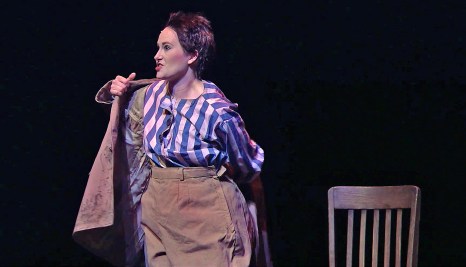
2021~Prisoner 34042-52

PRISONER 34042 remains a potent brew in spite of these discreet alterations, with language, lurid descriptions, and a vaguely simulated rape scene that might give today’s helicopter parents some pause. Perhaps the sponsorship of this filming by Culture Blocks, which partners with the Charlotte Mecklenburg Library system, was the inspiration for addressing such qualms with a more benign Student Edition of the film. (Unabridged, as far as I could determine.) Filmed at McGlohon Theatre by SimplisticPhobia Productions, the three-person camera crew helmed by Will Jenkins helps to dramatize the action with angled close-ups, from stage right or stage left, that nearly fill our screens with the two players. These give way to centered long shots that remind us that we’re in a theatre, especially when Giles perches over the lip of the McGlohon stage and, after the Nazi accordionist plays the verse, sings the first eight bars of “Stardust.”

2021~Prisoner 34042-29.jpg

Somehow all of the spot-on lighting changes by production designer Ryan Maloney stand out in better relief now than they did at Duke Energy Theatre 17 months ago, and photographs of Susan and her parents are far better showcased when shown in split-screen. Maloney also shines in sound design, whether bringing us that charming accordion, the sound of the cattle cars rumbling to the deathcamps with their human cargo, or the air-raid sirens when liberation is near. Decking his actors out in body mics that offer very crisp reproduction on the video, Maloney also provided pragmatic reasons for Giles to keep her hair and don a leotard.

Calmly helping Giles through all her costume changes and repeatedly partnering with her at key moments, Baldwin’s surrogate work seemed far more awesome as I re-watched her alternately stony and empathetic portrayals. Fearsome and melting like an iceberg, how much scurrying was Baldwin doing behind the scene, transforming from Mom to debonair boyfriend or from prisoner to Nazi oppressor, and how much of stage manager Callie Richards’ work was devoted to making Baldwin’s metamorphoses look effortless? She will likely be undervalued by many who see her because she has so few lines, but Delamar and LaBorde have given Baldwin a new epilogue to deliver after Giles is gone, and her perfection continues. A final elegant touch happened when she hung up one last article of clothing, surely the only costume Guichard didn’t design, for we see it on film immediately afterwards – with the real Dr. Cernyak-Spatz wearing it.

2021~Prisoner 34042-41

Giles’ performance would be cleaner and bobble-free if cuts had been decreed during the filming rather than entirely in post-production. Yet after all the immaculate multi-take perfection that I’ve seen for months in screening films and TV series at home, it was wonderful to experience the arc and energy and stamina of a true live performance, warts and nerves – with lapses in Austrian accent – and all. Giles’true professionalism emerges in adversity, and like the performance at Spirit Square that I attended in 2019, accent and performance grew stronger as her story progressed, as we witnessed Susan’s perils and desperate hopes gripping her more and more.

2021~Prisoner 34042-69

The little coda that LaBorde added to Cernyak-Spatz’s 2005 memoir, taking aim at emboldened White Supremacists and Anti-Semites as well as hate-spewing demagogues in the halls of Congress and the White House, sounded more potent and relevant on Easter Sunday than they did in late 2019 when Donald Trump was still our President. Maybe Delamar and Giles were simply more insistent on emphasizing LaBorde’s message. Or maybe the impact was greater for me now because, as these Holocaust echoes recede into the past, it’s more important than ever to remember them, remember how they recently grew more virulent and threatened our republic – and to call them out where they are still lurking.