Category Archives: Dance

Jamie Laval Injects Wassail, Bagpipes, Poetry, and Highland Dancing into His Scottish Christmas

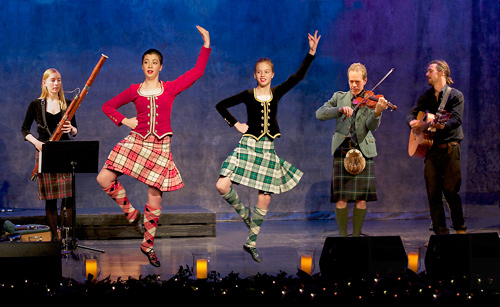
Jamie-&-Dancers-Christmas-5-Low-res

By Perry Tannenbaum

Unconvinced that Charlotte was a hotbed for competitive fiddling enthusiasts, I was a little doubtful that a U.S. National Scottish Fiddle Champion would attract a substantial crowd to a “Christmas in Scotland” concert on a Monday night three days after the holiday. But as we drew up to the Great Aunt Stella Center on a sloppy evening, we noticed that the outdoor parking lot was full. So was the lower level of the nearby parking deck, and there was a bit of a crowd in the lobby, where we picked up our tickets. Jamie Laval last appeared in the Metrolina area back in October at Belmont Abbey College, more than two years after participating in a Classical Idol fundraiser on behalf of the Charlotte Symphony – perhaps on the strength of the Asheville-based violinist’s previous Metrolina foray at Davidson College in 2011. This Christmas gift from the mountains had no precedent, but there is no doubt that the Great Aunt Stella Center has established an enviable folk music cachet in Charlotte due to the series of free concerts that Charlotte Folk Society stages there monthly.

Ensuring that the event would be nothing if not colorful, Laval brought plenty of artillery to the occasion, including four instrumentalists, a budding young vocalist, and four dancers, who changed costumes at least four times during the concert. Further diversifying the musical palette, most of the musicians played multiple instruments. Both McLeod brothers, David and Michael, played bagpipes and the less punishing smallpipes, with Michael adding a drum and a pennywhistle along the way. For the most part, Rosalind Buda supplied a fluid obbligato and continuo on bassoon, but she also wended her way through a couple of bombards, a recorder, and an odd percussion instrument that could have begun life as a black canteen. Above all else, Buda read all the poetry selections beautifully, adorning them with a warm expressiveness and just a faint touch of dramatic flair. When he wasn’t flashing his championship fiddling bravura, Laval switched less impressively to strumming a guitar. But Laval was also a relaxed and personable host – his intros, anecdotes, and stories flowing so effortlessly that I sometimes lost track of when he crossed over from one type of spiel into another.

Yet there was nothing offhand about this concert. Laval’s craftsmanship was immediately apparent in the arrangement of the opening medley. Kelly Brzozowski began it with a lovely solo on the Celtic harp, introducing the “Wexford Carol,” and reminding me what a marvelous acoustic the Great Aunt Stella offers – something I’d quite forgotten since I last heard music there in 2001. We savored the sweet-sounding Ana Carolina Scott soon enough as she sang the ensuing “Angelus ad Virginem,” where we also heard our first sampling of the smallpipes. By the time we galloped into the fifth and final tune in this medley, “The Flagon,” we had seen most of the musical arsenal. With three wind instruments blowing simultaneously, the dynamic difference from the opening quiescence was startling.

The variety, contrasts, and unpredictability of the opening medley were mirrored by the entire program, which eventually covered more than 30 songs. Scott returned for three more vocals before intermission, beginning with a quiet rendition of a pre-Christian version of “The Holly and the Ivy,” accompaniment by harp and guitar with a couple of bassoon fills between stanzas. Assembling his program, Laval took a special interest in Celtic materials, melodies and lyrics that were eventually commandeered by Christianity – altering traditions rather than superseding them. That didn’t prevent Laval from utilizing a trio of young women from Atlanta’s Glencoe School of Highland Dance in further exploring Scottish folkways or from sneaking into North American tradition for a taste of Cape Breton step dancing with Amy Mooney.

After Buda and the McLeod brothers demonstrated how loud and make-it-stop irritating just three smallpipes could be on “Ding Dong Merrily on High,” things quieted down for the no-less-lively “Cape Breton Step Dance” featuring Laval’s infectious fiddling and Mooney’s percussive stepping. Mooney’s dancing was actually so percussive that she and Laval would trade two-bar solos with each other as Brzozowski accompanied on harp (with a few foot stomps of her own). All three Glencoe dancers then appeared in bright plaid skirts for their “Highland Dance Set,” accompanied by Luval’s fiddle and the McLeods’ smallpipes.

Return visits by the quaint trio didn’t wear out their welcome. The Glencoes next appeared in black outfits that were bedecked with colorful strips of fabric. Shaking bell sticks in both hands as they danced, they simulated a pair of wassail ceremonies designed to waken the apple orchards in the dead of winter and ensure the hard cider for the coming year. The next costume change was even more surprising as the Glencoe gals shuffled back onto the stage after intermission in sailor suits, doing mock battle with one another as the two bagpipers played the “Sailor’s Hornpipe” behind them.

While the smallpipes’ wind is supplied entirely by a small bellows pumped under the armpit, the bagpipes are fueled by both breath and bellows. Two of them, as was proven by the ensemble’s “Bessie Brown” just before intermission, can be even more make-it-stop loud than three smallpipes – with a rougher, more irritating sound at full blast. A rock concert sensibility would have been helpful, but I found that I’d acclimated well enough by the time we reached the evening’s final medley, finishing with the “Break Your Bass Drone” and “Flett from Flocca.” Meanwhile, Laval pursued his musical travelogue even more extensively than the ladies’ dance rounds, taking us to Orkney, Brittany, Coventry, Sussex, and Gloucester before we were done.

Most engaging of all was Laval’s extended excursion to Iceland, from where he brought us some diverting Yuletide legends and anecdotes along with three very entertaining songs. Withholding them until the end of the evening, Laval obviously knew the value of what he had. But he also edited prudently, beginning the “Icelandic Yule Lada,” the local equivalent of “The Twelve Days of Christmas,” on Day 8. There are actually 13 days in the Icelandic tradition, and how that evolved was another narrative. Laval hadn’t sung audibly during the evening, and when he duetted with Scott in “The Wren in the Furze,” we could hear why, for his vocals were chiefly effective in contrasting with the beauty of Scott’s. The backstory of this song, traditionally sung on St. Stephen’s Day after Christmas, meandered into Icelandic history and how the wren became an icon for military betrayal before taking on a radically different meaning for the holidays. Basically, “The Wren” was the weirdest begging song I’ve ever heard.

The final medley began with the “Boar’s Head Carol” and ended with the entire audience clapping rhythmically as the musicians and dancers took their bows, both bagpipes blaring once again. Even that wasn’t a sufficiently emphatic return to Scotland, but Laval wasn’t guilty of an oversight. For an encore, the pipers and the harpist accompanied Scott as she sang “Auld Lang Syne.” I didn’t recognize Scottish laureate Robert Burns’ words – or his brogue – in the stanzas Scott sang, but when the ensemble answered with the refrain, all hearts were in the Highlands.

Hip-hop, the Blumenthal, and the Queen City Are Breakin’ Convention

By Perry Tannenbaum
The Ruggeds from the Netherlands (Photo by Belinda Lawley)

BirdGang Dance Company from the UK. (Photo by Belinda Lawley)

BirdGang Dance Company from the UK. (Photo by Belinda Lawley)

Strange things are brewing in Uptown. In the shadow of buildings named for Wells Fargo, Duke Energy and Hearst, there will be dancing in the streets. In the lobby of a building blessed by our most PC philanthropists, the Knight Theatre, they’re decking the hall with graffiti, setting up for our dopest DJs.

There’s more. The president of Blumenthal Performing Arts, that Brooks Brothers-ish man about town — yes, Tom Gabbard, y’all! — is spouting words like cypher, poppin’, waacking and the whole beatboxing vocabulary of hip-hop.

Of course, Charlotte’s hip-hop community is already hip to what’s happening. But whoa. Those folk who spin on their heads, float like robots across floors, move their arms impossibly behind their backs, and thoughtfully shake spray cans? They’re also changing: embracing the challenges of storytelling and theater.

Bro, it’s Breakin’ Convention, spinning into town this weekend — indoors at Knight Theater and Spirit Square. Spilling into the outdoors at Levine Avenue of the Arts Plaza and the old Goodyear Tire parking lot. Scissoring Spirit Square in its parking lot and alleyway. You, your parents and maybe your parents’ parents — and definitely your kids — need to check this festival out.

Hip-hop began some 50 years ago on the streets of New York, in the borough of the Bronx, without any theatrical aspirations. Twelve years ago, the Breakin’ Convention brand of hip-hop took shape in London at Sadler’s Wells, arguably the pre-eminent dance presenter in the world, where they added the elements of narrative and drama while framing it all with the prosceniums of their three stages.

Breakin’ Convention first crossed the pond and returned to its birthplace in 2013, expanding the mission and outreach of the legendary Apollo Theatre on the sacred ground of Harlem’s 125th Street. This year, Blumenthal Performing Arts is partnering with the Apollo in bringing the international artists who will headline the Breakin’ Convention premiere here this week and at next week’s encore in and around the Apollo.

The big-name crews on the Knight Theater stage this Friday and Saturday include The Ruggeds (Netherlands), BirdGang Dance Company (UK), Antoinette Gomis (France) and Compagnie Phorm (France/Argentina). On each of these nights, local crews from Charlotte and the USA will share the bill, including Street Kingdom, Aquaboogy, Breakers for Life, collectiveUth, NCDanceDistrict, the Nouveau Sud project, Queen City Bittys, Reliablebrother #TwinNation and The Vongolas.

You’ll need tickets to see all these proscenium performances, but everything outside Knight Theatre — including the Knight’s lobby — is open and free to the public. Breakin’ Convention breaks out at a bunch of locations, so here’s an overview.

Friday and Saturday

Beginning at 5 p.m. — Obey Your Verse Stage at Levine Avenue of the Arts.

5-7:15 p.m. — Graffiti Jams at the former Goodyear service station at the corner of N. Tryon and E. Stonewall.

6-7:15 p.m. — Tiny Totrock sessions, DJ and Dance Cyphers and a Graffiti Zone at the Lower, Main and Upper Lobbies of Knight Theater, respectively.

7:30-10:15 p.m. — The main stage performances at Knight Theater, punctuated by a 45-minute intermission at 8:30.

8:30-9:15 p.m. — The bodacious intermission: Totrock, Cyphers and Graffiti Zone resume in the Knight Lobbies while food trucks invade Levine Avenue of the Arts outside the Knight.

Saturday only

10 a.m. to 4 p.m. — Street Jam at Spirit Square: Graffiti Jam, Dance Cyphers, Drum Circle, food trucks, instructional sessions presented by Zulu Nation and workshops piloted by Gomis and The Ruggeds.

This massive project is really the first true arts festival to hit town since JazzCharlotte left the Uptown in 1994 and ignominiously bit the dust in the swamps of Carowinds. There was plenty of trepidation, preparation and mutual scouting in London and Charlotte before the new Blumenthal-Sadler’s Wells partnership was forged. Without hip-hop artist and entrepreneur Jonzi D, the Sadler’s visionary who pioneered the idea of elevating the art form with narrative and drama, the deal would not have been done.

“We brought him here,” says Gabbard, “about a year and a half ago to spend four days — to evaluate the hip-hop community, the size of it, what it was and their willingness to work with us. And we found out that there was a lot of enthusiasm for partnering with Blumenthal on this. Then this last May, Jonzi came for 10 days, and it was really just to work with the local community developing relationships.”

The 2015 Breakin’ Convention is just the beginning — for both the Blumenthal and Sadler’s Wells. Upstaging the Apollo, which is bringing the festival to Harlem in alternate years, Gabbard has signed on with Sadler’s for three consecutive years to see if Breakin’ takes with the public. He envisions transplanting a chunk of the festival to Romare Bearden Park for 2016, and he’s optimistic that other cities’ performing arts centers, after scoping out our event, will climb aboard and share costs for a 2016 Breakin’ tour. In the meanwhile, Jonzi will be staying in touch with the Queen City, performing Open Art Surgery, a weeklong workshop that will create a new hip-hop dance theatre piece.

Local hip-hoppers are already impressed.

Best remembered as the DJ narrator of Children’s Theatre’s wild, wild production of The Red Badge of Courage in 2013 — and, oh yeah, the winner of Best Rapper honors in Creative Loafing’s Best of Charlotte that same year — Mason “Quill” Parker raps again this Friday, performing his latest project, Loose Leaf vol 2.

Booked by Boris “Bluz” Rogers, the poetry slam guru who will emcee Obey Your Verse, Parker appreciates the creative energy that Jonzi is bringing to town: “the ideal he represents has helped mold four generations of hip-hop here in Charlotte and the world over. It is pivotal that it be promoted properly across cultural lines in order to flourish in the full fruition of the vision.”

Ana Ogbueze and NCDanceDistrict burst upon the scene about three years ago when the company she founded, The Dance District, was asked to perform at Taste of Charlotte. They began with seven dancers, have grown to 30, and will be featuring 13 onstage at the Friday show at Knight Theater.

She first met Jonzi last year when he came to a meet-and-greet with Charlotte hip-hop choreographers and teachers at the Blumenthal PAC, where he presented an already-completed Open Art Surgery piece.

“That really opened my eyes to this emerging world of hip-hop theater,” says Ogbueze. “I distinctively remember parts of the piece that made the entire room pause with a slightly perplexed sigh, followed by, ‘Did he just do what I thought he did?’ I loved it. From that moment on, I knew I had to see what this whole Breakin’ Convention was about. Honestly, I left feeling so crunk to learn more about the movement, Jonzi actually invited me up to London that following month to check out Breakin’ Convention first-hand! Thanks to the Blumenthal, I had the privilege of attending, and it was absolutely amazing.”

The rest of us get to see the Promised Land this week.

Charlotte Ballet Reboots!

Image result for Charlotte Ballet Fall Works pictures

Charlotte Ballet’s Alessandra Ball James and James Kopecky share a moment in Jiri Kylian’s Forgotten Land.

By Perry Tannenbaum

Turnover is a reality in most businesses, sometimes a necessity. In recent years, it hasn’t been at all unusual for Jean-Pierre Bonnefoux’s Charlotte Ballet to welcome three or four new dancers into its ranks after watching an equal number land a jeté into other troupes around the country – or into teaching, choreography, retirement, or parenthood. Transitions became so smooth at the Queen City’s pre-eminent performing arts troupe that I could view the newcomers as reinforcements. And the process? I called it reloading rather than rebuilding.

This season is different. Less than 18 months after changing its name from NC Dance Theatre, Charlotte Ballet opened its 2015-16 season with nine new dancers that weren’t on its roster last year. On top of that, the opening night of Fall Works came less than three weeks after Bonnefoux announced that he would fading away to emeritus status at the end of next season, with a new artistic director to be named next spring or summer.

Pardon me, but I’d call all of that a reboot.

Last week’s program gave us another preliminary chance to compare the new company with the old in revivals of Bonnefoux’s well-traveled Shindig, last presented here in 2009, and Jiří Kylián’s Forgotten Land, which was first brought to Charlotte in April 2014, the day before NCDT changed its name. Set to Benjamin Britten’s Sinfonia da Requiem and inspired by an Edvard Munch painting, Forgotten Land benefited from a simpler pre-recorded intro that was shown on a retracting projection screen.

Instead of navigating through the connections between Kylián’s choreography, Britten’s elegy for the receding East Anglia coastline, and Munch’s imagery – not closely matched by the costume designs – we could concentrate on the colors of John F. Macfarlane’s costumes. These three basic colors, worn by three different couples, represented the progression of youth to old age: white, red, and black. We actually saw these couples in reverse order, but each couple had a paler, less vivid, and less energetic couple in the sequence – fainter echoes in gray, pink, and eggshell.

After an extended dance of innocence from the dancers in white, we didn’t circle back to the reminiscing dancers in black. Instead, the entire 12-person ensemble gathered for what I’d call an anguished celebration of life. Then in a moving coda, the three vividly clad women were all alone onstage, faced away from us, moving toward McFarlane’s somber set design, a wide ocean wave eternally poised to break onshore in semi-darkness. Seeing it all for a second time, I found the quiet emotional acceptance of Kylián’s women reminiscent of the haunting resignation that suffuses John Millington Synge’s poetic drama, Riders to the Sea.

Pete Leo Walker was at his charismatic apex when he partnered with the sensuous Melissa Anduiza as the black-clad protagonists two years ago, but there was no lack of command or flair at Knight Theater when 10-season veteran Alessandra Ball James and newcomer James Kopecky replaced the escapees. Half of the couples were partnered exactly as they had been in 2014, Sarah Hayes Harkins with Addul Manzano, Chelsea Dumas with Josh Hall, and Jamie Dee Clifton with David Morse. So aside from the richer perspective provided by the intro, differences between the two performances were not at all cataclysmic.

No, the difference between now and then was most pronounced when we reached the elbows-up, kick-up-your-heels Shindig, Bonnefoux’s most frequently performed work after his annual Nutcracker. There’s a high-spirited yee-ha merriment to this piece, a shedding of balletic formality, that this 16-person ensemble didn’t quite capture on opening night. Jitters? I’m not sure whether the abandon that’s needed is attained until you reach the point when counting the beats and remembering the steps is no longer a chore.

Fortunately, between the two ensemble segments there are five smaller tableaux where one to four dancers are called upon to shine, and the live bluegrass music of the Greasy Beans quintet – featuring the hot fiddling exploits of Cailen Campbell and the unflagging bonhomie of guitarist/vocalist Josh Haddix – was a constant exhilaration. Extra musical helpings came with the curtain down as the Forbidden Land scenery was dismantled.

In the smaller Shindig segments, Clifton, James, Hall, and Harkins reasserted themselves. Among the newcomers, Amelia Sturt-Dilley aced her showcase, and in an all-male hoedown quartet, Kopecky and Ryo Suzuki flashed some more of their personality alongside Manzano and Morse.

If the rebooted company hasn’t completely acclimated to Bonnefoux’s festive Appalachia, they showed no such discomfort with Sasha Janes’s new setting for Vivaldi’s Four Seasons. It’s an intriguing collaborative effort that we’re likely to see again in years to come. While some of Christopher Ash’s seasonal projection designs were hackneyed animations from Stock Photoville, Aimee J. Coleman’s costume concepts became more and more amazing, peaking in the final “Fall” and “Winter” sections.

All 15 of the dancers were dressed in autumnal orange as we headed into “Fall,” but the women’s outfits were highlighted by what would normally be called tear-away skirts. These skirts were capable of standing by themselves and forming wee cone-like dwellings, becoming part of the scenery when guys weren’t wrapping them around the shoulders of their partners.

Coleman’s crystalline winter costumes were hardly anticlimactic, the most formal of her designs. The women’s dresses were regally white, fit for a palace in a traditional Russian ballet, and newcomer Raven graced the most regal of them all. Barkley made her spectacular entrance mounting a flight of stairs that rose from the orchestra pit. Nor were the men’s costumes any less spectacular – long thin full-sleeved coats, that were even more Russian in flavor, military in their formality, and sacramental in their white purity.

Vivaldi’s winter may have been Italian, but Janes and Coleman were clearly adding some Russian dressing. When snowflakes began fluttering down on the ensemble from the flyloft, Janes and the 2015-16 edition of Charlotte Ballet managed to magically transform the Venetian Vivaldi into a Yuletide Tchaikovsky.