Category Archives: Dance

Charlotte Ballet’s “Whispers, Echoes, Voices” Is Excitingly Sensual, Primal, and Imaginative

Review: Whispers, Echoes, Voices at Knight Theater

By Perry Tannenbaum

October 30, 2025, Charlotte, NC – Over and over again, as I drove home after opening night of Charlotte Ballet’s Whispers, Echoes, Voices – capped by the world premiere of resident choreographer Mthuthuzeli November’s As I Am, I found myself asking, “What Did I Just See?” That is not an unusual question for me to ask after a stellar evening of modern dance, for the art is usually abstract and chameleonic in the extreme, but on the eve of Halloween, the urgency of the question felt compounded. Exponentially.

Sitting in the fifth row, near many young people who were experiencing such vibrant abstractions for the first time, I couldn’t help but hear their exclamations and enthusiasms during the two intermissions that punctuated the program. “Amazing!!” was the most repeated outcry but not the only one, and the cumulative enthusiasm was at a you’ve-got-to-come-see-this pitch I rarely hear. But beyond the fevered response and what had caused it – for the standing ovation after November’s triumph was instant, electric, and virtually unanimous – there was a fundamental question that was not abstract. At the climax of As I Am, when a deluge rained down on soloist Maurice Mouzon Jr., out of the sky and into an opening at the top of the moody cave designed by Celia Castaldo, what had I seen? Literally.

At first blush, it seemed obvious that it was water. It looked like water, it glowed like water, it photographed like water, and it bounced like water. But as Mouzon’s primitive countrymen returned to the cave and helped him off the ground, evidence mounted quickly that it had been something else. Mouzon’s back was newly caked with the stuff and had to be wiped off. None of the barefoot ensemble of ten dancers sloshed or slipped on the stage afterwards, including the vatic priestess in her reindeer crown, and when we rose to applaud all this mystic magnificence, the stage was completely dry, without a single drainage hole in sight. Since a deluge of sand would be dangerous to the performers – and us! – my conclusion, confirmed by CharBallet the next day, was that we had seen rice.

What we had also seen, no question, was the premiere of Charlotte Ballet’s most exciting and primal original since Salvatore Aiello’s Rite of Spring.True, November’s companion soundtrack, which he composed, did not rival Stravinsky, but it was no less evocative… and obviously, more of a piece with the choreography. Here were the whispers and voices referenced by the program’s title, with plenty of pulsing and primitive percussion layered on.

After reading a review of the dress rehearsal performance, two further questions arose in my mind. How many people in the audience, contrary to the evidence before their eyes, had gone home thinking they had seen water onstage at the Knight? Was that more than the number of people who, not scrutinizing the program, didn’t realize that tonight the ensemble for As I Am was all-male, and that two of three remaining performances will be all-female? Costumes in CharBallet’s publicity photos confirms what they’ll miss. In all, four soloists will dance November’s new work, including Raven Barkley, Remi Okamoto, and the opening night priestess, Isaac Aoki.

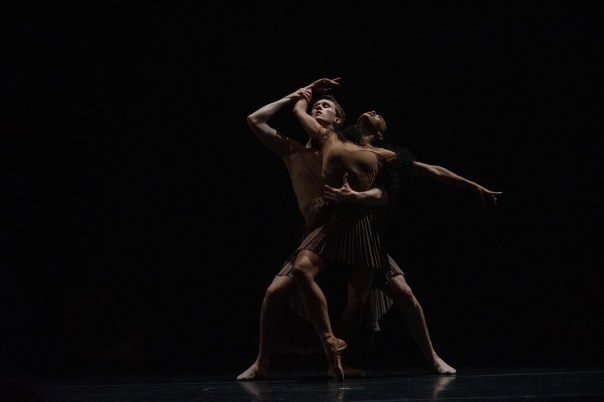
The evening began far more elegantly and wittily with a reprise of Jiří Kylián’s Petite Mort, an international staple premiered by Nederlands Dans in 1991 and unveiled at the Knight in March 2024. It’s good to keep in mind that Kylian’s piece is more about what the title implies, “the ecstasy of sexual intercourse,” than about the two slow movements from famed Mozart piano concertos, No. 23 and No. 21 (Elvira Madigan), he sets to dance in a series of ensembles and six pas de deux. There’s a definite uptick in the quality of what we see this time at the Knight, only partially because Kylián’s explanatory notes are printed in the program beneath the credits, cluing us in to the sensuality at the core of the choreographer’s concept and the precise satire he intends with the sabers wielded by the men.

You knew that sabres were sharp and pointy, but did you realize that, by accurately kicking their handles, they will roll around the floor in a perfect circle? Mastering that trick along with the close brushes that the blades, straight or curved, make with the females onstage during Petite Mort – these can account for a bit of fear and hesitancy among all the dancers. So another reason the revival scores better than the initial thrust two seasons ago is that the dancers are handling the hardware with more confidence and élan. A complete delight this time around, with all its suggestive episodes more sensuously sketched.

In the middle of the two rousing spectacles, Crystal Pite’s dimly lit Solo Echo, set to cello sonatas by Brahms, stood out in quiescent relief. Or it did during its early moments. Flakier stuff came down in the darkness as Pite’s piece began, partially illuminated by a vertical rack of lights from the wings. That horizontal lighting, designed by Tom Visser, gradually descended from the flyloft, stopping in midair just above the dancers’ heads. Slow-paced choreography, frequently for just a couple of the seven dancers, dressed drably in costumes by Joke Visser and the choreographer, added to the hypnotic spell. Confession: I briefly fought the impulse to doze off during this monochromatic dreariness.

But then the pace quickened and Pite deployed her complete ensemble in more feverish action – while the whole upstage brightened into a skyscape depicting a glorious snowy night. More importantly, Pite’s echo concept crystallized as six of the seven tightly intertwined, one on top of another, in a vertically mirroring pose above the recumbent Mouzon, once again garnering special attention. In this blizzard, the ensemble might split apart slowly like the folds of an accordion. Or they might break apart, scurry around chaotically, and make wretched attempts to form a moving circle. Often, however, one of the dancers stood isolated from the ensemble. He or she could be viewed as an outsider, but also as the solo mind generating the echoes.

Dimming the Lights, Cerrudo Delights With Three Dance Originals

Review: Charlotte Ballet’s A Realm of Existence

By Perry Tannenbaum

March 6, 2025, Charlotte, NC – Past and present eras of Charlotte Ballet intertwined at Knight Theater in their latest program, A Realm of Existence, named after none of the choreography below. Three of the four pieces were by artistic director Alejandro Cerrudo, including Dos y Dos y Dos, his first world premiere with the company since he was designated to lead it in 2022. After a break, Pacopepepluto lightened the mood with settings for three Dean Martin hits, and Cloudless cast an intimate, almost erotic aura before the second intermission. Hearkening back to the preceding Hope Muir stint as artistic director, nine dancers performed the surreal scenario of Johan Inger’s Walking Mad. It was the first piece performed at Knight Theater under Muir’s leadership in 2017, reprised there by Muir in 2019.

For a piece that emphasized pairs, Dos y Dos y Dos was strikingly touchless – and for that reason, perhaps most fascinating in its interstitial moments between the various couplings. The first ensemble reacted to one another in waves, like coils of a Slinky toy or a row of dominoes, creating the push-pull of gravity between them out of thin air. The intriguing style carried over into the pas de deux – not religiously since there was minimal contact – but wasn’t as unique for me in that idiom. While the variety of the ensembles grabbed me more, the variety of music for the couples – composed by Marek Hunhap, Jean Michel Blais, and Frederic Chopin – brought fresh vibes to their dreaminess.

Absent any props, scenery, or flashy costuming, Cerrudo placed strong emphases on form and flow in his new work. Lighting by Michael Korsch is important in this piece – but not expensive. Dim lighting has been almost a trademark of Cerrudo’s tenure, certainly CharBallet’s settled style in recent non-Nutcracker production photos. PR photos of A Realm of Existence couldn’t be anything other than dimly lit. But as Pacopepepluto quickly made clear, a dimly lit mood needn’t always chime with a Chopin Nocturne.

“Memories Are Made of This,” the first of Cerrudo’s three solo pieces (the “Paco” piece?), showcased a true gem of bad Dean Martin imitation by Joe Scalissi – or a treasure since neither Spotify nor Apple Music have a clue about Scalissi, Joe or otherwise. You could hardly imagine a better dance track for mocking Martin’s schmaltzy style, Cerrudo’s moves prodding Mouzon into projecting the antithesis of suavity.

Apparently, gems like Scalissi’s are very rare indeed, so Mario Gonzalez had to content himself with an authentic Martin cut, the exponentially schmaltzier and creepier “In the Chapel in the Moonlight,” so he drew more laughs than Mouzon’s antics anyhow. How did Cerrudo top himself after that for Rees Launer? With Dino’s most beloved – and outright silliest – hit, “That’s Amore,” complete with its original chart-topping chorus and accordions.

Packaging moon, stars, and an underfoot cloud, this was clearly the “Pluto” segment. There was so much intrinsic merriment in that track for Launer to build on with his discordantly spasmodic movements, and the choreographer mischievously brought back Gonzalez and Mouzon for comedic cameos as lagniappe. That really was amore, especially for the gals in the audience since the guys were hardly wearing a stitch.

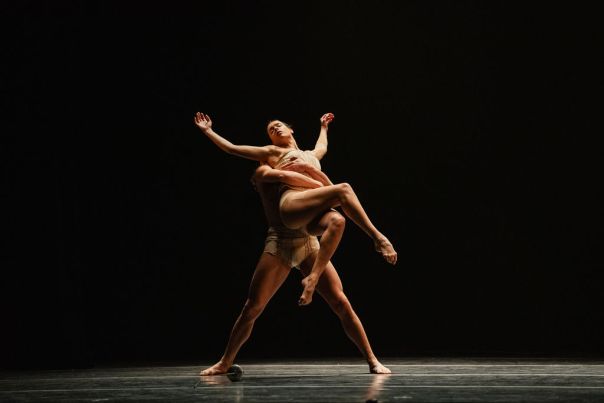
Flipping the customary script, Cerrudo had objectified his men more than he would the women in Cloudless, Anna Owens, and Adriana Wagenveld on opening night. Branimira Ivanova’s costumes for this pas de deux were more for a dance studio than a runway. That enabled Owen and Wagenveld to build their chemistry, intimacy, and heat from scratch, a steeper climb without flashy lights and glam dresses. With the gentle music of Nils Frahm simmering in the background, there was actually a bit of tension for me, wondering how far the intimacy would go – and whether it would upset the giggling church ladies sitting behind us. The work out costuming helped to widen Cerrudo’s latitude.

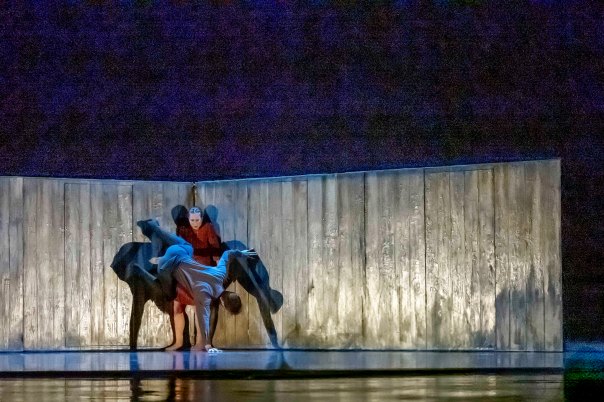
As for Walking Mad, I’ve written about it before, here and elsewhere. So I’m dispensing with yet another description of the piece and developing a theory about Inger’s intent – after noting those same church ladies’ surprise and delight in seeing it for the first time. No doubt the wooden wall, nearly as versatile as the dancers who play with it, is in permanent storage somewhere in town now that this crowd favorite has been performed three times. This wall plays such a big part in the action that what it is can quickly elude our consideration.

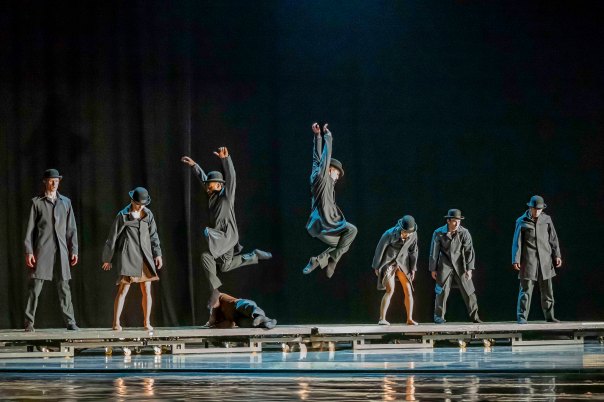
It’s a wall that separates the insiders partying behind it from the outsiders who can’t seem to forget their worries and merge with the mindless, monotonous fun. That’s fairly obvious when a crowd of partyers with conical hats spill out from the sides of the wall and briefly join the lonely, trembling folks on our side – especially since they’re almost always engulfed by the hypnotic repetitions of Ravel’s Bolero. But there’s also a night-and-day monotony to Inger’s scheme, for the first dancer we see, seeking to toss away his workday attire and join the festivities, is wearing a bowler hat.

A group of male dancers will parade funereally across the stage later in the piece, all wearing similar Magritte bowler hats. It’s a broad hint that our days are as repetitious and monotonous as our nights, only more formal and mindful. That’s where the fears and trembling of the outsiders come from. Notwithstanding the surprised gasps and giggles from the crowd, this may not have been the best realm of existence.

“Beyond the Surface” Amazes and Parties-Down

Review: Beyond the Surface at McBride-Bonnefoux Center

By Perry Tannenbaum

The new Charlotte Ballet season is off to a blazing beginning. Presenting Beyond the Surface at the McBride-Bonnefoux Center for Dance through October 26, the troupe looked fresher and younger than ever. But the choreography was far, far younger: two world premiere hatchlings that emerged from their shells last Thursday from Omar Román de Jesús and Mthuthuzeli November, and a third Charlotte Ballet commission by Jennifer Archibald that had its premiere less than two years ago in the same studio.

On that auspicious occasion, Archibald’s fledgling was at the top of the Innovative Works program, sparking hopes that the pieces that followed would reach the same high level. This year, HdrM is nestled in the middle of the program – and my 2023 hopes were already realized again in 2024 with the premiere of De Jesús’s Balúm.

Yes, the first dance of the night easily merited a climactic spot in any evening of premieres: beautiful, complex, mysterious, symbolic, intricate, moving, epic, and surreal. Music by OKRAA, Ola de Luz, was relentlessly propulsive, with random noises at random intervals littered around the main core, a minimalist loop with a harp-like timbre. Once that core cleared the noisy interference, like a spiraling starship navigating through a belt of asteroids, a sudden hypnotic calm and spaciousness prevailed – and the wonder of this dance multiplied, lending it an uncanny glow.

De Jesús has indicated that he is exploring our interactions with the air that engulfs us, from the moment we are born until we take our last breaths. Or maybe that emergence from the noise field near the beginning of the piece is an expulsion from the womb, our birth after a pre-natal prelude. The Puertorriqueño choreographer also has a hand in scenic design and Branimira Ivanova’s costume designs, for she has some specific prompts to execute in fashioning the dancers’ outfits and props.

The most notable of these are black: Two umbrellas that conjure up the surrealism of René Magritte and the fearfully magnificent ambiguity worn by Rees Launer. One of the umbrellas starts upstage center, held by one of the dancers seated on a bench, and it gets passed from dancer to dancer during the action, frequently cycling back to its starting position. The other is held stolidly by a woman on a side bench who resolutely faces away from the action until the stunningly gorgeous denouement – when we get to see the air!

At various moments when Launer grips our attention, we can have different conjectures about what his stern character represents. A raging fire-and-brimstone preacher? a demon? a witch? the Angel of Death? Launer will be a member of two of the three ensembles that get to present Balúm during its current 16-performance run. Another standout in the opening weekend’s seven-member ensemble, Maurice Mouzon Jr., will be in all the performances of this piece.

The liquefied movement of the dancers – along with some robotic intertwining – was juxtaposed with no-less-idiomatic lifts that were more horizontal than vertical. Like chapter markers at the end of episodes, the ensemble would gather and swirl around the stage in an evocative oval parade. Autumn leaves swirling in the wind. Often two or three subgroups performed simultaneously before an ensemble swirl would resolve the dissonance.

What amazed me most was that synchronized entrances and overlapping actions were so precise when there were seemingly no musical cues to give the dancers a toehold. If you’ve heard music by Philip Glass, you know that minimalism is not particularly danceable music. Musicians playing it and maestros conducting it must concentrate intently on the score to keep their bearings amid the repetitiveness. I’m still gobsmacked by how this Charlotte Ballet team pulled this off.

Following Balúm, a piece so untethered from every aspect of its music except for OKRAA’s tempo, Archibald’s HdrM struck me from an altered perspective. Archibald’s ability to mesh expressive movement to a soundtrack of musical compositions by Ludwig Ronquist, Heilung, and Federico Albanese stood out more boldly than ever after the more abstract and surreal De Jesús piece – though these intimate bonds in HdrM could be broken by abrupt mechanical disconnects from the score.

Two other conflicting factors came into play. Most welcome was the opportunity to see the Canadian-born choreographer’s work reprised by three of the eight dancers who performed at the 2023 premiere, Raven Barkley, Luke Csordas, and Shaina Wire. The piece looked more natural and “lived-in” twenty months later, so its internal contrasts were sharper and its sensual moments more relaxed. Barkley, in particular, stood forth dramatically, as sensual, captivating, and devastating as we’ve ever seen her. Nor can you fail to notice the ‘do.

Here, more than in any other dance of the evening, the ensemble bought into the “Unfiltered” theme of CharBallet’s 2024-25 season with their spirited, lyrical work. My only worry was off the dance floor and in the program booklet, where Archibald’s useful explanatory remarks where no longer in print. There in 2023, she was concerned with environmental psychology and posed a pointed question: “Is there a social responsibility to humanize architecture?”

Just asking that question helps us to connect with Archibald’s struggling language of movement. It also hints at the likelihood that Kerri Martinsen’s drab costumes are intended as institutional, such as clothing worn in hospitals, prisons, or mental wards. Aside from the contrast between lithe and mechanical movement, HdrM holds our gaze with a nice balance of ensemble, individual, and pair segments that flow naturally into one another.

Like many finales we’ve seen before from CharBallet, November’s Vibes and Variations is the most celebratory and carefree piece of the night. After last year’s From Africa With Love, it’s also the second consecutive November premiere to kick off a season at the McBride-Bonnefoux Center. Where Africa was surprisingly serene and monochromatic, preoccupied with mauve-colored ostriches from his South African homeland and their exquisite fragility, Vibes seems to wander westward to South America, to samba, tango, and carnivale.

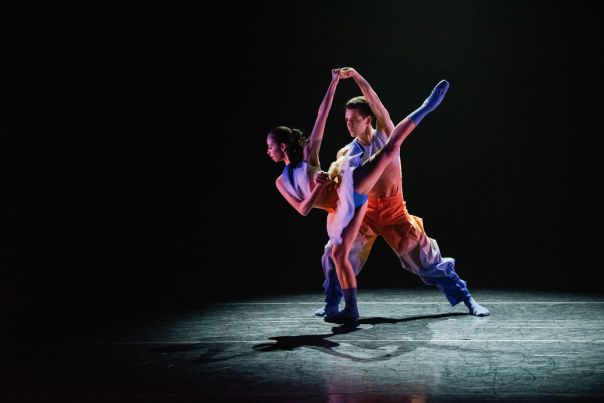
Ivanova’s costumes burst with pastel cotton-candy colors and outré pleating, what my late mom in her saltiest Yiddish would call ongepochket, crassly over-decorated. The bulges on the men’s costumes give them seahorse legs and the frilly women look like spinning tops in a color scheme that matches the men’s harlequin-like rigs. The music starts off rather quietly with Gaby Moreno singing the first vocal on the program, her cover of “Cucurrucucu Paloma” over a simple acoustic guitar accompaniment, smoldering with bossa nova intimacy and sadness.

Things intensify as the 15-person ensemble digs into the Bang on a Can All-Stars’ version of David Lang’s strangely percussive – and minimalist – “cheating, lying, stealing.” But the most intense partying launches when we arrive at beatmaker Jamie xx and MC Moose performing the brash, irresistibly mindless “Gosh.” Catching my eye most compellingly were Csordas and Fuki Takahashi, each of whom will be in two of the three rotating ensembles performing November’s piece throughout its current run.

If I have to predict who will land the title role in Carmen next spring when artistic director Alejandro Cerrudo and CharBallet unveil their Vegas-showgirl update, my guesses would be Takahashi or Barkley. Since that Charlotte premiere will be running for two weekends, both temptresses could take turns at it.

Breathtaking Perfection Makes Charlotte Ballet’s “Swan Lake” Premiere a Dazzler

Review: Swan Lake at Knight Theater

By Perry Tannenbaum

May 3, 2024, Charlotte, NC – For generations, budding ballerinas around the globe have aspired to be a member of the gaggle who dance to the primeval strains of Pyotr Ilyich Tchaikovsky’s Swan Lake. The best of them dare to dream of dancing the roles of Odette, Queen of the Swans, and her evil, seductive doppelganger, Odile. Yet more than 50 years elapsed in the life of Charlotte Ballet before the company brought Odile, Odette, and Swan Lake to the Queen City. To many, including millions of those budding ballerinas, Swan Lake and ballet are synonymous. So in a town that has a reputation of resisting the new and clinging blindly to proven classics, you have to wonder why this premiere – a quite glorious one at Knight Theater – has taken so long to happen.

Although scenery, costumes, and props are on loan from the ballet troupes of Cincinnati, Arizona, and Atlanta, the mélange is quite impressive. Choreography by Ib Anderson, based on the definitive 1895 overhaul by Marius Petipa and Lev Ivanov, and the work of CharBallet dancers, Charlotte Ballet II, members of the pre-professional program, and students of the Ballet Academy are more than enough to stamp this marvel as homegrown. Extra freshness and vivacity rose from the orchestra pit as the Charlotte Symphony, directed by Gavriel Heine, performed the full score for the first time – with the ardor of an orchestra that has been waiting over 90 years for a living, breathing ballet corps to partner with on this mammoth venture.

Those little-girl aspirations are freshly recalled by the glittery merch in the Knight lobby, so the anticipation in the audience before curtain-rise was akin to the excitement that greets the CharBallet-Symphony collaboration each December as Belk Theater fills up for The Nutcracker. Even after opening night, you are at a special event. While the Cincinnati scenery can be improved upon (rather easily, I’m afraid); especially in and around Prince Siegfried’s castle; the courtiers, the servers, and the ladies in waiting regally create a teeming spectacle that fulfills expectations in Act 1. Oliver Oguma, the first of three leading men who will rotate during the 12-performance run, is a soulful Prince Siegfried with a bonus of brawn. Some heavy lifting lies ahead, but before lifting Odile up high Oguma had to be able to shine solo in the opening scene, where he basically rejects every eligible maid in the kingdom. The Queen Mother is royally chagrined – a triumphant comeback for Ayisha McMillan Cravotta, more beautiful than ever.

Anderson discreetly subtracts some courtiers from the Petipa scenario, but there’s enough dazzle remaining for them not to be terribly missed. The dozen courtiers beguile us in varying configurations, and the pas de trois sequence with Bridget Fox, Humberto Ramazzina, and Samantha Riester is endearing elegance and charm. Dancing the Page’s solos, Academy student Russell Abel struck me as a prodigy, able to leap and land squarely on the beat. Yet as the act climaxed, viewers who are accustomed to seeing Prince Siegfried flanked by noble chums might feel that Oguma gradually becomes excessively forlorn in spite of all his solo exploits.

Yet it’s justified to view the sparsity of plot and companionship in the opening scene as a perfect way to magnify the éclat of Act 2, where the evil sorcerer Von Rothbart and his enchanted flock finally take the stage – a bevy of 24 Cygnets and Swans plus one sublime Queen. You might even be tempted to laugh at the triteness of the choreography that precedes Odette’s first entrance – until you realize that Ivanov and Swan Lake likely fashioned the familiar template that Hollywood, Broadway, TV, and Vegas have turned to ever after in innumerable dancing build-ups to the entrances of their stars. James Kopecky, in a spectacularly hideous bird costume of his own – with poles to extend his wingspan – is magnificently malign in his various poses and flourishes, adding magic and menace to the big moment.

Evelyn Robinson was more than equal to it. She was divine perfection: fearlessness, symmetry, balance, musicality, and supple flow were all absolute to an inhuman degree. Only the little expressive flutters of her head and face subtly reassured us that a tortured soul hovered above her pluperfect point work. Later, when Robinson invaded Prince Siegfried’s surprisingly drab ballroom as Odile, you kind of wondered whether she would dramatically vary or eclipse what has gone before. Seemingly responding to more spellbinding sorcerer gestures from Kopecky, a bit like a taunting pro wrestling baddie in his taunts, Robinson softened ever so slightly. Her seductiveness trickled naturally from her added liquidity, and her expressions became more worldly and knowing, like a Vogue supermodel shoot. Or Melania.

In sum, Robinson was all I could hope for and occasionally more. But the swans! I hadn’t even begun to imagine what they can be in live performance. Whether it was the composer’s masterstroke in the original 1877 score premiered by the Bolshoi or the brainchild of ballet specialist Riccardo Drigo, who revised the score for its successful 1895 resuscitation in St. Petersburg, the music hushes so much that the en pointe work of flock is clearly audible – not only audible but a chief element of the music’s fluttery percussion. Over the course of the 2 hour 17 minute epic, it wasn’t only principal harpist Andrea Mumm who excelled. Concertmaster Calin Ovidiu Lupanu came to the fore with some fine solo work in Act 3 and acting principal oboist Erica Cice was gold all evening long on the haunting big tune.

What floored me most, after watching Charlotte Ballet ever since it arrived here (from Winston-Salem) as North Carolina Dance Theatre in 1990, was the unprecedented synchronicity of this bevy of fluttering Swans. For decades, the individuality of each NC or Charlotte dancer was the company’s trademark. Let Miami and what’s-his-name do synchronicity! Yet here in an instant, the phenomenon of a perfectly calibrated ensemble of 24 women, dancing on point to the same heartbeat, had arrived in Charlotte, North Carolina. It was eerie and breathtaking. Historic.

Will CharBallet fully possess Swan Lake in the future with their own scenery, props, and costumes? Hope so. This is one you’ll want to see again.

Baran Dance’s “Homegrown” Feeds on Edgy Sunshine

Preview: Homegrown at Parr Center

Perry Tannenbaum

Is Audrey Baran the lead dancer at Baran Dance or is she the lead choreographer? Yes! 

As an evening at Parr Center during Baran Dance’s Homegrown show this weekend will confirm, Baran is still the throbbing heart of her company’s performances and choreography. But after 12 years at the forefront, Baran admits she’s withdrawing — a little.

“It’s been nice for me to relinquish some of the creative work and also to lean into that mentorship role that Baran Dance is really focused on,” she explains. “For a while, when I was the only choreographer in the company, I was performing so much in my own work, which is really hard to do. So I’m leaning into being just solely the choreographer for the pieces that I make and then being a dancer in other people’s work.”

Of the eight pieces on the bill for Homegrown, scheduled for June 1-2, Baran has choreographed three, the leadoff piece, “Tumbleweeds,” and the two closers, “Blood of Fools” and “Night Vision.” Among the remaining five pieces in-between, Baran will be onstage at Central Piedmont Community College’s Parr Center dancing in another three, Carolina Quirós Otárola’s “Regresar,” Ashley L. Tate’s “Carry the Weight,” and “Ouroboros” by Rahquelah Conyers and Lydia Heidt.

For Baran to say that she is “a dancer” in these latter works is shameless modesty, grossly understating her enduring energy, her luminous grace and her expressive charisma on the floor. Nor is the originality of Homegrown limited to the performances and the choreography we will see; all of the music is also original and homegrown.

Although rehearsals for Homegrown began early in January, planning for the Baran Dance season began in early fall with all the musicians on board.

“Yeah, it’s been a lot of work, a lot of artists going into it,” Baran admits. “The musicians all were asked to create new music. And so we had most of the music or at least a rough draft from them before we started choreographing. But there was certainly a lot of conversation and back and forth with each choreographer and their respective musician about tweaking the music and — maybe the choreographers had ideas — just talking about what the music means to the musician or the band and then what the dance means to the dancers and the choreographers.”

Baran Dance is a resident company of Open Door Studios, where half of Homegrown was workshopped on Cinco de Mayo (with drinks and snacks on the side). BD2, a youth company for high school students, was layered onto the main company in 2015, and BDU, an intern program for college students, began in 2022. 

Read more: Open Door Studios Makes a New Charlotte Home Inside Eastway Crossing

The network of local colleges connected with Baran Dance includes Winthrop University and Central Piedmont Community College, while UNC Charlotte, where Baran is a visiting professor, supplies the steadiest stream.

Ties to the musical community begin close to home, as Baran’s husband Mark plays with local indie-rock foursome Moa. So why wouldn’t Moa lead singer Lindsey Ryan wish to contribute her original music to Homegrown? “Pleiades” will also showcase choreography by two company members, Lauren Bickerstaff and Kate Micham.

“I’ve known Lindsey for years and years and years,” Audrey says. “Her voice is just beautiful and ethereal, and she plays a lot of solo piano, and it’s very minimal in a lot of ways.”

Baran says that “Pleiades” is definitely the most feminist piece on the program, inspired by female friendships. A bold claim when you’re talking about a company whose dancers and choreographers are overwhelmingly female.

“Male dancers are just not easy to come by, especially in Charlotte,” Baran shrugs. “So we definitely have a feminist-leaning aesthetic, and I think choreographers coming in know that and see that. But also it doesn’t matter because, as far as partnering or roles that people might play in a piece, women partner women.”

The heaviest lifting will likely surface in the aptly-titled Carry the Weight, a collaboration between longtime musical associate Derrick J. Hines, or DJHayche4Now, and Ashley Tate, a newer colleague of Baran’s now in her second year at UNC Charlotte. 

Perhaps what Baran enjoys most about watching the piece — and dancing in it — is the different way it moves.

Baran also knew Otárola, who’s originally from Costa Rica, for years before she joined the company as a dancer in 2021.

“Carolina is also an aerialist and a circus performer, so her work is very heavy with partnering, with contact,” says Baran. “She really loves using props and posing new challenges to dancers, which I love.”

The midsection of Ortiz’s music, clocking in overall at more than 10 minutes, peels away the guitar and electronic accompaniment from the vocals to leave us with a purely yearning a capella. Through duetting or maybe sleek studio overdubbing, there’s a strong sense of female bonding. Emerging from beneath a blue fabric, Baran dances the memorable duet with Heidt.

Baran’s most impactful piece is the

Balancing this bitter mourning, Baran has programmed a celebration of youth. The most youthful Homegrown work, “Continuum,” turns out to be a family project. Guest artist Gray Laxton choreographed the piece and their twin brother Jacob created the music. 

The twins’ sister, Mikaela Laxton, is in the main company, but since she’ll be a member of a wedding party this weekend, won’t be able to perform. Meanwhile, she’s been the rehearsal director.

The Laxtons paired up to pitch Baran on ways they could combine and contribute, so she opened the door at Open Door for a youth segment in Homegrown.

“I thought this would be a great chance for them to work with some of our younger dancers,” Baran recalls. “So that piece has dancers from our apprentice company, BD2, and some of our [BDU] interns as well.”

After graduating Central Academy of Technology and the Arts in 2021, Gray Laxton relocated to the Big Apple, pursuing a double degree — BFA in choreography and a BA in graphic design — at Marymount Manhattan College. Brother Jacob’s soundtrack is cool, polished and deftly multi-tracked. We’ll hear synthesized beats and instruments, episodes of rock and turbulence, and sprinklings of squawking birds and ocean waves.

If Gray’s choreography and the dancers’ work are equal to the music, “Continuum” will be a winner, interns or not.

The Full Cerrudo Experience Is a Hit in Come to Life

Review: Charlotte Ballet’s Come to Life at Knight Theater

By Perry Tannenbaum

March 7, 2024, Charlotte, NC – Midway through his second full season as artistic director, we can now say that Alejandro Cerrudo has stamped Charlotte Ballet as his company. The corps looks fresh, peopled with more newbies we’re getting to know than trusted heirlooms who have long since proven their mettle. The choreography on their current Come To Life program at Knight Theater – Cerrudo’s Little mortal jump, Jiří Kylián’s Petite Mort, and the world premiere of Penny Saunders’ Beat the Clock – is beguilingly adventurous. Wow factor? Check.

For those of you who remember the 1950s, yes, Beat the Clock exhumes the classic TV game show hosted by the preternaturally vacuous Bud Collyer and sponsored by Sylvania. So at first, it wasn’t at all apparent that Saunders was targeting gender roles in those ancient days. But while the jackpot money was still flying gloriously above the dancers portraying the announcer, the host, the contestants, and the amped audience, we were cinematically fade-dissolving into a different scene as the shower of bills hit the ground.

This was a panel discussion where three women discussed the provocative question of whether housewives could benefit from additional education. Though it’s a godsend for the choreography, the discussion got heated, which may frustrate a few feminists in the audience. What frustrated me, however, was that Saunders’ sound design wasn’t as clearly audible for the panelists as it was for the archival gameshow track.

As the panelists’ hubbub subsided at stage right, there were a few moments of split screen as Michael Korsch’s lighting intensified at stage left for a briefer husband-and-wife scene, where both of the marrieds ended up feeling ignored and unvalued. Is this why we won the war? Sometimes, it felt this way. This brief microcosm gave way to two concluding community scenes, the first spotlighting the women and the finale embracing the entire 14-person ensemble.

Kerri Martinsen’s costume design had something to say about conformity in the outfits sported by the gameshow contestants and audience, later giving way to assorted nondescript outfits. Similarly, Maurice Mouzon Jr. as the announcer and James Kopecky as the host wore uniform outfits – with glittery silver blazers, to hell with historical accuracy. Back then, the em in emcee stood emphatically for master of ceremonies, so I suspected that Saunders and Martinsen were double-underlining their point.

After the first intermission, the repertoire flipped from cinematic to theatrical, with costume designer Joke Visser adorning Kylián’s men with gilt-edged cavalier attire that fit tightly and, for his women, the stiffest possible dresses. Suffice it to say that you’ve probably never seen women move laterally across the stage as these ladies in black do. Nor can it be doubted that these ladies – or their dresses – are the little deaths implied by Kylián’s Petite Mort title. Scored with slow movements from Mozart’s 21st and 23rd Piano Concertos, Mort both celebrates and lovingly skewers classic elegance – with a beautiful set of pas de deuxs between the ensemble segments and a couple of breathtaking transitions that require some nifty undercover choreography of their own.

The most eye-catching pairings among the six couples, for me, were Kopecky and Samantha Riester along with Raven Barkley and Rees Launer. Your mileage may vary, especially if you’re witnessing Charlotte Ballet for the first time, and the six couples will change from performance to performance (only Reister and Kopecky are constants, and they will be swapping out dances and partners). Just try not to gag on the relentless grace and symmetry.

If Kylián’s piece was a wry and perfect gem, then Cerrudo’s Little mortal jump, premiered by Hubbard Street Dance back in 2012, impacted like a coolly calculated over-the-top extravaganza. Korsch italicized the spectacle with his lighting design, principally when he aimed his beams at the audience and when he illuminated rows of vanity bulbs on cue. Branimira Ivanova’s costumes arguably upstaged Korsch’s lighting and Cerrudo’s choreography, literally stopping the show and putting two of Charlotte Ballet’s dancers in suspended animation, pinned to the scenery. Well before that, it was apparent that Cerrudo’s scenic design – massive movable boxes about as high as a school locker – was an integral part of his choreography. The movements of these huge boxes made transitions between scenes a constant source of excitement and surprise.

Ten pieces on Cerrudo’s playlist, listed alphabetically rather than sequentially in the program booklet, add to the kaleidoscopic swirl of his scenario and the giddy, stagey energy of the dancers. So his magical moment of suspended animation stands all the more dramatically apart from the hectic electricity that bookends this utterly unique pas de deux. Cerrudo’s piece, longer than the others, fit in well with them, maybe even eclipsing them a little. More comfortable in his leading role, his welcoming remarks were confident, for his invitation to support CharBallet’s 2024-25 season would soon be buttressed with a stunning program. The buzz in the house seemed to indicate that Cerrudo is winning over fervent new fans in his audience and onstage. As one ticketholder summarized, leaving the elevator that descends into the nearby parking garage: “Holy cow.”

Cerrudo Is Boldly Breaking Boundaries – at the CharBallet Studio and in the Lobby

Review: Breaking Boundaries at McBride-Bonnefoux Center for Dance

By Perry Tannenbaum
With a lineup that has repeatedly included Fall Works, Spring Works, Innovative Works, and Nutcracker over recent seasons, it isn’t too harsh to say that Charlotte Ballet’s programming could stand a refresh – or at the very least, a more dynamic approach to its marketing. They’ve been pouring mostly new wine into those old bottles in recent years, bit an aroma of predictability was beginning to seep in.

Now in his second year as artistic director – and fielding the first full season he has chosen himself – Alejandro Cerrudo is starting to shake things up. “Works” must not have been working, for Cerrudo has banished all three from CharBallet’s 2023-24 lineup.

Starting out the season at the McBride-Bonnefoux Center for Dance instead of waiting until winter, Cerrudo is setting the tone with Breaking Boundaries, running through October 28. It’s more than a name change: Cerrudo is innovating how the Center’s studio and lobby spaces are used. Partnering with Middle C Jazz and the Charlotte Art League, he’s also extending intermission and making it a more integral part of the experience. Afterwards, assigned seating goes away.

For that reason and others, the world premiere of Mthuthuthzeli November’s From Africa With Love is actually the more conventional choreography now on display at the McBride-Bonnefoux. That is not at all to discount or belittle the beauty, deep emotional resonance, and cohesiveness of November’s artistry, including his costume design and musical composition.

Nor should you think that less of an assault on boundaries implies none. What we might expect From Africa are eye-popping colors, primitive revelry, jungle cats, or savannah beasts, syncopated with intensive drumming. What inspires the South African-born choreographer and costume designer instead are mauve-colored ostriches from his native land that CharBallet’s dancers’ grace will have you associating with flamingoes. First the women dance quietly into the intimately-lit studio space with their matching mauve skirts and leotards, almost floating across the floor.

Mildly surprising, the men join in shortly afterwards wearing similar outfits, their skirts destined to serve as their plumage in the final tableau. Initially, they are different from the women but the same, whether we view them as human or animal. November pointedly freezes the ensemble for a moment or two in a formation without symmetry or geometry, so we behold their randomness, diversity, and harmony like a vast meadow teeming with life, peacefully grazing, somehow safe from predators. Lighting design by Aaron Muhl adds mystery and magic.

A couple of tracks, “Ibuyile l’Africa (Africa Is Back)” and “Qhawe (Hero),” from South African cellist Abel Selaocoe’s debut Where Is Home album, animate most of the movement and define its range once the full ensemble gathers. There is ethereal solemnity when the tempos are halting; while singing, exultation, and defiant guttural exhortation drive the quickened choreography over a pulsating drumbeat and handclaps. Seamlessly, our attention narrows to a single couple, Evelyn Robinson, more consistently at the center, and Luke Csordas, who will lift his partner several times but remain the only dancer who briefly leaps into the air. Three other duos rotate during the 15-performance run.

Earthbound, with a seething impulse to soar, From Africa With Love is haunting. It’s impossible for me to be sure whether November views its lively yet fragile beauty as emerging or fading.

You will need to abandon your seat – and the McBride-Bonnefoux studio – during intermission. You will also be asked to change your seat when you return and give some thought to the question of whether you wish to sit in the front row. My wife Sue, the tender-hearted Tannenbaum, was concerned that the elderly and disabled who normally populate the front row would be displaced, forced to climb stairs to reach the rows behind them.

My faith in Charlotte Ballet was not shaken. Or to put it another way, I was not at all worried. After intermission, my faith was vindicated. Not only were there greatly expanded opportunities to grab a front-row seat, the other natural option, to return to our original seats, was eliminated. They were gone.

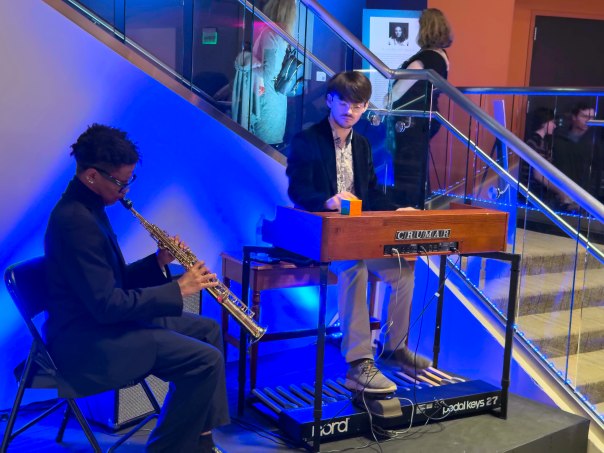
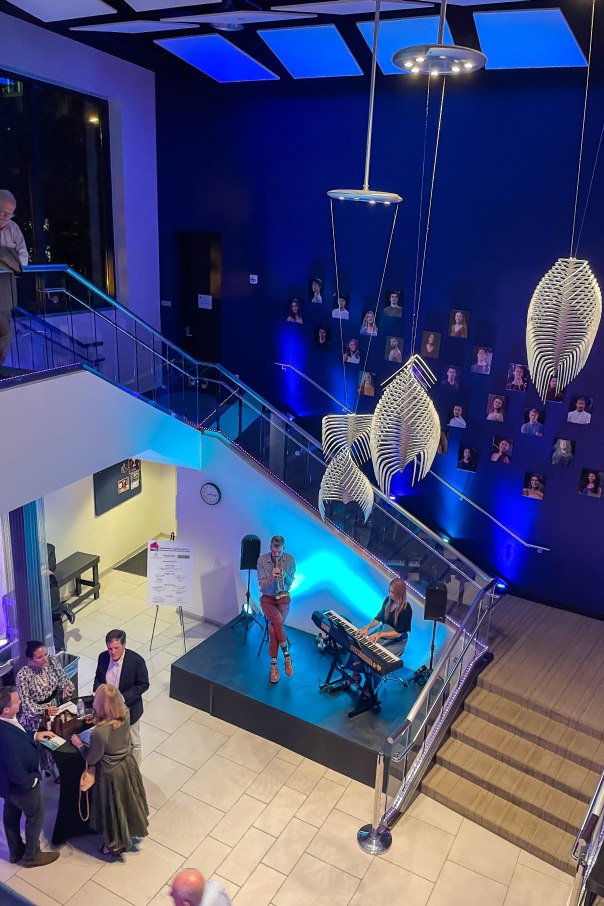
While this exciting transformation was happening behind closed doors, Patt and Sara, alias trumpeter Matt Postle and keyboardist Jess Borgnis, nestled into the Center for Dance lobby in front of the stylish staircase, framed by rows of purple lights as they played. Past the headshots of the CharBallet dancers, at the top of the staircase, we could look down at the cool jazz duo from the balcony or appreciate the artworks mounted on the walls behind us.

Sadly, my heartlessness extends beyond the elderly and physically challenged to the artists representing the Art League and the jazz duo. Other than enjoying the art and the music or noting that all was quite good, I observed an intermission of my own from reviewing and whipped out an iPhone to help me document the stylish ambiance. No other local company even strives to match the hospitality at the McBride-Bonnefoux, and only the Music @ St. Alban’s series up in Davidson seems to have stumbled upon similar possibilities of desserts and extra entertainment for all their patrons.

Yet the fullest impact of Breaking Boundaries was undoubtedly reserved for after intermission. The grandstand where our seats had been was now collapsed into the rear wall. Instead of one front row facing the studio performing space, there were now four rows of benches boxing it in. We made a beeline for a bench with a back rest, noticing along the way that there were spaces marked “Reserved”: our first hint.

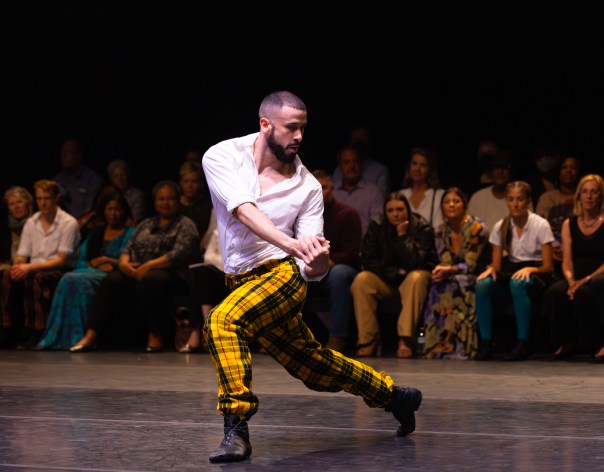
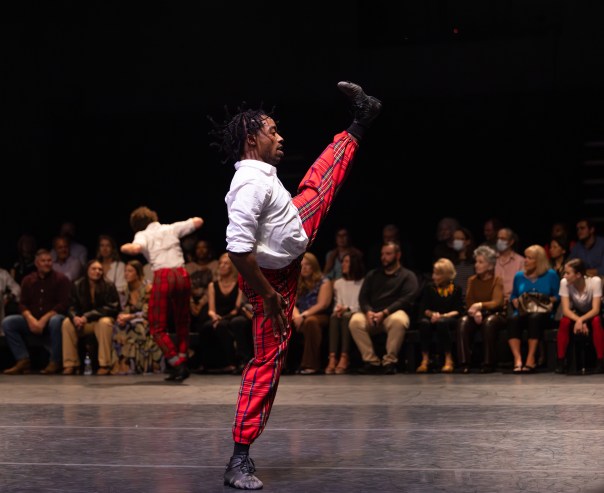
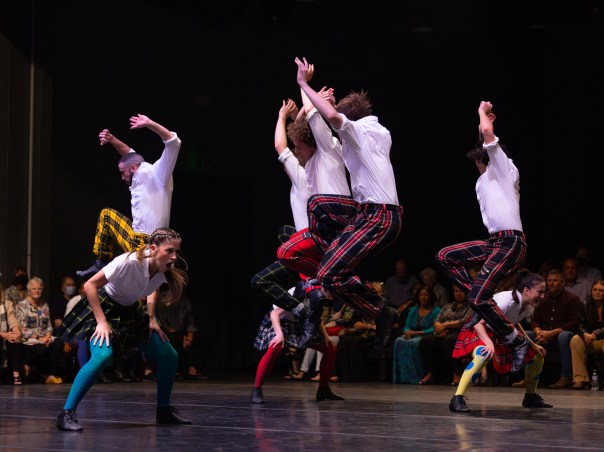
It wasn’t long before the 15 dancers performing Ohad Naharin’s Kamuyot, dressed in loud woolen plaid skirts and slacks, settled into those designated spaces. By this time, the reason for the front-row caution was clear enough. If you don’t mind being invited to join the dancers on the floor – or you don’t mind turning down such an invitation – you’re OK. Otherwise, second row. Those who experienced second-row remorse could remedy their plight with a little extra exertion when the time came, capturing a dancer’s attention and an invite.
Even translated from the Hebrew as “Quantities,” Naharin’s title didn’t offer much of a clue to what might follow. There were no song titles in the program, but the list of 22 composers and artists, ranging from John Tavener and L. V. Beethoven to Lou Reed and The Ventures, broadly hinted at a bumpy ride. Indeed, the delight of unpredictability was sustained throughout the piece as single dancers or couples from all four sides of the stage took their turns on the floor and returned to their places. From the randomness of the order of dancers seizing the spotlight and yielding it, a certain inevitability set in if we were noticing who hadn’t yet risen and performed.

From then on Kamuyot was more of an ensemble piece. Distilled from previous works, Naharin aimed this work specifically at young audiences and, logically enough, created it for The Young Ensemble of the company he founded in Tel Aviv, Batsheva. The work has been staged across Israel in school gymnasiums, so the work aligns more closely with the studio space than most of the choreography we have previously seen staged at the McBride-Bonnefoux. On the other hand, staging the work at night in front of an adult audience alters Naharin’s calculus and the whole atmosphere of the dance.

Instead of encouraging kids to get involved with dance and experience its joys, Kamuyot now stretches out its hands to adults and old-timers to bridge the gap between themselves and their youth. With a soundtrack that ranges from the opening bars of Beethoven’s Kreutzer Sonata to The Ventures’ “Theme Song from Hawaii Five-O,” Naharin’s lively, kaleidoscopic work encourages traffic in both directions, for nothing is dumbed-down for his intended family audiences, ages 6 and up.

When dancers stand silently in front of you, or when they beckon you to join them on the floor, you know exactly what Cerrudo meant when he named this rousing season-opening program Breaking Boundaries. I would rate my own performance, when I answered the dancers’ calls, as rather wretched – but I surrendered my objectivity and the ability to even view the entire spectacle as soon as I entered it. What I gained in exchange for those losses was the full flavor of the experience.

I invite you to try it, and to bring a child along with you.

Spoleto Festival USA: More Diverse, Hybrid, and Inclusive Than Ever

By Perry Tannenbaum

With so many theatre, dance, opera, jazz, orchestral, choral, and chamber music events to choose from – more than 300 artists from around the world, streaming in and out of Charleston over 17 days (May 26 through June 11 this year) – planning a dip into Spoleto Festival USA is always a challenge. Even Spoleto’s general director, Mena Mark Hanna, struggles to prescribe a strategy, as hesitant as a loving mother of 39 children to pick favorites.

“My suggestion for a first-time participant,” he says, sidestepping, “would be to see two things you like and feel comfortable about seeing, maybe that’s Nickel Creek (May 31-June 1) and Kishi Bashi (June 3), and two things that are really pushing the envelope for you. So maybe that’s Dada Masilo (June 1-4) and Only an Octave Apart (June 7-11).”

Nicely said. Only you can easily take in the first three events Hanna has named within three days, but you’ll need another four days before you can see singer-songwriter phenom Justin Vivian Bond and their monster opera-meets-cabaret-meets-pop collaboration with countertenor sensation Anthony Roth Costanzo. If you happened to see the recent Carol Burnett tribute on TV, the cat is out of the bag as far as what that will sound like, if you remember the “Only an Octave Apart” duet with opera diva Beverly Sills – recreated for Carol by Bernadette Peters and Kristin Chenowith.

What it will look like can be savored in the Spoleto brochure.

The giddy Bond-Costanzo hybrid is one of the key reasons that my wife Sue and I are lingering in Charleston through June 9. Equally decisive is the chance to see jazz legends Henry Threadgill (June 6) and Abdullah Ibrahim (June 8), the Spoleto Festival USA Chorus singing Thomas Tallis’ Spem in alium (June 7-8),and Jonathon Heyward conducting Hector Berlioz’s Symphonie Fantastique (June 9).

One other irresistible lure: the opportunity to see Maestra Mei-Ann Chen conduct Antonín Dvořák’s New World Symphony (June 7), along with works by Florence Price and Michael Abels – less than four months after her scintillating debut with the Charlotte Symphony.

Abels, you may recall, teamed with Rhiannon Giddens last year in composing Omar, the new opera that premiered at Spoleto – after an epic gestation that spanned the pandemic – and won the Pulitzer Prize for Music earlier this month. It was a proud moment for Spoleto, for Charleston, and for the Carolinas. For Hanna, it was an extra special serendipity to help shepherd that work to completion.

“I mean, it’s kind of incredible,” he explains, “to be someone who comes from Egyptian parentage, speaks Arabic, grew up sort of fascinated by opera and stage work and spent their career in opera and was a boy soprano – to then have this opportunity to bring to life the words of an enslaved African in Charleston, South Carolina. And those words are Arabic!”

We may discern additional serendipity in the programming of this year’s opera, Samuel Barber and Gian Carlo Menotti’s Vanessa (May 27-June 10), which garnered the Pulitzer in 1958. Revived at Spoleto in 1978, the second year of the festival – with festival founder Menotti stage directing – the production was videotaped by PBS and syndicated nationwide on Great Performances, a huge boost for the infant fest. That revival also sparked a critical revival of Barber’s work.

Omar was the centerpiece of a concerted pushback at Spoleto last year against the Islamophobia of the MAGA zealots who had dominated the headlines while the new opera was taking shape. Vanessa is part of what Hanna sees as a subtler undercurrent in this year’s lineup, more about #MeToo, Black Lives Matter, and the repeal of Roe v. Wade.

“I want there to be a kind of cohesiveness without necessarily us being able to see what the theme is,” Hanna reveals. “If there is something that unifies a lot of these pieces, it’s about understanding that we are telling stories from our past, some of them the most ancient stories that we have in our intellectual heritage. We are looking at these stories with a different sense that takes on the reverberations of today’s social discourse.”

Among other works this season at Spoleto that Hanna places in his ring of relevance are An Iliad (May 26-June 3), a one-man retelling of Homer’s epic featuring Denis O’Hare; Igor Stravinsky’s The Rite of Spring (June 5), as an orchestral concert and the inspiration for Masilo’s The Sacrifice; Helen Pickett’s new adaptation of Arthur Miller’s The Crucible for Scottish Ballet (June 2-4); and A Poet’s Love (May 26-30), a reinterpretation of Robert Schumann’s Dichterliebe song cycle by tenor/pianist Jamez McCorkle, who played the title role in Omar last year – with stagecraft, shadow puppetry, and projections by Miwa Matreyek.

“Going back to the Trojan War, An Iliad is as much about war and plague then as it can be today with the reverberations of Ukraine and the pandemic,” says Hanna. “Vanessa, is reinterpreted here through the lens of a remarkable female director, Rodula Gaitanou. The cast is just killer: You have Nicole Heaston as the lead with Zoe Reams and Edward Graves and Malcolm McKenzie and Rosalind Plowright, just a world class cast at the very, very top. And it’s also really cool to see these roles, which are traditionally sung by Caucasian people, being sung by people of color.”

Aside from the recurring motif of reclusion, so vividly resonant for all of us since our collective pandemic experience, Hanna points to a key turning point in the opera. Menotti left it mysterious and ambiguous in his libretto at a key point when Vanessa’s niece, Erika, either has a miscarriage or – more likely – an abortion.

For Hanna, that brings up an important question: “What does that mean now when we are looking at a renewed political assault on female autonomy? So these stories take on new messaging, new reverberation in 2023. And we need to retell these stories with the new lens of today.”

Especially in the Carolinas.

Long accompanied by a more grassroots and American-flavored satellite, the Piccolo Spoleto Festival, Menotti’s international arts orgy has taken a long, long time to shed its elitist mantle. Now it is moving forcefully in that inclusive direction with a new Pay What You Will program, offering tickets to about 20 performances for as low as $5 – thanks to an anonymous donor who is liberating about $50,000 of ticket inventory.

Hanna brought this exciting concept to the unnamed donor, hasn’t talked to him or her or them – yet – about sponsoring the program in future years, but he is pledging to continue it regardless.

“What art can do is endow you with a new experience, a transformational experience that you did not have before you took your seat,” he says. “It can help create an understanding of another side that is normally seen by one perspective as socially disparate, as highly politicized, as a discourse that’s just way too far away. Art can break down that barrier through the magic and enchantment of performance. To me, having those artists onstage, representative of a demographic we wish to serve, only takes us so far. We also have to lower the barrier of entry so that we can actually serve that demographic.”

Kishi Bashi not only continues Spoleto’s well-established outreach to Asian culture, he also typifies the more hybrid, genre-busting artists that Hanna wants to include at future festivals.

“We want to try to find these artists that are like pivot artists, who occupy these interstitial spaces between dance and theater and classical music and jazz and folk music,” Hanna declares. “And Kishi Bashi is one of those. He plays the violin on stage. He has all of these violinists on stage with him, but it’s this kind of strange, hallucinatory, intoxicating music that’s like somehow trance music and Japanese folk music, but using sort of Western classical instruments. Yet it’s very much in an indie rock tradition as well.”

Other wild hybrids include Leyla McCalla (May 26), the former Carolina Chocolate Drops cellist who blends Creole, Cajun, and American jazz and folk influences; Australian physical theatre company Gravity & Other Myths (June 7-11), mixing intimate confessions with acrobatics; Alisa Amador (June 7), synthesizing rock, jazz, Latin and alt folk; and the festival finale, Tank and the Bangas (June 11), hyphenating jazz, hip-hop, soul, and rock. Pushing the envelope in that direction is exciting for Hanna, and he promises more of the same for the ’24, ’25, and ’26 festivals.

Until the Pulitzer win, the year had been pretty rough on Hanna, losing Geoff Nuttall, the personable host of the lunchtime Chamber Music Series at Dock Street Theatre. Nuttall was the artist who convinced Hanna to come to Spoleto. At the tender age of 56, Nuttall had become the elder of Spoleto’s artistic leadership when he died, beloved for his style, wit, demonstrative fiddling, and his passionate advocacy of the music. Especially Papa Haydn.

The special Celebrating Geoff Nuttall (May 26) concert will gather his close friends and colleagues for a memorial tribute at Charleston Gaillard Center, including violinist Livia Sohn, cellist Alisa Weilerstein, countertenor Anthony Roth Costanzo, tenor Paul Groves, pianist Stephen Prutsman, and surviving members of the St. Lawrence Quartet. The occasion will be enhanced by the Spoleto Festival USA Orchestra and Atlanta Symphony’s Robert Spano – plus other guests soon to be announced.

Hosting chores for the lunchtime 2023 Chamber Music series, spread over the full festival, 11 different programs presented three times each (16 performances at 11:00am, 17 at 1:00pm) will be divvied among vocalists and instrumentalists who perform at the Dock. It was totally inappropriate, in Hanna’s eyes to replace Nuttall onstage this year, but he will begin to consider the charismatic violinist’s successor during the festival and into the summer. Hanna assured me that the player-to-be-named later will be a performer who participates in the musicmaking.

Continuing on the trail blazed by Amistad (2008), Porgy and Bess (2016) and Omar, Hanna wants to place renewed emphasis on the Port City and its African connection. It must run deeper than seeing Vanessa delivered by people of color.

“Charleston was the port of entry for the Middle Passage,” Hanna reminds us. “And Charleston has at its core an incredibly rich Gullah-Geechee-West African-American tradition that is part of the reason this is such a special, beautiful place to live in with its baleful history. So I think that you see that this year, you see that with Gakire Katese and The Book of Life (June 1-4), you see that with Dada Masilo and The Sacrifice, you see that with Abdullah Ibrahim and Ekaya.”

Resonating with the brutalities of Ukraine, Ethiopia, and Syria on three different continents, the US Premiere of Odile Gakire Katese’s The Book of Life may be the sleeper of this year’s festival, crafted from collected letters by survivors and perpetrators of Rwanda’s 1994 genocide and performed by Katese, better known as Kiki. “After the unthinkable, a path forward,” the festival brochure proclaims. The finding-of-hope theme will be underscored by music created by Ingoma Nshya, Rwanda’s first-ever female drumming ensemble, founded by Katese.

“Kiki is engaging with how a country tries to reconcile with its recent, terrifically horrific past of the Rwandan genocide as someone who grew up Rwandan in exile. You see that in the work of Abdallah Ibrahim, who was really one of the great musicians of the anti-apartheid movement, who composed an anthem for the anti-apartheid movement, was in a kind of exile between Europe and North America in the 80s. And then when he finally came back to South Africa for Nelson Mandela’s inauguration, Nelson Mandela called him our Mozart, South Africa’s Mozart.”

Marvelous to relate, you can hear more of South Africa’s Mozart this year at Spoleto Festival USA than Vienna’s Wolfgang Amadeus – or Germany’s Ludwig von Beethoven. That’s how eclectic and adventurous this amazing multidisciplinary festival has become.

See for yourself.

Cerrudo Revives Innovative Works With Fresh Excitement

Review: Innovative Works at Center for Dance

By Perry Tannenbaum

The Deatils Are the Meaning by Helen Simoneau - full cast - photo by Taylor Jones Charlotte Ballet’s reveal wasn’t as dramatic as the recent return of the renovated Old Barn on Queens Road with a full-fledged Theatre Charlotte musical. But after the COVID shutdowns, postponements and cancellations, and the abrupt departure of artistic director Hope Muir after barely five years – the last two during the pandemic – it was hard to feel that Charlotte Ballet was all the way back until last weekend. Until we had seen some choreography by the new AD, Alejandro Cerrudo. Extra frustrating for me, since I had declared his work a perfect fit for CharBallet when I had first seen it at Spoleto Festival USA in 2014, had been the absence of his imprint on the Fall Works program at Knight Theater last October.

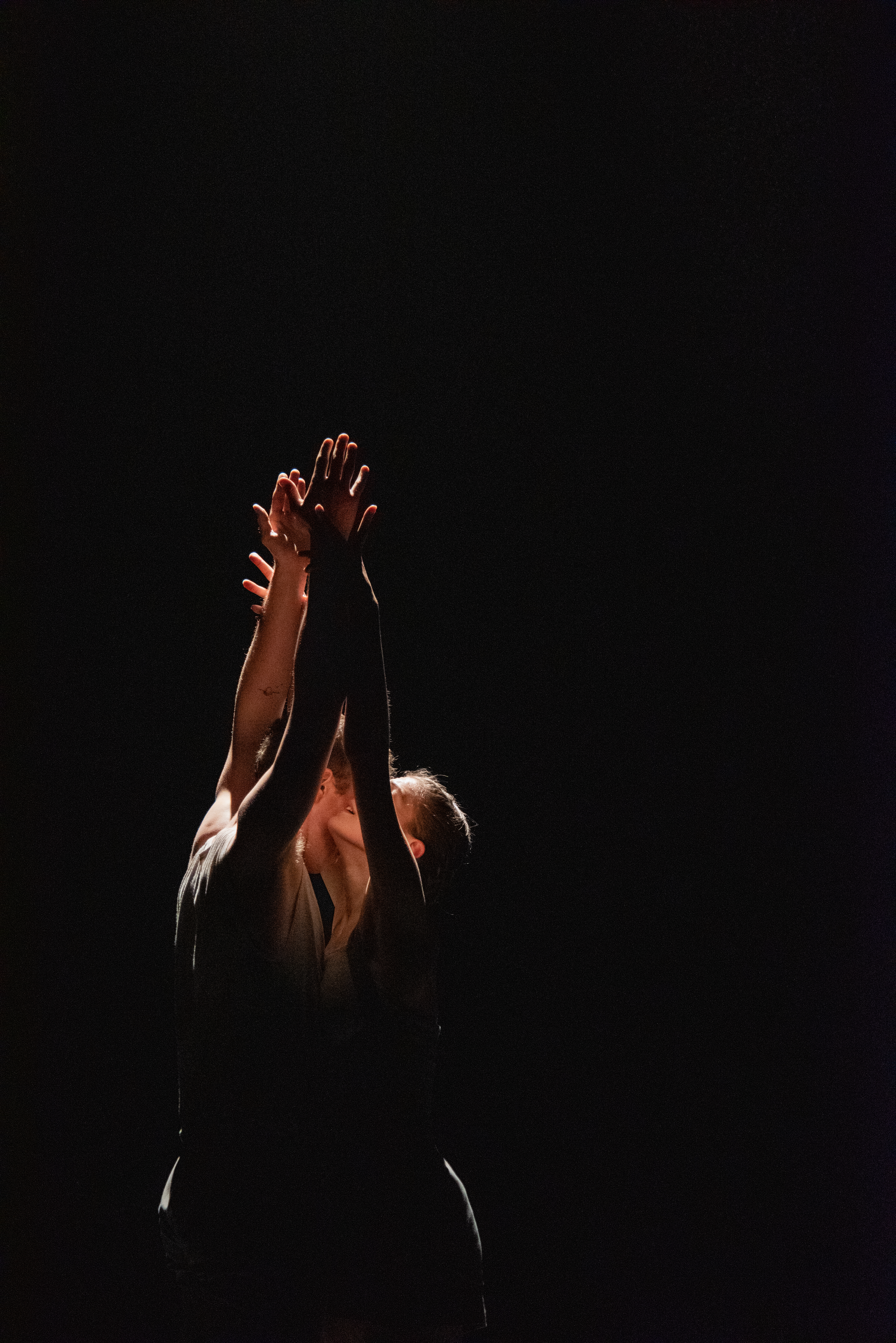
With Cerrudo now hosting the annual Innovative Works wintertime program, contributing a fine piece that crowns an invigorating evening at the McBride-Bonnefoux Center for Dance, we can let it all seep in. A new era has emphatically begun at the Center for Dance, with a new AD starting to reshape the company’s identity, working with a mix of familiar dancers, new dancers, and dancers who have matriculated to the varsity through the satellite Charlotte Ballet II troupe.

The state of Charlotte Ballet, to coin a phrase, is strong.HdrM by Jennifer Archibald - Olivr Oguma and Amelia Sturt-Dilley - photo by Taylor Jones

Jennifer Archibald’s vowel-starved HdrM and Helen Simoneau’s The Details Are the Meaning, both world premieres, preceded Cerrudo’s no-less-cryptic Silent Ghost. Silence was a subtle motif: It’s been awhile since Charlotte Ballet presented an entire evening of dance works that were devoid of storyline, song lyrics, or voiceovers. Taking on the hosting chores, Cerrudo recalled his takeaway from the first time he squired his daughter to a set of modern dance pieces. Comprehension was no problem at all, as it turned out. Just let it seep in was the core of his message.

On this occasion, anyway, Cerrudo discarded the introductory videos that have enhanced the studio ambience at past Center for Dance programs, where the evening’s choreographers, projected on screens flanking the audience, would talk about their works before we saw them, or dancers would give us their insights. Instead of those slick videos – all three “Behind the Ballet” videos are available at Charlotte Ballet’s website – we contented ourselves with Cerrudo’s remarks and a strange, mysterious welcome from CharBallet dancer Maurice Mouzon Jr. in a flowing black costume. Three quarters bacchante conjuration and one quarter airline steward pantomime, the conjuration was so absorbing that I really didn’t pay attention to the voiceover until Mouzon pointed out the exits to us.

That shtick was another great ice breaker, arguably the most amusing of the night.HdrM by Jennifer Archibald - Nadine Barton and Oliver Oguma - by Taylor Jones (1)

Like the other dances that followed, HdrM didn’t readily disclose its intentions, but Archibald offers a couple of useful hints in our program booklets. Her subject is environmental psychology, questioning whether society has a responsibility to humanize architecture. What the choreography takes aim at is “hard architecture,” as explored in Robert Sommer’s Tight Spaces: Hard Architecture and How to Humanize It (1974). Since there is no scenery with the fledgling piece, nor any projections, we can decide among several kinds of hard architecture that Sommer was concerned with: prisons, classrooms, asylums, hospitals, or zoos.

Kerri Martinson’s drab costumes seem to narrow that field to secure buildings for human adults, with no further clues provided by the music of Federico Albanese, Ludwig Ronquist, and Heilung. What I found most enjoyable here was Archibald’s struggling, yet never agonized, language of movement – a mixture of sensual interaction between the eight dancers and self-absorbed precision. Likewise, there were episodes when the dancers connected intimately with the flow of the music, interrupted by abrupt mechanical disconnects from the soundtrack.Silent Ghost - Anna Mains and Luke Csordas - photo by Taylor Jones

While the eight dancers never evoked a prison or an asylum, they brought us a dark, broken world. The moments of trauma were less common and affecting than the flow of brave, resolute striving. If the other choreographies reached these levels of intensity and artistry, I knew that the evening’s experience would be unforgettable.

Dressed in a different set of Martinson costumes, these in various colors with sheer unisex skirts, Simoneau’s The Details Are the Meaning showcased six fresh dancers whom we hadn’t seen in the previous piece. Though collections of Caroline Shaw compositions played by the Attacca Quartet have won two Grammy Awards since 2019, the music that Simoneau had selected was badly overmiked on Saturday night – far past the point of clarifying detail, if that was the point.

Movements in Simoneau’s setting were more classical and conventional than Archibald’s had been, with a greater tendency toward traditional partnering: Anna Mains with newcomer Oliver Oguma, Sarah Hayes Harkins with Rees Launer, and Isabella Franco with Mouzon. Beautifully executed lifts were no more lively or original, and I missed the point of the static, I-could-also-do-that poses in the middle of the piece. Combined with the wayward potting of the audio and the unsexy unisex outfits, this piece struck me as calling for more time in the workshop and more polish.Silent Ghost - Sarah Hayes Harkins and Sarah Lapointe - photo by Taylor Jones

Silent Ghost felt very consonant with the two premieres that had preceded it, so Cerrudo had been judicious in calling upon Michael Korsch to provide lighting design for the new works after serving as Cerrudo’s original designer back 2015, when Ghost premiered in Santa Fe. Saving his own work for last was also a sensible idea, for it presented more CharBallet dancers for our scrutiny and delight than either Simoneau or Archibald had engaged.

Yet as Cerrudo’s numinous title indicates, the mood was far from celebratory or triumphant, as you might expect capping an Innovative program. The ambiance hinted at in the ghostly title was perhaps best approximated by the music of Jon Hopkins and Kenny Anderson (King Creosote) – a dimly recorded household conversation mixed over New Age piano. The opening track, by Dustin Hamman, presented a similar profile with fuzzy guitar chords strummed over intermittently intelligible vocals. Additional tracks were by Ólafur Arnalds and Nils Frahm.

Costumes by Branamira Ivanova were even more monochromatic than Martinson’s for HdrM, but smarter somehow and more fun to wear and dance in. While Cerrudo’s style of movement never struck me as either edgy or outré, which Archibald’s choreography definitely had, the style was markedly individual, comfortably at odds with tradition rather than defiant of it. Silent Ghost flowed no less naturally than HdrM. There was no perceivable strain on the ensemble in clothing themselves with the choreographer’s movements, and they were all perpetually wedded to the soundtrack, no matter what combination was onstage.

These combos were often pas de deuxs pairing Sarah Hayes Harkins with Oguma or Mains with newcomer Luke Csordas, always excellent. To my understanding, past ADs at Charlotte Ballet haven’t given new company members so much spotlight so soon, tending to give the impression that there was an unofficial hierarchy. I applaud Cerrudo’s audacious impulse: it makes his new era of leadership feel more exciting and unpredictable.

“Sunlight and Solstice” Balances Seasons, Continents, and Testaments

Review: CP Dance Theatre’s Sunlight and Solstice

 By Perry Tannenbaum

2022~Sunlight and Solstice-06

December 2, 2022, Charlotte, NC – Compared with Charlotte Youth Ballet’s annual production of Tchaikovsky’s beloved Nutcracker, Central Piedmont Dance Theatre’s fall presentation, Sunlight and Solstice, drew only a small fraction of the huge crowd that converged on the CP Community College campus for the second weekend of the 2022 holiday season. Yet the few of us who chose the less-ballyhooed event were rewarded with more new things to see, for Sunlight and Solstice delivered plenty of new choreography in its bouquet of seven dance pieces, and the program was staged at The New Theatre – in the spanking new Parr Center complex. Dance faculty members Clay Daniel and Tracie Chan each created three pieces for the auspicious event, working with their students to synchronize and refine their performances.2022~Sunlight and Solstice-08

The program closed with a guest appearance from the Chris Thompson Cultural Ensemble, with live singing and drumming by their leader.

Sadly, the newness of the venue was underscored by the fewness of the audience. That increased my admiration for Daniel, who maintained his poise and geniality in handling his hosting chores. Without a printed program in our hands, you could say that Daniel’s intros were godsends, and as our host candidly disclosed, they also spread a convenient veil over the time needed backstage for costume changes between dances. Daniel was no less savvy in choosing his own 2014 settings for Shel Silverstein’s A Light in the Attic to start us off, for they provided a satisfying variety of little nuggets from the 1985 recording while introducing us to a wide swath of CP’s dance corps. Among the ten different vignettes, a couple as brief as 18 or 19 seconds, my favorites were “Bear in There,” “Homework Machine,” and “Monsters I’ve Met,” but all of these were decisively upstaged by “Eight Balloons,” which featured a helium balloon (an unbeatable prop) and an engaging array of dancers and movement.2022~Sunlight and Solstice-02

My first audition of the New Theatre’s sound system was a letdown after the brilliant impression made by the hall, the seats, and the sightlines. Silverstein’s poems should have been louder and clearer. Even more ominously, the backup music promised by Daniel was rarely audible. Replay at home on Spotify was necessary for me to confirm it was actually there.2022~Sunlight and Solstice-04

Nor was there instant redemption or revelation when the soundbooth cued up Camille Saint-Saëns’ Danse macabre for “Cadence,” the first of two Chan pieces that followed. Impact of the music was tepid rather than electrifying. The men who launched the dance were freer to move around than the more balletic women who came afterward, so the best of the work’s three segments was the last, when both groups joined together and movements emphasized leaps more than en pointe work. “Hannah” was an even more delightful piece, though I refuse to believe that Chan chose the best recording of “Hard-Hearted Hannah” she could find. On the other hand, Chan did choose Aubrey Conrad, her best and most alluring dancer, to portray the Vamp of Savannah, GA. Costumer Emily McCurdy dressed her in a tight, eye-popping red outfit to make sure we noticed. Backups (aged 17-69 as Daniel pointed out) were in slacks, their black tops besprinkled with coppery spangles.

A couple of interestingly varied Daniel pieces ensued, with music by JS Bach and Mark O’Connor. Their titles, Art of the Fugue and Appalachian Waltz, were sufficient to distinguish who composed what. Once again, Daniel’s programming was on-the-money, following the splashy éclat of “Hannah” with a piece for three men – Carson Fullwood, Dawsyn Ransome, and Nicolas Hare – more quietly titled “Prelude.” This agreeable trio also provided Conrad with extra time for a breather as well as the costume change she needed to reappear as the soloist in “Moonlit,” the dreamiest piece of the night.2022~Sunlight and Solstice-11

The perkiest piece of the night was undoubtedly Chan’s “Winter’s Frolic,” set to three choice cuts by the Vince Guaraldi Trio. Or maybe two choice cuts would be more accurate, since the choreographer’s musical taste could be questioned once again when she chose Guaraldi’s take on Beethoven’s “Für Elise” as the middle piece in her three-piece suite – not wintry, not frolicsome, and not typically Guaraldi, with no redeeming Christmas or Halloween spirit. The icy skating motif established by the dancers in “Skating” was stopped cold, thankfully returning with Chan’s finale. Somehow, Conrad managed another costume change to slip in among the six dancers, but it was Rieonna Weldon and Carson Fullwood who were featured.

2022~Sunlight and Solstice-09

Whether it was the African style of clothing Chris Thompson’s dancers wore or the lighting shift behind them from the rich violet of “Winter’s Frolic” to a peachy sunset hue, “Rivers of Babylon” brought on the most sunshine of the evening and reminded us that there are two solstices. With Thomson beating out rhythm on his drum, we could readily feel transported from winter to summer as his three dancers – Micheline Ruffin, Erika Guzman, and Briana Hubbard – moved gracefully onto the brightly-lit stage. Then it all came together as Thompson sang the reggae song: summer meshed with winter, one solstice followed another, and the words of an Old Testament song were sung in the season of the New Testament’s most joyous holiday.