Category Archives: Classical

Thorgy Brings Plenty of Christmas Cheer – and Drag Artistry – to the Queen City

Review: Charlotte Symphony Premieres A Very Thorgy Christmas

By Perry Tannenbaum
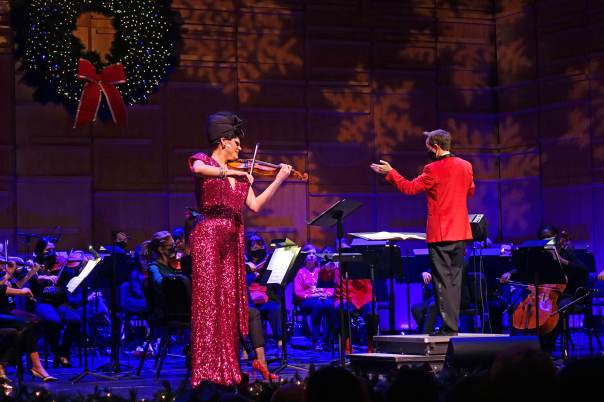
2021~Thorgy Xmas-37

The first thing to know about Thorgy Thor, a distinguished alum from the eighth season of RuPaul’s Drag Race, is that she is outrageous. If political correctness is your passion, then the next thing to know is that I’ve chosen her pronouns after consulting the program for the world premiere of A Very Thorgy Christmas, performed with the Charlotte Symphony and resident conductor Christopher James Lees. The Wikipedia entry for Thor, née Shane Galligan, is a tossed salad of pronouns that doesn’t conclusively settle the question.

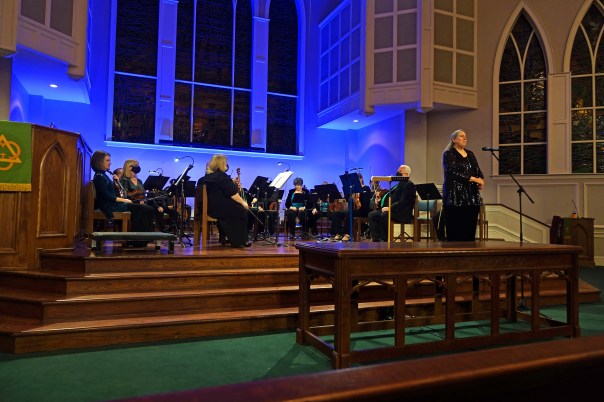
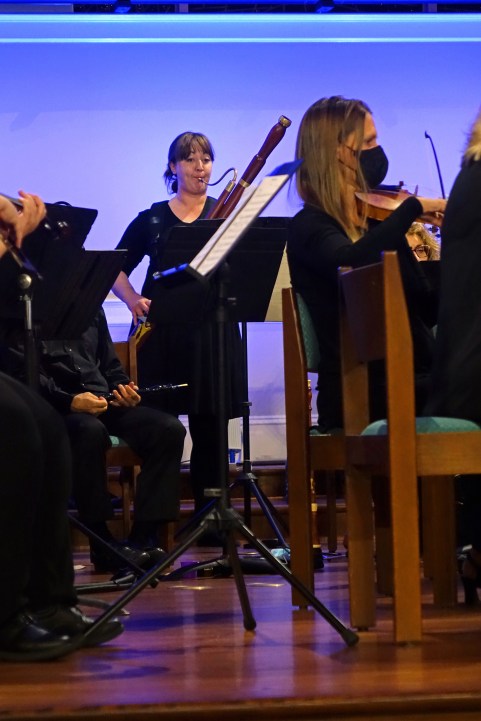
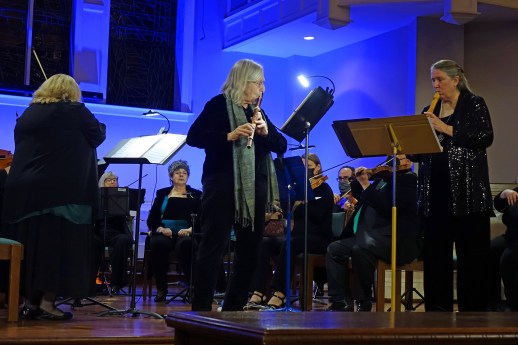
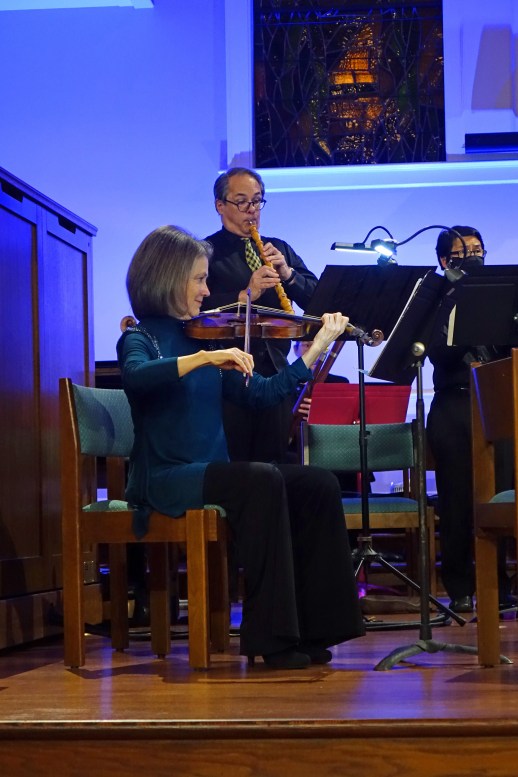
Headlining a Christmas show with a full symphony orchestra, Thorgy proved to have multiple talents. Not only did she serve as a guest violin soloist on three Christmas songs, she performed a standup monologue, screened a self-produced takeoff on an NPR podcast, presided like a gameshow host over a farcical giftwrap contest between four Symphony musicians, sang an autobiographical rewrite of “The 12 Days of Christmas,” and interviewed Lees a la late-night TV.2021~Thorgy Xmas-18

If Thorgy’s debut with Symphony in January 2020 had even half the variety and surprises of her Christmas extravaganza, it’s easy to understand why she was invited back so quickly – to basically do whatever she wished. The only restriction she acknowledged was an imposed limit of one f-bomb, and she certainly detonated that one with maximum impact. Lees and the ensemble began conventionally enough at Knight Theater for a very full house, launching into a merry rendition of “Joy to the World.” But the arrangement of this familiar carol soon became a mashup of several other carols and then an outright Christmas barrage – “Jingle Bells” and “Silent Night” at the same time? – before I began to wonder what few Christmas carols might be left over after this extravagant overture.

Unlike Jack Benny or Henny Youngman, the only other violinist comedians I can reference, Thorgy took herself seriously as she came on to play “O Holy Night.” Her tone was actually quite beautiful when she played, even though the arrangement and tempo didn’t demand impressive dexterity. “Carol of the Bells,” played just before intermission, required fleeter fingering, but even with this more energetic fare, Thorgy was flawless, unstressed, and only wisecracked once or twice over her performance. More of her freewheeling flamboyance came out when she put away the lumber and spoke out. This Very Thorgy Christmas was clearly a 2021 edition if Thor has any intentions of reprising her show as a Yuletide tradition. Not only was the new show silly, as Thorgy herself off-handedly remarked, it was also ephemeral.

Thorgy’s monologue was largely about her upcoming prospects and what she had done during the pandemic. Her pandemic shenanigans were plentiful enough, in fact, to supply prime fodder for her next two comical exploits prior to intermission. In the first, she went through the lowlights of her stint as a cameo celeb, that seemingly wholesome profession of producing customized video greetings for clients’ loved ones. As the smut piled on, we quickly realized that Thorgy didn’t attract a Hallmark Cards clientele. In the NPR video she showed us afterwards, Thorgy and a fellow drag queen, rather sedately dressed for this studio format, interviewed a comparatively blue-collar guy named Chef Schwetty. Judging by the varied colors of the samples he brought with him, I’d say Schwetty was a pastry chef. Without adding flavors or adjectives, Schwetty described his specialty as balls. Needless to say, the two gay interviewers feasted on the possibilities.

2021~Thorgy Xmas-36.jpgMore signals came after intermission that a 2022 edition of Thorgy Christmas would undergo drastic changes, for it was obvious that Thor revels in surprises. Dispensing with the customary concert preludes served up by her symphonic hosts, Thorgy burst onto the stage and kicked things off with a brash “Jingle Bells” spot. Of course, she had changed her outfit during intermission – from an ensemble highlighted by garish red-and-green-striped slacks to a fiery, glittery, fuchsia spectacular. She almost visually jingled in this one-piece caprice, and she discarded her dazzling Dolly Parton white wig in favor of a towering brunette bouffant. Thorgy is rather tall already.

Genial, easygoing, and relaxed, Lees complemented his guest artist handsomely. After the opening overture pillaged a huge chunk of Christmas inventory, Lees allowed the orchestra to stray briefly from holiday fare with an excursion to Grieg’s “Hall of the Mountain King.” When he returned to the podium, after the screening of Thorgy’s cameos, he and his cohort basically coasted along with a couple of snatches from Tchaikovsky’s Nutcracker, rep that they play repeatedly for Charlotte Ballet every December. After Thorgy made her splash to open the second half, Lees engaged with the Knight Theater audience to help him out with the whipcracks in Leroy Anderson’s “Sleigh Ride.” A woman in a lower box seat happened to have a black fan that made a whippier sound than our claps when she opened it, adding to the fun (especially when she was late).

Although the Knight audience was heavily infused with RuPaul devotees, the “12 Days of Christmas” parody was too crammed with obscure references to Thorgy’s misadventures on Drag Race and its All-Stars spinoff – and often too unintelligible – to garner universal laughter. And of course, the repetitions built into the familiar song didn’t help, a lesson for Thorgy to learn for her 2022 edition. After this partial misfire, Thorgy came up with her most hilarious bit of the night, the giftwrap contest with four surprisingly smart-alecky Symphony musicians. With a connoisseur’s unerring judgment, Thorgy chose four gifts for wrapping that offered maximum opportunity for failure and embarrassment: a cluster of inflated balloons, an open umbrella (closing it was strictly forbidden), a toilet plunger, and a broom and dustpan combo.

Like those frenetic cookoffs you may have watched on TV, the four wrappers had to cope with a tight time limit, so Lees and the orchestra timed the competition by performing… something. The action was too engrossing for me to take heed, but the ending and Thorgy’s flamboyant flourish were emphatic enough to signal the sudden frantic finish. The cluster of balloons proved to be disappointingly wrappable and humdrum, but the unopened umbrella was such a colossal fail that I found myself howling with laughter.2021~Thorgy Xmas-29

On the other hand, the wrapping for the plunger, cunningly separated into two pieces, was an absolute triumph. But flutist Jill O’Neill ultimately won the night – via a plurality of audience applause – with her amazing wrapping for the broom and dustpan. Audaciously rolling the merchandise on the floor helped O’Neill execute her design, and I suspect that adopting a witch persona as soon as she first held the broom helped to sway the judges. I was actually impressed by the rapport that Thorgy developed with each of the four contestants as they displayed their handiwork.2021~Thorgy Xmas-31
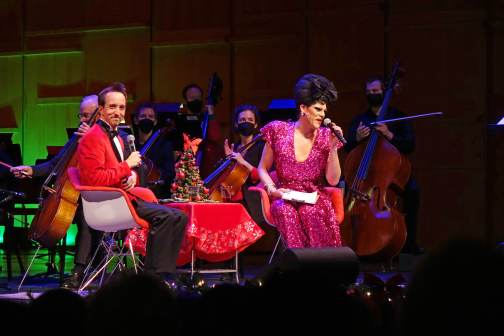
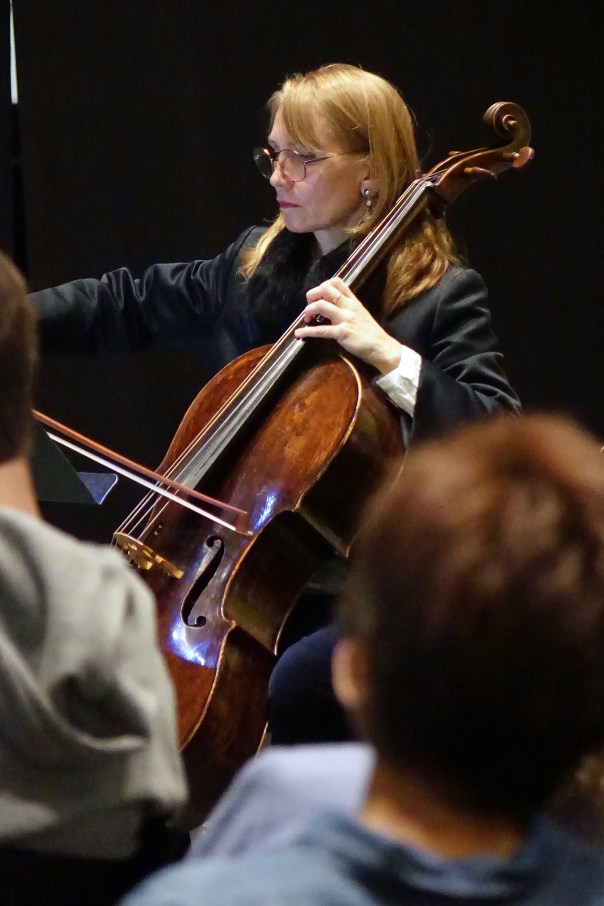
We gracefully glided homeward after this high-energy highlight, as Thorgy sat down for her cozy interview with Lees, occasionally prompting principal cellist Alan Black to imbibe from a tumbler of alcoholic beverage during the course of the conversation. Things became unexpectedly revelatory when, after a very personal question, Lees suddenly asked his interrogator if they could continue their conversation backstage later on. Some marital history soon followed. Those hilarious moments prevented the sitdown with Thorgy from becoming overly anticlimactic after the madcap giftwrap – and it segued nicely into Thorgy’s closing performance on violin, a beautiful and heartfelt “Silent Night.”

Originally published on 12/25 at CVNC.org

Big Names and Big Sound Mark Symphony’s Return to Mainstream Programming

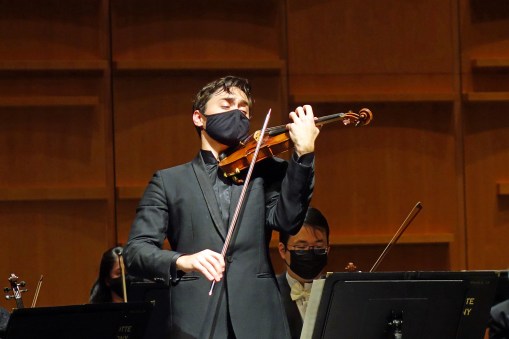
Review: Charlotte Symphony Plays Beethoven’s Fourth

 By Perry Tannenbaum

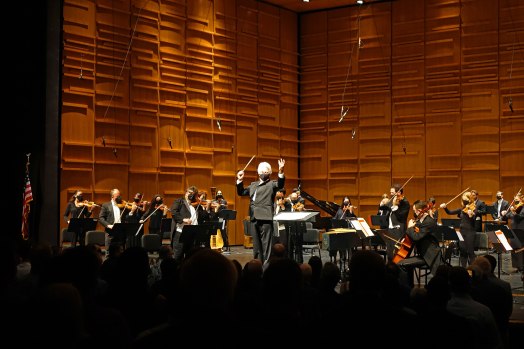
Vaccinated, boostered, masked, and carded, we’re all starting to feel more comfortable at public events these days. Charlotte Symphony had more than twice the number of musicians onstage on Friday night at Knight Theater, compared with just a couple of months ago. Social distancing is suddenly an ancient artifact. The stranger who presumed she could safely poach my seat at intermission readily took consolation by poaching the empty seat right next to me. Christopher Warren-Green felt so much at ease that, instead of scrounging for orchestral pieces that could be credibly performed by a reduced number of masked and distanced musicians, he stuck with a program of Mozart, Beethoven, and Prokofiev – returning to brand-name white male composers who have been dead for at least 65 years. And in a show of restraint that was unthinkable at the beginning of Symphony’s 2021-22 season, subscribers didn’t feel obliged to give every piece a standing ovation and every movement applause.

Premiered in 1918, Sergei Prokofiev’s “Classical” Symphony No. 1 actually qualifies as an antique. Looking back to Josef Haydn and Nikolai Rimsky-Korsakov for inspiration, with a third-movement Gavotte that the composer reworked for his 1935 Romeo and Juliet, the aim of the “Classical” was to straddle old and new styles. Warren-Green took a more delicate and reposeful view of the work than the one we find in the acclaimed London Symphony collection of Prokofiev’s seven symphonies conducted by Valery Gergiev. The joy of the work was also arguably purer at Knight Theater than that recording if you find Gergiev’s accelerated tempos more than slightly manic.

There was more than sufficient zest and high-stepping marching spirit in the opening Allegro con brio for the delicate episodes to stand out in relief. Lovely orchestral textures were lavished on the ensuing Larghetto, with principal Victor Wang and fellow flutist Amy Orsinger Whitehead peeping through to admirable effect. The CSO actually made better sense of the Gavotte than either of the recordings in my collection by the National Orchestra of the Ukraine and Gergiev’s London Symphony, starting out with a mock grandeur and ending a stealthy impish exit, better than the usual awkward afterthought. The purity of Warren-Green’s concept was especially apt in the joy emanating from the Molto Vivace final movement, where the composer made a special point of avoiding minor chords.

Although Beethoven’s Symphony No. 4 is the marquee piece now, Mozart’s Clarinet Concerto had top billing when it was last performed at the Knight in 2016 by guest soloist Michael Collins – interestingly enough, paired with selections from Prokofiev’s Romeo and Juliet. Charlotte native Taylor Marino was the soloist this time around. Maybe that was the reason that the Concerto surrendered top billing to the Symphony, but there was no surrender in quality. In the opening Allegro, Marino quickly demonstrated why he won numerous concerto competitions before joining Charlotte Symphony as principal clarinetist in 2019. Here there was ample drama from the orchestra behind Marino’s virtuosity, maintaining a brisk, effervescent tempo that subsided effectively into a sedate whimper.

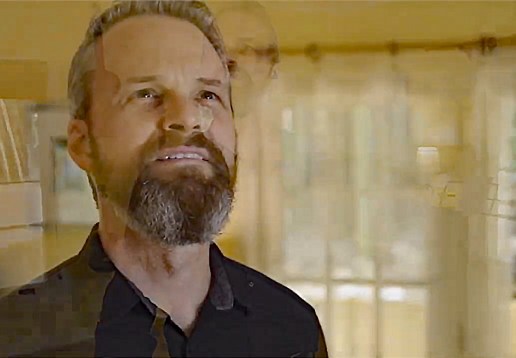
The lovely Adagio, singled out in Amadeus as the quintessence of Mozart’s genius, was absolutely exquisite in Marino’s hands, answered richly by the lower strings and woodwinds. I can never help reminiscing, when I hear this concerto, about the shining moment in 2004 when I heard it played by Martin Fröst on a basset horn at the Concertgebouw in Amsterdam, conducted by Ton Koopman. There was no applause or standing ovation here, but a couple of people sitting behind me could be heard marveling. The concluding Rondo: Allegro was only a slight anticlimax after such sublimity, for Marino’s virtuosity shone brightly again, and the bassoons added extra punch as we rounded toward intermission.

Between the heroic Symphony No. 3 and the mighty No. 5, Beethoven’s No. 4 can be seen as a merry middleweight. Returning from intermission without a score, Warren-Green wanted us to be in on Ludwig’s prank, making the Adagio opening to the first movement extra grave before it broke through to the galloping panache of its dominant Allegro vivace section. Violins snapped off phases with whiplash sharpness, the trumpets added steel while the flutes frolicked. The languid Adagio never quite lapsed into lullaby as the bumptious trumpets maintained patrol – with more restlessness from the lower strings and principal timpanist Jacob Lipham, while Wang on flute was an island of lyricism. Acting principal bassoonist Joshua Hood earned a subsequent curtain call from Warren-Green in the cheerful Allegro vivace, heckling the cheerleading strings. Yet the violins had the emphatic last word in the closing Allegro ma non troppo, busily sawing when they weren’t dominating. The cellos and the double basses only momentarily stole their thunder in preparing us for the ultimate climax.

Looking ahead, the concert was a fine bridge to the weightier fare that lies in front of us, as the 2021-22 season builds toward a Mahler symphony and Beethoven’s Ninth.

Originally published on 11/21 at CVNC.org
The Bechtler Ensemble’s Birthday Beatles Is a Big Hit

Review: The Bechtler Ensemble Plays The Beatles

By Perry Tannenbaum

DSC08879

Celebrating her father’s 80th birthday, Tanja Bechtler and her string quartet found a charming way to mark the occasion, commissioning composer/arranger Mark Adam Watkins to produce a bouquet of a dozen new Beatle song arrangements for the Bechtler Ensemble. The gift was presented in the form of a world premiere concert, part of the Music and Museum series at the Bechtler Museum of Modern Art, where Andreas Bechtler, founder of the Museum, sat proudly and happily in the front row. Making the concert even more of an artsy (and family) affair, Polaroid shots of the Bechtler family taken by Andy Warhol in 1973 – and the artworks that resulted from them – were projected on the upstage wall, during the musicmaking and during Tanja’s meticulously researched remarks on the tunes and arrangements.

DSC08875

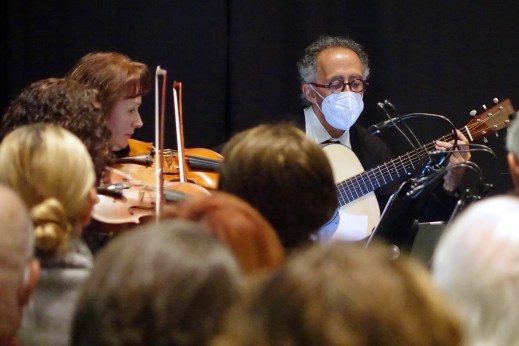
Watkins’ arrangements gave due deference to the leader of the Bechtler Ensemble’s instrument, the cello, but they were remarkably even-handed in offering extended opportunities for violist Vasily Gorkovoy and second violinist Tatiana Karpova to excel. Lenora Leggatt on first violin hardly eclipsed her cohorts, so evenly were the labors divided, and guitarist Bob Teixeira joined this Fab Four on a couple of the tunes, becoming an honorary Fifth Bechtler.

Watkins lists Beyoncé, Al Jarreau, and Lou Rawls most prominently among his previous collaborations, but it quickly became apparent that he knew his way around arranging for string quartet. On the other hand, arrangements of “Eleanor Rigby,” “Let It Be,” and “Live and Let Die” underscored how much classical influence already infused the original Top 40 hits. Lesser known selections like “Julia,” “Norwegian Wood,” and “Blackbird” supplanted such imperishable earworms as “Yesterdays,” “Lady Madonna,” and “Penny Lane” in the Ensemble’s survey, making the daughter’s gift to her father more heartfelt and personal. Oftentimes in her intros, Tanja would also spotlight phrases or sections of a lyric that were meaningful for her.

DSC08887

Not at all surprisingly, the Ensemble started off with one of the Beatles’ most familiar tunes, George Harrison’s “Here Comes the Sun,” the most streamed song on Spotify by the British rockers. Conceived as a song celebrating the joyous arrival of spring after “a long cold lonely winter,” Watkins seemed to imagine a more instantaneous scenario, sprinkling a series of pizzicatos across his quartet and then launching the melody from Bechtler’s cello as the plucking subsided – like his sun was emerging after rain showers. The melody itself never quite made it up to the violins as Gorkovoy carried us forward on viola, but there was a radiant aura of violins as the arrangement crested to its zenith.

Notorious for its cryptic and surreal John Lennon lyric – and its infusion of Eastern sitar by Harrison – “Norwegian Wood” became even friskier in Watkins’ hands as the bridge of the song, lugubriously slowed down by Bechtler, circled back to a lively intro that reminded me of a Latin street dance. Gorkovoy and Leggatt restarted the song, handing the melody back and forth until Bechtler checked back in. The Latin syncopation hung around stealthily in various guises underneath, maybe a sly suggestion of the song’s extramarital origin.

DSC08888

There were other instances where Watkins reacted as thoughtfully to the lyric as to the music. Paul McCartney’s “Eleanor Rigby” began very low in the cello with a mournful gliss from Bechtler, reminding us that the song was a breakthrough for a pop music confection in dealing with the loneliness and depression of the elderly. The inchoate intro of “Imagine,” as Bechtler pointed out, was like a blind groping for a melody – the cello seemed to hit the tune tentatively, and suddenly when it found the path, the sound became achingly sweet. “Revolution” started out like the four instruments were an inarticulate, unruly mob, but the melody lightened to a relaxed Western swing groove when Gorkovoy played it over volleys of triplets – as far from angry as Lennon’s lyric was from supporting violent revolution. When the violins took it to the next level, corresponding with Lennon’s “don’t you know it’s going to be,” the pulse was so swift that it sounded like the Gypsy jazz that violinist Stephane Grappelli pioneered with Romani guitarist Django Reinhardt. Karpova played the full-out licks, soaring high into the treble while Leggatt bowed ferociously behind her.

Hints of jazz lightened a couple of other Watkins arrangements. There was a bluesy boogie-woogie insistence from Bechtler, churning like the pistons of a locomotive or an R&B combustion engine, under the blend of the higher strings in McCartney’s “Drive My Car.” We nearly ended in jubilation when we reached the repeated “beep beep yeah” exclamations, but a wicked decelerating gliss instigated by Bechtler on her cello hinted instead that the car may have comically run out of gas. Karpova had the loveliest variants on the memorable melody of “Michelle,” the song McCartney serenaded the First Lady with at the White House, before Gorkovoy and Leggatt had a nice exchange over Bechtler’s jazzy pizzicato.

DSC08878

Teixeira first appeared with the Ensemble to enrich the very classical-sounding rendition of McCartney’s “Let It Be,” and he returned, logically enough, for the grand finale, “While My Guitar Gently Weeps.” Bechtler came most beautifully to the fore starting the melody, Leggatt was a fine exponent of the first violin’s role, and Karpova shone in some truly sublime treble, but Teixeira’s guitar was mostly relegated to a subservient strumming role, nothing at all like Eric Clapton’s electric exploits on the Beatles famed White Album. The Bechtler Museum’s lobby, where I was hearing my first classical concert after many amplified jazz concerts, wasn’t as kind to Teixeira’s acoustic guitar as it was to the other string instruments onstage. Bechtler, in fact, sounded far richer here on her cello than I’d heard her many times before upstairs at the Museum. Hopefully, Music and Museum will continue downstairs alongside the Jazz at the Bechtler series, but I hope more care will be taken in the future the next time Teixeira is called upon to mesh with the Bechtler Ensemble’s wonderful ecology.

Originally published on 11/14 at CVNC.org

Major and Minor Keys and Composers Besprinkle NC Baroque’s “Les fontaines de Versailles”

Review: Les fontaines de Versailles – Music @ St. Alban’s

 By Perry Tannenbaum

2021~NC Baroque-01

Yet another classical music ensemble, the North Carolina Baroque Orchestra, has joyfully returned to the stage and the thrill of live performance. Led by Frances Blaker, who also presided as emcee and took a turn as a recorder soloist, the authentic-instrument players assembled at Sharon Presbyterian Church, which has happily returned to hosting and sponsoring concerts in their sanctuary. The title of the concert, “Les fontaines de Versailles,” deftly signaled that the baroque offerings would not be limited to works by the usual German and Italian suspects. Aside from pieces by Handel, Telemann, Vivaldi and Albinoni, we heard music by Michel-Richard de Lalande, André Campra, Johann Fasch, Michel Corrette, and Jean-Philippe Rameau. Lalande’s Les fontaines de Versailles wasn’t the pièce de resistance of the evening, but it certainly keynoted the multiple infusions of Gallic flavor into the program.

2021~NC Baroque-14Georg Friedrich Handel’s “Overture to Alessandro” was likely the most familiar composition on a warhorse-free playlist, so there were multiple reasons for us sitting in the Sharon Presbyterian pews to experience frissons of pleasure. We could be surprised by the unexpected familiarity of the music or by how wonderful a live baroque orchestra sounded in a sanctuary after more than a year-and-a-half of being deprived of the satisfaction. This place was what this kind of music was for, though the complete Alessandro was a somewhat comical opera of royal intrigue with Alexander the Great in the middle of a romantic triangle. Violins were at the center of the gorgeous orchestral texture at the start of the Overture, its stately gait blooming emphatically and effortlessly throughout the hall. Tempos sped up and slowed with an ebb and flow that suggested the full opera in miniature – responses by the wind instruments growing boldest in the swift episode before the music settled into its ultimate repose.2021~NC Baroque-02

Lalande’s little gem, with grand treble harmonies from trilling winds over dancing strings in 3/4 meter, was actually nestled between two multi-movement concertos by Georg Philipp Telemann and Antonio Vivaldi. Each of these concertos, in turn, featured multiple soloists. In Telemann’s E Minor Concerto for Recorder and Flute, TWV 52:e1, Blaker teamed with flutist Kathleen Kraft on the first two movements of the four-movement work. The opening Largo had a more balanced interplay between the soloists, with exquisitely intertwined melodies and harmonies, but Kraft was clearly at the forefront in the ensuing Allegro, delightfully fleet in her playing with Blaker surfacing most deliciously when her recorder blended with the virtuosic flute.

Vivaldi’s D Major Concerto for two violins and two cellos, RV 564, was presented in its entirety, two Allegro movements separated by a shorter Largo. Blaker added some engaging showmanship by calling upon a different pair of violinists for each movement, thereby showcasing most of the section. Tom Lajoie and concertmaster Martie Perry, playing the violin solos in the brisk opening movement, with churning violins and foreboding cellos behind them, proved to be a tough act to follow. The Largo, pairing violinists David Wilson and Janelle Davis, reminded me of Vivaldi’s most familiar Mandolin Concerto, and the closing Allegro brought us spirited exchanges between Annie Loud and Steph Zimmerman – with cellists Alexa Hanes-Pilon and Lisa Liske making their most distinctive contributions.

After a halved intermission that Blaker proclaimed would be seven-and-a-half minutes, NC Baroque demonstrated that multi-movement pieces would not be devoted exclusively to famous composers. Gleaned from Campra’s three-act comédie-lyrique of 1699, Le Carnaval de Venise, the ensemble played four instrumental excerpts, shuttling between slow and fast. The Ouverture began as a stately processional before the winds began mimicking the accelerated strings in canonical fashion, gliding into a dignified slowdown. Two “Airs pour les Arts” followed, the second noticeably swifter than the first, and then a “Marche de la Fortune” for the Followers of Fortune, achingly slow and mesmerizing. Two passe-pieds offered joyous compensation for this lull, closing out this charming sampler, both of them very sprightly, bringing smiles to those faces that weren’t masked.2021~NC Baroque-10

Looking forward to the oncoming classical period, Fasch’s Allegro, from his three-movement Concerto Grosso in D minor, FaWV L:d7, was the pleasant little departure that Blaker promised, retaining many baroque traits with its woodwind filigree, yet more homophonic in its string textures. At times, the wind voicings sounded almost brassy. In the French segment that followed, Blaker and the orchestra began with the “Rondeau – Danse exécutée par les sauvages” from Rameau’s Les Indes Galantes and moved smoothly into Corrette’s “Carillon des Mortes.” Compared with the most outré moments of Stravinsky’s Rite of Spring, Rameau’s Danse was not savage at all, rather formal, and the alternate title, “Danse du Grand Calumet de la Paix,” is more accurately descriptive of this Rondeau, which was nearly as familiar to me as the Handel selection. Similarly, the back and forth of flutes in the Corrette composition was rather blandly descriptive compared to more percussive evocations of bells by modern composers. All in all, there was an amusing quaintness and restraint to these paired programmatic ventures.

Albinoni’s Sinfonia in G minor for two flutes, two oboes, bassoon and strings, Si 7, was a great way to conclude this concert, though I wondered why the wind soloists didn’t come downstage as Blaker and Kraft had done. On an I Solisti Veneti compilation of 12 concertos and three Sinfonias, conducted by Claudio Scimone, this G minor also concludes that program, so its appeal is far from subtle – which was likely why we heard much of the finest playing of the night in these three delectable movements, the whole of this petite symphony. Liveliness was apparent in the first notes of the Allegro, featuring some choice exchanges between bassoonists Chuck Wines and Hanes-Pilon, who abandoned her cello here. Flutes separated themselves melodiously from the full ensemble in the ensuing Larghetto e sempre piano, offered up in beguiling 3/4 time. We finished with what sounded like the fastest Allegro of the night, with especially dazzling ensemble bowing from the violins. This was not only a joyous return for NC Baroque, it was also a reaffirmation that Charlotte, with a return of our Bach Festival looming in 2022, is a hotbed for this music.

Originally published on 11/12 at CVNC.org

Anthem, Summer, and Winter Bring Enthusiastic Charlotte Symphony Audience to Its Feet

Review: CSO Plays Vivaldi’s Four Seasons

 By Perry Tannenbaum

2021~CSO Four Seasons-12-1

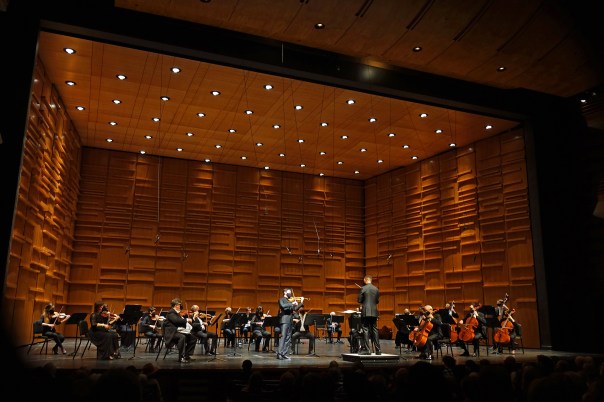
Charlotte Symphony had plenty to celebrate as their 2021-22 Classical Series began: they were playing on the Knight Theater stage for the first time since February 2020, they were beginning what is expected to be their first full season since 2018-19, it’s their 90th season, and it’s maestro Christopher Warren-Green’s farewell season as CSO’s musical director. Happy as Warren-Green and all the musicians appeared to be, there was no hiding that the return was not altogether smooth. The disconnect between what brochures in the lobby said the orchestra would be playing and the reality was fairly dramatic. All three of the selections originally scheduled in the “Russian Masters” program – including a Shostakovich symphony, a Glinka overture, and Tchaikovsky’s Violin Concerto, featuring Paul Huang – were dropped. Now we were three-quarters Italian, with works by Ottorino Respighi, Pietro Mascagni, and Heinrich von Biber served up before intermission and Huang switching off to Antonio Vivaldi’s beloved Four Seasons after the break.

When last season belatedly opened back in May at Belk Theater, in front of a socially-distanced audience, I wondered whether Warren-Green would honor Symphony’s tradition of playing our National Anthem to mark the first live concert. He declined then, and it seemed quite possible that he would hold off yet again, since the vaccinated audience, masked but no longer distanced, would be obliged to stand and sing together. But the mood was different now. Concertmaster Calin Ovidiu Lupanu preceded the maestro to the stage, gesturing so victoriously that you would have thought the orchestra had won the Super Bowl. After Warren-Green told us how glad he and his orchestra were to be playing to a live audience once again, he indeed turned sideways to cue the drumroll for the Anthem. As we stood together singing, rounding into the final eight bars, Warren-Green’s previous hesitance felt justified. For after the onset of the COVID-19 pandemic and the January 6 invasion of the nation’s Capitol, the affirmation that “our flag was still there” was more vivid now in a closely bunched crowd, suddenly fresh and renewed.

2021~CSO Four Seasons-02-1

All of the pieces that Warren-Green followed up with were musically descriptive in some fashion. Respighi chose three masterworks by Renaissance painter Sandro Botticelli for his Trittico botticelliano. The first, “La Primavera (Spring),” offered a tasty comparison with the opening Vivaldi concerto, light and airy with little solo passages that reintroduced us to the orchestra’s worthy principals playing French horn, trumpet, celesta, glockenspiel, flute, and reeds. Beauty and liveliness were nicely counterpoised in the steady, brisk tempo until the strings imposed their serenity. “L’Adorazione dei Magi (The Adoration of the Magi)” belied its expected bustle and ecstasy as it began, dark and solemn as acting principal Joshua Hood began on the bassoon and principal oboist Hollis Ulaky layered on. After some lovely runs by principal flutist Victor Wang, the middle of this movement did become more hectic and dramatic, keyed by harp and percussion, with a gently quickened tempo as the strings asserted themselves. Wang returned to the forefront at the start of the climactic “La nascita di Venere (The Birth of Venus),” surely Botticelli’s greatest hit, but the slow massing and building of the judiciously trimmed string section, forcefully topped by the violins, was the prime wonder in this satisfying ending.

2021~CSO Four Seasons-03-1

With unerring instinct, Warren-Green programmed Mascagni’s “Intermezzo from Cavelleria Rusticana” between the more substantial Respighi and Biber compositions so the three-minute piece for strings and harp played like an interlude as originally intended. The throbbing harp gave this lyrical gem a heartbeat, while the singing strings made it affecting like an aria. Now it was time for some fun as Warren-Green reveled in introducing Biber’s Battalia à 10, an eight-part evocation of warfare with some astonishing quirks. Most of these were novel ways that the musicians were called upon to replicate percussion instruments, beginning with the entire ensemble stamping their feet. Fingerboards of the basses and cellos were wrapped in paper and rapped with bows to simulate marching drums in the “Mars” section while Lupanu impersonated the piper on his violin. “Bartók slaps” were inflicted on the basses to mimic canon fire in the climactic “Battle” section, made more bizarre when the cellists turned their instruments sideways like guitars – with added mock drama when the harpsichordist fainted comically over her keyboard. Vying with this spectacle for the most memorable aspect of Battalia – and certainly the most modernistic – was the Bohemian composer’s second movement, “The lusty society of all types of humor.” Evoking the drunkenness of a teeming tavern, Biber split his little ensemble into four parts, each one playing a different song and blithely oblivious to the others. Warren-Green half-turned to us during this unspeakable cacophony and gave a little shrug.

2021~CSO Four Seasons-11-1

Returning to Charlotte for the first time since his Symphony debut two years ago, when he played the Dvořák Violin Concerto, Huang did not pale at all in comparison with the charismatic Aisslinn Nosky when she played – and conducted – The Four Seasons in 2018, the last time it had been presented here. The magnificent tone Huang achieved on his coveted 1742 “ex-Wieniawski” Guarneri del Gesù instrument was nearly as impressive as his fleet-fingered virtuosity and intensity. Even on normal occasions, recordings do not nearly capture the excitement of a live Four Seasons performance. On opening night, the pent-up hunger of this audience was palpable enough for the soloist, the musicians, and Warren-Green to feed off, and in the most turgid moments of these four familiar concertos, there was a feverish frenzy to the onset of the wind and storms that Vivaldi brings on. After the final notes of “Summer,” the crowd sprang to their feet, either electrified by Huang’s bravura or convinced that nothing could possibly follow what they had just heard. There are 12 movements, after all, so any confusion was easily forgiven – and the string players also joined the ovation, tapping their bows.

Yet there was more to come, including some nifty double bowing from Huang in the first movement of “Autumn” and a sprinkling of “Bartók slaps” from the upright basses in the last. Nor was “Winter” at all anticlimactic as Huang reached hyperintensity once again as Sirocco and Boreas engaged in windy combat. The final standing ovation was no less deserved than the previous outburst, and it lasted longer.

Cox and Beilman Play the Changes, Guesting with CSO

Review: Charlotte Symphony Plays Wagner, Mozart, and Brahms

 By Perry Tannenbaum

2021~CSO Brahms Serenade-03

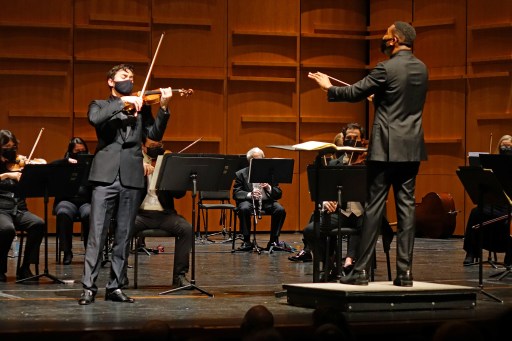
Holding our collective breaths, subscribers can hope that the current Charlotte Symphony program represents the last retreats from the fare originally announced for the 2021-22 season. Although Richard Wagner’s Siegfried Idyll replaced Zoltan Kodály’s Dances of Galánta and Johannes Brahms’ Serenade No. 2 replaced his Symphony No. 3, we still had guest conductor Roderick Cox and guest soloist Benjamin Beilman, though Beilman needed to be as flexible as the orchestra, switching from the Charlotte premiere of Samuel Coleridge-Taylor’s Violin Concerto to Mozart’s “Turkish” Violin Concerto No. 5. Of course, Brahms himself might have laughed out loud at the hasty substitution, since he had been so famously averse to attempting a symphony while Beethoven’s shadow still loomed so large. Compounding the hilarity, the Serenade No. 2 may have been historic, possibly the first closing piece at a Symphony Classics Series concert to be played without violins onstage.

Written for his wife, Cosima, in 1870 and later dedicated to their son upon publication, Wagner’s Siegfried Idyll isn’t extracted from any of his operas, though the music sometimes smacks of themes from The Ring cycle, especially Siegfried. It begins intimately enough, with a quiet string quartet, comprised of principals from the string sections, with concertmaster Calin Ovidiu Lupanu unmistakably the lead voice. So audience members at Knight Theater could easily imagine the romantic story of the music’s informal premiere, when Wagner stealthily placed his little orchestra (just 13 on that morning) on the stairway leading to Cosima’s bedroom while she was still sleeping – gradually awakening her as the music swelled. A couple of French horns and a trumpet eventually added force and volume to the composition, and principal oboist Hollis Ulaky played memorably in numerous spots.

2021~CSO Brahms Serenade-02

Beilman seemed to be even better matched with the Mozart than he had been with the Beethoven in his 2017 Charlotte debut. Hearing a live performance at this level was more rewarding than listening to my favorite recordings by Arthur Grumiaux, David Oistrakh, and Julia Fischer. By this time, it was quite obvious that Cox had taken the eleventh-hour changes in programming totally in stride, for the introductory orchestral passages of first two movements of the Mozart, an Allegro aperto followed by an Adagio, had a bloom that rivaled the most sublime passages in the Wagner, with no less polish. Beilman’s highest notes had admirable muscle, his pianissimos in that stratosphere were ethereal, and his midrange was as burnished as I had remembered from the Beethoven. The closing Rondeau showed us how truly ingratiating Beilman can be as he genially swayed us in a waltzing 3/4 tempo – then suddenly jerked us out of our comfort zone as he and Cox conspired, nearly halfway in, to bring extra drama to the sudden lurch into the “Turkish” section of this movement and its lively duple tempo. Try counting this section any other way than 1-2, 1-2, 1-2… I couldn’t.

2021~CSO Brahms Serenade-07

Unlike so many of the serenades inflicted on us – there, I’ve said it! – during the pandemic, Brahms didn’t limit either of his to strings alone. The Serenade No. 2 includes a full complement of woodwinds and a pair of French horns. Bassoonists Joshua Hood and Naho Zhu were unusually prominent in the reedy opening measures of the Allegro moderato, with flutists Victor Wang and Amy Orsinger Whitehead soon afterwards coming to the forefront. Violins over plucked cellos and basses heightened the intensity and made a pathway for Ulaky on oboe to shine again. Rigidly on-the-beat handling his stick, Cox made the ensuing Scherzo: Vivace more march-like than the acclaimed Michael Tilson Thomas recording, but the rhythmic thrust and liveliness remained unmistakable.

2021~CSO Brahms Serenade-09

Audience members should have noticed by this time that Brahms intended his clarinetists to switch between A, C, and B-flat clarinets over the course of this Serenade. Churning lower strings (remember, there weren’t any violins) ushered in the middle Adagio non troppo movement, but principal woodwind players had sufficient time to leave their imprints, including Ulaky, Wang, and – far in the treble – clarinetist Taylor Marino. With Cox taking a notably sprightly take, the penultimate Quasi menuetto was more of a trinket than the Scherzo had been, Ulaky and Wang excelling once again. Discarding all remaining restraint and tenderness that we might have expected from a Serenade, Cox and Symphony made the closing Rondo a rollicking romp from the first bars, clearly taking aim at compensating for the lack of a symphony on the program. Oboes, clarinets, and horns led the charge, with the low strings high-stepping right behind them. Erinn Frechette finally had chances to tweedle on her piccolo as the winds reached their maximum effervescence, but the congregation of strings eventually had their say, building to a satisfying ending.

Lupanu and Friends Feed off Audience Energy in Return to Live Performance

Review: Connor Chamber Series at Tate Hall

 By Perry Tannenbaum

2021~Connor Chamber Concert-5

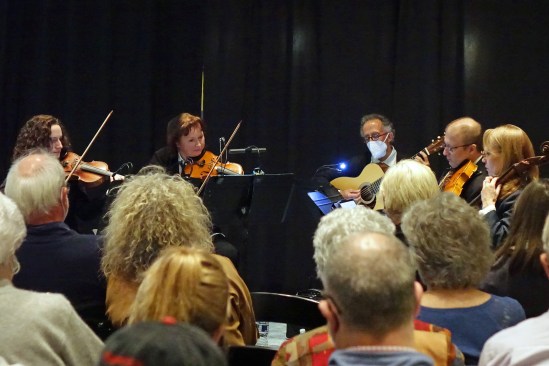
While orchestral performances have sadly languished during the COVID pandemic, recently reviving in Charlotte and elsewhere in prudent baby steps, chamber music has flourished in online productions. Back on Memorial Day weekend, while the youth choir and orchestra remained sidelined for a second consecutive season at Spoleto Festival USA, chamber music restarted at Dock Street Theatre in Charleston, running a full slate of programming and replaying edited versions on YouTube. Not surprisingly, it has been principals of the Charlotte Symphony Orchestra, cellist Alan Black and concertmaster Calin Lupanu, who have most dramatically stepped forward to fill the void, each of them spearheading a series of chamber music concerts while the larger ensemble remained mute or muted. More encouraging, then, for those of us who love the intimacy and verve of chamber music, is that neither of these initiatives is in retreat now that audiences are vaccinated.

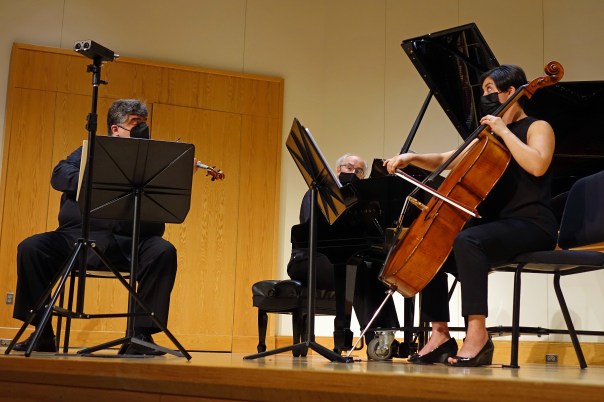
Thanks to the Connor Chamber Series, Lupanu could be seen at Tate Hall on the Central Piedmont Community campus while Symphony is returning to full strength, its mainstage classics series slated to launch at Knight Theater on October 15. Lupanu hosted the concert of works by Brahms and Anton Arensky, starting off together with Phillip Bush at the piano playing the Brahms Scherzo movement from the F-A-E Sonata, which was originally premiered by pianist Clara Schumann and violinist Joseph Joachim, for whom the piece was written in 1853. After this lively opening, Lupanu yielded the violin part for the Arensky Piano Trio No. 1, replaced by fellow Symphony musicians Monica Boboc and cellist Marlene Ballena. Lupanu returned after intermission – inserted to give Bush a rest, he jested – for the finale, the Brahms Piano Trio No. 1, written just a year after his Scherzo.

2021~Connor Chamber Concert-1

The Tate immediately proved hospitable to Lupanu’s violin in the Brahms Scherzo, which also drew movements by Robert Schumann and his pupil, Albert Dietrich. On the other hand, the treble breathed more freely from the Steinway than the bass end of its keyboard, perhaps because of its nearness to the upstage wall. The music, Lupanu’s placement downstage, and the excitement of playing chamber music for a live audience after 18 months of performing for mics and cameras (if at all) were all good reasons for the violinist to excel more than usual. Coming out and masking up, seeing the masked musicians onstage taking up their share of the pandemic risk and responsibility, the audience was also primed to be exceptionally receptive. Lupanu may have seen the enthusiasm in the audience’s eyes as he looked out on us, but he couldn’t help feeling the free, propulsive spirit of Bush behind him, very much inside the music, spurring him on to be better and better.

Arensky’s trio has been on my radar ever since pianist Yefim Bronfman headlined a Sony recording of the piece over 25 years ago (paired with an even more electrifying Tchaikovsky trio), so it was not surprising to see Bush assert more leadership. Yet both of the string players acquitted themselves admirably in each of the D minor’s four movements. A beautiful violin melody from Boboc at the top of the opening Allegro moderato was echoed in more abbreviated form by Ballena’s cello, yet it was likely that hearing Ballena’s cello so much more clearly in live performance put me in mind of Dvorak’s chamber pieces. Boboc captured the lightness of the ensuing Scherzo, but it was Ballena who became the prime advocate when that movement slowed to its more luxuriant Meno mosso tempo.


2021~Connor Chamber Concert-3

Bush’s sound, at times downright impressionistic, was the most distinctive element in the elegiac Adagio. Yet Boboc was also disarming, playing low enough on her violin to be mistaken for a cello if you weren’t watching. Not to be outdone, Ballena played even lower when we arrived at her spot. It was in the Allegro finale that Arensky finally matched the turbulence we had heard from Brahms. Bush assaulted the Steinway with a barrage of three-chord phrases while the strings stirred up the heat. Then he turned down the volume and the tempo in a poignant passage of four-note phases. Now it was the strings’ turn to dominate, Boboc and Ballena vying in eloquence as they demonstrated how lyrical and affecting those same phrases could be that Bush had played so feverishly.

Looking at the attentiveness of Bush and Ballena throughout the Brahms B Major trio, we could assume that Lupanu held the reins, yet there was admirable parity between the parts. Ballena’s cello sang out introducing the theme of the opening Allegro brio, and she had a transporting spot in the penultimate Adagio. Bush was pre-eminent in setting the tone, restless amid the shifting tempos of the opening movement, dreamy in his intro to the Adagio before the strings interceded with their sacramental harmonies, but most mischievous in the even-numbered movements. The second-movement Scherzo suddenly pivoted from a beguiling waltz tempo to a manic chromatic outburst that presaged Shostakovich, up in the treble where the Steinway fared best, and the grandeur he imparted to the Allegro con brio finale was star-spangled American. For Lupanu to dominate amid these exploits from his partners, projecting the joy of the Scherzo and the triumph of the Finale, was quite impressive.

Reboot of “I Dream” Reminds Us How True Heroes Fight for the Right

Review: I Dream from Opera Carolina

 By Perry Tannenbaum

I Dream.

After repeated efforts to capture the essence of Martin Luther King in his twice-revised I Dream, opera composer and librettist Douglas Tappin must keenly appreciate the biblical frustration of Moses on Mount Nebo – and of MLK behind a Memphis lectern on his final night. He has seen the Promised Land, but he cannot get there. For the life of this civil rights hero/icon/martyr is inextricably intertwined with his words, unforgettably spoken in Washington, in Memphis, from his Atlanta pulpit, and written from a Birmingham jail, yet hardly a trace of them can be found in Tappin’s script.

Opera Carolina’s latest remount of I Dream, which premiered in 2010 in Atlanta and reappeared in Toledo and Charlotte in 2018, newly revised for the 50th anniversary of MLK’s assassination, is a more strategically refined and focused dance around the rhetoric with new stage direction – and considerable dramaturgical input – by Tom Diamond. James Meena, now entering his twentieth season as Opera Carolina’s artistic director, once again directed the orchestra, arguably with more ardor than ever for Tappin’s score.

If the music brings Porgy and Bess to mind, your concept likely chimes with Meena’s, for two of his principals, Alyson Cambridge as Coretta Scott King and Victor Ryan Robertson as Hosea, figured prominently in the storied revival of George Gershwin’s opera at Spoleto Festival USA in 2016. Kenneth Overton as Ralph Abernathy and Lucia Bradford as MLK’s Grandma are also steeped in that Gershwin masterwork. Yet it’s equally apt to note the influence of Broadway-style musicals on Tappin, whether it’s the revolutionary fervor of Les Miz or Andrew Lloyd Weber’s notion of opera in his Phantom. Certainly, Tappin’s music disarms any fear of being assaulted by discordant recitative and parched in a desert where no melody or aria is to be heard. On the contrary, ticket holders should brace themselves for a superabundance of power ballads.

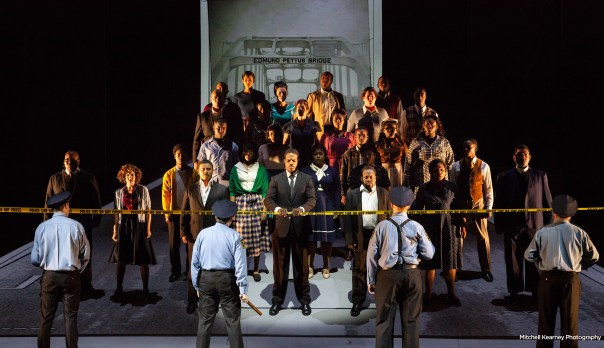
The musical climax of the show, in the Birmingham jail, is a duel of power ballads. Robertson challenges the whole non-violent ethos of King’s movement with a spirited, militant “No Victory by Love,” and Derrick Davis as MLK answers – still triumphantly, if audience reaction was any indication – with the anthemic title song. Davis and Tappin are at their best in showing us the visionary MLK and the staunch courage of his non-violent philosophy, but the libretto needlessly attempts to deepen our impression of King as a prophet. Repeatedly, Davis must dwell on a foreboding dream in which he sees the balcony of the Memphis motel where he will be shot.

We must assume that Tappin believes this device cements King’s credentials as a prophet, though it actually undercuts them, for Davis must keep puzzling about the meaning of this dream – which is emphatically not the dream we associate with King – and Overton as Abernathy, instead of all the substantial issues and concerns he might be discussing, must waste his time (and ours) by counseling his leader to confide Tappin’s invention to his dear wife Coretta.

One might quibble over whether MLK really dedicated his career to his Grandma, but Bradford’s rendition of “Sunday Is the Day” was certainly powerful enough to inspire dedication. If Coretta is also a formative presence in MLK’s career, there’s a place for Cambridge to be singing “I Have Love to Give,” since it dovetails with her husband’s story and core beliefs, but “Midnight Moon” merely detains us in generic romance. While repeating a song with new meaning is a traditional Broadway device, it’s a bit problematical in Tappin’s hands. Late in the show when Cambridge sings “Queen Without a King,” she memorably expresses a steely determination to continue her martyred Martin’s work and assume a leadership role, a wisp of Evita that should take firmer root in Tappin’s score. Earlier, the song simply types Coretta as a weepy wife wishing her husband would stay home with family instead of pursuing a noble cause.

Sounding like a swaggering song that Crown might sing in Porgy, “No One’s Gonna Keep Us Down” took us deepest into Gershwin’s bluesy groove, and “Count to 10” worked surprisingly well in espousing MLK’s turn-the-other-cheek credo. “Top of the World,” a song of risqué celebration like “Masquerade” in Phantom, hinted at the danger of celebrity for King that could have made him vulnerable to the scheming of FBI director J. Edgar Hoover, who gets a sadly superficial airing that is also symptomatic of Broadway. He’s not an implacable Javert, that’s for sure.

If Martin’s womanizing or Hoover’s scandal mongering could have been shown as jeopardizing MLK’s greatest enterprises – the March on Washington, the march on Selma, or the Voting Rights Act – they would have rewarded deeper exploration. But in circling King’s greatest speeches, Tappin barely grazes what Memphis meant and almost completely ignores the March on Washington. That’s nothing short of astonishing vis-à-vis the expectations of an audience coming to see I Dream – until we consider that Tappin is skirting the actual quote, “I have a dream.” Gaping hole there as well.

To be fair, Tappin’s last two revisions were pre-pandemic, when the freshest take on King’s legacy was the Oscar-nominated Selma. No doubt about it, the march on Selma and its aftermath, in a presidential address by Lyndon B. Johnson, are the dramatic high points in Tappin’s revision, in Diamond’s staging, and Michael Baumgarten’s lighting and video design, climbing majestically on the shoulders of the Birmingham sequence. Meena was strong throughout the evening, all through the two hours and 18 minutes that Tappin’s music flowed through him, perhaps strongest when he was needed most, after Davis climbed the ramp to the Memphis motel balcony for the last time.

Before the pandemic, George Floyd, the 2020 landslide election, and January 6, I Dream was more on target than it is today. If he had rewritten his opera after last November, Tappin would likely have sharpened his libretto’s emphasis on the importance of voting rights. A revision after January 6 might have further prompted a reawakening to the significance of the August 28, 1963, March on Washington. For we do need reminding now what peaceful protest really is, how powerful and transformative non-violence can be, and how much more civil “I have a dream” and “We shall overcome” are as rallying cries than “fight like hell or you won’t have a country anymore.”

Sadly, we also need to be reminded that Martin Luther King hoped to move us toward “that day when all God’s children, Black men and white men, Jews and Gentiles, Protestants and Catholics, will be able to join hands and sing.” The “you” that Donald J. Trump was addressing on January 6, 2021, belonged to only one of those groups, preferably those willing to march into the Capitol with a Confederate flag.

Spoleto Ends an Era With Infusions of New Works and Artists

Review:  “Spoleto is back!”

By Perry Tannenbaum


51224315640_e101915ab2_o-1

When Martha Teichner spoke with Nigel Redden over the Memorial Day weekend, there were three major takeaways from the Spoleto Festival USA general director – in what will stand as his exit interview for most of us in the live or online audience. As we might have guessed, setting up the 2021 festival has been notably awkward after the cancellation last year’s 17-day event: if Redden and his staff had anticipated how quickly vaccinations would open up Charleston’s indoor venues, Spoleto scheduling could have been more robust.

Because this year’s festival is so downsized after the hiatus, Redden also stated, next year’s festival will be pivotal for Spoleto’s survival. The normal balance between popular and outré events will need to be skewed toward the cash cows. Staying on until October but keeping his hands off the search for his successor, Redden will certainly play a key role in framing the 2022 lineup.

Notably modest about his impact and achievements during his most recent 26-year tenure – and his prior stint at the helm from 1986 to 1991 – Redden was surprisingly frank about his decision to step down. He pointed unhesitatingly to the #BlackLivesMatter Movement that arose amid the turbulence of 2020 and, more specifically, to the manifesto issued by the We See You White American Theatre coalition of BIPOC theatre artists demanding radical, immediate, and long overdue reforms.

Or to those willing to overlook the often-scathing tone and occasional militancy of the 29-page “Accountability Report” and its demands, WSYWAT was offering a blueprint on how to create an anti-racist American Theatre. Though not primarily a theatre person, Redden saw himself checking two major boxes in the laundry list of justifiable grievances, the color of his skin and the length of his reign.

What Redden said back in September, that the cancellation of the 2020 Spoleto and enforced isolation had weighed heavily upon him, sounded right for a press release. This more recent elucidation sounds right for Redden. We can see a continuous line of white males at the helms of various sectors of Spoleto since its opening season in 1977, beginning with festival founder Gian Carlo Menotti leading the student orchestra, Charles Wadsworth hosting the lunchtime chamber music concerts, and Joseph Flummerfelt leading the Westminster Choir.

The younger men carrying on their tradition are notably more adventurous in their programming, Joe Miller leading Westminster, Geoff Nuttall hosting the chamber music at Dock Street Theatre, and John Kennedy wearing one of the two hats worn by Menotti as resident conductor of the orchestra. Since the Westminster is a separate entity from Spoleto and Nuttall was Wadsworth’s hand-picked successor, Redden’s hand in pushing the festival to a fuller embrace of new and contemporary music was most emphatic in his appointment of Kennedy.

Yet the international tone and resources of the festival have led Kennedy to widen his horizons in recent years, and an unmistakable tidal shift has occurred in the choral and chamber music programming as well, now permeated with contemporary repertoire and studded with world premieres. COVID restrictions have kept Kennedy and Miller away from Spoleto for two seasons now, relegated to digital presentations on YouTube during this year’s festival – video self-portraits and bite-sized performances that will linger online through June 18. So it has been Nuttall’s responsibility to carry the torch in live events for the 2021 season, reasserting the festival’s right to be recognized among the world’s preeminent champions of new music.

Nine of the 11 programs at this year’s festival (each one is repeated three times) are showcasing works by living composers, including five pieces by composers appearing live at Dock Street Theatre, and four world premieres. Most of these were clustered at the top end of the schedule, making tickets – tough to score on opening weekends of all Spoletos – particularly tight in this atypical year of social distancing. So we were obliged to miss all four live performances of works by this year’s composer-in-residence, Jessica Meyer, and asked to limit our requests for press seats to one concert.

51237256635_891351fef7_o

Turning my attention to the second of Spoleto’s three weekends, I had little difficulty settling on my choice: Program VII, the return of cellist Alisa Weilerstein to the festival in the world premiere of Osvaldo Golijov’s Milonga. With Beethoven’s Septet in E flat on the same program, I would also get to see five players I’d never seen before at Dock Street.

Hoping against hope, I also requested Program VIII: more Alisa Weilerstein – again paired with pianist Inon Barnatan – and the return of Anthony Roth Costanzo, the superstar countertenor, beloved at Spoleto years before the huge éclat of his Met Opera debut. “Nothing ventured…,” right? My first choice was granted. Although Costanzo’s return was solidly sold-out for all three of its iterations, my chutzpah was rewarded with an offer to choose between two additional programs.

51224005159_3f4cd34198_o

Had I known that violinist Livia Sohn, Nuttall’s spouse, would be returning from a hand injury in Program III to premiere a Meyer composition written specially for her, From Our Ashes, my choice of her subsequent appearance in Program V would have been easier to make. That concert included the Handel Oboe Concerto in G minor and Saint-Saëns’ fearsome “Hippogriff” violin sonata, with a contemporary wildcard in between them, Kenji Bunch’s The 3 Gs for solo viola.

Whether he’s anticipating next season’s make-or-break festival or simply realizing that much of what he does on the Dock Street stage will endure in perpetuity on YouTube, where excerpts of every concert are streamed as little as one day after a program bows out, Nuttall has noticeably sharpened his emceeing. Simply watch the streamed excerpts of Program VII and you’ll see.

To gin up excitement for Golijov’s Milonga, Nuttall not only hailed the return of the Weilerstein-Barnatan duo and the stature of the composer, he brought on hornist David Byrd-Marrow to help demonstrate the two rhythms clashing with each other in the piece. These two rhythms, the 3-3-2 pattern of the milonga and the 4/4 of Joseph Achron’s “Hebrew Melody” (written for Jascha Heifetz), repeatedly diverging and converging, personify the composer himself and his Argentinian/Jewish heritage.

Before bringing Byrd-Marrow on, Nuttall mocked himself a little by confessing that Barnatan had suggested that he demonstrate the milonga beat with one hand and the 4/4 with the other – a “total fail,” he recounted, when he made the attempt. At the end of the demo, having said that the two rhythms bumped against each other, Nuttall and Byrd-Marrow actually finished back-to-back, bumping each other.

In short, Nuttall scorns the seriousness of “setting the mood” in favor of trying to make his enthusiasm contagious. Remarkably, this humorous approach worked for a melancholy piece, cuing us to look for something we would surely find. That turned out to be chiefly Achron’s tune and Golijov’s variations on it, for Weilerstein is such a mesmerizing and rapturous performer that I gladly dwelled in the soul of Jewish melody while I was at Dock Street Theatre, mostly oblivious to the countercurrent of Barnatan’s Argentinian flavorings at the keyboard. That friction was more readily savored a day later when the YouTube replay was released.

Nuttall analyzed the Septet in a manner that would have pleased Wadsworth, but he added a couple of layers: the wild popularity of the piece, which eventually annoyed the more mature Beethoven, and his own iconoclastic preference for early Beethoven over the more widely admired masterworks of the middle and late periods. The sunniness of the music and the fecundity of melody, Nuttall extravagantly predicted, would surely send us off into the streets singing and dancing.

The Septet was a wonderful chance to see most of the newcomers in action, including bassoonist Monica Ellis, violinist Jennifer Frautschi, violist Ayane Kozasa, cellist Arlen Hlusko, and Byrd-Marrow. While this genial romp gave Byrd-Marrow a merry workout on the French horn with repeated hunting calls, the chief protagonists were Frautschi and clarinetist Todd Palmer, facing off at opposite sides of the stage. Palmer was as jocund and propulsive as ever, leading the woodwinds, while Frautschi was liveliness, intensity, and joy leading the strings. Anthony Manzo, like Palmer a longtime fixture at Spoleto, stood like a pillar between the two sections, genially keeping time on the double bass.

51237256305_a9be5d159b_o

Frautschi had already distinguished herself in the “Hippogriff,” lavishing her bold fruity tone on the Saint-Saëns sonata with even greater intensity, zest, and decisiveness, bringing Program V to a triumphant conclusion. Peak ferocity was reached minutes after the notorious torrent of 704 sixteenth notes that begin the closing Allegro Molto, when Frautschi and pianist Pedja Muzijevic, already red-lining the tempo, turned on the turbojets.

Ignoring the note count of the frantic Allegro Molto, Nuttall cited it as among the greatest moments in all of chamber music and asserted that Saint-Saëns is inexplicably underrated in the pantheon of great composers, a genius in the Mozart mold. His intro for the Handel concerto was more droll, embarrassing oboist Smith by floating the idea of celebrating his manly beauty by making him a centerfold in a Spoleto swimsuit calendar. Then he prevailed on Smith to demonstrate how Handel expected his featured soloists to improvise. To contrast, Nuttall now invited all the musicians onstage, instead of playing their written parts, to improvise behind Smith as he repeated his little performance.

Cacophony. A bad idea – illustrating the Baroque balance Handel adhered to. One of Nuttall’s cornier shticks.

Like Wadsworth before him, Nuttall doesn’t scorn pedagogy altogether. He seemed to revel, in fact, in teaching us the concept of scordatura, purposeful mistuning, as violist Hsin-Yun Huang prepared to make her Spoleto debut soloing on Bunch’s The 3 Gs. Nuttall and Huang showed us the normal tuning of her instrument from top to bottom, A-D-G-C, and how Bunch would be obliging the violist to retune two of strings to an A-G-G-G configuration.

Then a parting shot for us to mull over as Nuttall exited to the wings: “Hsin-Yun will never be closer to Jimi Hendrix as you are about to see her.” We soon realized what he had meant – and why there was a piano bench onstage next to Huang. Strums on the strings were the easiest of Bunch’s demands on the violist’s right hand in the hectic opening section of his piece. A sprinkling and then a barrage of finger taps on the four strings and along the fingerboard launches the solo, utilizing three or four fingers and making it impossible to grasp a bow.

When the piece did permit Huang to pick up her bow from its resting place on the piano bench, the music moved slightly closer to Hendrix, settling in a region somewhere between jazz and bluegrass, a bit funky and definitely appealing – with plenty of ricochet and double bowing to test the soloist’s mettle. In the video excerpt, which remains free online through June 18, Huang’s exploits on viola are followed almost instantly by Frautschi’s bravura in the Saint-Saëns finale, a rather remarkable sequence.

51236402383_d39b604ab7_o

Three of the four Jessica Meyer works featured at Spoleto this year are also preserved on the streamable excerpts. Sohn’s comeback is predictably captured, as is “American Haiku,” cellist Paul Wiancko’s touching tribute to his wife, Kozasa, and their mixed heritages, which the couple performed in a memorable cello-viola duet. Kozasa is even more impressive in Program IV, where she teams with Palmer – at the top of his game – and Muzijevic in Mozart’s “Kegelstatt” Trio. None of that performance is omitted. Nuttall’s intro, a typical mix of humor and nostalgia, will tell you why.

Redden’s valedictory season will have a momentous afterword when the curtain goes up fully again in 2022. Then we will finally behold the world premiere of Omar, the new opera by Rhiannon Giddens. Originally scheduled for a 2020 premiere, Omar is based on the autobiography, written in Arabic, of Omar Ibn Said, a Muslim-African man who was enslaved and transported to Charleston. The twice-postponed premiere will be a final testament that Redden’s vision for Spoleto is grounded in diversity – and firmly rooted in Charleston’s chequered history.


NC Bass-Baritone Ryan McKinny Is Ready for His Close-Up

Review: Ryan McKinny Sings Wagner

By Perry Tannenbaum

Our calendar listing for “An Afternoon with Bass-Baritone Ryan McKinny” was conventional enough, and the presenting organization, Triangle Wagner Society, made it fairly obvious what we would hear at this online event. Entering the Zoom portal some 20 minutes early, just to make sure any technical problems were solved before the Wagner program began, I was surprised to find a three-way Zoom conversation already in progress onscreen. Society president Marjorie Satinsky, McKinny, and WCPE (The Classical Station) radio host Bob Chapman – all casually dressed in front of their far-flung webcams – were all making their preparations for the program that was slated to begin at the top of the hour.

Clearly, something quite different was in the works. The terminology and personalities I found myself encountering reminded me of a now-defunct New York Times Forum, where I mostly lurked a couple of decades ago, sometimes offering provocative opinions and topical reflections, sometimes mediating disputes, and sometimes fanning the flames. One outspoken contributor who went by the name of Fafner often held forth on the special qualities of heldentenors and the special instincts of true Wagnerian conductors, while Queen of the Night and Operalover disputed various fachs – the first time I’d been exposed to either of these terms. Decades later, I found myself in similar company, fanatics who made my parents’ opera fanaticism seem comparatively mild.

At the top of the hour, as Satinsky took control, what broke out was less of a concert than a Society meeting. Before introducing Chapman and McKinny, Satinsky called on three guest presidents of Wagner Societies – representing Boston, New York, and the Upper Midwest – to tell us all about their chapters and their activities. All of these guests seemed even more homespun and casual, not a Viking helmet in sight. Better yet, the ladies from the cities and the gentlemen from Minneapolis did not outstay their welcomes. Based on what I had heard and seen so far, I was resigning myself to an extended interview with the amiable McKinny, a 40-year-old Asheville resident, devoid of any singing.

2021~Ryan McKinny-22

Fortunately, more surprises were in store. Mixed in with Chapman’s deft interviewing and McKinny’s cheerful candor were five pre-recorded musical selections taken from operas that the bass-baritone is still building his reputation on. Three of these were Wagner roles, Amfortas from Parsifal, Wolfram from Tannhaüser, and Wotan from Das Rheingold; and two were quintessential Mozart, the title roles in The Marriage of Figaro and Don Giovanni. Perhaps the least satisfying of these was recorded under the most august circumstances, when McKinny sang Amfortas in 2016 on the fabled Bayreuth stage. Yet his magnificent “Lasst ihn unenthüllt,” rendering the sufferings of an ancient king who feels too afflicted and unworthy to perform a Holy Communion, lacked the sonic clarity and immediacy of the Zoom session in progress, and the recording was seven minutes of audio-only.

Pared down to simple piano accompaniment and seemingly filmed at his home, the videos that followed sounded more like a McKinny concert recital, interspersed with further interchanges between Chapman and the performer. Musically, the performances weren’t duets as we usually define them, for McKinny filmed them with the sound of pianist Kevin Miller’s accompaniment playing wirelessly through an earpiece. Two cameras were deployed for each of the slickly cut videos, giving different angles, one of them close-up. The improvement in sound quality was as notable as the addition of video, quickly apparent when McKinny sang another prayerful song, Wolfram’s “Song to the Evening Star” (“O du mein holder Abendstern”). Here the warmth and rich texture of his voice came through far more vividly than the Bayreuth recording.

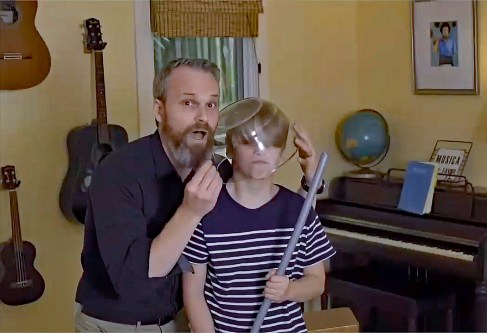
2021~Ryan McKinny-13The comedy interlude stole the show as McKinny sang the familiar “Non più andrai” from Le Nozze. Adding to the hilarity, this Figaro recruited the singer’s son, Louis McKinny, to suffer Cherubino’s torments. They began incongruously enough as Dad pried away his son’s headset and then confiscated his cell phone. The indignities that followed were more in line with the action of the opera, where Figaro terrorizes the effeminate Cherubino with the prospects of heading into battle and achieving military glory. A glass mixing bowl became a soldier’s helmet and then a broom seemed to serve as a rifle – until our suffering Cherubino was commandeered for KP. “You missed a spot,” Dad barked as Miller played the final notes.
After that hilarious turn, it was heartening to learn that McKinny will be playing his Figaro to a nationwide audience next January when he performs his first title role for the Metropolitan Opera next season. McKinny outlined the course a Wagnerian singer takes, moving from one role to another as his voice ages and matures, subtly changing in color, weight, and range – or from one fach to another. Most penetrating, however, was his appreciation of the challenges in Don Giovanni, where the title role demands three kinds of singing over the course of a single evening. McKinny has sung both Leporello and the Don during his career – demonstrating a special merit in Mozart’s design, for Leporello is forced to impersonate his master in order to abet one of his seductions. The same voice should be able to sing both roles!

2021~Ryan McKinny-24

We saw the tender side of the Don as McKinny sang “Deh vieni alla finestra,” the serenade that Giovanni sings to Elvira’s maid – dressed as Leporello. This lyrical bauble, a trinket even within Giovanni, made for nice lead-up to the summit of Wotan’s “Abendlich Strahlt der Sonne Auge.” It’s a rich concluding aria in Das Rheingold, just before he and the lesser gods set forth for their palace in the sky, which he has named Valhalla – and just after he has triggered the curse of the Ring. The effect was stunning somehow, despite its diminishment and possibly because of it. Wagner’s grand orchestration was reduced to a single piano, his cosmic staging confined to a cozy Asheville parlor, and the king of the gods lost all his royal trappings and his legendary spear. McKinny’s gray-streaked beard and black shirt had to suffice. Yet in this sensitively filmed short, much of the moment’s majesty still shone through, because McKinny contained it all. Winner of a 2020 Grammy Award, he’s an artist you want to keep your eye open for, definitely ready for his close-up.