Category Archives: Classical

Memorable Evening at EMF Includes an Adolphe World Premiere

Review: Eastern Music Festival – Greensboro, NC

By Perry Tannenbaum
2016emf_0006


If you haven’t heard about her before, expect to hear more about Julia Adolphe soon. The 27-year-old composer is the 2016 winner of the Lincoln Center Emerging Artist Award, and her Viola Concerto was commissioned by the New York Philharmonic for Cynthia Phelps, their principal violist. Come November, when Jaap van Zweden will lead his first concert at David Geffen Hall since becoming the music director designate for the 2017-18 season, the Adolphe concerto will gets its premiere performance with the NY Phil.

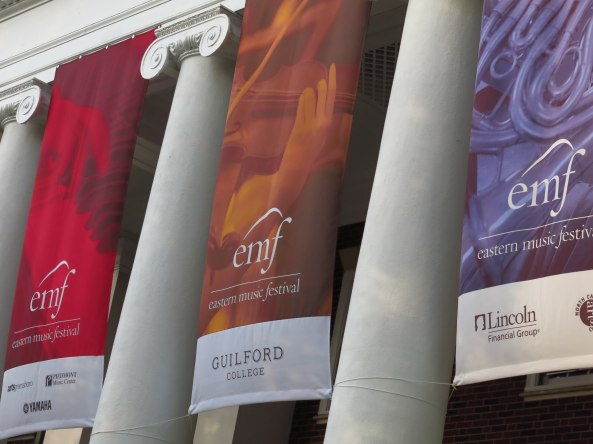
But Phelps has already played the world premiere performance – in Greensboro, NC, on the Guilford College Campus at the 2016 Eastern Music Festival. Van Zweden plans to surround his premiere with works by Wagner and Tchaikovsky. With Gerard Schwarz conducting the Eastern Festival Orchestra, the new Adolphe Violin Concerto fit very well into a program that included an adventurous 20th century sampler: Maurice Ravel’s Alborada del gracioso, Leoš Janáček’s Sinfonietta, and Joaquin Rodrigo’s Fantasia para un Gentilhombre, featuring a second guest soloist, guitarist Jason Vieaux.

Three interacting orchestras keep EMF humming, presenting 45 concerts over the space of 34 days, idle only on July 4, presumably in deference to the holiday and the evening’s fireworks. Two of the ensembles are Young Artists Orchestras made up of promising student musicians, aged 14-23, who perform four programs apiece with resident conductors Grant Cooper and José-Luis Novo.

2016emf_0004_edited-1Like the students, the professional 64-member Eastern Festival Orchestra hails from around the country, mostly on furlough from symphony and university posts during the regular season. They double as the students’ mentors, for the Young Orchestras not only rehearse six times a week on a professional regimen, they also get one-on-one individual instruction from a faculty member every week, 3-4 chamber music rehearsals each week, and one sectional meet-up.

I’d be hard-pressed to think of anyone better equipped to pilot EMF’s mission than its music director Schwarz. Before joining EMF in 2005, Schwarz had previously built the Seattle Symphony into a powerhouse, launched scores of new American orchestral compositions, many preserved in unsurpassed recordings.

Only a fraction of the daily campus bustle is evident when you attend an evening concert at Dana Auditorium. As you walk from the nearby parking lot, music wafts toward you from a practice room, and as you reach the top stairs of the Dana’s pillared entrance, a brass quintet of students greets you.
2016emf_0015

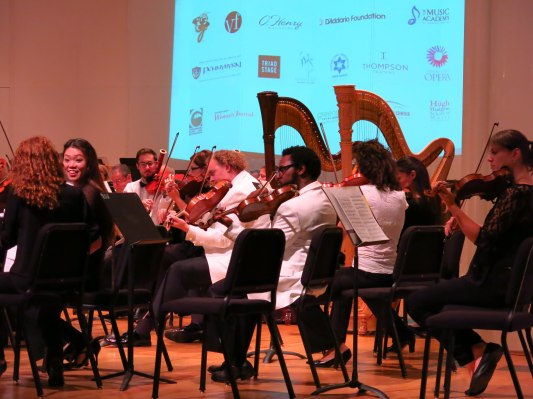
The white acoustic shell at Dana was as ugly as I had remembered from the last time I visited EMF during its 50th anniversary in 2011 – or perhaps the better word is incongruous, for the white shell is a like an interior of 2001: A Space Odyssey plopped down into the royal palace of The Lion in Winter. Mitigating the stark contrast, projections appear on the back wall, promoting future events and blazoning sponsor logos.

When Schwarz and the Eastern Festival Orchestra struck up the Alborada del gracioso, the value of the acoustic shell instantly manifested itself. Pizzicatos maintained their crispness at the start, and the mellow sound of the single oboe didn’t struggle to reach me in Row L. The first big orchestral sforzando leaped from the stage with a rousing wallop, so the soft interlude that followed had a luxuriant repose. I was barely satisfied by the bassoon, the clarinets, and the muted trumpets setting up the closing, but the onset of percussion and brass at the end was very convincing in the final tutti, reminding me of the concluding roar of Ravel’s Bolero.

Adolphe’s Viola Concerto will undoubtedly draw better notations when it arrives at Lincoln Center, for there were no markings in the EMF program book to confirm that the piece is in three movements, and the program notes were merely a condensed version of the Adolphe bio that preceded it. Unearth, Release was already given at the NYPhil.org website as the work’s title when I looked in a week after the performance, but apparently the composer hadn’t divulged that info before the EMF program book – 124 glossy pages –had gone to press.

If you heard Adolphe’s Dark Sand, Sifting Light at the NY Phil Biennial 2014 – or on the recording you can download from the orchestra or stream on Spotify – then you’ve heard the textures and the moods Adolphe likes to work with. The swirling eeriness at the start of the Viola Concerto isn’t as soft and subdued as Dark Sand, and Phelps’ first two entrances plunged the piece into darkness, urgency, and anguish much sooner. Both the orchestra and concertmaster Jeffrey Multer had answers for Phelps after her agitated cadenza. Cellos dominated the orchestral palette until drums, cymbals, violins, and brass swelled into a majestic cacophony, dissolving into a calm dominated by the high woodwinds. A tinkling piano under a harmonics-infused outburst from Phelps closed the movement after a volley of timpani.

In contrast to the dense and spooky outer movements, the second movement was less brooding, more scherzo-like, with a bright flute, jaunty brass, woodblocks, and thin harp passages leading up to a flurry of trumpets. The concluding movement started with sweet sounds of the second violins over eerie flutes. Multer had a chance to shine on some harmonics-laced passages before soft trumpets signaled more bravura from Phelps. There was more delicacy here as bass clarinet, chimes, and oboe glistened in the texture before the final fadeout of the viola.

Adolphe’s concluding “release” was more of a weary escape than a celebratory triumph, yet it came in the wake of substantial struggle and suffering, so I could detect a glimmer of sublimity in the outcome. Van Zweden will need to be at the top of his game to equal this performance, and I suspect that both he and Schwarz will want to record the piece.

The Festival Orchestra thinned out noticeably during intermission, yet I still worried how well Vieaux would be heard over the ensemble. Fantasia para un Gentilhombre generally plays second fiddle to Rodrigo’s famed Aranjuez on recordings that anthologize the composer or the guitar. Although the piece is familiar, I’d never heard it in live concert before.

For the most part, Rodrigo deftly avoids clashes between the soloist and the orchestra. When the orchestra swells, the guitar part usually diminishes to rhythmic strums or simple arpeggios, and when the soloist takes the spotlight, the orchestra is often hushed.

2016emf_0023

When that didn’t happen, Schwarz was discreet without being self-effacing. The effect was very natural in the opening “Villano y Ricarcare” as warm strings and softly strident winds preceded Vieaux’s entry. As the winds began chirping more assertively, Vieaux took to strumming, his muted presence still counting underneath in accompaniment until he emerged gracefully at the close.

There was a festive feeling from both the soloist and the orchestra throughout – and a couple of noticeable affinities with the more often programmed Concierto de Aranjuez. Very briefly in the penultimate “Dance of the Axes,” there was some interplay between Vieaux and the oboe that echoed the Adagio in Aranjuez, and the final “Canario” evoking the Canary Islands, had a frolicksome quality akin to Allegro gentile that closes Aranjuez, dancing a little livelier. Vieaux almost sounded like he was playing electric bass just before some nice bits of trumpet introduced his final cadenza.

Over the years, I’ve seen more of Janáček in operatic productions than I have in concert halls, so it was a treat to find his Sinfonietta anchoring this evening of enterprising choices. Inspired by the sounds of a brass band heard in Brno after Czechoslovakia declared its independence on October 28, 1918, the five-movement piece is astonishing, teeming with trumpets and fanfares. Schwarz obviously reveled in its colors and its American-like brashness, so plenty of intricate variety emerged amid the military, wartime thrust.

Plenty of orchestra members returned to the stage from their Rodrigo exile. There were rich sounds from the French horns over a snare drum complementing the brass in the opening “Fanfare,” before Janáček evokes various parts of Brno in subsequent movements. Activity from the flute, piccolo, and clarinet swirled around “The Castle,” and “The Queen’s Monastery” actually sounded quiet and monastic with chaste violins before turning brassy and scherzo-like.

Violins cast a tone of anxiety over the quieted trumpets’ dance on “The Street Leading to the Castle,” and the “Town Hall” was steeped in tragic sorrow when we arrived. Timpani and pulsating brass weren’t sculpted to simulate joy and jubilation as I might have wished, settling into a more bellicose battlefield tattoo, but I was pleased – and consoled – when Schwarz and the Festival orchestra captured the majesty and grandeur of the ending.

Festival Singers Tune Up for Charleston With a Lively, Mostly Modern “Elements” Concert

By Perry Tannenbaum

Most music lovers would probably be bracing themselves at the prospect of sitting through a classical concert of 10 pieces if they were told that nine of them would be by composers born since 1939. But modern choral music isn’t at all the atonal, minimalist minefield we’ve come to dread in the instrumental and electronic repertoire by contemporary composers. So after “Fire, Fire” by Thomas Morley (1557-1602) opened the “Elements: Earth, Water, Air & Fire” concert by the Carolina Voices’ Festival Singers, the pieces that followed weren’t a plunge into the abyss.


Performed at St. John’s Baptist Church, the concert also skirted undue formality thanks to director Donna Hill’s affable introductions and her resourceful staging. Donna Clark accompanied the Singers on most of the selections from the keyboard, but Hill was also open to support from percussionist Stephanie Wilson and soprano saxophonist John Alexander. The acoustic at St. John’s is not at all like an echo chamber, further preventing a mood of sanctified solemnity from setting in.

With the Singers deployed to the sides of the hall, flanking the audience, “Fire, Fire” was a lot to take in with its five different parts and its cascades of fa-la-la’s. Frankly, I never penetrated the dense foliage of voices to the clearing where an antique rhyme – “I sit and cry me, and call for help. Alas, but none comes nigh me” – was running in continuous overlapping loops. Eventually, the framing fa-la-la’s consoled me that I hadn’t missed much verbally, and I simply luxuriated in the effervescence of this polyphonic madrigal.

The choristers then gathered at the front of the sanctuary to sing David L. Brunner’s far more decipherable “Song of the Earth Spirit.” The lyrics are more of a chant than a poem, written by Stephen C. Jett, a specialist in Navajo culture from the point of view of the Earth Spirit. As you might surmise from its refrain, “It is lovely indeed,” the song’s harmonies are soothing. There was a whiff of inchoate chromaticism toward the end when the Singers lingered on the word “lovely,” all the more satisfying when the final repetitions of the word resolved into a sunny major.

Title #1

Both of the pieces on the program by Eric Whitacre were set to poems by Octavio Paz, but in “Water Night,” he worked with a beautiful translation by Muriel Rukeyser, though the lyric was still occasionally difficult to decipher. A more echoey acoustic would have slurred the lyrics even more, but it would also have enhanced the sense of misty moonlit night that the composer was seeking. The other Whitacre work, “Cloudburst,” was clearly the showpiece of the concert, employing handbells and percussion along with an assortment of finger snaps, handclaps, and thigh slaps. Hill brought the Singers up front, nearer to the audience, as she introduced the piece as a “celebration of unleashed kinetic energy.”

Although the lyrics were printed in the program with a translation, Hill had one of her choristers read them to us to sample the sound before the singing began. The performance was very much about sound from its opening words, “La lluvia,” as the choir sounded like the rain they were singing about. A strangely soothing meditation preceded the grander storm, which was foreshadowed by the tingling of the bells and a whoosh of brushed cymbals. Then the full fury was let loose by a large kettledrum, a thunder sheet, fortissimo singing, and the various body sounds generated by hands, fingers, and thighs. Adding to the wonder of this spectacle was the realization that the Singers had to abandon their scores and memorize this piece before they could adequately perform it.

Stephen Paulus was the second composer on the program to celebrate fire with his “Hymn to the Eternal Flame,” though its incantatory lyric more closely echoed the spirit of Brunner’s earth song. I’m not absolutely sure which of the elements James Kevin Gray’s “My Gift” celebrated, but since Gray is a minister at St. John’s, he was present to introduce his song along with the recipient of the “Gift,” his wife Alison, who was sitting by his side. The lyric is rather touching, voicing the composer’s feeling that only the gold of the moonlight would be a fitting gift for his beloved – yet he can only truly give himself. After the ardor and atmosphere Gray evoked here, he might consider moving on to Matthew Arnold’s “Dover Beach.”

Having just turned 38, Ola Gjeilo was the youngest composer on the program, represented in two titles. The first of these, “Tundra,” has an English lyric by Charles Anthony Silvestri that was inspired by photos of Gjeilo’s native Norway. While the poem is about earth and sky, it was written exclusively for women’s voices, so I rarely understood the earthly and skyey words that had bounced back to Gjeilo. Heavenly sounds definitely predominated in the stratosphere of the vocal haze he composed.

The words of Gjeilo’s “The Ground” proved to be more intelligible as the full chorus performed them – and understandable for anyone already familiar with the liturgical Latin. The opening verses of “Osanna” praise and “Benedictus” thanks were sweet and pleasant, but the “Agnus Dei” passages were striking, as powerful when the Festival Singers sang them as any “Lamb of God” setting I’ve ever encountered.

The remainder of the concert was given over to choral settings of familiar African American spirituals, first an Anders Paulsson arrangement of “Deep River.” Already rich in feeling, the performance was enhanced by Alexander’s solos on soprano saxophone. When the ensemble came forward a second time for the concluding “Wade in de Water” arranged by Allen Koepke, they brought their scores with them – mostly looseleaf notebooks but also a couple of iPads.

After the formidable “Ground” by Gjeilo, this finale was not at all anticlimactic, for it burst with celebratory energy and came adorned with finger snaps and foot stomps. The Festival Singers were alert and precise throughout their program, a worthy tune-up for their upcoming concert in Charleston. As you may know, the name of this chamber choir isn’t accidental, for they have sung at the Piccolo Spoleto Festival on 27 occasions. They will reprise their “Elements” program for their 28th appearance in Charleston on May 29 at 2pm at the Bethel United Methodist Church.

Charlotte Symphony Spotlights the Balcony in “Romeo and Juliet” Tribute

et-romeo-juliet-maria-kochetkova-joan-boada-end_1000

By Perry Tannenbaum

May 20, 2016, Charlotte, NC – A distinguished scholar who taught my undergrad Shakespeare course once told us that a precious folio edition of the Bard’s plays was on display at one of England’s most prestigious libraries, available to all to peruse, and that the most well-worn page in the whole book – by far – was the balcony scene from Romeo and Juliet. “Rightly so,” she added after a brief pause, defusing my presumption that she was about to sneer at popular taste. Charlotte Symphony Orchestra musical director Christopher Warren-Green might very well agree with my professor’s sentiments, for at the latest KnightSounds concert, he programmed that scene twice in succession, underscoring the fact that we still haven’t tired of that balcony 400 years after Shakespeare’s death.

Helping the demonstration at Knight Theater were emissaries from UNC Charlotte’s Theatre Department and Charlotte Ballet. Charlotte-based soprano Melinda Whittington helped to similarly double-underline the appeal of two other prime Juliet moments. So in the space of a mere 70 minutes, 50 less than the “two hours’ traffic of our stage” promised in the tragedy’s prologue, we not only had orchestral and operatic works inspired by Shakespeare’s first great tragedy, we had the lovers themselves speaking the lines of their most memorable scenes.

Tchaikovsky, Gounod, Prokofiev, and Nino Rota all took their cues from the blank verse and rhymed couplets in different ways. Of course, Tchaikovsky’s famed Fantasy-Overture wasn’t written for any specific production of Romeo and Juliet. With three fully developed themes for Friar Lawrence, the Montague-Capulet strife, and the R&J romance, the flavor of the piece is more like a Liszt tone poem than a true overture. About half the size of a Tchaikovsky symphony, the KnightSounds performance quickly offered us opportunities to savor the work of the clarinets, the double basses, the violins, the French horns, the cellos, the flutes, and harpist Andrea Mumm.

At the same time, the performance was streamed outdoors to the plaza at the nearby plaza on the Levine Avenue of Arts, and the screen hovering above the Knight Theater stage gave us the pleasure of seeing what the outdoor audience saw with the added thrill of the live sound. There were more than enough cameras deftly at work to prove that this video production had been nearly as meticulously rehearsed as the music. We didn’t cut to the French horns or the cellos in the early going, and the cameras later settled on the second violins too late and missed English hornist Terry Maskin entirely. Yet overall, direction was quite polished.

Romeo & Juliet 'Plazacast' Closes KnightSounds Sitting toward the front of the orchestra, I found that the cameras consistently revealed who was playing upstage when the musicians in front of them blocked my sightline. My fears of being overwhelmed by the sheer loudness of the orchestra were also allayed: the acoustic shell that graces the Knight stage gathers in the orchestral sound while still allowing it to breathe. This was different from the old school presentation that the CSO brought us of the Fantasy-Overture at Belk Theater in 2011, and while there was little to prefer musically at either performance, I have to say that the camera work lifted the current experience above the one I praised five years ago, enriching what I saw and heard then with occasional close-ups of Warren-Green’s expressions.

I had little hopes for the UNC Charlotte segments of the evening, with Jennifer Huddleston appearing as Juliet and Sammy Hajmahmoud as Romeo. When their stage director, Professor Andrew Hartley, appeared onstage to recite Shakespeare’s prologue, he didn’t exactly fire up my hopes. Nor was I initially impressed with Hajmahmoud when he initially came onstage to launch the party scene where the masked Romeo first meets Juliet. But Huddleston was pure luminosity as Juliet, instantly proving the advantage of casting the role as youthfully as possible. The glow of her performance magically turned Hajmahmoud’s halting awkwardnesses into virtues and he gradually relaxed into Romeo, further igniting their chemistry. Together they grew irresistibly charming, somewhat upstaging their elders when they followed.

13263907_1718667768397005_7712306438347482717_nAfter Huddleston, Whittington seemed woefully mature as Juliette singing the bubbly “Je veux vivre” from Gounod’s opera. The costume she wore was comparatively formal and neither the suppleness of her coloratura nor the lightness of her tone matched what we hear from elite sopranos in this showpiece. But she returned later in the concert and absolutely scorched Juliette’s “Potion Aria,” demonstrating the power that opera can add to turbulent moments of indecision. Huddleston and Hajmahmoud do all the potions and suicides as well, but their most glorious moments – and Hartley’s as well – come when they do the balcony scene.

Romeo initiates the scene onstage, but a spotlight cues us to the likelihood that Juliet will appear in the box seat section of the Knight’s balcony. It’s absolutely sublime when she does. Part of the magic is sculptural, after all, for the moonlit Juliet is not only more divine at a height, Romeo is more ardent and worshipful below her with his upward gaze. Hartley played around with the usual blocking and Romeo’s climbing up and down, but somehow he contrived to have Juliet down at the orchestra level and onstage for the latter half of the scene and its exquisite farewells.

The “Balcony Scene Pas de Deux” from Prokofiev’s ballet score had to follow this sublimity, and the presence of two eminent Charlotte Ballet principals, Josh Hall and Alexandra Ball, helped to ease the descent. Hall and Ball were so impressive, in fact, that I fairly well ignored Prokofiev’s music and the excellence of the orchestra. But as majestic as the lifts were – Ball’s hands as she rises have a musicality that most ballerinas can only envy – the sculptural advantages of the theatrical staging we had just seen were surrendered, along with Hajmahmoud’s touching awkwardness and Huddleston’s youth. An impossibly acrobatic final kiss partially compensated for those missing elements

After the stunning sequence of balcony scenes and potion scenes, the concert grew more somber with Rota’s “Romeo and Juliet: A Renaissance Timepiece” and Hartley’s pronouncement of the tragedy’s concluding lines. Until I heard CSO’s performance, I’d assumed that the Rota melody most familiar to me was his “Theme from The Godfather.” As often as I’ve heard that tune over the years, I wouldn’t be surprised if I’d heard Rota’s Romeo and Juliet melody even more often. The familiar melody nestles nicely in a composition that has more to offer, with some gorgeous work from Mumm, oboist Hollis Ulaky, and flutists Amy Orsinger Whitehead and Erica Cice.

An evening that I expected to be pleasantly light and superficial turned out to be rich and deeply satisfying. Programs were in the funky style that usually characterizes the KnightSounds series, but they are augmented by the Charlotte Symphony app that can be downloaded to your smartphone. You can get bios of the featured professionals from this app as you ease into your seat – it’s general admission, so early arrival can be recommended. While I couldn’t confirm my suspicion that Charlotte Ballet artistic director Jean-Pierre Bonnefoux was the choreographer, the app did supply translations of the Gounod arias.

Charlotte Symphony ends its classics season seductively

Review of Carmina Burana

By Perry Tannenbaum

When the Charlotte Symphony Chorus was known as the Oratorio Singers of Charlotte, they hooked up on numerous occasions with the Charlotte Symphony Orchestra in the most popular piece in the classical repertoire, Beethoven’s Symphony No. 9. More often than not, those collaborations would happen at the end of a season – or even at the end of a music director’s tenure with the company.

Sure, it’s as important to end your season with a bang as it is to start that way, for it’s your last shot at convincing fence-sitting newbies in the hall – as well as existing subscribers who haven’t yet renewed – to pony up for next season’s concerts. But you can’t trot out the “Choral Symphony” every year, can you? Lately, the CSO has found another winning warhorse in their stable, Carl Orff’s Carmina Burana.

Last week’s trio of Carmina concerts marked the third time in the past eight years that Symphony programmed Orff’s settings of mostly Latin poems. Not one of these poems, dating back to the 11th-13th centuries, has the chaste plainsong flavor of the church or Christianity, except perhaps for the most famous – and fearsome – “O Fortuna.” The worship of Fortune and her wheel surfaces in the works of Chaucer and lingers on in the tragedies of Shakespeare, a medieval oddity if ever there was one. Orff’s music restores its primal, superstitious force.

Lawrence Zazzo

But you need to hear it and see it live to get the full power that movie scores, CD recordings, and TV commercials only hint at. Some of the 24 songs are bawdy, others lyrical, some sensuous, and still others festive and carousing, as the section names suggest: “Springtime,” “In the Tavern,” and “The Court of Love.” The weirdest of the songs, “Olim Lacus Colueram” (“Once I Dwelt in the Lakes”), always sounded Oriental to me when I was growing up, listening to my dad’s vintage vinyl. I never suspected that the narrator was a swan getting roasted on a rotisserie!

Delaying his entrance onto the Belk Theater until this song began, countertenor Lawrence Zazzo literally made a meal out of it. Emitting a high-pitched lament bordering on sobs, Zazzo compounded the weirdness of his torment in way I would never have anticipated. As he reached the song’s final stanza, beginning “Now I am lying in a serving dish,” he pulled out a large handkerchief. Instead of dabbing his wounds or his tears, he stuffed the handkerchief into his shirt collar, turning it into a napkin. Then he reached into another pocket, fetched out what must have been a succulent duck leg, and began munching on it contentedly as he made his exit.

Hard to top that little cameo. But I’d say that Javier Arrey, shouldering most of the solo chores, was the best baritone we’ve had here in Carmina – and his alcoholic Abbot of Cockaigne wasn’t altogether anticlimactic in the wake of Zazzo’s roast duck. I wasn’t especially wowed by soprano Klara Ek’s initial efforts, but when she reached “In Trutina” (“My Feelings Alternate”) and its wavering between chastity and erotic enslavement, she was sublime.

Clocking in at slightly more than an hour, CSO’s Classics Series finale was more like a KnightSounds event at Knight Theater. Indeed, the last time Symphony and Chorus combined on Carmina in 2012, it was a KnightSounds event. At the Belk, when Christof Perick last conducted Carmina in 2008, the program was fortified with a Mozart Violin Concerto served up as an appetizer.

Marketing was also cleverer. After crowning her performance of “Dulcissime” with an orgasmic “Ah!” that topped all the hedonism we had heard before, soprano Heidi Meier didn’t simply vanish into history. Nope, she had already been announced as a guest performer for the season to follow.

That’s not to say that the audience was let down by the relative scarcity of music and promotional tie-in. When I heard various people in the grand tier humming “O Fortuna” as we exited to the lobby – or singing that Latin out loud – I sensed total satisfaction in the air.

An Upset People’s Choice Winner Caps the Delights of the 2016 Young Chamber Musicians Competition

By Perry Tannenbaum

Co-sponsored by Davidson College’s music department and their radio station, Classical Public Radio 89.9 WDAV, the 2016 Young Chamber Musicians Competition was judged in two separate divisions: juniors aged 14-18 and seniors 19-25. Now in its third year, the competition has grown in audience interest, in the number of youth ensembles vying for the prizes, and in the prize money they’re playing for: $2500/1500 in the junior division for the top two groups, and $4000/2000 for the seniors. The event was not only moved from Tyler-Tallman Hall to the Duke Performance Hall but it was also broadcast live on WDAV for the first time.

Finalists were selected from video submissions, assured not only of second place prize money in each division, but also flown into Davidson with complimentary hotel accommodations. In the junior division, the Noctis Quartet from New York City faced off against a Los Angeles outfit, the Chimera Quartet, hailing from the Coburn School. Their elders came from university programs that the juniors might be aspiring to: the Von Quartet from Jacobs School of Music at the University of Indiana and the Onyx Quartet from the Cleveland Institute of Music, which is affiliated with Case Western Reserve University.

The judging panel included Charlotte Symphony’s principal cellist, Alan Black; Wake Forest University’s composer-in-residence, Dan Locklair; and the Western Piedmont Symphony’s music director, John Gordon Ross. I doubt that the judging panel’s august expertise was truly necessary in determining the winners in each of the two divisions, but the question of which ensemble was the best overall turned out to be unexpectedly challenging, calling upon some true discernment. It was fortunate that a new prize had been added to the competition – a $2000 People’s Choice Award.

Votes were cast via cellphone texts by members of the live audience and by WDAV’s listeners. Each of the four finalists had a distinctive code listeners could text to a phone number that was shown online and in the hall – one vote per cell phone. The line did not open until all the competitors had performed, and listeners had three minutes to submit their choices while they listened to a recorded performance by a past winner. While it was possible to game this voting system, it was nothing like the vote-early-and-vote-often travesties promoted by American Idol or Major League Baseball’s All-Star Game.

Each of the auditions submitted to the competition had to be comprised of complete movements from two separate chamber works selected from two different periods of classical music history – Early or Baroque (pre-1770), Classical (1770-1810), Romantic (1811-1900), Modern (1900-50), or Contemporary (1950-present).

noctis-quartet

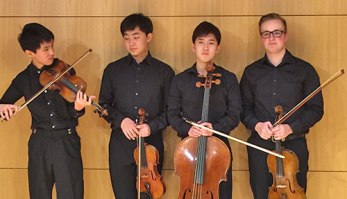
Opening the finals, Noctis was unique among the quartets in performing their two movements in reverse chronological order, beginning with the famed “Death and the Maiden” second movement of Schubert’s String Quartet No. 14 (1826) and continuing with the final movement of Beethoven’s String Quartet No. 9, the last of the three Op. 59 “Rasumovsky” quartets (1806). Although the “Death and the Maiden” tempo seemed a notch too slow at first, I was very impressed by the sound in the hall, where I’d never heard a classical concert before. I’d seen numerous stage musicals in the hall, by the Theatre Department and the town’s Community Players, with musicians placed either upstage or in the orchestra pit, so it was a bit revelatory to hear how warm, clear, and full-bodied a string quartet sounded from center stage not too far forward from the proscenium.

Helping the hall to shine, first violinist Kevin Zhu coaxed very sweet sounds from his instrument from the start, playing with praiseworthy élan particularly in the low and midrange. If the sluggish tempo at the outset seemed somewhat misjudged, the sudden acceleration and increase in volume were that much more startling when they came, and if Zhu seemed less assured in his first ascents into the treble, he clearly improved when the music sped into triplets, though there was lingering thinness even in his most assured playing. Behind Zhu, cellist Chase Park, second violinist Andrew Kim, and violist Jacob van der Sloot were unexceptional in the Schubert, but van der Sloot leapt into Beethoven’s Allegro Molto fearlessly at an uncompromised tempo, followed by Kim and Park on the same fugal path – all three of them more characterful than before. The effect was thrilling even before Zhu layered onto the fugue, absolutely on fire from his first notes. No doubt about it, the strategy of flipping the chronology of their pieces allowed the Noctis Quartet to leave with a very positive impression.

chimera-quartet-photo-Tomber-Su

The other junior finalists, the Chimera Quartet, had nearly as much of a prodigy factor going for them as their rivals. Their first violinist Geneva Lewis, like Zhu, had logged two appearances on Christopher O’Riley’s From the Top, the NPR program showcasing young classical musicians – but Lewis hadn’t been showcased there until the ripe old age of 16 while Zhu had scored his first nationwide airtime when he was 12. From the start of Haydn’s String Quartet Op. 77/2 in F, Lewis was the more completely polished performer, and she enjoyed more impressive backing from cellist Tomsen Su amid the shifting tempos and dynamics of the opening Allegro Moderato. The ensemble’s program was also better calculated to show its range, shifting from Haydn’s F Major to the spirited Allegro vivace from Bartók’s String Quartet No. 1 in A minor. Su once again excelled and, though violist Emma Wernig was unexceptional in the brief moment when she took the lead, Cameron Alan-Lee showed some solid potential when he took the spotlight. Yet it was Lewis who raised her level most impressively in Bartók’s second movement, immersing herself in the tempo and mood changes, wowing the audience and inspiring her collaborators.

von-quartet

After the Chimera Quartet lifted my expectations for the senior division, the Von Quartet let me down, beginning their pairing with the opening Allegro assai appassionato from Mendelssohn’s E minor String Quartet No. 4. In the wake of Lewis’s polished work – and Zhu’s rich tone – Von’s first violin, Jisun Lee, sounded surprisingly pinched and tinny, not as impressive as she sounds on the ensemble’s YouTube video. Lee steadied noticeably when the movement calmed for a second time, just past the midpoint, but Joanne Yesol Choi’s sound remained richer and surer as she played the cello. While the Icelandic second violinist, Gudbjartur Hakonarson, evidently had input into the Von’s Icelandic name, he didn’t have enough say in the music-making for me to pass a meaningful judgment. On the other hand, Ursula Steele demonstrated the fire that Ginastera calls for when the ensemble came to the Furioso fifth movement of his String Quartet No. 2, and Choi continued to assert herself effectively. The churning astringency of the movement was also friendlier to the washboard aspect of Lee’s thin tone.

onyx-quartet

The Onyx Quartet had little difficulty eclipsing their senior rivals, but they committed a strategic misstep in competing for the People’s Choice Award. Starting out with Beethoven’s String Quartet No. 11 in F minor, they didn’t put their best foot forward in parrying the exploits of first violinists Zhu and Lewis. Taking the first violin chair for the Allegro con brio opening movement, Michael Siess was underpowered and unexceptional. However, cellist Noah Krauss was a steady force in accompaniment, and Genevive Smelser was unquestionably the best second violinist I had heard all afternoon – so much so that I wondered whether better results might have been achieved if she and Siess had switched places. Sure enough, when Onyx moved along to Debussy’s G minor String Quartet, Smelser took over the first violin chair for the opening Animé et très decidé movement. Although the music didn’t match the excitement of the Noctis “Rasumovsky” or the Chimera assault on the Bartók, the performance was easily their equal. Not only was the first violin richer and more forceful, the ensemble harmonies were exquisite as Krauss warmed to Smelser’s leadership, adding more gusto.

While the judges’ decisions, awarding the top prizes to Chimera and Onyx, were predictable enough, I wondered whether they would have had the temerity to pick the junior winners as the best overall. Audience members and broadcast listeners who voted on their cell phones had sufficient discernment to choose Chimera as the People’s Choice winners – an upset victory as surprising to the audience as it was to members of the quartet. There was one more delicious surprise for the audience that wasn’t detailed in our program booklets: the senior winners earned the opportunity to perform an encore. As Smelser resumed the first violin chair, we got another taste of their Debussy from Onyx, this time the Andantino third movement. Not only did Siess surpass himself here on second violin while Krauss contributed some really fine work on the cello, violist Spencer Ingersoll emerged from obscurity with some noteworthy input. All four members of this quartet can return to Cleveland with their heads held high.

© 2016 CVNC

Warren-Green Pays off Bronco Bet After Rousing All-Russian Concert

By Perry Tannenbaum

Calin Lupanu plays Prokofiev’s Second Violin Concerto this week with the Charlotte Symphony Orchestra.

March 17, 2016, Charlotte, NC – For the first time in nearly two years, the Charlotte Symphony Orchestra presented an all-Russian concert. These two programs were elegantly linked by the appearance of CSO concertmaster Calin Lupanu playing one of Sergei Prokofiev’s two violin concertos on each occasion. Or that was the intent, because after conducting Sergei Rachmaninoff’s Symphony No. 3, music director Christopher Warren-Green was obliged to pay off a wager he had made in early February, prior to his previous appearance in the orchestra’s classics series. That was the weekend of the Super Bowl, when the Carolina Panthers squared off against the Denver Broncos. Well, since both orchestras are led by Christophers and abbreviate themselves as the CSO, it was natural that the friendly municipal pre-game wagering would not be limited to our mayors. Amid an online exchange of jovial slurs and vaunts, Warren-Green declared that, if the Panthers lost, he would conduct the Broncos’ theme song, Copland’s “Rodeo,” wearing Bronco quarterback Peyton Manning’s iconic No. 18 jersey. Keeping his word, Warren-Green capped an evening that began by intoning the Satanic revels of Modest Mussorgsky’s “Night on Bald Mountain” with the sunshine and mirth of the quintessential American composer’s ballet music.

Warren-Green’s prime objective with Rimsky-Korsakov’s orchestration of Mussorgsky’s macabre classic was very much like it was in 2009, when he conducted the piece as part of his audition for the music directorship. Then and now it was quite obvious that Warren-Green felt that the concluding calm of the piece, beginning with the churchly tolling of the tubular bells, was normally undervalued. Fortunately, the orchestra took a more dynamic path this time around than they did seven years ago, when they drained the tone poem’s familiar opening of all its wonder and terror. Now instead of smoothing it over, Warren-Green was exaggerating the contrast, speeding up the tempo of the rampaging strings and calling forth more volume and sforzando snap from the brass and percussion. The effect veered way too far from Bela Lugosi toward video game, but the onset of the bells was far more miraculous this time around. Accompanied by Andrea Mumm’s harp, the violins suddenly sounded mournful and exhausted after the wild Witches’ Sabbath, eventually modulating toward calm and restoration after poignant solos by clarinetist Drucilla DeVan and principal flutist Amy Orsinger.

You could hardly ask for a sweeter opening than Lupanu’s for the Prokofiev Violin Concert No. 2 – even from the justly lauded Maxim Vengerov recording with Rostropovich and the London Symphony. But I wanted more muscle as the tempo speeded up. We occasionally lost the soloist’s line behind the French horns, but the sinew of Lupanu’s playing emerged in the Allegro moderato when the lower string sections moved into the background, very persuasive in the higher passages. Although it couldn’t be confused with Philip Glass’s work, there is intensive repetitiveness at various points of the soloist’s part in Prokofiev’s outer movements, which may explain why Lupanu felt compelled to bring the score with him onto the Belk Theater stage.

Subscribers who are persnickety about such things, expecting their guest artists to memorize their pieces, were probably more pacified by Lupanu’s soulful performance of the Andante assai inner movement. After the stealthy intro from the woodwinds, gently weighted toward the clarinets, Lupanu’s lyricism excelled again in the upper regions. Over a leisurely 3/4 accompaniment, the music swelled to anthemic strength with Lupanu gliding and somersaulting above. Muted trumpets then pulsated, quickening the pace as the soloist broke into a gallop. When the accompaniment resumed its previous repose, Lupanu wove some high filigree and pizzicato work into the fadeout. The jauntiness of the 3/4 tempo was most pronounced in the closing Allegro ben marcato, punctuated by a snare drum, a set of maracas, and the brass pumping a merry oompah behind Lupanu’s lusty fiddling. There was a final burst of intensive churning where Lupanu snuck a glance or two at the score, but he ended admirably with a virtuosic flourish at a blistering tempo.

The CSO program booklet is utterly confused about the orchestra’s only previous performance of the Rachmaninoff A-minor symphony, for the 2009 date ascribed to guest conductor Leslie Dunner was actually the date of Warren-Green’s aforementioned audition with its woeful “Bald Mountain.” No, it was during the twilight of the Clinton Administration, January 1999, when I greeted the only previous performance of Rachmaninoff No. 3 as “turgid, clichéd movie music, grandly entertaining and flamboyantly superficial.” But the allusion to Warren-Green’s is curiously apt because once again, the CSO maestro has improved upon a previous CSO flop.

Where Dunner stumbled in his attempts to “civilize and homogenize” Rachmaninoff’s abrupt shifts of mood and tempo, Warren-Green succeeded brilliantly, rehabbing the music as effectively as my Mariss Jansons recording with the St. Petersburg Philharmonic. Again the middle Adagio-Allegro movement stood out as when Dunner performed it, with principal French hornist Frank Portone ably caressing the forlorn intro once more. This time, with Lupanu sitting out the second half of the concert, it was Joseph Meyer in the concertmaster’s chair following up so beautifully on the violin. Not only did Warren-Green navigate the rollercoaster shifts of the outer movements more convincingly, he also held the inner logic of the middle movement together more securely. When we circled back to the solos by Portone and Meyer, there was a satisfying sense of an epic circle being completed, crowned by more tasty solo work by Terry Maskin on the English horn and Eugene Kavadlo on the clarinet.

© 2016 CVNC

Up Close and Versatile: Michael Collins Plays Mozart, Stravinsky, Adams, and Bruch

Michael Collins | University of London Symphony Orchestra

By Perry Tannenbaum

February 1, 2016, Charlotte, NC – Michael Collins will no doubt bring pleasure to thousands later this week when he plays Mozart’s great concerto for basset clarinet with the Charlotte Symphony on consecutive nights at Belk Theater. Yet it would probably be exaggerating to say that hundreds were in attendance when the esteemed virtuoso performed another pair of concerts earlier in the week on the fourth floor of the Bechtler Museum of Modern Art – one for a lunchtime crowd and another after work. Poetic justice would have decreed that at least an equal number should bear witness when Collins, toting two other clarinets, headlined a program that not only included a complete Mozart clarinet trio but also a solo Stravinsky suite and generous samplings of works by John Adams and Max Bruch. Joining Collins were pianist Bruce Murray, who pinch-hit personably on most of the hosting, and violist Rosemary Furniss. There were a couple of links between the two pairs of concerts: Collins is playing both programs and Christopher Warren-Green, the Charlotte Symphony’s musical director conductor, is united in holy matrimony to the woman who wielded the viola.

Furniss’s hand was certainly perceptible in the choice of repertoire, since she collaborated on Mozart’s “Kegelstatt” Trio and a selection of Bruch’s 8 Pieces for Clarinet, Viola and Piano at a Davidson College concert in September 2013. These sweet trios framed the two more raucous works that Furniss sat out. All three trio members had their moments to shine from the opening Andante of Mozart’s E-flat gem. Furniss introduced the first subject at the beginning and its return at the end of the movement, answered by Murray, who laid the groundwork for Collins’ first entrance and then beamed with joy as soon as he heard the clarinetist’s first notes. With good reason. The waltzing 3/4 sway of the ensuing Menuet was instantly evident, especially since Collins himself swayed a bit with the melody while Furniss sawed an agitated countermelody. Nor was Murray idle here, at times playing two strands of accompaniment at the same time. Collins dreamily led into the concluding Rondeaux, hitting the high notes effortlessly, and Murray’s responses from the keyboard grew more elaborate. Interplay was quite delightful as Murray and Furniss led off successive rounds. At a certain point, Collins’ answers gave way to an outright takeover, with delicious filigree that dipped into the lower range of the instrument. Staccato passages near the end, when the trio chimed in together, were brimming with charm.

The first of Stravinsky’s Three Pieces for Clarinet Solo was actually a mellow, brooding thing, ideally suited for showing how much better-suited the clarinet is to the Bechtler space than a grand piano. Following this Molto tranquillo, the second piece was quick, raucous and squawking. Collins himself called attention to the hall midway through, pausing for a moment and waiting until the echo almost died away before flinging himself into that latter half. The third piece was no less fleet and raucous, but it had more of a circular, chasing feel rather than jumping around helter skelter, ending with an emphatic tweet that Collins clearly relished.

It was Collins who premiered Adams’ Gnarly Buttons in 1996, and he chose the middle movement of the piece, the shortest yet most signature of the three. “Hoe-down (Mad Cow)” would normally be associated with horses, according to the composer’s album notes, but it takes on its altered perspective as a nod to his “British friends who gave the first performance during a time of quarantine.” Recorded with the London Sinfonietta, the album cover features a wide-eyed animal that could serve as the perfect poster child for the infamous mad cow disease. It’s the most challenging of the three movements, but as Collins pointed out in his intro, in distilling the 11-piece accompaniment to the piano, the arranger had probably shifted the burden of difficulty to Murray. Indeed, Murray poured forth fistfuls of notes during this merry frolic. Interspersed with his hoe-down romping, Collins had the most minimalistic figures, which occasionally sounded like a boogie-woogie bass pattern. Clearly enjoying himself and Murray’s trials, Collins had time to point out the most important ingredient that this reduced version had to sacrifice – the sound of the lowing cow from the orchestral version. He mouthed the moo when it came around.

Scored for viola or cello (Furniss split her part with cellist Alan Black in her previous go-round), Bruch’s 8 Pieces are mostly dark and melancholy, so the four movements selected were altered from their intended sequence, leaving out the final Moderato and ending instead with the penultimate Allegro vivace, the only segment of the suite in a major key. The overtones of Murray’s introduction to the “Nachtgesang” actually emulated a clarinet’s sound, but there was no mistaking Collins’ true entry, floating in on high and dipping into darkness. Furniss’s nocturnal viola intertwined with the clarinet, before and after an exquisite Collins monologue, forming an ethereal frame. Launching the brief Allegro con moto, the viola came in darkly before before Collins echoed it from above, but the most characteristic of the Bruch pieces was “Rumänische Melodie,” with Furniss achingly setting the tone, at times reminiscent of Sarasate’s firelit Gypsy ruminations and the keening of Jewish cantorial music. Collins and Murray were at the forefront of the Allegro vivace, but Furniss was very expressive in the accompaniment, fomenting the augmented intensity when frolicsome passages veered suddenly into turbulence. Throughout the concert, I had an up-close view, less than 10 feet from Collins when he took his final bows. Nor were my seats reserved: any one of the thousands who may marvel at Collins’ musicianship this Friday and Saturday night could have snatched up the same opportunity on Tuesday, at a fraction of the ticket price.

Copyright © 2016 CVNC

Two Simpatico Spirits Combine on Saint-Saëns

Photos by Michael Polito and Sheila Rock

By Perry Tannenbaum

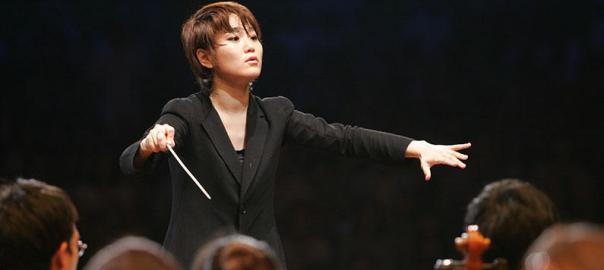
January 8, 2016, Charlotte, NC – Twenty years after her breakthrough recording of Saint-Saëns’ First Cello Concerto, Han-Na Chang made her debut with the Charlotte Symphony last week. Only she wasn’t playing the cello as she was then, when Mstislav Rostopovich conducted the London Symphony. No, at the ripe old age of 33, Chang was our guest conductor and Cicely Parnas, 22, was our soloist – in the midst of a victory lap of her own with the Saint-Saëns.

ParnasPredictably, the concert perked up when the kindred spirits collaborated. The busy opening isn’t easy for the soloist to project in a concert hall. Among the recordings I’ve sampled – including two I own by cellists Yo-Yo Ma and Jacqueline DuPré – only the one recorded by the Seattle Symphony by Gerard Schwarz with his son Julian as the soloist manages to truly balance orchestra and cello. So I suspect that legerdemain was accomplished at a mixing board.

Chang didn’t hold back in her accompaniment any more than Rostropovich had, but there was a little more snap to her conducting, a special relish for the sudden sforzandos. Some exquisite filigree from flutist Amy Orsinger Whitehead adorned the opening Allegretto non troppo, instigating some sweet dialogue as Parnas played the slow section beautifully, more body suffusing her tone.

Somehow there was more space provided for her sound when Parnas returned to the uptempo climaxes of the movement. Yet there was no sense of her being hurled into these more passionate outpourings. The suddenness of the sforzandos halted the flow instead of prodding the soloist onwards, and I wasn’t as swept along as I am listening to the two London recordings.

The soft middle movement, a quaint Allegretto con moto, crept in without quite matching the delicacy you hear from Michael Tilson Thomas in his fine 1993 recording, also with the Londoners, behind Steven Isserlis. Gradually, the orchestra in staccato was partially won over by the cello’s legato, so a rather starchy minuet eventually became a pleasantly flowing waltz. Here there was more admirable delicacy from the woodwinds with Parnas trilling behind them.

With no pause between the middle movement and the concluding Allegro non troppo, the dialogue between the Chang and Parnas came into fullest flower. Principal oboist Hollis Ulaky keyed the return to the fast tempo, and the snappiness of Chang’s approach worked perfectly. The big orchestral passages were played speedily, zestfully, and precisely – with Parnas answering in kind. (The Chang and Isserlis are at the head of the class among the Saint-Saëns recordings I’ve heard. Ultimately, I find that the Isserlis has the benefit of richer sound.)

As graceful in her own willowy way as Christopher Warren-Green on the podium, Chang often reminded me of Seiji Ozawa and his zest for color and percussion. Applied to Ravel’s eight-part Valses nobles et sentimentales, the opening suite of the concert occasionally sounded too raucous and contemporary, as if warring with the sentimental waltzes and its own pastoral charm. The French horns and the strings emitted a magical glow in one of the middle movements, and the woodwinds faded gracefully in the quiescent conclusion, leaving plucked strings in their wake.

But I really loved the zest that Chang brought to the Sibelius – and the bravura that came from Charlotte Symphony’s principals. Eugene Kavadlo opened this Andante with an extended clarinet solo, occasionally backed by a soft rumble of the timpani. What really triggered the full orchestral outburst, among the most memorable for me in symphonic music, was the churning of the second violins. Each time the music peaked, the robust brass section – three trumpets, three trombones, and the tuba – were there to crown it.

The violins were very sweet – or skittish – carrying us along toward the huge brassy reprise. In the quieter moments, harpist Andrea Mumm conspired first with Ulaky and later with Kavadlo, but as the storms gathered, timpanist Leonardo Soto became increasingly active. Another andante followed, where Chang and the violins seemed spontaneously swept along. When she brought her characteristic snap to the orchestral texture, it was after the strings had ratcheted up the urgency and let out a keening lament. At the point when we spun toward warlike fury, those jagged edges spiked the insanity. A weepy aftermath ensued from the violins with a solemn overlay from the brass.

Sibelius’s idea of Scherzo was also much to Chang’s liking, its quick marching sections very amenable to the punch she applied to them. Lighter moments came courtesy of the flighty flutes and the calm French horns. Soto was able to play the insistent marching theme a few times on timpani, and he didn’t shrink at all from his moments of melody.

Chang was no more immune to the rhapsodic allure of Sibelius’s Finale than Jan himself must have been when he heard the symphonic works of Tchaikovsky that surely inspired it. (Scratch that, Sibelius hated it when everyone compared his symphonies to Tchaikovsky’s!) There’s plenty of turbulence counterbalancing the opening schmaltz, plenty of opportunities for Chang’s slashing proclivities to come to the fore. But unlike the Ravel, the shuttling between the bellicose and the sentimental episodes was deftly handled.

Mumm was not only active in the sugary sections. There were times when she actually coaxed a tinny sound from her harp. The spotlight fell on her at the end of the piece, as the last thunder from Soto and the brass gave way to a brief hush. My favorite recording of the symphony remains the first I acquired, by Mariss Jansons and the Oslo Philharmonic. They thoughtfully give a special credit to the clarinetist, so it was no surprise that Chang asked Kavadlo to stand for the first bow. The audience needed no such prompting.

“Schumanniana” Presents Vivid Echoes of Bipolarity and Romanticism

By Perry Tannenbaum

There is certainly no post-holiday letdown in Classical programming at the Bechtler Museum of Modern Art. Leaping into 2016, they’ve resumed their first-Tuesday series with an all-Schumann concert of chamber music gems, foreshadowing a February visitation by world-renowned clarinetist Michael Collins, who will be playing trio works by Mozart and Bruch. In addition, a side order of John Adams is planned early in the same week, when he plays Mozart’s concerto for basset clarinet with the Charlotte Symphony. Nor does the March installment of the Music and Museum series qualify as an anticlimax, since Antonio Lysy will be playing half of Bach’s six solo cello suites at the lunchtime concert and the other half – the even-numbered suites – later in the day at the after-work concert.

Turning the clock further and further back as it progressed, the noontime “Schumanniana” launched the new year with the first of the composer’s two 1851 violin sonatas, calmed down somewhat with the cello sonata scoring of the 1849 Adagio and Allegro, and galloped to the finish line with the rousing Piano Trio No. 1 from 1847. Bruce Murray, the former Brevard Music Center dean, was at the keyboard throughout. After the opening piece, Charlotte Symphony’s assistant principal cellist, Jon Lewis, joined him. Only the young French-born violinist, Chloé Kiffer was making her Charlotte debut – one that I will not soon forget.

If the programming strategy had prioritized acclimating the audience to the echoey acoustic of the Bechtler’s fourth floor with its high-vaulted ceiling, the ensemble would have opted to begin smoothly and lyrically with the Adagio and Allegro. Instead, we plunged into the dark brooding mood of Schumann’s “Mit leidenschaftlichem Ausdruck” (with passionate expression), the swift opening movement of the A minor Violin Sonata No. 1. It wasn’t the best way to spotlight Kiffer’s precision – or her silvery tone – as she attacked the turbulent swirl of Schumann’s romanticism. However, amid the hairpin turns of mood there were calm episodes when the music slowed down long enough to dispel the room’s reverberations and reveal the pearlescent clarity of Murray’s accompaniment and the graceful sinew of Kiffer’s playing. Kiffer navigated the shifting currents with the driving purposefulness of an Olympic kayak racer knifing through the rapids.

We could luxuriate more in Kiffer’s sweet lyricism when we reached the middle Allegretto movement, where the Bechtler’s acoustic warmth became more of an asset. The lilt of the violinist’s playing didn’t disappear during quicker-paced episodes. Their joy bloomed while a delicate elegance remained. Rounding into the closing “Lebhaft” (lively) movement, Kiffer didn’t have to deal with the constant bipolarity of Schumann’s mood swings, and forged straight ahead with a speed that carried the jubilation of love along with its urgent anguish. Only a couple of cautionary decelerations punctuated the onrush of exhilaration. Murray and Kiffer conspired to sustain the freshness of this finale, serving up abrupt changes in dynamics and tempo until it climaxed.

There were far more opportunities for Murray to shine in the A-flat Adagio and Allegro, beginning in the opening movement, marked “Langsam, mit innigem Ausdruck” (slowly with heartfelt expression), where he and Lewis passed the melody back and forth. The cellist’s fine left hand was particularly effective here, delivering silken glissandos and a well-judged vibrato. Lewis hit the more familiar Allegro melody with admirable gusto, although he also ran afoul of the room’s acoustics in the most agitated moments, as you might expect with a movement marked “Rasch und feurig” (quick and fiery). The effort required to savor Lewis’ work on the melody often distracted me from Murray’s fine work at the keyboard, a richer accompaniment than you might expect behind such a catchy tune. As we reached the crest of this powerfully yearning movement, the duo turned up their intensity a notch, drawing attention to their fine rapport as the piece ended.

Schumann’s Piano Trio No. 1 is so chockfull of memorable ideas that only the third of the four movements can sound unfamiliar after you’ve heard the piece two or three times. Both Murray and Kiffer reveled in the melodiousness of the opening, sharing most of the action of this “Mit Energie und Leidenschaft” (with energy and passion) movement. Lewis was most impactful in the onset of the mood change, Kiffer stamping it in wistfulness before the onset of another passionate storm.

The violinist had a keen sense of the flourishing gestures in the foreboding moments and of their connection to the grand peaks that followed. She and Murray galloped into the ensuing movement, nearly violating the “not too fast” component of its “Lebhaft, doch nicht zu rasch” marking. Nor did the softer midsection of the movement ease off as dramatically as other readings I’ve heard. So the return to the opening gallop was more organically connected, though less dramatic. Yet there was still unmistakable bravura held in reserve for the conclusion.

An island of calm – and ordinariness – in this powerful masterwork, the third movement was particularly notable for its pleasantly tart blending of Lewis’ cello with Kiffer’s violin. Murray was no less effective here, levitating the end of this “Langsam” so that it floated decorously into the final “Mit Feuer” without a pause. It was here that I noticed the ongoing ministrations of the projectionist, which dissolved a previous quibble I had with the slides on the rear wall that I noticed as Benjamin K. Roe was delivering his erudite intros to the works and the musicians. Amid the movements listed under the titles of each succeeding piece, the first movement was always bolded, standing apart from the other movements. It was only when we moved seamlessly to the final movement of the concert that I noticed the boldface helpfully shifting to “Mit Feuer” on the projected slide.

While the trio didn’t initially illuminate the mystery of why Schumann thought this movement was notably fiery, they brought out its true anthemic flavor as well as any live performance or recording I’ve heard. Murray and Kiffer were both ardent handing the melody off to each other, all the more powerful when they chimed in together. The entire trio churned ominously before the final return of the triumphal theme. After it sounded, the pianist and the violinist took turns taking us on arpeggiated excursions, ratcheting up the tension before an ultimate release of true fire. It was a frantic, galloping rush to the finish, and there was no mystery at all about why the performance drew a standing ovation.

For Veterans and Victims

Concert Review: Charlotte Symphony Performs Fauré’s Requiem and Ravel’s Mother Goose

By 

The Charlotte Symphony’s most recent concert was designed by music director Christopher Warren-Green to be a seasonally appropriate tribute to the brave men-in-arms who serve and sacrifice for our nation in our military. Between Veterans Day on November 11 and the first of three concerts at Belk Theater on November 19-21, history intruded in Paris and Beirut. So after the orchestra played George Butterworth’s A Shropshire Lad Rhapsody and Maurice Ravel’s Mother Goose, maestro Warren-Green returned to the podium and rededicated the final piece of the evening, Gabriel Fauré’s Requiem – and, indeed, the entire program.

Now the 1888 Requiem was dedicated to veterans of our armed forces and to victims of terrorism in Paris, Beirut, and around the globe. While the traditional Latin text isn’t custom-tailored to either group, the setting by Fauré sounded very serendipitous. We’ve had four other requiems presented in Charlotte in recent years, by Mozart, Verdi, Duruflé, and Howells. The Fauré reminded me most of the Duruflé in its calmer moments, most of the Verdi in its moments of turbulence.

Drama resonating with our anger and outrage had to be vented in response to this shocking occasion, and baritone Douglas Williams – along with the Charlotte Symphony Chorus under Kenney Potter – voiced those emotions most compellingly when we reached the “Agnus Dei” section and its climactic “Day of Wrath” stanza. Yet we also needed the consoling serenity of Christina Pier softly singing the “Pie Jesu” in her velvety soprano.

Butterworth certainly wasn’t the only turn-of-the-20th-century British composer to be inspired by the terse stoical beauty of A.E. Housman’s pastoral poetry, but this rhapsody for orchestra had a special twilight radiance under Warren-Green’s baton. The sonority of the full ensemble was poignantly punctuated with a wide palette of succinct solos by clarinetist Eugene Kavadlo, English horn virtuoso Terry Maskin, harpist Andrea Mumm, concertmaster Calin Lupanu, bassoonist Mary Beth Griglak, and bass clarinetist Alan Rosenfeld. Amy Whitehead had the ethereal last word on flute over a soft barrage of timpani from Leonardo Soto.

You wonder whether Warren-Green considered moving Ravel’s charming fantasy suite to the end of the program, just to send us home with a smile. Stealing the scene from the other impish or enchanting episodes was the penultimate “Conversations of Beauty and the Beast.” Kavadlo, Whitehead, Mumm, oboist Hollis Ulaky, and – highest of all – Lupanu all took turns with the beauteous portion of the dialogue. But ‘twas contrabassoonist Lori Tiberio as the Beast who unquestionably conquered the beauties in musical derring-do. Keeping these lighthearted moments in the middle of all the somber moods surrounding it proved to be the right choice.