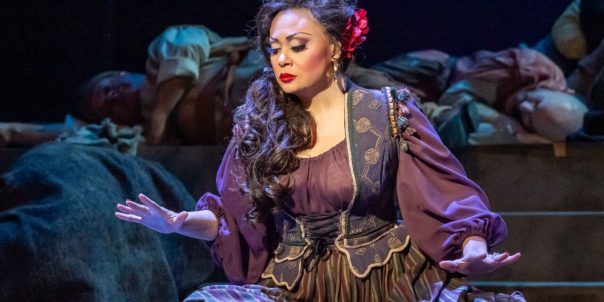
“Prends garde à toi!” You better watch out when la Carmencita gazes at you lovingly. The queen of Seville’s cigarette girls proclaims this insolent challenge – to the men she slinks past in the town square and a detachment of lascivious soldiers lazing on guard duty – almost as soon as we see her in Bizet’s Carmen. Differences between her and Micaëla, Corporal Don José’s fiancée, are artfully shown to go much deeper than city-girl brunette and country-girl blonde. When the drooling men in uniform offer their hospitality to Micaëla while she awaits Don José’s arrival, the chaste damsel skitters away in distress, promising to return later. Carmen quickly proves to be much different: shameless, seductive, and fearless, a wicked brew of beauty, passion, playfulness, and gypsy flair.
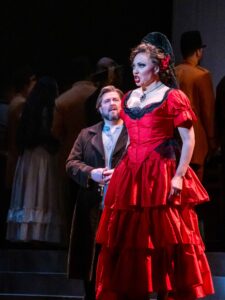
And yet we’ve still haven’t seen all the colors and facets of her portrait – or realized the full depths of what we’ve already seen in the eleven French scenes of Act 1. Alyson Cambridge, striking in appearance and lithe as ever in her movement, satisfied almost instantly at Belk Theater on opening night in reprising her Opera Carolina triumph of 2019, igniting and seething sooner as she built to the frenzy of the “Chanson Bohème” (“Les triangles des sistres tintaient”) that torches the opening of Act 2. Cambridge is as much the temptress now as she was in 2016 when she took on a title role in the special 40th Anniversary production of Porgy and Bess at Spoleto Festival USA. If anything, she’s more brazen and confident than she was as Tosca late in 2022, when she also seemed to be saving her strength for the more tempestuous final acts.
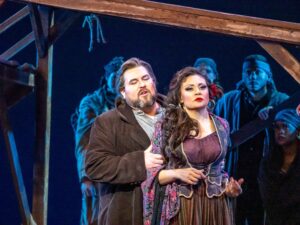
Certainly, stage director Dennis Robinson, Jr. deserves some of the credit for this higher-voltage Carmen, but so does the contrast so vividly framed by soprano Melinda Whittington as the sweetheart Micaëla, quaintly relaying a kiss to Don José from his dear ailing mother back home. Each of Whittington’s plaintive arias in the first three acts is a gem, wafting an anthemic lyricism from Micaëla’s native countryside over the stage and threatening to steal Carmen’s thunder. Cambridge must respond! Yet the new dimension for me came from the men who capture Carmen’s flitting fancy, tenor Jonny Kaufman as Don José and baritone Daniel Scofield as Escamillo, the dashing bullfighter.
No disrespect to tenors Ramón Vargas and the charismatic Roberto Alagna, both extremely capable vocalists that I’ve seen at the Metropolitan Opera as José, but neither was a hulking or intimidating presence. With or without his pearly smile, Kaufman does stand out among his fellow dragoons. Discarding the smiling ease of his welcome to Micaëla for the torments of love and passion that Carmen arouses, Kaufman is already anguished by the end of Act 1, two months before the deeper agonies of Act 2. Between this José and this Carmen we saw a battle between fidelity and wanton caprice. That’s what we expect from Bizet’s masterwork, and it escalated through Act 4 when Carmen’s fatal presentiments were fulfilled.
What comes into focus more sharply in this Opera Carolina revival, on top of the palpable danger of loving a woman who flouts soldiers, hangs out with smugglers, and dishes out a mean lap dance, is that Carmen is drawn to formidable strong men – able to see the violence lurking within before we do. She embraces the scent of danger. She loves the hunt, the capture, the freedom, the risk, and the danger of a wild predatory life. We saw a Carmen bent on living life on her terms, willing to die for it.
Scofield delivers the goods better than most of the Escamillos we’ve seen at the Belk parading into Pastia’s Tavern with his torchlit “Toreador Song,” but while all Josés we’ve seen are credible as the great matador’s fans, none have been as formidable as adversaries. That makes the outcome of the Act 3 knife fight between the rivals, by far the best of Dale Girard’s fight choreography here, as credible as José’s candid admiration. Carmen can see what this soldier is capable of in this production, believe in the terrible fate that her deck of cards predicted, and spit in his face anyway.
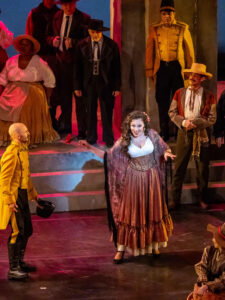
A production this well-staged, acted, and sung deserves a grander set design than the one we see here from Annabelle Roy, but the costumes by Susan Memmott Allred – on loan from Utah Opera – go far in making up for the colorlessness of this Seville. In fact, the yellow-gold of the dragoons’ uniforms vividly reminded me of the amazing clay surface of the Plaza de Toros and its dazzling buttery hue, where bulls and bullfighters shed their blood, more like Seville for me than Roy’s standard-issue arches.
When performances are this committed and intense, whether from conductor James Meena and the Charlotte Symphony or from Cambridge as the Gypsy temptress, even a moment of slackness can be instantly telling. Such a moment happened on opening night when the trumpets’ retreat was sounded – seemingly from backstage – summoning José back to his barracks right in the middle of Carmen’s quiet, sexy, up-close dance for him alone. Riled up by Kaufman’s impulse to depart in mid-enchantment, Cambridge yielded up to Carmen’s full insulted fury – except when she took off her castanets and carefully set them down on a nearby café table instead of flinging or slamming them down, breaking character for nearly a full second. By the time she flung José’s saber and hat to the floor, she was fully returned to raging diva mode. Kaufman was just one among multitudes in the house who would now follow Cambridge anywhere.
February 14, 2025, Charlotte, NC – Russian-born pianist Olga Kern has now played in Charlotte at least five times, making her one of our most popular and welcome guest artists. Yet, it wasn’t exactly inevitable that she would someday sit before us in a Charlotte Symphony program headlined by the music of Edward Elgar. We’ve had distinguished artists here playing Elgar concertos, including violinist Nigel Kennedy and cellist Alisa Weilerstein, but Sir Edward’s fame has never rested upon his scant keyboard output, though his piano quintet is a masterpiece.
More predictable, perhaps, was the pairing of German-born guest conductor Ruth Reinhardt, the music director designate at the Rhode Island Philharmonic, with Elgar’s Enigma Variations (1899) – or with Robert Schumann’s Piano Concerto, since it was premiered in 1842 with Clara Schumann, the composer’s wife, at the keys.
Better yet, Reinhardt brought a piece with her by Josef Suk, a Czech composer we rarely hear in the Queen City. Suk was Antonín Dvořák’s most prized student, and his Pohádka (Fairy Tale) premiered as incidental music for Julius Zeyer’s play, Radúz and Mahulena, less than eight months before he became Dvořák’s son-in-law on his mentor’s silver wedding anniversary in 1898. Adding to the poignancy of this very romantic and dramatic music, Dvořák and Otilka would both die less than a year apart before Suk could ever celebrate his seventh wedding anniversary.
The opening movement, “The True Love of Radúz and Mahulena and Their Sorrows,” rearranged from Acts I and III, swept in with the warm cellos, dominating until the high winds and then the violins entered. CSO concertmaster Calin Ovidiu Lupanu had a lovely pair of solos sandwiched around the two sorrowful orchestral swells, the first triggered by the timpani and the second by the French horn. Since Suk was also a violinist, co-founder of the famed Czech String Quartet, it might be possible to imagine Lupanu as the composer serenading his bride-to-be with the Princess Mahulena’s theme, “Lovely Maiden with the Violin,” when the spotlight fell on the concertmaster.
Plenty of scurrying sounds sketched the “Game of Swans and Peacocks” intermezzo, apparently a game played by the young lovers (duck and goose, anyone?). The liveliness crested grandly into hints of massive carnival joy, bounced by the percussion, winds, and brass. While the printed program omitted the “Intermezzo” labeling from the ensuing movement, “Funeral Music,” you’ll find it preserved in the gorgeous digital program, where useful glosses on each section of the Enigma Variations also appear. Even before the twin tragedies would befall Suk, he a had natural talent for this lugubrious solemnity, initiated by the cellos and basses. There’s a uniquely queasy sound from the winds at this funeral that I jotted down as “nauseating” at first blush.
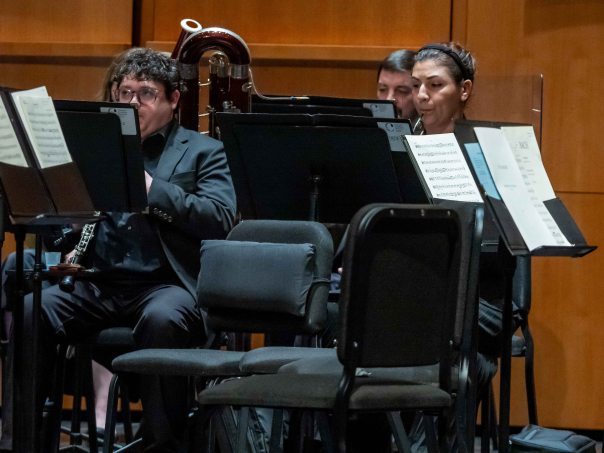
“The True Love” was long enough to elicit applause from audience members who weren’t following in their programs, but even though a percussionist pointedly rose at the end of “Funeral March” and readied his cymbals to launch the finale, more applause splurted forth to provide an extra gap before “Runa’s Curse and Victory of Love.” Subtitles above the stage cuing the beginning of movements could have prevented or muted these outbursts, which seem smilingly tolerated by the musicians rather than welcomed. The juicy story of Runa’s curse and the lovers’ escape, since Zeyer’s play will not likely ever be seen again, would have been a nice topping to the rising and falling episodes of the music, raucous in the wake of the cymbals before receding into a mellow calm with a lovely spot for clarinetist Taylor Marino.
Runa’s curse, the program or supertitles could have told us, turns the lovely Mahulena into a poplar tree and erases Radúz’s memory. Yet love – or fabulous luck – conquers all! The tragical Radúz somehow decides to chop down the poplar. Out pops Mahulena, breaking Runa’s curse and killing the witch. The last graceful decrescendo glided into a valedictory solo from concertmaster Lupanu evoking the Princess.
To be fair, adding supertitles to Reinhardt’s finely sculpted performance of Fairy Tale wouldn’t have come to mind if supertitles hadn’t proven to be such an enjoyable extra in CSO’s Enigma Variations, last given in 2010 with Christopher Warren-Green at the podium in an all-Elgar program – the program that featured Weilerstein’s Charlotte Symphony debut. Even if you had read the 15 blurbs from the digital program, occasionally condensed on the projections, you might not remember them all while the music was playing. As early as the second section, where the opening Andante slides smoothly into Variation I – (C.A.E.) L’istesso tempo, dedicated to his wife, you could lose track of where we were.
When we reached Variation XI (G.R.S.), for example, we could more fully be in the moment knowing that the piece wasn’t really about organist George Robertson Sinclair but about his bulldog plunging into a river. No doubt Elgar was purposely (needlessly?) cryptic in his Enigma dedications, as in the penultimate Variation XIII, dedicated to (***) rather than Lady Mary Lygon or a previous fiancée. The last, dedicated to himself, is initialed E.D.U. Word of warning: though this towering finale should be crowned with an obbligato organ, the impressive array of upstage organ pipes have never made a peep at Belk Theater since it opened in 1992. Temper your expectations if they’re on a Westminster Abbey scale.
Warren-Green always had a wonderful touch with programmatic music, usually engaging and helpful when he lent his bass-baritone to witty and concise spoken intros. Reinhardt had no less sensitivity or success with the music, so the supertitles added zest, flavor, and purpose to the music. But she never spoke to us, missing the opportunity to shape the occasion or even briefly add extra coherence to the program. This was Valentine’s Day, and all of the listed works were inspired by a wife or a fiancée.
Kern certainly personified the theme, playing the grand work inspired by its first soloist, Clara Schumann. It’s easy to forget the Cliburn Competition winner’s first appearances in Charlotte when she pounded Rachmaninoff to raucous submission before her Symphony debut. Carolinas Concert Association subscribers were absolutely besotted with her beauty and power in 2006 and 2007. Only when Alan Yamamoto reined her in on the Rach 2 later in 2007 could I jump onto the bandwagon. In the outer Allegro movements of the Schumann, she was certainly the powerhouse that Stephen Hough was when he gave the concerto here in 2014 with Warren-Green, and almost equaled his magical finesse in the beguiling middle movement Andantino. Two dazzling encores, immediately smashing the evening’s Valentine motif with the first, Gershwin’s “Fascinating Rhythm,” ensured that the devotion of her Charlotte fanbase would endure.
Review: The Play That Goes Wrong at Theatre Charlotte
By Perry Tannenbaum
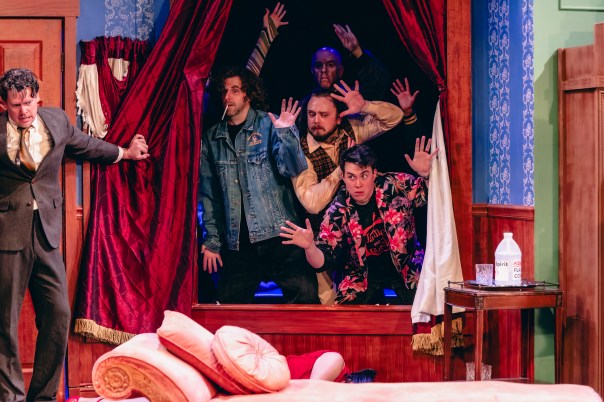
Every time Inspector Carter declares his determination to solve “The Murder at Haversham Manor,” lights at Theatre Charlotte suddenly turn a lurid red to triple-underline the melodrama. This may be the only technical element that consistently goes right in The Play That Goes Wrong, now running – and decomposing before our very eyes –through February 23.
The mantelpiece over the fireplace in Charles Haversham’s study remains a work-in-progress long after the master is murdered. The painting above the mantle – clearly the wrong painting – doesn’t stay where it belongs, and a pesky door stubbornly resists efforts to unlock it when it isn’t wandering off its hinges. In similar disrepair, we may count the phone, the intercom, the elevator leading up to the second-floor office, and the walls themselves.
It is a precisely flimsy set, lovingly put together by Theatre Charlotte artistic director Chris Timmons, so precisely flimsy that it must conform to approximate dimensions to accommodate the cast. So active that the set predictably won the Tony and Drama Desk Awards for best scenic design in its 2017 Broadway debut. Like Michael Frayn’s famed Noises Off, another British play-within-a-play that goes comically wrong and wronger – but on a stage that revolves a full 180ᵒ – the set is like a machine. It could be packaged like an Ikea kit.
Written by Henry Lewis, Jonathan Sayer & Henry Shields, The Play That Goes Wrong nestles more naturally at the Old Queens Road Barn than at Knight Theater, where the national tour touched down in the QC six Novembers ago. The basic concept is that a small-time community theatre, perennially understaffed and underfunded, has suddenly received a grant that will finally enable it to present a full-fledged production.
No longer will Chekhov’s classic Three Sisters be reduced to Two Sisters at the Cornley University Drama Society. Nor will Lloyd Webber’s resplendent Cats be shrunk to Cat. It’s the birth of a new era!
But unfortunately, the new era hasn’t ushered in an influx of fresh acting talent and technical know-how. Dennis struggles with her lines and usually mispronounces the tough words written on her hands. Jonathan repeatedly re-enters the action before he’s supposed to. Sandra has an unfortunate knack of being in the wrong place at the wrong time; and her understudy, Annie, after subbing for Sandra when she’s knocked unconscious, reads terribly. Yet she refuses to yield back her role when Sandra revives.
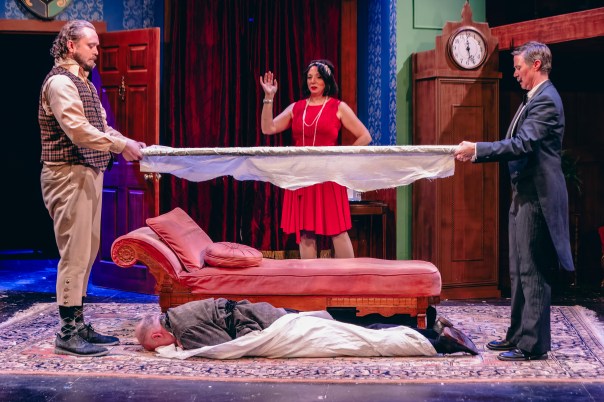
Props aren’t reliably placed in their assigned locations by the incompetent crew. When they are properly placed or deployed, like the stretcher needed to carry the corpse through the finicky front door, they may not function properly. The Duran Duran CD, sought after by lighting-and-sound man Trevor before the play begins, will turn up inconveniently onstage deep into Act 2.
Which reminds me: even though those redlight cues are absolutely reliable, the portentous sound cues accompanying them are not.
Tonya Bludsworth directs all this carefully calibrated chaos with an able assistant director, Brian Lafontaine. Together, they and Brandon Samples as Chris bring out a key point that didn’t strike home for me as forcefully when I saw the touring version in 2019. Chris not only plays the plum role of Inspector Carter in The Murder at Haversham Manor, but he also serves as the stage director, prop maker, box office manager, and PR rep – totally responsible for this catastrophe, and obviously overstretched.
On the smaller Theatre Charlotte stage, Samples is closer to us and we can focus on him more sharply than if his flop sweat were dripping down at Knight Theater. Makes a difference when one protagonist seems to be especially invested in the worsening outcome, valiantly trying to cover up the metastasizing miscues, and gaping at the sheer scale of his own mismanagement and incompetence.
For me, Sample’s visible struggles – from his nervous shit-faced grins on up to his hissy fits – made Chris a little more poignant for me. Here is a man who cares so much about theatre, and he’s watching all his multiple shortfalls in artistry and management implode so spectacularly. We can feel for the rest of this woeful team, but not nearly as much.
Lee Thomas earns a distant second place in our sympathies just for the physical punishment he takes as Charles Haversham, the stepped-on, sat-on, and mishandled murder victim. Or for the dismal ratio of abuse absorbed to dialogue delivered. When he finally does speak, maybe for the first time at Theatre Charlotte since 2020, it is as an actor of mind-boggling incompetence, eclipsing nearly all of his castmates. Thomas is rather good at looking quietly embarrassed, confused, and discombobulated.
Jenn Grabenstetter as Sandra starts off in a sympathetic slot, cast as Florence Colleymore, the murder victim’s bride-to-be. Our empathy for her slackens when we learn that Charles’s brother, Cecil Haversham, is Florence’s true love. Or when we see how stylized Sandra is as a performer. Or when she skips ahead one line, answering Inspector Carter’s questions before he asks them. But we feel for her – a little bit, anyway – when the front door flattens her and her castmates prop her up inside a clock. When Florence revives, she has to battle Annie to reclaim her role with some fine screwball fight choreography by Allison Collins.
The character arc for Rachel Mackall as Annie is even more transformational, for her Florence starts off in a near-catatonic monotone until she does the first of her pratfalls, scattering the pages of her script and maybe dislodging a contact lens. That raises Annie’s energy level, leading to the subsequent miracle where, battling Grabenstetter for the spotlight, she suddenly has her lines memorized while becoming a vicious gladiator.
More WWWF-style action would not have been amiss, but there’s still plenty.
Like Selsdon in Noises Off, Dennis’s prime reason for existing in The Play That Goes Wrong is to roundly muck things up. Lewis, Sayer & Shields seem to be indicating that he’s inept, miscast, or over-the-hill. What the hell, Bludsworth casts a woman in the role, the venerable Andrea King, who may have actually portrayed more women on QC stages than men and describes herself like a cute puppy for sale in the digital playbill.
With so much incompetence surrounding the Haversham Murder production, it’s a bit cruel to arraign her as the sole culprit for substituting turpentine when a decanter of adult beverage is served to guests at the Manor. Or it is when that happens for the first time. It’s on her when the screwup is repeated, sparking a prolonged series of spit-takes because she has also forgotten a line that would propel the action forward instead of casting it into a never-ending loop.
King maintains a cheery insouciance no matter what kind of havoc she causes, enabling Cody Robinson as Robert to become king of the spit takes as the bride-to-be’s brother, Thomas Colleymore. With a preternatural Joe Belushi energy, Robinson demonstrates that Robert’s distaste for “White Spirit” can actually increase with each sip! When we think Robinson’s frustration and rage have peaked or even exceeded expectations, he still turns it up a couple of notches.
Adam Peal as Robert and Roman Michael Lawrence as Trevor fill out the roster of actors implicated in the murdering of The Murder at Habersham Manor. Robert is not only amateurish but also a carefree hambone, so naturally Chris gives him two roles to botch. Initially, Peal appears as Cecil Haversham, Charles’s scheming brother and Florence’s true love. But there’s more to butcher when Robert resurfaces as Arthur the gardener, laying on some eyewitness evidence.
Did I mention that Trevor, after losing track of his Duran Duran treasures, must abandon his functions as lighting and soundman when Annie, replacing Sandra, is also stricken? That script-scattering pratfall was just the beginning of her misadventures. While Lawrence has already shown us – and will continue to show us – how badly Trevor performs at his chosen specialties, we can brace ourselves for his slaughter of Florence Colleymore, postponed only by his reluctance to play the role.
On my second viewing, it was possible to pay more attention to the convoluted mystery plot by “Susie H. K. Brideswell.” Now I can confidently proclaim that Habersham Manor is a masterpiece of implausibility. Doesn’t work at all.
Woefully, Theatre Charlotte doesn’t seem to have experienced a financial windfall that parallels Cornley University’s. That would have enabled them to append a faux playbill for the Habersham Manor production to the conventional Play That Goes Wrong program. Then we could learn the last names of the players and the Habersham roles they play with less fuss and bother. A few tidbits about the players also enriched the experience of the touring production.
Apparently, when the playwrights founded their Goes Wrong franchise (Peter Pan and The Nativity are among the spin-offs), they must have been focused on crafting three of the roles for themselves to perform in London and Broadway – and meshing with Nigel Hook, their mad genius set designer. So they didn’t insist that their faux playbill must be printed to accompany the show.
That lack of detailing serves to emphasize where The Play That Goes Wrong doesn’t measure up to Noises Off! Frayn’s work fleshes out relationships between the actors onstage when they’re backstage and, with its first-act rehearsal scene, gives us a more vivid idea of how the play-within-a-play is intended to go. For that reason, despite all the hilarity that Lewis, Sayer & Shields deliver, I’d hesitate to recommend The Play That Goes Wrong to anyone who is new to theatre – or hasn’t experienced a play that goes right.
But for sheer fun in frightening times, this show is welcome medicine for everyone else. TikTok & Friends may have brought nostalgia for America’s Home Videos to a screeching halt, but this latest romp at the Queens Road Barn revives the special pleasure – and laughter – of similar train wrecks large and small running right at us, non-stop, on a live stage.
Joe Turner’s Come and Gone, directed by Corlis Hayes, last came and went at Central Piedmont Community College in 2015. Back then, the production demonstrated how ill-suited even a renovated Pease Auditorium was for the best of August Wilson’s dramas. Panoramic Pease has now been demolished, so it will be interesting to see Hayes come back again to the CP campus, along with Jonavan Adams reprising his role as Herald – at a real theater in the fledgling Parr Center. Dominic Weaver, also in the mix ten years back, gets a juicier role this time as Bynum, the conjuring root doctor.
Turner, the second play in Wilson’s decade-by-decade traversal of the 20th century, The Pittsburgh Cycle, is set at a Pittsburgh boarding house in 1911. Rather than hinting at WW1 later in the decade, the drama hearkens back to slavery, the Civil War, and their aftermath, both glorious and sad.
“Every character has a story, and every story has a song,” says Hayes. “The play explores African American identity, healing from trauma, and the power of community and self-discovery. More significantly the play is an examination of Black people in transition during The Great Migration.”
Though it never settles down here in the QC, it’s nice to know that Steve Martin’s beautifully crafted Bright Star, while tracing its graceful decades-longstory, carves a North Carolina oval around Charlotte. Crisscrossing between Asheville and Raleigh with stopovers in Hayes Creek and Zebulon. Martin’s music leans pleasantly westward, delivering bluegrass and mountain flavors, brightly flecked with sounds of the comedy polymath’s signature banjo. Nor in transporting the original “Iron Mountain Baby” story to the Blue Ridge Mountains, does Martin neglect the rhythm of the rails, for a train traveling over a river is pivotal to the plotline.
So of course, this genial musical, which stopped at Belk Theater on its national tour in 2018, is a perfect match for Matthews Playhouse (and its nearby depots) as it arrives for a richly deserved revival. Newly crowned last month with the 2024 North Carolina Theatre Conference Community Theatre Award, headquartered at the Matthews Community Center, this company is perfectly poised to deliver the authentic vibe.
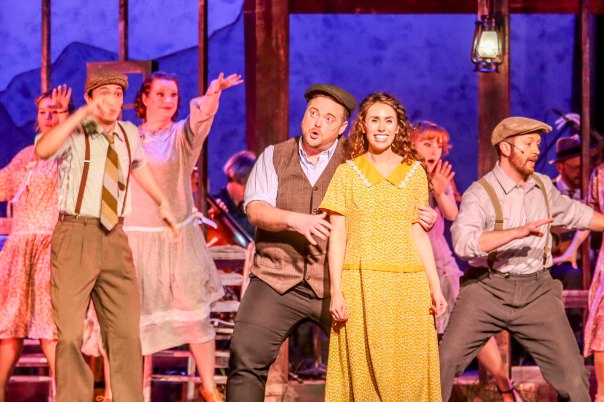
Under the meticulous direction of Paula Baldwin, it does. Her design team, also leaning mountainward, delivers a rusticated look overall, with Yvette Moten’s varied costume designs pushing gently back against the drift of scenic designer Marty Wolff’s driftwood-and-tree-trunk set. Even when we’re at the Asheville Southern Journal, where Alice Murphy passes judgment on manuscripts by Carl Sandburg and Tennessee Williams, the fancy signage over the office is painted on wood. This buttoned-up office is no less rusticated than Jimmy Ray Dobbs’ porch at the mayoral mansion in Zebulon, way over past Raleigh.
And the music! Nestled in an upstage shed framed by the timbers, musical director Ellen Robinson leads a zesty septet from the keyboard, with Nelson Frazier on the banjo. Edie Brickell’s lyrics ain’t no great shakes, but he had a hand in composing the music, so we’ll give him a pass.
Shuttling across the Tarheel State, we also shuttle between 1923 and 1946, when Alice decides to tell us her story. Although I loved the tale when I first set sight on it over six years ago, it wasn’t until I revisited it last week that I experienced its full power. Part of the revelation came from the alchemy of gradually remembering the Bright Star story as it unfolded anew inside Fullwood Theater – knowing what was coming a few minutes before it happened – and part of it came from Baldwin and her company simply doing a better job.
It seemed like the director of the touring production, whose name I didn’t mention in my review, cast his Alice solely on the basis of how well she personified the spinster-like stickler editor of 1946 rather than how well she evoked the vivacious and vulnerable underage victim of 1923. But Hilary Powell is consistently flesh-and-blood in spanning the wide gap between her prim present and her more primal past.
Powell decisively makes these Alices different people when we finally get to see the lass who captivated Jimmy Ray, the mayor’s son. Her smiles are like a sudden outpouring of sunshine on a previously rainy day. When we first saw her as a formidable editor, still aggrieved by her ancient breakup, we could hardly guess how it all had ended. As open and joyous as she once was, the prestigious editor is now largely inscrutable. Was her dear Jimmy Ray cruel and alive or devoted and dead?
Turns out there’s another possibility when we delve into Alice’s past, meet Jimmy Ray, and revisit their illicit romance. Lit up by Powell, Nick Culp as her beau brings us more radiance, eclipsing the touring portrayal we saw in 2018 as charismatically as his paramour does.
While we’re time-traveling out in Asheville and over in Zebulon, the story in Hayes Creek moves steadily forward from 1945, when Billy Cane returns from WW2, apparently unscathed, undecorated, and unkissed. He’s an aspiring writer with many stories to tell about his hometown, so it’s natural that the owner of Margot’s Bookstore is the first to greet him – clearly more chastely than she’d like. Billy’s heart is set on Asheville, where he hopes to publish his first works in the Southern Journal.
Not above a little subterfuge, Billy pens a letter of recommendation from Thomas Wolfe to bring along with his manuscripts to the Journal office. Gatekeepers Lucy and Daryl find Billy’s presumptions ludicrous, blithely tossing the unknown’s precious manuscript in the trash before his eyes. Fortunately, Alice happens by and, knowing that Wolfe has been dead these seven years, finds herself impressed by Billy’s duplicitous audacity.
We can presume that Billy knew enough about Wolfe’s connection to Asheville to accurately gauge how a recommendation from him would resonate there. Conveniently enough for Martin’s purposes, Wolfe’s Asheville home – a boarding house really, if you remember Look Homeward Angel – wasn’t turned into a memorial landmark until 1949. Sandburg’s home in Flat Rock, as you may know, is also a National Historic Site.
Billy sheepishly realizes that he’s been busted by the person he most wishes to impress, which only enhances his naïve charm. Alice keeps one of the manuscripts, not to publish but because she sees promise. Subsequently, she puts Billy under Daryl’s tutelage as his personal editor and sounding board. Robert Allen isn’t too swishy as Daryl but gay enough, and he provides a cosmopolitan contrast to Joshua Brand’s wide-eyed innocence as Billy.
I’m willing to entertain the idea that Brand is fulfilling the role of a drop-dead dreamboat, but it’s Hannah Daniels as Lucy who cements his magnetism, coming on to Billy after his first tastes of alcohol. Brand is hit-and-miss in rendering Billy’s reactions, overacting more than once, but I’ll admit that made him more unpolished and adorable for me.
Truth is, the augmented professionalism of Theatre Charlotte and Matthews Playhouse – in the absence of big Equity companies across the Metrolina region – makes me miss community theatre. Yet I also found the exaggerated greenhorn aspects of this Billy to be very complementary to the dark, melodramatic side of Martin’s yarn. Softened only by his contrite drunkenness deep in Act 2, Darren Spencer was absolutely fiendish as Mayor Josiah Dobbs, more like the ketchup Trump we’ve never seen than the eating-cats debater who is merely hilarious TV.
Jimmy Ray’s dad was a man who could stuff a newborn baby in a satchel, board a train, toss his grandson in a river, and inspire a lurid folksong. Spencer revels in the moment and Baldwin makes a point of triple underlining it. She also makes sure that Culp and Murphy don’t mute their reactions to the loss of their child and the atrocity.
Of course, in this retelling, the satchel dropping doesn’t become notorious. Alice keeps seeking to discover the whereabouts of her adopted son and her parents nurse their regrets, dad for signing the papers and mom for letting him. Compared to Mayor Dobbs, John West as Daddy Murphy and Liz Waller as Mama are benign, eventually earning our empathy with their years of suffering, estrangement from their daughter, and remorse. Even at his worst, West contrasts meaningfully with the diabolical mayor, rejecting his grandson out of wrongheaded righteousness rather than self-interest.
Back in Hayes Creek, Daddy Cane and Margot eagerly follow Billy’s progress over in Asheville. Looking at Todd Basinger as the dad, you can easily see where Billy’s simplicity and goodness came from. And if Gabriella Gonzalez as Margo seems conspicuously more experienced as an actress than Brand, that also plays beautifully. Remember, she’s a successful bookstore owner. Like Alice, she knows good writing when she sees it.
Daddy Cane has a big secret, but in a moment that reverberates back to Ulysses’ scar in The Odyssey, the secret gives itself up without him. Aristotle himself would have been delighted to see how Baldwin brought his concept of anagnorisis – the moment of recognition – to life. That heart-stopping revelation brought me close to tears, mostly because I saw it coming.
January 11, 2025, Charlotte, NC – Although we still get steady rations of Mozart from Charlotte Symphony since the days when Christof Perick passed the baton to Christopher Warren-Green, we havn’t heard much Bach from the orchestra since the autumnal Bachtoberfest faded from Symphony’s portfolio nearly a decade ago. This is understandable, if lamentable: after bringing us a double dose of the Baroque titan in 2018 – plus a shot of Vivaldi’s Four Seasons – violinist/conductor Aisslinn Nosky became a mainstay at Bach Akademie Charlotte (and one of the annual Charlotte Bach Festival’s primary claims to national prominence). A return to the Classics Series, set for 2020 via the Leipzig master’s Brandenburg Concerto #2, was quashed by the onset of COVID.
You could say that the suspense has been building. For a while, it seemed like CSO was tacitly conceding the high ground to the Akademie and its festival, presented by musicians from across the country who perform on authentic Baroque instruments. Playing the music of Bach on modern instruments, you could argue, has become paradoxically retro.
Yet the more deeply you explore musical history and authenticity, the more obvious it becomes that ancient (looking at you, Vivaldi-Schubert-Tchaikovsky) composers eagerly embraced new instruments, recycled their compositions for different instruments and different-sized ensembles, and encouraged musicians to copy, interpret, modify, and spread their music as they pleased. Reverence for absolute fidelity to original compositions is as absurd as assuming that top recording artists, whether it were Bob Dylan or Taylor Swift, would never allow covers of their greatest hits. If it sounds good – and magahits often do – go for it!
So it was heartening to find that CSO was intrepid enough to present a Bach Orchestral Suite in a modern-instrument performance and, perhaps to underscore the point, Johann Sebastian’s Keyboard Concerto No. 6, adapted by the composer himself from the Brandenburg No. 4. A certain amount of ambiguity pervaded Knight Theater as guest conductor Jeri Lynne Johnson made her debut. The house that greeted her was packed to the topmost row of the balcony. Yet the cause for the crush may have been the cancellation of the previous evening’s performance due to a “snowstorm” that had generated more bloated hype than solid news.
The only sparsity was on the Knight Theater stage. Johnson and the CSO would not be discarding all of the orthodoxies of the authenticists: the size of the orchestra had been scaled back to those employed in Bach’s days and those that would have played Mozart’s Symphony No. 25. The interloper on the program, Stravinsky’s Concerto for Piano & Wind Instruments, was also conspicuously downsized.
Viewed in profile, Johnson’s black suit – and her decisiveness – enhanced her resemblance to Kamala Harris. Symphony responded energetically to her baton all evening long, yet there was no lack of lyricism or finesse when Bach’s Orchestral Suite No. 3 transitioned from its brassy opening Overture to the famed Air (on a G string). Concertmaster Calin Lupanu, accorded considerable space in the opening movement, spearheaded the ethereal violin section to the requisite sublimity as the big tune gracefully swelled. Their intimacy quickly pointed up the advantage of a trimmed ensemble.
Subscribers who hadn’t scrutinized their program leaflets, let alone scanned its QR code for the full booklet, were likely shocked by the mass departure of the string sections, the arrival of the Steinway, and the empty chairs that remained as pianist Orion Weiss made his genial entrance. Deceptive! After a rather solemn Largo opening from the winds, with a somewhat promising crescendo at its center, Weiss’s first notes from the keyboard in the Allegro section were savage knuckle-busting clusters, met by a lusty clamor from the previously wan winds, crowned by a thumping of timpani.
Amid the cascade of chords that Weiss inflicted on the keyboard, a jazzy percussive rhythm infectiously emerged – even if it was impossible to determine whether the blizzard of notes Weiss was playing were the right notes. Suddenly, Weiss had taken on the appearance of a febrile Russian madman! The ensuing Largo provided lyrical reassurance, with some primeval passages set aside for oboists Erica Cice and principal Timothy Swanson. The pacing of the closing Allegro was almost as frenetic as the opening: if there were wrong notes here, Stravinsky had put them there with wicked glee.
Unless you were expecting an enormous horde of string players to flood the stage for the Mozart symphony, the biggest surprise after intermission was at the beginning, when Weiss returned for the Bach Keyboard Concerto. When Johnson stood by, she applauded not only Weiss but also flutists Amy Orsinger Whitehead and principal Victor Wang. Jackson’s outfit hadn’t been the only one I’d noticed until then. As she took her place with the winds for the Orchestral Suite, Whitehead’s black attire seemed to be strikingly ornate and elegant. So this featured slot explained the seeming breach of decorum.
Nor do you need to go more than a couple of bars into the Brandenburg Concerto No. 4 or its Keyboard Concerto offspring to savor the impact of its paired flutes delivering the catchy theme of its opening Allegro. Baroque aficionados, on the other hand, might have needed a minute or so to acclimate themselves to hearing the more rounded and gilded timbres of modern metal flutes. Their record shelves are likely clogged with trendier authentic recordings, marked by the presence of ancient wooden flutes and their hollower sound. Frankly, it was refreshing – and fun – for me, and Weiss bore a distinctly merrier look as well, though his cadenzas remained challenging.
Let’s not waste any more time in declaring that Charlotte Symphony retains its zest for Mozart. With this trim ensemble and Jackson’s accenting, what we heard at the Knight ranked among the most exemplary performances CSO has lavished on a Mozart symphony, even if the youthful No. 25 doesn’t rank among his very best. The opening 25-note sequence from the legendary 17-year-old prodigy, a 16-note vamp followed by a nine-note melody, hasn’t worn out its winsomeness in over 250 years.
Standing out almost as much as the crispness of the orchestra were the lovely solo spots from Swanson, capping what was perhaps his finest evening since assuming the first oboe chair this season. Jackson was gratifyingly bold in differentiating Mozart’s dynamics, finishing out the penultimate Menuetto with a satisfying crescendo. The closing Allegro featured more assertive playing from the winds pitted against the ferocity of the strings. Every now and then, we could discern Swanson’s oboe hovering above the fray.
Whether it’s jazz, bluegrass, or the rock fantasias of Eric Clapton, John McLaughlin, and Carlos Santana, much of modern music is rooted in the appeal of riffing on a tune. That allure has been around for centuries, known as theme and variations when dressed up in the periwigs and cravats of the Baroque Era. Among the great classical composers who have shown off their wizardry in the form are Rachmaninoff, Tchaikovsky, Brahms, Beethoven, and Bach.
Embellishing a melody and cracking open its chord structure are at the heart of theme-and-variations praxis, but there are also wicked, macho elements of challenge, competition, and virtuosity baked into the form. The jam session in jazz becomes a cutting contest when two titans collide. Who can imagine and execute the most intricate, complex, and satisfying variation?
So it was gratifying to learn that Johann Sebastian Bach’s A Musical Offering originated as a challenge. The challenge was issued in Berlin to the visiting Leipzig master – by none other than Frederick II, King of Prussia, his son Carl Philipp Emanuel’s employer. After Bach had duly impressed the king, his noblemen, and an assembly of the finest musicians in Europe by improvising new compositions on each of the new fortepianos at court, King Frederick laid down his gauntlet.
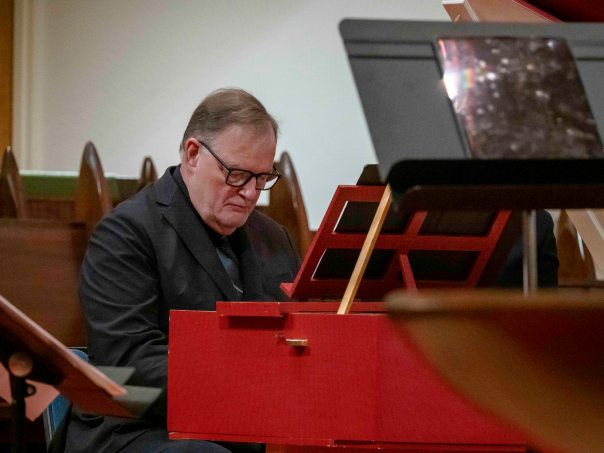
Compose a three-part fugue on the spot based on a melody he, the king, had written. Game on! Bach sat down once again at one of the keyboards he had just tested and tossed off a brand new 1747 masterwork on May 7, the first piece in Bach Akademie Charlotte’s inaugural concert of 2025 at St. Mark’s Lutheran Church, played by renowned harpsichordist Ian Watson.
Thankfully, “Frederick the Great” was royally miffed to see Bach meet his challenge so effortlessly. He literally doubled down on his challenge to humiliate his distinguished guest, daring Bach to execute a six-part fugue on the same tune. Here Bach judiciously yielded, saying that he would need some time at home to fulfill such a daunting assignment on such a worthy theme. Within two months, at age 62, Bach delivered on the king’s request and completed the six-part invention plus over a dozen more canonic gems.
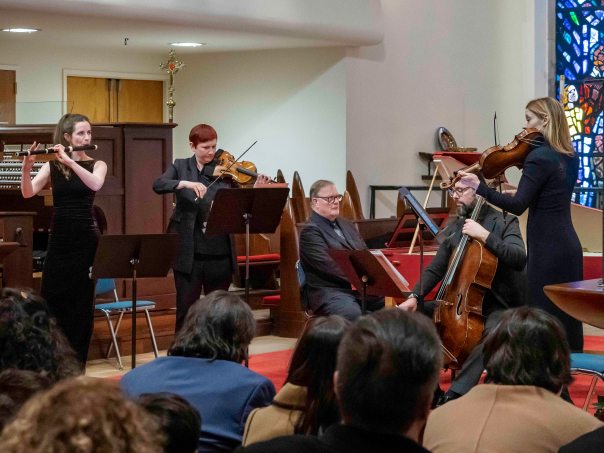
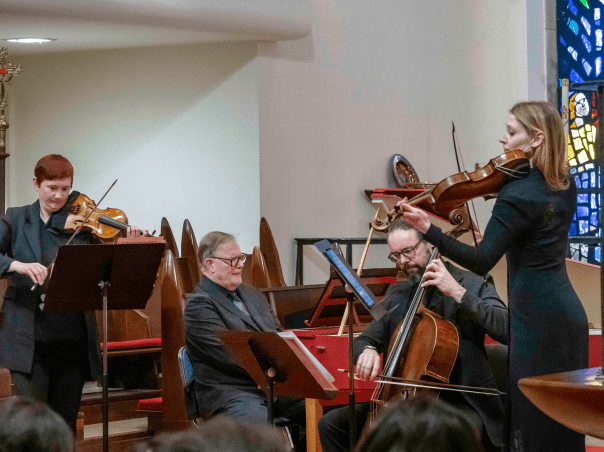
Modern recordings of A Musical Offering are all over 50 minutes in length and, depending on whether the original theme is prefaced, 16 or 17 tracks. Various instrumental configurations are available after the initial solo track. For this live Akademie concert, BACh artistic leader Guy Fishman assembled an all-star quintet that included himself on cello, Watson at the keyboard, Emi Fergusson on transverse flute, co-artistic leader Aisslinn Nosky on violin, and Renée Hemsing playing viola and violin.
Though I have four or five Goldberg Variations in my collection, I’ve never heard Bach’s most famous variations performed live, so this opportunity to hear the lesser-known Musicalisches Opfer was doubly special. Interspersed with the marquee piece of the evening were three other works, a CPE Bach Violin Sonata, a flute sonata by King Frederick II, and a Cello Sonata by Carl Heinrich Braun, another Bach contemporary.
Fishman’s spoken remarks, supplemented by his generous program notes, vividly described the king’s arrogance and his guest’s tactful responses. Nor did the principal cellist of Boston’s Handel & Haydn Society avoid detailing the various devices and complexities that Bach lavished on his thematically connected compositions. But with five musicians assembled before us, many in the audience must have been surprised that Watson alone would be playing Bach’s opening salvo.
The result was denser and tinnier than orchestral recordings of the Ricercar a 3, with less linearity than a recording on organ that I’ve heard. Three voices presented by two hands on a live stage! No matter how dense that sounded – remember that an organ can differentiate with multiple keyboards and registers plus a pedal board – it was amazing to see and hear.
Each new movement in the piece was usefully punctuated by musicians rising and sitting while music stands were being set up in new configurations. Nevertheless, confusion set in before we reached the second piece of the evening, the King of Prussia’s Flute Sonata No. 9. Three movements were listed under the Musical Offering and the ensemble was clearly playing more.
I lost track. Scattered in the program, in clusters of three, five, and five (if I’m deciphering the typography properly), were the remaining pieces of the Musical Offering. Titles for the remaining movements didn’t entirely correspond with titles of any recording available to me on Apple or Spotify. The four Sonata movements embedded in the piece could have been mistaken for another listing if it weren’t for the BWV catalog number, and a hefty number of the segments that could easily be recognized were played sooner or later than common practice.
Most recordings don’t label any of the movements “Quaerendo invenietis,” a title given twice in the Akademie program, and where they do appear, they are played consecutively. Not at St. Mark’s Lutheran. The climactic Ricercar a 6 that Frederick had ordered, for another example, usually claims Track 9 on Musical Offering recordings. At St. Mark’s Lutheran, it was sixteenth and last on the bill. Thus I can say with conviction that all five instrumentalists were involved in the glorious finale, but I’m more than a bit hazy on most of the rest.
While this disorientation made it impossible for us to even attempt to track the incredible gymnastics of Bach’s inventions – themes and variations played in reverse, simultaneously in varying tempos, descending instead of ascending, or even upside down – the confusion didn’t carry over to the other pieces on the program. Here we were freer to scrutinize and enjoy.
Fergusson, of course, benefitted most from the spotlight shifting toward the non-Musicalisches pieces. One of these by Frederick II, in addition to the four-movement sequence embedded in the Offering, was a flute sonata. It was possible, upon hearing Fergusson’s performance of the king’s Sonata No. 9, to reserve judgment for a little while since the first of Frederick’s three E-minor movements was at a slow Grave tempo. Prussia’s monarch was a flutist, after all, writing chiefly to spotlight his own prowess.
But the next two movements were fast and faster, Allegro assai and Presto, so there could be no doubting Frederick’s genuine proficiency as a composer or as a performer. The piece was also sufficiently virtuosic to tempt me toward rushing to judgment on Fergusson, partly because the acoustics at St. Mark’s were so extraordinarily friendly to her transverse flute.
This performance was the best I had seen live on baroque flute since 2004 when I had the privilege of seeing, hearing, and meeting Michala Petri at the Verbier Festival. When we arrived at the four-movement Trio Sonata for Flute, Violin, and Continuo shortly after intermission, my reflex reactions to Fergusson’s artistry were bolstered. In the lyrical odd-numbered movements, her fruity tone bloomed again. And in the two uptempo Allegros, where her virtuosity not only impressed but intertwined with Nosky’s delicious work, one could nearly marvel as much at the musicians as at the composer.
“Now for something completely different,” Fishman quipped before leaning into Graun Sonata for Violoncello and Continuo in C, accompanied by Watson. If you’ve heard Fishman tackle Bach’s Cello Suites here in Charlotte, the three-movement Graun was lighter and less daunting. Fishman seemed to have the most fun with the final Allegretto, making it dance in its 3/4 waltz tempo.
Even simpler, Fishman joined Watson as continuo partners in Carl Philipp Emanuel’s Violin Sonata in D, accompanying Nosky. Here again, the piece was not a stretch for anyone involved, but it brought us merrily enough to intermission, with another movement in 3/4, a leisurely Menuet sandwiched between two iterations of a faster one.
The piece closes a delightful collection of CPE Violin Sonatas released by Rachel Podger in 2023, demonstrating over and over that Bach’s most prestigious son merits more play. Three minor-key sonatas on the same disc are equally fine. The E-minor, in particular, yields more pleasure in less time.
January 19, 2025, Davidson, NC – With so many churches in the metro Charlotte area, it’s little wonder that the Queen City is fertile ground for choirs and choristers – and receptive audiences for choral music. Considering this profusion of talent and activity, as well as the total absence of Caritas A Cappella Ensemble press releases in my voluminous mailbox and the lack of catch-up info on the Caritas website, I was able to forgive myself for not having known about this organization, founded by Cathy Youngblood in 2017, until signing up for this review.
More ominous, as we entered the St. Alban’s Episcopal Church, was the elephant in the room: a spanking new grand piano in the middle of the sanctuary, standing in front of two rows of music stands where the singers would be placing their iPads and music scores. Was there somebody at Caritas HQ (if there’s more to it than the PO Box given at the website) who needed to learn the meaning of a cappella?
Thankfully, the piano was there for a delayed pre-show, so the mammoth obstacle turned out to be a blessing. For once, my wife Sue and I had arrived early enough for a Music at St. Alban’s concert to take in the prelude event, where star students from the Davidson area are given the opportunity to play for an audience and warm us up for the featured guests.
Those of us who had arrived on time for the pre-show were rewarded, while awaiting the arrival of Tianyang Chen, with a couple of delightful morsels of Brahms from his teacher, Cynthia Lawing. Once Chen had gone through his recital of pieces by Ginastera, Liszt, Brahms, and Debussy, the elephant could be moved to make way for the marquee players.
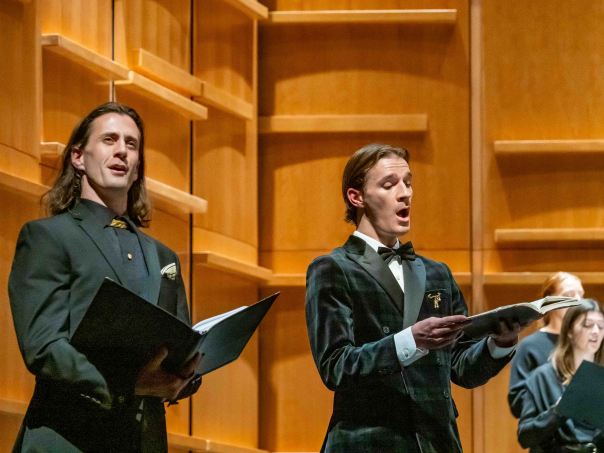
Surprises didn’t cease with the piano’s exit. Caritas artistic director Jeremy Mims entered the sanctuary in the usual way, but the Ensemble didn’t take their places behind the music stands. Instead, they encircled the audience – men in front, women at the rear of the hall – for the opening selection, “Musick’s Empire” from Triptych by Lloyd Pfautsch (1921-2003). Besides the ethereal surround sound blend, this presentation heightened the drama when Mims cued the female voices. Fittingly, the outré deployment of the Ensemble was devoted to a modern piece. It wasn’t until the singers took their places after this opening that the title of their concert, “A Capella Through the Ages,” could be fulfilled in a more orderly, chronological manner.
Fussing a bit with the printed program, replacing a couple of titles on the list with new selections and occasionally shuffling the order of performance, the concert kept to its original design, flashing back to the Baroque days of Vivaldi, Palestrina, and the Scarlattis with a nice mix of sacred and secular lyrics. Whether it’s Handel or Bach, we hear many of the mightiest works from that wondrous era, so it was nice to sample these less familiar gems.
What interested me most on the program was the predominance of more modern pieces, from the days of Bruckner, Holst and Vaughan Williams to the present day. Pieces like these, which sound surprisingly retro compared to the modern chamber and orchestral pieces we’re familiar with, have always been mainstays at Spoleto Festival USA concerts down in Charleston, SC, so I was eager to see how these performances would compare and how a North Carolina audience would react.
The composers’ names were no less intriguing and enticing. We don’t readily recognize contemporary composers Elaine Hagenberg (1979-), Kevin Memley (1971-), Eric Whitacre (1970-), and Pärt Uusberg (1986-) by their last names. As for Frank Tichelli (1958-), whose “Earth Song” was inserted after the program was printed, I was nowhere close to knowing how to spell his name when Mims announced it. “Sikelly” was my first stab. Well-matched to the slow-paced, richly-scored music, Earth’s lyric was rather simple at its core: “Oh war and power, you blind and blur. The torn heart cries out in pain. In pain. But music and singing have been my refuge, and music and singing shall be my light.”
Uniquely, the beauty of the hallelujahs later on was more like a solemn sunset than a jubilant festival. Sadly, Caritas’s enunciation was no clearer than that of multiple recordings – including one by the famed Seraphic Fire – I sampled on Spotify, which offered welcome first aid in deciphering the lovely lyrics. Consonants were often unclear, vain routinely indistinguishable from pain. And vowels! Try to hear “light” when that word pops up!
Never again will I blame myself for losing track of what a choir is singing in Latin (or any other foreign language) when I have the printed text before me. For that reason alone, Uusberg’s magical “Ōhtul” nudged “Earth Song” aside for me as the most impressive piece on the program. Since translations were appended to the program, full contentment with the performance was a simpler matter. The grand swell, as the poet’s song paddled away, was a lovely surprise after everything else – bird, little flower, and forest trees – had been silenced and lulled to sleep by the twilight. Erkki-Sven Tüür (1959-) and Arvo Pärt (1935-) will need to leave some space for this youngster on their pedestal as my favorite Estonian composers.
As for the practice of printing translations for vocal performances, a brief word. Follow the practice of most opera companies nowadays who project subtitles even when the operas are performed in English. Print the English texts with the translations for our fullest enjoyment.
“Nunc Dimitis” by Gustav Holst (1874-1934) impressed me nearly as much as the Uusberg, with solos from soprano Sarah Ochoa and tenor Nicholas Setzer. The soloists not only sang their brief solos purely, they set the stage for responses from the Ensemble at a dramatically augmented volume. Wisely, the Latin didn’t appear in the program, clearing the pathway to pleasure when we went straight to the translation.
Of course, the fullest experiences at this concert came from songs in our language that were either familiar to us or readily grasped in real time. The most enjoyable of these included Hagenberg’s joyous “Alleluia,” though it sported few more words aside from amen, and the finale that followed, “Ezekiel Saw de Wheel” as arranged by William L. Dawson (1899-1990). Most surprising of all was Vaughan Williams’ “O Mistress Mine,” from his Three Elizabethan Part-Songs, a rather frisky departure for a composer better known for the grandeur of A Sea Symphony, the anguish and majesty of Job,and the simple tragedy of Riders to the Sea.
Gerald Finzi’s “My spirit sang all day,” mercifully brief, didn’t really speak to me, and “Shenadoah,” as arranged by James Erb (1926-2014) disappointed. Crossing the “wide Missouri,” we have an inalienable right to more bass and sinew between the shores. Bypassing my personal distaste for the foundational baby-worship that pervades Christianity, the pairing of Whitacre’s “Lux Aurumque” and Memley’s “O Magnum Mysterium” were more pleasing to me in Latin, since ignoring the translations – and savoring Memley’s heavenly harmonies – was an option.
Amusingly enough, I had to adjust my attitude toward Caritas’s choice of William Billings’ “I am the Rose of Sharon” past the midway point of a largely repetitive and pedestrian performance. When the famed snippet from the Song of Solomon reached its denouement, “for, lo, the winter is past and the rain is gone,” you could look out the huge St. Alban’s windows and see that the rain really was stopping in response to these pertinent repetitions.
If you missed that, you couldn’t help but notice streaks of bright sunlight suddenly streaming across the front rows of singers. In his intro to the piece, Mims had hoped that the concluding verse would bring an end to the rain. But the power of Caritas’s incantations exceeded this extravagant hope. Repetitions and all, you won’t find me arguing with such cosmic success!
More than a decade before Cabaret, Tootsie, Victor Victoria, The Birdcage, and Kinky Boots pushed harder and harder against Hollywood’s crossdressing taboo, Billy Wilder’s SOME LIKE IT HOT smashed through in 1959. This was a deliciously adult film, and with Marilyn Monroe and Tony Curtis as the leads, deliriously appealing to hordes of teens who cherished the stars as their heartthrobs and hormone stirrers. Because of the sleeping cars and backstage dressing rooms tightly woven into singer Sugar Kane’s roving lifestyle, there was an extra edge of voyeurism for Marilyn to innocently exploit in close quarters.
True to its outlaw spirit, the story yanked us back to the days of Prohibition, legendary mobsters, and big band jazz – the speakeasy trinity. Any other kind of music in a musical adaptation of this comedy would be a turn-off for me. Listening to the sound of violins in the overture of Sugar, the first Broadway musical adaptation of Wilder’s screenplay, with music by Jule Styne and orchestrations by Phil Lang, my ears recoiled and my gorge rose as soon as the strings got involved with tremolos and sugary transitions.
No cocktails, please. Even Sugar drank hard liquor in the film. From a flask she stashed in her stocking.
Though many will question the liberties Matthew Lopez and Amber Ruffin take with Wilder’s storyline, they follow a more natural path with Marc Shaiman’s jazzier 2022 score than their 1972 predecessors. Predictably, as the current touring version confirms, they choose a more progressive PC path as well.
As soon as Sugar follows her boss, Sweet Sue, into the spotlight at Belk Theater, movie mavens and dilettantes will surely notice her radical Lopez/Ruffin makeover: Sugar isn’t lily white like the players in Wilder’s cast. Or dumb. Or objectified.
Now Marilyn wasn’t so dumb that she would pass up the chance to seduce a millionaire (it’s in the background checking that she faltered), but director/choreographer Casey Nicholaw has his leading lady, Leandra Ellis-Gaston, easing off a little when she presses that pedal. There are plenty of other places in this yarn where the comedy can be broadened.
The guys that Wilder’s risqué trailer called Marilyn’s “bosom buddies” get some subtler remodeling. Jerry still plays bass like Jack Lemmon, but he and bandleader Sue are now Black musicians. No less important, Tavis Kordell is going to take more readily to drag than his ‘50s counterpart, with a more profound and nuanced appreciation of womanhood than even Dustin Hoffman achieved as the more cerebral Tootsie. After a while, Jerry feels like he is Daphne, a transition that Kordell, a non-binary Raeford native and a UNC-Greensboro grad, is pleasingly at home with.
As Curtis did, Joe still blows the saxophone before and after he crossdresses, transforms into Josephine, and joins Sweet Sue and her Society Syncopators Band. But since Christian Borle was nearly 50 when he opened on Broadway in the role, the former Black Stache (Peter and the Starcatcher)and rockstar Shakespeare (Something Rotten!) was repeatedly chided for being old. So unlike the suave matinee idol of the film, when Matt Loehr whips off his blonde wig and reverts from Josephine to Joe, his hair is more salt than pepper.
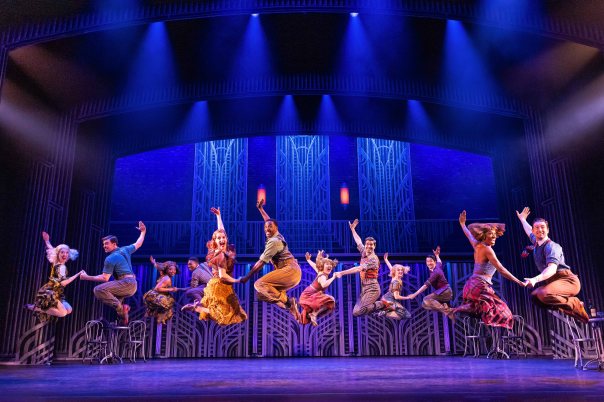
Ranging further from the original, both Josephine and Daphne double their showbiz talents as an amazing tapdance duo – so the oldster has drawn a high-energy role. If Loehr is at pains to keep in step with Kordell and Ellis-Gaston, his huffing and puffing can only augment the comedy. Somewhat fiendishly, Nicholaw delights in giving all three leads a workout, even embracing the absurdity that all the Syncopators can become ace tapdancers – along with the waiters and bellmen they meet on the way.
Of course, when the tap duo is in disguise, they dance in high heels.
Momentum for the story – and the guys’ motivation to sequester themselves in drag – pushes from Chicago, where mobster Spats Columbo initially hires Jerry and Joe to perform. The production saves on scenery and props by keeping Spats’s killings indoors while arming him and his henchmen with pistols instead of machine guns. But Scott Pask’s scenery economies go too far.
Evidently, Pask never received the memo that all touring shows playing the Belk must be able to hit audiences in the eye with the production logo from a distance of 50 yards. Some Like It Hot not only lacks a logo on its faux curtain and proscenium, it’s missing any trace of color! Worse, the stage-filling motif is recycled over and over in various scenes, occasionally acquiring the hues of purple and turquoise. With the aid of smart bulbs, a quartet of chandeliers also reappears over and over during the band’s odyssey, as if they are stowaways on their voyage.
Hotel rooms, ballrooms, Spats’s office, and Osgood’s millionaire yacht are even more cheaply evoked. They do succeed in making Gregg Barnes’s costume designs look even more resplendent in relief, enhancing their Tony Award-winning aura.
Pity poor Devon Goffman as Spats – too resplendent! If the gangleader could only be more raffish and déclassé, Lopez and Ruffin might have armed him with a larger gang and Shaiman might have begrudged him a song. Goffman draws a disappointingly clean-shaven and corporate image, too seldom onstage to tighten the dramatic tension.
Nicholaw doesn’t seem to mind the void at all. Instead, he feasts on the show’s two big chases, choreographing them for their comedic flavor while evoking one of the most beloved trademarks of silent film. Ironically, we witness much of the touring Some Like It Hot as if it were a silent film because the sound at the Belk is as muffled and foggy as ever. We’d love Tarra Conner Jones as the irascible and ebullient Sweet Sue so much more if we could decipher what she’s belting so lustily. We can be thankful, too, when Ellis-Gaston gets to vamping, for her body communicates to us more completely than her larynx.
Only Edward Juvier consistently pierces through the sonic fog as the millionaire Osgood in his screwball pursuit of Daphne. Gather round him, fellow cast members, and let him preach unto ye the gospel of enunciation.
Ultimately, Lopez and Ruffin succeed in elevating the resolution between Joe and Jerry, diversifying the love match between Joe and Sugar, and crafting a more evolved relationship between Jerry and Osgood. Shaiman had the more formidable task in concocting his score, which is probably why his Some Like It Hot often feels so effortful onstage. They’re all striving so hard to create what the film so naturally was in the first place: a road musical with cherrypicked hits for Marilyn Monroe to croon, including “Runnin’ Wild,” “I Wanna Be Loved by You,” and “I’m Thru With Love.”
You can stream the original soundtrack online and judge for yourself. With a little extra diligence, you can search out Marilyn’s rare single recording of “Some Like It Hot” and see how it measures up to Shaiman’s title song, written with lyricist Scott Wittman. Pretty well, I’d say.
Handel’s Messiah Rejoices Greatly with Charlotte Symphony
By Perry Tannenbaum
December 13, 2024, Charlotte, NC – While I’m not as faithful to the Yuletide visitations of George Frideric Handel’s Messiah as I was ages ago at Queens College CUNY, where I attended free concerts at least three of my four years, my diligence has lately improved. In the last decade, I’ve seen four performances, counting the one that launched this weekend’s run at Knight Theater, with Kenney Potter preparing the Charlotte Master Chorale and guest conductor Julian Perkins leading the Charlotte Symphony. I’d actually had my heart set on a Messiah performed at the Teatro Colón in early November, but an unresponsive press office and an unexpected dress code, discovered at the box office after we had landed in Buenos Aires, thwarted our plan.
Wrapped into our plans were an opportunity to hear how a Bach choir flying in from Stuttgart would handle the King’s English, and how the vocalists would compare with our esteemed Chorale and guests. Not to mention the fabled acoustics of Teatro Colón. Lacking those Argentinian comparisons, I can still say that the Chorale was a match for any chorus I’ve heard in Messiah, and that the guest vocalists were the best I’ve heard in recent memory, including those who performed with the New York Philharmonic in 2015. Those who look for a massive orchestra might have reason to pause before rushing to the Knight, for the scale of forces led by Perkins seemed more like the North Carolina Baroque Orchestra that performed with the Chorale at First United Methodist in 2018 than the band we saw at the Knight in 2017. Over a dozen different orchestrations evolved during Handel’s own performances of Messiah over 17 years, from 1742 to 1759, so Perkins could easily match a version to the number of his orchestral recruits.
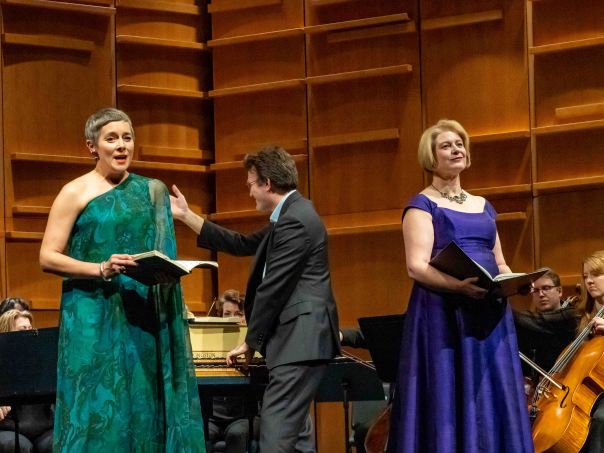
Leading from behind a harpsichord – pretty novel in itself – Perkins had some interesting ideas on staging, deploying the brass to the balcony for their dramatic entrance into “For unto us a Child is Born” and then after intermission, bringing principal trumpeter Alex Wilborn downstage for a climactic “The Trumpet Shall Sound” confrontation with bass baritone Hadleigh Adams. Otherwise, it would seem presumptuous to say that Perkins, for all his Handel and Baroque expertise, directed any of the four guest soloists at all. Each one of them was magisterially confident and self-assured. Hadleigh was not the least of them in that regard, striding auspiciously to centerstage for the first time and quaking the hall with his “Thus saith the Lord” proclamation. After delivering his towering “Why do the nations so furiously rage together?” rebuke at the crest of Part 2, Hadleigh loudly clapped his book shut and stormed back to his seat.
Richard Pittsinger was not quite so flamboyant, for the tenor wore his hair the same way before and after intermission. But his impact came sooner with supremely creamy accounts of the “Come ye, my people” recitative and the “Ev’ry valley shall be exalted.” He truly made the “rough places plain” again and again with soft floating glides that never strained his breath control. Drama was definitely in his arsenal, just before the climactic “Hallelujah” chorus, when he delivered one of the more militant verses of the Psalms, “Thou shalt break them with a rod of iron.”
It was no less difficult deciding whom to love most among the women. Mezzo-soprano Diana Moore sang her first air, “But who may abide the day of His Coming,” so richly and dramatically that I could hardly wait for her return in “O Thou, that tellest good tidings to Zion” so she could conquer its challenging low notes. Even the QR code on the program sheet doesn’t lead to the text, so Moore faced a more amusing hurdle when she came to the “spitting” in her “He was despised and rejected of men” air near the beginning of Part 2. Pronounced too diffidently, the audience might wonder what was said – too emphatically and you risk laughter. Passing that test, she went on to a satisfying Part 3 duet with Pittsinger in “O death, where is thy sting?”
Less tasked and dramatic but far more lyrical, soprano Anna Dennis dazzled in each of her airs, especially in her first splash late in Part 1, “Rejoice greatly, O daughter of Zion!” Here the refrain ideally exemplified how spectacularly Handel brought his lyrics to life. Equal to the joy she delivered here was the sanctified tenderness Dennis lavished upon “I know that my Redeemer liveth” launching Part 3. The effect was all the more ethereal for the effortless way that Dennis reached her highest notes.
Of course, the “Hallelujah” and the closing “Amen” fugue make the mightiest, most lasting impressions, but the Chorale delivered drama and delight all evening long. They were hardly accompanied by more than the harpsichord and organ until the brass and sawing violins exploded into “Wonderful! Counsellor!” in the incomparable “For unto us a Child is born.” The dynamic was no less dramatic toward the end of the evening when they reached the shuttling between gloom and jubilation in “Since by man came death.” Most exquisite, perhaps, was the delicacy Potter and Chorale endowed upon “All we, like sheep, have gone astray” seemingly more staccato than we’d ever heard it before. A disagreement seemed to arise whether it was “glorify” or “purify” when the Chorale broke into so many contrapuntal groups for “And He shall purify.” Any other blemish in the evening was almost impossible to detect.
Review: Miss Bennet: Christmas at Pemberley @ the Cain Center
By Perry Tannenbaum
If it weren’t for all the adaptations we hear about on TV and in movies, we could say that it required supreme audacity for Lauren Gunderson and , to tread in Jane Austen’s footsteps and pen a sequel to Pride and Prejudice, her wittiest and most beloved novel. But despite the obvious commercial bent of Miss Bennet: Christmas at Pemberley, Gunderson and Melcon have aimed to capture Austen’s essence and bring fresh life to her characters.
As you’ll find up at the Cain Center in Cornelius, no small thanks to the audacious direction of Steve Kaliski, the script sprinkles a bit of modern perspective on the Bennet sisters and their beaus – occasionally forcing us to recognize that Austen’s times are not so different from our own. Elizabeth Darcy, the heroine of the novel, still retains enough decorum not to call Fitzwilliam Darcy by his first name. Even in the privacy of their own home!
Likewise, elder sister Jane and her beloved Charles address each other as Mr. And Mrs. Bingley. “Happy Christmas” rather than “Merry Christmas” is the greeting norm, and the Christmas tree tradition has yet to take root in England in December of 1815. It’s Elizabeth’s audacity that brings this German custom to the Pemberley drawing room with its attached library.
In some ways, history has circled back. Back in college, my professor instantly drew our attention to the epistolary nature of Pride and Prejudice. The story is largely driven by letter writing. A chief turning point in the story is contained in a letter from Darcy addressed to Elizabeth, debunking her previous prejudices against him!
The prevalence of letter writing astonished us then – and felt alien. Ancient. Forty-plus years later, the sight of Mary Bennet, her sister Lydia, and Arthur de Bourgh exchanging billets-doux while under the same roof has to remind me of today’s texting, Instagramming youth, perpetually thumbing their cellphones. Buttressed by books, these youngsters can put quill to paper.
With Kitty off in London, not expected to arrive until Christmas Day with her parents, Mary is the only Miss Bennet we see and unexpectedly the leading lady. Arthur is an entirely new character, rivalling Mary in his bookishness. Resigned to spinsterhood, Mary is shocked to find that they’re hitting it off.
The forward-looking Gunderson and Melcon, proclaiming that Austen is for everyone, encourage diverse casting. But Kaliski and his Davidson Community Players go further, bringing us an all-female/non-binary cast. It’s an added semicircle backwards to Elizabethan days when only boys and men were permitted to perform onstage.
All three of these transpositions – Brooke McCarthy as Darcy, Rhianon Chandler as Bingley, and Jennifer Adams as De Bourgh – add a fresh patina of mirth and comedy. As for the playwrights, they inject plenty of wit and sparkle of their own. Speaking to Darcy before we see that Jane is seven-months pregnant, Elizabeth broadly hints she is arriving “safely and enormously.” Lizzy is more tactful when the expectant mother enters and they exchange greetings:
Lizzy: Look at you! You’re radiant.
Jane: I’m as large as a cottage.
Lizzy: And exactly as a cottage, you are warm, filled with life, and lit from within.
Although McCarthy plays him with some florid gestures, we soon see that he is richly endowed with breeding and tact. When the punctilious Mary presumes to correct Bingley, by informing him that the tree standing before them is a spruce and not a fir, Darcy pointedly intervenes. Before any dispute can begin, he proposes that he and his longtime chum exit for a brandy.
The ladies can now rebuke Mary, if they wish. They do, while gradually discovering that their younger sister has more charm and talent than previously suspected. Arthur’s admiration for her shocks them as much as it shocks Mary herself. As it turns out, Lizzy and Jane better be witty and perceptive, for Mary and Arthur are the plumiest roles. Fortunately, with the arrival of Lydia, the silly sister with the sham marriage, Lizzy and Jane can redirect their sharpest barbs.
Arthur is the heir to the nearby Rosings estate, but he is a distant nephew of the late Lady Catherine and has never lived there. There is some juicy history at that estate, left over from Pride and Prejudice,chiefly the presumption that Darcy would marry Milady’s daughter and not the comparatively lowborn Lizzy. Not to worry, Pemberley gracefully catches us up if we don’t remember Austen’s original.
What makes the role of Arthur so appealing is that he has no clue how to run an estate – and no solid experience with other men, women, or people. Adams carries a book around with her as if it were Arthur’s security blanket. Without one, Adams seems at a loss for what to do with her hands and arms, so we see Arthur almost perpetually in a scholarly or supplicating pose.
Attempting a billet-doux, Adams as Arthur reminded me of Christian in Cyrano de Bergerac, only he has nobody to help him out. When Arthur learns that his cousin Anne, after getting jilted by Darcy, now presumes she is betrothed to him, Adams’ awkwardness and shyness veer toward desperation and panic. When bliss is achieved, Adams’ glow is mesmerizing.
Crippled by a similar lack of self-esteem, Sahana Athreya as Mary is no more experienced and no less shy than Arthur – so she can range from being pedantic and irritating to heartbroken and pitiful to vivacious and adorable. Athreya can also freely gesticulate with her arms and sit down regally at the pianoforte.
The central triangle is further complicated by Destiney Wolfe as the compulsively silly Lydia. Glossing over her troubled marriage doesn’t inhibit Lydia from flirting shamelessly with Arthur, giving us extra tastes of how unaccustomed he is to such attentions. Nor does Kaliski bar Wolfe from being as irritating as Mary at her worst. On the contrary. Wolfe, when she isn’t pouncing, is often prancing.
At the center of all the overtures from Mary and Lydia – and the strict orders from Agatha Emma as the imperious Anne – Adams gets to be meaningful as well as stressed and sympathetic. For Mary and Lizzy, in the face of Arthur’s inclination to yield to Anne, are at considerable pains to remind him that he has what women don’t: a choice.
Of course, when Gunderson and Melcon wrote their merry comedy in 2016, they had no inking that “Your body, my choice” would be staging a comeback. But the playwrights are far from declaring that women were powerless. Even before her Christmas awakening, Mary is strong enough to proclaim that she would rather wed a plant than an unsuitable man.
Caring about their sisters, Lizzy and Jane sustain their relevance, Skylar Schock as Lizzy warming up to Mary and Emma Kitchin as the Jane becoming Lydia’s tactful benefactor. Christmas can even be celebrated by Emma, for it turns out that there’s kindness in Lydia beneath her silly, meddlesome surface.
Kaylen Gess’s scenic and lighting design complement each other handsomely, with Caleb Sigmon’s projections adding an extra festive luster. I’d imagine that Gunderson and Melcon would have envisioned a much larger, more intrusive tree at Pemberley. But as a Tannenbaum, I’m probably prejudiced.
The tree outside Cain Center, let me add, is big and bright enough for anyone.

















 Art on My Sleeve