
“Eureka” and “Vanya” Agreeably Disagree
Review: Charlotte Symphony Plays Respighi’s Pines of Rome
By Perry Tannenbaum

November 14, 2025, Charlotte, NC – Neither Maurice Duruflé nor Ottorino Respighi would rank high among composers that Charlotte Symphony subscribers most wish to hear. The orchestra’s previous two music directors, Christopher Warren-Green and Christof Perick, never performed Respighi as part of the orchestra’s classics series – he remained the province of guest conductors – and the Duruflé Requiem, after concerts by the old Oratorio Singers and Carolina Voices early in the century, hadn’t surfaced at all locally since 2007.
So a pairing of Duruflé’s most highly regarded work with two Respighi favorites, The Pines of Rome and The Fountains of Rome, didn’t figure to fill Belk Theater with rabid enthusiasts. Yet the sheer scale of the Requiem, calling forth the Charlotte Master Chorale under Kenney Potter’s leadership, made the Belk an obvious choice over the snugger Knight Theater.

Although our current music director, Kwamé Ryan, brought us Respighi’s Roman Festivals last spring, a guest conductor was once again on the podium for these more beloved Roman delights by the Italian icon. While a Duruflé-Respighi pairing will never be boffo box office, starting with the Requiem – which likely drew hundreds of the choristers’ family members to these performances – made the host of Master Chorale choristers onstage before intermission available to swell the audience for the Fountains and Pines afterwards. Adding to the electricity in the house, guest maestro Francesco Lecce-Chong deployed two groups of brass players upstairs to opposite sides of the grand tier for the final “Appian Way” section of The Pines.

Based on Gregorian themes from the Mass of the Dead, the Requiem sounded like the oldest piece on the program, though it was the newest. Fortifying that impression was the dominant role of the Chorale compared to the two soloists, mezzo-soprano Megan Samarin and baritone Eleomar Cuello. Most of us likely felt that Cuello’s noble bearing and vocals in the “Domine Jesu Christe” section were all too brief: even there, the choir had the larger share of the singing.
Samarin’s conquest in the middle “Pie Jesu” section, an ethereal solo, also seemed too fleeting, though here the Chorale was silent. Sampling recorded versions of the Requiem on Spotify and Apple, you’ll probably conclude that the orchestral version performed at the Belk packs more wallop than the organ scoring, which was probably the version that Carolina Voices chose 18 years ago at the Friendship Missionary Baptist Church. Another reason for the guest vocalists to make a more muted impression this time.

The fourth section, the “Sanctus,” decisively upstaged Cuello as Lecce-Chong rallied the forces of the orchestra and the Chorale together, but the baritone returned for a second cameo during the first half of climactic “Libera Me,” fueling the fires of the choral “dies irae” that followed. Somehow, the sublimity of the concluding “In Paradism” doused those fires. The beatific loveliness of the women’s voices certainly made for a heavenly arrival, yet the men miraculously eclipsed them in their visionary entrance, truly a mystic chorus of angels.
Instrumental excellence peeped in occasionally during the Requiem, chiefly in Timothy Swanson’s oboe obbligato for the “Kyrie” section, in bassoonist AJ Neubert’s “Lux Aeterna” intro, and in the exquisite welcome to “In Paradisium” from yet another principal, harpist Andrea Mumm Trammell. Even more play was afforded to the players in the Respighi pieces with all their resplendent colors and shadings.
Memories of hearing Respighi are invariably more sugary to me than the actual music, which under Lecce-Chong’s baton, especially in The Fountains of Rome, was refreshing and exhilarating – and, of course, effervescent. Neubert probably made an even stronger impression on oboe in his lovely, languid sketching for “The Fountain of Valle Giulia at Dawn,” with principals Taylor Marino on clarinet, Jon Lewis on cello, and Victor Wang on flute following eloquently in the same opening section.
The sunnier middle sections, depicting “Triton Fountain” and “The Fountain of Trevi,” were more impressively orchestral and brassy, Triton’s horn issuing an early proclamation at the beginning of his section and a rampage of brass, chiefly trombones, heralding midday at Trevi, Rome’s most majestic fountain. No doubt the audience was a bit surprised by the delicacy of the Fountains finale, “The Villa Medici Fountain,” and its sprinkling of percussion, celesta, and soft chimes, simulating a distant church at twilight.
My mind had first been changed on Respighi way back in 1997 when Daniele Gatti had led the London Royal Philharmonic into town with diva pianist Alicia de Larrocha. His rendition of The Fountains with the Londoners was sufficiently revelatory for me to place a rush order for Gatti’s recording of Respighi’s complete Roman trilogy, where additional revelations awaited: Roman Festivals and Pines of Rome were both more powerful, varied, and grand. Though The Pines had popped up on my calendar at the dearly departed Eastern Music Festival in 2011, this was my first opportunity to hear – and compare – Fontane di Roma and Pini di Roma in the same live concert.

With a feel as sure for Respighi as Gatti’s, Lecce-Chong’s performance was worth the long wait. “The Pines of the Villa Borghese” had a marvelous orchestral bustle before principal trumpeter Alex Wilborn was dispatched to the wings for the signature eerie effect in the solemn “Pines Near a Catacomb.” Even more quietude came with “The Pines of the Janiculum” as piano, clarinet, cellos, and a soft oboe anthem enhanced the magic. But the epic build and variety of “The Pines of the Appian Way,” seasoned with prerecorded nightingale chirruping and crowned, at the end of a satisfyingly long and majestic crescendo, with the outbreak of brass from the balcony, surpassed the grandeur of the Respighi we had heard before and joined the peaks of the Master Chorale as the pinnacles of the evening.

We can thank the Brits for the notion that passenger trains should run with absolute timeliness and precision. Now that Ken Ludwig’s meticulous adaptation has opened at the Queens Road Barn, we can also thank Agatha Christie, Britain’s most avidly read mystery writer, for her Murder on the Orient Express. Layer on Jill Bloede’s bubbly direction – and dialect coaching – and the treacherous trip rattles along with a savory continental flavor.
That soupçon of glitter and effervescence is greatly enhanced by Theatre Charlotte artistic director Chris Timmons’ fleet and fluid set design, an art deco wonder that transitions delightfully from an Istanbul hotel to a smoky train depot to the luxe interiors of the Orient Express. Since the landscape and snowscape outside the legendary train are also moodily conveyed by projections, it’s difficult to draw a precise borderline between Timmons’ scenic exploits and his lighting design.
While the paucity of professional theatre companies in the QC continues to account for the plethora of professional-grade acting talent we behold at the Barn, so does the opportunity to appear in opulent costumes such as those designed by Sophie Carlick – for hotel waiters, train conductors, and various glitterati who can afford a first-class sleeping compartment on a luxury transcontinental train.
Speed is beneficial in a murder mystery, especially as it plods along, contrary to real life, when we’re introduced to a multitude of suspects who have sufficient motive to commit the cold-blooded crime. Anyone who grew up watching the Perry Mason series on TV (or has binged on it more recently) knows the classic drill: the murder victim antagonizes a slew of enemies. So many enemies that we’re unsure who might have done the deed and more than mildly uncaring about the victim, no matter how brutally they were killed.
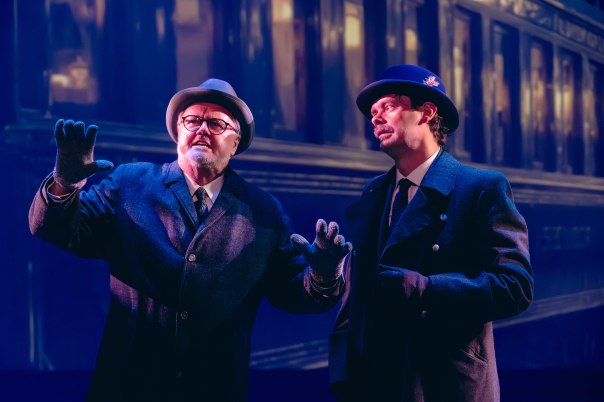
Ludwig admirably singles out our obnoxious victim-to-be and all the antagonisms he can spark while introducing us to Christie’s heroic protagonists, Constantine Bouc, owner of the Orient Express line, and peerless detective Hercule Poirot. There will be debate about Bloede’s decision to shitcan Poirot’s mustache wax and twirls in favor of a more conventional groom, but Brandon Samples’ initial entrance as the Belgian is star quality.
There’s a bit of aristocracy to Samples’ bearing that allows Poirot to fit in with his fellow passengers, including a princess, a countess, and a colonel. While Timothy Hager zestfully cements his repulsiveness as Samuel Ratchett, it’s also important for us to see that Poirot has sufficient dignity, discernment, and assets to reject Ratchett’s crass job offer.
Poirot also offers Samples a few brief episodes of befuddlement, for the culprit he is hunting leaves a blizzard of clues.
Unlike all of those complacent Perry Mason victims destined for the morgue and a court-ordered autopsy, Ratchett is keenly aware that he is being hunted. He’s willing to retain Poirot for a fabulous amount of money to protect him. Perry, you’ll remember, doesn’t arrive on the scene until after the wrong suspect is accused and arraigned. Here, Poirot is directly involved while the victim is alive. So when Samples shows no guilt or remorse for not accepting Ratchett’s offer after he is murdered, we’ll need further reasons for despising the playboy.
Christie piles them on and, in doing so, makes the bizarre solution to her mystery more plausible, for Ratchett is far more monstrous than he first seems to be.

Yet the elegance, hauteur, and glamor of the leading ladies would seem to instantly eliminate them from suspicion – or any close acquaintance with the vulgar victim. To think that Paula Baldwin as the Russian Princess Dragomiroff would deign to inflict eight stab wounds on the repellent Ratchett seems like sacrilege.
Likewise, Julia Howard as the serene and mysterious Countess Helena Andrenyi from Hungary seems worlds away from the slain playboy. The ethereal Gretchen McGinty as English governess Mary Debenham, also a smashing beauty, seems to live in an entirely different sphere, more involved with Scottish Colonel Arbuthnot (Ben Allen with a brash brogue) than the slain American.
As for Kathryn Stamas, as an esteemed actress traveling under the assumed name of Helen Hubbard, she is sufficiently brash, loudmouthed, and inconsiderate for us to worry whether Ratchett, trying to get some sleep next door and stewing with rage, will burst into her room and murder her. Murdering him would ruin her delight in riling him with her late-night singing.
However laudable it might be to murder Ratchett, three acts of God will prevent the ghoulish plan from eluding discovery: the unexpected arrival on board of legendary unraveller Hercule Poirot, the serendipitous intervention of Orient Express owner Constantine Bouc in securing a first-class compartment for Poirot, adjacent to the victim’s room. After these pieces are in place, with Bouc ready to serve as Poirot’s loyal sidekick, comes the fortuitous storm that halts the regal train in a snowbank out in the wilderness, giving Poirot sufficient time to investigate.

Bouc is obviously a key prong in Christie’s plotcraft, allowing Poirot to board the Orient Express and vesting him with the authority to investigate. Otherwise, our mustachioed sleuth wouldn’t be able to scan all our suspects’ passports or rummage through their luggage. Dramatically, he enables Poirot to interview all the suspects, another ritual of the mystery genre, corresponding to Perry Mason cross-examinations, that cries out for swift pacing.
The venerable Dennis Delamar would seem ideal for bestowing the requisite bonhomie on our gracious host and eager sidekick, except… for all his wholesome triumphs as Henry Higgins, Grandpa Vanderhoff, Kris Kringle, John Adams, Hucklebee, Jacob the Patriarch, and many more, has he ever done a French accent before? Maybe that was the question Delamar was asking himself on opening night when he uncharacteristically stumbled over a few of his opening lines.
Even for a semi-pro like me, those are lines you should be able to say in your sleep. Of course, Double D never broke character during his difficulties, so to neophytes in the audience, it may have seemed like the garrulous pensioner was stumbling over his English. Delamar’s imperturbability in this brief crisis only made Bouc more charming when he righted himself – and real panic was safely in reserve when the unsolved murder, right under his nose, threatened the image and prestige of his company.
Bouc also serves as a buffer between Poirot and the petty annoyances presented by our suspects, allowing Delamar to display his comedic chops. Samples, on the other hand, gets to revel in flipping over innocent façade after innocent façade in revealing the secret underbellies of his artful gallery of suspects. The parade of skeletons emerging from closets can’t help but add to our merriment.
So most of the actors on stage need to be adept not only in erecting their respective façades, but also in carrying off those deliciously satisfying moments when they are so disconcertingly exposed. Joshua Brand as Ratchett’s querulous secretary seems particularly innocent and above suspicion, while Emma Brand as the Princess’s trembling missionary ward is even further above. So pleasant when they fall.
Climb aboard this fatal train, and you’re likely to find the ride more fun than you expect.
October 10, 2025, Charlotte, NC – It’s a bit of a mind-bending concept, so after launching Charlotte Symphony’s 94th season by leading his orchestra and audience in the National Anthem, music director Kwamé Ryan needed to take a couple of minutes to explain what exactly a musical logo is. Symphony also has a new conventional logo, a graphic see-through C with a top seraph that reminds one of a bass clef. But Symphony’s musical or sonic logo, Ryan explained, is akin to the six notes you hear on your iPad when you get a fresh sports bulletin from ESPN or the sonic boom that blasts you off your couch when you sign in to Netflix.
Ryan joked that Symphony had gone to John Williams to write the new theme but he wasn’t available. So he settled for Mason Bates, the second most-performed living composer (by American orchestras), who accepted the commission. The timing was auspicious, for Bates’s acclaimed new opera, The Adventures of Kavalier & Clay, opened at the Met less than a month ago.
Ryan proceeded to lead his orchestra in two versions of the new logo, the world premiere of an extended concert version followed by the abbreviated five-second version concertgoers could expect to hear in the Knight Theater lobby, summoning us back from intermission. Tell me I’m wrong, but Bates also seemed to have Williams in mind, in a heraldic vein, when he fulfilled his commission. And if musical or sonic logos become a thing among orchestras, Bates, Ryan, Symphony, and its subscribers can all claim to have been on the ground floor at the Knight.
Bates also took honors for composing the first piece to appear on our printed programs for the new season, Attack Decay Sustain Release. Premiered 12 years ago on the Left Coast, this lively five-minute appetizer was written, Ryan revealed, in 7/4-time. Bates’s title was likely onomatopoetic, describing the flow of his primary melody, for the seven beats often ended with a sustained crescendo. In its multiple episodes, the five-minute piece also boasted plenty of space for highlighting Symphony’s strings and brass section, sprinkled with an assortment of woody and frond-y percussion.
The remainder of the evening would be devoted to Dmitri Shostakovich, if our printed programs were to be trusted. In greeting us, however, Symphony president David Fisk told us to expect an extra musical moment after intermission. Surprises galore! Maybe the biggest went unmentioned by Fisk and Ryan: the turnout at the Knight. Compared with the “disappointing” turnout I reported last November for Shostakovich’s Ninth, the first and only previous occasion that Shostakovich topped the bill of a Symphony program, our 2025 crowd for the composer’s Fifth was robust, few empty seats across the orchestra section and seats sold in the balcony to the uppermost row.
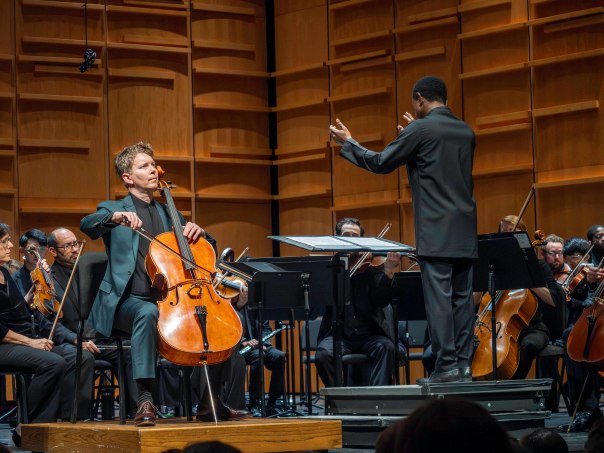
Guest soloist Joshua Roman may not have been apprised of the surprisingly enthusiastic crowd awaiting him, appearing slightly wary as he seated himself for Shosty’s Cello Concerto No. 1. With good reason. The piece, written for Mstislav Rostropovich in 1959 is bold and daring from the brash onset of its opening Allegretto movement, not at all a timid or apprentice composition. Roman’s part in the Allegretto was precociously modern; so driving, repetitive, and mechanical that it seems to antedate the minimalism of Philip Glass and John Adams. The comical interjections from brass and clarinet upstaged the soloist somewhat in my first live audition of this piece.
Roman could have told himself to be patient about winning us over, for his role became more complex and impressive after the only pause in the piece, when he tackled the cluster of three final movements, delivered without further pause. At the heart of this cluster, between a soulful Moderato and a joyous Allegro con moto, Ryan and his orchestra observed a reverential silence as Roman played the Rostropovich-worthy third movement cadenza. There were bowed sections featuring a melody and a bassline simultaneously and, deeper into the virtuosic display, interludes of counterpoint where he bowed with his right arm on open strings while plucking a second melody line with his left hand. You couldn’t miss the difficulties here even if you closed your eyes. Nor was the final movement anticlimactic, featuring the return of the orchestra and a more decorative and colorful return of the march motif from the opening movement.
Undoubtedly, the audience perceived the military triumph they had witnessed, rising for a lusty standing ovation. This triggered a final pre-intermission surprise, for after being cheered back onstage a couple of times, Roman sat himself down for an encore and, before the tumult died down, launched into the Prelude to J.S. Bach’s Cello Suite No. 1, maybe the most familiar solo he could possibly offer.
Pure negligence prevented me from sampling the sounding of the musical logo prompting our return after intermission for our most touching surprise, played in tribute to three dearly departed members of the Charlotte Symphony family. Thankfully, it wasn’t Samuel Barber’s Adagio but rather a piece that necessitated some fresh sculpting and rehearsal, Arvo Pärt’s Cantus in memoriam Benjamin Britten. Beautiful!

We’ve heard a lot from Ryan in recent years, though many Symphony subscribers might say we should have heard much more. In preparing what Shostakovich subtitled “A Soviet Artist’s Practical Creative Reply to Just Criticism” – from renowned music critic Josef Stalin – Ryan trampled on the notion that Symphony No. 5 was in any way servile, apologetic, or conciliatory. All the true moods of Shosty’s 1937 portrait of Soviet Russia were vividly rendered, beginning with the bleak, haunting, and ultimately aching qualities of the epic opening Moderato. This battlefield desolation was not altogether relieved by the comical marching of the ensuing Allegretto, which combined sourness with merriment, along with a delicious dancing interlude from concertmaster Calin Ovidiu Lupanu. The Largo reverted to the weepy and misty grumblings and dyspepsia of the opening movement. Then we transitioned wonderfully – especially in ghoulish October – to the surreal, manic phantasmagoria of the concluding Allegro non troppo. My happy memories of Christopher Warren-Green conducting this work have faded since 2013, so I offer no comparisons. But this was no doubt the finest performance I
A vampire visits a comely maiden dressed bewitchingly in black for Halloween. A werewolf goes to a special summer camp for monsters. A strange woman with a cloven head conspires with a mouse to murder an angel. These are among the seasonal dainties served up by Concord-based Post Mortem Players in Laugh ‘Til You Die, their second annual invasion of the QC, continuing at The VAPA Center through October 12.
Subtitled “A Night of Spooky Sketches & Songs,” this Charlotte’s Off-Broadway production is even more freewheeling and fragmented than last month’s Meet and Greet medley of one-acts at the VAPA Black Box. Eleven sketches and songs paraded across the cramped stage on opening night, but that number figures to fluctuate as the second weekend of the run rolls in.
That’s because the musical chores are handled by a revolving roster of guest artists. Last weekend, these included Cole Thannisch, Myles Arnold, and cast members from Post Mortem’s upcoming production of The Rocky Horror Show. Rocky, Magenta, Frank-N-Furter, Columbia, and Riff Raff will all be on hand to torment Brad and Janet up yonder in Concord, when the full Rocky premieres on October 23 at the Old Courthouse Theatre’s new Wilson Family Black Box.
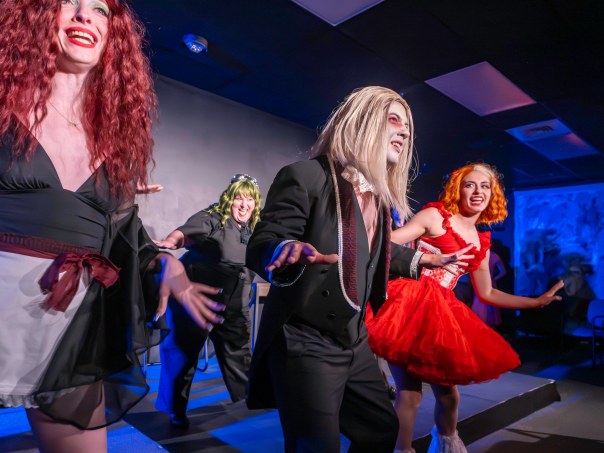
Meanwhile, enough of the gang showed up in full costume to fill the VAPA stage for two of the ghoulish musical’s signature numbers, the dreamy “Science Fiction Double Feature” and the imperishable “Time Warp” dance orgy. The young lions and lionesses will return for two of the three remaining Charlotte performances. More adventurous and exhibitionistic theatergoers will likely opt for the Rocky visitation at the Saturday night special, which amps up the macabre mischief with a costume contest.

Most lamentably revolving out of the guest rotation will be Arnold’s rousing rendition of the “Oogie Boogie Song” from The Nightmare Before Christmas, a charming amalgam of Cab Calloway, Fats Waller, and The Grinch. Thannisch yielded nothing to Arnold’s exploits in terms of charisma, smoothest and most urbane in his golden jacket as the evening’s first vampire.
Director Alli B. Graham mostly had Thannisch and Arnold singing to members of her sketch cast, so the shuttling back and forth between sketch and song flowed quite naturally. Because Nicole Cunningham wrote three of the five Laugh ‘Til You Die blackouts – each of the three a screwball parody – there was a stylistic consistency as well.

After serving as a very willing recipient for Thannisch’s vampire advances, staged far too chastely by Graham for a Charlotte audience, Cunningham cunningly continued as a witch named Laura in “Cry Witch,” strewn with references and quotes from Arthur Miller’s The Crucible. Laura seemed to be a Halloween witch rather than the real thing, married to Ryan: Dalton Norman dressed up as a fiery red devil.
The hellish secret they share is a piña colada-flavored pair of edible panties that was very unfortunately misplaced. Christine Hull, skilled at overacting in the grand Saturday Night Live manner, is the community’s moral watchdog and grand inquisitor, sending Norman and Cunningham into a nicely frothed panic. So refreshing to see a genuine witch hunt, isn’t it?

In a nicely gauged solo, Cunningham – in a costume that reminds us of an airline stewardess – welcomes us aboard a cruise along the River Styx with wonderfully plastic cheer in “Onboarding.” Since Gretchen isn’t getting off at Hades like the rest of us, maybe because she’s been there and back, she allows herself a certain amount of smug superiority mixed with her peppiness toward those of us who will stay the course. The rest of us, she serenely predicts, will jump ship. Not a preferable option.
Zaniest of all, Cunningham has penned the surreal “Cilantro and Old Lace,” where we encounter Hull once again as a cutesy mouse named Michelle and the creepy Bobbi Hawk as the cloven June, a somehow embittered woman with a meat cleaver embedded across her head. Whether or not it has anything to do with the blood-spattered cleaver, June holds some kind of grudge against the angel (or fairy?) Rhea, a precious and catty Norman in drag.
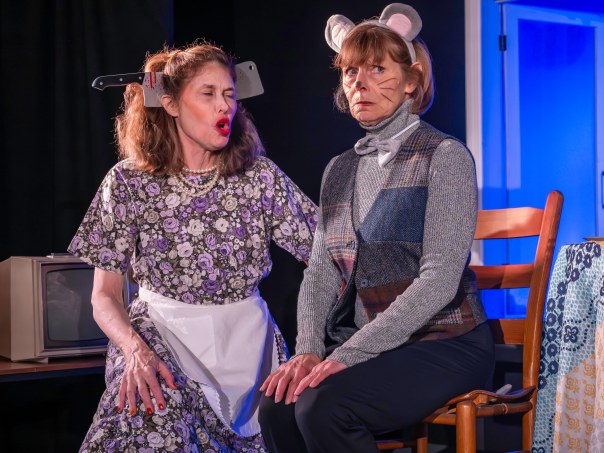
Yes, Rhea is irritating, but maybe not to the extent that she should fall victim to the deranged June taking advantage of her nemesis’s cilantro allergy. Cilantro doesn’t exactly replace the arsenic in the familiar – and similarly off-kilter – Arsenic and Old Lace. Cunningham serves the more iconic poison as a side dish.
The remaining skits are written by Andrew Pippin and Mortem marketing manager Kimberly Saunders. “Final Girl” by Saunders has arguably the least Halloween aroma of all the Laugh ‘Til You Die segments, though its ends with a fairly creepy twist. Dave Gilpin is both boss and job interviewer as Mr. Smith, eventually allowing himself to be coaxed into giving his own assistant – Hull already in her mousey mode – a crack at the opening.

Neither Cunningham as Candidate 1 nor Steve Harper as Candidate 2 earns an on-the-spot job offer from Mr. Smith before Hull gets her chance to shine in the spotlight. Harper charmed me more as the also-ran, so efficiently toting his portfolio and handing Mr. Smith his résumé. Graham must have been equally charmed in her director’s chair, for she brought Harper back for an encore immediately afterwards, clutching his portfolio for dear life as Arnold slayed in his Oogie Boogeyman showstopper.
Pippin’s “Camp Amamonsta” has as much Halloween seasoning as “Cry Witch,” with a pinch more plotting, swift pacing, and a delicious ending, though Graham’s staging is a bit stagnant. Hull is at her most fulsome as Kate, the camp counselor welcoming all her monster campers to their first day – fulsome enough for us in the audience to feel included in the welcome.
The opening day lineup includes Hawk as Vampire Bella, Norman as Jackula III, Marcella Pansini in the thankless sheet-over-her-head role as a banshee ghost, and the wondrous Harper as Harry the Werewolf, though you might perceive a lick of Cowardly Lion. Into this idyllic bliss, a scorned outsider will intrude: Gilpin as Dave. A human being!
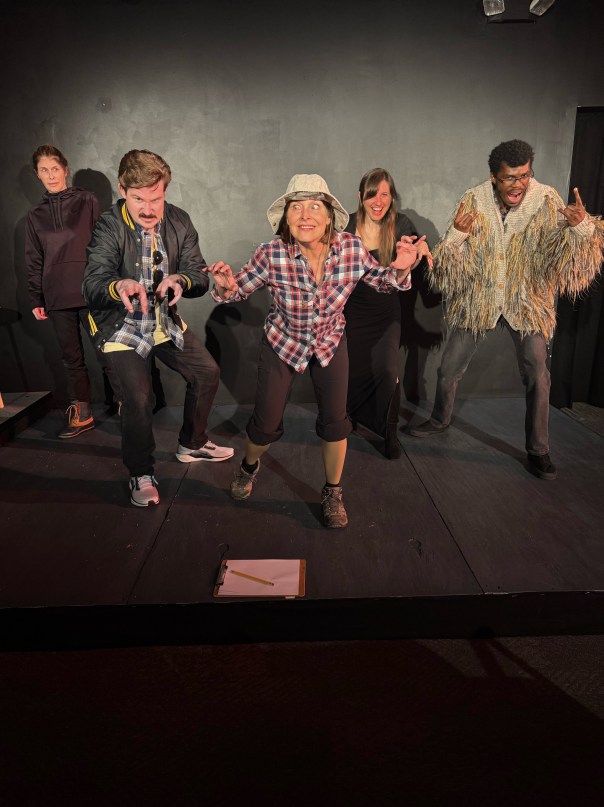
Hull retains an all-you-kids-play-nicely airiness amid the hullabaloo as Kate when it turns out that Bella is carrying on a forbidden romance with Dave. Like the rest of us, Dave is confident that his beloved merely has cosplay friends rather than fearsome monsters. Truth is, the bully among the campers, Jackula seems more likely to chugalug a beer than gobble up Dave. Harry? He’ll probably follow Jack’s lead. Whatever.
To avoid all these threats, Bella manages to talk Dave into pretending he’s a new camper rather than an outsider. Dave, however, doesn’t discard his insouciance, playing along rather than realizing he’s in peril. Yes, Pippin’s playlet actually has a setup that he could extend as long as he wishes.
At present, that isn’t too long, though we encourage Pippin to have second thoughts. Meanwhile, there’s a nifty ending in his hip pocket.
If you put the full Concord production of Rocky Horror on your calendar, you will be treated to multiple helpings of the leggy Lindsey Litka-Montes as the Popcorn Usherette and Magenta. She vamped me pretty good in “Science Fiction Double Feature,” camping next to me in the front row before making her rounds among the paying customers.
I confess to finding her even more tempting than the popcorn.

October 30, 2025, Charlotte, NC – Over and over again, as I drove home after opening night of Charlotte Ballet’s Whispers, Echoes, Voices – capped by the world premiere of resident choreographer Mthuthuzeli November’s As I Am, I found myself asking, “What Did I Just See?” That is not an unusual question for me to ask after a stellar evening of modern dance, for the art is usually abstract and chameleonic in the extreme, but on the eve of Halloween, the urgency of the question felt compounded. Exponentially.
Sitting in the fifth row, near many young people who were experiencing such vibrant abstractions for the first time, I couldn’t help but hear their exclamations and enthusiasms during the two intermissions that punctuated the program. “Amazing!!” was the most repeated outcry but not the only one, and the cumulative enthusiasm was at a you’ve-got-to-come-see-this pitch I rarely hear. But beyond the fevered response and what had caused it – for the standing ovation after November’s triumph was instant, electric, and virtually unanimous – there was a fundamental question that was not abstract. At the climax of As I Am, when a deluge rained down on soloist Maurice Mouzon Jr., out of the sky and into an opening at the top of the moody cave designed by Celia Castaldo, what had I seen? Literally.
At first blush, it seemed obvious that it was water. It looked like water, it glowed like water, it photographed like water, and it bounced like water. But as Mouzon’s primitive countrymen returned to the cave and helped him off the ground, evidence mounted quickly that it had been something else. Mouzon’s back was newly caked with the stuff and had to be wiped off. None of the barefoot ensemble of ten dancers sloshed or slipped on the stage afterwards, including the vatic priestess in her reindeer crown, and when we rose to applaud all this mystic magnificence, the stage was completely dry, without a single drainage hole in sight. Since a deluge of sand would be dangerous to the performers – and us! – my conclusion, confirmed by CharBallet the next day, was that we had seen rice.
What we had also seen, no question, was the premiere of Charlotte Ballet’s most exciting and primal original since Salvatore Aiello’s Rite of Spring.True, November’s companion soundtrack, which he composed, did not rival Stravinsky, but it was no less evocative… and obviously, more of a piece with the choreography. Here were the whispers and voices referenced by the program’s title, with plenty of pulsing and primitive percussion layered on.
After reading a review of the dress rehearsal performance, two further questions arose in my mind. How many people in the audience, contrary to the evidence before their eyes, had gone home thinking they had seen water onstage at the Knight? Was that more than the number of people who, not scrutinizing the program, didn’t realize that tonight the ensemble for As I Am was all-male, and that two of three remaining performances will be all-female? Costumes in CharBallet’s publicity photos confirms what they’ll miss. In all, four soloists will dance November’s new work, including Raven Barkley, Remi Okamoto, and the opening night priestess, Isaac Aoki.
The evening began far more elegantly and wittily with a reprise of Jiří Kylián’s Petite Mort, an international staple premiered by Nederlands Dans in 1991 and unveiled at the Knight in March 2024. It’s good to keep in mind that Kylian’s piece is more about what the title implies, “the ecstasy of sexual intercourse,” than about the two slow movements from famed Mozart piano concertos, No. 23 and No. 21 (Elvira Madigan), he sets to dance in a series of ensembles and six pas de deux. There’s a definite uptick in the quality of what we see this time at the Knight, only partially because Kylián’s explanatory notes are printed in the program beneath the credits, cluing us in to the sensuality at the core of the choreographer’s concept and the precise satire he intends with the sabers wielded by the men.
You knew that sabres were sharp and pointy, but did you realize that, by accurately kicking their handles, they will roll around the floor in a perfect circle? Mastering that trick along with the close brushes that the blades, straight or curved, make with the females onstage during Petite Mort – these can account for a bit of fear and hesitancy among all the dancers. So another reason the revival scores better than the initial thrust two seasons ago is that the dancers are handling the hardware with more confidence and élan. A complete delight this time around, with all its suggestive episodes more sensuously sketched.
In the middle of the two rousing spectacles, Crystal Pite’s dimly lit Solo Echo, set to cello sonatas by Brahms, stood out in quiescent relief. Or it did during its early moments. Flakier stuff came down in the darkness as Pite’s piece began, partially illuminated by a vertical rack of lights from the wings. That horizontal lighting, designed by Tom Visser, gradually descended from the flyloft, stopping in midair just above the dancers’ heads. Slow-paced choreography, frequently for just a couple of the seven dancers, dressed drably in costumes by Joke Visser and the choreographer, added to the hypnotic spell. Confession: I briefly fought the impulse to doze off during this monochromatic dreariness.
But then the pace quickened and Pite deployed her complete ensemble in more feverish action – while the whole upstage brightened into a skyscape depicting a glorious snowy night. More importantly, Pite’s echo concept crystallized as six of the seven tightly intertwined, one on top of another, in a vertically mirroring pose above the recumbent Mouzon, once again garnering special attention. In this blizzard, the ensemble might split apart slowly like the folds of an accordion. Or they might break apart, scurry around chaotically, and make wretched attempts to form a moving circle. Often, however, one of the dancers stood isolated from the ensemble. He or she could be viewed as an outsider, but also as the solo mind generating the echoes.


 Art on My Sleeve