Review: Pergolesi’s Stabat Mater at The Mint Museum
By Perry Tannenbaum

September 11, 2025, Charlotte, NC – With its stained-glass windows, high ceiling, and resonant wooden flooring, the Uptown Mint Museum proved to be an unexpectedly apt venue for Opera Carolina and Charlotte Symphony to join in commemorating mournful, horrific events with sacred music. Reflexively, we look to the past – and to religion – to express our feelings amid present woes, but neither of the musical organizations could have anticipated the extra layers of calamity earlier in the week that would pile onto their memorial to the victims and heroes of 9/11 on its 24th anniversary. The work they performed, Giovanni Battista Pergolesi’s Stabat Mater, has always had a tragical tinge. Pergolesi composed his most-performed work near the end of his life, all too suddenly ended in 1736 by the onset of tuberculosis at the age of 26.
The Italian was casting his eyes across the centuries in scoring his Latin text, which had already existed for four or five hundred years, depending on whether it was written by Jacopone da Todi, a Franciscan friar, or by Lotario de’ Conti di Segni, better known as Pope Innocent III. The “Stabat mater dolorósa” poem, 20 three-line stanzas written in trochaic tetrameter, meditates on the sorrows and sufferings of Jesus’ mother, more than a millennium further back in time, standing by her son during the agonies of crucifixion. While the Oxford Dictionary of Music describes the piece as originally written for male soprano, male alto, and orchestra, most of the vocalists on the 60 or so recordings of the work have been female sopranos and mezzos.
Marie Van Rhijn was the first woman to conduct a recording of Pergolesi’s chef d’oeuvre in 2021 on the Chateau de Versailles label, so Emily Jarrell Urbanek was almost a pioneer in adding her special empathy toward the grieving Virgin Mary as she stood on the podium leading the Charlotte Symphony Orchestra Ensemble. But wait: the Van Rhijn recording was done with two male vocalists! Samuel Mariño and Filippo Mineccia, listed on the album cover as the “deux costrats,” also perform the Vivaldi Stabat Mater on that release with Van Rhijn conducting. So together, Urbanek, soprano Corey Raquel Lovelace, and mezzo Leyla Martinucci may have been making feminist history after all.
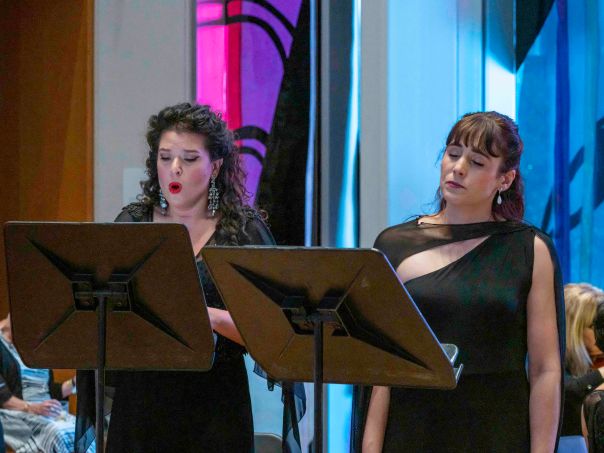
Of course, the Van Rhijn recording remains a great place to begin if you’re wishing to hear how Pergolesi’s Stabat Mater actually sounded at its premiere in Naples. Yet it didn’t take long for the first all-female version ever led by a woman in Charlotte – and the first Symphony concert we’ve heard at The Mint – to impress. Pergolesi divided the twenty-stanza text into 12 compositions, and the opening “Stabat Mater dolorosa” duet is by far the most beloved. While the orchestral intro was engaging enough, though recordings with an organ yield more heft, the blending of Martinucci’s voice with Lovelace’s was sublime.
The first five sections of Pergolesi’s Stabat Mater fully demonstrate the composer’s strengths in solo and duet writing, his lithe capacity for transitioning back and forth between those modes, and his perverse disregard for the stanza couplings of the text’s rhyme scheme. After hearing Lovelace and Martinucci, I sampled Van Rhijn’s recording, then a starry version with Anna Netrebko and Magdelena Kožená, and finally ancient music specialist Christopher Hogwood’s prestigious recording with Emma Kirkby and James Bowman. My admiration only grew for both Lovelace and Martinucci’s approach to the music. Less vibrato and ornamentation seemed more in keeping with the sacred music and the solemn occasion.
Martinucci was the more unique find overall because of the creamy richness of her sound, though Lovelace sang equally well and matched her purity. Not long after Martinucci’s luscious and revelatory “Quae moerebat et dolebat,” Lovelace’s most affecting solo was the “Vidi suum dulcem natum,” two sections later. Between them came Pergolesi’s fifth section, “Quis est homo qui non fleret,” perhaps the apex of the concert. Lovelace launched into this section at some length, so it briefly seemed like this was a solo and Martinucci had neglected to take her seat. But Martinucci had an equally gorgeous solo afterwards and Lovelace didn’t return to her seat, either. We would be ascending heavenwards once more when the two voices soon intertwined.

The tone of the special occasion was nicely prefaced with words from OpCarolina general director Shanté Williams and Profit Insight senior advisor Duncan MacNichol, who a tolled a bell for each of the four planes that crashed in 2001 when the Twin Towers fell. The only discernible shortcoming at the Mint Museum was the lack of supertitles keeping track of where we were in the text. Though Lovelace was often difficult to follow, Martinucci usually lost me. Better to luxuriate in her voice than to decode her Latin.

 Art on My Sleeve