Review: Magnificent Baroque at St. Mark’s Lutheran
By Perry Tannenbaum

August 8, 2025, Charlotte, NC – Baroque music may not be synonymous with magnificence, but magnificence was arguably what baroque composers strove for most ardently in their music, particularly in a sacred setting. Little wonder, then, that over 80 percent of baroque music concerts in the Metrolina area are performed in churches – or that St. Mark’s Lutheran Church has now hosted the area’s three foremost baroque ensembles, Carolina Pro Musica, Bach Akademie Charlotte, and The North Carolina Baroque Orchestra.
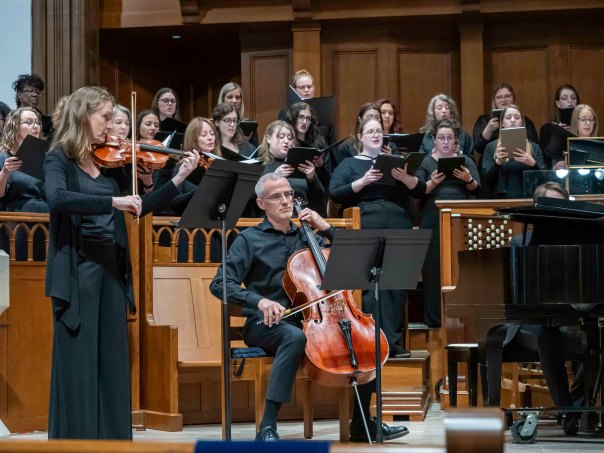
Though based in Davidson, musicians in the Orchestra hail from more than ten different states across the US. Currently in their fifteenth year, they are still led by their sister co-founders, artistic director Frances Blaker and executive director Barbara Blaker Krumdieck. Ailing in San Francisco, Blaker yielded her conducting chores to concertmaster Martie Perry. Titling their St. Mark’s concert “Magnificent Orchestral Music of the Baroque,” NC Baroque wasn’t obliged to stray far from familiar composers or their warhorses. Yet even with J.S. Bach and Antonio Vivaldi on the program, the selections were all adventurous, with works by Johann David Heinichen and Joseph Bodin de Boismortier in the mix.

It’s never a terrible idea to begin with Vivaldi, but the Concerto in D minor was especially apt, since it allowed opportunities for both our co-hosts, Perry and first cellist Krumdieck, to immediately swing into action. Indeed, the chief delights of the opening Allegro were the exchanges between the two violinists, Perry and Annie Loud, and the phalanx of four cellists led by Krumdieck. The slow movements, an Adagio and a Largo, were charming, but the Allegros following them underscored one of the chief characteristics we cherish in Vivaldi, his abrupt changes in tempo and dynamics.
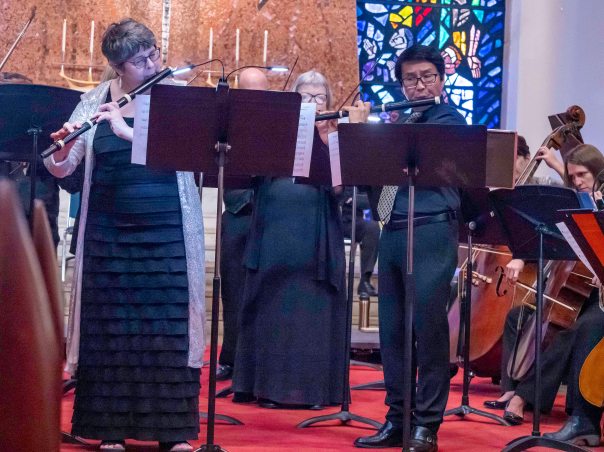
Vivaldi wrote over five hundred concertos in his lifetime, hundreds more than the famously prolific Georg Philipp Telemann, so NC Baroque had no problem unearthing repertoire that we had never heard before – or outside the familiar keyboard and string orbit. Fourteen oboe concertos and over 40 bassoon concertos are out there, to cite a couple of examples. Still, it’s a labor of patience, endurance, and discernment for the ensemble to settle on a single Concerto for Two Flutes in C (RV 533) – and from that three-movement concerto, to single out the opening Allegro molto. For the occasion, Sung Lee and Barbara Norton rose from the front pew of St. Mark’s, took their places centerstage between the violins and the cellos, and played flawlessly on their authentic instruments. What a lovely blend.
Krumdieck did the honors in introducing the double flute Vivaldi, but it was Perry who introduced the rarely-heard Heinichen, perhaps being offered for the first time in the region. Our Cultural Voice index mentions the German just twice over the years, both at performances in the Triangle Area: a Sonata for oboe, viola, and harpsichord, played in Raleigh by Mallarmé Chamber Players in 2015, and two unspecified Dresden Concertos played at the American Dance Festival in Durham two years earlier – likely through loudspeakers – accompanying a new work, Perpetual Dawn, by the Paul Taylor Dance Company.
If Spotify and Apple Music are to be trusted, virtually nobody knew about Heinichen until 1993, for that was when the much-lauded 2-CD collection of 11 Dresden Concertos was released on the Archiv label, performed by the Musica Antigua Köln led by Reinhold Goebel. My own familiarity with Heinichen, many of whose works were destroyed in the Dresden bombings of 1945, began shortly after reading a rave review of the recording (and Goebel’s introductory essay) in Gramophone.

On this night, the Concerto Grosso in G major (S. 215) and the Concerto Grosso in F (S. 232) – apparently Heinichen’s favorite keys – were the highlights, delivering the most magnificence. They were rightfully presented in ascending, chronological order, the G major after the Vivaldi works and the F major as the program finale after a sheaf of Bach Sinfonias. Again we would hear Lee and Norton on their flutes, but both Heinichen scores added a pair of oboes, played by Will Thauer and Sarah Weiner, that clashed rather than blending with the other winds.
After the first Heinichen, the two movements from Boismortier’s comic ballet, “Don Quichotte chez la duchesse,” were more than pleasant. My only problem with the performance was finding myself oversold on Perry’s tasty intro. Never did detect the promised windmills or underworld in the music, and if Mendelssohn had done Sancho Panza’s donkey, I’m sure little Rucio wouldn’t also have eluded me. Yet the Overture and Chaconne by the Frenchman provided a nice transition to the unique Bach segment of the program: four introductory instrumental pieces from four Bach Cantatas, an interlude comprised of four preludes.
All of these pieces were well chosen, none of them coming off like background Divertimentos or lackadaisical baroque elevator music. They offered fresh opportunities for soloists to take on different instruments. Subbing for Blaker on recorder, Weiner intertwined beautifully with Trauer’s oboe in the contrapuntal passages of the opening Sinfonia from the Tritt auf die Glaubensbahn (“Step onto the path of faith”) Cantata.
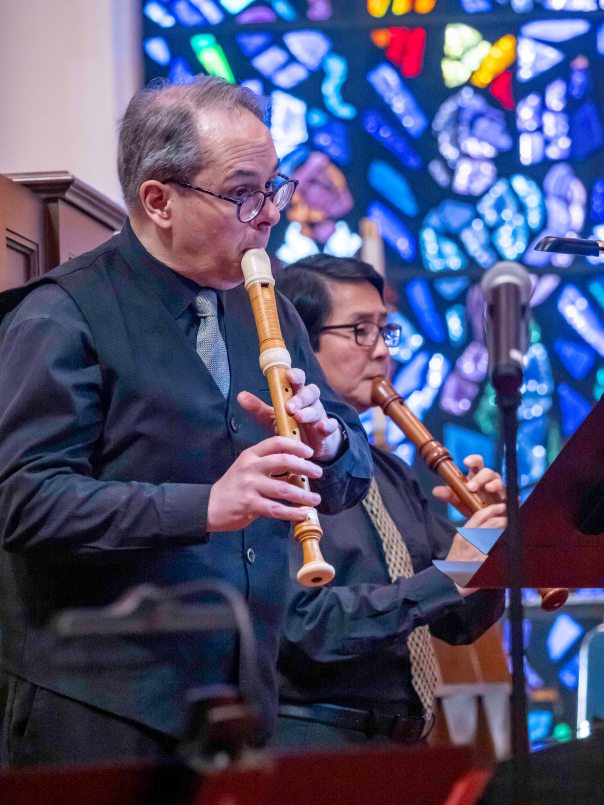
Trauer and Lee both switched from oboe to recorder for Gleichwie der Regen und Schnee vom Himmel fällt (“Just as the rain and snow fall from heaven”), bringing the Sinfonia set to a sparkling finish. Other versions you may audition on Spotify won’t sound as crisp, for it seems they’re fronted by oboes. Not that the oboes were slighted in the Sinfonia set. Weiner switched back to her customary instrument, playing beautifully on the Weinen, Klagen, Sorgen, Zagen (“Weeping, lamenting, worrying, fearing”) Sinfonia. Yet she had already been upstaged by Lee’s achingly lovely rendition of the Ich steh mit einem Fuß im Grabe (“I stand with one foot in the grave”) Sinfonia, likely repurposed from a previous concerto and subsequently recycled into the Harpsichord Concerto in F minor. Nectar of the gods.



 Art on My Sleeve