Monthly Archives: August 2025

“Electricidad” Electra-fies!!

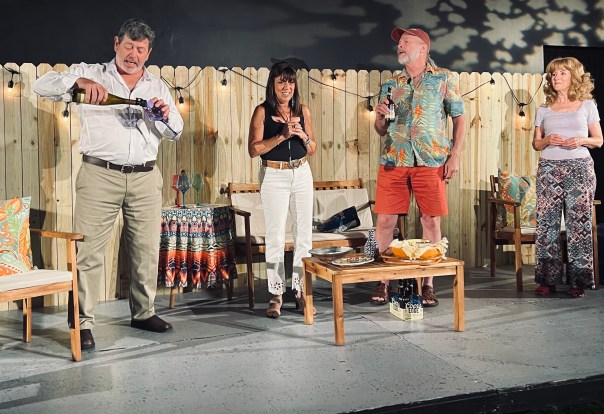
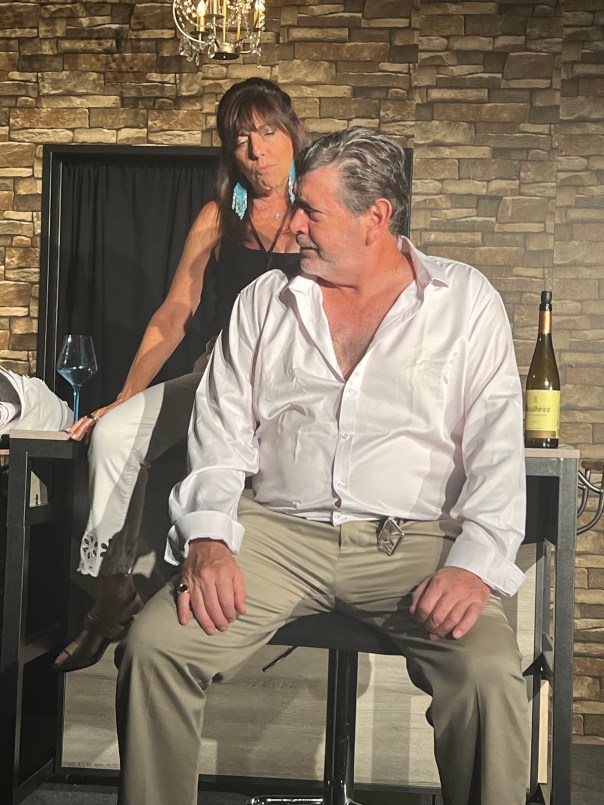
Review: Three Bone Theatre’s Electricidad at The Arts Factory

By Perry Tannenbaum

Maybe by now we’re numbed to the truth. You know how it is: 30 dead, 57,000 acres burned, 18,000 homes and buildings burned to the ground, and 200,000 people evacuated. Not enough problems already in California? Let’s call in masked men from ICE and the National Guard!!

The upheavals out West are almost enough to deflect our attention away from the all-important Jeffrey Epstein files. Los Angeles is on fire! And we shrug it off.

From what I’ve seen so far in Three Bone Theatre’s first two installments of The Greek Trilogy by Luis Alfaro, Mojada: A Medea in Los Angeles last August and Electricidad now, the plan is to keep the flames burning high and out of control from beginning to end. At peak visceral heat.

Alfaro grew up as a queer Chicano in LA and came of age before Rodney King and the infamous 1992 riots. Electricidad was actually the playwright’s first dip into Sophocles in 2003, six years after he won the MacArthur “Genius” Fellowship. So you might expect this youngest Greek modernization to be Alfaro’s angriest, fieriest, and most rebellious.

You would be right, but watch out: so far, Electricidad is also the funniest.

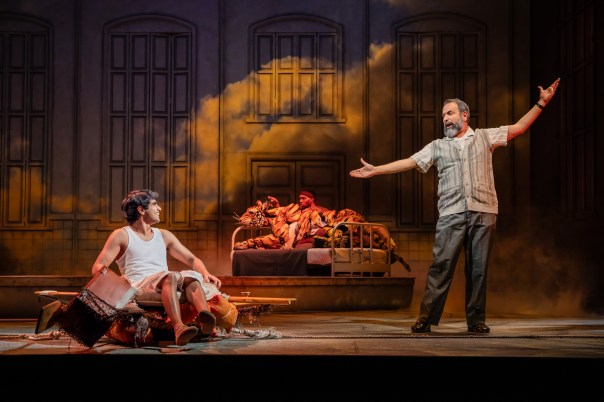
That can be a problem for director Glynnis O’Donoghue and her powerhouse cast at the intimate JCSU Arts Factory on West Trade. When Electricidad, Alfaro’s reincarnation of Sophocles’ Electra, describes her chola quarter of the LA barrio as the recognized pharmacy of the area, I was able to hear the air-quotes that surround the playwright’s text and laughed out loud.

Portraying the title princess, Melissa Lozada seemed a bit surprised and perturbed at the laughter. But her father, the venerated Agamenón (“El Auggie”), whose corpse lies enshrined in the front yard of Electricidad’s home, was the drug lord of the barrio. Her kingdom, which she plans to somehow usurp from her murderous mother, Clemencia, is built on drugs and community “protection.”

Or as one of the gossipy local Greek Chorus members puts it, “We don’t dial the 911 no more.”

More than in last year’s Mojada, the pretensions of our protagonists are repeatedly mocked and deflated. Ifigenia, E’s younger sister, is now a born-again Christian because she discovered that the meals served at her convent are far better than those she got in jail. Having taken over her abusive husband’s kingdom, Clemencia wants to sell rather than rule. She has Century 21 on speed dial and hopes to move to Pasa-fucking-dena.

In place of the ancient Greek gods, we have the modern monoliths: Target, Sears, 7-Eleven, Payless, and Oprah. Agamenón’s grieving mother, Abuela, exemplifies the warrior chola pride handed down through the generations, boasting that she pulled off her first shoplifting exploits from her baby carriage.

Brooding and vengeful, Electricidad stands apart from her family, even in her religiosity. You won’t find her praying to Jesus or the Blessed Virgin. To her, Auggie’s corpse is a sacred object, defiled by Forest Lawn, which would allow her father’s body to lie in state overnight with nobody watching.

She and Abuela whisked the body to the front yard, where she stands vigil, a squatter on her own property. E prays to her father’s spirit and talks to it, occasionally lifting her prayers to the severed head of ancient Aztec daughter Coyolxuahqui, better known as the moon.

No, Electricidad doesn’t think her devoted vigil, her seething rage, or any of her impassioned ravings are funny. Nor is she looking for a good laugh, even if her fanatical love for her father may be more than a little pathological. So Lozada’s glaring, combustible intensity is Electra, whether it’s Sophocles’, Hugo von Hofmannsthal’s, Jean Giraudoux’s, Jean Paul Sartre’s, or Eugene O’Neill’s. The laxity and corruption that surround her only increase Electricidad’s saturnine glow.

And a supremely hopeless mourning it is, for the bloody vengeance she is craving is unseemly for a woman – and Electicidad is as faithful to the old cholo ways as she is to her papá.She doesn’t realize that her brother Orestes, after being exiled to Las Vegas, where dear Clemencia ordered a hit on him, is still alive. His mentor, Niño, has thwarted the hit and is carrying on with his mission to toughen the kid up so he can take over the House of Atridas and continue in the king’s footsteps.

Although Jennifer O’Kelly’s lurid set design and projections combine with Madison King’s lighting to give the impression that LA’s el barrio is ablaze 24-7, the Arts Factory space is too limited to back up the idea that Clemencia’s check from Century 21 will be a huge fortune. It is Isabel Gonzalez as Clemencia who makes the House of Atridas formidable in a towering performance to savor every moment she’s onstage.

Even in the opening scene, as the speechless Electricidad dominates our attention sitting next to the shrine she has fashioned from Agamenón’s shrouded remains, Gonzalez lurks restlessly in the shadows in the corner of the room, a dynamo of nervous energy. The arrogance and majesty only emerge later when she paces the front room, caged in her own castle, chain-smoking, and unable to purge the terror squatting in her front yard.

Coming out to confront her sleek, gimlet-eyed daughter, Clemencia has a robust arsenal of tactics, from sweet cajoling and bribery to fierce, defiant, threatening, screaming, thundering rage. What a pair! For in retelling the fall of the House of Atreus, Alfaro has not only resurrected Agamemnon’s sacrificed daughter, Iphigenia, but he has also blotted out Aegisthus – Clytemnestra’s lover, protector, and partner in crime, ruler of Argos while the original Auggie was out of town, winning the Trojan War.

For feminists and progressives, Clemencia is unquestionably the strongest Clytemnestra of all that have been presented onstage since Aeschylus fathered the Greek rep that has survived the ages. When Gonzalez faces off against Lozada, as she did last week at the VIP dress rehearsal, we can also crown Alfaro’s Clemencia as the best of the Clytemnestras conceived for stage or opera (Hofmannsthal’s script became the libretto for Richard Strauss’s Elektra).

She certainly stands on higher moral ground than any of her predecessors, and if you hadn’t recognized Gonzalez as the diva of Hispanic actors in the QC until now, your mind will likely be changed by this hot gem. Lozada’s “Electra-fying” debut will stamp the Venezuelan spitfire no less convincingly as this year’s most exciting QC newcomer. Yes, there is spitting in el barrio.

Just don’t overlook the quieter, nuanced magnificence of Eduardo Sanchez in capturing Orestes’ mix of innocence, steely nobility, and self-doubt – prodded along by Luis Medina’s sometimes proud, sometimes slightly exasperated Niño patiently punching and tattooing his pupil into manhood. Sanchez is more than soft enough when we first encounter him to justify his skepticism about filling his father’s shoes and wearing his crown.

Matricide?!? That’s a terrifying prospect when he returns from Vegas to LA and learns what’s what. Even Mom understands his hesitance, calling him “My most sensitive one.”

O’Donoghue was still tinkering with pacing on the night we attended. Too fast and you can miss Alfaro’s choicest quips, especially with Mariana Corrales, Allison Graham, and Marcella Pansini as the Chicano chorus of street sweepers, not the best players in the lineup. Slow it down, and the comedy threatens to take over.

But when it comes to the key moment, that spark-gap instant when Orestes becomes who he was destined to be, O’Donoghue nails it with hardly a single prompt from Alfaro’s script. It’s a kind of magic, a key superpower Alfaro also preserves from ancient times for his Medea in Mojada.

As Orestes returns to Clemencia’s living room, where mamá is smoking and watching TV, she begins chanting: “Find the courage. Find the rage. Find the darkness.” This chant becomes a background incantation as Celemencia deals with the shocking reunion and Orestes copes with the enormity of his mission.

Until Electricidad screams out. It’s as if the live-wire transformer decreed by Alfaro at the top of his script, humming and crackling in the background all evening long, bursts into flame. As if Electricidad is triggering Orestes’ actions by remote control.

There’s only scant proof for my theory about O’Donoghue’s concept. Aside from The Penguins’ “Earth Angel,” specified by name in the playscript, sound designer Neifert Enrique inserts Santana’s “Black Magic Woman” as a perfect foreshadowing. You did not live the ‘70s if you don’t know it.

The pesky and complaisant sister usually assigned to irritate Electra is most often named Chrysothemis, so Michelle Medina Villalon is drawing a fairly thankless role as Ifigenia. But Alfaro perks her up a bit as Ifi really is iffy to the core, trying to get her elder sister and her mom to make peace, let bygones be bygones, and trying out Christianity as an alternative to whatever kept landing her in jail. Still sporting vivid tattoos from her past, Ifi carries around a little statue of the Blessed Virgin as a security object: to pray to, to purify her living, and maybe to mark her territory if she decides to move back permanently.

Villalon also carries around a distinctively blank and traumatized look about her – maybe a prophecy of what Orestes and Electricidad will soon become. The earth here seems to be so scorched that both the sanitation department and the police stay clear. There’s no more likelihood that the siblings will face legal consequences for their crime than Clemencia faced for hers.

As one of the street sweeper gossips tells us, this is the wild, wild ouest. The only repercussions to assail the Atridas family for all their crimes are inward – the pains of guilt, regret, and that mark that has branded our species since the days of Cain. Drugs? Expelled from the equation.

Abuela remembers the good old days, reminiscing with Niño briefly upon his return before luring him to her place. With Banu Villadares embodying the tough and pragmatic Abuela, who didn’t weep at her son’s funeral because it would mar her makeup, we can understand why she is the only person on the planet who can make Electricidad laugh. Or momentarily rescue her from her own darkness.

You just gotta love her indomitable sass. Especially in a world that’s on fire.

“Sex, Lies, and a Sycamore Tree” Almost Goes for the Jugular

Review: Sex, Lies, and a Sycamore Tree

By Perry Tannenbaum

Away somewhere in Sycamore Grove, a subdivision in the burbs of a certain fast-growing New South city in the Carolinas, there’s a diversity problem. For the McLeans and the McDaniels, lily-white next-door neighbors in playwright Elaine Alexander’s new comedy, Sex, Lies, and a Sycamore Tree, there’s still too much of it.

Owners of an ostentatious year-old McMansion that the pushy missus already plans to expand, the McLeans project an image of wealth that clearly intimidates Tracy McDaniels as she enters her neighbor’s posh patio for the first time. She’s an English teacher who has lived in Sycamore Grove with her carpenter husband, Rick, since long before Hugh and Ali arrived next door, refugees from California’s wildfires, mudslides, and property taxes.

They don’t fit in.

The McDaniels can remember when the subdivision actually resembled its name, with more modest ranch houses like theirs and many more trees. On one memorable occasion, Tracy cussed out the greedy real estate developers who were heartlessly bulldozing the signature sycamores at a city council meeting. Now their sycamore is the only one left.

Alexander herself is directing the world premiere of her new script at The VAPA Center in the Charlotte’s Off-Broadway black box – a perfect vantage point for the playwright to gauge what’s working and what isn’t. She also designed the set. On opening night, Alexander could be seen among us in the front row, scrutinizing her brainchild. Likely, she discerned some needed touchups, but she could hardly have been dissatisfied with her sharp cast.

I’m not sure we had ever seen Elyse Williams in a role as declassee as Tracy before, so I was instantly wary. Her slacks and her wig, the flamboyant antitheses of down-to-earth, were not going to help me overcome my qualms. Keith Hopkins as the rugged and grizzled Rick, on the other hand, instantly clicked with his apt attire and Alexander’s crafty characterization.

For Rick, the McLeans’ invite is a bit of a godsend, a chance to visit one of these neighborhood McMansions as a guest rather than as a laborer or a handyman. Yet he comes armed with defenses against his hosts’ possible pretensions, carrying with him a six-pack of craft beer and a bag of Doritos – in case he is offered anything he can’t pronounce.

As we can quickly divine from the stemmed glassware and the spigot-less bar on Alexander’s set, Rick is right on-target with his premonitions. After a year in the neighborhood and their recent trip to Portugal, the McLeans will ply their dear neighbors with Portuguese wine, gazpacho, and a sprinkling of Portuguese idioms. The gallant Hugh has even saved a pocket-sized book of Portuguese poetry for the occasion.

Hugh’s gallantry and savoir-faire are driven by a fairly active libido, so Tom Schrachta has quite a juicy role in counterbalancing Rick’s savvy, crafty vulgarity. In addition to his newly acquired Portuguese, Hugh can hurl some choice Freudian jargon at Mr. Six Pack. Yet Hopkins can parry with choice verses from the King James Bible and the occasional Shakespearean quote on loan from his wife’s teaching curriculum.

The collision between California and the Carolinas – Old and New South – is sharply delineated in the men’s lifestyles. Yet Alexander has crosswired their presumed political leanings.

It’s that lone sycamore lurking behind the scenes that triggers the plot and unveils the main conflict.

Fran Kravitz gets to drive the plot as the fiendishly scheming Ali. She hasn’t belatedly invited her neighbors over to make friends, but rather to make amends for their tree’s trespasses. Nor does she wait until the first bottle of Alvarinho is emptied or the first beer can is crushed. Instinctively, both of the McDaniels come to the defense of their innocent centuries-old sycamore – earning Ali’s patrician scorn and the stigma of liberals.

Yeah, we get to hate Kravitz quickly, and the hits keep coming. Her initial hospitality at the beginning of her opening night performance was too big and loud for the room, so I had misgivings, but her subsequent belligerence and deceit were nicely calibrated, on par with Williams’ righteousness and occasional moral lapses. Kravitz meshed well in the Lies and Sycamore components of Alexander’s plot.

Plausibly motivated and ruthless, Kravitz was also the most convincing in the Sex sector. But Alexander layers on more sex, and it’s here where she is less artful than in the more compelling legal and moral struggles. It looks very early like Hugh and Tracy have a prior history – and that both are taken aback at encountering each other so close to home.

How this is possible after living as neighbors for a year is just the first thing we ought to have explained. By not fleshing out the details, Alexander allows these elements of the comedy and drama to remain noticeably slapdash. Although the playwright does contrive to set aside quality time for Hugh and Tracy, most of the meatiest time they have alone together happens during intermission.

When Hugh’s gallantries and jovial deflections ignite Rick’s jealousy, opening the gates to his choicest Scripture and Shakespeare, the sexual chemistry layered onto the conflict really does turn up the heat in a delightful way. As soon as we see Hopkins stalking in with the axe that Rick has discovered in the McLeans’ backyard, we can see comedy and drama beginning to teeter on the tip of the blade.

Furthermore, Hugh’s roving eye gives some common cause for Rick and Ali, providing extra leverage when she litigates and negotiates a mutually beneficial resolution to the matter of the McDaniels’ pesky sycamore. With so much lying, scheming, and betrayal going on around him, will Rick be the last to succumb?

No less suspenseful, we wonder if the two families can become good neighbors and if the two couples can remain intact. Slapdash or not, this is complicated.

Alexander’s instincts seem to tell her not to get too bogged down in the moral, political, economic, and environmental issues she brings up – no to be too dogmatic or preachy. That allows her drama, her comedy, and her audience to breathe more easily. It allows her to favor dramatic and comic impact over message and allows her plot and her characters to have more sway.

All to the good, especially with this cast in Alexander’s directorial hands. Yet I still wish for more eloquence and passion from both sides of the Sycamore controversy. I’m never sure that the playwright quite realizes the magnitude of what she has accomplished here.

She has greatly levelled the playing field in a debate that usually pits big business, real estate developers, grasping politicians, and banks in a one-sided battle against private homeowners and brainy conservationists. Here we have two families with these conflicting interests – with the McLeans retaining enough monetary advantage to keep it real. Let’s have Tracy, Rick, and Ali all fervently pleading their cases as if their futures depended on it, OK? And keep the sex (plus backstory) intact.

It’s hard to deny that if George S. Kaufman were working this material, now or 90 years ago, his slant would have ultimately been more progressive. Why should we be more cautious and regressive now?

Yes, we are in purple North Carolina rather than blue California, but who are we convening in these seats at this world premiere? Overwhelmingly, we are progressives and liberals who still get the gist of the US Constitution, the Bill of Rights, and settled science. That is the reality now and that will be the reality in the foreseeable future: whether or not PBS, NEA, CBS, and Stephen Colbert survive this disgusting decade.

Upsized “Immediate Family” Has the Buzz, Needs More Heat

Review: Immediate Family at Booth Playhouse

By Perry Tannenbaum

Anyone who saw the fine Theatre Charlotte production of Lydia R. Diamond’s Stick Fly this past spring can be forgiven if they feel a vague sense of déjà-vu at Booth Playhouse, where a revival of Paul Oakley Stovall’s Immediate Family has been launched with ultra upscale production values by Blumenthal Arts.

Both of these family dramadies are hiding a long-ago infidelity that led to left-out stepsisters, both gatherings may shortly involve two impending marriages, and both center around prosperous Black families about to be surprised by the race of their prospective in-laws. In both, there’s a brother on the brink of publishing or finishing his first novel – and talk of ordering in Chinese food.

Before we discover any of this at Booth Playhouse, there’s the set design of Immediate Family. It is almost the mirror image of the three productions of Stick Fly that I’ve seen on Broadway in 2012, at Actor’s Theatre in 2015, and at the Queens Road barn this May – with stage right and stage left reversed. Both plays were initially presented in Chicago, Diamond’s in 2006 and Stovall’s in 2012.

While there is no blood relationship between Diamond and Stovall, there’s a definite family link between the two most famous exponents of their scripts. As the left-out stepsister in the Broadway production of Stick Fly, Condola Rashad became a breakout star in 2012, and her two-time Tony Award-winning mom, Phylicia Rashad, is now directing Immediate Family for the third time (previously at the Mark Taper Forum in 2015 and at the Goodman Theatre in 2012).

Chicago, LA, and Charlotte. We’re in good company, for Rashad has been on the QC scene tweaking the production while Stovall is also in the mix. The playwright, who was in the national tour of Hamilton as George Washington, was fine-tuning his script as the Blumenthal Arts extravaganza was previewing and gathering media publicity, already extended to September 7 before its official opening. In multiple ways, this run is upsizing the norms of locally-produced theatre.

Previews? Press events? Tuesday, Wednesday, and Thursday night performances? It’s happening. We haven’t seen this much buzz over a local attraction at Booth Playhouse since Charlotte Repertory Theatre was at the height of its ambitions in 2003. Rep planned to take its production of The Miracle Worker, starring Hilary Swank,to Broadway.

Never mind the buzz and, if you’re still pondering Stick Fly, don’t worry about the déjà-vu. Immediate Family has its own story to tell, turbocharged with one big issue that Diamond never addressed.

Still, I’d say that Stovall should definitely bulk up his script – and strengthen his exposition – if he plans to fulfill his Broadway aspirations. For her part, Rashad needs to get more power and sharpness from key players.

All of this proves easier for me to summarize than it was for a press night audience to see and hear. In real time, determining how Evy is related to Tony takes way more time than it should, partly because Evy is bossy – and starchy – enough in the opening scene with Tony to be his mom. Or evil stepmother. And since the fancy Blumenthal Arts playbill departs from the playwright’s practice of listing his characters in order of appearance, you may wind up confusing Ronnie and Evy until intermission. Or beyond.

There are no strangers onstage until after intermission, so everybody in Immediate Family already knows everyone else – as the title implies. There is a next-door neighbor, described as the Bryants’ “play sister” in the script, who could catch up with returning family and new arrivals. To his credit, Stovall introduces her early on in the second scene, conveniently toting in trays of food that she’s cooked up for the rehearsal dinner just as Jesse arrives.

They greet each other loudly enough: “…BLACK FAGGOT!” “…LESBIAN!” But the actors playing Jesse and Nina, Elijah Jones and Kai Almeda Heath, don’t speak nearly as loudly or clearly afterwards, trimming off too much and making it too real for me to consistently understand them in Row H. When Jones and Heath cruised through the siblings’ birth order and legitimacy, it was a blur.

As the inside outsider, Nina becomes a juicy role, so it was a shame that Heath zipped through so many of her sassy one-liners so unintelligibly. That’s a problem that Rashad may have already fixed.

But the more consequential bulking up of the action is unfinished work that only Stovall can do. With their loud greetings after Evy’s first exit, Nina and Jesse foreshadow the big issue that the Bryants will confront before the night is done, one that Stick Fly never tackled. There’s a disconnect that Stovall will expose between the widespread homophobia in the African American community and the prominent roles that gays have played in their cultural heritage.

He needs to do it more often and more aggressively. Ronnie and Evy, who will tangle more heatedly in Act 2, sideswipe the issue of homophobia before intermission. Preparing to teach a summer school class to young Blacks, Evy plans to blow their hip-hop TikTok minds by introducing them to the pillars of their heritage, one inspiring biography at a time.

Malcolm X, MLK, Medgar Evers, Harriet Tubman, Thurgood Marshall, Sojourner Truth, and Booker T. Washington are already written up. So Evy wants Jesse, the best writer in the family, to help her fill out her gallery of 50 Black heroes by completing bios of Rosa Parks, the Obamas, and five more of his choosing.

Ronnie asks for a look at Evy’s list. She scrutinizes the list closely. Where are Langston Hughes and Billy Strayhorn? It’s mostly a list of political figures, Evy responds. And what about Bayard Rustin, who refused to give up his bus seat 10 years before Rosa Parks, and organized the storied 1963 March on Washington?

Cornered, Evy answers frankly that Rustin was arrested on “morals charges” several times. We don’t learn until deep into Act 2 that Evy has problems saying “gay” out loud.

But Ronny can. In fact, she may have undergone a sexuality makeover while Stovall was expanding his original one-act play into its present form. Instead of calling her stepsister on her homophobia then and there, she waits until later to lobby Jesse into sneaking in bios not only of Rustin but also of Langston Hughes, Barbara Jordon, Alice Walker, and Angela Davis.

Jesse deflects when confronted with these gays – only fessing up when Ronnie plays her trump card. Lorraine Hansberry! Evy would kill him, Jesse blurts out: perfectly mirroring Stovall’s own reluctance to confront the issue head-on.

Let’s say it plain. Paul, you’re in the New South now in 2025. Bring it, bro!

I say this all the more boldly because Stovall is already on the record saying that he wants to.

Thanks to Rashad’s casting, there’s plenty more firepower available for both Evy and Ronnie to turn up the heat at the Booth. We love hating Evy almost from the moment the lights come up with all the haughtiness, bossiness, and preacher’s-daughter righteousness that Christina Sajous lavishes upon her. Whether plotting to waken her summer school students or sitting down to a game of bid whist, this is one serious woman. The slow burn she does at the card table is beautifully modulated and explosive.

As hinted earlier, it’s Britney Coleman as Ronnie who gets shortchanged on chances to turn up her fire – though you won’t be at all disappointed when Coleman reaches her boiling point. Not only does Ronnie miss out on a full-frontal assault on Evy’s homophobic pantheon of Black icons, but Coleman doesn’t really get a chance to build grandly to her destructive drunkenness in Act 2. It kind of creeps up suddenly, notwithstanding Stovall’s foreshadowing in Act 1.

Less subtlety, and maybe some comical misdirection, would work better. When Stovall does detonate his denouement, albeit without sufficient build, the effect and the efficiency of his work are breathtaking.

Chemistry between the Bryant brothers could hardly be better. The scene where Jones “comes out” to Tony is simply a gem, with Freddie Fulton as fresh-mouthed to his elder brother as he was to Evy. But Tony doesn’t always come off as the carefree hipster in the family. When Jesse’s partner of three years, Kristian, not only reveals himself as a man but a white man, Fulton aligns with Evy in his disapproval – drawing some of the flak reserved exclusively for her until then.

Andy Mientus’s arrival early after intermission was therefore a litmus test of sorts. Those in the press night audience who gasped at Kristian’s Svedish vhiteness obviously hadn’t opened their playbills and scanned the cast photos. I kinda envied their surprise. Jesse’s difficulties with Evy, specifically his ploy of passing Kris off as the wedding photographer, rightfully test the men’s relationship, so Mientus gets to show us some strength of character as well as wholesomeness.

But Stovall doesn’t stop there. There’s an unexpected late-night scene, one of his best, where Mientus and Sajous are all alone by the bookcase. Nicely done all around.

Heinichen Highlights NC Baroque’s “Magnificent” Concert

Review: Magnificent Baroque at St. Mark’s Lutheran

By Perry Tannenbaum

August 8, 2025, Charlotte, NC – Baroque music may not be synonymous with magnificence, but magnificence was arguably what baroque composers strove for most ardently in their music, particularly in a sacred setting. Little wonder, then, that over 80 percent of baroque music concerts in the Metrolina area are performed in churches – or that St. Mark’s Lutheran Church has now hosted the area’s three foremost baroque ensembles, Carolina Pro Musica, Bach Akademie Charlotte, and The North Carolina Baroque Orchestra.

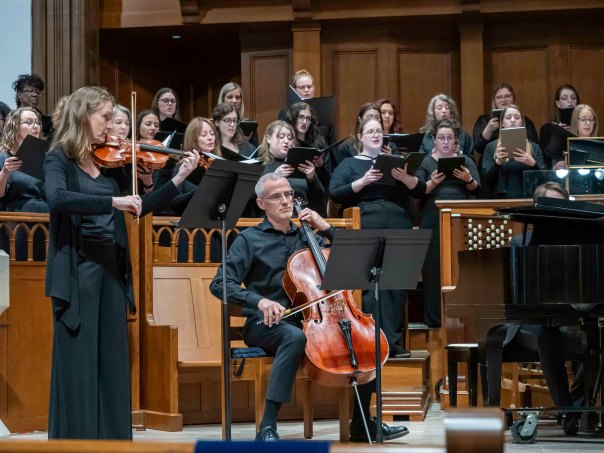
Though based in Davidson, musicians in the Orchestra hail from more than ten different states across the US. Currently in their fifteenth year, they are still led by their sister co-founders, artistic director Frances Blaker and executive director Barbara Blaker Krumdieck. Ailing in San Francisco, Blaker yielded her conducting chores to concertmaster Martie Perry. Titling their St. Mark’s concert “Magnificent Orchestral Music of the Baroque,” NC Baroque wasn’t obliged to stray far from familiar composers or their warhorses. Yet even with J.S. Bach and Antonio Vivaldi on the program, the selections were all adventurous, with works by Johann David Heinichen and Joseph Bodin de Boismortier in the mix.

It’s never a terrible idea to begin with Vivaldi, but the Concerto in D minor was especially apt, since it allowed opportunities for both our co-hosts, Perry and first cellist Krumdieck, to immediately swing into action. Indeed, the chief delights of the opening Allegro were the exchanges between the two violinists, Perry and Annie Loud, and the phalanx of four cellists led by Krumdieck. The slow movements, an Adagio and a Largo, were charming, but the Allegros following them underscored one of the chief characteristics we cherish in Vivaldi, his abrupt changes in tempo and dynamics.

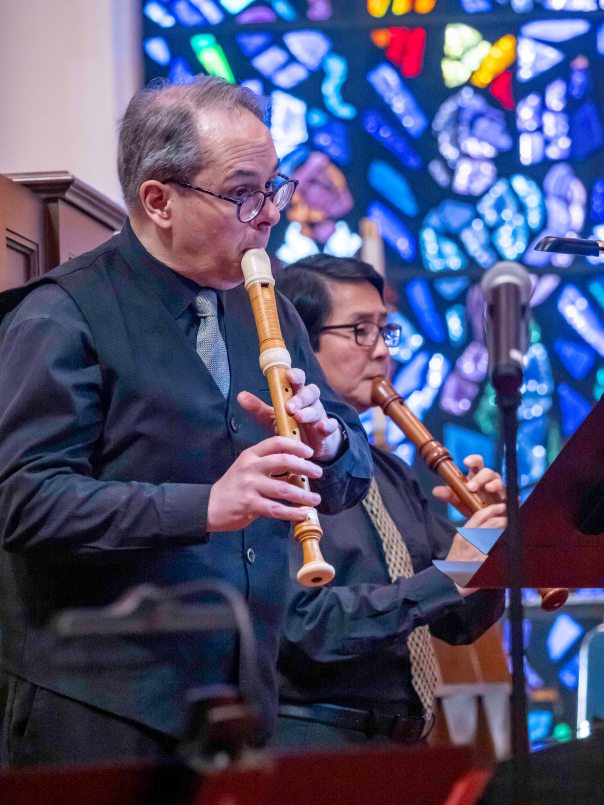
Vivaldi wrote over five hundred concertos in his lifetime, hundreds more than the famously prolific Georg Philipp Telemann, so NC Baroque had no problem unearthing repertoire that we had never heard before – or outside the familiar keyboard and string orbit. Fourteen oboe concertos and over 40 bassoon concertos are out there, to cite a couple of examples. Still, it’s a labor of patience, endurance, and discernment for the ensemble to settle on a single Concerto for Two Flutes in C (RV 533) – and from that three-movement concerto, to single out the opening Allegro molto. For the occasion, Sung Lee and Barbara Norton rose from the front pew of St. Mark’s, took their places centerstage between the violins and the cellos, and played flawlessly on their authentic instruments. What a lovely blend.

Krumdieck did the honors in introducing the double flute Vivaldi, but it was Perry who introduced the rarely-heard Heinichen, perhaps being offered for the first time in the region. Our Cultural Voice index mentions the German just twice over the years, both at performances in the Triangle Area: a Sonata for oboe, viola, and harpsichord, played in Raleigh by Mallarmé Chamber Players in 2015, and two unspecified Dresden Concertos played at the American Dance Festival in Durham two years earlier – likely through loudspeakers – accompanying a new work, Perpetual Dawn, by the Paul Taylor Dance Company.

If Spotify and Apple Music are to be trusted, virtually nobody knew about Heinichen until 1993, for that was when the much-lauded 2-CD collection of 11 Dresden Concertos was released on the Archiv label, performed by the Musica Antigua Köln led by Reinhold Goebel. My own familiarity with Heinichen, many of whose works were destroyed in the Dresden bombings of 1945, began shortly after reading a rave review of the recording (and Goebel’s introductory essay) in Gramophone.

On this night, the Concerto Grosso in G major (S. 215) and the Concerto Grosso in F (S. 232) – apparently Heinichen’s favorite keys – were the highlights, delivering the most magnificence. They were rightfully presented in ascending, chronological order, the G major after the Vivaldi works and the F major as the program finale after a sheaf of Bach Sinfonias. Again we would hear Lee and Norton on their flutes, but both Heinichen scores added a pair of oboes, played by Will Thauer and Sarah Weiner, that clashed rather than blending with the other winds.

After the first Heinichen, the two movements from Boismortier’s comic ballet, “Don Quichotte chez la duchesse,” were more than pleasant. My only problem with the performance was finding myself oversold on Perry’s tasty intro. Never did detect the promised windmills or underworld in the music, and if Mendelssohn had done Sancho Panza’s donkey, I’m sure little Rucio wouldn’t also have eluded me. Yet the Overture and Chaconne by the Frenchman provided a nice transition to the unique Bach segment of the program: four introductory instrumental pieces from four Bach Cantatas, an interlude comprised of four preludes.

All of these pieces were well chosen, none of them coming off like background Divertimentos or lackadaisical baroque elevator music. They offered fresh opportunities for soloists to take on different instruments. Subbing for Blaker on recorder, Weiner intertwined beautifully with Trauer’s oboe in the contrapuntal passages of the opening Sinfonia from the Tritt auf die Glaubensbahn (“Step onto the path of faith”) Cantata.

Trauer and Lee both switched from oboe to recorder for Gleichwie der Regen und Schnee vom Himmel fällt (“Just as the rain and snow fall from heaven”), bringing the Sinfonia set to a sparkling finish. Other versions you may audition on Spotify won’t sound as crisp, for it seems they’re fronted by oboes. Not that the oboes were slighted in the Sinfonia set. Weiner switched back to her customary instrument, playing beautifully on the Weinen, Klagen, Sorgen, Zagen (“Weeping, lamenting, worrying, fearing”) Sinfonia. Yet she had already been upstaged by Lee’s achingly lovely rendition of the Ich steh mit einem Fuß im Grabe (“I stand with one foot in the grave”) Sinfonia, likely repurposed from a previous concerto and subsequently recycled into the Harpsichord Concerto in F minor. Nectar of the gods.

Berko’s “Sacred Place” Is the Chief Revelation at Master Chorale’s Wholeness Concert

Review: Wholeness Concert at First Presbyterian Church

By Perry Tannenbaum

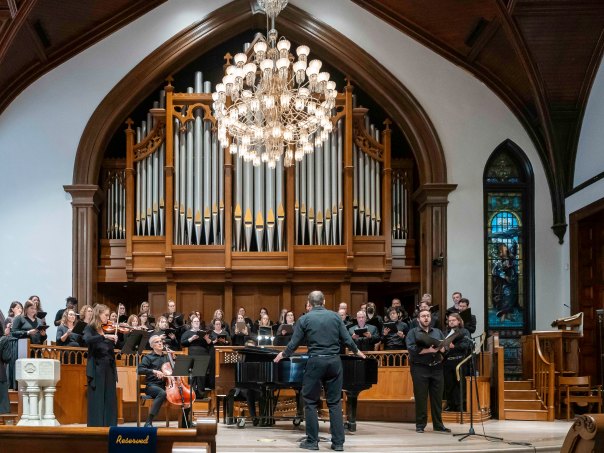
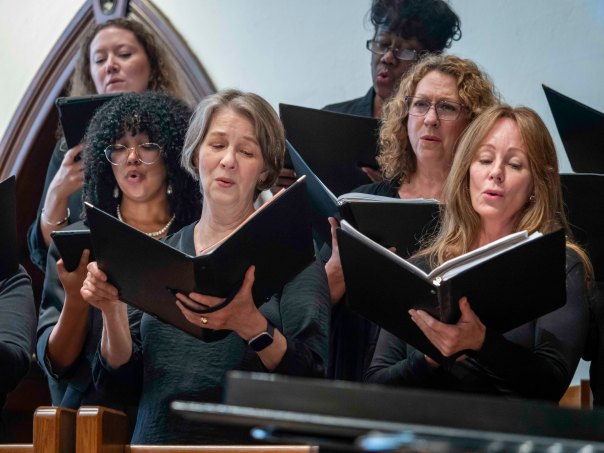
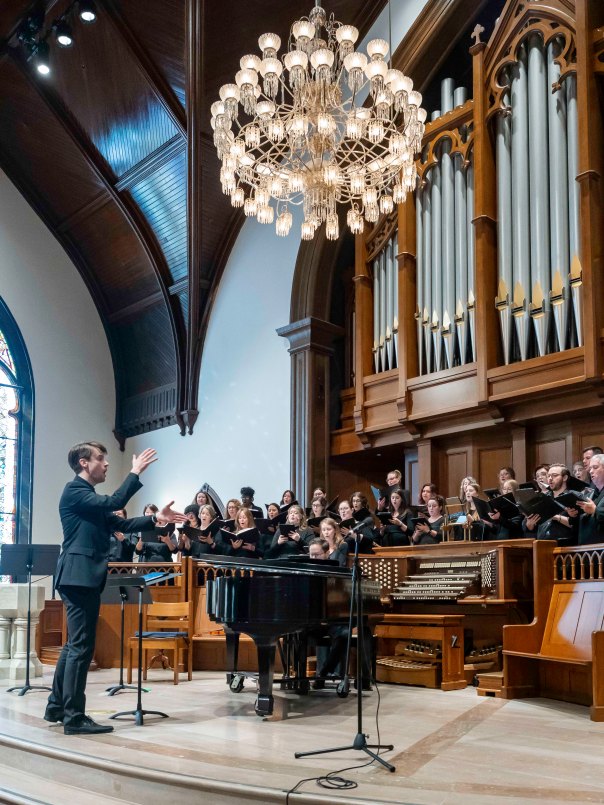
May 17, 2025, Charlotte, NC – Noted singer, conductor, and educator Helen Kemp (1918-2015) was most concerned with the musical training and development of children through children’s choirs when she coined her beloved mantra, “Body, mind, spirit, voice. It takes the whole person to sing and rejoice.” But in times of widespread warfare, terrorism, societal fracturing, and political upheaval, the Charlotte Master Chorale aptly adopted these words to subtitle its final concert for the 2024-25 season. Their “Wholeness” concert, conducted by Kenney Potter and Philip Biedenbender, affirmed the First Presbyterian Church of Charlotte as a place of healing, harmony, and communal gathering.

With Alex Berko’s Sacred Place as the centerpiece of the program, ecumenical engagement became the most salient feature of Wholeness for me. Between Shabbat morning services at Temple Israel of Charlotte and a Charlotte Symphony concert at dusk with works by Jewish composers Bernstein and Copland topping the marquee, Wholeness – and especially Sacred Places – proved to be a surprisingly perfect bridge. Berko’s six-part service is modeled on Jewish liturgy, with four of the six sections bearing the Hebrew title of a foundational prayer. These core elements of this prayerful suite were framed by an identical opening and closing prayer, excerpted from Wendell Berry’s 1966 poem, “The Porch Over the River.”

The prayers became a distillation of the poem, where Berry’s porch was the most benign human intrusion upon the primeval serenity of nature at a wooded riverfront. As for the Jewish service, texts chosen by Berko were only obliquely connected to the original Hebrew – actual connection in the instance of “Amidah” vestigially retained only in the composer’s introductory note. The music echoes the transition in Berko’s chosen texts from the hushed tranquility of Berry’s riverscape to John Muir’s evocations of majesty and glory in his eloquent description of Yosemite. It was originally sent to Theodore Roosevelt, urging the president to preserve this magnificent temple of nature. Only the connection between text and the literal meaning of “Amidah,” mostly a silent prayer said while standing, remained obscure.

Musically ranging from solo vocals to grand choral proclamations – accompanied by violinist Sarah Case and cellist Peter Case, with Biedenbender at the keyboard – the “Amidah” was only slightly eclipsed by the ensuing “Shema,” which superbly referenced the cornerstone of all Jewish prayer. Orthodox Jews will have the words of the “Shema” on all their doorposts and say them at least two times daily, if not three, biblically enjoining Israelites to listen and hear that the Lord is their god and the Lord is one. For this pivotal section, Berko chose William Stafford’s 1961 poem, “In Response to a Question: ‘What Does the Earth Say?’” Unlike the voice of the Lord, thundering from the peak of Mount Sinai and proclaimed by Moses to the people below, Stafford strains to hear what the earth says. Presumably, the poet has divined its message: “The earth says have a place, be what that place requires…” So again, Berko’s music roars and whispers.

Text for the “Mi Shebeirach” had a smidge of Hebrew in it, but contrary to Berko’s belief, it was not a translation of the actual prayer. Instead, it was taken verbatim from a setting that Debbie Friedman had written for the prayer in 1993, using the English she had interspersed with the original Hebrew. The Friedman version has amazing popularity, widely replacing the original “Mi Shebeirach” prayer across the English-speaking world, so Berko’s mistake is not unusual. Nor is it the worst.

A drama that was judged for the 2013 Jewish Plays Project, The Man in the Sukkah, presumed that the song, with its mishmash of Hebrew and English, was sung by persecuted Jews during the days of the Holocaust. When Berko’s setting reached the brief Hebrew phrase in Friedman’s lyric – “Bless those in need of healing with r’fuah sh’leimah” – the section, which had been more like recitative until this point, swelled with melody and feeling. The section that followed, “Kaddish,” retreated briefly toward the quietude of “Closing Prayer” with a snippet from Rabidranath Tagore’s Stray Birds (No. 273). It was good to have the delayed final words, “at the margin of starry silence,” printed out in the program booklet for the sake of clarity – and to fully savor the music’s sublimity.

Although the other nine pieces on the program didn’t benefit from the favor of being printed out – or credited, when the lyricist was not the composer – they were all worthy of the Wholeness theme. None of them were at all too brief, cute, or at all bouncy. The closest to rejoicing was Reginal Wright’s “We Are the Music Makers.” Less facile and more propulsive was the Adam and Matt Podd arrangement of “How Can I Keep from Singing,” with touches of melancholy throughout, especially in its concluding decrescendo.

The most intimate and solemn of the short works was Don Macdonald’s “When the Earth Stands Still,” with lyrics by the composer that merited inclusion alongside Berko’s texts. But the most remarkable piece of the afternoon was arguably Craig Hella Johnson’s beauteous, slightly sugary “Psalm of Life,” set to one of Mattie J.T. Stepanik’s Heartsongs. Before succumbing to a rare form of muscular dystrophy at the age of 13, the astonishing prodigy appeared on TV with Larry King, Oprah Winfrey, with former president Jimmy Carter on Good Morning America, and on New York Times bestseller lists on multiple occasions with his books of poetry and essays. Like all the other composers and writers behind the Wholeness concert, I’d never been acquainted with Stepanik before. He was a revelation to me among revelations.

Puppetized “Life of Pi” Vindicates Its Truthiness

Review: Life of Pi at Belk Theater

By Perry Tannenbaum

Not too many novels weigh the merits of imagination against observation, myth against reality, or fiction against truth: the author’s bias in favor of fabrication is implicit from the first word in his first chapter. But after relating an epic and fantastic tale of a boy’s survival on the open seas, Yann Martel did exactly that in his LIFE OF PI, questioning and testing Pi’s story and measuring it against an alternate narrative.

Son of a Pondicherry zookeeper and named after a Parisian swimming, Piscine Molitor Patel is the only survivor of the Tsimtsum, a mystically-named cargo ship that set sail from the shores of India, bound for Canada. Martel, brooding over reviews of a previous book and suffering from writer’s block, finds out that Patel, now a grown man with “a story that will make you believe in God,” is living in Toronto.

Nearly a year after taking notes at his meeting with Pi, Martel purportedly received a 1978 audiotape and an official report from the Japanese Ministry of Transport, completing his research. Martel’s book won the Man Booker Prize in 2002, the year after its publication. Ang Lee’s film version of 2012, based on a screenplay by David Magee, won four Academy Awards, including one for the director.

The stage adaptation of Life of Pi by Lolita Chakrabarti, now touring at Belk Theater in Charlotte, has gathered even more accolades since it premiered in the UK, first in Sheffield in 2019 and then in a 2020 London production that bridged the pandemic. By 2023, when the production – still directed by Max Webster – arrived on Broadway, the story of the teenager adrift on the Pacific Ocean with a Bengal tiger named Richard Parker must have seemed like an ancient relic to theatergoers, despite its technical dazzle.

Showered with enthusiastic reviews and five Tony Award nominations, the Broadway show ran less than four months, closing shortly after its design team nabbed three Tony wins. Looking around the Belk on opening night, you could see that a hefty amount of nosebleed seats had been sold in the uppermost balcony. Even though that performance was cancelled because of technical difficulties, it seemed like the Charlotte run would sell more tickets than any week of its NYC run.

The “worldwide phenomenon” touted in TV promos has not cooled in Charlotte, and it seems obvious that the tour will outgross the Broadway original. All of the original design team has remained intact through all of this production’s installations and transcontinental travels. Perhaps we should reserve the highest praises for puppet designers Nick Barnes and Finn Caldwell, winners of the Drama Desk Award, for their work likely travels even better than Carolyn Downey’s Tony Award-winning sound design.

An impromptu interview downstage on opening night confirmed that Tim Hatley’s scenic design had been trimmed for the road, so Pi’s lifeboat wouldn’t be rising up onto the stage from below when the tour’s turntable was fixed. Everything in the lighting booth looked calm and shipshape for the opening. It wasn’t too surprising, then, to see a projection greeting us on the front scrim two nights later when we redeemed our raincheck – a reassuring sign that this boat was ready to float.

Aside from the puppetry, delightfully engaging our imaginations all evening long, Chakrabarti takes a simplified, direct, yet convoluted path through Martel’s Pi, stripping away the narrative layers of Martel, his informant in Pondicherry, and the elder Patel in Toronto. The diary that Pi kept during his epic voyage, mentioned just once in Martel’s prefatory “Author’s Note,” is discreetly forgotten.

Chakrabarti wants to balance the veracity of Pi’s two tales more delicately, it seems. She takes us directly to the Benito Juárez in Tomatlán, Mexico, where Pi will be interrogated by Mr. Okamoto of the Japanese Ministry and the more empathetic Lulu Chen from the Canadian Embassy. That whisks us to Chapter 95 of Martel’s 100-chapter book, leaping over the narrative we have read without interruptions from Pi’s point of view by investigators.

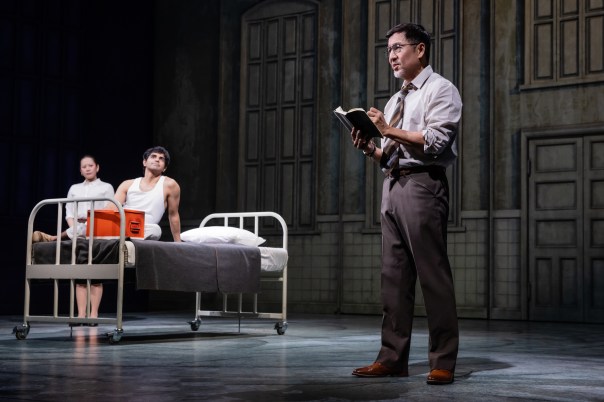
Further compromising the boy’s credibility, Pi isn’t visible immediately in his hospital room. He is nesting underneath his hospital bed, hidden behind his dangling bedsheets. When he is coaxed by food and other rewards into coming out, we readily observe that he is haunted, traumatized, and animalized by his experiences at sea – appropriate results for both versions of his story – and conditioned to fiercely hoarding his food.

Pi’s histrionics, which punctuate his narrative, give Taha Mandviwala fresh opportunities to rouse Okamoto’s skepticism and Chen’s empathy in the title role, but the added flash – along with the missing diary – must be scored as detrimental to the lad’s credibility.

Yet there’s a buoyancy to Mandviwala as he relives his adventures that wins us over, with plenty of moments that underline his irrepressibility: dancing in the dingy streets of Pondicherry, insouciantly entering Richard Parker’s lair at the zoo, and standing triumphantly on the stern of a lifeboat lost at sea – or on his hospital bed. With or without a paddle, he holds his fist up high. Yes, in a fine bit of theatre magic, bed and boat are the same in both locations.

Paradoxically, all the artifices of puppetry, lighting, and projection make us want to believe Pi’s story more and more. Even when Toussaint Jeanlouis, after playing the ship’s nasty cook, reappears out of Richard Parker’s head and becomes the tiger’s voice. The pushback from Alan Ariano as Okimoto and the caring of Mi Kang as Chen ultimately testify to our inborn needs for fiction, myth, and imagination.

Though I’ve read the book, it’s been a while. I’m not sure whether Martel’s Pi was blessed with family visitations during his animal story or whether these were additions from Chakrabarti’s fancy. Either way, the reappearances of Sorab Wadia as Father, reminding Pi how to tame a tiger, Jessica Angleskhan as Amma, counseling her son on staying vegetarian at sea, and Sharayu Mahale as Rani, scolding her brother for succumbing to fish and turtle meat, do more than keep the rust off these endearing characters after the Tsimtsum sinks.

Collectively, they endow this Life of Pi with more mythic aroma, like talismans or magical weapons gifted to heroes of sagas. They are Disney sprinklings of Tinkerbell’s fairy dust and Jiminy Cricket’s guidance. Of course, they don’t cross over when Pi’s fantastical story dissolves into an antiseptic hospital!

When God has been proven to you, a sinking ship, a shark-infested ocean, a vast flesh-eating island, and an arid Mexican shore with jungle in the distance are all better places to be, as long as there are stars above to wish on. In Martel’s novel and onstage, young Pi has sat devotedly at the feet of Hindu, Islamic, and Christian mentors concurrently for weeks on end because he is so hungry for God – while Martel attests to extensively studying zoology and the cosmogony of Isaac Luria, the great Jewish Kabbalist.

For Pi and Martel, preferring a beautiful, ennobling story to a plausible one is a way of life. Actually, Martel states it more politically than that at the end of his preface: If we, citizens, do not support our artists, then we sacrifice our imagination on the altar of crude reality and we end up believing in nothing and having worthless dreams.

Maybe Martel’s thrust has more currency now in Charlotte than it did on Broadway. Yes, and maybe this message has more urgency now for Americans than it ever had for Martel’s fellow Canadians.