Daily Archives: December 23, 2024

Review: “Messiah” at Knight Theater

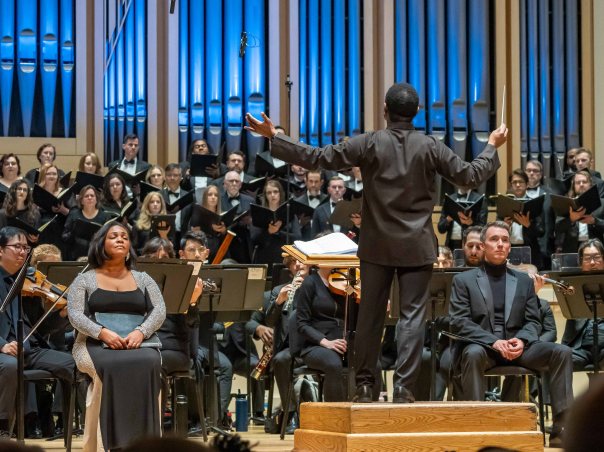
Handel’s Messiah Rejoices Greatly with Charlotte Symphony

By Perry Tannenbaum

December 13, 2024, Charlotte, NC – While I’m not as faithful to the Yuletide visitations of George Frideric Handel’s Messiah as I was ages ago at Queens College CUNY, where I attended free concerts at least three of my four years, my diligence has lately improved. In the last decade, I’ve seen four performances, counting the one that launched this weekend’s run at Knight Theater, with Kenney Potter preparing the Charlotte Master Chorale and guest conductor Julian Perkins leading the Charlotte Symphony. I’d actually had my heart set on a Messiah performed at the Teatro Colón in early November, but an unresponsive press office and an unexpected dress code, discovered at the box office after we had landed in Buenos Aires, thwarted our plan.

Wrapped into our plans were an opportunity to hear how a Bach choir flying in from Stuttgart would handle the King’s English, and how the vocalists would compare with our esteemed Chorale and guests. Not to mention the fabled acoustics of Teatro Colón. Lacking those Argentinian comparisons, I can still say that the Chorale was a match for any chorus I’ve heard in Messiah, and that the guest vocalists were the best I’ve heard in recent memory, including those who performed with the New York Philharmonic in 2015. Those who look for a massive orchestra might have reason to pause before rushing to the Knight, for the scale of forces led by Perkins seemed more like the North Carolina Baroque Orchestra that performed with the Chorale at First United Methodist in 2018 than the band we saw at the Knight in 2017. Over a dozen different orchestrations evolved during Handel’s own performances of Messiah over 17 years, from 1742 to 1759, so Perkins could easily match a version to the number of his orchestral recruits.

Leading from behind a harpsichord – pretty novel in itself – Perkins had some interesting ideas on staging, deploying the brass to the balcony for their dramatic entrance into “For unto us a Child is Born” and then after intermission, bringing principal trumpeter Alex Wilborn downstage for a climactic “The Trumpet Shall Sound” confrontation with bass baritone Hadleigh Adams. Otherwise, it would seem presumptuous to say that Perkins, for all his Handel and Baroque expertise, directed any of the four guest soloists at all. Each one of them was magisterially confident and self-assured. Hadleigh was not the least of them in that regard, striding auspiciously to centerstage for the first time and quaking the hall with his “Thus saith the Lord” proclamation. After delivering his towering “Why do the nations so furiously rage together?” rebuke at the crest of Part 2, Hadleigh loudly clapped his book shut and stormed back to his seat.
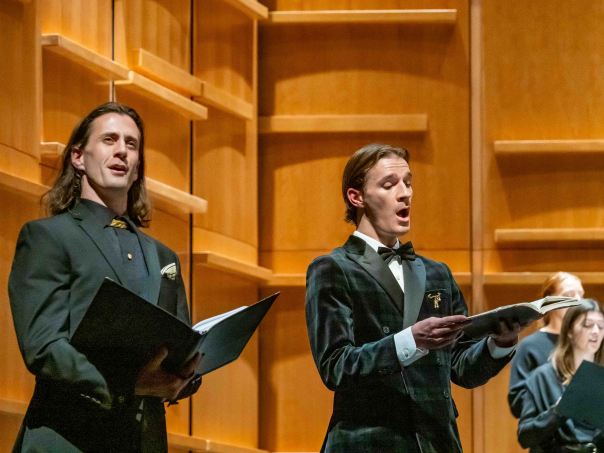
Richard Pittsinger was not quite so flamboyant, for the tenor wore his hair the same way before and after intermission. But his impact came sooner with supremely creamy accounts of the “Come ye, my people” recitative and the “Ev’ry valley shall be exalted.” He truly made the “rough places plain” again and again with soft floating glides that never strained his breath control. Drama was definitely in his arsenal, just before the climactic “Hallelujah” chorus, when he delivered one of the more militant verses of the Psalms, “Thou shalt break them with a rod of iron.”
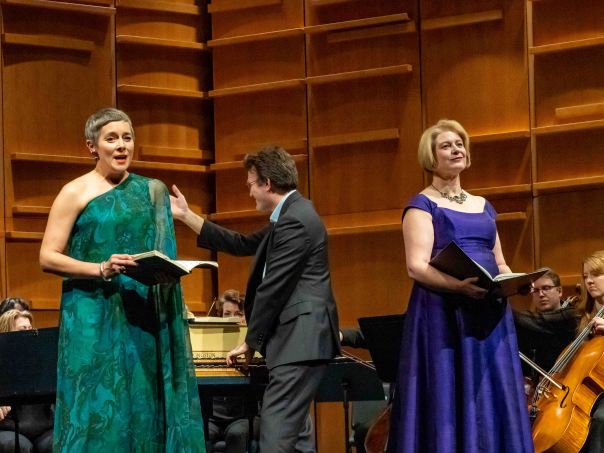
It was no less difficult deciding whom to love most among the women. Mezzo-soprano Diana Moore sang her first air, “But who may abide the day of His Coming,” so richly and dramatically that I could hardly wait for her return in “O Thou, that tellest good tidings to Zion” so she could conquer its challenging low notes. Even the QR code on the program sheet doesn’t lead to the text, so Moore faced a more amusing hurdle when she came to the “spitting” in her “He was despised and rejected of men” air near the beginning of Part 2. Pronounced too diffidently, the audience might wonder what was said – too emphatically and you risk laughter. Passing that test, she went on to a satisfying Part 3 duet with Pittsinger in “O death, where is thy sting?”

Less tasked and dramatic but far more lyrical, soprano Anna Dennis dazzled in each of her airs, especially in her first splash late in Part 1, “Rejoice greatly, O daughter of Zion!” Here the refrain ideally exemplified how spectacularly Handel brought his lyrics to life. Equal to the joy she delivered here was the sanctified tenderness Dennis lavished upon “I know that my Redeemer liveth” launching Part 3. The effect was all the more ethereal for the effortless way that Dennis reached her highest notes.

Of course, the “Hallelujah” and the closing “Amen” fugue make the mightiest, most lasting impressions, but the Chorale delivered drama and delight all evening long. They were hardly accompanied by more than the harpsichord and organ until the brass and sawing violins exploded into “Wonderful! Counsellor!” in the incomparable “For unto us a Child is born.” The dynamic was no less dramatic toward the end of the evening when they reached the shuttling between gloom and jubilation in “Since by man came death.” Most exquisite, perhaps, was the delicacy Potter and Chorale endowed upon “All we, like sheep, have gone astray” seemingly more staccato than we’d ever heard it before. A disagreement seemed to arise whether it was “glorify” or “purify” when the Chorale broke into so many contrapuntal groups for “And He shall purify.” Any other blemish in the evening was almost impossible to detect.

Photos by Perry Tannenbaum

Christmas at Pemberley Gets a Gendered Makeover

Review: Miss Bennet: Christmas at Pemberley @ the Cain Center

By Perry Tannenbaum

If it weren’t for all the adaptations we hear about on TV and in movies, we could say that it required supreme audacity for Lauren Gunderson and , to tread in Jane Austen’s footsteps and pen a sequel to Pride and Prejudice, her wittiest and most beloved novel. But despite the obvious commercial bent of Miss Bennet: Christmas at Pemberley, Gunderson and Melcon have aimed to capture Austen’s essence and bring fresh life to her characters.

As you’ll find up at the Cain Center in Cornelius, no small thanks to the audacious direction of Steve Kaliski, the script sprinkles a bit of modern perspective on the Bennet sisters and their beaus – occasionally forcing us to recognize that Austen’s times are not so different from our own. Elizabeth Darcy, the heroine of the novel, still retains enough decorum not to call Fitzwilliam Darcy by his first name. Even in the privacy of their own home!

Likewise, elder sister Jane and her beloved Charles address each other as Mr. And Mrs. Bingley. “Happy Christmas” rather than “Merry Christmas” is the greeting norm, and the Christmas tree tradition has yet to take root in England in December of 1815. It’s Elizabeth’s audacity that brings this German custom to the Pemberley drawing room with its attached library.

In some ways, history has circled back. Back in college, my professor instantly drew our attention to the epistolary nature of Pride and Prejudice. The story is largely driven by letter writing. A chief turning point in the story is contained in a letter from Darcy addressed to Elizabeth, debunking her previous prejudices against him!

The prevalence of letter writing astonished us then – and felt alien. Ancient. Forty-plus years later, the sight of Mary Bennet, her sister Lydia, and Arthur de Bourgh exchanging billets-doux while under the same roof has to remind me of today’s texting, Instagramming youth, perpetually thumbing their cellphones. Buttressed by books, these youngsters can put quill to paper.

With Kitty off in London, not expected to arrive until Christmas Day with her parents, Mary is the only Miss Bennet we see and unexpectedly the leading lady. Arthur is an entirely new character, rivalling Mary in his bookishness. Resigned to spinsterhood, Mary is shocked to find that they’re hitting it off.

The forward-looking Gunderson and Melcon, proclaiming that Austen is for everyone, encourage diverse casting. But Kaliski and his Davidson Community Players go further, bringing us an all-female/non-binary cast. It’s an added semicircle backwards to Elizabethan days when only boys and men were permitted to perform onstage.

All three of these transpositions – Brooke McCarthy as Darcy, Rhianon Chandler as Bingley, and Jennifer Adams as De Bourgh – add a fresh patina of mirth and comedy. As for the playwrights, they inject plenty of wit and sparkle of their own. Speaking to Darcy before we see that Jane is seven-months pregnant, Elizabeth broadly hints she is arriving “safely and enormously.” Lizzy is more tactful when the expectant mother enters and they exchange greetings:

Lizzy: Look at you! You’re radiant.

Jane: I’m as large as a cottage.

Lizzy: And exactly as a cottage, you are warm, filled with life, and lit from within.

Although McCarthy plays him with some florid gestures, we soon see that he is richly endowed with breeding and tact. When the punctilious Mary presumes to correct Bingley, by informing him that the tree standing before them is a spruce and not a fir, Darcy pointedly intervenes. Before any dispute can begin, he proposes that he and his longtime chum exit for a brandy.

The ladies can now rebuke Mary, if they wish. They do, while gradually discovering that their younger sister has more charm and talent than previously suspected. Arthur’s admiration for her shocks them as much as it shocks Mary herself. As it turns out, Lizzy and Jane better be witty and perceptive, for Mary and Arthur are the plumiest roles. Fortunately, with the arrival of Lydia, the silly sister with the sham marriage, Lizzy and Jane can redirect their sharpest barbs.

Arthur is the heir to the nearby Rosings estate, but he is a distant nephew of the late Lady Catherine and has never lived there. There is some juicy history at that estate, left over from Pride and Prejudice,chiefly the presumption that Darcy would marry Milady’s daughter and not the comparatively lowborn Lizzy. Not to worry, Pemberley gracefully catches us up if we don’t remember Austen’s original.

What makes the role of Arthur so appealing is that he has no clue how to run an estate – and no solid experience with other men, women, or people. Adams carries a book around with her as if it were Arthur’s security blanket. Without one, Adams seems at a loss for what to do with her hands and arms, so we see Arthur almost perpetually in a scholarly or supplicating pose.

Attempting a billet-doux, Adams as Arthur reminded me of Christian in Cyrano de Bergerac, only he has nobody to help him out. When Arthur learns that his cousin Anne, after getting jilted by Darcy, now presumes she is betrothed to him, Adams’ awkwardness and shyness veer toward desperation and panic. When bliss is achieved, Adams’ glow is mesmerizing.

Crippled by a similar lack of self-esteem, Sahana Athreya as Mary is no more experienced and no less shy than Arthur – so she can range from being pedantic and irritating to heartbroken and pitiful to vivacious and adorable. Athreya can also freely gesticulate with her arms and sit down regally at the pianoforte.

The central triangle is further complicated by Destiney Wolfe as the compulsively silly Lydia. Glossing over her troubled marriage doesn’t inhibit Lydia from flirting shamelessly with Arthur, giving us extra tastes of how unaccustomed he is to such attentions. Nor does Kaliski bar Wolfe from being as irritating as Mary at her worst. On the contrary. Wolfe, when she isn’t pouncing, is often prancing.

At the center of all the overtures from Mary and Lydia – and the strict orders from Agatha Emma as the imperious Anne – Adams gets to be meaningful as well as stressed and sympathetic. For Mary and Lizzy, in the face of Arthur’s inclination to yield to Anne, are at considerable pains to remind him that he has what women don’t: a choice.

Of course, when Gunderson and Melcon wrote their merry comedy in 2016, they had no inking that “Your body, my choice” would be staging a comeback. But the playwrights are far from declaring that women were powerless. Even before her Christmas awakening, Mary is strong enough to proclaim that she would rather wed a plant than an unsuitable man.

Caring about their sisters, Lizzy and Jane sustain their relevance, Skylar Schock as Lizzy warming up to Mary and Emma Kitchin as the Jane becoming Lydia’s tactful benefactor. Christmas can even be celebrated by Emma, for it turns out that there’s kindness in Lydia beneath her silly, meddlesome surface.

Kaylen Gess’s scenic and lighting design complement each other handsomely, with Caleb Sigmon’s projections adding an extra festive luster. I’d imagine that Gunderson and Melcon would have envisioned a much larger, more intrusive tree at Pemberley. But as a Tannenbaum, I’m probably prejudiced.

The tree outside Cain Center, let me add, is big and bright enough for anyone.

Ryan Clicks with the Master Chorale in a Walloping CSO Debut

Review: A German Requiem at Belk Theater

By Perry Tannenbaum

November 22, 2024, Charlotte, NC – In Kwamé Ryan’s first full season as the new music director of Charlotte Symphony, we aren’t getting to see him perform as much as we would hope, but when we do see him onstage at Knight Theater or Belk Theater, he always appears to be overjoyed to be here. Ryan was absolutely beaming as he took the Belk’s centerstage for the first time as CSO’s leader – and he certainly didn’t wear out his warm welcome, delivering a walloping performance of Johannes Brahms’ Ein deutches Requiem. Even before Ryan’s arrival, the new season has proven to be adventurous and diverse in its programming, showcasing fresh repertoire and youthful guest soloists.

Subscribers can judge for themselves whether Ryan’s outré intro to his debut program, coupling the Brahms with Latvian composer Pēteris Vasks’ Musica Dolorosa, was a sign of confidence or a symptom of nervousness. Whether or not my recollection can be trusted, Ryan’s scripted intro was unprecedented. Some intros we may have seen in the past could be dismissed as gratuitous – or countenanced as witty fluff. Here, Ryan’s intro was necessary, for we needed to be prepped for how the program would be delivered: without a pause between the music of the two composers. That would also be fairly unique. Our new maestro was crafting an experience.

Indeed, Ryan’s preface was necessary for another reason. Vasks’ piece flowed into the Brahms so smoothly it was as if they were written in collaboration and in the same key. Outside that merging point, the two pieces were quite different in the ways that they dealt with death. Responding to his sister’s untimely death, Vasks voiced his personal despair and compounded his feelings with grieving for his nation, still subject to Soviet rule when the Dolorosa premiered in 1984. Written for string orchestra, the mood of the opening section of Dolorosa may put you in mind of Barber’s Adagio. But the Vasks elegy eventually transcends the sameness and the hypnotic monotony of Barber’s dolor with louder and more piercing pain.

As the lower strings tap and strum percussively, Vasks gradually quickens the pace and turns up the volume as the beat becomes more insistent and dramatic. Once the dynamics peak, the strings, now smoothed out with a cessation of the percussion, become even more disturbing, tossing away pleasant tonality in a disciplined cacophony of fearsome chaos. The slashing lower strings, however, hadn’t been vanquished. They punctuated this harshness and dissonance at its height, seemingly puncturing it, for the noise homogenized into the sound of a diminishing wind or a siren receding into the distance – clearing the way for the quietest and most memorable episode in the Dolorosa. Principal cellist Jonathan Lewis, echoing the opening bars, played an eloquent lament from his downstage seat, accompanied only by the low mysterious hum – like a bass clarinet or a contrabassoon – emanating from upstage, hidden from my sight. The higher strings now took up the cello’s increasingly bold cry and built it to raw anguish.

The slightly hushed and abrupt ending of the Dolorosa nicely conformed with Ryan’s concept, and it dispensed with the shuffling of chairs usually necessary for the transition to full orchestra with winds, brass, and drums. Nor were the troops of the Charlotte Master Chorale obliged to parade in from the wings and settle into their perches above the Symphony. That honor was reserved for the guest vocalists, soprano Janai Brugger and baritone Alexander Birch Elliott, gracefully delayed until well after the transition between the Dolorosa and A German Requiem. The Brahms is not new to the CSO, last given by Christopher Warren-Green almost exactly 10 years ago – after his predecessor, Christof Perick, had presented it (already for the second time this century) in 2005.

With its consoling attitude, the Requiem is not at all a bad fit for the holiday season. You’re likely to recognize more than a couple of verses from the Brahms, conveniently projected in supertitles, as German translations of verses from Handel’s Messiah, the most beloved musical birthday celebration that we have. Most notably, you’ll get an Oktoberfest taste of “The trumpet shall sound.” Maybe sitting down in the orchestra, as opposed to the Grand Tier Circle, accounted for the heightened thunder of Ryan’s rendition, but Symphony somehow sounded crisper. The sudden sforzandos struck like a punch to the jaw, yet Ryan kept the ensemble under strict control, never threatening to overwhelm the hall with volume, emphatically relishing the work’s percussive moments.

Both Brugger and Elliott shone in their debuts. There was a noticeable Renee Fleming-like milkiness and sheen to Brugger’s voice, most appropriate for the motherly comfort she delivered in “Ihr habt nun Traurigkeit (You now have sorrow).” Elliott was even more impressive in his larger workload, a more pleading “Herr, lehre doch mich (Lord, teach me),” bolstered by a lusty Chorale response, before he delved into the “trumpet shall sound” mystery and affirmation of “Denn wir haben hie keine bleibende Statt (For here we have no everlasting city).” Belatedly, Music Chorale artistic director Kenney Potter was summoned onstage to share the credit for his singers’ brilliance and verve. He was absolutely beaming with delight.

Photos by Perry Tannenbaum