Monthly Archives: July 2024

Can “Back to the Future” Fly as a Musical?

Review: Back to the Future The Musical at Belk Theater

By Perry Tannenbaum

The stars aligned – and Hollywood’s star system functioned flawlessly – when Michael J. Fox and Christopher Lloyd, both proven TV commodities, came together in 1985 to star in the year’s top-grossing blockbuster, Back to the Future. You could easily “see” Fox as Marty McFly if you tuned into Family Ties, where the diminutive 23-year-old was already starring as a son who was more grounded, pragmatic, and strait-laced than his hippy dad. Likewise, the lean and bony Lloyd was perpetually disheveled and long-haired enough on Taxi to ace an audition for the pivotal role of Doc Brown, the eccentric nuclear physicist who unlocks the secret of time travel.

Doc and Marty live in Hill Valley, a town that is perfectly rigged to enable time travel back-and-forth from 1985 to 1955, according to the unique formula concocted by screenwriters Robert Zemeckis and Bob Gale The writing/directing team clearly liked wheels: they put Marty on a skateboard and put wheels into time travel – in a customized DeLorean that was as fuel hungry as a space rocket. No less than the force of an atomic bomb was required to achieve lift-off at the magical speed of 88mph.

Anybody remember Oldsmobiles?
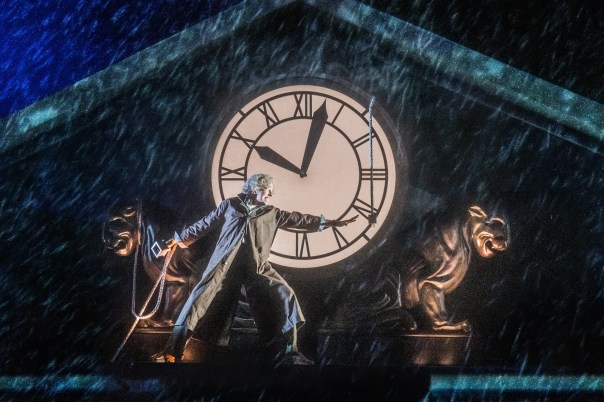
Stolen plutonium fuels the DeLorean in its maiden flight to 1985, but if you don’t already know, it’s Hill Valley and its highest, most visible landmark that powers the kooky, suspenseful journey back. More than 30 years after the box office smash – and a franchise that includes two film sequels, video games, amusement park rides, and a lunchbox – Gale wasn’t going to hand over his story to anyone else when the time was ripe for Back to the Future The Musical.

As fans of the film will soon discover at Belk Theater, Gale’s parental care for his brainchild hasn’t prevented him from tinkering extensively with its workings. Doc’s DeLorean is now equipped with voice recognition, with a smart-ass voice that tells McFly he can no longer change its settings. In other vehicular news, Marty’s grandpa will no longer run into him with his jalopy and the lad’s skateboard usage will be seriously curtailed. Nor is there any traffic onstage from Libyan terrorists, so Marty’s letter to Doc, to be acted upon 30 years later, now has a different safety warning.

The magical family snapshot that Marty carries along with him to 1955, providing useful updates on whether he and his sibs still exist in 1985, is gracefully finessed. No, we can’t see closeups of the photo at the Belk like we could on a big screen, but Doc’s lab is thoughtfully outfitted with an overhead projector so we can track changes on a smaller pulldown screen.

While the telltale snapshot is upscaled, so is the buffoonery of Marty’s dad, George McFly. A conspicuous loser in both time slots, carrying over a Jerry Lewis gawkiness into each, Burke Swanson feasts on George’s timid nerdiness, threatening to steal the show whenever he appears. Next to her clownish husband, Zan Berube suffers some shrinkage in 1985 as Lorraine, Marty’s long-suffering mom, but she conspicuously flowers as the younger teen in 1955, evidently the queen bee of Hill Valley High.
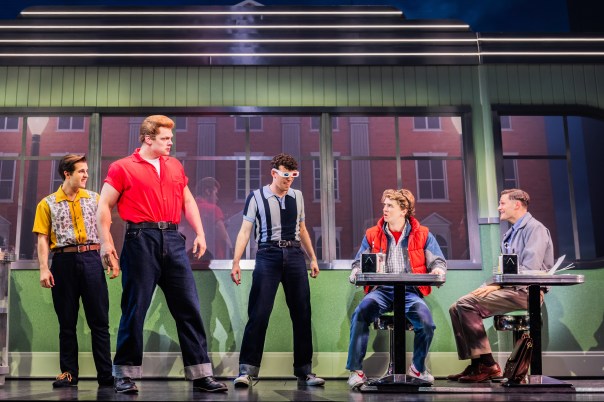
There she is glamorous as the ideal of both George and his nemesis, Biff Tannen*, the town bully – and she is dangerous because she fancies Marty, a mortal threat to the space-time continuum and his existence. Aided by a bodacious Campbell Young Associates wig, Ethan Rogers makes for wonderfully cartoonish Biff, looking like a monstrously morphed Archie Andrews, with flecks of Bluto, Curly from Oklahoma, and The Donald. This Biff ought to be the toast of the town in New York.

With so many delicious distractions – and so many, many, many songs by Alan Silvestri and Glen Ballard – Don Stephenson as Doc and Caden Brauch as Marty struggle to stay at the forefront throughout Act 1, where pacing reaches cruising speed but never really sustains it. We pine, we ache for the DeLorean whenever it’s parked out of sight.

But the payoff for the increased development of Mom and Dad, before and after marriage, lands nicely as Act 2 accelerates to its finale. We’re not assailed with frantic jumpcuts or chases, but so many difficulties and complications remain to be resolved as 10:04pm inches closer at the fateful courthouse clock tower. Before the lightning strikes, hopefully lavishing its gigawatts on the DeLorean at its magical speed, Biff must be thwarted, Mom and Dad – with nothing to build on yet in their relationship – must consummate their first kiss, and Marty must take fond leave of all the key people in his life.

Preferably, with his own survival assured. Then all he needs to do, in the dark of night in a high wind driving his DeLorean at 88mph, is thread a needle at precisely the right moment. Piece of cake.

It’s easy to forget the emotional weight of the film’s relationships and time-traveling farewells 35 or more years after savoring its pulsating adventure, so they all came back forcefully for me on opening night. Although they aren’t Rodgers & Hammerstein, the songs by Silvestri & Ballard mystically magnified that weight – even if I sometimes wished the revving-up sounds of the DeLorean might drown them out.

While his headgear and goggles still brand him as a mad scientist, Stephenson as Doc veers more toward personifying the physicist as a visionary. His vision of the “21st Century” impacts comically as cockeyed optimism rather than eccentricity, and his “For the Dreamers,” an anthem for losers, resonates rather poignantly with the sorry loser futures faced by George and his present-but-unborn son.

Fox’s fidgety acting style, his three little jumps before making an exit – or simply moving – have become avatars for seemingly every leading man on tour or on Broadway in a musical. Those hiccups are intact in Brauch’s embodiment of Marty McFly, punctuated with all his skateboard and DeLorean business, but he also recaptures Michael J’s anguish and urgency as he counsels his own dad on how to be a man. Yes, that’s the knack that Fox brought to movies from his stint on Family Ties, but here the stakes are immensely higher – as high as they can be – in a cosmic comedy!

At times, the time traveling intervention with Dad is cringeworthy. Marty is basically telling Dad how to bed his mom so he can be born. But with music, Brauch can heighten his role from advisor to motivator. Brauch’s powers of inspiration are magnified when he plants idea of running for mayor in the mind of the kid sweeping the floor at the diner where Marty first encounters his dad-to-be (a fine “Gotta Start Somewhere” cameo for Cartreze Tucker as Goldie Wilson).

When he sings “Put Your Mind to It” to Dad in Act 2, Marty must skirt the Scylla and Charybdis of phoniness or peppiness. We don’t want him sounding like huckster Max Bialystock singing “We Can Do It” in The Producers or evoking a Richard Simmons workout session.

So yeah, besides those hops, Brauch also needs to have that youthful brashness we associate with Fox and McFly. Elevating a shallow and tepid rock song into a motivating “We Can Do It” mantra, Brauch pours on all the energy and earnestness needed to make Marty take flight.

Nor does it hurt when the DeLorean levitates.

*No relation

“Young Frankenstein” Delivers Excess, Glitz, and Glorious Shtick

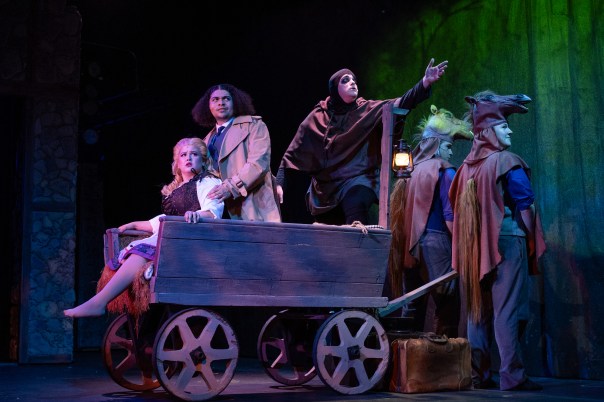
Review: Young Frankenstein at Matthews Playhouse

By Perry Tannenbaum

July 12, 2024, Matthews, NC – Just turned 98, Mel Brooks has overachieved in every way possible, including longevity. Yes, he wrote the music and lyrics in adapting his own Oscar-winning script, The Producers, into a Broadway musical. If that 2001 megahit was the most prodigious and successful transformation of his career – already past 50 years as a writer, comedian, and actor – then his 2007 follow-up, Young Frankenstein, was the most natural.

Mel had already stolen Irving Berlin’s “Puttin’ on the Ritz” and Victor Herbert’s “Ah, Sweet Mystery of Life” to gild two of the most shining moments of the original film, shot in retro black-and-white. Composing his musical adaptation, Brooks stole some more, changing the ardent lyrics of “One Song” from Disney’s Snow White into a deliciously salacious “Deep Love” after the Broadway edition’s third coital climax.

There are some rather filthy connotations strewn throughout our horrific romp through Transylvania, enough for Matthews Playhouse to caution parents against bringing youngsters under 13 to the current production. But stage director Jill Bloede presents each granule of this glorious filth with bawdy, bodacious, and childish glee at Fullwood Theater. Scenic designer Marty Wolff, costume designer Yvette Moten, lighting designer Jeffrey Childs, and choreographer Emily Hunter are all let loose to fashion fresh layers of excess and glitz.

A whole second stage opens up behind the teeming downtown Transylvania downstage when we reach Victor Frankenstein’s secret laboratory hidden behind the mad scientist’s library – an installation that permits special effects designer Roy Schumacher to make the moments of creation and coition inside the lab more spectacular.

Brooks’s venerated comedy reputation and Bloede’s every-shtick-in-the-book approach have drawn a bounty of professional grade talent to this cast. Wearing a frizzy Gene Wilder hairdo, Neifert Enrique cements his elite credentials as Dr. Frederick Frankenstein, grandson of Mary Shelley’s “Modern Prometheus,” bringing a youthful wonderment to the role that makes all the lead women’s roles a little plumier. If you missed Nick Culp’s outdoor exploits as Columbia in The Rocky Horror Picture Show during the pandemic, one of Actor’s Theatre’s valedictory efforts, his Matthews debut as Igor will likely come as a revelation, though he looked way closer to Fester Addams than to a hump-backed Marty Feldman. Lungs of steel and a wicked comedy flair.

With Mary Lynn Bain as noli-me-tangere New York socialite Elizabeth Benning and Gabriella Gonzalez as Inga, the cheery and buxom Transylvania peasant, the contrast between “Please Don’t Touch Me” and “Roll in the Hay” is as radical as any horny Frankenstein could wish. Bridging this chasm is The Monster, endowed by Brooks with a super-virility that surely would have drawn a polite giggle from Ms. Shelley. Hulking Matthew Corbett, roaring and bellowing with the best, makes Elizabeth’s deflowering a special joy, for while he is melting Bain’s ice maiden inhibitions, Brooks cooly has him overcoming his fear of fire.

Now we easily can find on YouTube that Peter Boyle actually danced in the Hollywood version, but the “Ritz” extravaganza concocted by Hunter is arguably more demanding, with Moten outfitting a good chunk of the Transylvanian peasantry in white tuxes. Top hats and canes for all the gents! We can’t call him Bojangles just yet, but Corbett contributes handsomely to the tap segments.

With leading roles in The Producers, La Cage aux Folles, Cabaret, and Ruthless! over the past 30 years, the charismatic Steve Bryan is a bit of overkill for his cameo as the Hermit. Decked out like a medieval monk, with a wig worthy of Joan Crawford in her dotage, Bryan is perfection as The Monster’s blind and bumbling host, not a trace of a smirk as he scalds his starving guest with soup – a comical affirmation of the beast’s docility as we delight in Corbett’s bellowing. Typical of his elegance, Bryan didn’t milk the last drop of deathless pathos out “Please Send Me Someone” before Corbett’s on-cue arrival answered his lonely prayers. True, Bryan got down on his knees begging, but he never once cried out for his mammy. Maybe next week.

Charlotte Bach Festival Travels Back to the Future With “Bach, the Next Chapter”

by Perry Tannenbaum

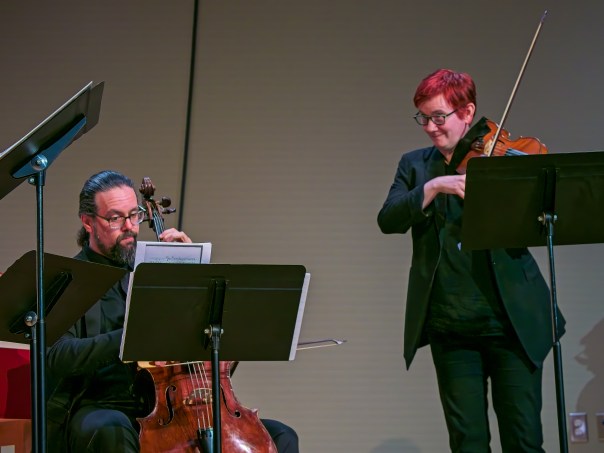
CHARLOTTE, NC – With the departure of the two people most instrumental in establishing Bach Akademie Charlotte and the Charlotte Bach Festival, artistic director Scott Allen Jarrett and chief exec Mike Trammell, we couldn’t help wondering how radical changes might be at the 2024 festival. The new artistic leaders filling in for Jarrett have actually been with the Bach Festival since the first Charlotte celebration in 2018. All three – concertmaster Aisslinn Nosky, cellist Guy Fishman, and keyboardist Nicolas Haigh – have made significant contributions in performance season after season. The new executive director, Garrett Murphy, began his hosting chores last spring at the Venetian Vespers concert, prior to the last year’s Bach Fest that featured marathon offerings of Johann Sebastian’s Christmas Oratorio.

The changes for 2024 were somewhat telegraphed by the first glimpses we had of Claudio Monteverdi’s Vespers of 1610 in that spring concert last year. For the first time, the headline works for the opening and closing concerts at Charlotte Bach are not by Bach. The laurel for the big opening at Sandra Levine Theatre was Antonio Vivaldi’s The Four Seasons, with Nosky fronting a string reduction of the iconic score that reprised her triumph as guest soloist with the Charlotte Symphony a few months before the inaugural festival. Stamping and mugging, red-headed Nosky brought the Red Priest’s electricity back. But with two afternoon sessions devoted to demonstration concerts of the Vespers, the closing concert with Monteverdi’s gem has been clearly designated as this year’s top highlight.

Not that Johann has been totally neglected. He had some play when Peter Blanchette, inventor of the 11-string archguitar, unofficially opened the festival with a “Bach at the Brauhaus” event at the temporary Pianodrome constructed at the Brooklyn Collective. And in the wake of The Four Seasons, where Bach’s “Tilge, Höchster, meine Sünden” served as a handsome preamble, Jonathan William Moyer‘s Organ Recital was all-Bach, an earth-shaking German Organ Mass that may be the best organ concert in the festival’s history.

In this year of transition, the “Bach, the Next Chapter” concert instantly stood out for me as the most telling event in this year’s lineup. Not only was the festival looking at Bach’s predecessors and contemporaries to explore their influence, it was now guiding us forward to examine his legacy – beginning in his own family with his most illustrious son, Carl Philipp Emanuel Bach. That extra stretch of the envelope – at a new venue, the Kathryn Greenhoot Recital Hall, never before called into service at Charlotte Bach – made “Next Chapter” a little more fetching than the half dozen other festival events scheduled at sites making their CBF debuts.

“Next Chapter” began with Johann Sebastian’s Magnificat, but only a small taste of its Canon Perpetuus – played by Nosky, Fishman, and oboist Kristin Olson – enough to establish the Leipzig master’s achievement as a jumping off point. Then before playing CPE’s Sonata for Oboe in G minor, Olson discussed how the younger Bach was intent on diverging with his illustrious father. Without the modern oboe’s metal keys, the baroque oboe would prove to be a fussier instrument, requiring more frequent swabbing, and its tone was noticeably thinner in the opening Adagio movement, with a litheness that seemed even better suited to the middle Allegro. The wide leaps of the closing Vivace were effortlessly navigated, and Olson’s tone grew slightly richer.

Johann Gottleib Graun’s Trio Sonata in B-flat for Violin and Viola actually brought four musicians to the fore. Harpsichordist Jennifer Streeter teamed with Fishman on the continuo while violist Maureen Murchie shared the title roles with Nosky. Introducing the piece, Nosky emphasized the new tendency of composers to give the spotlight to multiple soloists. Yet the promised parity between violin was only confirmed in the opening Adagio before it was discarded in the middle Allegretto, where Nosky was clearly the superior among equals in drawing technical challenges. Murchie had more of a chance to shine in the closing Vivace, where she had the first run at the theme.

All five hands came on deck for Johann Adolph Hasse’s Sonata for Oboe, Violin and Viola, though we were cautioned that Hasse was likely not the true composer of this charming piece. Olson drew most of the spotlight, with Nosky her chief responder, but Murchie had more challenges here than in the preceding piece. Nosky and Murchie withdrew for the next work by Princess Anna Amalia of Prussia, and Olson had the joy of announcing the discovery of a woman composer in the generation that followed Bach. Nosky’s excellent program notes offered only a slight clarification, reminding us that Anna Amalia studied with a student of Johann’s, distancing her musically from Bach by an additional generation.

Olson also confided that the piece was originally written for flute before possessing it in scintillating fashion with her oboe. The beauties of the opening Adagio drew even richer sounds from the oboist, yet Olson had to pause before the ensuing Allegretto “so all the notes will come out,” explaining the troubled relationship between her instrument and moisture as she swabbed. Fishman sat by patiently before upstaging his colleague, helpfully quipping that it was the same with his cello. Not to worry, Olson more than answered back with dazzling work on both the Allegretto and the concluding Allegro ma non troppo.

Nosky and Murchie returned for the evening’s finale, Johann Gottlieb Janitsch’s Quadro in G for Oboe, Violin and Viola, but once again Olson more than justified her top billing – in a four-movement crowdpleaser that was the most radical break with the Baroque Era that we heard. Once again, we had a swabbing pause between movements as Olson primed her instrument for the final fireworks of the Vivace non troppo. If you think of the baroque music canon as a cavalcade of perpetual motion machines, this last salvo was a shocker. Olson excelled yet again, laying down the gauntlet on multiple occasions and, rather than merely repeating, Nosky and Murchie fired back their flaming responses – after dramatic silences that crackled with tension.

Photos by Perry Tannenbaum