Monthly Archives: August 2023

“Hit the Wall” Reminds Us of the Continuing Relevance of the Stonewall Riots

Review: Hit the Wall at The Arts Factory

By Perry Tannenbaum

August 19, 2023, Charlotte, NC – On the eve of the annual Charlotte Pride Festival & Parade, a series of LGBTQ+ events spread across the city in the coming week, Queen City Concerts has chosen a perfect moment to commemorate the Stonewall Riots of 1969, a watershed moment for gay liberation and empowerment. Best known for their resourceful reductions of big musicals to a more bare-bones concert format, Queen City has previously shattered their own template with a fine script-in-hand production of Tony Kushner’s Angels in America, Parts 1 and 2.

Three months later, after a return to form with Diana: The Musical late last month, the company has shown us that Angels wasn’t a fluke, staging the local premiere of Ike Holter’s Hit the Wall, a 2012 play with music that premiered in Holter’s hometown of Chicago before director Eric Hoff restaged his original Steppenwolf Garage production with a New York cast. That Off-Broadway production opened in the spring of 2013 at the Barrow Street Theater, not far from Christopher Park in Greenwich Village, where much of the original action went down.

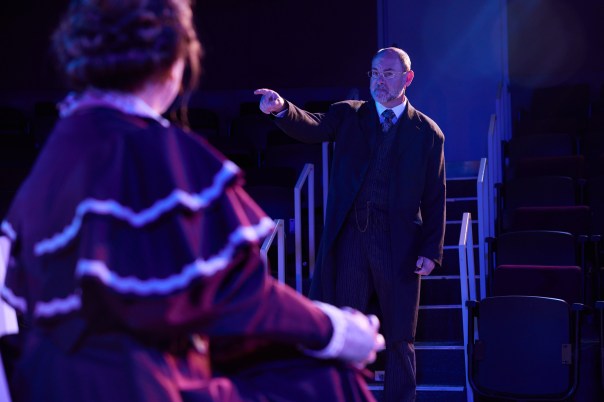
Directing this concert version at The Arts Factory, J. Christopher Brown isn’t quite as resourceful or ambitious as he was with Angels in utilizing projections and costumes. Scenery and props are also less lavish, and there are no stage directions at all read aloud. With a rowdy rock trio roaring from one corner of the black box space, the experience remained richly visceral, though our awareness of where we are or who is speaking was sometimes delayed. We get an abbreviated staircase for the proverbial sidewalk stoop, where the “Snap Queen Team” of Tano and Mika hang out, and a couple of chairs occasionally appear.

Projections could have transported us inside the Stonewall Inn gay bar, but we only get the exterior, and a lamppost or a park bench could have transported us to Christopher Park more emphatically. It doesn’t take long to get the gist after scenes at these locations begin, but who is telling us in the opening tableau that “The reports of what happened next are not exactly clear”? Without a simple cop’s uniform on actor Nick Southwick, it takes a long while before we know how to digest this declaration.

Of course, a long while in a production that zipped through Holter’s script in less than 90 minutes wasn’t uncomfortably long. What Christopher continued to do extremely well was cut down on key moments when actors read from their scripts. For most of the production, actors were off-book and the booklets they clutched served as reminders of their cues rather than reading material. We were aware of the scripts onstage, but the flow of the action and the actors’ lively energy grabbed nearly all our attention. If anything, the occasional peep at a script reminded us how quickly and thoroughly this cast had mastered its essence with just a few rehearsals.

We should also understand that the sanctification of Stonewall over the past 54 years has partly happened as myth rushed in to fill in a vacuum of determined facts. It’s interesting to see the strategies Holter used to recreate Stonewall, chiefly by inventing a compacted community of fictionalized gay, lesbian, queer, and crossdressing people, from the neighborhood and from elsewhere, who gather at The Stonewall, owned by the mob but catering to this eight-person crowd.

As the Snap Queen Team, Lamar Davis as Mika and Zelena Sierra as Tano have attitudes, sometimes confrontational, about anyone who passes by. When Zachary Parham arrives as the queer Newbie, the Queens are not at all welcoming. But Holter’s style of hostility isn’t mean-streets raw or even ‘60s bohemian. Combats and putdowns come at us in the form of rap rhymes and poetry slams.

Aj White, arriving in high heels and a low-cut dress as Carson, is too much for the Snap Queens to handle despite his grieving over the recent death of Judy Garland. Yet he is visibly floored by the advances of lanky Neifert Enrique as the self-confident, draft-dodging, pot-smoking Cliff, a fatalistic drifter who assumes he will be dumped into the Viet Nam War the next time he is picked up in a raid. None of these core characters appear ripe for radicalization, though the tough Carson and roving slickster Cliff have agreed to meet at The Stonewall. Eric Martinez as the arrogant A-Gay further convinces us of the submissiveness that bonds the Newbie and the Queens. The Harvard grad lords it over all three.

Two catalysts for change are deftly stirred into the mix. Shaniya Simmons as Peg will combine with Carson in fomenting the police brutality at The Stonewall, and Valerie Thames as Roberta, an activist perpetually straining to draw a crowd, will finally be gifted with a galvanizing cause. Besides Southwick as the Cop, friction comes from Iris DeWitt as Madeline, a character who morphs from a concerned citizen to a disapproving sister. Music blasted by guitarist Daniel Hight, bassist Harley, and drummer Paul Fisher was most appropriate when we convened at The Stonewall and the bulk of our cast began to party.

Ironically, the music was most effective when it suddenly stopped as police commands triggered the raid. The music vibe and the slam poetry styling were shattered simultaneously. Soon we were in the ladies’ room watching the grim brutality. A little less riveting – but perhaps more emotionally fraught – was the climactic confrontation between the sisters after the raid.

Reports of what happened afterwards are unclear, but we do adjourn to the sidewalk stoop where the main point impacts the Queens who sit on it: there’s no turning back. Paired with Angels within three points, Hit the Wall reminds us that Kushner’s epic ended with a similar takeaway. The feeling that both dramas remain timely urgently underscores the fact that the Pride movement has more work to do.

Make the Speech and Slam the Door – Again?

Review: A Doll’s House, Part 2 at The Mint Museum

By Perry Tannenbaum

If you make a brief study of Henrik Ibsen’s original script – going beyond the Wikipedia write-up – you can get a good understanding of how playwright Lucas Hnath went about imagining his 2017 sequel, A Doll’s House, Part 2. Crack open the 1879 original, published the same year it was premiered, and you’ll find that Hnath plays fast-and-loose with the text, even before Ibsen’s characters speak. The architecture of the house is changed when Nora Helmer returns 15 years later to the place where she delivered the feminist “door slam heard around the world.” That iconic door is now emphatically displayed, rather than concealed, in Hnath’s reimagining of the scene where Nora liberated herself by simply walking out on her husband Torvald and their children.

This time, she knocks insistently rather than daintily ringing a doorbell offstage. Once she enters, received by her antique nanny Anne Marie, she notices several items are gone, including her piano, an old cuckoo clock, a cabinet with trinkets, and a portrait of Mom. But only the piano was actually there when Ibsen set the scene, and Hnath is treating Henrik’s stage directions as cavalierly as a modern stage director.

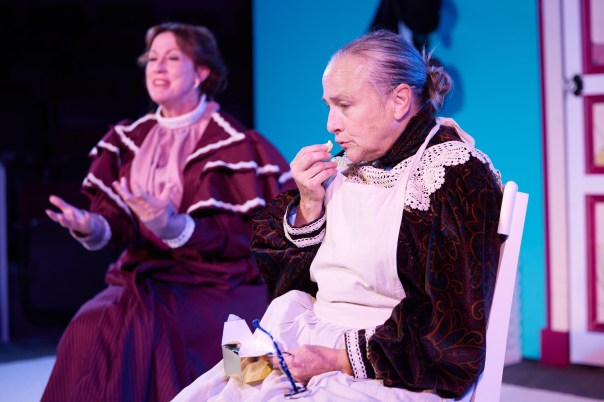
At the Mint Museum on Randolph, where Charlotte Conservatory Theatre is presenting the Queen City premiere, director Matt Cosper accurately gauges Hnath’s irreverence toward the papa of mod drama. But that doesn’t hinder Cosper from pushing the envelope a little further, by unleashing Gina Stewart to be the most skittish and hyper-fretful Anne Marie we can imagine – with a bit of hyperventilating slathered on. As the limping, desiccated nanny of yore becomes Nora’s sounding board once again, every juicy and exotic disclosure that Kellee Stall makes in the role about her tribulations and triumphs over the intervening 15 years becomes exponentially more scandalous, outre, and delicious by virtue of the old crone’s overreactions.

Cosper gives Stewart some extra business to accent her energy and curiosity, some laundry drudgery for starters as Nora is knocking on the door. Then as the wanderer opens up to her, Anne Marie is hungrily chewing on munchies or nibbling on the luxurious chocolate bonbon Nora has brought her, visibly devouring each scrap of news she hears. There’s a nibbling squirrel in both Ibsen’s Doll’s House and Hnath’s, but this time it isn’t Nora.

So exactly how has Nora thrived over these past years? For Stall arrives in a dress so resplendent, thanks to costume designer Beth Killion, that she evokes the majesty of a Macy’s Parade float or the Chrysler Building. Stretching the suspense, Nora asks Anne Marie to guess. This is fun, she remarks, bringing back more memories of Ibsen’s opening scene.

In Anne Marie’s first guess and in Nora’s subsequent revelation, we get keen glimpses into how deeply Hnath dived into Ibsen’s creation. Once you skim the Wikipedia write-up, after all, you realize that Nora is based on the marital turbulence of a writer, Laura Kieler, whom Ibsen knew well. By revealing Nora as a successful writer, Hnath is taking his cue from Ibsen, and by stealing Ibsen’s story, he exacts revenge on Kieler’s behalf, for the Norwegian novelist always resented the Norwegian playwright’s use of her story. (In real life, Mr. Kieler had his missus committed to an insane asylum.)

It’s kind of tasty.

Never guessing that her dear Nora had literary talent, Anne Marie guesses that she became an actress – a shrewd and prescient guess that will mirror Hnath’s thinking when Nora and Torvald thrash out their failed marriage. For the great fault – or fault-line – in Ibsen’s play has always been the wide gulf between the cheery and complaisant little magpie who charms Torvald in Acts 1 and 2 only to become an unbending and defiant crusader against her husband and society after the second intermission.

Famed New York Times theatre critic Walter Kerr pointed out this chasm in his analysis of the 1971 Broadway revival of the play, and he celebrated Claire Bloom’s approach to Nora as an effective way to bridge the gulf. What Kerr inferred from Bloom’s performance is pretty much what Hnath has Nora saying out loud in her final showdown with Torvald: the cheery, charming Nora that her husband remembers so fondly was largely a mix of playacting and manipulation, subterfuges that the new Nora disdains.

Shawn Halliday is as stodgy and respectable as the Torvald Helmer of old, but Hnath has given him fresh insights and self-delusions to play with – and to help Hnath in texturizing Nora a bit further. Ironically, the woman who went on to writing books that have espoused the end of marriage, inspiring other wives to walk out on their husbands, has soured Torvald on the idea of marriage simply by walking out and staying away.

“You sorta killed that for me,” he confesses.

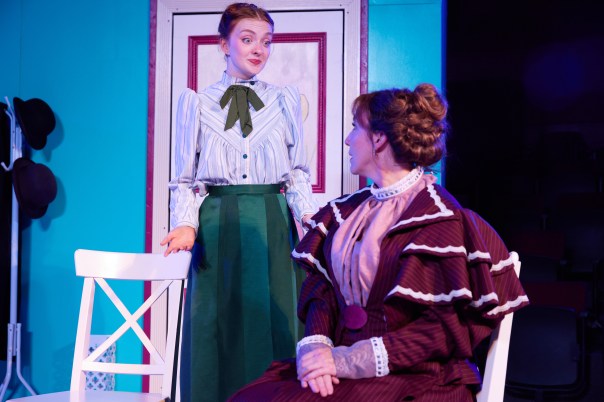
There’s also 15 years of hurt for Halliday to harp on – and for Stall to coolly deflect. Cosper allows Halliday to play the victim card way past the brink of comedy as he turns his chair away from Stall, like a pouting child who will not speak until Nora explains why she has returned. With the exception of the elaborately decorated front door, Tom Burch’s simple set design veers as much toward hospital waiting room as it does toward a doll’s house. But when the two simple white chairs, seemingly stolen from a patio or a beach, come into the action on a matching white rug, the smallness of the Mint stage accents the husband-and-wife role reversal beautifully, especially Master Torvald’s regression.

Clearly, the best of Torvald’s grievances goes straight to her walkout. Disarmingly, he admits that Nora had made some good points before she left, but if they really hadn’t had a serious conversation on a serious subject during their whole marriage, it should have been imperative for them both to attempt to have an adult conversation right then, on the spot, aimed at building the marriage that should have been.

Nora doesn’t wish to have the what-about-the-kids conversation, but Hnath doesn’t let her off the hook. The passage of time allows him to bring Emma Helmer, Nora’s daughter, to maturity as essentially a fresh creation. It’s another plum role, and Laura Scott Cary makes a scintillating debut in it, offering Nora the most devastating pushback she gets all evening.

When Emma claims she bears no ill will toward her mom, Cary is so intelligent, poised, and tastefully dressed that we can’t be sure if she’s telling the truth. A wee bit doll-like? It would be easy to presume that Emma has been molded by the strictures Anne Marie and Torvald live by, perhaps processed through the smarts and spirit she inherited from Nora. Yet Cary lets us see with steely clarity that she is not intimidated by her notorious mom. Better yet, she lets Nora see that her absence, more than anything else, has cemented her daughter’s belief in the benefits of marriage and family.

Poof, Nora’s claim that marriage will be an extinct institution within 30 to 40 years, which instantly draws laughs from the audience as Hnath leverages history, now deflates before Nora’s eyes in the confines of her old doll’s house. Quite a supreme irony for someone who has picked up a torch on a mission to change society.

Every time somebody onstage lets loose with an f-bomb, we’re reminded that Hnath’s historical perspective fuels this dramatic comedy. Ibsen denied that he intended A Doll’s House as a feminist play, but Hnath hardly needs to bother making this claim. If anything, he might need to defend himself against the charge that, as exemplified by Anne Marie and Nora, he’s telling us that women don’t know what they want. No, you will not find the answer to why Nora returns in this review. The best way to find out what is driving Nora – and to experience all the shocks she delivers and receives – is to watch how Hnath’s rewarding sequel unfolds at the Mint Museum Randolph. Perhaps the better question to ask, after seeing this beautifully balanced Charlotte Conservatory Theatre production, is whether Nora will ever take yes for an answer

Hurry, Hurry, See “The Chinese Lady” for 50¢

Review: The Chinese Lady at The Arts Factory

By Perry Tannenbaum

Somewhere in China, either forgotten in the innards of a few cellphones and computer hard drives or hanging up proudly framed on living room walls, are photos of my wife Sue and me taken in front of the fabled Great Wall, posing with a couple of families who had never seen Westerners before. For a few fleeting moments during our 2016 travels, we could have empathized – a little – with Afong Moy, the teenager imported from Canton City in 1834 by traders Nathaniel and Frederick Carne and put on display. “To be stared at, for half a dollar a head,” according to a disapproving New York Mirror editorial.

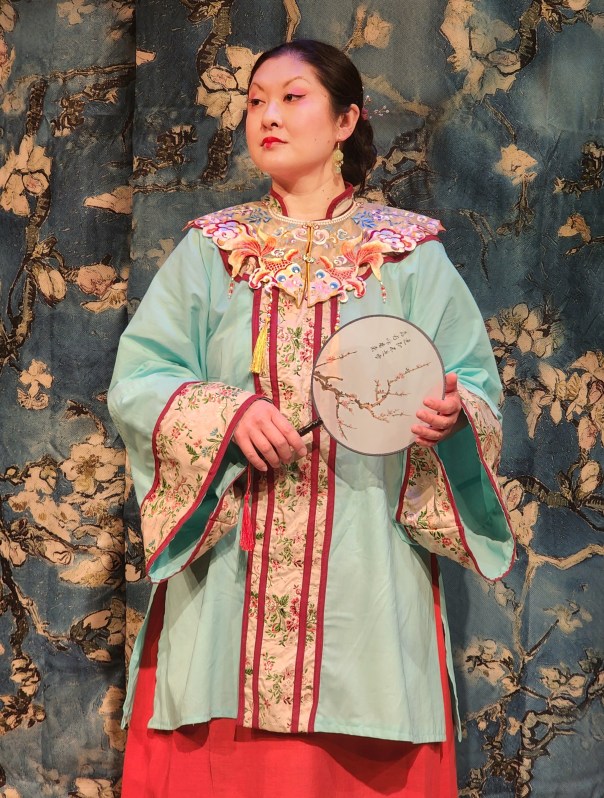
But we hadn’t heard of Afong Moy, and our ignorance remained intact until last Friday evening when Lloyd Suh’s The Chinese Lady had its local premiere at The Arts Factory in an affecting Three Bone Theatre production. Directed by Three Bone co-founder Robin Tynes-Miller and starring Amy Wada, Suh’s 2018 script repeatedly reminds us that we’re merely witnessing a performance – not really hearing Moy’s voice or even her words and not really seeing her body.

For in the great tradition of American aggrandizement, the original Moy’s body wasn’t her own, either. It was purportedly on loan to the Carne Brothers from Moy’s dad for two years, a deal that the Americans found easy enough to break, setting the precedent for Madame Butterfly and other dealings Uncle Sam and her upright citizens have had with the Far East. As for the absurdity of it all, we can easily perceive sweet revenge for Moy as Wada introduces us to such exotic fundamentals as brewing tea, holding chopsticks, and actually managing to walk with her tiny bound feet.

We can almost hear that lusty voice of P.T. Barnum himself proclaiming, “Ladies and Gentlemen, you are being patronized!” Yes, after the novelty began to wear off, the exhibition at Peale’s Museum in Philadelphia and an ensuing national tour having run their course, Moy becomes a sideshow at Barnum’s traveling circus. Running parallel to that deepening degradation, Stephen West-Rogers is Atung, Afong’s translator. Since Moy never speaks a word of Cantonese to us, the modern surrogates for The Chinese Lady’s actual audiences, Atung is stoically aware of his irrelevance from the start.

West-Rogers bickers with Wada when he isn’t serving her or bossing her, no need for his translation services except in one climactic scene. At the height of her celebrity, Moy gets to see “America’s emperor,” President Andrew Jackson, at the White House. Suddenly, Atung is the only person in the room who can tell us everything that was said. It’s a feast for West-Rogers who gets to play the lascivious Old Hickory with a thick cowboy drawl only to spring out of his regal easy chair to portray Atung cunningly and diplomatically mistranslating key parts of the conversation – if that’s the proper word.

Wada plays a more nuanced set of multiple roles. At times, she’s channeling Moy and at other moments she has become Suh’s mouthpiece, for Moy is merely Exhibit A in an extensive list of atrocities, prohibitions, and indignities inflicted by Americans upon Asians since she arrived here as a tender 14-year-old – and the playwright is not letting them slide. Nor should he, since our widespread ignorance of Chinese and Asian travails in the US goes far beyond not knowing about Afong Moy.

More than likely, the players who deliver Suh’s sad drama are also learning and digesting some of this history. There’s still another dimension to Afong in her early years here, for her purposes were not strictly educational. The Carne Brothers had merch to sell to their captivated audiences via their exotic spokeswoman: maybe the chopsticks Moy was eating with for starters, maybe the quaint tea sets and trays that Atung officiously carries in from the wings.

Afong is surrounded, of course, by decorative furnishings, vases, fabrics, draperies, and – at the whim of set designer Chip Davis – an elegant wooden birdcage that may have been unloaded from the same ship she sailed in on. Our Chinese Lady simply models many of these items without saying a word, the Carne Brothers merely scripting her actions. But at other times, Moy was an actress dutifully mouthing words that were not her own, words of gratitude to her benefactors and words directing our attention to the Carne Brothers’ merch on sale nearby.

It’s bittersweet, then, when Barnum has relieved her of her commercial obligations and transformed her into one of many sideshow attractions. As she becomes more authentically herself and gradually learns the language of her new homeland, Afong becomes less unique, less celebrated, less valuable to her employer, and more degraded and disposable.

Just one altercation between Afong and Atung, when he attempts to draw the curtain closed around her little performing space, is enough to remind us that her comings and goings are not voluntary. Each closing of the curtain propels the action at last a year closer to our time. While Suh doesn’t spend much effort in dramatizing Moy’s increased mastery of her second language during those years – and partial forgetting of her first – he diligently opens her eyes to how we proceeded to exploit the influx of Chinese immigrants that came after her.

It wouldn’t have been a pretty sight even if Moy had lived past 1850, when history loses track of her. The first great wave of Chinese immigration was triggered by the California Gold Rush of 1849. By the time the Golden Spike completed Transcontinental Railroad in 1869, there were 12,000 Chinese in the construction crew that completed its western leg, working for the Central Pacific Railroad.

Sketching our great nation’s appreciation for Chinese labor, Suh’s Afong catalogs a few of the hideous slaughters of miners and laborers that Asians were treated to. Then in 1882, our US House of Representatives had their first opportunity to express their gratitude to the immigrants by voting down the Chinese Exclusion Act, which would stop immigration in its tracks for the next 10 years. But guess what. Our Congress passed the heinous restrictions overwhelmingly, the first such action Congress had taken against any nation, and 10 years later, they passed an extension of the Exclusion Act for another 10 years.

Then in 1902, our wise and magnanimous Congress said enough is enough. This time, they made the law permanent.

Now I can’t recall learning any of this back in my school days, no doubt a comfort to many framers of school curricula today who worry so devoutly about disturbing their fragile offspring. Lucky for them, The Chinese Lady was written before the COVID-19 pandemic rekindled widespread hatred and violence toward Asians. Tynes-Miller refrains from layering on any additional references to the re-emergence of this ugly bigotry, a kindness that was not granted by last year’s New York revival at the Public Theatre.

Still, Suh’s play won’t appeal to the haters or the educational censors who redline uncomfortable highlights of American history. Big green light, though, for those of you who feel like we should all know our history as fully and fairly as possible. You will be rewarded with new insights and an extraordinary pair of performances by both Wada and West-Rogers.