Monthly Archives: May 2023

“Angels” and QC Concerts Are Aiming High

Preview: Angels in America at the Georgia Tucker Fine Arts Hall

By Perry Tannenbaum

AIA Rehearsal Photo 1.6

We’ve had historic productions of Tony Kushner’s Angels in America here before, most famously the Charlotte Rep bombshell of 1996, which blew up into a culture-war disgrace that shamed the Queen City nationwide. Rep’s greatest hit – in attendance and critical esteem – sowed the festering seeds of the regional company’s eventual demise in 2005.

Nor did Carolina Actors Studio Theatre (CAST) have any better success in 2014 when, following in Rep’s footsteps, they also staged both Part 1 and Part 2 of Angels: Kushner’s Millennium Approaches, which won the Tony Award for Best Play and the Pulitzer Prize for Drama in 1993; and Perestroika, which repeated for the 1994 Tony, Drama Desk, and Olivier awards in 1994. After just one more production, CAST folded.2023~Georgia Tucker Center-07

By even contemplating an Angels revival, QC Concerts and music director/founder Zachary Tarlton are obviously tempting fate. More than that, they’re smashing their own musical template and flouting the company’s brand – by airlifting their upcoming production to Matthews and the new Georgia Tucker Fine Arts Hall.

QC Concerts has happened by accident, beginning like Angels with the onset of an unheard-of disease. In Tarlton’s case, the plague was COVID-19 rather than HIV AIDS.

The company started small. Smack in the middle of preparing to spearhead an Actor’s Theatre of Charlotte fundraiser at Middle C Jazz, Tarlton was faced with the suddenness of the pandemic shutdown and the uncertainty of what would follow. He didn’t want to sit around idly by his keyboard.

“So I launched kind of an online streaming platform,” Tarlton recalls. “We were then known as QC Quarantine Concerts – a bit of a play on words. What we did was we modeled ourselves after a program in New York that Seth Rudetsky [and his husband, James Wesley] from Sirius XM started called Stars in the House, where he was running these broadcasts at the same time that shows would have been running.”

Thursdays through Sundays, for a 10-week run extending from mid-March through June of 2020, Tarlton’s piano room became a streamcasting studio. To create these mini-concerts, Theatre Charlotte’s go-to music director networked with Matthews Playhouse, Davidson Community Players, and Children’s Theatre of Charlotte, as well as Actor’s Theatre.
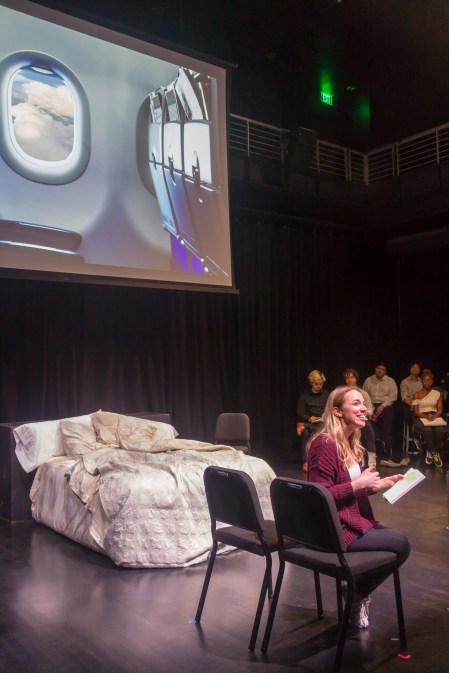
Tracks recorded in the Tarlton piano room also went beyond the QC to contacts who became singing collaborators in Chicago, New York, and musical performers who had been left in the lurch by stalled national tours.

“It was a good opportunity to kind of bring the arts together at a time when that was not really possible and people were kind of starving for the arts. And it gave us a chance to really get to know and meet and work with a lot of really, really wonderful people.”

That sweet taste of collaboration – and that newly-forged network of musical artists – seemed like a shame to waste. When live theatre began to return late in the summer of 2021, Tarlton dropped the Quarantine from his brand, fired up his network, and launched the live programming of QC Concerts, season one. Angels will mark the end of season two, detouring from a cavalcade of musicals that has included Titanic, Kinky Boots, Head Over Heels, and Cruel Intentions.

Season three scheduling was unveiled last month, and the all-musical lineup will include Diana The Musical, Hit the Wall, Local Singles, Merrily We Roll Along, Parade, and Sunset Boulevard. Late in July, the season kicks off with Diana at Free Will Craft + Vine, a favorite NoDa haunt where Tarlton staged Kinky Boots. The season reaches its pinnacle in November, when Sunset Boulevard opens Uptown at Booth Playhouse – backed by a 40-piece orchestra.

The emphasis, except when Angels are flown in, is always on the music.

“We do concert stage productions of shows,” Tarlton explains. “So we do them with the full orchestra, whatever the complement is that the show is written for. A lot of our musicians are Symphony subs that play all the Broadway national tours, and their schedules fill up super quickly. So to get those folks willing to come on board and play Titanic [boasting a 22-piece orchestra] for one weekend with two rehearsals is astounding.”

Dramatic presentation continues to evolve, though Tarlton has no plans to move beyond the concert format. In the beginning, it was a fairly straightforward reading-stage layout, with the singers at music stands behind a row of mics and the orchestra lurking upstage. At Free Will in NoDa, they built a drag-show style runway and the audience surrounded the players.

Prodded by imaginative guest directors, Tarlton kept pushing the envelope, adding light costumes, some props, and moving his leading men and women away from their scripts for the key musical numbers. While guest director J. Christopher Brown won’t be crashing ceilings or flying angels when QC Concerts travels to the Georgia Tucker, he will be using projections and sound design to clarify the narrative and amp up the key moments.

That will put the traditional reading-stage setup on steroids. Written for an eight-person ensemble, Angels could be expected to add on a narrator for the script-in-hand format to read the scene settings and stage directions. Brown is expanding his cast to 18, using multiple narrators and cutting down on actors playing two or more roles. There are 21 roles in Millennium Approaches and 25 in the stupendous Perestroika.AIA Rehearsal Photo 1.5

Only one cast member doesn’t double, the actor who portrays protagonist Prior Walter. It’s an epic role that single-handedly justifies Kushner’s audacious Angels subtitle, A Gay Fantasia on National Themes. Not the kind of role you plunge into if you’re accustomed to singing “The Surrey With the Fringe on Top” or “Marian the Librarian.”AIA Rehearsal Photo 1.7
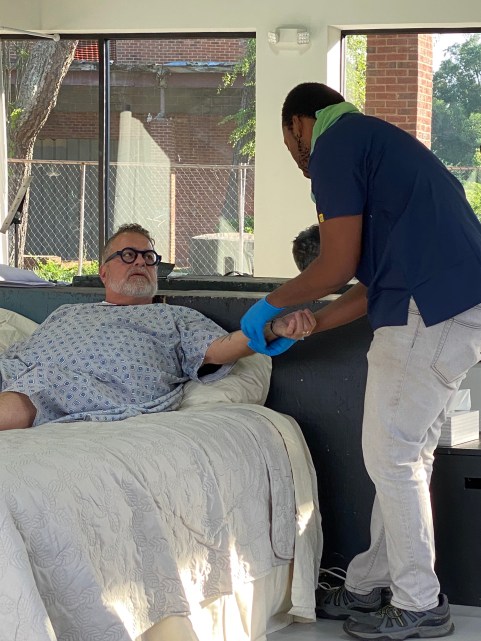
Casts from previous QC Concerts productions fill only four of the 18 slots for the company’s first nonmusical foray. Most notorious among these usual suspects will be Beau Stroupe as Roy Cohn, the demonic counterpart of the angelic Prior. Both of these powerhouse characters are AIDS victims, and another QC mainstay, Lamar Davis as Belize, is the link between the two – he’s the registered nurse who cares for the hospitalized Cohn, and he’s Prior’s prior lover.

The other major roles came from outside QC’s musical circle, a daring outreach since Brown didn’t bring a wealth of local experience to the table.

“It was 100% a leap into the void,” Tarlton admits. “I hoped that [Angels] was a title that would catch people’s eyes and they’d be like, ‘I might never get the chance to do this again.’ Foundational to the work we do is that idea of creating a home for everybody and really doing a lot of diverse work to challenge the way we think about and view the world. We’re not a company with a 95-year history – I’m totally out there to push the envelope and to bring something new and exciting and fresh, and if it makes people mad, it makes people mad. If people love it, people love it.”

Tarlton’s zest for challenging himself evidently goes beyond founding a theatre company unlike any we’ve seen before in Charlotte. Although he hadn’t appeared onstage since he was “in college a million years ago,” he auditioned for Angels after telling Brown not to use him if he sucked.AIA Rehearsal Photo 1.2
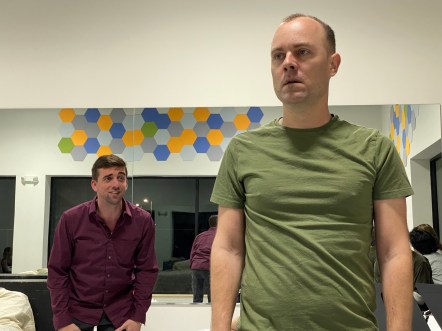
He’ll be playing Louis Ironson, the self-pitying nebbish and seducer who connects Prior with a third plotline. Too weak to stand by Prior in his AIDS sufferings, he abandons him in favor of his Mormon co-worker, Joe Pitt, luring him away from his religious principles and from his flaky, pill-popping wife, Harper Pitt. While Angels on high are recruiting Prior to redeem America, Harper is taking flight to a narcotic dreamworld and Roy Cohn is haunted by the ghost of Ethel Rosenberg. Enter Hannah Pitt, flying in from Salt Lake City to save her dear son Joe from the mortal sin of sodomy.

Yeah, it’s a lot.

Additionally, Tarlton is glad that two married couples, neither of whom have appeared with QC before – or at Theatre Charlotte – have become core players in Concerts’ Angels.AIA Rehearsal Photo 1.4
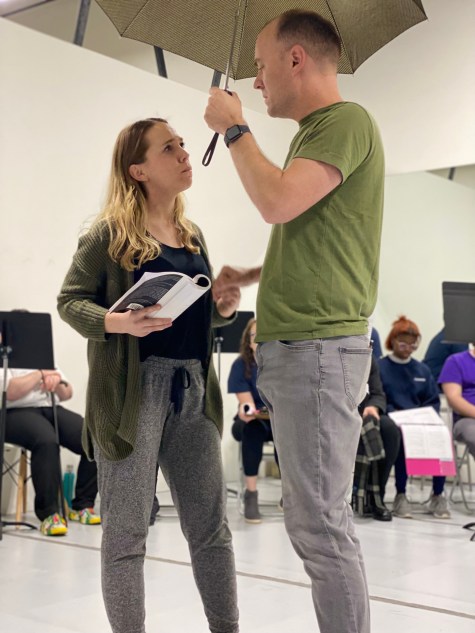
Rachel and Brandon Dawson, both faculty members at Winthrop University, are making their Charlotte debuts, Rachel as the confused, jilted, and somewhat spacey Harper and Brandon as our gay visionary Prior Walter. The scene they will have together is among the most incredible of the entire epic. Scott and Robin Tynes-Miller, on the other hand, have been mainstays on the Charlotte theatre scene for the last decade, ever since Robin founded Three Bone Theatre in 2013.AIA Rehearsal Photo 1.1
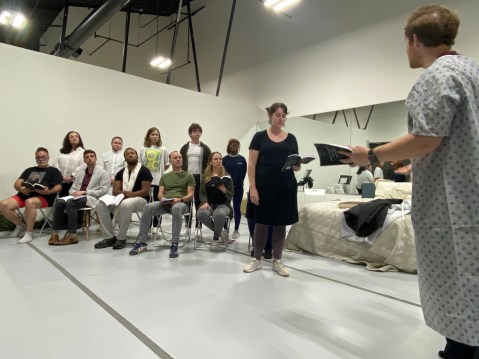
She is also the one solid link between the current QC Concerts Angels and the CAST production, shifting from the role of Harper Pitt in 2014 to the more elevated role The Angel. Rehearsal photos repeatedly depict Robin rising above ground level, even if she doesn’t fly. Scott figures to be more earthbound as the straight-arrow Joe Pitt.

While Actor’s Theatre of Charlotte provided the platform for QC Quarantine’s launch at their website, Theatre Charlotte deserves credit as the more significant source of inspiration for Tarlton’s unique enterprise – and its true birthplace. At about the same time that Tynes-Miller was piloting her first Three Bone production in 2013, the old Queens Road barn began hosting a series of annual fundraising concerts, Grand Nights for Singing, showcasing showtunes.

Tarlton was a fixture at the keyboard for these concerts. That’s where he started to become the only theaterperson in Charlotte to be connected with two different Tony Kushner works. Instead of the customary medley format, focusing on a particular era (like pre-1965) and highlights from a signature show (like Funny Girl), Tarlton approached executive director Ron Law with the idea of doing a full show.

So on February 26, 2016, the new concert musical concept took wing in the lobby of Theatre Charlotte with Caroline, or Change – music by Jeanine Tesori, book and lyrics by Kushner.

Caroline, or Change was one of those shows that I just felt like it was the right time, the right group of people in Charlotte to be able to pull something like that off. It was an incredible experience,” Tarlton says.

He caught the return of that musical to Broadway in 2021 as well as the Nathan Lane Angels in 2018. Taking his first leaps away from musicals with Angels – as a producer and as an actor – was pretty much a no-brainer.

“There’s no better show to do than something that means so much to me and the community.”

Georgia Tucker Fine Arts Hall, July 13th, 2021Publicity photos for the Georgia Tucker Fine Arts Hall are delicious, showing a 145-seat black box with ample projection and soundbooth resources for a knockout Angels. As the new fringe theatre movement continues to gain momentum around town, the Tucker becomes another tempting place for it to hang out.

The runs of QC Concerts’ shows remain tantalizingly short, a limitation Tarlton hopes to address in the coming years. This week’s Angels run, four performances from May 18-21, offer only two opportunities for us to see both parts of Kushner’s masterwork. Then it’s gone.

For Tarlton, that ephemerality is part of QC Concerts’ attraction. Like New York City Encores or the Broadway Center Stage Program at Kennedy Center in DC, the concept might be stretched to a full week. Maybe the sweet spot for ticket sales, publicity, reviews, and word-of-mouth will be found in that discreet degree of expansion.

“The idea is that these shows live and breathe in one specific moment in time,” Tarlton insists. “Our goal is to become a fully professional company in the next five years so we’re able to kind of pay everybody along the way.”

“Crowns, Kinks and Curls” Highlights Afro Hair

Review: The Glorious World of Crowns, Kinks and Curls at The Arts Factory

 By Perry Tannenbaum

2023~Crowns Kinks-01

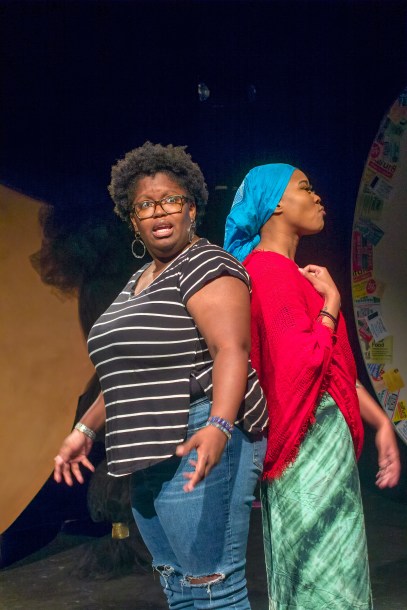
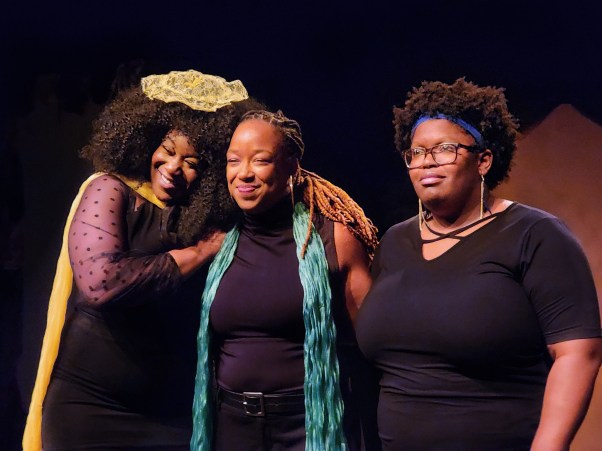
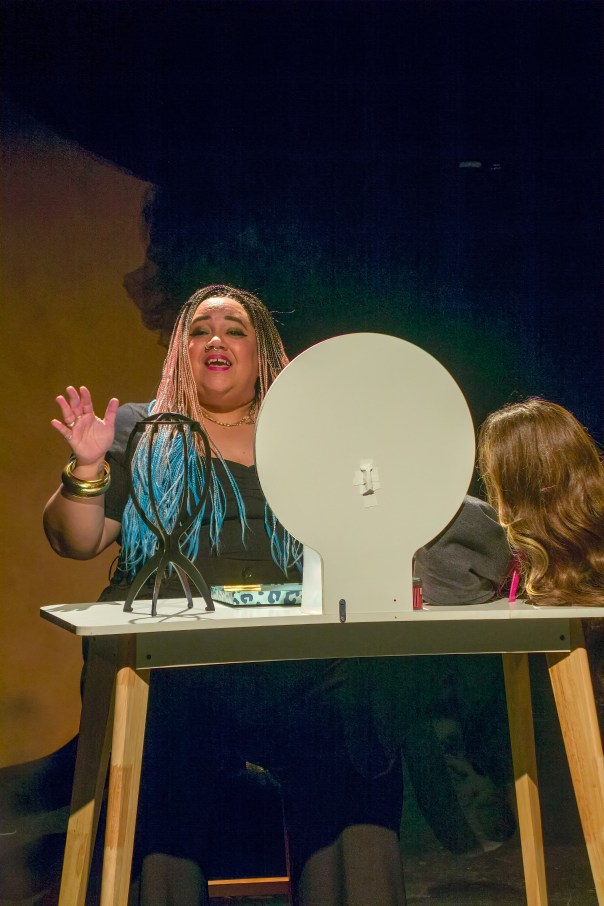
If you weren’t aware that Black women have a special relationship with their hair, Keli Goff’s THE GLORIOUS WORLD OF CROWNS, KINKS AND CURLS, now premiering at The Arts Factory, will set you straight. Although a streamed three-woman version of the show produced by Baltimore Center Stage aired in 2021, Three Bone Theatre is currently performing the first live production – with a six-woman cast.

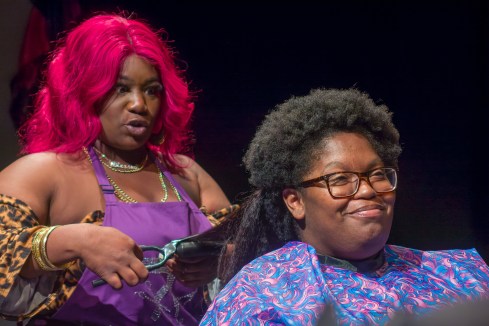
Doubling the cast turns out to be a wise decision by director Tina Kelly, enabling costume designer Toi A. Reynolds Johnson and hair designer Blue Edmonds to show off more of their work, while allowing the sextet of actors to concentrate on their performances instead of how to manage frenetic backstage changes. With 20 different monologues, sketches, and rhymed rants along the way, there’s still plenty of material to go around.

Maybe Kelly and her artistic team decided to add players during the rehearsal process, for the distribution of acting chores certainly isn’t even – and the script came into their hands without the logistics of staging the show having ever been worked out in live performance. The impact of a larger cast performing for a live audience might also be a revelation for Goff when she comes down to the Queen City this coming weekend to witness Three Bone’s handiwork.2023~Crowns Kinks-02

More heads of hair onstage seemed to add weight – maybe even universality – to their cumulative testimony, and the audience reaction layered on at the Sunday matinee I saw made their words gospel. Short of outright amens, there were a variety of audible affirmations.

Anxiety over black women’s hair seems to crop up most impactfully in the workplace, where long-ingrained attitudes and prejudices can affect hiring, performance evaluations, and advancement. Ashleigh Gilliam seems to get off to a wobbly start as she welcomes the audience to an experience beyond theatre, where we can hope to encounter humorous and engaging therapists, feel like we’ve met up with old friends, or maybe make new ones.

But there’s a finely calibrated stage fright in Gilliam’s delivery that had me worrying, until Goff had Gilliam flipping the script with a bit of sleight-of-hand. It turned out that her character was auditioning for her role. Then an unseen casting director makes it quite clear that the role will not be going Gilliam’s way – unless she does something with her hair to make it more “ladylike.”

While I knew that racism was ubiquitous, centuries old, and ongoing, it was revelatory for me to learn that all Black women – no matter what kind of hair they have or how much, whether they are rich or poor – have a story to tell about their “crown and glory.” Even more stunning, as three specific stories began the cavalcade of testimonies, all three women before us had stories of people who had the nerve to reach out, without permission, to touch their hair.

At work. On a date. On a yacht.

Recalling the horror, they reached out toward us in unison: “The hand!” “The hand!” “The hand!” The lady executive, the hip-hop producer, and the plutocrat yachtswoman were all the same. Rude, insensitive, and invasive.

“Don’t ever touch a black woman’s hair without her permission,” they finish in unison. By leaving out seven exclamation points and over 140 capital letters from Goff’s playscript, I don’t think I’m exaggerating her emphasis. But to the Sunday matinee crowd’s credit, there was a healthy amount of laughter mixed in with the affirmations as these horror stories climaxed and the lights went out.

The slights don’t all come from white people. In the ensuing monologue, “Dear God, It’s Me, Amaya,” the little girl has been told by a Black classmate that her hair is nappy. She prays for pretty hair for her eighth birthday. Dressed in purest white for her wedding, it’s Gabrielle in the next sketch who is still hearing her mom’s outrage and weeping – because she has opted for short hair – as she tells us her story.

Aside from cataloging the slings, slights, and chemicals that have assailed Black women’s hair over the years, Goff also creates an arc of progress and a hopeful outlook, fortified by her humor. Here we can fault Kelly and projection designer Will Jenkins for not including the date markers that the script calls for, blurring Goff’s somewhat faint timeline. Nor are Kelly and Gilliam quite helpful enough in cementing the full connection between Goff’s first scene and her last.2023~Crowns Kinks-04

But there are also detours in between, like the prerecorded segment that informs us that Black moms often experience post-partum hair loss. An extended scene at a DC beauty parlor, “The Ball.” goes slack and loses its comical edge long before Goff attempts to rescue it with a notable historical context that grounds us in 2009. These are missteps that a playwright will notice more readily when she watches her work alongside a live audience. Goff’s visit may very well provide her with the first opportunity she’s had to remediate CROWNS, KINKS AND CURLS with that kind of precious feedback.

She will definitely enjoy the Three Bone ensemble. Only Vanessa Robinson has performed at The Arts Factory before as the down-to-earth social worker in Three Bones’ Andy and the Orphans back in February. Here she delivers impressively as a rape victim preparing to testify in “Chantal’s Fierce Magic.” Among various roles, Michelle Washington shines most memorably as Amaya in her debut, while Cailin Harrison is alternately poignant and adorable as Gabrielle, the conflicted bride.2023~Crowns Kinks-07

Dior Scott had one of the juiciest monologues in her debut, resplendently dressed for “Adaora and Her Little Princess,” perhaps Goff’s best segment. Yet Scott was a force to be reckoned with in multiple ensemble pieces, such as the “Don’t Touch!” freak-out and her confrontation with Washington in “Office Politics.” Ka’Shara Hall was stateliest as the Congresswoman in the “Pauline on When Hair Gets Political” monologue, but her give-and-take with Scott on “It’s Just Hair” crackled with vivacity, making Goff’s rhyming easier to swallow.

Goff plans to linger after the next Sunday matinee for a talkback. It will be interesting to hear her reactions to the live performance – and maybe find out if she’s having second thoughts about Adaora’s adoration of Meghan Markle.

Lan Shui’s Rachmaninoff Is a Special Gift – and a Flexion Point for Charlotte Symphony

By Perry Tannenbaum

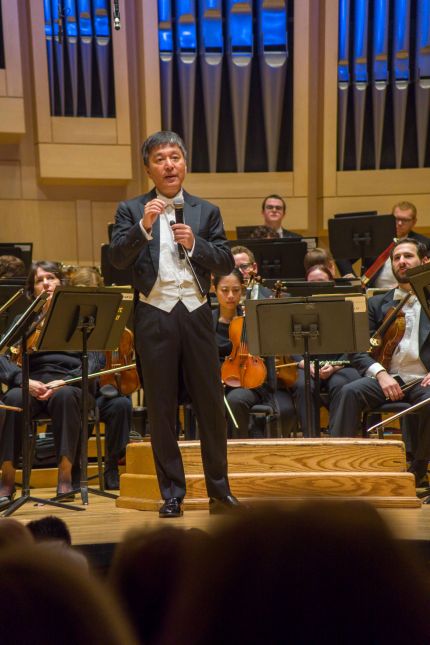
2023~Rahmaninoff 2-19

April 28, 2023, Charlotte, NC – It’s time to admit that Charlotte Symphony has flipped the script. After a string of four consecutive concerts that I’ve reviewed in 2023, with four different guest conductors, every one of them immaculately played, I can no longer agree that CSO is in search of a new music director who will take the orchestra to the next level. The virtuosity and consistency are here, the responsiveness to varied composers and conducting styles is here, and the mastery of a multitude of musical styles can no longer be overlooked.

My moment of revelation came after the intermission in this week’s program at Belk Theater with guest conductor Lan Shui. Everything had been wonderful so far: Samuel Barber’s “Overture to The School for Scandal” had been colorful, cohesive, and melodious; the accompaniment of guest pianist Mari Kodama’s scintillating work on Mendelssohn’s Piano Concerto No. 1 had been as robust as the support Canadian soprano Alexandra Smither received on Benjamin Britten’s Les Illuminations with guest conductor Vinay Parameswaran on the podium.

My moment of realization came as the opening Largo-Allegro movement of Sergei Rachmaninoff’s Symphony No. 2 came to its finish – epic in its variety, impeccable in its flow, and utterly convincing in its pacing and drama. I had never appreciated how rich and gorgeous this music was. Repeatedly over the years, I have written about the low points in my CSO concertgoing experiences, when I needed to hurry home after performances of Beethoven’s Eroica and Copland’s Appalachian Spring to re-establish, via CDs in my collection, that I actually liked and admired this music. Finding out at Belk Theater what I’d missed on recordings I have heard before at home, as I did last night with Symphony’s Rachmaninoff, was a complete 180-degree turnaround.

Mei-Ann Chen’s exhortations that Charlotte should support their orchestra as much as it deserved weren’t tainted at all with pragmatic flattery as I had thought, it was plain honesty. The only reason she remains the top candidate among those I’ve heard after Shui’s equal triumph is that I still feel Chen will bring more youth and effort to the true tasks at hand – keeping CSO’s performance level at its admirable height, enlarging its numbers, and enhancing its reputation and touring opportunities. Nor should I leave what is implied here unspoken, that Christopher Warren-Green completed his mission of lifting Symphony’s quality to international standards by the time his tenure ended in 2022.

2023~Rahmaninoff 2-24

Triggering the lush and playful violins, principal oboist Hollis Ulaky and principal clarinetist Taylor Marino played beguiling solos. Pacing and dynamics were beautifully judged until the cycle repeated, the violins seeming to respond lower in the treble and Marino playing more challenging passages. The Mendelssohn that followed was Molto allegro from the start, Kodama’s febrile attack matched by Symphony’s zesty engagement. When we flowed into quieter interludes the transitions were utterly seamless, with lyricism spontaneous enough to foreshadow an ethereal rapturous treat when we reached the middle movement – so transporting that I need to rouse myself and realize we were already in that dreamy movement and that the orchestra had arrived there without a pause.

2023~Rahmaninoff 2-12

Kodama caressed the treble at times with her delicate right hand while cherishing it in her left hand with a closed fist, at other times, she leaned back and gazed almost directly upwards. Shui and the orchestra were far more emphatic in signaling the segue to the finale, a rousing Presto-Molto allegro. Early in the movement, Kodama wasn’t as crystalline in her fingering as Howard Shelley in his recording with the London Mozart Players, and I’m not sure she quite equaled the drama of the manic build at the very end that Stephen Hough achieved with the City of Birmingham Orchestra. Overall, though, the live Kodama-CSO performance matched them both.

2023~Rahmaninoff 2-21

As the glory of Symphony’s performance of the Largo-Allegro moderato opening movement flowed so gorgeously from pinnacle to pinnacle, cogent and suffused with seething tension, it occurred to me that the orchestra’s immersions outside their mainstage classical offerings – in big band jazz charts and film scores – has paid off in handsome dividends. From measure to measure, like frame to frame at the movies, connections remained ironclad. Shui’s spoken intro was entertaining and informative, not above repeating some of the information in the digital program booklet, a practice that Warren-Green religiously avoided. He warned us of the hourlong length of the piece and had us on the lookout for Marino’s lovely clarinet spot at the beginning of the Adagio third movement. It emerged unforgettably out of a hush and took sad flight until the strings joined in the restless, aching keening, flowing into work’s biggest tune.

I couldn’t trace any previous CSO performances of this grand piece on my calendar or in my document dating back to 1994, so few if any of the musicians onstage were much more familiar with this gem than those of us in the audience marveling at its beauty. Shui has recorded all the Rachmaninoff symphonies with Singapore Symphony Orchestra, where he was music director from 1997 to 2019, so he has a special affinity for this music. Getting to hear his interpretation of the E minor No. 2 is a special gift for us.

“Sister Mary Ignatius” Takes Dogma and Certitude to the Limit

Review: Sister Mary Ignatius Explains It All for You at CATCh

By Perry Tannenbaum

2023-04-20#015

For playwright Christopher Durang and now for the Queen City, Sister Mary Ignatius Explains It All for You has a special historical significance. When it premiered in 1979, Sister Mary was presented Off-Broadway in an evening of one-act plays that included works by Tennessee Williams, David Mamet, Marsha Norman, Romulus Linney, and Murray Schisgal – a pretty decent lineup.

Just that billing would have put Durang on the map. More distinctions swiftly followed: Not only was Durang’s satire proclaimed the best of that distinguished group, he and Elizabeth Franz (who would ultimately play the title role in three separate productions) won Obie Awards for that season.

While the Innovative Theatre production of 1989, directed by George Brown and starring Barbara Hird (of Lost Colony fame), may not have been a Charlotte premiere, it marked the auspicious debut of Brown’s company. Over the next five years, as actor/director wunderkind Alan Poindexter moved into the Innovative orbit, critically acclaimed productions gushed forth, including The Illuminati, The Chairs, Old Times, and The Search for Signs of Intelligent Life in the Universe. Innovative is also fondly recalled for its laugh riots at the legendary Pterodactyl Club, chiefly Psycho Beach Party and the imperishable Vampire Lesbians of Sodom.

Although Comedy Arts Theater of Charlotte or CATCh has been around since 2017, presenting standup and improv comedy most weekends at their South Boulevard location, Sister Mary Ignatius is their first foray into scripted live theatre. Perhaps it shouldn’t be that surprising that two Charlotte companies would begin with this same outrageous satire.

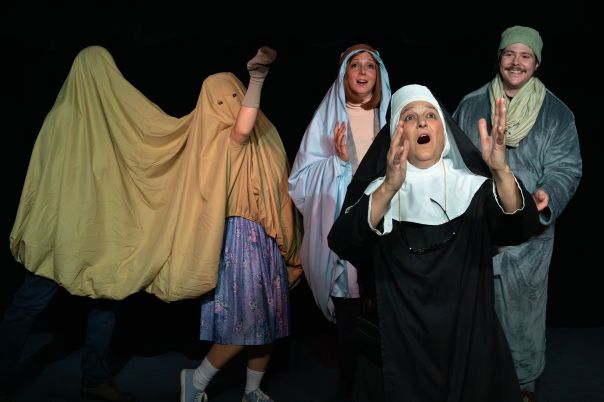
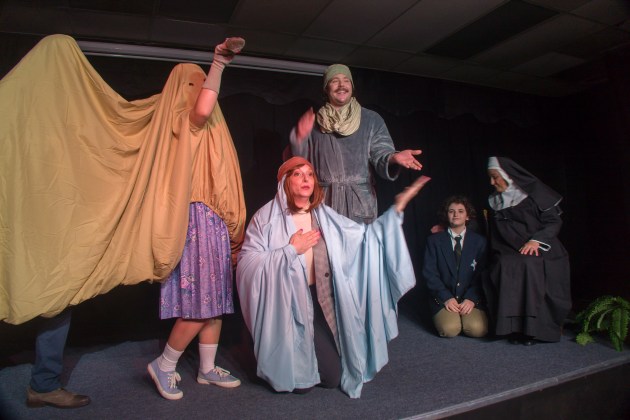
“The stage is fairly simple,” Durang has said. “There should be a lectern, a potted palm, a chair to the side for Sister to sit on.” Find a nun’s habit and a couple of Nativity play costumes – could be as simple as a bathrobe, a towel, and a couple of bedsheets – and your stage director can start thinking about holding auditions.

Kevin Shimko, a co-founder of CATCh with Abby Head, has been fitfully involved in the Charlotte theatre scene before – and with storefront theatre production. Interestingly enough, Shimko’s storefront outing at the former SouthEnd location of the Charlotte Art League was a semi-improv experience. Eight actors rehearsed all seven roles in Eat the Runt, and the audience decided who would play each of the unisex roles.

So none of the actors was sure he or she would go on! On the night we attended the performance on Camden Road, Shimko was the last actor selected, barely avoiding being left out. Among those preceding him in the casting that night were Andrea King and Jenn Grabenstetter, both of whom are on the Sister Mary team. King is in charge of lighting and sound while Grabenstetter as Diane Symonds, is the bitterest of Sister Mary’s former students, playing the virgin in the Christmas play.

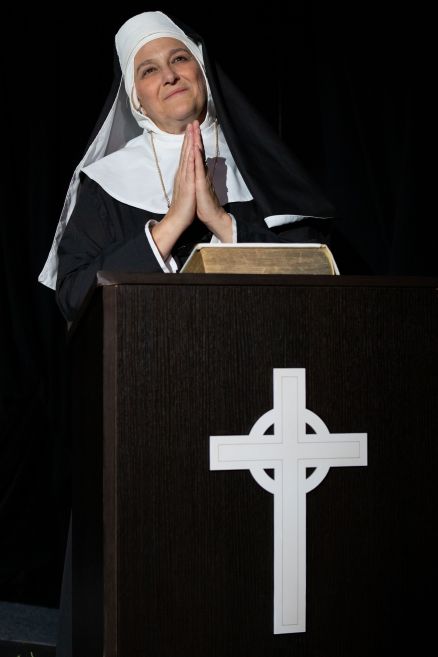
The CATCh location off South Boulevard, visible only when you reach their parking lot, is more clubby than quaint. Beyond the lobby space, the theater within has black-box dimensions and ambiance comparable to the performing venues at the VAPA Center on Tryon Street. So Shimko goes a little high-tech at the outset. Instead of the simple pointer and easel that Durang envisioned Sister working with, Joanna Gerdy gets a retractable projection screen – one that opens and closes electronically via remote control – and she picks on a front-row audience member to help her extend a more business-like collapsible pointer to its full, slightly obscene length.Sister I

Shimko himself greets us in clergy robes and prepares us for Sister’s lecture. These added touches of formality and presentation polish make the childish simplicities of the first two projected slides and Sister’s remarks about them all the more surprising. First slide, world: Earth, sun, and moon. Second slide, universe: Heaven, Purgatory, and Hell. From these simplicities, we plunge into the incomprehensible absurdity of Limbo, where unbaptized babies were sent before Vatican 2 and Pope John XXIII.

Like the Earth and moon, all that follows from Sister Mary is to be accepted as fact, not merely belief. This is Catholicism, boys, and girls, so theory and uncertainty have no place here. To underscore this point, Gerdy introduces us with twinkling pride to Thomas, Sister’s prize seven-year-old student. With a curly head of hair you could easily mistake for a wig, Sydney Kai Qualls will not so easily be mistaken for seven, particularly when Gerdy braces herself in inviting him to sit on her lap.

Thomas is Sister Mary’s echo chamber, acolyte, and mouthpiece. He’ll bring Sister water on command, and Sister will reward him with little cookies when he answers her questions correctly – as he invariably does. Correct may not adequately describe the precision of Thomas’s answers, which emerge from Qualls as three-quarters angelic, one-quarter robotic, with a bit of space given over to beaming teacher’s-pet pride.

More Q&A format follows as Gerdy picks up a little wicker basket that Shimko has left near the lectern, with little index cards supposedly containing personal and religious questions submitted by the audience. Gerdy’s answers have a smug cordiality to them, curt in matters of Jesus and nuns, a bit more spontaneous when asked about Sister’s family, yet somehow always rigidly doctrinaire. If she has no answer to a question, she calmly goes on to the next. If you ask her about Sodom, she will get a bit upset.

While Hird was ever-insouciant and imperious as Sister Mary, Gerdy gives her more latitude, allowing some slippage in her equipoise and then regaining it. Things will gradually change as four of Sister’s former students from her 1959 class, all adults now, come in without any introduction, to perform the same Christmas pageant they performed annually when they were classmates. The pageant’s Joseph recalls that the script was written in 1948 by one of Mary’s star pupils.Sister

It’s amazing how much of what we’ve heard earlier in Sister’s lecturing is recycled into the pageant of Jesus’s birth, crucifixion, and resurrection. Just as Sister can’t remember for sure whether she actually invited these former students, we can’t be sure how Sister’s quirky pronouncements made their way into the pageant. They could have been part of the 1948 script and approved by Sister Mary, or they could have been inserted by former students when they reviewed and rehearsed their old routine. Or maybe they just now overheard Sister’s bromides as they lurked in the shadows, waiting to appear, and decided to repeat them.

Regardless of how – or when – Sister’s quirky gospel was intermixed with the traditional story, we may wonder why. Either these passages are heartfelt tributes to the ordained teacher or irreverent mockery.

After witnessing all of Gerdy’s fulsome dogma and certitude, all of Thomas’s recitations (he’s so well-trained that he can answer a handful of Sister’s index-card queries so she can take a catnap), you will likely find these outbreaks of ambiguity refreshing. Surely they are forebodings of more insane comedy or a flip to drama. Or both.

When the darling little pageant wraps up, Sister begins to learn about her former students. One of 26 children herself, Mary begins with a progeny count. It’s not promising: children barely outnumber abortions.

Matthias Burrell as Gary Sullivan quickly becomes the pageant emcee, wearing a terry cloth robe to introduce the story before becoming St. Joseph. Having heard Sister’s thoughts on Sodom earlier in the evening – and likely many times before – Gary will be hesitant about explaining why he isn’t married. He has had the most benign memories of Sister Mary until now, merely scared of her.Sister

Durang may have intended all the bygone abuse of the other three 1959 seminary grads as a comical exaggeration when he penned his 1979 satire. He certainly doesn’t insist, in his 1995 intro to Sister Mary, that the prevalence of abuse at Catholic schools hinted at here is simply based on fact or his own Catholic upbringing. So a little of the sharp satiric impact that hit me when I first saw Sister in 1989 has been dulled by subsequent scandals and revelations.

Cate Jo as Philomela Rostovich and Joe Watson as Aloysius Benheim are the front and rear ends, respectively, of Misty, Joseph and Mary’s talking camel. Philomela remembers being banged around a bit, worse than Diane (the Virgin Mary) was, but we quickly sense that Sister Mary was crueler by far to Aloysius. With two children, Sister can readily forgive Aloysius’s shortcomings, which are no worse than wife-beating.

Grabenstetter gets the best supporting role as Diane. After sharing the pageant narrative with Burrell, Grabenstetter draws the only truly lengthy and impactful monologue aside from Gerdy as she catalogs the torments of her life. It rather sticks out because it’s not part of the pageant script and breaks free of Sister’s ensuing interrogation. Going overboard in blaming Sister for all her life’s mishaps, Grabenstetter triggers the unpredictable denouement.

All of the absurdity and mayhem, Gerdy assures us with sacramental calmness, accords perfectly with Vatican teachings and logic, which makes it all the more delicious.

One last historical footnote: after the second successful Off-Broadway run of Sister Mary in 1982, a small St. Louis company planned to stage Durang’s play at the Mayfair Hotel in January 1983. The local chapter of the Catholic League for Religious and Civil Rights made enough of a fuss, asserting that the play was anti-Catholic, that the St. Louis Archbishop got involved and the hotel withdrew their hospitality.

When Washington University and the University of Missouri offered to host the play, the state senate became involved, threatening funding repercussions. Two daily newspapers in St. Loo took opposite sides in the controversy. The brouhaha received national attention, including spots on CBS Sunday Morning, Phil Donohue, and Entertainment Tonight. Defunding threatened against the universities never happened. The little professional outfit that staged Sister, Theatre Project Company, felt the full financial consequences.

If that sounds a bit parallel to Angels in America and Charlotte Repertory Theatre, listen up. Theatre Project bit the dust in 1991, eight years after they succeeded in staging Sister Mary, just like Rep, which folded in 2003, eight years after Angels.

So belatedly, Charlotte can take a couple of bows. Between the St. Louis dust-up – followed by a string of Sister Mary controversies in Boston, Detroit, Erie, and Coral Gables – and our own Angels humiliation, George Brown and Innovative Theatre opened up Sister Mary in our Uptown without a murmur of protest. And now, Kevin Shimko and CATCh have followed suit. In fine style.