Monthly Archives: January 2022

“Deadly Sins” Upstage Jazzy Ravel in Fun-Filled CSO Concert

Review: Charlotte Symphony Plays Ravel’s Piano Concerto

By Perry Tannenbaum
2022~Ravel Piano Concerto-07

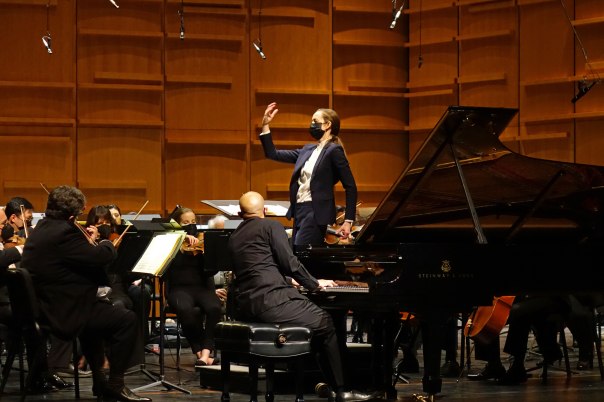
January 28, 2022, Charlotte, NC – You could arguably call it a facelift. After Charlotte Symphony’s powerful performance of Mahler’s somber, morbid, mercurial, epic, and sometimes phantasmagorical Ninth Symphony, almost everything seemed changed two weeks later. A new conductor was onstage, Australia-born maestra Jessica Cottis, making her Queen City debut. All six guest artists were making their debuts in Symphony’s Classics Series, and even the site of their musicmaking was different, moving southward from Belk Theater at the Blumenthal PAC to Knight Theater at Levine Avenue of the Arts. Most transformative was the music, a kaleidoscopic multinational program connected by a distinct American thread.

The headliner on the program was Maurice Ravel’s Piano Concerto, last performed by Symphony in 2013 when the wondrous Pascal Rogé made his Belk Theater debut at the keyboard. Jesse Montgomery’s folksy, bluegrass-flavored Strum preceded the main event, when Canadian pianist Stewart Goodyear seated himself at the Steinway. Cottis had plenty more excitement in store for us after intermission, plunging into Igor Stravinsky’s Circus Polka, for a Young Elephant – actually written at choreographer George Balanchine’s request in 1942 for Ringling Brothers Barnum & Bailey’s massive troupe of not-yet-controversial young elephants. Uncannily, another Balanchine commission rounded out the program, Kurt Weill’s The Seven Deadly Sins (1932) with lyrics by Bertold Brecht – obviously written for people rather than pachyderms.2022~Ravel Piano Concerto-36
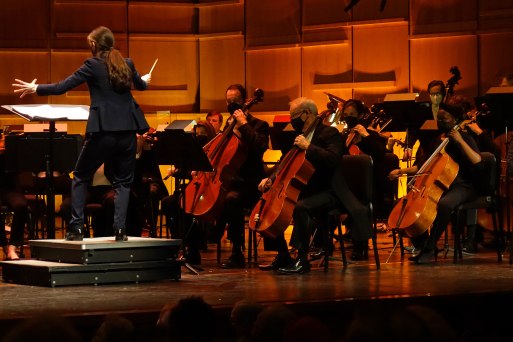
Nearly a year ago, Montgomery’s Starburst aptly keynoted a program that showcased Mozart’s Eine Kleine Nachtmusik (“A Little Night Music”). Longer and decidedly sunnier, Strum set the tone for CSO’s American evening as perfectly as the title readied us for a work written exclusively for strings. Reading Montgomery’s program notes, chronicling the various incarnations of the piece, we get the sense of experiencing its evolution as it unfolds, for it bounces around among three principal string players before beginning its breathtaking ascent to full power and beauty. Laying out the first pizzicatos, violist Benjamin Geller was soon joined by cellist Alan Black, strumming and then bowing. But it was concertmaster Calin Ovidiu Lupanu’s treacherous entrance that truly ignited the fray, triggering Montgomery’s ricochet effects and banjo-like strumming.

Honestly, the performance by CSO became a more massive, lovelier, and less ferocious thing than the studio version by the Catalyst Quartet on Montgomery’s 2015 Strum CD. With a full string orchestra came more majesty when the main melodies were revealed – and extra bite when the piece ended with a collective pizzicato. Nor are “folksy” and “bluegrass” any less flattering in describing Montgomery’s music here than they are in describing many of Aaron Copland’s signature works.2022~Ravel Piano Concerto-01

From the first time I saw him in 2017, playing all of Beethoven’s piano sonatas in a single day at Savannah Music Festival, Goodyear stamped himself in my mind as a prodigious talent. Prior to those three three-hour immersions, Goodyear’s distillation of Tchaikovsky’s The Nutcracker, on his 2015 solo CD, had clued me in. The soloist starts at a disadvantage in the Ravel Piano Concerto, having to follow the famed whipcrack that launches the opening Allegramente. Not to worry, Goodyear showed his mastery of the bluesy and jazzy licks of the movement soon afterwards, and harpist Andrea Mumm Trammell had a lovely interlude.

Inspired by Mozart’s Clarinet Quintet, Ravel’s middle movement drew absolutely mesmerizing lyricism from Goodyear, with English hornist Terry Maskin as stellar behind him as he was for Rogé. Yet everyone on the Knight stage seemed most inspired by the concluding Presto. Goodyear unleashed dazzling intensity and bravura, never easing up on the tempo, and the ensemble didn’t merely keep up: they seemed to be prodding their guest to play faster. Turbulence from the winds, brass, and percussion made the climax even more exhilarating.

Apparently, music for dancing elephant isn’t classified as ballet, since it doesn’t appear on The Robert Craft Edition of The Ballets on the notoriously completist Naxos label. Yet Stravinsky never disavowed his Balanchine bagatelle, conducting “Circus Polka” among his voluminous recordings of his own works, where it clocked in at a modest 3:27 on Columbia. Why this rambunctious crowdpleaser isn’t played more often as a concert appetizer is beyond me. While Cottis and the Symphony may have been a tad helter-skelter where Ravel called for more élan, they were marvelously attuned to Igor’s riotous absurdities, his brassy bombast, and the celebratory glee of his wild, galumphing jamboree. It seemed to start in mid-parade before the dainty spots hilariously evoked the pachyderm pixies.2022~Ravel Piano Concerto-31

The zaniness had hardly begun. Bass-baritone Reginald Powell, dressed in a flowery kitchen apron in order to portray the mother of our tempted/temptress heroine, led a barbershop quartet across the stage, sitting down at the end of their march behind a bank of microphones. Strange accessories for a classical concert. So Seven Deadly Sins was classical with a three-penny Kurt Weill twist. Nor was this an opera, though a cabaret table and some props were set in place before our chanteuse, soprano Lindsay Kesselman as Anna I + II, made her/their noire-ish entrance in a spymaster trench coat.2022~Ravel Piano Concerto-37

More than a hint of decadent vaudeville came with her, since each of the nine sections of Weill’s confection was heralded by an old-timey placard placed onto an easel. Prologue, Epilogue, Greed, and the gang were all embroidered with an apt skull-and-crossbones motif. Sad to say, much of this flavorful creativity was outweighed by Charlotte Symphony’s failure to provide supertitle projections once Anna I + II began vocalizing with her/their Family. A few audience members down with us in the orchestra section had the temerity to fire up their cellphones, where they had previously downloaded Symphony’s digital program, so they could follow along.

Not the best experience when you’re trying to keep up with columns of German and English on your iPhone while there is also action onstage to follow. The magnitude of this blunder would only be compounded if you returned home, flipped through the digital program, and discovered that the translation was written by life partners W.H. Auden & Chester Kallman, esteemed poets and librettists in their own rights – they worked on Stravinsky operas! Not only does their Deadly Sins translation rhyme, the syllable counts of every line meticulously match Brecht’s text. Learning that all five vocalists had North Carolina roots – and afterwards listening on Spotify to a recording with the Auden-Kallman lyrics – only deepened my incredulity.

Everyone at Knight Theater, singers and audience alike, could have been so comfortable, and all Brecht’s wit, irony, and satire could have been so clear!

Stepping up to one of mics, Cottis was helpful in her introductory remarks in laying out Brecht’s storyline, which is basically Anna’s odyssey across seven American cities on a mission to sustain her family back home in Louisiana, encountering one of the deadlies in each locale. Ideally, the Balanchine concept is fulfilled when Anna I is the soprano and Anna II is a sublime dancer. Part of the comedy that got lost when Kesselman was both Annas was in the lopsidedness of the dialogue between them. Anna II has very little to say.2022~Ravel Piano Concerto-28
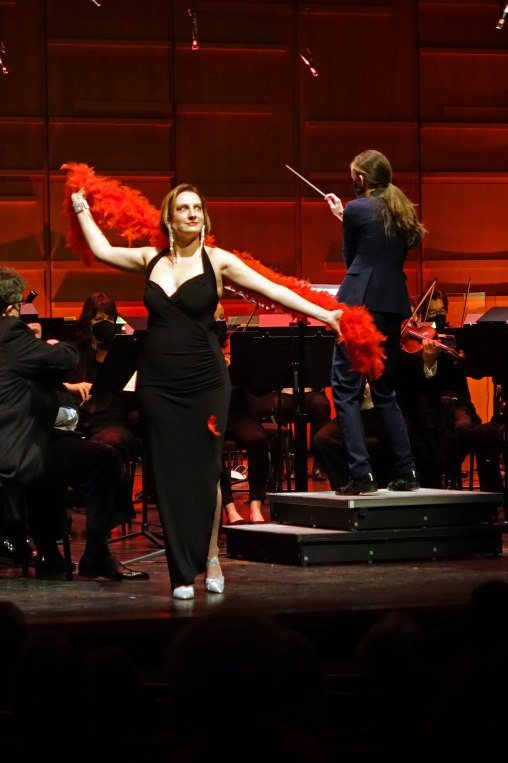
The staging helped this decadent Weill bauble to upstage Ravel’s merriment – or at least prevented it from being an anticlimax. Kesselman soon peeled off her trench coat, revealing an evening dress as the Family’s Sloth along the Mississippi River transitioned to Pride as Anna II took a job in Memphis as a cabaret dancer. Anna added a flaming red boa encountering Wrath in LA, and an uncredited lighting designer made a similarly lurid choice illuminating the Knight’s acoustic shell. Purple became apropos for Gluttony in Philly, a lighter pinkish red presided over Lust in Boston, and a dark golden hue settled in over Baltimore when she battled Greed. So I had to think that nobody wanted to offend New York during the Great Depression.

Need we say that when Anna’s journeying ended with Envy in San Fran, where Kesselman made her final grand entrance as a rich celeb, totally soused and brandishing a nearly empty bottle of vodka, that the stage was flooded in a deep dark green? Didn’t think so.

A wonderful ending to a melodious, fun-filled, and dance-filled evening. Even without dancers. Facelift and uplift.

Originally published on 1/30 at CVNC.org

Symphony Arrives at Sublimity, Amping Up Mahler to Heavy-Metal Decibels Along the Way

Review: CSO Plays Mahler’s Ninth Symphony

By Perry Tannenbaum

2022~CSO Mahler's Ninth-17

January 14, 2022, Charlotte, NC – When the new Compact Disc digital recordings were first heralded and released in the early 1980s, the mythic story began circulating from Sony and Philips that the dimensions and capacity of the new CD format were determined by its ability to present all of Beethoven’s Ninth Symphony on a single disc. Subsequent refinements to the technology increased the capacity of those discs from 74 minutes of music to 80, leaving Ludwig far out of the equation. The 80-minute capacity we see on today’s prerecorded discs and the recordable CD-Rs we might dub them onto is more suitable for containing Gustav Mahler’s Ninth Symphony – but only if conductor and orchestra are in a hurry. Only the very quickest of the many recordings of Mahler’s last completed orchestral work clock in at 79 or 80 minutes. Completing his Mahler Journey with the Charlotte Symphony Orchestra in his final season as music director, Christopher Warren-Green let it be known that his Ninth would be a more expansive 90-minute experience. There was no intermission at Belk Theater, and program booklets remain a strictly online affair.

Vaccination cards were scrutinized at both the outdoor entrances to the Blumenthal Performing Arts Center and at the indoor entrance from Founders Hall. My mom and I felt very comfortable with the social distancing downstairs in the orchestra section, but no such amenity was granted to subscribers who entered the hall from the lobby – in fact, I’ve never seen the Grand Tier more fully occupied, a gratifying affirmation of the Queen City’s Mahler enthusiasm. The balcony above looked similarly packed. Masking, of course, was compulsory, but ticketholders should chiefly be forewarned that vigilance was strictly enforced at the entrance to the orchestra section. Folks that were late for the first notes of the Mahler performance, between 7:35 and 7:40pm, were obliged to wait in front of TV monitors in the lobby until the conclusion of the opening Andante comodo movement at approximately 8:05.

Each of the outer movements, both preoccupied with mortality and dying, is as lengthy as the two inner movements combined. Only the second movement can be described as lighthearted, and all four are teeming with mood swings. Without adding audible gaps between episodes, recordings conducted by Leonard Bernstein and Herbert von Karajan with the Berlin Philharmonic are divided into 33 and 30 tracks respectively. Those seemed to be very conservative numbers when Warren-Green and Charlotte Symphony immersed themselves in the score, reveling in its seemingly countless contrasts. Emerging with the opening melody from a backdrop of cellos, basses, horns, and harp, the second violins emphatically signaled that all sections of the vast ensemble would have their chances to shine.

2022~CSO Mahler's Ninth-04

This was by far the most extensive instrumentation we had seen at either Belk Theater or Knight Theater since the beginning of the pandemic. From orchestra level, it was difficult to precisely count all the unmasked flute, clarinet, oboe, bassoon, French horn, and trumpet players arrayed behind the masked string sections. But the percussionists were plain enough when they stood up, either singly or as an ominous group, and there was additional space set aside, upstage and on the stage left wing, for the three trombones, two harps, and the tuba. Curving around stage right to the upstage was an armada that included timpani, a mighty bass drum, cymbals, a gong, snare drums, and tubular bells.

So the prospect of high-volume music was apparent before all the Symphony musicians were fully congregated. Yet when these expected Mahler explosions actually occurred, Mom and I were both taken aback by how loud they were. The difference between sitting at the rear of the grand tier late last spring and sitting in Row O below was compounded by the additional troops and artillery onstage. Earplugs weren’t quite necessary for these fortissimos, but rock-concert decibels weren’t far in the distance. Mom may have nodded off for a few seconds during Gershwin’s Lullaby last year or when Branford Marsalis luxuriated in the luscious Larghetto middle movement of Jacques Ibert’s Concertino da camera. Not this year. Onsets of trumpets, trombones, or percussion could be so sudden that, even if she didn’t revere Mahler, Mom wouldn’t dare close her eyes.

There were plenty of less aggressive surprises scattered across the lordly length of this symphony. In the epic Andante, the harpists reached out to pluck a bass line, and the mournful funereal dirge had the backbone of a military march, punctuated by the wan tubular bells. If you’re new to Mahler, the waltzing liveliness of the “Im Tempo eines gemächlichen Ländlers” (in the tempo of leisurely country dances) might catch you pleasantly off-guard – and what plan did the composer have for a triangle and cymbals playing in unison? The third movement Rondo-Burlesk was brimful of contrasts and contradictions as Warren-Green kept us on the lookout for the next twist. A busy, contrapuntal opening suggested a fugue with frolicsome and comical touches, but midway through this Burlesk, each of the orchestra’s sections seemed to have something soulful to say – not at all the path you would expect leading to a screaming conclusion.

2022~CSO Mahler's Ninth-15

Perhaps the biggest surprise of the evening came at the climax of the Adagio finale when a furious pounding of the big bass drum, topping off a majestic crescendo, suddenly gave way to – in the hushed blink of an eye – nearly total silence. This abrupt whisper of weepy violins, proved that Mahler’s precipitous subsidings can be almost as dramatic as his volcanic peaks. Most of Symphony’s principals distinguished themselves over the course of this epic evening, including oboist Hollis Ulaky, clarinetist Taylor Marino, cellist Alan Black, and concertmaster Calin Ovidiu Lupanu, but the final movement underscored the special praise earned by French horn principal Byron Johns and principal flutist Victor Wang. Even Johns’ one little wobble on the horn came at an ideally aching moment, and Wang was merely perfection in the sublime epilogue.

Originally published on 1/15 at CVNC.org

Thorgy Brings Plenty of Christmas Cheer – and Drag Artistry – to the Queen City

Review: Charlotte Symphony Premieres A Very Thorgy Christmas

By Perry Tannenbaum

2021~Thorgy Xmas-37

The first thing to know about Thorgy Thor, a distinguished alum from the eighth season of RuPaul’s Drag Race, is that she is outrageous. If political correctness is your passion, then the next thing to know is that I’ve chosen her pronouns after consulting the program for the world premiere of A Very Thorgy Christmas, performed with the Charlotte Symphony and resident conductor Christopher James Lees. The Wikipedia entry for Thor, née Shane Galligan, is a tossed salad of pronouns that doesn’t conclusively settle the question.

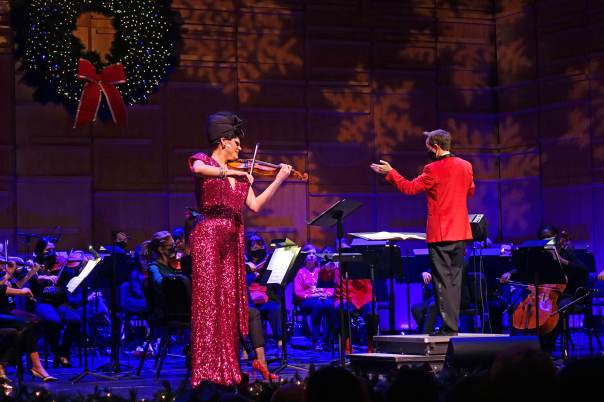
Headlining a Christmas show with a full symphony orchestra, Thorgy proved to have multiple talents. Not only did she serve as a guest violin soloist on three Christmas songs, she performed a standup monologue, screened a self-produced takeoff on an NPR podcast, presided like a gameshow host over a farcical giftwrap contest between four Symphony musicians, sang an autobiographical rewrite of “The 12 Days of Christmas,” and interviewed Lees a la late-night TV.2021~Thorgy Xmas-18

If Thorgy’s debut with Symphony in January 2020 had even half the variety and surprises of her Christmas extravaganza, it’s easy to understand why she was invited back so quickly – to basically do whatever she wished. The only restriction she acknowledged was an imposed limit of one f-bomb, and she certainly detonated that one with maximum impact. Lees and the ensemble began conventionally enough at Knight Theater for a very full house, launching into a merry rendition of “Joy to the World.” But the arrangement of this familiar carol soon became a mashup of several other carols and then an outright Christmas barrage – “Jingle Bells” and “Silent Night” at the same time? – before I began to wonder what few Christmas carols might be left over after this extravagant overture.

Unlike Jack Benny or Henny Youngman, the only other violinist comedians I can reference, Thorgy took herself seriously as she came on to play “O Holy Night.” Her tone was actually quite beautiful when she played, even though the arrangement and tempo didn’t demand impressive dexterity. “Carol of the Bells,” played just before intermission, required fleeter fingering, but even with this more energetic fare, Thorgy was flawless, unstressed, and only wisecracked once or twice over her performance. More of her freewheeling flamboyance came out when she put away the lumber and spoke out. This Very Thorgy Christmas was clearly a 2021 edition if Thor has any intentions of reprising her show as a Yuletide tradition. Not only was the new show silly, as Thorgy herself off-handedly remarked, it was also ephemeral.

Thorgy’s monologue was largely about her upcoming prospects and what she had done during the pandemic. Her pandemic shenanigans were plentiful enough, in fact, to supply prime fodder for her next two comical exploits prior to intermission. In the first, she went through the lowlights of her stint as a cameo celeb, that seemingly wholesome profession of producing customized video greetings for clients’ loved ones. As the smut piled on, we quickly realized that Thorgy didn’t attract a Hallmark Cards clientele. In the NPR video she showed us afterwards, Thorgy and a fellow drag queen, rather sedately dressed for this studio format, interviewed a comparatively blue-collar guy named Chef Schwetty. Judging by the varied colors of the samples he brought with him, I’d say Schwetty was a pastry chef. Without adding flavors or adjectives, Schwetty described his specialty as balls. Needless to say, the two gay interviewers feasted on the possibilities.

2021~Thorgy Xmas-36.jpgMore signals came after intermission that a 2022 edition of Thorgy Christmas would undergo drastic changes, for it was obvious that Thor revels in surprises. Dispensing with the customary concert preludes served up by her symphonic hosts, Thorgy burst onto the stage and kicked things off with a brash “Jingle Bells” spot. Of course, she had changed her outfit during intermission – from an ensemble highlighted by garish red-and-green-striped slacks to a fiery, glittery, fuchsia spectacular. She almost visually jingled in this one-piece caprice, and she discarded her dazzling Dolly Parton white wig in favor of a towering brunette bouffant. Thorgy is rather tall already.
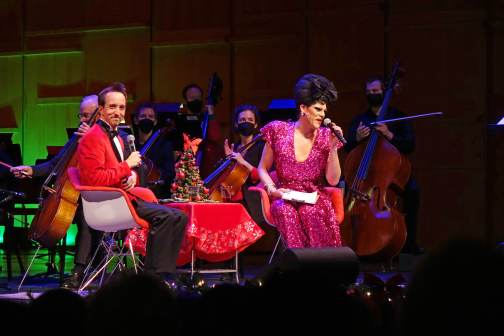
Genial, easygoing, and relaxed, Lees complemented his guest artist handsomely. After the opening overture pillaged a huge chunk of Christmas inventory, Lees allowed the orchestra to stray briefly from holiday fare with an excursion to Grieg’s “Hall of the Mountain King.” When he returned to the podium, after the screening of Thorgy’s cameos, he and his cohort basically coasted along with a couple of snatches from Tchaikovsky’s Nutcracker, rep that they play repeatedly for Charlotte Ballet every December. After Thorgy made her splash to open the second half, Lees engaged with the Knight Theater audience to help him out with the whipcracks in Leroy Anderson’s “Sleigh Ride.” A woman in a lower box seat happened to have a black fan that made a whippier sound than our claps when she opened it, adding to the fun (especially when she was late).

Although the Knight audience was heavily infused with RuPaul devotees, the “12 Days of Christmas” parody was too crammed with obscure references to Thorgy’s misadventures on Drag Race and its All-Stars spinoff – and often too unintelligible – to garner universal laughter. And of course, the repetitions built into the familiar song didn’t help, a lesson for Thorgy to learn for her 2022 edition. After this partial misfire, Thorgy came up with her most hilarious bit of the night, the giftwrap contest with four surprisingly smart-alecky Symphony musicians. With a connoisseur’s unerring judgment, Thorgy chose four gifts for wrapping that offered maximum opportunity for failure and embarrassment: a cluster of inflated balloons, an open umbrella (closing it was strictly forbidden), a toilet plunger, and a broom and dustpan combo.

Like those frenetic cookoffs you may have watched on TV, the four wrappers had to cope with a tight time limit, so Lees and the orchestra timed the competition by performing… something. The action was too engrossing for me to take heed, but the ending and Thorgy’s flamboyant flourish were emphatic enough to signal the sudden frantic finish. The cluster of balloons proved to be disappointingly wrappable and humdrum, but the unopened umbrella was such a colossal fail that I found myself howling with laughter.2021~Thorgy Xmas-29

On the other hand, the wrapping for the plunger, cunningly separated into two pieces, was an absolute triumph. But flutist Jill O’Neill ultimately won the night – via a plurality of audience applause – with her amazing wrapping for the broom and dustpan. Audaciously rolling the merchandise on the floor helped O’Neill execute her design, and I suspect that adopting a witch persona as soon as she first held the broom helped to sway the judges. I was actually impressed by the rapport that Thorgy developed with each of the four contestants as they displayed their handiwork.2021~Thorgy Xmas-31

We gracefully glided homeward after this high-energy highlight, as Thorgy sat down for her cozy interview with Lees, occasionally prompting principal cellist Alan Black to imbibe from a tumbler of alcoholic beverage during the course of the conversation. Things became unexpectedly revelatory when, after a very personal question, Lees suddenly asked his interrogator if they could continue their conversation backstage later on. Some marital history soon followed. Those hilarious moments prevented the sitdown with Thorgy from becoming overly anticlimactic after the madcap giftwrap – and it segued nicely into Thorgy’s closing performance on violin, a beautiful and heartfelt “Silent Night.”

Originally published on 12/25 at CVNC.org