Interview: Billy Ensley
By Perry Tannenbaum

Call him Mister Versatility. To find anyone else in the Charlotte theatre scene who has been celebrated for excellence in so many different areas as Billy Ensley, you would have to summon up the memory of Alan Poindexter, the wunderkind who came out of the UNC Charlotte theatre program and won accolades as an actor, director, and sound designer. Ensley’s awards, a total of 16 from Creative Loafing and the Metrolina Theatre Association, have been for his work as an actor, director – in musicals, comedies, and dramas – and as a choreographer.
Song and dance were Ensley’s calling cards from the beginning, and they remain handy skills as he directs the upcoming Matthews Playhouse production of Mamma Mia! – the fifth musical that he has directed there. We interviewed Ensley about his evolution as an artist, the enduring popularity of Mamma Mia! and the vital importance of our community theatres.
QC Nerve: Take us back to the early days. Outside of school productions, what was your first appearance on a Charlotte stage? Can you tell us how you felt about theatre at that time and the part it would play in your life?
My first appearance on a Charlotte stage after school was in Seesaw (1983) at Theatre Charlotte [then known as Little Theatre of Charlotte]. At that time, I was moving into theatre as a result of having dance training throughout my youth. Male dancers were in demand, and therefore I was able to make that transition and learn acting and singing as well. While performing on Charlotte stages in my 20’s, I regularly got work in professional theatres, some of which include The Blowing Rock Stage Company, Opera Carolina, Busch Gardens, and Cook/Loughlin productions at Spirit Square.

I wanted to dedicate my life to the theatre arts, but I also had a strong desire to own a home and be self-sufficient. I worked for over a decade as the director of office operations for the Robinson, Bradshaw & Hinson law firm. After a couple of years in the travel industry, I went to work for Rexus Corporation, a national background screening company, where I am their chief operations officer for 15+ years.
By the time I first saw you back in the late 80s, in House of Blue Leaves and The 1940s Radio Hour, you were well on your way to establishing yourself as Charlotte’s pre-eminent triple threat. How committed were you at that time to accomplishing that goal, and how did you hone your acting, singing, and dancing skills?
At the time, I was not aware that I was establishing myself in any way actually. I was merely doing what I loved and what I was driven to do. Of course, it helped that I was receiving good reviews in the local press and support from the theatre community. That was positive reinforcement to keep working basically two full time jobs.

Through the support and training of many people in Charlotte – including Tom Vance, Tom Hollis, Ron Chisholm, Terry Loughlin, Steve Umberger, to name a few – I was fortunate enough to work in the theatre almost constantly. I received a lot of my acting and singing training by being in productions, but I also continued to take dance classes, study voice with Joyce Marshall and study acting privately.
What role did our community theatre play in launching your career in theatre? How do see Theatre Charlotte and Matthews Playhouse figuring in the local scene today?
Theatre Charlotte often had the best directors and performers in the region. I was surrounded by some of the best and, as a result, I almost always got a paying gig from that exposure in community theatre. In addition, I was getting excellent hands-on training from them.

Theatre Charlotte and Matthews Playhouse figure prominently in the local scene today, attracting good directors and seasoned performers as well as exciting new talent. In addition to cultivating new talent, they both are providing a venue for professional performers to have the opportunity to perform roles that may not be possible otherwise, due to the fact that Charlotte still struggles with sustaining many theatre companies.
You’ve made a couple of dramatic changes to reignite your career. First, you stopped doing musical after musical and took on a major role in a straight play, You Should Be So Lucky, in 1997. Then in 2003-04, we suddenly found you directing local productions of Evita, Bat Boy, and Hedwig and the Angry Inch. What motivated you in each of these instances to break out of your previous mold – were there practical considerations involved, or was it all about self-fulfillment?
For me, it was a combination of both. As a dancer, you learn pretty early in life that the thing you have been training for, performing and loving, must eventually come to an end, or at least morph considerably. The same applies to playing the young male leads in musical theatre. I knew that I wanted the theatre to remain in my life, and I wanted to continue growing in other ways so that I could facilitate that.
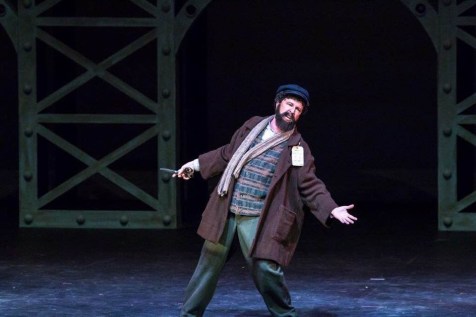
As a youngster, I marveled at performers that were always reinventing themselves – David Bowie comes to mind, actually – and I thought that was a great way to remain relevant. I also did not want to be pigeonholed in musical theatre, which I felt I clearly was. I wanted the challenges of dramatic acting like McDonagh’s The Pillowman (2007), in which I was lucky enough to play the lead, Katurian, in the Actor’s Theatre of Charlotte production.
As for directing, that was a slow and methodical process, and not an easy career to break in to. I started choreographing and directing in theatres outside of Charlotte like Belmont Abbey College and Wingate University. Eventually, the executive director at Theatre Charlotte, Candace Sorensen, offered me my first directing job in Charlotte with Sweet Charity (2002). After a few Charlotte shows, I got a great deal of support from Dan Shoemaker and Chip Decker at Actor’s Theatre of Charlotte.
Tell us about your history with Matthews Playhouse and what you have experienced there in terms of the quality of their facilities, staff, and talent pool.
I have directed Shrek, Joseph and the Amazing Technicolor Dreamcoat, Bonnie & Clyde and Grey Gardens for Matthews Playhouse. Matthews Playhouse is an excellent example of a successful and vibrant community theatre. Under the leadership of June Bayless, they have an excellent staff, a remarkable youth training program, combined with a very nice auditorium and excellent technical staff.
Who are the familiar audience favorites and the hot new discoveries that are going to make your Mamma Mia! a smashing success? Who are the scenic design, costume design, and choreographer aces on the case?
 Lucia Stetson and Lisa Blanton are audience favorites. Lucia having played Maria in The Sound of Music and Lisa Blanton having played Little Edie in Grey Gardens. Our two young romantic leads both qualify as hot new discoveries. They are Alexa Thomas and Spencer Ellis as Sophie and Sky. Lisa Blanton agreed to pull double duty for this show by both choregraphing and playing the role of Tanya. Lisa Altieri is handling costumes and Emmy Award-winning John Bayless is the scenic designer. His work is amazing and his talents run very, very deep.
What do you continue to find in Mamma Mia! that keeps us from getting tired of it?
Well, ABBA of course! The music is familiar and well loved; bringing back lots of memories of love and romance for us middle-aged folk. The women characters in the show are strong and independent, the male characters are sensitive and compassionate. Like other jukebox musicals, it is fun to watch a scene that evolves into a song that most of us know at least some of the lyrics to. It is a show where the audience should come in with their hair down, their troubles stowed away, and perhaps their inhibitions stowed away as well – in favor of singing along or dancing in the aisles!


 Art on My Sleeve