Reviews: The Classics in the Czech Republic’s Capital City
By Perry Tannenbaum

The Czech national river, Vltava, flows through the Republic’s capital city of Prague, crossed by no fewer than 18 city bridges and most famously memorialized in Bedřich Smetana’s Ma Vlast (My Country) – where the river usually goes under its German name, “The Moldau.” A rich vein of classical music also flows through Prague, as you might expect in the heart of Bohemia. The gorgeous city not only nurtured Smetana and Antonín Dvořák, it was a friendly haven for Mozart, who premiered Don Giovanni and La Clemenza di Tito at the Estates Theatre.
Classics still pulse through the city. Daily. At the Church of Nicholas in the Old Town, posters proclaim two concerts every day. The Czech Philharmonic, the Prague Symphony, and the National Theatre Opera all have their own venues, and they don’t seem to fret over performing on the same nights as the others. In mid-September, when we visited, the Prague scene was conspicuously intense, diverting us from Vienna and Budapest, where the new seasons had not quite begun.
The National was offering the last performance in its 2019 run of Don Giovanni – at the Estates Theatre! – and Prague Symphony was opening its season with guest shots by Pinchas Zukerman and Amanda Forsyth. Two festivals were in full swing when we arrived, the Young Prague International and the star-studded Dvořák Prague International. By star-studded, we’re talking Gil Shaham, Nicola Benedetti, Ivo Pogorelich, Gautier and Renaud Capuçon, and Boris Giltburg among this year’s virtuosi; Zubin Mehta, Neeme Järvi, Christoph Eschenbach, Semyon Bychkov, and Emmanuel Villaume among the conductors; and the Israel Phil, the Estonian National, the Prague Radio Symphony, the Essen Phil and the Italian National Radio and TV Symphony among the orchestras.

We could have concentrated on the Dvořák Prague Festival, which offered five concerts during our five-night stay, but we opted for a broader survey of the local companies and venues. The National’s Don Giovanni was obviously a more Prague-infused choice than its La Traviata, so we pounced on that opportunity. Nor were we passing up the Zukerman opener, offered on the same evening as the Verdi. Our dance card was rounded out by the all-Tchaikovsky concert featuring Gautier Capuçon, my one chance to sample the Czech Phil in action.
To our surprise, National Opera was nearly as excited about our coverage of their Don Giovanni as we were about seeing it in the same hall where Mozart conducted it for the first time on October 29, 1787 – and where Czech director Miloš Forman insisted on filming his Oscar-winning Amadeus. National’s stock of production photos evidently didn’t replicate the cast that we would see on September 15, so they committed to providing us with photos from that performance!
The offer certainly didn’t stem from a desperate need for audience or publicity. Notwithstanding the fact that the Dvořák Festival was offering two concerts that evening – one featuring Shaham and the other showcasing Mehta’s Israelis performing Mahler’s Third – the Estates with its five tiers of boxes and balconies was packed to capacity. We were given aisle seats, to be sure, but it was necessary for management to bring in chairs to make that happen.
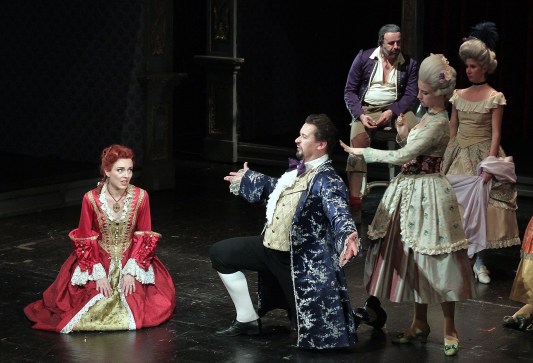
Musicians of the State Opera Orchestra, under the baton of Richard Hein, likely numbered less than 30, even with a fortepiano and a mandolinist on hand, a prudent size for Mozart’s music. The Ouvertura probably would have sounded firmer and more sinewy from one of those mid-level boxes, if my experience at the similarly cylindrical La Scala can serve as a guide. But the hall seemed to warmly embrace operatic voices whether you were seated at ground level or up in the rafters.
A statue of the Commendatore lurks outside of the Estates, indicative of the dark hues often attributed to Giovanni and reinforced by Amadeus. But if you delight in seeing a brighter balance of comedy and drama in Lorenzo Da Ponte’s libretto, this cast directed by Jiří Nekvasil (reviving the 1969 production conceived by Václav Kašlík) was ready to deliver heartily. As the Don, baritone Martin Bárta was more than sufficiently virile and predatory, but there was a smoothness in his serenading that underscored his legendary charm. Bass-baritone František Zahradníček maintained a pragmatic ambivalence toward his master as Leporello, and his quick tongue on his most familiar arias proved that he was Rossini-ready.

Giovanni’s lady conquests were wonderfully differentiated by the sopranos who sang them and in the sumptuous costume designs by Theodor Pištěk, who took home an Oscar for his work on Amadeus. Veronika Hajnová was elegant, wanton, and insatiable as the love-blinded Donna Elvira, and Petra Alvarez Šimková was so starchy and pure as the grieving Donna Anna that she actually drew laughs when she put off Don Ottavio yet again after Giovanni had gotten his comeuppance. Upstaging both of these nobles was Lenka Pavlovič as Zerlina, deliciously vamping her Masetto in two of her arias.
Utilizing the side aisles and a couple of the audience’s side exits, Nekvasil heightened the comical flow of the action and the sense that Giovanni was constantly pursued by Donna Anna and Donna Elvira. From our ground-level vantage point, it seemed doubtful that folks seated in some of those side boxes and balconies could see all of the offstage action at the sides of the hall, but they were better situated for the Czech and English supertitles, which were projected high above the stage near the proscenium.
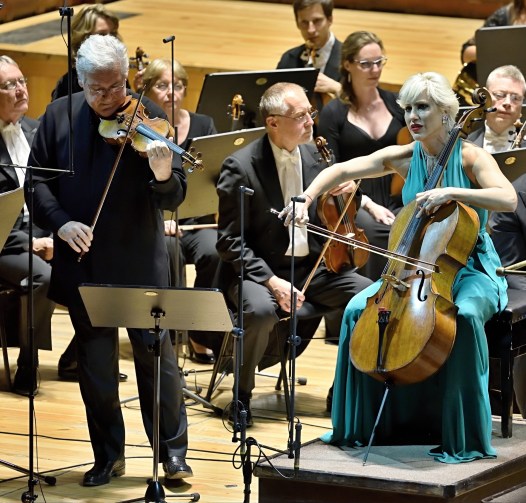
There were no such tradeoffs between ground level and the balconies at the Smetana Hall in the Municipal House, where Zukerman and Forsyth teamed up on the Brahms Double Concerto for Violin and Cello. To see them or hear them, ground level was best. Elsewhere in the art nouveau Smetana, you will feel a little exiled from conductor Pietari Inkinen and his Prague Symphony, though the hall’s design spares ticketholders below from any overhangs.
The opening night program was deftly crafted so Zukerman fans wouldn’t feel cheated by his sharing the spotlight in the Brahms. Both Zukerman and his wife of 15 years had individual turns in the spotlight at the start of the evening when they presented two Dvořák gems, the Romance for Violin and Orchestra followed by a showcase for Forsyth, Silent Woods. When we reached the Brahms, it was Forsyth’s cello that was most favored by the hall’s acoustics in the dreamy Andante middle movement, but the couple’s musical chemistry crested in the closing Vivace non troppo.
Slated to conduct a new Wagner Ring next summer at Bayreuth, Inkinen also holds chief conductorships at the Japan Philharmonic and Deutsche Radio Philharmonie. In a cute encore after the Brahms, he picked up his violin and traded pizzicatos with Forsyth, radiating genuine charm. Then after intermission, the 39-year-old Finn displayed his affinity with Jean Sibelius in a majestic rendition of the Symphony No. 5. By evening’s end, the Smetana’s quirky acoustics were no longer a worry.
No acoustic blemishes marred the all-Tchaikovsky concert at the Rudolfinum’s glorious Dvořák Hall, where we heard a transcendent account of the Variations on a Rococo Theme from Capuçon. The gorgeous, impactful Symphony No. 5 from Bychkov and the Czech Phil was not at all anticlimactic, with splendid playing from the principal French horn, bravura from the timpanist, and tack-sharp section work from the brass. But the shape, control, and opulence that the orchestra brought to the Serenade for Strings in C to start the evening – plus the Viennese lilt to the Valse movement – demonstrated that the Czechs’ excellence encompasses sensitivity and finesse as well as brilliance and power.
Capuçon was amazing, the enduring pinnacle of the evening. I’ve heard Alban Gerhardt, Lynn Harrell, Mischa Maisky, Daniel Müller-Schott, Pieter Wispelwey, Alisa Weilerstein, Zuill Bailey, Joshua Roman, and Steven Isserlis in live performance. None of them surpassed the exquisite pianissimos, the gleaming harmonics, or the stunning virtuosity I heard from Capuçon as he possessed the Rococo Theme and each of its eight variations.
Ah, but I’ve never heard any of those other cellists at the beautiful Neo-Renaissance Rudolfinum! Capuçon himself seemed inspired by the sounds that reverberated back to him from the Dvořák Hall. It wasn’t surprising at all that so many orchestras from near and far were converging on the Dvořák Prague International: the sonics at the Rudolfinum have that kind of ravishing, Siren appeal. So does the September weather in Prague. High temperatures ranged between 58° and 75°F during our five-day stay, ideal for strolling through this walkable and photogenic city, and nighttime lows dipped down to 48°F, justifying my choice of a long-sleeve dress shirt under my blazer for our after-concert walks back to our hotel – along the rim of the Vltava when we attended the Festival.
Preceded on the Prague cultural calendar by the now-defunct Prague Autumn International Music Festival, the Dvořák Prague Festival website yields no hints of kinship to – or rebranding of – the event it replaced. Yet it remains locally and internationally in the shadow of the older and broader Prague Spring International Music Festival, which begins annually on May 12, the anniversary of Smetana’s death.
The Dvořák event has plenty in its favor. Prague’s weather isn’t quite as unique in May, which is why classical music is especially cool here in September.


 Art on My Sleeve