Daily Archives: April 30, 2018

“Rite of Spring” Showcases the Best of Charlotte Symphony and Ballet

Review:  Rite of Spring: Reinvented

By Perry Tannenbaum

As scarce as modern music was in Charlotte Symphony’s classics concerts last fall – or anything that wasn’t by Beethoven – subscribers can be delighted (or appalled) by the cavalcade of moderns this spring. Sibelius, Ravel, Prokofiev, and Bernstein were all beautifully represented at Belk Theater in March, encouraging Charlotte’s staunch traditionalists to discard their modern music trepidations at the beginning of April and come out en masse for Rite of Spring: Reinvented, an evening of Stravinsky.

Further enticement to come and hear Christopher Warren-Green leading the orchestra came from Charlotte Ballet. Newly led by Hope Muir in her first season as artistic director, the company would not only reprise George Balanchine’s setting for Apollon musagète, they would also be premiering a new choreographic setting by Peter Chu for the seminal Rite of Spring.

The proven excellence of Symphony in modern repertoire, the excitement of a collaboration with Charlotte Ballet, and the lure of a world premiere probably all contributed to filling the hall with subscribers and newcomers. Yet there was another element in play. While the Apollon served as a calling card for the company’s magisterial authority in all things Balanchine, the world premiere of Chu’s Rite served as a showcase for their backup Charlotte Ballet II troupe, as well as their company apprentices, youth ballet participants, and students in the Charlotte Ballet Reach program.

Serving children 7-13, Reach is obviously an impressive program with branches at the Ivory Baker Recreation Center, the Albemarle Road Recreation Center, and the Hickory Grove Recreation Center. Of the 67 performers involved in Rite of Spring, 48 were from the Reach program, all performing for the first time at Belk Theater. Some of these kids had never attended any event there before.

Such an event would be a big deal for parents and relatives – as it is when Charlotte Youth Ballet performs Ovens Auditorium or Knight Theater elsewhere in town. Conceiving his Rite of Spring as a community event, Chu didn’t hurt ticket sales at all, for those friends, parents, and relatives certainly came out to see these students perform.

What they saw raised Symphony and Ballet to a higher plateau, even in the Apollon reprise. Because Symphony had been reduced to approximately 30 players for the most recent run of Ballet’s annual Nutcracker, it had been awhile since the full ensemble had performed from the orchestra pit in their collaborative relationship. And because Opera Carolina seats the press down at stage level, this may have been the first time I’d heard them performing in the pit from the vantage point of the grand tier.

From the downstairs level, the sound of the Charlotte Symphony can be slightly constricted from the pit, although our main attention in opera is always on the stage. Up in the grand tier, where my Symphony tickets are, I found that the confines of the pit added a warm glow to the sound, a welcome aura for patrons who might find the Belk’s acoustics too clinical and in-your-face when the orchestra plays from the stage.

Performing Apollon to live music also had a gratifying effect on the Charlotte Ballet performance. Strumming on Apollo’s lyre, Josh Hall seemed to be playing the instrument for the first time, precisely in sync with Stravinsky’s score instead of vaguely going through the motions. The newfound synergy between Balanchine’s choreography and Stravinsky’s helped to make the reprise of Hall’s performance fresh again.

So did the continuing grace and charm of his three muses, Chelsea Dumas as Calliope, Sarah Hayes Harkins as Polyhymnia, and Alessandra Ball James as Terpsichore. Even the iconic sun-god tableau, perhaps the most compelling Balanchine image that Jean-Pierre Bonnefoux and Patricia McBride gave to us when they took the reins of Charlotte Ballet, was freshened by the live music. Hearing the delighted surprise of so many ballet newbies in the crowd to this famous ending freshened it more.

Depicting a human sacrifice, Stravinsky’s scenario was definitely communal – but also barbaric, no more heartwarming than Shirley Jackson’s classic, “The Lottery.” Yet in setting this oftentimes harsh music for a large group of children who hadn’t finished middle school, Chu and costume director Aimee Coleman weren’t aiming to turn this scenario into pure sunshine.
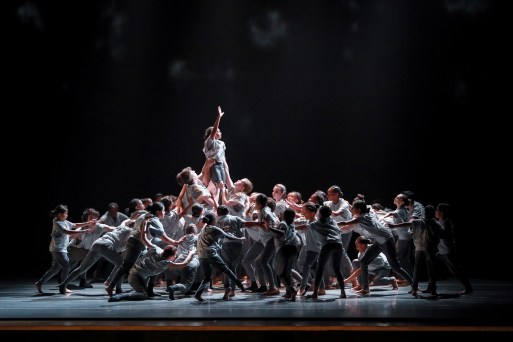
On the contrary, the most haunting images Chu and Coleman created with their large cast was of waves of migration – poor peoples under stress, fleeing war and tyranny, caring deeply for their children, and looking for a peaceful homeland. Exactly the kind of people that America’s ruling party doesn’t want to think about, let alone welcome. Chu and his large cast, to put it another way, turned the primitive barbarity of Stravinsky’s original scenario for the Ballet Russes in 1913 into a more modern barbarism – showing the effects of tyranny, war, and callous indifference upon unmistakably good people.

I’m not sure Chu’s scenario needed to be quite as inchoate as the refugees’ lives that he depicts. Showing us the tyrants, the jackboots, or the marauders that the good folk were fleeing might have given a more substantial shape to what we were witnessing. Nor did I feel that the Charlotte Ballet II dancers were stretched anywhere near to their fullest. Yet Chu’s images of mass migration and parents fretting their children’s survival were more than sufficiently powerful to make the big audience at the Belk feel involved in this community happening.

The event also seemed to be special for Warren-Green and the Symphony musicians. Apollon is more sedate than you expect Stravinsky to be, and the ensemble called forth all its beauties. But when we reached barbarities of Stravinsky’s Rite, nobody in the pit was holding back, and the essence of the music came through with all its primal force.

“On Golden Pond” Is Still Sugary at CP, but Never Cloying

Review:  On Golden Pond

By Perry Tannenbaum

Although I had not seen the original 1979 Broadway production – and had staunchly avoided playwright Ernest Thompson’s 1981 Hollywood adaptation – I thought I knew all I cared to know about On Golden Pond when it finally caught up with me at Theatre Charlotte in 2006. Through unsolicited excerpts flashed at me on TV, I had become all-too-familiar with Henry Fonda’s crustiness as Norman Thayer Jr., Katharine Hepburn’s gritty steadfastness as his wife Ethel, the whininess of Jane Fonda as their daughter Chelsea, and the gooey honey that bound them all together.

Were there other characters in the script? That was one of the unexpected delights I discovered as my first full encounter with On Golden Pond, like so many others with The Sound of Music, turned out to be better than I feared. Yet as I also find with that Rodgers and Hammerstein evergreen, there’s a recoil effect that comes with intervening years, and I was dreading On Golden Pond once again as it opened at Central Piedmont Community College.

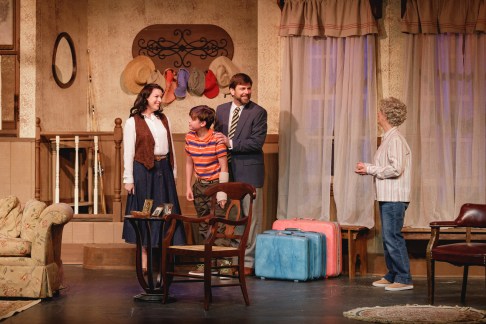
Directed by Marilyn Carter, the stage version proved to be somewhat sweeter than the film; largely because Elyse Williams gives a sunnier, more domesticated rendering of Ethel; dispelling the hardy Yankee, outdoorsy Hepburn effect. Williams and Tom Scott are less iconic and godly as the elder Thayers than Hepburn and Henry, so Amy Pearre Dunn as Chelsea seemed far more sensible and far less petulant than Jane. Toss in the other people who enter the Thayers’ summer home in Maine, and the story seems less about age-old family animosities and far more mundane.

After many years of estrangement, Chelsea, with her dentist fiancé and his son, arrive to celebrate the dour Norman’s 80th birthday. The betrothed couple presumes to impose twice upon their hosts’ hospitality, sleeping together in the same bed and then – with Norman’s grumbling permission – dropping off Billy Jr. for a month while they fly off to Europe. The Billy invasion has unexpected results, shifting the story away from centering exclusively on the Thayers and their parenting. Ultimately, it also takes in the tribulations of Norman’s aging, his surprising capacity for growth, Ethel’s sweet forbearance, and the realities of a successful marriage.

This is the penultimate show at Pease Auditorium, which will be demolished after Agatha Christie’s The Mousetrap plays there this summer. It’s hard to think of any script that has ever fit Pease’s squat stage better than Thompson’s rustic yarn, for James Duke’s set design takes fine advantage of Pease’s panoramic width, and the dwarfish staircase up to the Thayers’ bedrooms hardly seems to matter. I can’t remember if there ever was a curtain drawn across this epic stage, but a curtain would have been largely redundant when the elderly couple arrived, for all the furnishings were covered in drop cloths until, one by one, the Thayers lifted and folded them. Thompson showed a fondness for such elaborate episodes of stage business to kick off his scenes, but it grew less effective in subsequent scenes, where the scurrying business veered toward farce.

The sweeter Ethel in the CPCC Theatre production allows Scott, as a retired Penn professor, to venture close to maximum orneriness – because he’s the one formidable figure onstage. His words stung when Norman and Chelsea had their long-delayed showdown, but part of their impact came from Dunn’s stunned reaction, so I could believe that Norman was being almost casually honest rather than intentionally hurtful. Spoken by Scott instead of a cinematic icon, Norman’s inbred racism also counted for more.

The big dramatic moments of On Golden Pond, as well as most of comedic moments, come because Norman is such a thorny force to be reckoned with – and so insistently morbid. In his confrontations with Chelsea, her fiancé, and Billy, Scott not only wore Norman’s armor well but also showed that it could be pierced. With Ethel, he could be more vulnerable and yielding, which made the climax of the final scene very moving.

Williams was more than sufficiently cheery as Ethel for Norman to spout all his morbid thoughts in self-defense. Sugary, yes, but never cloying. What surprised me most about Williams’ performance opposite Scott was her consistent strength paired with one of the most robust acting voices in town. She was not only as audible as Scott in combat with Pease’s wayward acoustics, she was more consistently intelligible, for Scott occasionally softened his projection or toyed with a regional accent. There was easily enough force from Williams for us to grasp that Ethel was the decider of where things belonged in the house, yet the nuances of her deference toward Norman and its impact upon her relationship with Chelsea were also preserved.

I didn’t get the impression that Dunn was in her early forties, so I missed the overlay Chelsea’s missing her child-bearing years in her bitterness. Unresolved issues with her parents seemed nettlesome rather than crippling, with Scott taking on more of the animosity between father and daughter. Chelsea’s grudges against Mom and Dad were more evenly split here. At her point of aging, Dunn didn’t seem as desperately in need of healing as Norman did, facing the deterioration of his memory. Paul Gibson as Bill really did seem to be the adult upgrade Chelsea needed for her second marriage, showing his mettle when Norman tested it, tellingly enriching our portrait of his perspective father-in-law.

We would hardly miss mailman Charley Martin if Thompson had surgically removed him from his scenario, but Todd Magnusson makes him winsome enough, a garrulous exemplar of local color and a longtime admirer of Chelsea, though he could have been a tad surer in picking up and remembering his lines. Stepp Nadelman has more onerous difficulties to overcome in his first big Charlotte outing as Billy, and the youngster made himself better heard than many older actors have at Pease Auditorium, especially when it counted. Nadelson is no longer at an age where merely standing there and smiling would make him appealing, yet Thompson lavishes a considerable amount of texture upon Billy, commensurate with his ultimate importance to Norman. Although there were occasional drop-offs in his projection, Nadelson’s acting never flagged.