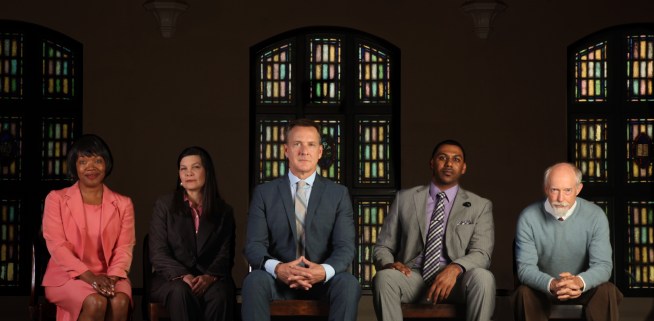
Review: The Christians
By Perry Tannenbaum
When Pastor Paul picks up his microphone at an unspecified megachurch to begin his sermon in Lucas Hnath’s The Christians, he tells his congregants – thousands of them, flocking to the Sunday service – that there is a crack in their church. Describing this crack in a four-part sermon, Paul weaves together a 20-year history of the astonishing growth of his church with two epiphanies, both involving conversations with God.
One of these epiphanies results in Paul’s marriage to the beautiful Elizabeth, who sits proudly next to her husband on the mainstage. The other leads to a new perception of God’s goodness and justice, one that rejects the idea of eternal damnation for all people, no matter how virtuous, who have not accepted Jesus as their savior.
So on the same Sunday that Paul can announce that the vast church property has finally been fully paid for, including its “parking lot that you can get lost in,” he also proclaims that his church no longer believes in hell.
Ironically, the crack that Paul described in his sermon was abstract, not previously perceived by anyone else in the assembly, but by the end of the Sunday service, Paul has created a real, tangible crack. Unable to accept the new doctrine, Associate Pastor Joshua walks out after some spirited disputation from the pulpit. The very visible rifts won’t end there.
As a native New Yorker and someone who takes his Bible seriously – at least the Old Testament – this opening scene combines two of the irritating qualities that I discovered in Christians when I emigrated from Gotham. So many of them converse so regularly with God, a most exclusive privilege in the Bible that I was raised on, that they must believe that their God is handling as many simultaneous personal conversations as Ma Bell.
More irritating is the whole spectacle of Christians who “wrestle” with their faith and feel like other people should care. So when I saw the world premiere at the Humana Festival of New Plays in 2014, I often found the Actor’s Theatre of Louisville production tedious and bland. Later that year, adjudicating the 2015 Steinberg Award as a member of the American Theatre Critics Association panel, Hnath’s script appeared in my Inbox.
Although the panel kept Hnath’s drama among the elite scripts into the final voting, for me, it was definitely middle of the pack among the 27 works we considered. Did I miss something when I read the script? Or perhaps did Actor’s Theatre of Louisville miss something when they brought it to life?
I was hoping so when I entered Booth Playhouse, for Steve Umberger and his Playworks Group were bringing The Christians to town in its local premiere with a cast that evoked Umberger’s years as artistic director of Charlotte Repertory Theatre. In his return to Charlotte, Umberger was also backed by a design team associated with his greatest directorial triumph, the 1995 production of Angels in America, Parts 1 and 2.
From the outset, Umberger’s answer to both of my questions was a resounding yes. The Playworks church choir – “the bigger the better,” Hnath urges in his playscript – is far more energetic and spirited in Charlotte than it was in Louisville, led by Dareion Malone from an electric keyboard and populated with singers who can rock the house when they solo. Set design by Joe Gardner is slicker, more dynamic than the Humana production, with twin projection screens above the action cuing the congregation on the lyrics of the songs and the key points of Pastor Paul’s sermon.

Brian Robinson decisively exorcises blandness from this production as soon as he launches into Pastor Paul’s sermon, slick and confident with the mic and moderately charismatic so that he never becomes a Joel Osteen caricature. There is enough self-confidence and self-absorption to qualify as hubris, yet Pastor Paul’s geniality and approachability keep him far short of Oedipal arrogance. Paul tells Joshua he can leave his church, not that he must. Big difference, and Robinson gets it.
But it’s Chandler McIntyre’s performance as Sister Elizabeth, arguably McIntyre’s best ever, that crystallizes what the Louisville version missed. Embedded in Paul’s narrative about how he met his future wife on an airplane is a theme that is more relevant to us all today than whether hell exists. Here he passes along a note via a helpful stewardess, quoted from an NYU English prof that serves as the play’s epigraph: “I feel an uncontrollable urge to communicate with you, but I find the distance barrier insurmountable.”
It’s a pretty classy pickup line – until it becomes something totally unexpected in a bedroom scene unlike any that you’ve ever seen before. All through this drama, everybody speaks into a microphone, and there are no scenery shifts. Those conditions are only mildly incongruous when we see Elder Jay, representing the church’s governing board, coming into Paul’s office, picking up a microphone, and discussing the repercussions of Joshua’s defection.
Husband and wife picking up mics in the privacy of their bedroom takes the incongruity into comical territory. Sister Elizabeth starts off this climactic scene much as she has seemed before, a loyal, decorous, and diffident pastor’s wife. As Paul airs his suspicions and she reviews his breaches in respect and trust, we watch the quiet pulpit ornament grow into a whirlwind that could intimidate Job, let alone Paul.
Soon afterwards the question scribbled more than 20 years earlier on an airplane is reprised, but we see a different slant from Hnath on the insurmountable distance Paul has spoken of. In a way that hadn’t jumped at me off the pages of the playwright’s script nor the Louisville production, I can now see that Hnath is asking this: Can we work, pray, or even live together anymore after we’ve recognized that we fundamentally disagree?
It’s a very American question, transcending theology. Our nation rests on two very contradictory pillars – the narrow “Sinners in the hands of an angry God” dogmatism of the first Puritan settlers and the “liberty and justice for all” openness of the Deists who framed our Constitution. We probably thought the insurmountable distance between these outlooks had been permanently bridged long ago. What Humana and I didn’t see in 2014 was the election of 2016. A serious crack in our society has re-emerged.
We get fine performances from the rest of the cast that further humanize and texturize their disagreements. As Joshua, Jonavan Adams fumbles a bit in his disputation with his mentor – as he should, since the new doctrine has caught him off-guard and he’s explicitly “wrestling” with his mentor’s sermon. But Adams helps us focus on how much he would like to believe there isn’t a hell, for he vividly envisions his mom there.
April C. Turner emerges from the choir as Jenny, a troubled congregant whose questioning of Pastor Paul is even more powerful than Joshua’s – because she’s had the time to write down her thoughts and gather reactions from around the community in the wake of the schism. To a lesser extent than Sister Elizabeth, Turner grows more formidable right before our eyes as Jenny becomes more comfortable behind the microphone in the spotlight. There’s also a gentle hint that she becomes progressively more irritated and emboldened when Pastor Paul seems to be patronizing the seriousness of her concerns.
Before and during this huge turning point, Graham Smith makes his presence felt as Elder Jay. This isn’t the most towering performance we’ve seen from Smith – he was, after all, Roy Cohn, in Angels back in ’95 – but it ranks among his most rusticated. And the man can still make an exit. His private conversation with Pastor Paul, which had been most notable for me in getting across Jay’s practical business anxieties, registered more deeply this time around, for they also discuss Associate Pastor Joshua and bring out more about him than we knew.
Joshua not only harbors that “Sinners in the hands of an angry God” viewpoint, he’s been aggressively talking up hellfire on the streets of town. So Paul may actually have had Joshua in mind when he perceived a crack in his church, and his defection may not have been as sudden and unanticipated as it first appeared. Pastor P may be as cunning and calculating as Jenny suspects.
Needless to say, I found The Christians to be a far more substantial piece the third time around – and it’s not surprising to learn that Umberger first encountered it in the aftermath of the 2016 election. The revitalized impact of a production like this reminds us how important a professional theatre company can be in the cultural life of a city. Response from the audience during the post-performance talkback confirmed that a satisfying cross-section of people at Booth Playhouse can instantly get what The Christians is saying to us now.
We had that extra intellectual jolt in our community far more often during the years that Charlotte Rep became a prominent member League of Regional Theatres (LORT) under Umberger’s leadership. Umberger could possibly build his current Playworks enterprise to similar prominence, if The Christians draws the support it deserves.

![IMG_5366[5]](https://artonmysleeve.net/wp-content/uploads/2017/10/img_53665.jpg?w=604)
![IMG_4580[9]](https://artonmysleeve.net/wp-content/uploads/2017/10/img_45809.jpg?w=492&h=328)
![IMG_4372[13]](https://artonmysleeve.net/wp-content/uploads/2017/10/img_437213.jpg?w=524&h=349)

 Art on My Sleeve