Reviews: Waiting for Godot, Ramona, Murmurs, Angel, and While I Have the Floor at Spoleto Festival USA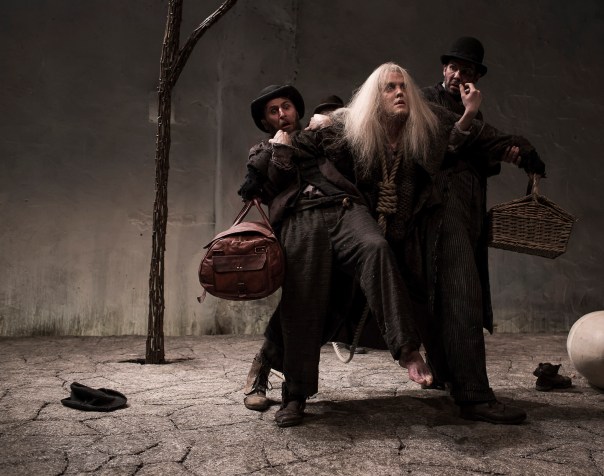 By Perry Tannenbaum
Programming at Spoleto Festival USA runs in cycles as it evolves. Now in its 41st season in Charleston, SC, there is a breadth of performing arts at the 17-day event that is unparalleled this side of the annual Edinburgh Festival in the UK. Opera, dance, symphony, chamber music, jazz, and theatre flit around at nine or 10 venues daily from 11:00 AM until late in the evening. Some category-defying hybrids are also hatched during the revels.
Ever since Gian Carlo Menotti founded the American branch of his Italian festival, capitalizing on his prestige as an opera composer who briefly conquered Broadway in the early ‘50s, Spoleto has been unapologetically international in its flavor and fiercely challenging in its thrust. Last year marked a welcoming celebration of the festival’s 40th season with a long-overdue production of Porgy and Bess in its native Charleston setting – at the gloriously renovated and reopened Gaillard Center, the grandest hall in town.
Complementing the homecoming vibe signaled by the lavish Porgy and Bess, jazz programming returned homewards from its distinctively European bent to a noticeably more American groove, with René Marie, Randy Weston, Freddy Cole, Cécile McLorin Salvant, and Arturo O’Farrill topping the lineup. Three large dance troupes invaded Charleston, Bill T. Jones/Arnie Zane and LA Dance Project the most recognizable of these. Theatre was also noticeably less edgy and foreign, with Gate Theatre’s The Importance of Being Earnest and Jonny Donahue’s off-Broadway charmer, Every Brilliant Thing, among the imports.
 For 2017, Spoleto Festival has largely shuttled back to its edgier, more challenging, and more cryptic self. The Charles Lloyd Quartet took some jazz lovers beyond their comfort zones, singer Sofia Rei came from Argentina backed by a free jazz trio, and Dee Dee Bridgewater frankly declared that she was forsaking jazz this year for Memphis blues and soul. Only one dance troupe, the Marís Pagés Company, was large enough to command the Gaillard stage, the balance shifting to smaller groups and more outré choreography.
Led by Samuel Beckett’s Waiting for Godot, the 2017 theatre lineup is similarly trim, challenging, and audacious. Under the direction of Garry Hynes, this Druid Theatre production made it clearer to me that Vladimir and Estagon, awaiting the mysterious Godot and his nebulous benefits, are unsure of where they are, what day it is, and when they last met. Hynes, who won the 1998 Tony Award for directing The Beauty Queen of Leenane, also makes the friendship and mutual loyalty between our protagonists more open to question than previous productions I’ve seen. Instead of shying away from the script’s absurdism, Hynes embraces it.
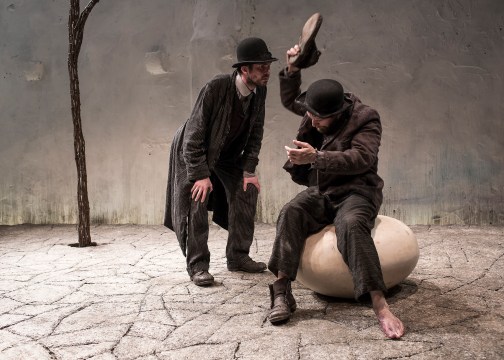 Maybe other directors feel that too much absurdism might risk audience confusion and vertigo. Turns out that amping up the absurdity made the show more comical for the audience at Dock Street Theatre. Strangely enough, Aaron Monoghan as the more ignorant Estragon, isn’t as funny as his cohort. While Monoghan is a purer, less salty fool as Estragon, willowy Marty Rae turns Vladimir into a comical joy, his inquiries into his friend’s mind and his reactions to those revelation drawing equal mirth.
Although Hynes acquiesced, in a public interview at the Charleston Library Society with Martha Teichner, to the notion that Pozzo and Lucky are mere distractions in the tedium of our protagonists’ lives, her staging says otherwise. Compounding the vaudevillian exaggeration that Beckett lavishes upon Pozzo the oppressor and Lucky the oppressed, Rory Nolan as Pozzo and Garrett Lombard as Lucky upsize them, exaggerations in the flesh – and in Lombard’s case, in the hair – augmented by Doreen McKenna’s shabby and surreal costumes.
Juxtaposed with our lonely and futile heroes, Druid’s Pozzo and Lucky both seem gargantuan and powerful, though Lucky’s is a sleeping strength that Vladimir and Estragon fear to waken. At some level, they look like invaders from a real world that our lovable protagonists have skirted. Downtrodden as he is, Lucky seems to be lucky to be employed, even if humiliating subservience is the price.
So what if his boss is an overbearing boor? So is the President who won our Electoral College. While Godot plays at Dock Street from the beginning to the end of Spoleto, there are four other presentations categorized as theatre by the festival that peep in for more limited engagements, five or six performances apiece at smaller venues. The most charming so far has been Ramona, Gabriadze Theatre’s first production at Spoleto – and at Emmett Robinson Theatre – since their doleful and stultifying Battle of Stalingrad in 2003. This time, Rezo Gabriadze’s fanciful script for marionettes and puppeteers is about a shuttling engine whose travel vistas are no more than 300 meters and the mighty love of her life, Ermon, a Trans-Siberia locomotive who spans Mother Russia in his wanderings.
As this true Penelope waits patiently for her Ulysses, a militaristic railroad official tyrannizes over her and a friend. Like any other sensible woman in these circumstances, Ramona and her pal decide to run away to the circus! Scandalous rumors reach Ermon up on tundra, but he remains steadfast in his trust. The ending is very tragic because Ramona is less adept as a tightrope walker than she was as a train. Absurd comedy doesn’t prevent the poignancy of these star-crossed lovers from shining through.
Though both had considerable strengths, Victoria Thierrée Chaplin’s Murmurs and Henry Naylor’s Angel didn’t satisfy as fully. I gradually caught up with what was happening in Avital Lvova’s portrayal of Rahana, the Angel of Kobani, but I needed my wife’s help in grasping the full details after Angel was over. Based on a true story, our narrator becomes a latter-day Joan of Arc champion of the Kurds, amassing 100 kills as a sharpshooter battling ISIS for control of her hometown.
Lvova is well-cast as an action hero, but in the rat-tat-tat battle scenes where she throws herself around on the floor, I found her to be largely unintelligible. Another woman in our row at Woolfe Theatre moved closer to the stage soon after the topsy-turvy opening, and a few minutes later, I slunk into an empty seat that was even closer to the action. I was still missing some of what Lvova was saying at close distance. Part of the excitement was how Angel broke a fundamental rule of one-person shows at the very end. I wished that I could press a rewind button to more fully enjoy it from the beginning.
A visual stunner, Murmurs had virtually no dialogue and not too much more coherence or character development. The subtitle, Aurélia and Her Ghosts, seems to have been dropped between the time that the festival brochure was printed and when the official program book – 152 pages – was codified. But it remains a useful description of the action. Aurélia Thierrée portrayed the heroine who, when we first met her, was on the verge being evicted – or rescued – from her crumbling tenement.
The crisis throws Aurélia into a strange state, for she experiences flashbacks, hallucinations, and things that go bump in the night. Instead of dialogue, Chaplin and Armando Santin provided choreography, but not enough of it to keep me consistently engaged, and Chaplin’s costume designs – with a team of three other designers – outstayed their novelty. More choreography and an infusion of music, maniacal or otherwise, would make this striking piece more impactful.
While Murmurs may be yearning to be a full-fledged dance, Ayodele Casel’s While I Have the Floor, categorized by Spoleto as dance, has an unmistakable hankering to be regarded as theatre. Like Murmurs, Casel’s world premiere morphed after the season brochures were sent out: her “virtuosic piece exploring language, communication, identity and legacy” coalesced into a tap dancer’s autobiography as the piece crystalized into a one-woman show with a title. Casel not only explores her own artistic evolution, she connects us with heritage of tapping, tracing its development from the mid-19th century through such mainstays as Bill “Bojangles” Robinson, the Nicholas Brothers, Jimmy Slyde, Gregory Hines, and Savion Glover. She doesn’t hide her childhood infatuation with Fred & Ginger and engagingly recounts her first confrontation – as a collegian – with a true proponent of the art.
As YouTube can presumably verify, Casel’s demos of tapping are intricately rhythmic and visually dazzling. But the big surprise here is Casel’s acting chops. She can turn on the tears at a moment’s notice, and as a writer, she finds a compelling reason to display that talent. Toward the end, which threatens the dump us off at today and Casel’s well-earned fame, our narrator sprouts a mission and a cause: to revive the memory of female tappers before her and to make sure their names aren’t forgotten again.
Until you’ve witnessed While I Have the Floor, you probably haven’t seen a tap-dance show that reaches an emotional peak. Now it’s here, and Spoleto can be very proud of hosting its world premiere.





 Art on My Sleeve