Tag Archives: Zach Humphrey

Watch for the Closing Door at CAST’s “Sunset Limited”

Review: The Sunset Limited at The Arts Factory

By Perry Tannenbaum

Would it rub you the wrong way to be solicited by a beggar selling candies outside your favorite theater? What if we add a tramp handing you your tickets, then a drunk, a druggie, a streetwalker, and a guy hawking fake Rolexes for six bucks lining the path to your seats? Welcome to experiential theatre at the Arts Factory on West Trade, where Cormac McCarthy’s THE SUNSET LIMITED is rounding the bend into its second weekend.

Or if you’re already fondly familiar with how Carolina Actors Studio Theatre means to do things, welcome back to the good old days.

CAST artistic director Michael Simmons doesn’t merely content himself with just these genial Skid Row stereotypes. No, no, no, for then your experience would normalize as soon you entered the theater.

Not so fast, for Simmons’ rather fiendish set design has at least six walls. After you enter the theater doorway, you need to wind around a cruddy corridor to reach another doorway that leads into the shithole apartment where McCarthy’s action takes place. This is absolute brilliance from Simmons, since the seediness of our host’s life helps to balance the to-be-or-not-to-be debates to come.

This point gets double-underlined when our host, a hulking Black ex-con, triple locks his front door behind his reluctant – and relatively puny – white guest. Subtly, something may click instinctively in us as we hear the clank of the locks. We are locked in this space for the duration of this debate, and the longer we linger, the more forceful White’s arguments become that Black’s life is cramped, sordid, and futile. We’ve gotten a taste.

It’s director Dee Abdullah who layers this emphatic entrance for Zach Humphrey onto the script, a nice touch. McCarthy also tips the balance of the debate in this harrowing direction, for Thom Tonetti as White is armed with more age, experience, education, wealth, and endowed with a professorial intellect.

In a jumpsuit designed by Abdullah, Humphrey appears to have more keys and tools dangling from him than locks on his doors – as if he’s a janitor or a subway worker. That’s where Humphrey saved Tonetti from jumping in the path of an oncoming train, catching him and carrying him home.

If Tonetti stays too long, his rescue becomes a kidnapping, and Humphrey seems to understand there’s a time limit on how long he can hold his suicidal guest against his will. His main intellectual artillery is the Holy Bible, bolstered by his faith, which he frequently brandishes if he’s not thumbing through it. Trying to preach this book to the local drunks, derelicts, and druggies hasn’t yielded any positive results – and he’s been at it long enough that The Greatest Book Ever Written engraving has worn off its cover.

Without a doubt, Humphrey has the more urgent, desperate, and anguished role, especially when Tonetti rubs his nose in his past and present failures – and the squalor surrounding them both. At his most fragile moments, we see Humphrey processing the devastating irony that he has admirably served his time, licked his wounds, and freed himself from one prison only to lock himself in another.

(McCarthy called his players Black and White in his 2006 script, subtitled “A Novel in Dramatic Form,” but those names are absent from the actual dialogue and the CAST playbill.)

One of the reasons we manage to like Humphrey more is his ability to admit, no offense to Jesus or Scripture, that he is intellectually overmatched. Teaching should trump preaching since it’s fortified with facts and knowledge. Won’t it simply hurt horribly when the Sunset Limited rams into him? No, Tonetti calmly responds, at 70mph, the train would outspeed his neurons.

If we press the pause button here, we can scrutinize a telling moment, for Tonetti – (and maybe McCarthy) has miscalculated. Trains don’t ever speed past train platforms at 70mph, needing to decelerate and accelerate before they’re gone. And if McCarthy had only had the luxury of a Google Hub a couple of decades ago, he could have ascertained that the max speed for MTA subway cars is 55mph.

So Tonetti has an extra psychological advantage: when he starts spouting facts – real, imagined, or fabricated – Humphrey will not contradict him. Yes, he does have all the time in the world to throw himself in front of the Sunset Limited, so he can remain calm and keep his cards close to the vest. If he maintains his resolve, whether combatively or cordially, he will prevail. He even realizes that he can spare the time for a cup coffee of and a bite to eat.

Heightened emotions from Tonetti spill out when he is most tellingly challenged and when he swerves to the counterattack. We may be hoping that Humphrey goads him sufficiently to spew out all the venom, hatred, resentment, and bitterness that lurks inside him, resulting in some sort of cleansing purgation. Or exorcism, since a dilapidated bible is ready-to-hand.

As it turns out, Tonetti has had too little connection with other humans for oceans of accumulated bile to come cascading out of him. Maybe he’s only metaphorically a professor! There is an enervated numbness to Tonetti that makes his sudden outbursts all the mightier.

It’s all a conspiracy, for we must factor in how Simmons has configured his black box into a thrust staging. The thrust of the compacted performance space, extending from Humphrey’s kitchen to his triple-locked door, implicates us all as it heightens our involvement.

When telling his gory prison tale of intense violence and grim survival, he was looking straight at Tonetti… and me right behind his left shoulder! And when I viewed both men sitting close to me in profile, I couldn’t help glimpsing how audience members in two other sections were reacting.

Yeah, it’s intense but sometimes a little comical. Face it, since the days of Socrates and Plato, any philosophical or existential dialogue will have its circular, tedious, or repetitive patches. You’ll be seeing smiles from other people across the way, some deeply pondering expressions, and the occasional blank wearied stare.

For me, that added to the experiential realism of my evening and enhanced my involvement.

“Clyde’s” Serves Up a Delicious Seize-the-Food Message

Review: BNS Presents Clyde’s at the Parr Center

By Perry Tannenbaum

September 13, 2024, Charlotte, NC – Over a lazy Duke Ellington piano riff that becomes indelible almost as soon as you hear it, John Coltrane layers on the melody of “In a Sentimental Mood,” recorded 62 Septembers ago. Although we’re in a kitchen at a truck stop that doesn’t look nearly that old, somewhere along the highway in Berks County PA, it’s a fitting intro to the new BNS production of Clyde’s. Along with the mean and sassy owner of this diner, Clyde, we meet her star employee, the zen-like Montrellous, also described by two-time Pulitzer Prize winning playwright Lynn Nottage as “the John Coltrane of sandwich making.”

Nottage’s newest comedy-drama originally premiered in Minneapolis as Floyd’s in 2019, less than a full year before George Floyd was killed by local police – so it was prudent to change the title before the Broadway opening in 2021. Yet a police state haze still hovers over the action, since all the employees at Clyde’s are ex-convicts or parolees, including the owner. She’s not a criminal now, but something or someone has clearly hardened her. Montrellous believes that Clyde’s could be a smashing success if it served up extraordinary sandwiches. She wants to stick to basics, lay low, keep a low profile, and lower her costs on the ingredients her drones drop between two slices of bread.

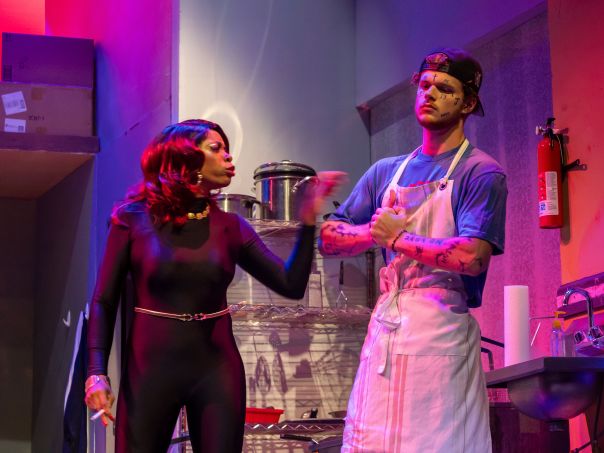
Limiting ourselves on food analogies, let’s say Clyde is one tough cookie, tightly wound to match the tight-fitting outfits costume designer Aneesah Taylor has tailored for her. You do not smile around Clyde, Montrellous warns newbie Jason, a recent parolee. He doesn’t listen. To his distress, he will learn the hard way that Clyde is the Captain Bligh or Queeg aboard this ship. Ah, but there is deeper wickedness to this boss: there is a Jezebel gene in her DNA, for Clyde is a toxic temptress. On a couple of occasions, the owner’s forays into her kitchen reminded me of Curley’s luscious wife sashaying among the farmhands in John Steinbeck’s Of Mice and Men.

The mice here mostly get to play when the boss isn’t peeping through the pickup station, hanging a barely legible order on a little carousel, and banging a bell. Director Dee Abdullah has her kitchen staff reveling in those moments when they aren’t wrapped up in a food prep frenzy. transforms the place. For him, sandwich making should never be drudgery. It is more like a mission, a calling, a crusade, an artform…or a lifelong quest for the perfect sandwich. Suffering and anger can seep into the food you make.

This ministry is not for Montrellous exclusively. When the pace in the kitchen slackens, all four workers lean over their prep stations and take turns chanting the ingredients of sandwiches never built before, swooning collectively over their imaginary deliciousness. In these moments, the kitchen is more like a studio or a writers’ room as the creators brainstorm ideas. And when the coast is really clear, Montrellous reaches into a low cabinet upstage center and extracts his latest masterwork, placing it reverently in the exact middle of the three prep stations. Since James Dukes’ lighting design accentuates the gleam of the Saran wrap around Montrellous’ newborn brainchild, the radiance turns Clyde’s kitchen into a holy temple of sorts. Epicures looking at the three stations centerstage at the Parr Center can be excused if they’re reminded of the Last Supper by Jennifer O’Kelly’s set design.

With this sacred imagery in mind, it’s hardly surprising that Montrellous’s precepts begin to transcend food preparation as we get to know more about him and about Clyde, Jason, slicer-and-dicer Letitia, and the man with the pans at the stove, Rafael. As much as Montrellous wants to convince Clyde to be more enterprising and adventurous – and less dogmatic and stingy – the adoring and adorable Rafael wants Letitia, forever stressed by her infant and her ex, to just give him and chance. Really, this romantic subplot occupies more space and time than the overarching struggle between Clyde and Montrellous, so we don’t think we’re watching supporting players when we see Lisandro D. Caceres-Zelaya in action as Rafael propositioning and wooing Toi Aquila R.J. as Letitia.

“Not enough salt, the flavor doesn’t come out; too much salt, it’s inedible,” Montrellous pronounces. Both women, taught by their past experiences, fend off new ideas and intimacies, fearing all because they’ve had too much before. Both are skeptical that being asked out could be motivated by any other reason than sexual exploitation, whether tender or forceful. Fortifying her resistance to anything Montrellous creates, Dominica Ivey as Clyde turns down every simple invitation to give it a taste. She wields her ever-present cigarette like a dagger, and her every exit is a devastating kiss-off, somewhat comical because she’s so decisive. You begin to wonder whether Ivy has any empathy for her ex-cons: maybe Clyde hires them because they can be bought cheaply.

To be sure, Ivy can string any male along in her wanton mode, but it’s Aquila as Letitia who gives off the most bi-polar vibes. When she isn’t sullenly brooding or crazily hacking lettuce as if she were Lizzie Borden, Aquila is shaking some fine booty and boogeying, reminding us of the charisma she radiated as Eartha Kitt last September. We have no difficulty understanding what Rafael sees in her, and Caceres-Zelaya lights up the stage with his sunny energy, evoking for me the irrepressible verve of Usnavy in Lin Manuel Miranda’s In the Heights.

When he isn’t presiding over the sacrament of sandwich making – and his apostles’ efforts to reach his lofty level – Zach Humphrey as Montrellous is largely a peacemaker. He intervenes with calm authority when Clyde and Jason come close to blows, and he’s a guiding light for both Letitia and Rafael as they gravitate toward one another. “Trust your ingredients,” he sagely says more than once. Everyone is different. People’s possibilities are as infinite as the varieties of sandwiches you can imagine.

Making his professional debut, Anthony Lonzo as Jason presents special challenges that audience members might struggle with, for the tats on his face and spew barbarity and hatred. Onstage, the tats are chiefly repellent to Latitia, but since Jason doesn’t speak much at first, we also need to delve beyond skin depth to grasp what he’s all about. Nottage gives each of the kitchen workers a juicy monologue to reveal what’s inside and in their rearview mirrors, and we’ll likely remember Lonzo’s nearly as vividly as Humphrey’s. But an unspoken maxim sprung to mind as Duke’s lighting finally sanctified Clyde in her memorable epiphany. It’s a wonderful little saying from the Psalms of David that I first learned from a book title by Denise Levertov: O Taste And See. At times the lesson is merely culinary. But ultimately, the message is experiential, about adopting an empirical attitude instead of hardening our prejudices. Above all, it’s an injunction to fully live our lives.

Photos by Perry Tannenbaum

The Young Jewish Girl Who Became a Post-War Icon

Review: The Diary of Anne Frank @ Central Piedmont

By Perry Tannenbaum

The Diary of Anne Frank 

You can sneer and call her the poster child of the Holocaust, or you can marvel at how she continues to be a lightning rod. But 77 years after the last words of her secret diary were written, followed by her death at the Bergen-Belsen concentration camp six months later, nobody can say that Anne Frank has been forgotten – or that she will be in the foreseeable future.

A recent segment on 60 Minutes was devoted to solving the mystery of who betrayed her and her family to the Gestapo in early August 1944 after two years of hiding in the famed “Secret Annex” in Amsterdam. Managing to make even more of an ass of himself than we thought possible, anti-vaxxer Robert F. Kennedy Jr. somehow turned the 13-year-old Dutch immigrant into a talking point, comparing rules enforcing COVID vaccinations to the tyranny of Hitler’s Germany.

“You could cross the Alps to go to Switzerland,” he said of those threatened by the Nazis. “You could hide in an attic, as Anne Frank did.”

Before people had to worry about COVID and those pesky vaccines, the Anne Frank House, where the “Secret Annex” is preserved, attracted well over a million visitors every year.

So with Holocaust survivors thinning out, living memories of the Third Reich growing dim, and misinformation metastasizing, is the time ripe for dusting off and re-examining The Diary of Anne Frank? It has been done before. First published in 1950 and translated into English in 1952, The Diary of a Young Girl premiered on Broadway with its more familiar title in a Pulitzer Prize-winning adaptation by Frances Goodrich and Albert Hackett in 1955. The rebranding stuck after the film, directed on by George Stevens, won the Oscar and Golden Globes for Best Picture in 1960.

All of those originals have been edited, retranslated, or updated – many times, in the case of new graphic novels, children’s book abridgements, TV versions, and movie takes.

But Anne’s text, assembled by Otto Frank from multiple handwritten manuscripts, has only been re-edited a couple of times, once in a critical edition by the Netherlands State Institute for War Documentation in 1989 (revised in 2003), and once revisited by Anne’s father in 1993. The Goodrich-Hackett drama has only been overhauled once, by Wendy Kesselman, in a newly adapted version that opened on Broadway in late 1997.

That’s the version we’re seeing now at Halton Theater in a Central Piedmont Theatre presentation directed by Marilyn Carter. Since 2008, when I reviewed this new adaptation at Theatre Charlotte, it has become the Metrolina standard, with subsequent productions by Matthews Playhouse in 2010 and Davidson Community Players in 2018.

While the Halton isn’t as ideally sized for Anne Frank as Theatre Charlotte or the old Morehead Street location of Children’s Theatre, whose 1996 production remains the Queen City’s gold standard, set designer Robert T. Croghan doesn’t make the mistake of either glamorizing the Annex or expanding it to fill out the capacious stage. Amazingly, the compacted set has four levels without looking at all posh. Yet as we must peer over an unused orchestra pit that becomes a moat between the audience and the stage, our eagerness for a new CP venue, replacing old demolished Pease Auditorium, becomes all the keener.

We won’t have to wait long. They’re promising a spring unveiling.The Diary of Anne Frank

Strikingly fresh and radically different still don’t describe the revamped script, which hit me like it did in 2008 at the Queens Road barn – after previously seeing the original in Charlotte no fewer than three times. Yes, there are substantial differences, some of them welcome improvements and some curiously out of focus if you already know and love the original movie. Some of the signature moments, like Mr. Dussel’s comedy, have dropped out of sight. But the dramatic highlights are pretty much the same as always.The Diary of Anne Frank

What Kesselman has chiefly refreshed is the Holocaust context, deepening it with more frequent references while providing more extensive portrayals of Dussel, the Franks, and the Van Daans as Jews. Carter has Josh Logsdon as the dentist Dussel wearing a tallis and singing a traditional Hebrew prayer. Subsequently, we get pretty good pronunciation from Hannah Sidranski and Summer Schroter as the Frank sisters when they sing the “Maoz Tsur” after the Chanukah blessing.

The most sensible and gratifying change that Kesselman made was upgrading the presence of Otto Frank, who had become a more renowned public figure during the 42 years following the first Broadway premiere of The Diary. It makes a big difference that he no longer greets us at the beginning, discovering the red plaid diary onstage and ushering us into its imperishable contents. Instead of that prologue, Arthur Lightbody as Otto presides over an epilogue, where he can not only reclaim the abandoned diary but also disclose the fates of all the characters we have come to know over the previous 90+ minutes.

Considering how brutally sudden the Gestapo raid is in this newer script, I’ve found that Otto’s return is oddly helpful in processing the final moments of this little makeshift Jewish community. This is a more spasmodic and sobering narrative, less sensitive and romantic in depicting Anne. Sidranski is more energetic, brainy, and immature as Anne. Words gushed out of her so quickly on opening night that we often had only a vague idea what she was saying. At first, I hoped that Sidranski might soon slow down to evince her maturation during her two years in hiding.

That’s not how Kesselman and Carter seem to be thinking. It’s easier to see moodiness among these families than to see any of them evolving. They’re chafing under the restrictions of their survival mode, that’s for sure, and with the passage of time, we’re getting to know them better – and so are they.

Carter also seems to have spearheaded a rethink on Halton’s chronic audio woes. The setup of mics now dangling down from the flyloft yields far clearer – and continuous – sound amplification than we’ve heard in the past, though differences in levels could be detected, especially upstairs on the set, when actors were more directly under the mics.

Adults in the cast were projecting more consistently than the youths, easier to follow overall. But everyone is believable. Croghan’s costume design is as impeccable as his set, and Carter’s casting is always spot-on. Lightbody radiates a leader’s calm and quiet dignity as Otto, oozing warmth toward the youngsters, especially his favorite Anne, and seeming to take the long view while everyone else is caught up in the moment. By contrast, Rebecca Kirby gives us a sterner portrait of Anne’s mother, Edith, not adjusting well to the protracted confinement and never sunny enough to be called bi-polar.

You may feel otherwise about Poppy Pritchett and her flamboyant turn as Mrs. Van Daan, fetishizing her fur coat, worrying herself over what Anne might be writing about her, and flapping her protective wings around her ravenous husband when she isn’t berating him. On the other hand, Daniel Keith keeps a remarkably even keel in excelling as Mr. Van Daan, Otto’s one-time benefactor, perpetually in quest of respect always winding up as the hydrant of the underdog.

The Diary of Anne FrankMalychia Abudu-Clark and Zach Humphrey come by infrequently, essential buffers between the Secret Annex and the Gestapo, delivering needed supplies and news from the outside, never staying long enough to remove their outerwear. That would be risky for a Dutch national harboring Jews. They best demonstrate their caring when they urge the Franks and the Van Daans to accept Mr. Dussel into their company – and it is here that Lightbody is most impressive in his authority as Otto in waving aside all objections.

No doubt about it, Logsdon changes the vibe when he enters as Dussel. For the first time in months, the Franks and the Van Daans get the grim news of what’s happening elsewhere in the Jewish community. About the merciless Nazi raids. About the transports. At the same time, he’s disturbing the settled sleeping arrangements of the Franks and, moving in with Anne, disturbing the budding adolescent’s privacy and social life while consigning Margot, the older sister, to bunking with Mom and Dad.

The Diary of Anne FrankThere is friction between the roommates across the generational divide, but Logsdon never shrinks from it, frankly outraged when Anne wakens him suddenly, shrieking from her latest nightmare. Yet he is an elite force, reveling in Dussel’s standing as household cantor and tooth extractor, not quite as unflappable as Otto because he never has to take charge.

Margot is rather bland compared to her little diva sister, so Dussel’s arrival is rather fortunate for Schroter in playing the role, for she can proceed to establish herself as the family’s good sport, accepting her altered sleeping arrangements to start with and Anne’s intimacy with young Peter later on. Better yet, Margot is one of the two young people, along with Michael Swinney as Peter, that Anne can open up to when she’s ready for more mature conversations.

These conversations – less obnoxious, overamped, and impulsive than those she has with her elders – help to calm Sidranski down a bit as Anne and show herself off at her best. Huddled downstairs in Anne’s bedroom instead of upstairs where Peter resides and gets his private moments with our diarist, Schroter has the advantage over Swinney in being closer to the audience and more readily audible.

Of course, we strain harder to hear Peter’s precious conversations with Anne, thinking they will probably be the happiest she ever has.