Review: Caritas a Cappella Ensemble @ St. Alban’s
By Perry Tannenbaum

January 19, 2025, Davidson, NC – With so many churches in the metro Charlotte area, it’s little wonder that the Queen City is fertile ground for choirs and choristers – and receptive audiences for choral music. Considering this profusion of talent and activity, as well as the total absence of Caritas A Cappella Ensemble press releases in my voluminous mailbox and the lack of catch-up info on the Caritas website, I was able to forgive myself for not having known about this organization, founded by Cathy Youngblood in 2017, until signing up for this review.
More ominous, as we entered the St. Alban’s Episcopal Church, was the elephant in the room: a spanking new grand piano in the middle of the sanctuary, standing in front of two rows of music stands where the singers would be placing their iPads and music scores. Was there somebody at Caritas HQ (if there’s more to it than the PO Box given at the website) who needed to learn the meaning of a cappella?

Thankfully, the piano was there for a delayed pre-show, so the mammoth obstacle turned out to be a blessing. For once, my wife Sue and I had arrived early enough for a Music at St. Alban’s concert to take in the prelude event, where star students from the Davidson area are given the opportunity to play for an audience and warm us up for the featured guests.
Those of us who had arrived on time for the pre-show were rewarded, while awaiting the arrival of Tianyang Chen, with a couple of delightful morsels of Brahms from his teacher, Cynthia Lawing. Once Chen had gone through his recital of pieces by Ginastera, Liszt, Brahms, and Debussy, the elephant could be moved to make way for the marquee players.
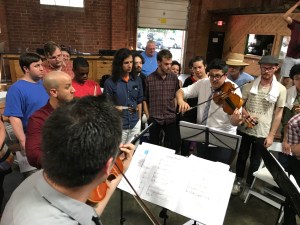
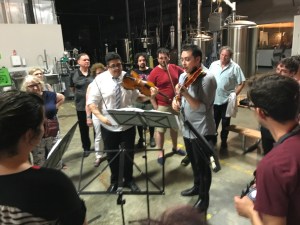
Surprises didn’t cease with the piano’s exit. Caritas artistic director Jeremy Mims entered the sanctuary in the usual way, but the Ensemble didn’t take their places behind the music stands. Instead, they encircled the audience – men in front, women at the rear of the hall – for the opening selection, “Musick’s Empire” from Triptych by Lloyd Pfautsch (1921-2003). Besides the ethereal surround sound blend, this presentation heightened the drama when Mims cued the female voices. Fittingly, the outré deployment of the Ensemble was devoted to a modern piece. It wasn’t until the singers took their places after this opening that the title of their concert, “A Capella Through the Ages,” could be fulfilled in a more orderly, chronological manner.
Fussing a bit with the printed program, replacing a couple of titles on the list with new selections and occasionally shuffling the order of performance, the concert kept to its original design, flashing back to the Baroque days of Vivaldi, Palestrina, and the Scarlattis with a nice mix of sacred and secular lyrics. Whether it’s Handel or Bach, we hear many of the mightiest works from that wondrous era, so it was nice to sample these less familiar gems.

What interested me most on the program was the predominance of more modern pieces, from the days of Bruckner, Holst and Vaughan Williams to the present day. Pieces like these, which sound surprisingly retro compared to the modern chamber and orchestral pieces we’re familiar with, have always been mainstays at Spoleto Festival USA concerts down in Charleston, SC, so I was eager to see how these performances would compare and how a North Carolina audience would react.
The composers’ names were no less intriguing and enticing. We don’t readily recognize contemporary composers Elaine Hagenberg (1979-), Kevin Memley (1971-), Eric Whitacre (1970-), and Pärt Uusberg (1986-) by their last names. As for Frank Tichelli (1958-), whose “Earth Song” was inserted after the program was printed, I was nowhere close to knowing how to spell his name when Mims announced it. “Sikelly” was my first stab. Well-matched to the slow-paced, richly-scored music, Earth’s lyric was rather simple at its core: “Oh war and power, you blind and blur. The torn heart cries out in pain. In pain. But music and singing have been my refuge, and music and singing shall be my light.”
Uniquely, the beauty of the hallelujahs later on was more like a solemn sunset than a jubilant festival. Sadly, Caritas’s enunciation was no clearer than that of multiple recordings – including one by the famed Seraphic Fire – I sampled on Spotify, which offered welcome first aid in deciphering the lovely lyrics. Consonants were often unclear, vain routinely indistinguishable from pain. And vowels! Try to hear “light” when that word pops up!
Never again will I blame myself for losing track of what a choir is singing in Latin (or any other foreign language) when I have the printed text before me. For that reason alone, Uusberg’s magical “Ōhtul” nudged “Earth Song” aside for me as the most impressive piece on the program. Since translations were appended to the program, full contentment with the performance was a simpler matter. The grand swell, as the poet’s song paddled away, was a lovely surprise after everything else – bird, little flower, and forest trees – had been silenced and lulled to sleep by the twilight. Erkki-Sven Tüür (1959-) and Arvo Pärt (1935-) will need to leave some space for this youngster on their pedestal as my favorite Estonian composers.
As for the practice of printing translations for vocal performances, a brief word. Follow the practice of most opera companies nowadays who project subtitles even when the operas are performed in English. Print the English texts with the translations for our fullest enjoyment.

“Nunc Dimitis” by Gustav Holst (1874-1934) impressed me nearly as much as the Uusberg, with solos from soprano Sarah Ochoa and tenor Nicholas Setzer. The soloists not only sang their brief solos purely, they set the stage for responses from the Ensemble at a dramatically augmented volume. Wisely, the Latin didn’t appear in the program, clearing the pathway to pleasure when we went straight to the translation.
Of course, the fullest experiences at this concert came from songs in our language that were either familiar to us or readily grasped in real time. The most enjoyable of these included Hagenberg’s joyous “Alleluia,” though it sported few more words aside from amen, and the finale that followed, “Ezekiel Saw de Wheel” as arranged by William L. Dawson (1899-1990). Most surprising of all was Vaughan Williams’ “O Mistress Mine,” from his Three Elizabethan Part-Songs, a rather frisky departure for a composer better known for the grandeur of A Sea Symphony, the anguish and majesty of Job,and the simple tragedy of Riders to the Sea.
Gerald Finzi’s “My spirit sang all day,” mercifully brief, didn’t really speak to me, and “Shenadoah,” as arranged by James Erb (1926-2014) disappointed. Crossing the “wide Missouri,” we have an inalienable right to more bass and sinew between the shores. Bypassing my personal distaste for the foundational baby-worship that pervades Christianity, the pairing of Whitacre’s “Lux Aurumque” and Memley’s “O Magnum Mysterium” were more pleasing to me in Latin, since ignoring the translations – and savoring Memley’s heavenly harmonies – was an option.
Amusingly enough, I had to adjust my attitude toward Caritas’s choice of William Billings’ “I am the Rose of Sharon” past the midway point of a largely repetitive and pedestrian performance. When the famed snippet from the Song of Solomon reached its denouement, “for, lo, the winter is past and the rain is gone,” you could look out the huge St. Alban’s windows and see that the rain really was stopping in response to these pertinent repetitions.
If you missed that, you couldn’t help but notice streaks of bright sunlight suddenly streaming across the front rows of singers. In his intro to the piece, Mims had hoped that the concluding verse would bring an end to the rain. But the power of Caritas’s incantations exceeded this extravagant hope. Repetitions and all, you won’t find me arguing with such cosmic success!
Photos by Perry Tannenbaum


 Art on My Sleeve