Tag Archives: Theatre

“Beyond the Surface” Amazes and Parties-Down

Review: Beyond the Surface at McBride-Bonnefoux Center

By Perry Tannenbaum
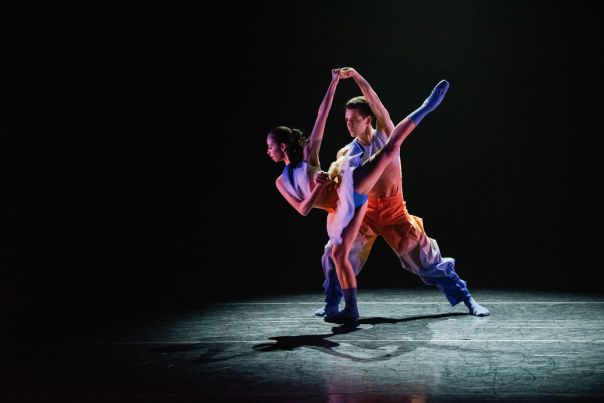
The new Charlotte Ballet season is off to a blazing beginning. Presenting Beyond the Surface at the McBride-Bonnefoux Center for Dance through October 26, the troupe looked fresher and younger than ever. But the choreography was far, far younger: two world premiere hatchlings that emerged from their shells last Thursday from Omar Román de Jesús and Mthuthuzeli November, and a third Charlotte Ballet commission by Jennifer Archibald that had its premiere less than two years ago in the same studio.

On that auspicious occasion, Archibald’s fledgling was at the top of the Innovative Works program, sparking hopes that the pieces that followed would reach the same high level. This year, HdrM is nestled in the middle of the program – and my 2023 hopes were already realized again in 2024 with the premiere of De Jesús’s Balúm.

Yes, the first dance of the night easily merited a climactic spot in any evening of premieres: beautiful, complex, mysterious, symbolic, intricate, moving, epic, and surreal. Music by OKRAA, Ola de Luz, was relentlessly propulsive, with random noises at random intervals littered around the main core, a minimalist loop with a harp-like timbre. Once that core cleared the noisy interference, like a spiraling starship navigating through a belt of asteroids, a sudden hypnotic calm and spaciousness prevailed – and the wonder of this dance multiplied, lending it an uncanny glow.

De Jesús has indicated that he is exploring our interactions with the air that engulfs us, from the moment we are born until we take our last breaths. Or maybe that emergence from the noise field near the beginning of the piece is an expulsion from the womb, our birth after a pre-natal prelude. The Puertorriqueño choreographer also has a hand in scenic design and Branimira Ivanova’s costume designs, for she has some specific prompts to execute in fashioning the dancers’ outfits and props.

The most notable of these are black: Two umbrellas that conjure up the surrealism of René Magritte and the fearfully magnificent ambiguity worn by Rees Launer. One of the umbrellas starts upstage center, held by one of the dancers seated on a bench, and it gets passed from dancer to dancer during the action, frequently cycling back to its starting position. The other is held stolidly by a woman on a side bench who resolutely faces away from the action until the stunningly gorgeous denouement – when we get to see the air!

At various moments when Launer grips our attention, we can have different conjectures about what his stern character represents. A raging fire-and-brimstone preacher? a demon? a witch? the Angel of Death? Launer will be a member of two of the three ensembles that get to present Balúm during its current 16-performance run. Another standout in the opening weekend’s seven-member ensemble, Maurice Mouzon Jr., will be in all the performances of this piece.

The liquefied movement of the dancers – along with some robotic intertwining – was juxtaposed with no-less-idiomatic lifts that were more horizontal than vertical. Like chapter markers at the end of episodes, the ensemble would gather and swirl around the stage in an evocative oval parade. Autumn leaves swirling in the wind. Often two or three subgroups performed simultaneously before an ensemble swirl would resolve the dissonance.

What amazed me most was that synchronized entrances and overlapping actions were so precise when there were seemingly no musical cues to give the dancers a toehold. If you’ve heard music by Philip Glass, you know that minimalism is not particularly danceable music. Musicians playing it and maestros conducting it must concentrate intently on the score to keep their bearings amid the repetitiveness. I’m still gobsmacked by how this Charlotte Ballet team pulled this off.

Following Balúm, a piece so untethered from every aspect of its music except for OKRAA’s tempo, Archibald’s HdrM struck me from an altered perspective. Archibald’s ability to mesh expressive movement to a soundtrack of musical compositions by Ludwig Ronquist, Heilung, and Federico Albanese stood out more boldly than ever after the more abstract and surreal De Jesús piece – though these intimate bonds in HdrM could be broken by abrupt mechanical disconnects from the score.

Two other conflicting factors came into play. Most welcome was the opportunity to see the Canadian-born choreographer’s work reprised by three of the eight dancers who performed at the 2023 premiere, Raven Barkley, Luke Csordas, and Shaina Wire. The piece looked more natural and “lived-in” twenty months later, so its internal contrasts were sharper and its sensual moments more relaxed. Barkley, in particular, stood forth dramatically, as sensual, captivating, and devastating as we’ve ever seen her. Nor can you fail to notice the ‘do.

Here, more than in any other dance of the evening, the ensemble bought into the “Unfiltered” theme of CharBallet’s 2024-25 season with their spirited, lyrical work. My only worry was off the dance floor and in the program booklet, where Archibald’s useful explanatory remarks where no longer in print. There in 2023, she was concerned with environmental psychology and posed a pointed question: “Is there a social responsibility to humanize architecture?”

Just asking that question helps us to connect with Archibald’s struggling language of movement. It also hints at the likelihood that Kerri Martinsen’s drab costumes are intended as institutional, such as clothing worn in hospitals, prisons, or mental wards. Aside from the contrast between lithe and mechanical movement, HdrM holds our gaze with a nice balance of ensemble, individual, and pair segments that flow naturally into one another.

Like many finales we’ve seen before from CharBallet, November’s Vibes and Variations is the most celebratory and carefree piece of the night. After last year’s From Africa With Love, it’s also the second consecutive November premiere to kick off a season at the McBride-Bonnefoux Center. Where Africa was surprisingly serene and monochromatic, preoccupied with mauve-colored ostriches from his South African homeland and their exquisite fragility, Vibes seems to wander westward to South America, to samba, tango, and carnivale.

Ivanova’s costumes burst with pastel cotton-candy colors and outré pleating, what my late mom in her saltiest Yiddish would call ongepochket, crassly over-decorated. The bulges on the men’s costumes give them seahorse legs and the frilly women look like spinning tops in a color scheme that matches the men’s harlequin-like rigs. The music starts off rather quietly with Gaby Moreno singing the first vocal on the program, her cover of “Cucurrucucu Paloma” over a simple acoustic guitar accompaniment, smoldering with bossa nova intimacy and sadness.

Things intensify as the 15-person ensemble digs into the Bang on a Can All-Stars’ version of David Lang’s strangely percussive – and minimalist – “cheating, lying, stealing.” But the most intense partying launches when we arrive at beatmaker Jamie xx and MC Moose performing the brash, irresistibly mindless “Gosh.” Catching my eye most compellingly were Csordas and Fuki Takahashi, each of whom will be in two of the three rotating ensembles performing November’s piece throughout its current run.

If I have to predict who will land the title role in Carmen next spring when artistic director Alejandro Cerrudo and CharBallet unveil their Vegas-showgirl update, my guesses would be Takahashi or Barkley. Since that Charlotte premiere will be running for two weekends, both temptresses could take turns at it.

“The Humans” Is More Haunting Than Ever

Review: The Humans @ Armour Street Theatre

By Perry Tannenbaum

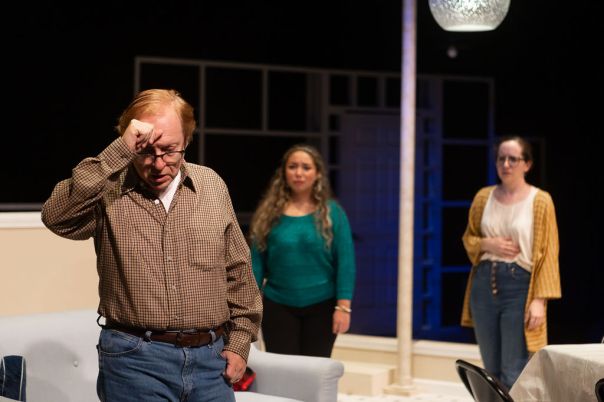
Thanksgiving in Chinatown, in the shadow of the fallen Twin Towers – Stephen Karam’s spooky, mystifying, and hilarious The Humans hands us a world teeming with paradox. For an afternoon in a creaky old two-story apartment, newly rented by Brigid Blake and her boyfriend Richard Saad, her family gathers to celebrate, the whole lot of them nursing open wounds – and their Alzheimer’s-stricken elder, “Momo” – trying to heal from recent setbacks.

First staged in the QC at Knight Theater in a 2018 touring production starring Richard Thomas as family patriarch Erik Blake, Davidson Community Players brings us a downsized reprise in the first locally-produced staging, with the venerable Hank West in the lead.

Haunted by his return to the vicinity of Ground Zero and by his recent misdeeds, tormented by a deadly mix of sleeplessness and nightmares, Erik vies with elder daughter Aimee for which of the Blakes is suffering the most. Since last Thanksgiving, Aimee has come down with ulcerative colitis and taken major hits to her love life and her career as a Philadelphia lawyer – with major surgery looming on the horizon.

Yet Erik fires a wicked one-liner at Brigid, whose gripe, like his wife Deirdre’s, barely hovers above the “suck it up” level compared with his own. “If you’re so miserable,” he asks the health food fanatic, “why are you trying to live forever?” Inside negativity, Karam can be equally trenchant and funny when Aimee philosophizes about her recent breakup: “Maybe loving someone long-term is more about deciding whether to go through life unhappy alone or unhappy with someone else.”

Only Deirdre and Erik have an agenda for the afternoon, subtly suggested in a couple of brief dialogues. We’re mostly watching Karam’s keen observations of family interactions – their bonds, their tensions, their little quirks, and their tectonic divides. These appear all the more chaotic because dialogue often overlaps and action is happening simultaneously upstairs and in the more commodious basement.

Knight Theater probably gave us an oversized impression of Brigid and Richard’s love nest, while DCP’s Armour Street can’t help look both height- and space-challenged. Remarkably, Evan Kinsley’s more cramped set design lessens the struggle of viewing multiple tracks of action and family intrigue. Yet Karam and director Glynnis O’Donoghue are still able to provide enough compelling distraction at a key moment to allow the aged Momo to disappear without our noticing.

Even without two-story height, Kinsley’s set has an alleyway leading to an elevator shaft to accommodate the wheelchair-bound Momo’s transit between the two floors. The slice of set that serves as the upstairs somehow has enough space for the front door, an entrance to a bathroom (Aimee’s frequent retreat), and the only window looking out on the city. When the apartment’s oddities need to impact, Kinsley’s set and Sarah Provencal’s sound design deliver.

The divides between the Blakes will be familiar to anyone who has grown up in a family of siblings. Although Brigid would never consider living in Philly, the geographical divide is as important here as the generational difference, for neither of the daughters would ever think of moving back to Scranton, PA – except to a summer home that Erik tells us can move towards construction once there’s a sewer system near their pristine plot.

Those anticipated PA pilgrimages will not bring either of the sibs back into the bosom of the holy church. Nor will it erase the fact that these country folks’ children are irremediably citified, one a lawyer and the other an aspiring composer. Safety, religious, and lifestyle concerns plague the homespun parents. Ahead of their Thanksgiving visit, Deirdre has sent a care package that includes a statue of the Virgin to protect Brigid’s new home. Meanwhile, Aimee can expect an email any time a lesbian commits suicide.

Karam provides plenty for the Blakes to discuss in their near and distant back histories, with a handful of stunning updates. If things get dull, he serves up a choice collection of singularly awkward moments that would instantly embed themselves in family lore ever after, lovingly and mockingly retold at holiday dinners and special celebrations.

There’s even a “pig smash” ritual unique to Blake Thanksgivings, a nice spotlight for Richard. Often the aspiring social worker serves as our ears in his role as outsider, giving the Blakes the chance to explain all that is long-known among themselves.

These moments reverberate warmly within us, but the most haunting vibes, from Erik’s dreams and experiences, touch us all, nonchalantly invoking 9/11 and Superstorm Sandy – specters of terrorism and climate change. Over and over, whether Deirdre wheels Momo around or Aimee summons an Uber with her cell, we hear an eerie, insistent whisper from the playwright emanating from his vivid, painstakingly detailed dream: this is how we live.

On Davidson’s compacted stage at Armour Street, the natural flow of The Humans, the lack of powerhouse confrontations that shake us to the core when we witness such American classics as August: Osage County, Who’s Afraid of Virginia Woolf? or The Little Foxes, reminds us of Chekhov’s more placid classics. Rich and funny and touching as all the action is, we will likely struggle to discern a solid plot until Erik’s big reveal.

Inexperienced theatergoers are therefore advised to ignore any FOMO anxieties they may be experiencing and surrender themselves to the many delights, laughs, shocks, and epiphanies that West and his castmates deliver.

On the page, Karam’s script doesn’t pop out at you with the color and verve that O’Donoghue gets from this ensemble. West actually comes onstage with a couple of key advantages over Richard Thomas. We more readily accept West as an ordinary janitor-turned-equipment-manager, and he can bring out a curmudgeonly edge to Erik that I’d never noticed before.

No less surprising is the bubbly, goofball likability that Breanna Suarez brings to Brigid, though she is often the family contrarian and party-pooper in the script. The vibrant energy she exudes somehow turns pure negativity into simple immaturity, emphasizing Brigid’s spoiled qualities. As our genial hostess, Suarez tunes in on Brigid’s side hustle as a bartender, so she’s the life of the party while subtly fueling the true plot, endearingly committing a faux pas for the ages along the way.

Portraying West’s wife for the first time since 2005, when they both earned best actor honors in Coyote Ugly, Anne Lambert makes the wait worthwhile. Although Citizen Trump famously descended his escalator in June 2015, between the time that The Humans opened Off-Broadway and when it reappeared on Broadway with a completely new cast and director, Deirdre likely struck the late-2015 Broadway crowd as a MAGA maniac.

Interestingly, Karam could have taken Hillary Clinton as his model if he had written his tragicomedy 20 years earlier, but Lambert still strikes me as a MAGA nutjob even if that couldn’t have been the playwright’s intent. The religious zeal, the paranoia, and the constant moralizing are almost non-stop, so thanks to Lambert’s implacable disapproval, Deirdre winds up ennobling Erik and humanizing her daughters – just by enduring her. Yet there is an unmistakable sincerity to this steely, troubled soul.

Deirdre’s relatively spurious sufferings also brighten Aimee’s halo. Her woes are certainly the most tangible, so Alyssa Whitting has the freedom to add some hard edges to her performance, aiming her best zingers at Brigid with an assortment of barbs for the rest of the fam. Ascending and descending DCP’s imaginary staircase for extended poops, Whitting makes a pungent impression when she’s with us. She’s the slick urban professional among the Blakes, getting better reception on her cell than Dad and handling all the key calls.

Preoccupied with the cooking, Ryan Miles as Richard is also frequently on-leave from the family flow, but he’s a fine audience surrogate when we need things explained. Without fuss or bravado, Miles keys into the fact that Richard is the most laid-back, financially secure person in the room – the one lifelong New Yorker – in between Brigid’s age and Erik’s, accentuating his unique perspective.

Momo’s lines are annoyingly repetitive and approximately 85% gibberish to my ear, meticulously transcribed by Karam word-by-nonsensical-word. So if Wandy Fernandez is accurately delivering Momo’s babblings as written without considerable improvisation, she has performed one the most prodigious feats of memory in the history of theatre. There is wonderful variety in her performance with a lovely little miracle in the middle, which of course gratifies Erik and Deirdre the most. Words or not, the woman can also throw a fit.

The cryptic ending of The Humans, where the thin thread of Karam’s plot crystallizes, was clearer to me the second time around. Along the way, it’s helpful to note the circular shape of the Blakes’ history, the dream Erik divulges stage by stage, and the explanation Richard offers. Erik’s worries, sadly enough, are suddenly more topical in the Carolinas than ever before. After Sandy, the fact that Chinatown was a Zone A flood zone was fearfully real. Now that Asheville is isolated, adrift from interstate highways until next year, we can legitimately wonder what zone is not a flood zone after all the climate damage humans have done.

Richard says it succinctly, recalling a comic book he loved as a kid: “horror stories for the monsters are all about humans.”

“Girl from ther North Country”: A Dream Dispelled

Review: Girl from the North Country at Belk Theater

By Perry Tannenbaum

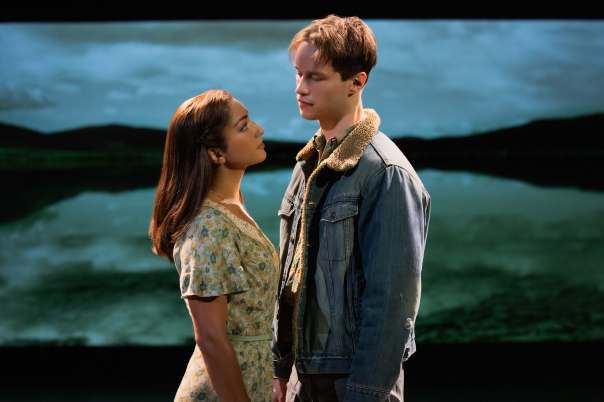
When it premiered in 2017 at The Old Vic in London, Girl from the North Country must have seemed like the fruition of a musical theatre dream team. The original book would be by acclaimed Irish playwright Conor McPherson, who would freely roam amidst the vast catalogue of music and lyrics by Bob Dylan, the 2016 Nobel Prize Laureate, to choose his songlist. By most surviving accounts and reviews, Girl from the North Country was must-see theatre in two successive London productions, Off-Broadway in 2018, and on Broadway in 2020.

Previous peeps at the show on the road, chronicled in regional sections of BWW, have only been slightly less enthusiastic. So opening night at Belk Theater earlier this week was a massive shock when the national tour touched down here for the 28th of its 30 scheduled stops.

The first stunner was the sparsity of the crowd. Often sold out on opening night for brand-name shows, the Belk was less than half-filled for the Charlotte premiere. Traffic to the Uptown was no lighter than usual, and blackouts had already been a non-factor for previous events I had covered in Plaza Midwood and Davidson. Were fervid Dylan fanatics, among the most loyal anywhere, diverted by the WNBA Playoffs? Were they glued to their TV sets, watching the Walz-Vance debate?

Whatever reason the stay-aways may have had, the biggest shocker was that the no-shows were so right. The dream team is merely a mirage on the road, though the esteemed playwright is still listed as the stage director.

As much as we both love Dylan – my wife Sue and I held hands when the mighty “Hurricane” was sung – Girl from the North Country never fully connected with us. The boxer and escaped convict in McPherson’s script is Joe Scott, we’re in 1934 Duluth (three years before Rubin “Hurricane” Carter was born), and when Warren Nolan Jr.* plunges into the song, he must segue into “All Along the Watchtower” long before the tale of the framed boxer reaches its epic, cumulative power and intensity.

This is not the story of the Hurricane. Yet the connection of this suddenly anachronistic song, unlike the decisively irrelevant “Watchtower” or “Idiot Wind” that complete the medley, is stronger than nearly all the others we hear. At its worst, the beginning of Act 2 at Nick Laine’s dingy Duluth boarding house devolves into a chaotic Dylan concert with no forward-moving drama at all, the most inert and aimless musical theatre I’ve seen since Cats purred back from its intermission.

Action revolves around the innkeeper, his bipolar wife Elizabeth Laine, his alcoholic and artistic son Gene, and his adopted black daughter Marianne, five months pregnant. Curiously, Nick is the musical eye of this stormy family, the only member who never gets a solo to sing. John Schiappa is devoted to his demented wife, whom he dutifully feeds though she might slap the plate out of his hands, but he cares more for his longtime boarder, Carla Woods as Mrs. Neilsen, a possible financial lifeline if her late husband’s ever gets out of probate.

As Elizabeth, Jennifer Blood gets the most outré actions from McPherson – even when she’s brooding at an upright piano – and a royal gem from the Dylan songbook at the end of each act, “Like a Rolling Stone” followed “Forever Young.” These briefly sounded like echoes from the days of Janis Joplin reign as rock’s blues queen. Days of mad incense and love. Elizabeth has more reasons to be jealous of her admirably stable and ruggedly handsome husband than justifications for her relentless resentfulness and orneriness.

Yet even this most powerful of McPherson’s roles never quite bridges the gap between the footlights and our hearts. My most generous theories for why this was so on opening night are the sheer size of the Belk, double the seating capacities of the houses where North Country played London and New York, and the wretchedness of the sound, a chronic Blumenthal ailment.

Come back to us, MJ! – or at least send your sound crew.

Sharaé Moultrie gives a velvety smooth voice to Marianne and, despite her precarious position as an unwed mother-to-be, enough serenity for us to occasionally suspect that her conception was immaculate. She gets her share of solos, if not the choicest harvest. Dramatically, Marianne is the calm center of a vortex, with love and affection swirling around her from at least three different men.

Concerned about her future, Nick seeks to wed her to the financially secure – but elderly – Mr. Perry, portrayed by Jay Russell with humility, gentleness, and heart. Manuel as Joe is almost immediately smitten by Marianne, no doubt imagining himself as her redemption and she as his. She has reason to be impressed, for when he was challenged to a fight by her drunken brother Gene, Joe reluctantly yielded to the challenge and floored Gene with a single blow.

Prodded by Nick to get a job to help steady the Laines’ finances and avert foreclosure on the guesthouse, Aidan Wharton* as Gene sees his hopes of becoming a writer fading away. More sorrows to drown in drink are triggered by his ladylove, Chiara Trentalange as Kate Draper, when she announces that she is already engaged to be more pragmatically married. The ensuing Wharton-Trentalange duet on “I Want You” was probably the most dramatically apt of the evening.

Might have been more impactful in a smaller house with cleaner sound.

McPherson puts plenty of life onstage that never quite projects to Belk’s empty upper balconies. Aside from Mr. Perry; a wild bible salesman with a frayed clerical collar arrives with Joe, Jeremy Webb as Reverend Marlowe; and our sometime narrator, Alan Ariano as Dr. Walker, pops up periodically at the boarding house, making his rounds. Of the two, Webb as Marlowe is far more dangerous – almost dramatic – for his fugitive status and his poverty make his sales pitches aggressively hard-sell and his fingers tend to get sticky when he thinks nobody is looking.

With so many plots already brewing in Duluth, McPherson thoughtfully adds a family from the outside world that tends to add variety to the inbred local atmosphere of seediness and decay. The well-dressed Burkes are a fallen uppercrust family, as iconic during the Great Depression as the downtrodden wanderers crossing the Dust Bowl to sunny California.

Both Mr. Burke, who lost his business during the Great Crash, and Mrs. Burke, who lost a chunk of her patrician trust and self-confidence as a result, are on the lookout for new opportunities, not necessarily with each other. Both David Benoit and Jill Van Velzer, playing the elder Burkes, also sit down occasionally to play the drums, adding a new musical level to the evening while expanding the social context of North Country. Benoit gets to be more decadent, proposing to manage a ring comeback for Joe.

The couple’s son Elias has some sort of learning problem, so D’Marreon Alexander* gets a breakout moment in Act 2 – parallel to Blood’s with “Rolling Stone” in Act 1 – when Elias suddenly emerges from his cognitive cocoon with “Duquesne Whistle.” Doubly surprising for me, for “Duquesne” hurtles forward with the drive of Dylan’s best work and because I’d never heard the 2012 composition before. Wow.

I wish I could praise any of McPherson’s dramatic moments as highly. We’re not likely to experience a theatre week such as the current one for ages to come. Two living playwrights who have translated works by Anton Chekhov – and do not hesitate to use his methods – have pieces running simultaneously in Metrolina. Arguably, McPherson’s book, repeatedly stressing the consequences of inaction, has more of the Russian master’s most distinctive flavor.

But Stephen Karam’s The Humans, set in post-9/11 and post-Hurricane-Sandy Chinatown, will rock your world. Anyone torn between the two would be best-advised to bypass the Broadway Lights production at the Belk and head up Interstate 77 to Davidson, where Karam’s masterwork is playing at the Armour Street Theatre.

*Note: On opening night, Wharton, who normally portrays Elias, replaced Ben Biggers (sick all week ) as Gene. Alexander replaced Wharton as Elias and Nolan Jr. subbed for Matt Manuel.