Review: The Diary of Anne Frank @ Central Piedmont
By Perry Tannenbaum
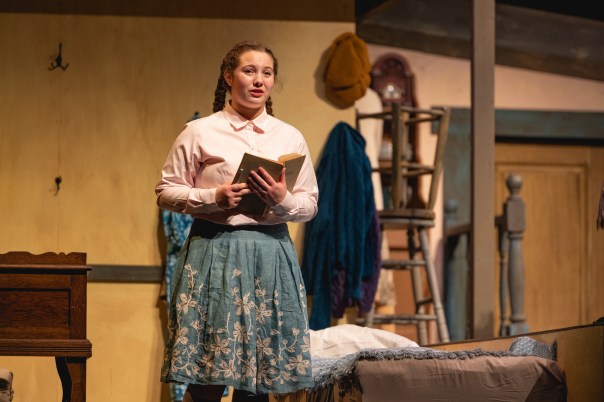
You can sneer and call her the poster child of the Holocaust, or you can marvel at how she continues to be a lightning rod. But 77 years after the last words of her secret diary were written, followed by her death at the Bergen-Belsen concentration camp six months later, nobody can say that Anne Frank has been forgotten – or that she will be in the foreseeable future.
A recent segment on 60 Minutes was devoted to solving the mystery of who betrayed her and her family to the Gestapo in early August 1944 after two years of hiding in the famed “Secret Annex” in Amsterdam. Managing to make even more of an ass of himself than we thought possible, anti-vaxxer Robert F. Kennedy Jr. somehow turned the 13-year-old Dutch immigrant into a talking point, comparing rules enforcing COVID vaccinations to the tyranny of Hitler’s Germany.
“You could cross the Alps to go to Switzerland,” he said of those threatened by the Nazis. “You could hide in an attic, as Anne Frank did.”
Before people had to worry about COVID and those pesky vaccines, the Anne Frank House, where the “Secret Annex” is preserved, attracted well over a million visitors every year.
So with Holocaust survivors thinning out, living memories of the Third Reich growing dim, and misinformation metastasizing, is the time ripe for dusting off and re-examining The Diary of Anne Frank? It has been done before. First published in 1950 and translated into English in 1952, The Diary of a Young Girl premiered on Broadway with its more familiar title in a Pulitzer Prize-winning adaptation by Frances Goodrich and Albert Hackett in 1955. The rebranding stuck after the film, directed on by George Stevens, won the Oscar and Golden Globes for Best Picture in 1960.
All of those originals have been edited, retranslated, or updated – many times, in the case of new graphic novels, children’s book abridgements, TV versions, and movie takes.
But Anne’s text, assembled by Otto Frank from multiple handwritten manuscripts, has only been re-edited a couple of times, once in a critical edition by the Netherlands State Institute for War Documentation in 1989 (revised in 2003), and once revisited by Anne’s father in 1993. The Goodrich-Hackett drama has only been overhauled once, by Wendy Kesselman, in a newly adapted version that opened on Broadway in late 1997.
That’s the version we’re seeing now at Halton Theater in a Central Piedmont Theatre presentation directed by Marilyn Carter. Since 2008, when I reviewed this new adaptation at Theatre Charlotte, it has become the Metrolina standard, with subsequent productions by Matthews Playhouse in 2010 and Davidson Community Players in 2018.
While the Halton isn’t as ideally sized for Anne Frank as Theatre Charlotte or the old Morehead Street location of Children’s Theatre, whose 1996 production remains the Queen City’s gold standard, set designer Robert T. Croghan doesn’t make the mistake of either glamorizing the Annex or expanding it to fill out the capacious stage. Amazingly, the compacted set has four levels without looking at all posh. Yet as we must peer over an unused orchestra pit that becomes a moat between the audience and the stage, our eagerness for a new CP venue, replacing old demolished Pease Auditorium, becomes all the keener.
We won’t have to wait long. They’re promising a spring unveiling.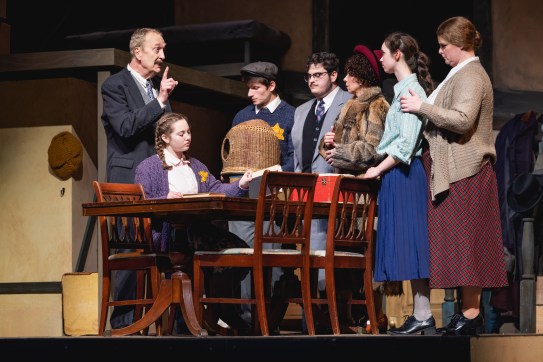
Strikingly fresh and radically different still don’t describe the revamped script, which hit me like it did in 2008 at the Queens Road barn – after previously seeing the original in Charlotte no fewer than three times. Yes, there are substantial differences, some of them welcome improvements and some curiously out of focus if you already know and love the original movie. Some of the signature moments, like Mr. Dussel’s comedy, have dropped out of sight. But the dramatic highlights are pretty much the same as always.
What Kesselman has chiefly refreshed is the Holocaust context, deepening it with more frequent references while providing more extensive portrayals of Dussel, the Franks, and the Van Daans as Jews. Carter has Josh Logsdon as the dentist Dussel wearing a tallis and singing a traditional Hebrew prayer. Subsequently, we get pretty good pronunciation from Hannah Sidranski and Summer Schroter as the Frank sisters when they sing the “Maoz Tsur” after the Chanukah blessing.
The most sensible and gratifying change that Kesselman made was upgrading the presence of Otto Frank, who had become a more renowned public figure during the 42 years following the first Broadway premiere of The Diary. It makes a big difference that he no longer greets us at the beginning, discovering the red plaid diary onstage and ushering us into its imperishable contents. Instead of that prologue, Arthur Lightbody as Otto presides over an epilogue, where he can not only reclaim the abandoned diary but also disclose the fates of all the characters we have come to know over the previous 90+ minutes.
Considering how brutally sudden the Gestapo raid is in this newer script, I’ve found that Otto’s return is oddly helpful in processing the final moments of this little makeshift Jewish community. This is a more spasmodic and sobering narrative, less sensitive and romantic in depicting Anne. Sidranski is more energetic, brainy, and immature as Anne. Words gushed out of her so quickly on opening night that we often had only a vague idea what she was saying. At first, I hoped that Sidranski might soon slow down to evince her maturation during her two years in hiding.
That’s not how Kesselman and Carter seem to be thinking. It’s easier to see moodiness among these families than to see any of them evolving. They’re chafing under the restrictions of their survival mode, that’s for sure, and with the passage of time, we’re getting to know them better – and so are they.
Carter also seems to have spearheaded a rethink on Halton’s chronic audio woes. The setup of mics now dangling down from the flyloft yields far clearer – and continuous – sound amplification than we’ve heard in the past, though differences in levels could be detected, especially upstairs on the set, when actors were more directly under the mics.
Adults in the cast were projecting more consistently than the youths, easier to follow overall. But everyone is believable. Croghan’s costume design is as impeccable as his set, and Carter’s casting is always spot-on. Lightbody radiates a leader’s calm and quiet dignity as Otto, oozing warmth toward the youngsters, especially his favorite Anne, and seeming to take the long view while everyone else is caught up in the moment. By contrast, Rebecca Kirby gives us a sterner portrait of Anne’s mother, Edith, not adjusting well to the protracted confinement and never sunny enough to be called bi-polar.
You may feel otherwise about Poppy Pritchett and her flamboyant turn as Mrs. Van Daan, fetishizing her fur coat, worrying herself over what Anne might be writing about her, and flapping her protective wings around her ravenous husband when she isn’t berating him. On the other hand, Daniel Keith keeps a remarkably even keel in excelling as Mr. Van Daan, Otto’s one-time benefactor, perpetually in quest of respect always winding up as the hydrant of the underdog.
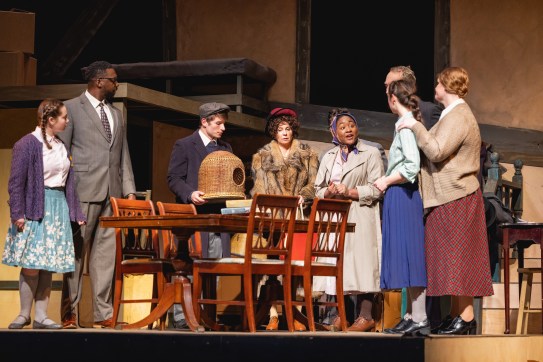 Malychia Abudu-Clark and Zach Humphrey come by infrequently, essential buffers between the Secret Annex and the Gestapo, delivering needed supplies and news from the outside, never staying long enough to remove their outerwear. That would be risky for a Dutch national harboring Jews. They best demonstrate their caring when they urge the Franks and the Van Daans to accept Mr. Dussel into their company – and it is here that Lightbody is most impressive in his authority as Otto in waving aside all objections.
No doubt about it, Logsdon changes the vibe when he enters as Dussel. For the first time in months, the Franks and the Van Daans get the grim news of what’s happening elsewhere in the Jewish community. About the merciless Nazi raids. About the transports. At the same time, he’s disturbing the settled sleeping arrangements of the Franks and, moving in with Anne, disturbing the budding adolescent’s privacy and social life while consigning Margot, the older sister, to bunking with Mom and Dad.
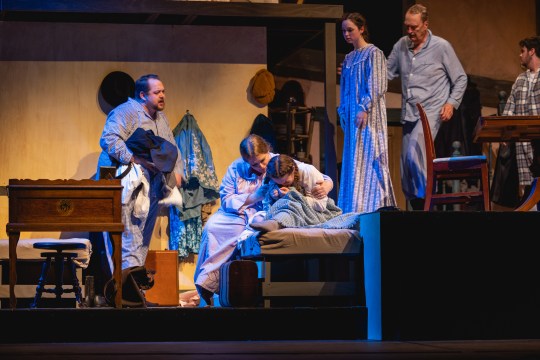 There is friction between the roommates across the generational divide, but Logsdon never shrinks from it, frankly outraged when Anne wakens him suddenly, shrieking from her latest nightmare. Yet he is an elite force, reveling in Dussel’s standing as household cantor and tooth extractor, not quite as unflappable as Otto because he never has to take charge.
Margot is rather bland compared to her little diva sister, so Dussel’s arrival is rather fortunate for Schroter in playing the role, for she can proceed to establish herself as the family’s good sport, accepting her altered sleeping arrangements to start with and Anne’s intimacy with young Peter later on. Better yet, Margot is one of the two young people, along with Michael Swinney as Peter, that Anne can open up to when she’s ready for more mature conversations.
These conversations – less obnoxious, overamped, and impulsive than those she has with her elders – help to calm Sidranski down a bit as Anne and show herself off at her best. Huddled downstairs in Anne’s bedroom instead of upstairs where Peter resides and gets his private moments with our diarist, Schroter has the advantage over Swinney in being closer to the audience and more readily audible.
Of course, we strain harder to hear Peter’s precious conversations with Anne, thinking they will probably be the happiest she ever has.



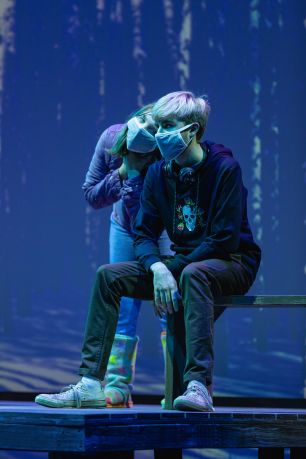
 Can you literally return all the love your boyfriend has given you? In Almost, you can, as Gayle, infused with extravagant irrationality by Hannah Snyder, demonstrates by lugging suitcase after suitcase filled with it into a hapless Lendall’s living room. Responding to Hannah’s imperious demand that he return all her love, Andrew Blackwell as Lendall returns with a wee little red pouch – without faulting his beloved for the disparity. You can’t help feeling for the flummoxed lad.


 Art on My Sleeve