Tag Archives: Stewart Goodyear

“Deadly Sins” Upstage Jazzy Ravel in Fun-Filled CSO Concert

Review: Charlotte Symphony Plays Ravel’s Piano Concerto

By Perry Tannenbaum
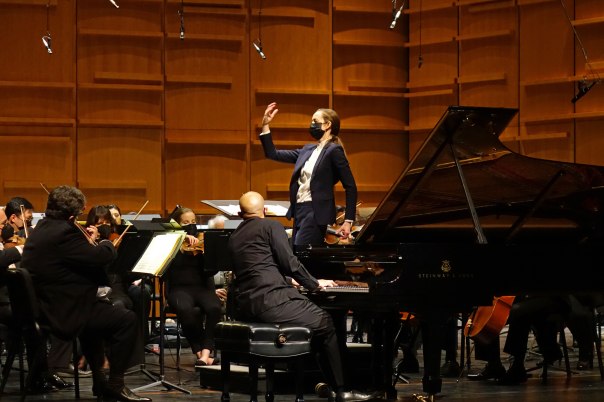
2022~Ravel Piano Concerto-07

January 28, 2022, Charlotte, NC – You could arguably call it a facelift. After Charlotte Symphony’s powerful performance of Mahler’s somber, morbid, mercurial, epic, and sometimes phantasmagorical Ninth Symphony, almost everything seemed changed two weeks later. A new conductor was onstage, Australia-born maestra Jessica Cottis, making her Queen City debut. All six guest artists were making their debuts in Symphony’s Classics Series, and even the site of their musicmaking was different, moving southward from Belk Theater at the Blumenthal PAC to Knight Theater at Levine Avenue of the Arts. Most transformative was the music, a kaleidoscopic multinational program connected by a distinct American thread.

The headliner on the program was Maurice Ravel’s Piano Concerto, last performed by Symphony in 2013 when the wondrous Pascal Rogé made his Belk Theater debut at the keyboard. Jesse Montgomery’s folksy, bluegrass-flavored Strum preceded the main event, when Canadian pianist Stewart Goodyear seated himself at the Steinway. Cottis had plenty more excitement in store for us after intermission, plunging into Igor Stravinsky’s Circus Polka, for a Young Elephant – actually written at choreographer George Balanchine’s request in 1942 for Ringling Brothers Barnum & Bailey’s massive troupe of not-yet-controversial young elephants. Uncannily, another Balanchine commission rounded out the program, Kurt Weill’s The Seven Deadly Sins (1932) with lyrics by Bertold Brecht – obviously written for people rather than pachyderms.2022~Ravel Piano Concerto-36
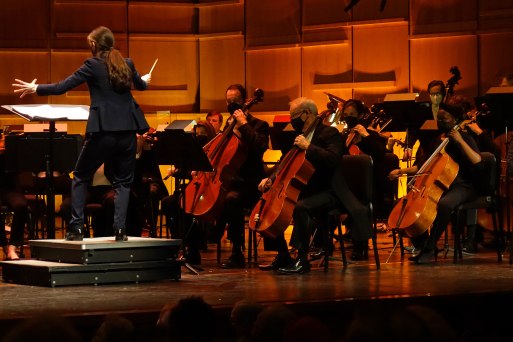
Nearly a year ago, Montgomery’s Starburst aptly keynoted a program that showcased Mozart’s Eine Kleine Nachtmusik (“A Little Night Music”). Longer and decidedly sunnier, Strum set the tone for CSO’s American evening as perfectly as the title readied us for a work written exclusively for strings. Reading Montgomery’s program notes, chronicling the various incarnations of the piece, we get the sense of experiencing its evolution as it unfolds, for it bounces around among three principal string players before beginning its breathtaking ascent to full power and beauty. Laying out the first pizzicatos, violist Benjamin Geller was soon joined by cellist Alan Black, strumming and then bowing. But it was concertmaster Calin Ovidiu Lupanu’s treacherous entrance that truly ignited the fray, triggering Montgomery’s ricochet effects and banjo-like strumming.

Honestly, the performance by CSO became a more massive, lovelier, and less ferocious thing than the studio version by the Catalyst Quartet on Montgomery’s 2015 Strum CD. With a full string orchestra came more majesty when the main melodies were revealed – and extra bite when the piece ended with a collective pizzicato. Nor are “folksy” and “bluegrass” any less flattering in describing Montgomery’s music here than they are in describing many of Aaron Copland’s signature works.2022~Ravel Piano Concerto-01

From the first time I saw him in 2017, playing all of Beethoven’s piano sonatas in a single day at Savannah Music Festival, Goodyear stamped himself in my mind as a prodigious talent. Prior to those three three-hour immersions, Goodyear’s distillation of Tchaikovsky’s The Nutcracker, on his 2015 solo CD, had clued me in. The soloist starts at a disadvantage in the Ravel Piano Concerto, having to follow the famed whipcrack that launches the opening Allegramente. Not to worry, Goodyear showed his mastery of the bluesy and jazzy licks of the movement soon afterwards, and harpist Andrea Mumm Trammell had a lovely interlude.

Inspired by Mozart’s Clarinet Quintet, Ravel’s middle movement drew absolutely mesmerizing lyricism from Goodyear, with English hornist Terry Maskin as stellar behind him as he was for Rogé. Yet everyone on the Knight stage seemed most inspired by the concluding Presto. Goodyear unleashed dazzling intensity and bravura, never easing up on the tempo, and the ensemble didn’t merely keep up: they seemed to be prodding their guest to play faster. Turbulence from the winds, brass, and percussion made the climax even more exhilarating.

Apparently, music for dancing elephant isn’t classified as ballet, since it doesn’t appear on The Robert Craft Edition of The Ballets on the notoriously completist Naxos label. Yet Stravinsky never disavowed his Balanchine bagatelle, conducting “Circus Polka” among his voluminous recordings of his own works, where it clocked in at a modest 3:27 on Columbia. Why this rambunctious crowdpleaser isn’t played more often as a concert appetizer is beyond me. While Cottis and the Symphony may have been a tad helter-skelter where Ravel called for more élan, they were marvelously attuned to Igor’s riotous absurdities, his brassy bombast, and the celebratory glee of his wild, galumphing jamboree. It seemed to start in mid-parade before the dainty spots hilariously evoked the pachyderm pixies.2022~Ravel Piano Concerto-31

The zaniness had hardly begun. Bass-baritone Reginald Powell, dressed in a flowery kitchen apron in order to portray the mother of our tempted/temptress heroine, led a barbershop quartet across the stage, sitting down at the end of their march behind a bank of microphones. Strange accessories for a classical concert. So Seven Deadly Sins was classical with a three-penny Kurt Weill twist. Nor was this an opera, though a cabaret table and some props were set in place before our chanteuse, soprano Lindsay Kesselman as Anna I + II, made her/their noire-ish entrance in a spymaster trench coat.2022~Ravel Piano Concerto-37

More than a hint of decadent vaudeville came with her, since each of the nine sections of Weill’s confection was heralded by an old-timey placard placed onto an easel. Prologue, Epilogue, Greed, and the gang were all embroidered with an apt skull-and-crossbones motif. Sad to say, much of this flavorful creativity was outweighed by Charlotte Symphony’s failure to provide supertitle projections once Anna I + II began vocalizing with her/their Family. A few audience members down with us in the orchestra section had the temerity to fire up their cellphones, where they had previously downloaded Symphony’s digital program, so they could follow along.

Not the best experience when you’re trying to keep up with columns of German and English on your iPhone while there is also action onstage to follow. The magnitude of this blunder would only be compounded if you returned home, flipped through the digital program, and discovered that the translation was written by life partners W.H. Auden & Chester Kallman, esteemed poets and librettists in their own rights – they worked on Stravinsky operas! Not only does their Deadly Sins translation rhyme, the syllable counts of every line meticulously match Brecht’s text. Learning that all five vocalists had North Carolina roots – and afterwards listening on Spotify to a recording with the Auden-Kallman lyrics – only deepened my incredulity.

Everyone at Knight Theater, singers and audience alike, could have been so comfortable, and all Brecht’s wit, irony, and satire could have been so clear!

Stepping up to one of mics, Cottis was helpful in her introductory remarks in laying out Brecht’s storyline, which is basically Anna’s odyssey across seven American cities on a mission to sustain her family back home in Louisiana, encountering one of the deadlies in each locale. Ideally, the Balanchine concept is fulfilled when Anna I is the soprano and Anna II is a sublime dancer. Part of the comedy that got lost when Kesselman was both Annas was in the lopsidedness of the dialogue between them. Anna II has very little to say.2022~Ravel Piano Concerto-28
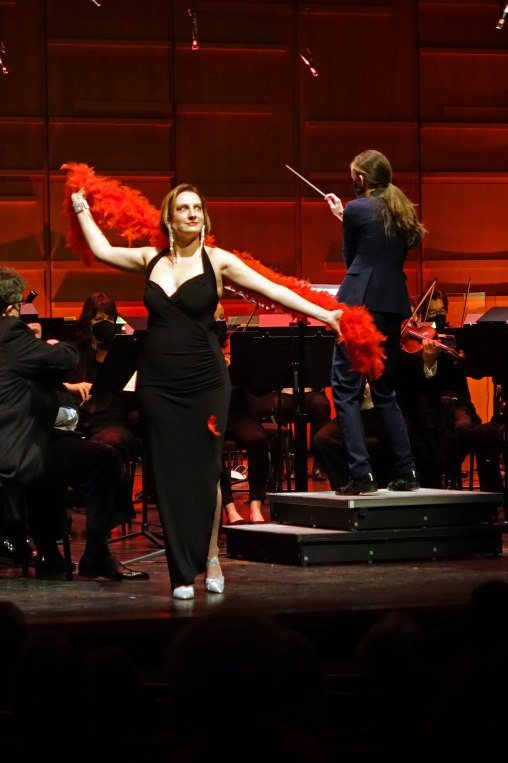
The staging helped this decadent Weill bauble to upstage Ravel’s merriment – or at least prevented it from being an anticlimax. Kesselman soon peeled off her trench coat, revealing an evening dress as the Family’s Sloth along the Mississippi River transitioned to Pride as Anna II took a job in Memphis as a cabaret dancer. Anna added a flaming red boa encountering Wrath in LA, and an uncredited lighting designer made a similarly lurid choice illuminating the Knight’s acoustic shell. Purple became apropos for Gluttony in Philly, a lighter pinkish red presided over Lust in Boston, and a dark golden hue settled in over Baltimore when she battled Greed. So I had to think that nobody wanted to offend New York during the Great Depression.

Need we say that when Anna’s journeying ended with Envy in San Fran, where Kesselman made her final grand entrance as a rich celeb, totally soused and brandishing a nearly empty bottle of vodka, that the stage was flooded in a deep dark green? Didn’t think so.

A wonderful ending to a melodious, fun-filled, and dance-filled evening. Even without dancers. Facelift and uplift.

Originally published on 1/30 at CVNC.org

Hope Prevails With Quatuor Ébène at Savannah

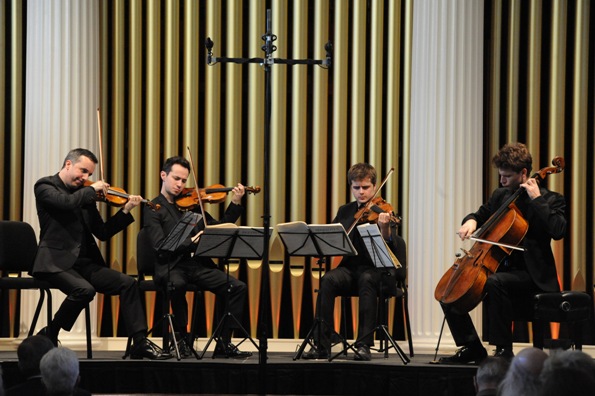
Ébène and Daniel Hope at Savanah Music Festival

By Perry Tannenbaum

Celebrated for their recordings of Fauré, Debussy, and Ravel, the Quatuor Ébène have shown themselves to be equally comfortable in repertoire by Haydn, Mozart, Bartók, the Mendelssohn siblings, Jobim, Piazzola, Sting, and Erroll Garner. The string quartet is currently touring the US with new infusions of Beethoven, culminating with an all-Beethoven program at Carnegie Hall on March 31 and a Beethoven-Debussy mix at the Kimmel Center six nights later.

Yet Savannah Music Festival artistic director Rob Gibson and violin colossus Daniel Hope, the festival’s associate artistic director for classical programming, could legitimately claim a coup for the Ébène’s return to Savannah, where they had played an all-French program in 2011. Wowed by their performance of the Ravel, Hope had prevailed upon the quartet to join him and pianist Simon Crawford-Phillips in Ernest Chausson’s Concert in D Major for Violin, Piano and String Quartet.

Prior to intermission, the program foreshadowed what New Yorkers will hear on Friday at Carnegie: the String Quartet in B-flat, Opus 18, No. 6, followed by the String Quartet No. 11 in F Minor, Opus 95, “Serioso.” Based on the performances we heard down in Savannah, New York concertgoers need only fear that what follows after intermission might be anticlimactic.

Having listened to the great recorded Beethoven traversals of the past by the Takács, Tokyo, Guarneri, Juilliard, Italiano, Alban Berg, and Budapest quartets, I still found the live performances by the Quatuor Ébène at Trinity United Methodist Church astonishing. Part of the wonder, no doubt, was the church’s acoustics, even friendlier to strings than to either vocal or keyboard performances – though I’ve never heard its gilded organ pipes in action.

More decisive were the ensemble’s creamy approach to the harmonized sections of the score, the conversational interplay of the musicians, and the sheer excellence of first violinist Pierre Colombet. Of the recent surveys I’ve listened to, only the Belcea Quartet comes close in their recording of the B-flat Quartet No. 6 to matching the relish that Ébène took in the harmonious ritardandos of the opening Allegro con brio movement, which usually sound like lulls between the fireworks. That same attention to detail was also evident within those fireworks as the quartet zestfully leapt upon the opening exposition, varying tempos and dynamics with restless precision.

What surprised me most, from musicians making their first forays into Beethoven’s quartets, was the liveliness of their interplay. Adrien Boisseau sounded buoyant when he peeped in on viola, and the dialogue between Colombet and cellist Raphaël Merlin was even richer, the first responses by the cello playful and the last answer delivered with abrupt, prankish ferocity. Colombet’s artistry was more exquisite in the ensuing Adagio, as he floated lyrically above the soft accompanying trio before gracefully landing with a couple of delicate pizzicato chords.

In the bubbly Scherzo, Colombet and second violinist Gabriel La Magadure drove the music, darting around unpredictably while the lower strings were restrained. Any worries that the Ébènes might not be up to the demands of heavier Beethoven were largely dispelled in the “Malinconia” section of the final movement. Slow, and darkly harmonized, Merlin’s cello was especially morose as the instrumental lines diverged, until Colombet ignited a quicker, folksier tempo.

While no one questions the position of Quartet No. 6 as the last of Beethoven’s early Opus 18 period, offering tantalizing hints of the more turbulent middle period ahead, the No. 11 “Serioso” seems to lie slightly on the cusp. Nearly all quartets group the F Minor Opus 95 with their Rasumovsky and “Harp” recordings from the middle period, but a few let it lead off their compilations of the Late Quartets.

With the onset of the opening Allegro con brio, the Quatuor Ébène emphatically let us know, in a stunning wave of collective turbulence, that their most intense ferocity and flame throwing still lay ahead. Not immediately, of course, for middle Beethoven is ever mercurial, and we’re never sure if he’s wickedly mischievous with his surprises or divinely deranged. The opening storm soon gives way to reflective unrest, enabling a second onrushing wave to be more ferocious – cycling back and forth to a quiescent close.

Quiet returned throughout mournful Allegretto, beginning with Merlin’s lachrymose intro on cello, transitioning to a fugal section launched by Boisseau’s viola, and growing exquisitely slow and eerie with Colombet softly ascending the treble. Now came the time for peak ferocity, a final fury somehow kept in reserve, as we moved without pausing into the signature Allegro assai vivace ma serioso movement.

Diabolically, the pause missing at the start of this movement gets transferred to the middle – more than once after comparative lulls. Even when I knew another sforzando was coming after the second pause, it came with a jolt. Lacking the same fury as the Serioso movement, the concluding Larghett0-Allegretto might have been sorely anticlimactic if it weren’t so melodious and joyful, the contagious tune handed to each of the musicians as part of the jocund farewell.

It isn’t the last we’ll be hearing of Beethoven’s music at the Savannah Music Festival this year. The special Ébène event came between two “Beethoven and Beyond” concerts fronted by violinists Hope and Benny Kim with pianists Crawford-Phillips and Sebastian Knauer, backed by a quartet festival regulars. Each of those concerts had a Beethoven piece paired with works by his musical contemporaries or descendants – before and after intermission. My deadline for this review strikes in the middle of another mammoth Beethoven event, Stewart Goodyear’s three-concert “Sonatathon,” presenting all 32 piano sonatas in a single morning, afternoon, and evening.

A kind of closure with Beethoven will happen this Saturday when the Dover Quartet follows the latest of Mozart’s “Prussian” quartets with two late Beethovens, No. 13 in B-flat and the Grosse Fuge. Cellist David Finckel and pianist Wu Han add a charming coda next week when they perform the 12 Variations on Handel’s “See the Conqu’ring Hero” in the middle of a program that includes pieces by Bach, Shostakovich, and Rachmaninov.

Amid a 17-day festival that also embraces jazz, blues, bluegrass, country, pop, and world music, the aforementioned are barely half of the classical offerings. Tops among other headliners include pianists Jan Lisiecki and Knauer, violist Lawrence Power, and the Atlanta Symphony under the direction of Robert Spano, presenting an all-Rachmaninov program with Stephen Hough playing the Piano Concerto No. 1.

All of these will struggle to eclipse the éclat of Hope, Crawford-Phillips, and the Quatuor Ébène in Chausson’s Concert in D. After three harsh opening chords from Crawford-Phillips, the quartet’s entry was happily ominous, still restless when the piano part suddenly became rhapsodic. Hope soared above this conflict, and while the quartet – individually and collectively – continued to make telling contributions, it was Hope and Crawford-Phillips, playing off each other, who built to a climax of resounding joy, ecstatic joy, yearning joy, fulfilled joy, and purely sweet joy. That was merely the epic Décidé, Animé movement, with three more to come.

In the splendor that followed, the Quatuor Ébène ran the gamut from orchestral might to mute passivity. These extremes were crystalized in the final Très animé. After some galvanic fireworks from the keyboard, the sliding ensemble work with looping crescendos and decrescendos made me think that Chausson could have easily added a extra o to his title, for here his Concert seemed to have the fullness of a piano concerto. Moments later, the quartet wasn’t playing at all during an extended episode that was a fiery Hope/Crawford-Phillips violin sonata. None of the Quatuor members bothered to hide their frank awe of the violinist standing before them.

Joining in after this violin sonata eruption, the quartet played with a richness that made me wish to hear them taking on Dvořák’s quartets. Then a pizzicato shower as Hope and Crawford-Phillips crested to peak intensity again. No, there was one more detonation from the keyboard – and yet another before the final satisfying chords.

Thrilling was almost an adequate description of the first Chausson Concert that I heard at Spoleto Festival in 2002 and two others that followed, most notably with Chee-Yun and Anne-Marie McDermott in 2009. With Quatuor Ébène behind them, Hope and Crawford-Phillips set the bar even higher.

Last night at “Beethoven and Beyond, Part II,” Hope and Crawford-Phillips came perilously close to topping themselves – with Keith Robinson playing cello – in Shostakovich’s harrowing Piano Concerto No. 2. Prior to the concert, Gibson revealed that the festival’s 2018 slate had been set. He divulged only two tantalizing bookings: Pinchas Zukerman is on the guest list, and (after taking over the reins of leadership from Sir Roger Norrington) Daniel Hope is bringing the Zurich Chamber Orchestra to Savannah.

Everything I’ve heard at Savannah Music Festival this year has been encouraging, especially the music. That’s why I’m filing this review early and making sure I don’t miss a note of Goodyear’s “Sonatathon.”