Review: A Small and Humble Erasure at Davidson Community Players
By Perry Tannenbaum

As playwright Tracy Letts knows well, there are unpleasant truths at the heart of American life and the American Dream. “Sometime tonight, when the temperature of your home drops to a specific mark and you hear the heater come on because that’s what you’ve programmed it to do, remember that you live in a cocoon of comfort and safety because a lot of people who came before you weren’t afraid to get their hands dirty.”
Those clear-eyed, merciless words were delivered by the Mayor Superba of Big Cherry at the climax of The Minutes, Letts’ unexpectedly savage and sensational 2017 drama. The Metrolina premiere was presented last month at the Armour Street Theatre as Volume 1 of Davidson Community Players’ Sacred Places project. With a no less of an innocuous title, the world premiere of Stephanie Gardner’s A Small and Humble Erasure is completing DCP’s project – with a sacred place that hits closer to home.
Gardner has actually customized her script for Armour Street and for the members of the cast, directed by Michelle Medina Villalon. While Letts located his drama at a fictitious City Hall built on the blood of slaughtered Native Americans, Gardner’s piece reminds us that Theatre Charlotte is built on more sacred ground, over a cemetery consecrated for African American slaves.

And she tells us, naming names, just how this cemetery was “deconsecrated” and who was responsible. Mayor Ben Douglas and numerous councilmen are in the room where it happened, all of them white men from respected Charlotte families: Baxter, Hovis, Albea, and Wilkinson – with mischievous colorblind and gender-blind inroads in Villalon’s casting. Starting with the famed Mayor whose name is perpetuated on the QC’s international airport.
A future councilman, attorney John Small, introduces the motion at a City Council meeting in 1936, nine years after Theatre Charlotte had been founded as the Charlotte Drama League and five years before the Old Queens Road Barn celebrated its housewarming. By this time, Tom Humble had settled into his role as Little Theatre of Charlotte’s artistic director.
So the workings of this Small & Humble alliance give Gardner’s title a clever double entendre. Humble, at least, is haunted by the fact that his new fixture in Charlotte’s cultural life was built on the backs and graves of Southern slaves. Big Cherry, on the other hand, leans into their past desecrations after the truth is painstakingly revealed to them by a rogue councilman. Their actions are sensationally horrifying, while Gardner’s white folk are more decorously rueful.
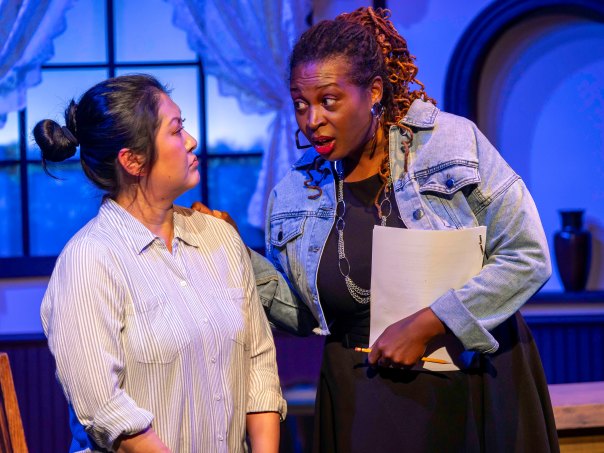
Of course, there’s considerable satirical bite to Gardner’s concept, above and beyond the casting vengeance she takes on all the benign and virulent segregationists who are culpable for this sacrilege. An African American, Andrew C. Roberts, portrays both Mayor Douglas and plutocrat Harold Dwelle, and Amy Wada, an Asian American, is our narrator!
She brings us into the Myers Park homes of these benefactors, the Dwelles and the Myerses themselves, delving into the petty maneuverings of their estates. These include the hallowed cemetery and the adjoining Cherry neighborhood. Yes, DCP executive director Steve Kaliski & Co. could have easily called their pairing “The Cherry Project.” Interestingly enough, both Cherrys have insulting and racist slurs associated with their names as well as complicit Mayors in their dramas.
Making Amy Wada our personable and slightly stressed narrator is obviously an entertaining choice. But I’m not always aboard with the idea of actors behind her frequently breaking character and interrupting her – perforating and undermining the seriousness of her narrative, threatening to trivialize the history.
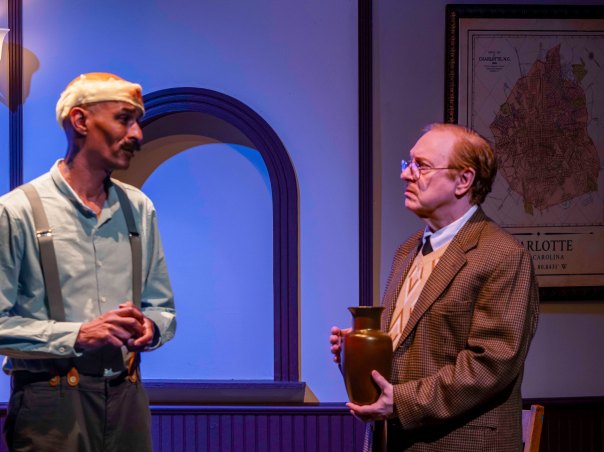
Getting Hank West, indisputably one of Charlotte’s best, to play Tom Humble is a similarly two-edged sword. Villalon and Gardner must have been sure that West gave the best audition, and he impeccably balances the Indiana native’s haughty elitism, his ambitions for the Queen Road Barn, and his conscience. But for those of us who have seen West’s work over the last four decades, it’s a bit of a hurdle disliking his Humble in the artist’s worst moments.
Clean-cut with mature Everyman looks, Mark Ariail is a fine complement to West as the conniving Small, the lubricant that connects Humble and Myers Park to the Charlotte City Council. We have a hard time labeling him as evil despite the obvious earmarks. Little Theatre was little, after all, and Queens Road was the closest the fledgling company could hope to get to the QC’s high-priced Uptown real estate.

Gardner seems willing to allow that the upstanding Charlotte citizens of the 1930s were shaped by their times and less eager than Letts to condemn and ridicule them for their actions and customs. But she does provide a second backdrop to the unfolding Small & Humble “erasure”: black folk who set the plutocrats’ tables and black folk who were buried beneath them.
Roberts is neither of these, but he’s useful in Gardner’s concept beyond his key roles as Dwelle and Mayor Douglas. He’s also “new” to the cast, so Wada can be explaining the history – and the colorblind casting – to him as well as us. Lowell Lark, when he removes the enslaved Harvey Foster’s bloody bandage from his head, becomes a somewhat comical Councilman Baxter when the Theatre Charlotte ordinance is passed, returning years and years later to haunt Humble and become part of Queens Road lore. When that happens, it no longer seems amiss that he doesn’t strictly conform with Gardner’s description of him as a 17-year-old when he died.
Myneesha King as Johnsie Foster, the Dwelle family housemaid, gets to be a sometimes-acerbic conscience for the great white benefactors of Myers Park – and she’s pretty sassy toward Amy, so it isn’t a demeaning role. King is also significant the living descendant of the buried and betrayed slave population distilled into the voice and wounded image of Harvey Foster.

Briefly, King can relish returning as Barbara Burke, the first African American to appear in a Little Theatre production in 1970. It’s Wada, though, who points out that this was three years after Humble retired. Then we hear the vanilla quote in our newspaper’s coverage straight from King’s lips: “If the whole world would say people are people and not what color you are, it would be a wonderful place.”
We do get along here in Charlotte, don’t we? Ironically enough, Gardner reminds us that the first play produced at the new Little Theatre, once the gravestones were cleared away, was Moss Hart & George S. Kaufman’s George Washington Slept Here. Talk about a whitewash!
The white women of Myers Park, bless their hearts, are at least ambivalent about what’s going on over at the top of Queens Road. Pam Coble Newcomer as family matriarch Mary Rawlinson Myers insists that the Negro Cemetery should belong to the Cherry community in perpetuity, but has neglected to ensure that her wishes are legally airtight.

Along with King as Johnsie, we empathize with Mary the most, especially since she’s confined to her deathbed. Newcomer is liberated from her bedclothes for two comical turns, becoming Councilman Albea and Little Theatre actor Jack Knell. Jack’s wife, Dorothy Knell, is also in the cast of the first show presented at the new theater in 1941, so Cat Rutledge completes the amusing little gender-blind episode.
Rutledge, like Newcomer, also gets to have fun at City Hall as Councilman Wilkinson, one of our proud city’s banking visionaries. (Is the notorious boulevard named after him? Yup.) She also comes out as perhaps the meanest meanie onstage at Armour Street, jousting with both Mary and Johnsie as Mary Myers Dwelle – or Mary II – as she helps push the Little Theatre initiative through City Council.
Perhaps because she also pushed through the first art museum in the state, The Mint, Myers’ aristocratic daughter is allowed to luxuriate in regrets similar to Humble’s. Aw, cut them some slack, Gardner seems to say. Better to simply mention The Mint, IMHO.
Volume 2 isn’t speckled with shameful or diabolical celebrations like The Minutes, last month’s Volume 1. Nor does it chill us like Mayor Superba’s cynical admonition, cited above. The best Humble can do is “I don’t know how to fix it.” Honest enough. Mary Dwelle is more pragmatic and resolute, asking us “Why should we have to leave town for our culture? We’ll build it here!”
Ninety years later, the QC is teeming with theatre artists who believe Charlotte shouldn’t be the largest city in the country without a regional professional company. They’re still waiting for that same Myers Park/Banktown resolve to lead somewhere.
Maybe Roberts, the newbie to A Small and Humble Erasure, has drawn Gardner’s most devastating line. “Excuse me,” he asks Amy, “am I playing a white guy??”
His disdain and disgust speak volumes.
Needless to say, it was a bit awkward to be driving back home on I-77 through Charlotte after this bold show in Davidson. If DCP’s collaborator, Anne Lambert & Charlotte’s Off-Broadway, could contrive to bring Small and Humble to this side of Lake Norman, it might find a bigger audience at the right place. With the potential of reaching the right audience and getting the right proactive reaction. I’d suggest a peppier title, like The Small & Humble Desecration, when that happens.
Davidson Community Players now performs at three different venues, adding Davidson College and the Cain Center in Cornelius to their portfolio over the years. What do you have, Charlotte?
It’s like this on the QC’s pitiful theatre landscape: Since DCP’s Sacred Places began last month, two modest professional productions have opened in the QC, by CAST and Charlotte Conservatory Theatre – both of them at The Mint Museum. Yeah, that’s how much local theatre building we’ve done in the last 90 years.


 Art on My Sleeve