Tag Archives: Sequina DuBose

Master Chorale Excites and Excels With Superior Renditions of Dett & Bernstein

Review: Dett & Bernstein at the Cain and Gambrell Centers

By Perry Tannenbaum

September 28 and 30, 2023, Cornelius and Charlotte, NC – Historically, a collaboration between Charlotte Symphony and the Charlotte Master Chorale is far from a groundbreaking event, since the two organizations had been joined for a while before breaking apart when Symphony absorbed the original Oratorio Singers of Charlotte after many years of proud collaboration. But when the rebranded Master Chorale not only partners with Symphony but also with two additional choirs, the Queens University Chamber Singers and The University Chorale of UNC Charlotte, something special must be brewing. Bring in five guest solo vocalists and expectations rise to Mahlerian proportions. That wasn’t the kind of extravaganza that the longtime collaborators had in mind, however, when they conceived their Dett & Bernstein program and reached out so dramatically.

Less intimidating, the event at Gambrell Center, on the Queens University campus, was a welcoming epic of diversity and inclusivity. For all the ensembles never gathered grandly together in symphony-of-a-thousand fashion. R. Nathaniel Dett rightfully headlined the bill, for The Ordering of Moses (1937) is more than double the length of Leonard Bernstein’s Chichester Psalms (1965) and armed with more vocal soloists and instrumental artillery. In something of a tune-up for the Gambrell event, the Master Chorale and Symphony had performed both of the headliner pieces at the new Cain Center in Cornelius two nights earlier. Neither of the University ensembles made the trip up I-77 to Cornelius, but tenor Jason Dungee, who would sing the title role in Dett’s oratorio, is also director of UNCC Chorale, so a couple of his prize students mysteriously appeared as two of the four adult solo singers in Chichester Psalms, obviously smuggled onto the tour bus.

Losing out on seeing the full University choirs, missing the opportunity to hear the gems by Adolphus Hailstork and Margaret Bonds that kicked off the Saturday program at Gambrell, the Cain Center still had the honor of hosting the North Carolina premiere of The Ordering of Moses. Commissioned by the May Festival Chorus, who premiered the piece in Cincinnati, the piece triumphed in front of the festival audience, but its live national NBC radio broadcast was abruptly snatched from the airwaves about 40 minutes into the performance, clearly a craven cave-in to a few racist listeners. Righting this wrong, if not the subsequent neglect of Dett’s oratorio, Moses was revived by the Cincinnati May Festival in 2014 and given a Carnegie Hall premiere a few days afterward – adorned with a live broadcast by WQXR that was not aborted.

As the Bridge recording of that concert demonstrated, the revival conducted by James Conlon was well-deserved. Hearing the live performance with Chorale artistic director Kenney Potter conducting the Charlotte Symphony was a very different experience from the sonorous broadcast version on the Bridge label, longtime champions of American composers. From the start, the work of Symphony’s assistant principal cellist Allison Drenkow stood out more boldly in relief, yielding a better grasp of how Dett structured his piece, for there are cello solos strewn throughout the piece, acting as friendly bookmarks, that she gorgeously performed with gossamer tone. Nor were the vocal soloists less than the equals of their Carnegie Hall counterparts, mezzo Sarah Brauer bringing wondrous elan to The Voice of Israel, soprano Anne O’Byrne fortifying Miriam in her biblical song and in duets with brother Moses with her fervor, and bass-baritone Marques Jerrell Ruff thundering The Word and afterward The Voice of God – with rumbling timpani quaking the earth around him.

In his introductory remarks during a pre-show segment, Dr. Marques L.A. Garrett had us looking out for the core of Dett’s music, the two themes of “Go Down, Moses.” The famous refrain theme peeps in behind a veil of different melodies, most notably the keening “When Israel was in Egypt land” theme before the full chorus breaks forth – after a vocal trio from Brauer, O’Byrne, and Ruff followed by a swirl of cellos and a bassoon – with the fortissimo command, further developed with fugal filigree. Yes, Ruff’s Voice of God is a tough act to follow, but who knew that Dungee, rising from his seat with the aid of a cane, had such a piercing, rafter-cracking tenor voice to answer the Almighty’s call? The dialogue between God and Moses was a thrilling highlight, enough for me to justify attending the second North Carolina performance as well as the first.

Fresh rewards awaited me at the Gambrell that lived up to my expectations. The Master Chorale is a large chorus, too large to share the Cain Center stage with Symphony, so they doubly split on both sides of the audience on two levels of the building. Gambrell Center has a more commodious hall and stage, but only one side level for deploying the choristers, so the Master Chorale waited to make their appearance while the two University choirs gathered on opposite sides of the audience, spilling onto short flights of stairs the led up from the orchestra to the sloped exit aisles. To our right, Dundee led the UNC Charlotte ensemble in two songs by Hailstork (b. 1941). Crucifixion or not, “My Lord, What a Moanin’” had a grace and energy worthy of a program finale or an encore. The hushed and reverent “Blessed Is the Man” was written as a gift specially for Dungee, who chose Hailstork as the subject of his doctoral dissertation, and the tenor’s fondness for the piece suffused his choir’s performance.
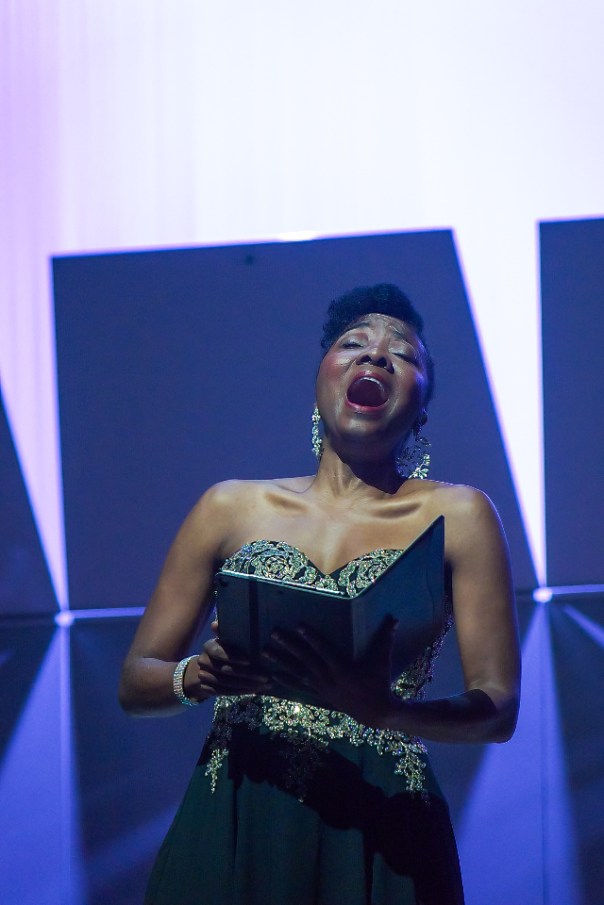
Not to be outdone by her UNC Charlotte colleague, soprano Sequina DuBose has had a song cycle written by Maria Thompson Corley for her recent Blurred Lines: 21st Century Hybrid Vocal Works recording on the Albany label, reviewed at this site earlier this year. You could say she crossed the line when she appeared as a guest soloist with the Queens U Chamber Singers in excerpts from Credo by Margaret Bonds (1913-1972) – if there were a rivalry between the two schools rather than hospitality and fellowship. Set to a prose poem by W. E. B. Du Bois, the posthumous Credo was premiered by Zubin Mehta and the LA Symphony shortly after Bonds’ death but not recorded until earlier this year on a magnificent Avie Records release by the Dessoff Choirs and Orchestra.

Presented at Gambrell with a spare piano accompaniment, the performance was admirable for its promptness, but it gave only a hint of the work’s full grandeur when heard unabridged with a full orchestra behind it. At Gambrell, pianist Brenda Fernandez provided all the accompaniment. The complete work, now that it has conquered with a brief foretaste, should be on top of Charlotte Symphony’s short list of new and newly-discovered pieces to be programmed at their Uptown venues.

Nor was DuBose to be outdone in her rendition of the second song in the six-song suite, “Especially Do I Believe in the Negro Race.” If you’ve heard her luminous performance of “Summertime” in two extended runs of Porgy and Bess in Charlotte, most recently with Opera Carolina back in January, or her Elvira in Don Giovanni, you won’t be surprised to learn that the smoothness of her tone and the clarity of her diction far eclipse what you might hear on Spotify in the world premiere recording.

Recordings do have an influence on repertoire selection, which may be why I’ve never heard Charlotte Symphony perform Chichester Psalms before – and why I haven’t heard a performance of Bernstein’s paean to peace in the Queen City since 2009, when Carolina Voices’ Festival Singers brought a slimmed-down version of the work to Temple Beth El for a Yom HaShoah commemoration, accompanied by piano, percussion, and harp. Marin Alsop’s version of the work on Naxos with the Bournemouth Symphony and Chorus is only slightly less wretched than Bernstein’s own version on DGG with the Israel Philharmonic and the Vienna Boys Choir.

Both of their engineering teams failed them miserably in the pivotal middle movement, where Bernstein juxtaposes the incandescent Psalm 23, “The Lord Is My Shepherd,” sung by a boy soprano, with the angry Psalm 2, sung by the Master Chorale in a sudden crescendo. The Hebrew text is probably most familiar to us via the powerful aria in Handel’s Messiah,“Why do the nations rage so furiously together, and why do the people imagine a vain thing?”

To replicate the dynamic range so easily rendered at the Cain and Gambrell Centers, you’ll need to turn your volume knob to the one or two o’clock position to make out the boy soprano faintly in the outer sections of this movement – and hurriedly turn back to the 11 o’clock position for the midsection to avoid waking your wife and neighbors when the full chorus unleashes their fury. Even sitting at the front end of these halls, I never felt assaulted by the fortissimos: acoustic balances and clarity were always tight. It was a joy to hear Calvin Potter singing the soprano part so clearly, stealing nervous glances at his dad on the podium as he awaited his cues. The boy was nearly perfection on the Hebrew until his unfortunate gaffe in the final line, mispronouncing the penultimate word at both performances.

Immediate consolation gushed forth after the Potter lad departed, for the final Chichester section, set to the warm and placid Psalm 131 with a sprinkling of 133, is preceded by a gorgeous orchestral lament that brought out Symphony’s best playing of the night. The transition between these last two Psalms was also treasurable, a lovely cello quartet. A wonderful vocal quartet – including those two UNC Charlotte imports – led into the final sublime fadeout, dominated by the women’s treble. Again: the last minute of Chichester Psalms was divine in live performance, but turn your hi-fi volume past 12 o’clock at home.

Opera Carolina’s “Porgy and Bess” Remains True to Gershwin and Heyward

Review: Porgy and Bess at Belk Theater

 By Perry Tannenbaum

2023~Porgy & Bess-27

January 22, 2023, Charlotte, NC – Curiously enough, Opera Carolina didn’t get around to producing the Gershwin Brothers’ Porgy and Bess – an opera incomparably suffused with the sounds, scents, and DNA of the Carolinas – until its 33rd season in 1980. Turns out that was somewhat bolder than Spoleto Festival USA, which waited until its 40th anniversary in 2016 to bring this opera to Charleston, where the story is set, and where its creator/librettist DuBose Heyward was born. It can be argued that the snooty world of opera recordings was even more hesitant to acknowledge this American classic, issuing the first full-length CD edition in 1976, a full 41 years after the Boston and Broadway premieres.

Hesitancy has lingered a little at Opera Carolina, which brought back new homegrown productions of Porgy and Bess to Belk Theater in 1995 and 2003, but no others until now. OpCarolina did bring us a touring version in 2010, commemorating the 75th anniversary of the Broadway premiere, but that fiasco is best forgotten. A couple more touring versions have come our way over the past quarter century. The best of these was at the Belk in 2014, the touring version of the slimmed-down 2012 Broadway revival that had starred Audra McDonald and Norm Lewis (who just happened to be performing in the touring version of A Soldier’s Play as it finished up its two-week Charlotte run down the block at Knight Theater).

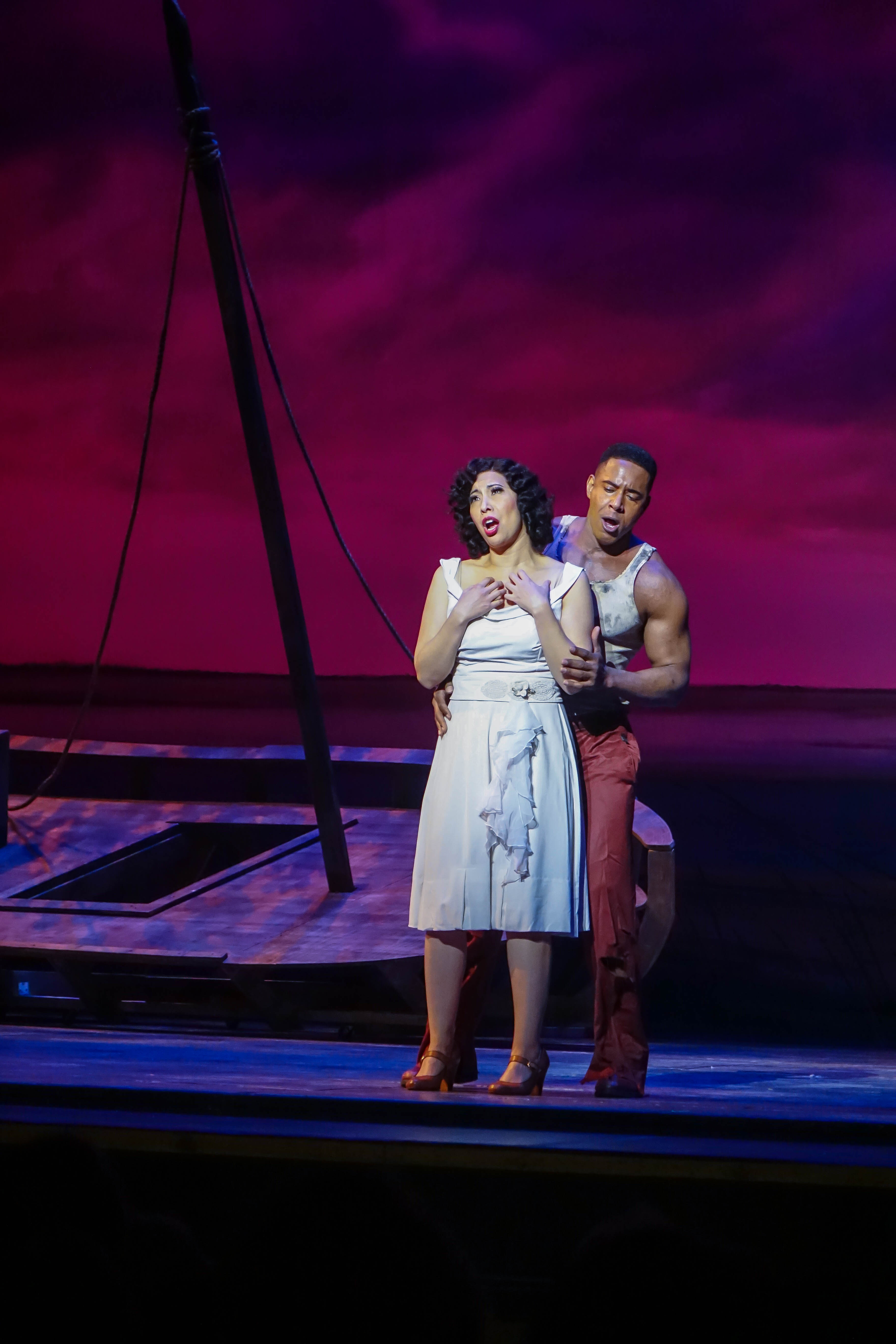
In comparison to that estimable touring treat, the new Opera Carolina production conducted by artistic director James Meena did not need to blush. At the Sunday matinee premiere, Sequina DuBose reprised her role of Clara from the Broadway tour while Nicole Cabell, featured as Clara – who sings the incandescent “Summertime” – on Decca’s landmark 2006 recording of the original 1935 Broadway score, made her Charlotte debut as Bess. Kenneth Overton, who was billed as the star of that infamous 75th-anniversary tour, was replaced by a fifth-string singer at Ovens Auditorium whose name could not be determined until five days later, finally got his chance to impress as Porgy. No less prestigious, Victor Ryan Robertson gave us a taste of what made the ornate Spoleto production so splendid by reprising his slickster grace as Sportin’ Life.

2023~Porgy & Bess-03

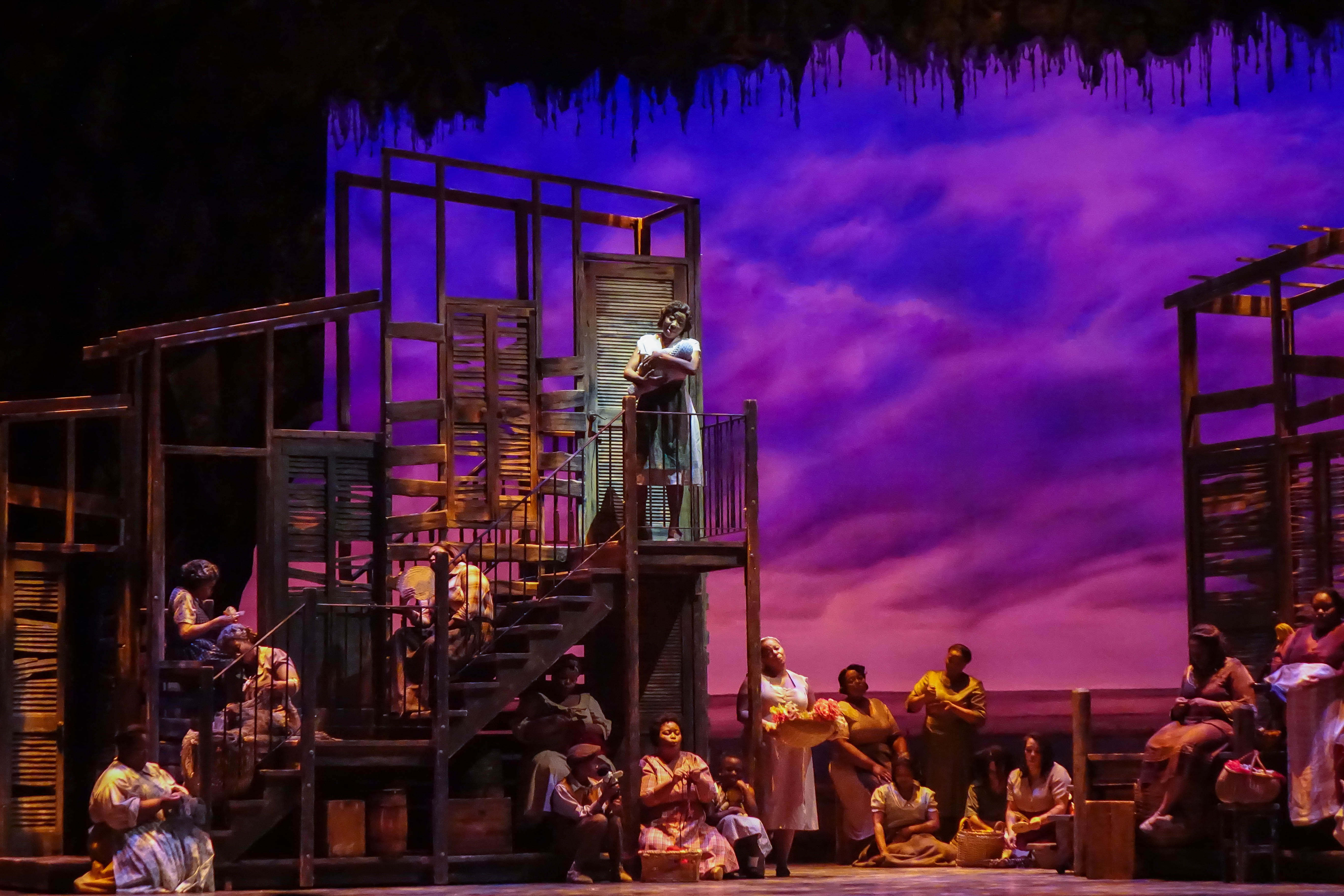
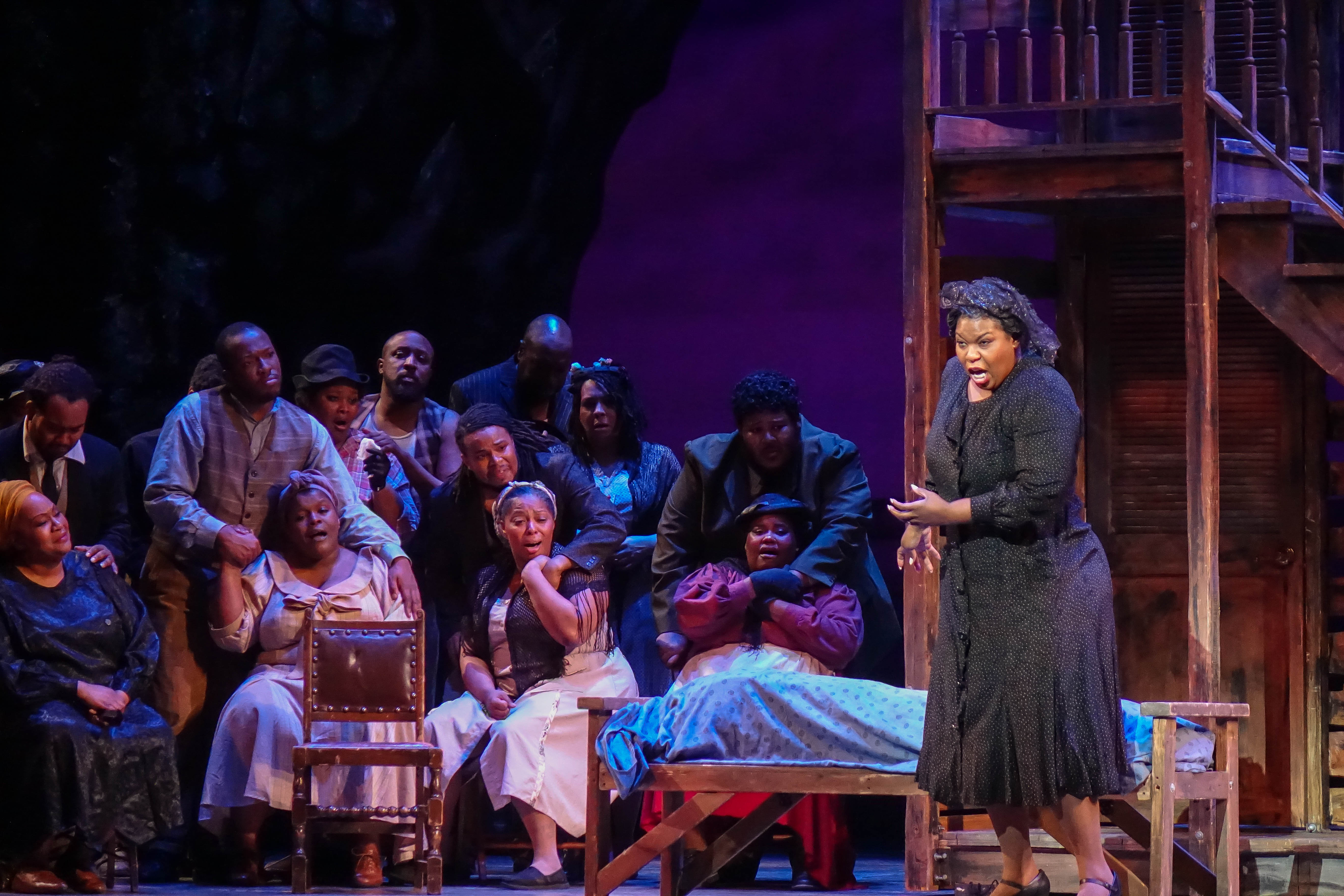
Stage director Dennis Robinson hasn’t sought to replicate that scenic Spoleto splendor, concentrating his attention instead on building the drama. Two rolling set pieces by scenic designer John Farrell replicate the dilapidated Catfish Row tenements, with backdrops and Michael Baumgarten’s wonderful lighting supplying much of the color. Those colors are usually upstaged by Ildikó Debreczeni’s artful costume designs, motley women’s and working men’s clothing in the outdoor community scenes, veering toward black in the dimly lit funeral scene for the murdered Robbins, and suddenly switching to a splash of white linens for the Kittiwah Island picnic.

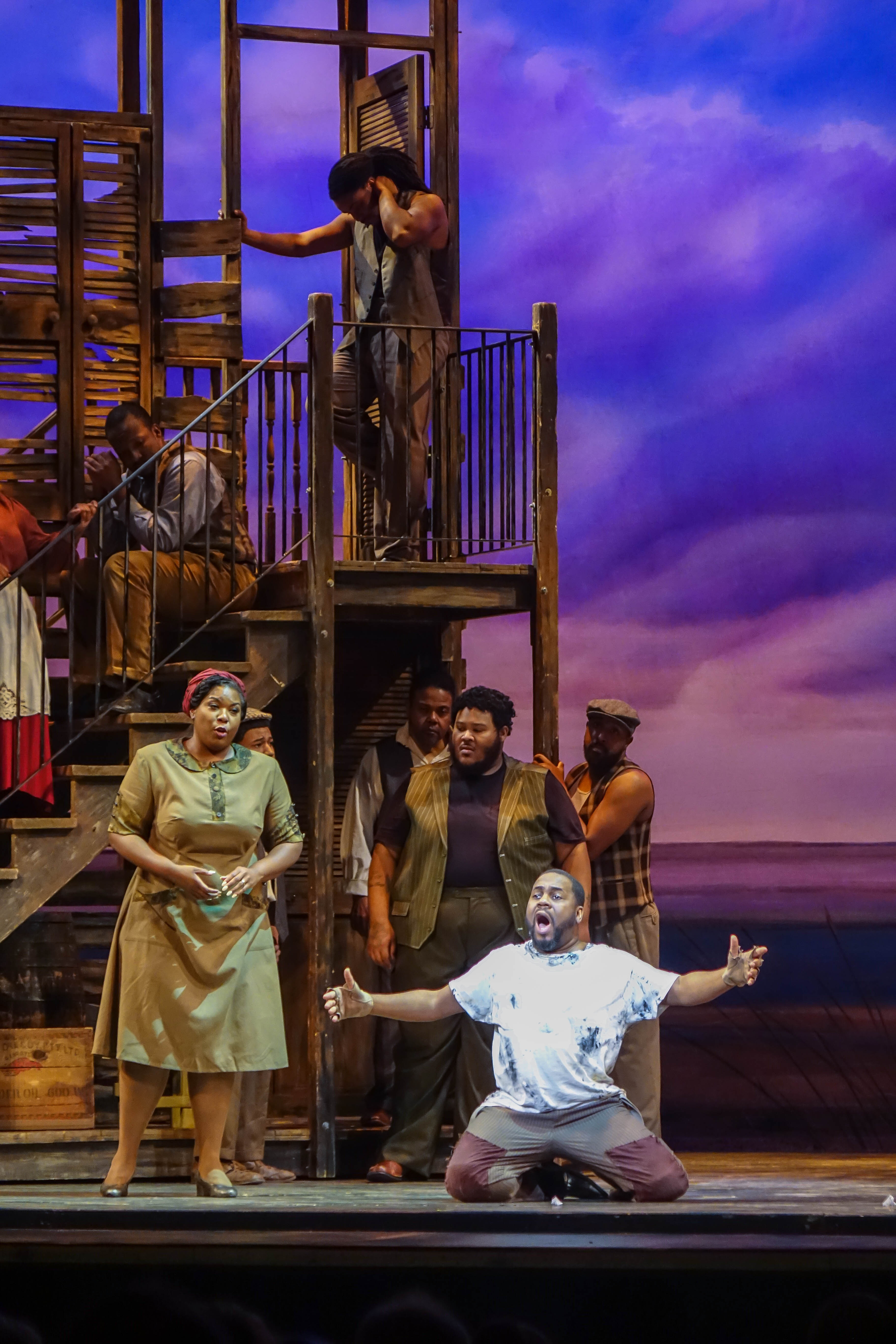
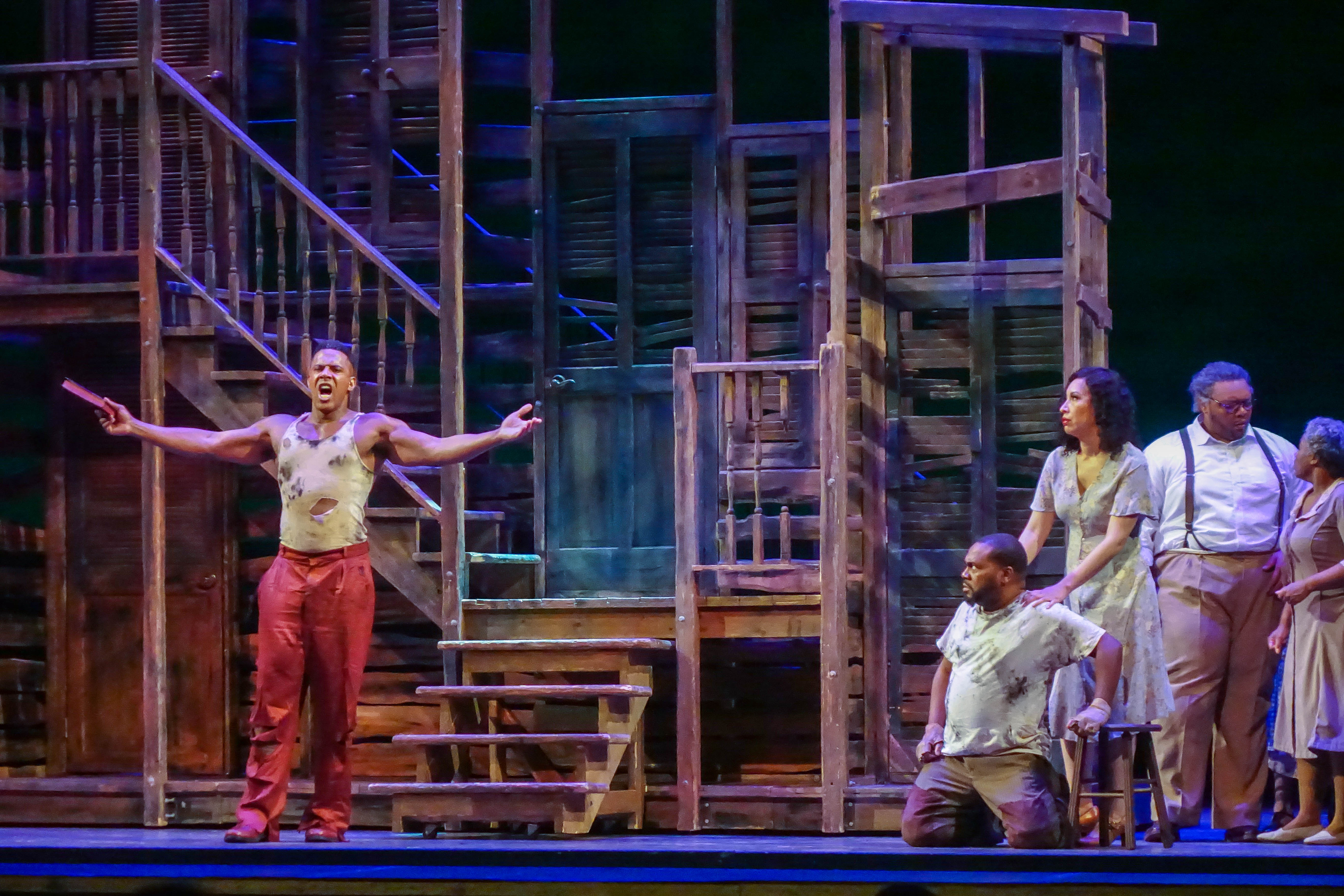
Even the stylish Sportin’ Life, all purple with gold accents when we first see him, wears pure white pants and vest at the beach, though a lurid silk fuchsia shirt peeps through. Other costumes sketch the main characters’ evolution. Crown, Robbins’ murderer and Bess’s abusive former husband, is nearly as dandified as Sportin’ Life when we first see them shooting craps, yet he’s nearly in tatters when he madly emerges from hiding, seeking Bess. Debreczeni’s Bess transforms only slightly less dramatically, her first appearance in a flaming red dress when she still belongs to Crown, followed by a citified black “mourning” dress at the funeral – pointedly accessorized with pearls.

2023~Porgy & Bess-09

The funeral and picnic scenes both show off how dignity has triumphed over poverty along Catfish Row, though the seafaring men and a climactic hurricane remind us how tenuous their victory is. As Jake, Clara’s husband, reminds us as the lead voice in the men’s worksong, “It Take a Long Pull to Get There,” evoking the Promised Land in much the same way that Rev. Martin Luther King would at the Lincoln Memorial decades later. Laudably, Robinson isn’t ashamed of either Porgy or Bess. He permits Cabell’s Bess to be Bess, ambivalent toward Porgy, Crown, and Sportin’ Life, just as she was written – bold yet insecure. She yields resignedly to Crown after arguing and resisting, so she is absolutely credible when she confesses the full range of her fears in her famed “I Loves You, Porgy” of the imminent confrontation when Crown comes for her: “he hypnotize me when he take hold of me with his hot hand.”

2023~Porgy & Bess-61

Refusing to enlighten Bess or belittle her demons, Robinson collaborates with Overton to rehabilitate Porgy, making him happier and less pathetic than I’ve ever seen him before. Robinson doesn’t ignore Porgy’s mobility issues, but unlike other directors, he offers Overton multiple avenues for motion, dispelling the cripple’s usual monotony and impotence. In most productions, Porgy perpetually limps with a crutch or glides along on a cart. Occasionally, you might see that four-wheel vehicle at the rear of a goat cart, honoring Samuel Smalls, alias “Goat Cart Sam,” the real-life Charlestonian that Heyward based his protagonist upon in his celebrated 1920 novel.

2023~Porgy & Bess-04

Discarding that goat, Overton will limp, glide, crawl, and – at one key dramatic moment – even attempt to stand up and walk. This variety made Overton’s Porgy more restless, powerful, and dynamic. His crutch is a forked affair, topped by little ironing board-like cushion joining the branches, enabling Porgy to lean on it with his arm and stand upright. The cart is also cushioned to comfortably accommodate Porgy’s kneepads. We see that Overton can glide a good distance along the stage with a single paddling motion, braking with his toes, but I really didn’t notice that his wheels could swivel until the last possible moment. That revelation made Porgy’s final exit the most stunning I’ve ever seen.

2023~Porgy & Bess-46

When Overton first entered, the neighborhood greeted him with affection rather than pity. Even before he got his gal and somewhat domesticated her, he brimmed with sufficient confidence and joie-de-vivre to heartily sing “I Got Plenty o’ Nuttin’” to every woman along Catfish Row who had doubted him. You could believe in Overton as he jumped into the transcendent “I Loves You, Porgy” duet: he will stand up to Crown – and unlike the original libretto prescribed, this Porgy met Crown face-to-face rather than sneaking up on him.

2023~Porgy & Bess-53

Until Porgy’s surprisingly military departure, Robertson’s slithery balletic grace as Sportin’ Life provided the most delicious movement we saw. Executing Michael Jackson-styled spins, Robertson was the “happy dust” he peddled, the wicked exhilaration of the high life that Bess was giving up. Citified and flamboyant, Robertson also rocked Sportin’ Life’s cynicism smack in the middle of the idyllic Kittiwah picnic. His “It Ain’t Necessarily So” became a showstopper that launched Act 2 buoyantly, no less successful than DuBose’s spotlit “Summertime” when the curtain first rose. Nor did the quality wane after the drunken brawl at the dice game and Robbins’ murder when we adjourned to the gloomy funereal aftermath. Not only did we get to see Porgy duded up, upright on his feet, and escorted by a newly demure and penitent Bess, we got reminded by Michelle Johnson as Serena, Robbins’ grieving widow, of the heartfelt power pent up in “My Man’s Gone Now,” Serena’s swaying lament.

2023~Porgy & Bess-35

As the murderous Crown, Donovan Singletary had ample pects and biceps for Bess to ogle at in his OpCarolina debut, manhandling her on Kittiwah Island with the confidence – and restraint – of a brute who has willed “his” woman back to his arms for the last five years anytime he wished. The “Oh, What You Want wid Bess” duet had exactly the right blend of chemistry, antagonism, lust, and loathing. More of Singletary’s heat surfaced as Catfish Row rode out the hurricane, but his raunchy “A Red-Headed Woman” was too abbreviated, defanged, and on-the-fly for my liking. Give us a longer version, please!

Otherwise, the only persistent flaw in this beautifully sung, meticulously crafted production was the singers when they weren’t singing their arias. Nobody else came close to matching Overton’s intelligibility or audibility when dialogue or recitative pushed the story forward, an unwanted reminder of the touring production that played Ovens Auditorium in 1998. The dropout in decibels was especially dreary for me in the opening scene as the crap game dragged on, but my discomfort may be benign compared to what Porgy newcomers experienced if they didn’t already know the lyrics to the songs.

Once the brawl broke out, Heyward’s story pretty much told itself for me through the actions we watched, aided by George Gershwin’s music and orchestrations. Miking the dialogue, as most touring Broadway shows do, would certainly have been helpful, but the simplest solution for these nagging woes at the Belk would have been supertitles. That way, we could have appreciated Heyward and lyricist Ira Gershwin nearly as much as George.

Opera Carolina Finds New Balance in Mozart’s “Don Giovanni”

Review: Don Giovanni at Belk Theater

 By Perry Tannenbaum

220203_OPC_CON_1103

February 3, 2022, Charlotte, NC – Among the lovable scoundrels of Western world literature, surely Don Juan has proven to be the most lovable – Molière, Goldoni, Lord Byron, Shaw, and Mozart are just a few of the notables who have sung the Spanish Don’s sins over the past 400 years. His tale can be seen as a series picaresque escapades and comical conquests, or as a grim and grisly revenge tragedy, or as a stern moral lesson. Armed with a wondrous libretto by Lorenzo da Ponte, Mozart disdained to choose among these alternatives, daring to make his Don Giovanni all of the above. With so much to see and emphasize, it’s no wonder that each of the six productions I’ve reviewed since 1991 has been so different from the others – including a Czech National Theatre production at the Estates Theater in Prague, the venue where Mozart’s masterwork premiered in 1787.220201_OPC_DON_053

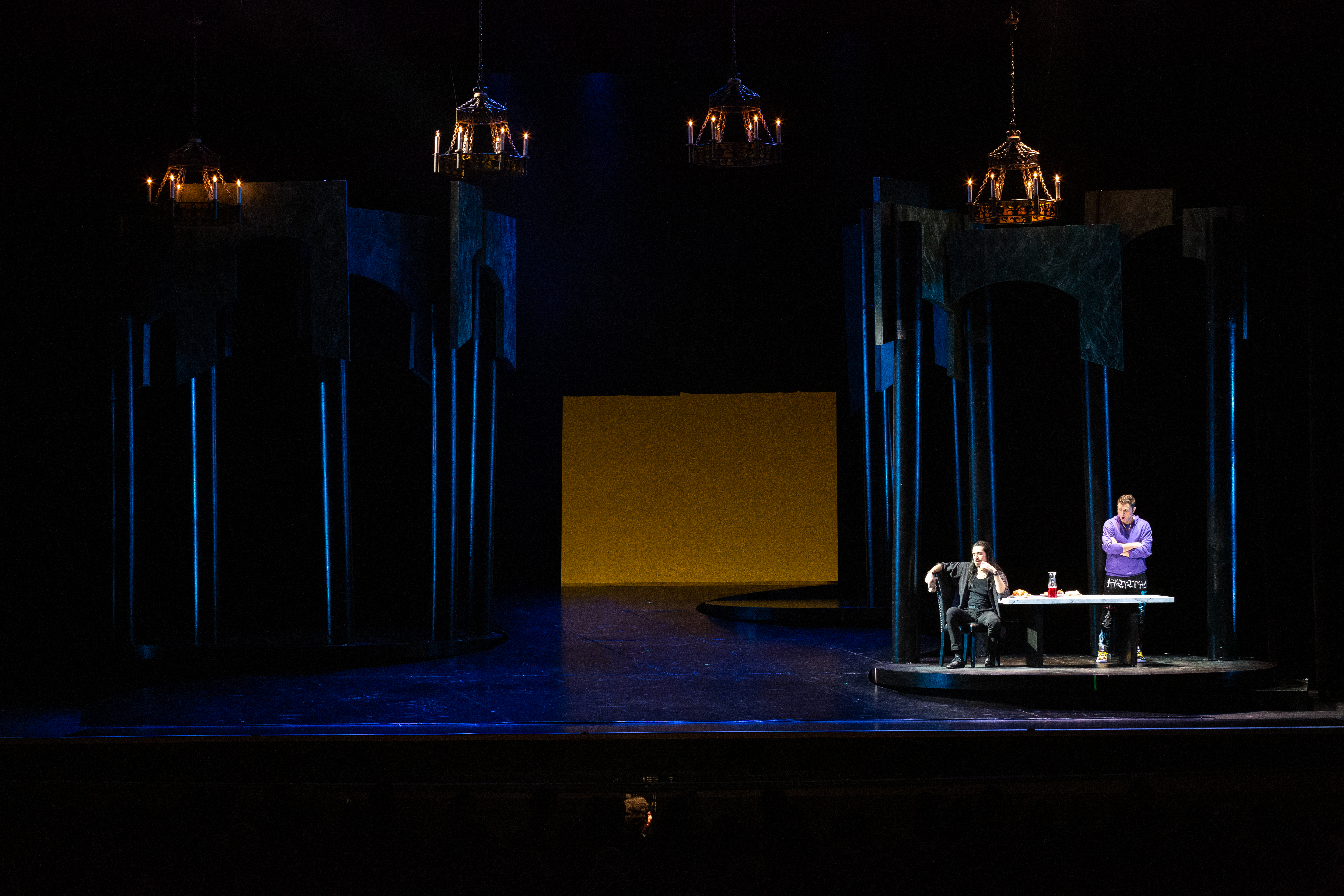
In her Opera Carolina debut, stage director Eve Summer pays little attention to scenery, relying on props and Whitney Locher’s costume designs to modernize the action. Donna Anna’s home doesn’t have a façade in the opening scene, where Giovanni flees after raping the noblewoman and is compelled to murder her father before he can escape. Nor is there an exterior, let alone an upstairs, at Donna Elvira’s lodgings in Act 2, when Giovanni serenades milady’s maidservant while Leporello, the Don’s servant masquerading as his master, creates a cunning diversion. Three revolving pods help simulate the places where the swift action unfolds, and Michael Baumgarten’s lighting designs signal the transitions and enhance the drama – especially in the denouement, when the Commendatore, Donna Anna’s murdered father risen from the dead, implacably gets his revenge.220201_OPC_DON_426

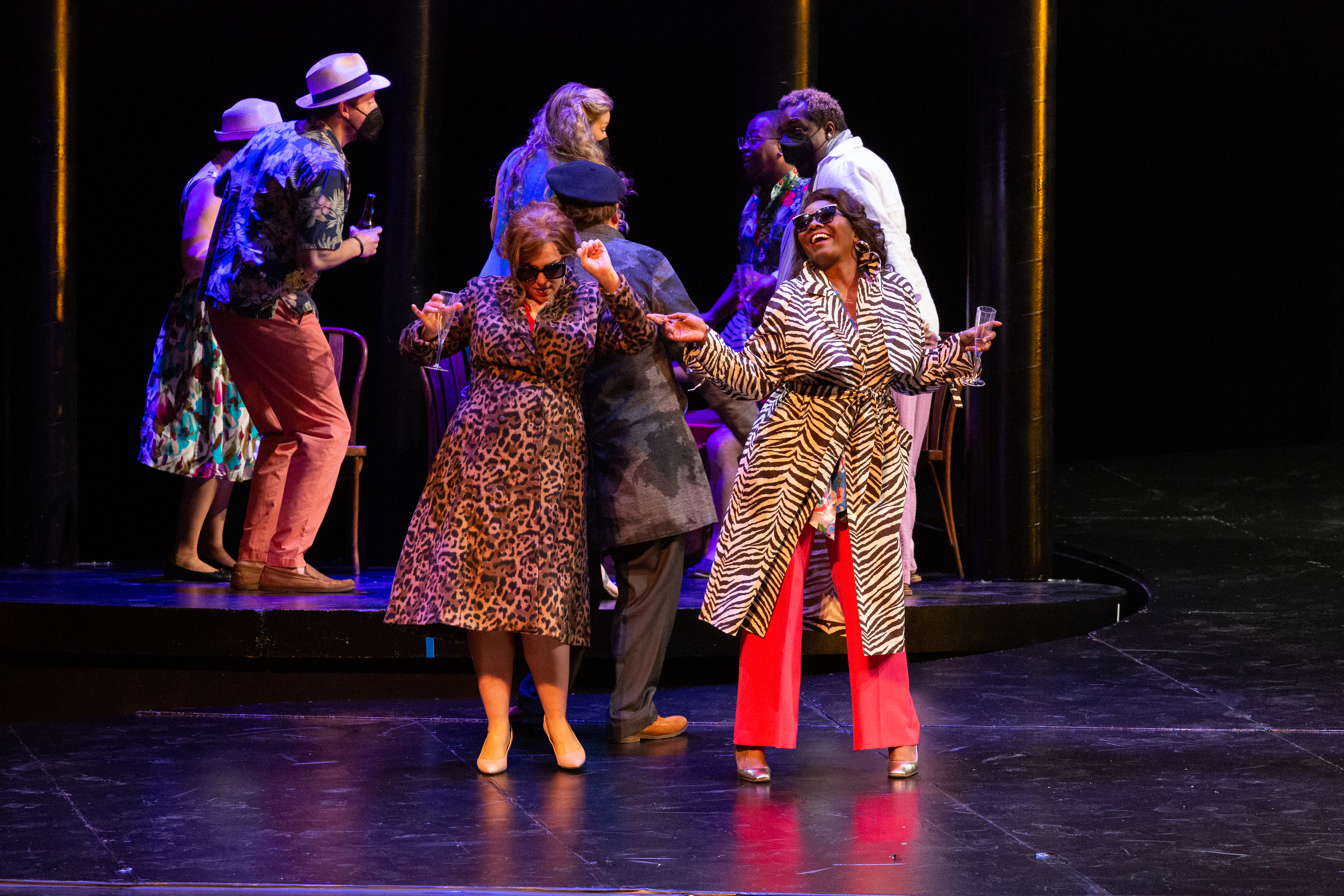
Summer hasn’t totally surrendered to modernity in her vision of Giovanni, for she surely could have gone further than equipping Elvira with contemporary luggage as she pursues the Don and turning the pages of Leporello’s book chronicling the rogue’s romantic conquests into an iPad that he scrolls. Balancing these modern touches are the curved tops of the revolving pods, evoking ancient arches, and the presence of harpsichordist Emily Jarrell Urbanak, seated at stage right throughout the evening. In a way, the singers also straddled different eras, always immersing themselves in Mozart’s music, yet the diversity of the casting – and a few of the dance moves they busted at Giovanni’s soiree – returned us to the new millennium. Most anachronistic were Sequina DuBose as Elvira, lugging her rolling stack of suitcases up a couple of stairs and down a ramp, and Alex Soare as Leporello, discarding his sensationally grungy attire only when he impersonated Giovanni (though Locher’s design here may have also been inspired by the Ghost of Christmas Future).220201_OPC_DON_170

Dashing, cruel, and overflowing with conceit, bass-baritone Richard Ollarsaba made a stunning debut as Giovanni, even if the mod dress deprived him of the opportunity to unsheathe a sword. His overtures to Elvira, her maid, and the peasant girl Zerlina were all lusciously seductive. Encounters with Leporello and Masetto, Zerlina’s fiancé, crackled with scornful superiority, sometimes snarling and sometimes nonchalant. The old Commendatore seemed to draw the very best from Ollarsada, cavalierly deferential to his age in resisting his challenges to combat in the opening scene, defiant and fatally unrepentant when Giovanni’s fate was sealed. As rich and appealing as Ollarsaba was when he sang, Alex Soare was startlingly convincing as Leporello when the servant was called upon to masquerade as his master. To bring out the servant’s comic flavor, moments when Leporello was marveling at the gullibility of Giovanni’s victims were underscored more boldly than the disillusion, disgust, and abject fear that the Don’s escapades put him through. Nor was bass-baritone Ashraf Sewailam chiefly onstage as Masetto to clownishly portray the peasant’s malleability, showing us far more of the hothead than the usual hayseed. In the same spirit, tenor Johnathan Stafford White as Don Ottavio, Anna’s staunch and patient fiancé, is more of a noble champion than a feckless chump.27sQMG5Q

Perhaps even more than the men, the excellence of the three sopranos cemented my suspicion that this was the deepest Opera Carolina cast I’ve seen. While Summer didn’t allow Rachel Mills quite as much risqué latitude as I saw in Prague in consoling her battered Masetto, this Zerlina was no less irresistible in her “Vedrai carino,” applying the balm of love on his bruises. Although there were slight chinks in DuBose’s vocal armor, there were no losses in sweetness when there were dips in volume as Elvira sang her woes, and DuBose is such a fine performer that I had second thoughts each time I steered my attention elsewhere – so many of her reactions are worth watching. Most revelatory was Melinda Whittington as Donna Anna, a role I’ve often found annoying in her chaste righteousness. Whittington amped up the feeling of this grieving rape victim while tamping down her outraged fervor. Summer allowed her to wear a color to the Don’s soiree instead of shrouding her in mourning, and those dance moves further humanized her.220203_OPC_CON_1197

The joyous epilogue, celebrating the triumph of justice over wickedness, is scrapped in this new Opera Carolina production. Somehow that enhances the impact of bass Jordan Bisch as the avenging Commendatore. Both at the cemetery accepting Giovanni’s dinner invitation and later at the Don’s banquet hall, Bisch resounds thrillingly as the voice of doom. After blasting my eardrums just three weeks earlier from the Belk Theater stage with Mahler’s Ninth, a discreetly reduced Charlotte Symphony sounded comparatively wan as it wafted the Giovanni overture out of the orchestra pit. But Opera Carolina artistic director James Meena had the ensemble perfectly calibrated for the occasion, and when the curtain rose, the blend of singing and playing gave constant pleasure. As I stepped onto the elevator with another couple, hurrying to beat the Belk crowd out of the parking lot, the husband couldn’t help gushing, “This is the first classical opera we’ve seen!” If future productions are as good as this Giovanni, they will be coming back again and again.

Originally published on 2/5 at CVNC.org