Review: Charlotte Symphony @ Carolina Theatre
By Perry Tannenbaum
March 28, 2025, Charlotte, NC – In so many ways – for me, for Charlotte Symphony enthusiasts, and for the city – last week’s Spring Gala at the Historic Carolina Theatre was a thrilling revival and an orgy of nostalgia. First and foremost was the reopening of the ancient movie theater and concert hall, dormant movie-wise since 1978 and briefly revived in the late 1990’s by Moving Poets Theatre of Charlotte and the beloved Creative Loafing Theatre Awards. The Carolina has stood in midtown Charlotte since 1927 and the Charlotte Symphony Orchestra sprang to life there with its first public performance on March 20, 1932. So a couple of auspicious centennials are on the horizon during the next decade.
On the other hand, Carolina Theatre crystallizes what Symphony has become in its recent years of modernization. Within the past month alone, our orchestra has performed in front of movie screens on three programs, John Luther Adams’ Become Ocean, John Powell’s How to Train Your Dragon in Concert, and the glittery Spring Gala featuring Renée Fleming. If memory serves, we hadn’t seen Fleming perform with the Charlotte Symphony since 2004, and the last time my mom and I saw her at the Metropolitan Opera was in 2014, playing the title role of The Merry Widow.
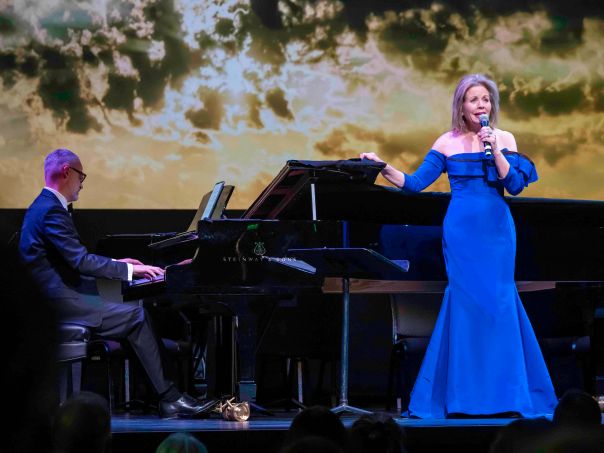
The epic assemblage of National Geographic footage added extra dimensions to Fleming’s live rendition of her Grammy Award-winning album of 2021, Voice of Nature: The Anthropocene – or it would have if the soprano had actually sung more than two of the album’s 17 tracks in front of the lushly cinematic backdrop. Two additional screens flanked the stage, not only tripling the Geo cinema to near-surround proportions but also supplying the texts or translations of the songs if you could peel your eyes away from Fleming, still glamorous at 66, accompanied by pianist Bradley Moore.
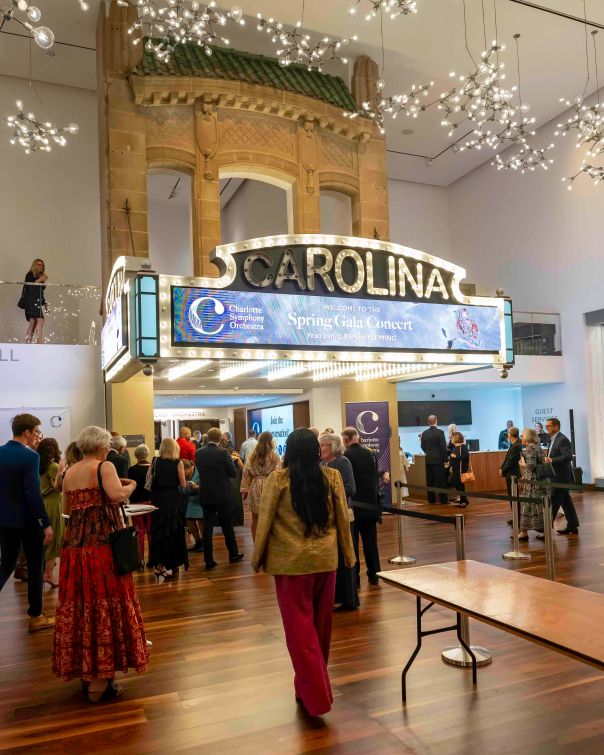
Cinematically and acoustically, the renovated Carolina Theatre was quite good for its age, too, but not spectacular. If you came to behold the sensational, that was taken care of before you entered the hall, for the glow of the lobby and the Carolina signage could be seen from blocks away as you began grappling with the riddle of where to park. Inside the lobby, where the sleek glassy modernity of the hall clashes with the quaintness of the updated Roaring Twenties marquee, you’re already in the presence of something unique, but when you enter the hall, spanking new with all its old-timey trimmings, you feel like you’re inside a time capsule.

So it’s hard for a critic to be churlish about Fleming delivering less than a quarter of her original Anthropocene in live performance when the 15 songs she substituted were so well-chosen and – mostly – flawlessly sung. From the album, Kevin Puts’s “Evening” and Reynaldo Hahn’s “L’heure Exquise” were the most delightful, but an objective assessment of Nico Muhly’s “Endless Space” was impossible for me. This was where the screens surrounding Fleming exploded with National Geo imagery: the glories of sky, ocean, rivers, and ice, followed by the ravages of fires, floods, drought, and sunbaked skeletons. Hazel Dickens’ “Pretty Bird” and an aria from G.F. Handel’s Atalanta were charming enough, but chiefly backed by massive tree trunks, comparatively sleepy on celluloid.
My favorites among Fleming’s inserts were Curtis and Pearce Green’s “Red Mountains Sometimes Cry,” Maria Schneider’s “Our Finch Feeder” from Winter Morning Walks,Giacomo Puccini’s “O mio babbino caro” from Gianni Schicchi,Rodgers & Hammerstein’s “The Sound of Music” and Joseph Cantaloube’s “Baïlèro” from his Chants d’Auvergne. Allow me a little churlishness on “Baïlèro”: although it was the most achingly lovely song that we heard before intermission, still magical though stripped down to Moore’s accompaniment, a full orchestral version with Symphony could have elevated the magic to sublimity with its lovelorn oboe passages and sprinklings of harp. Recorded versions by Frederica von Stade, Kiri Te Kanawa, and Victoria de los Angeles are the best – along with Fleming’s own, the final track on her 1998 Beautiful Voice album.
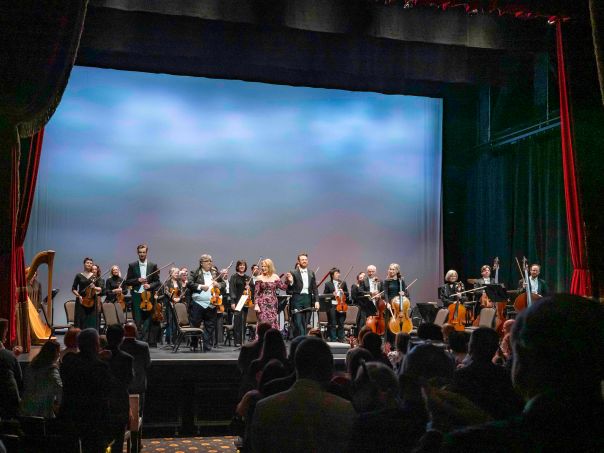
When Charlotte Symphony finally assembled onstage, it was more than an hour after president and CEO David Fisk and Charlotte Mayor Vi Lyles graced the evening with their gala presences and welcoming remarks. A bit undermanned for guest conductor Courtney Lewis in his Charlotte debut, the Orchestra sounded lackluster in the Overture to Mozart’s Le nozze di Figaro and downright moribund in the Overture to Gabriel Fauré’s Masques et bergamasques. It amazed me to find that nothing could mar or spoil this occasion when you felt privileged to be there. Partly because our expectations had been politely lowered, Lewis and Symphony seemed to overachieve in Richard Rodgers’ “Waltz” from Carousel.
Fleming’s voice has lost some of its creaminess above her midrange and I found myself rooting for her to easefully reach her top as she climbed to the climax of R&H’s “You’ll Never Walk Alone.” But Renée had banked plenty of his goodwill for arts lovers long before she resigned recently from the tainted Kennedy Center. Decades before she put her heart post-pandemic into the global environment, she championed American opera, most notably in 1998 when she premiered the role of Blanche in André Previn’s A Streetcar Named Desire while also collecting American arias into an 11-track album representing nine composers, I Want Magic! The aging diva is still banking residuals and Spotify pennies for her exemplary recorded output. Meanwhile, each time Charlotte Symphony had the chance to play live behind Fleming, they seemed to play better, producing fresh magic aplenty for us all – with the promise of much more from Fleming and the Carolina Theatre in years

 Art on My Sleeve