Review: Wholeness Concert at First Presbyterian Church
By Perry Tannenbaum
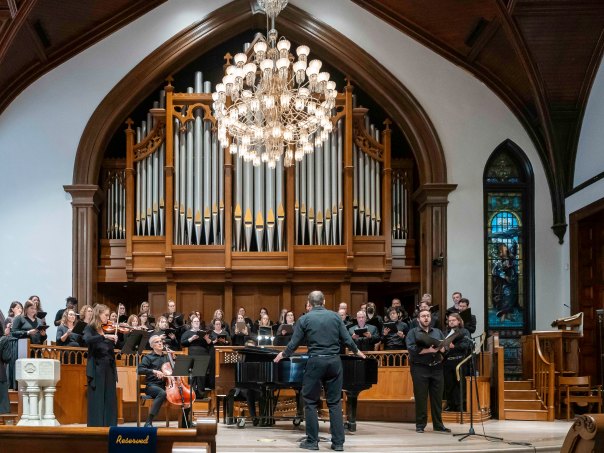
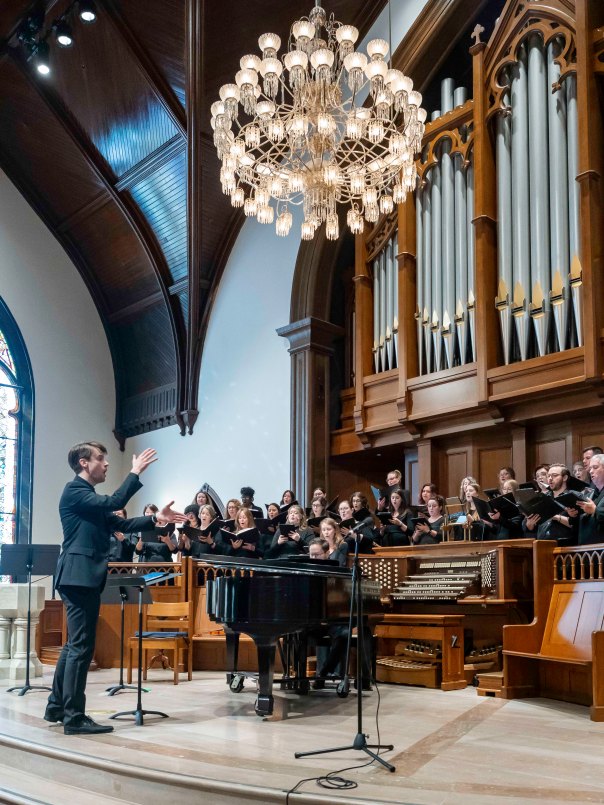
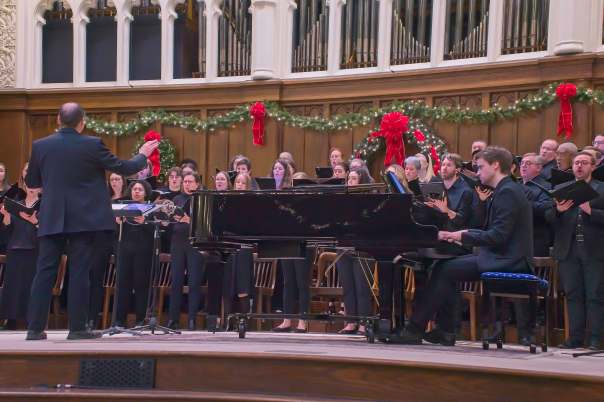
May 17, 2025, Charlotte, NC – Noted singer, conductor, and educator Helen Kemp (1918-2015) was most concerned with the musical training and development of children through children’s choirs when she coined her beloved mantra, “Body, mind, spirit, voice. It takes the whole person to sing and rejoice.” But in times of widespread warfare, terrorism, societal fracturing, and political upheaval, the Charlotte Master Chorale aptly adopted these words to subtitle its final concert for the 2024-25 season. Their “Wholeness” concert, conducted by Kenney Potter and Philip Biedenbender, affirmed the First Presbyterian Church of Charlotte as a place of healing, harmony, and communal gathering.
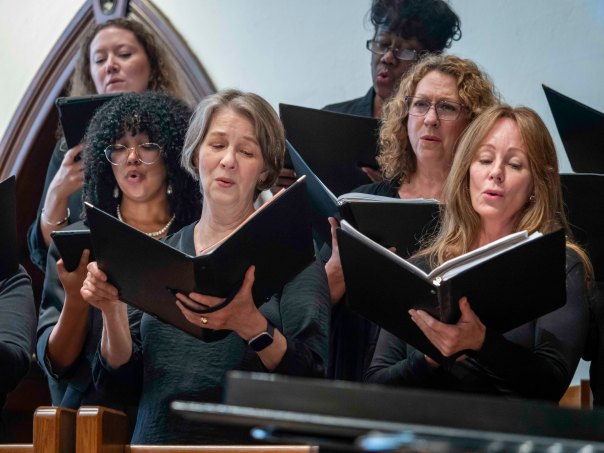
With Alex Berko’s Sacred Place as the centerpiece of the program, ecumenical engagement became the most salient feature of Wholeness for me. Between Shabbat morning services at Temple Israel of Charlotte and a Charlotte Symphony concert at dusk with works by Jewish composers Bernstein and Copland topping the marquee, Wholeness – and especially Sacred Places – proved to be a surprisingly perfect bridge. Berko’s six-part service is modeled on Jewish liturgy, with four of the six sections bearing the Hebrew title of a foundational prayer. These core elements of this prayerful suite were framed by an identical opening and closing prayer, excerpted from Wendell Berry’s 1966 poem, “The Porch Over the River.”
The prayers became a distillation of the poem, where Berry’s porch was the most benign human intrusion upon the primeval serenity of nature at a wooded riverfront. As for the Jewish service, texts chosen by Berko were only obliquely connected to the original Hebrew – actual connection in the instance of “Amidah” vestigially retained only in the composer’s introductory note. The music echoes the transition in Berko’s chosen texts from the hushed tranquility of Berry’s riverscape to John Muir’s evocations of majesty and glory in his eloquent description of Yosemite. It was originally sent to Theodore Roosevelt, urging the president to preserve this magnificent temple of nature. Only the connection between text and the literal meaning of “Amidah,” mostly a silent prayer said while standing, remained obscure.
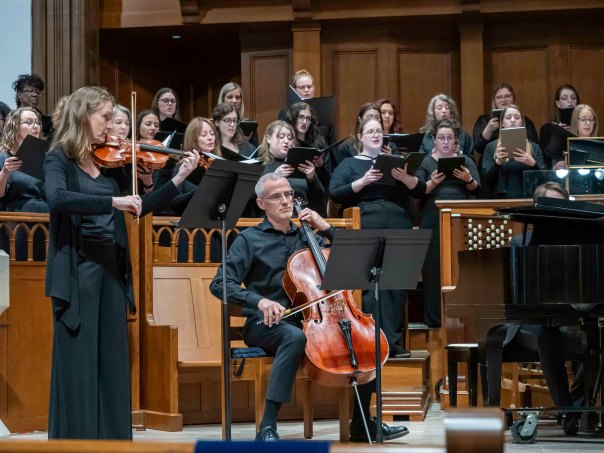
Musically ranging from solo vocals to grand choral proclamations – accompanied by violinist Sarah Case and cellist Peter Case, with Biedenbender at the keyboard – the “Amidah” was only slightly eclipsed by the ensuing “Shema,” which superbly referenced the cornerstone of all Jewish prayer. Orthodox Jews will have the words of the “Shema” on all their doorposts and say them at least two times daily, if not three, biblically enjoining Israelites to listen and hear that the Lord is their god and the Lord is one. For this pivotal section, Berko chose William Stafford’s 1961 poem, “In Response to a Question: ‘What Does the Earth Say?’” Unlike the voice of the Lord, thundering from the peak of Mount Sinai and proclaimed by Moses to the people below, Stafford strains to hear what the earth says. Presumably, the poet has divined its message: “The earth says have a place, be what that place requires…” So again, Berko’s music roars and whispers.
Text for the “Mi Shebeirach” had a smidge of Hebrew in it, but contrary to Berko’s belief, it was not a translation of the actual prayer. Instead, it was taken verbatim from a setting that Debbie Friedman had written for the prayer in 1993, using the English she had interspersed with the original Hebrew. The Friedman version has amazing popularity, widely replacing the original “Mi Shebeirach” prayer across the English-speaking world, so Berko’s mistake is not unusual. Nor is it the worst.
A drama that was judged for the 2013 Jewish Plays Project, The Man in the Sukkah, presumed that the song, with its mishmash of Hebrew and English, was sung by persecuted Jews during the days of the Holocaust. When Berko’s setting reached the brief Hebrew phrase in Friedman’s lyric – “Bless those in need of healing with r’fuah sh’leimah” – the section, which had been more like recitative until this point, swelled with melody and feeling. The section that followed, “Kaddish,” retreated briefly toward the quietude of “Closing Prayer” with a snippet from Rabidranath Tagore’s Stray Birds (No. 273). It was good to have the delayed final words, “at the margin of starry silence,” printed out in the program booklet for the sake of clarity – and to fully savor the music’s sublimity.
Although the other nine pieces on the program didn’t benefit from the favor of being printed out – or credited, when the lyricist was not the composer – they were all worthy of the Wholeness theme. None of them were at all too brief, cute, or at all bouncy. The closest to rejoicing was Reginal Wright’s “We Are the Music Makers.” Less facile and more propulsive was the Adam and Matt Podd arrangement of “How Can I Keep from Singing,” with touches of melancholy throughout, especially in its concluding decrescendo.

The most intimate and solemn of the short works was Don Macdonald’s “When the Earth Stands Still,” with lyrics by the composer that merited inclusion alongside Berko’s texts. But the most remarkable piece of the afternoon was arguably Craig Hella Johnson’s beauteous, slightly sugary “Psalm of Life,” set to one of Mattie J.T. Stepanik’s Heartsongs. Before succumbing to a rare form of muscular dystrophy at the age of 13, the astonishing prodigy appeared on TV with Larry King, Oprah Winfrey, with former president Jimmy Carter on Good Morning America, and on New York Times bestseller lists on multiple occasions with his books of poetry and essays. Like all the other composers and writers behind the Wholeness concert, I’d never been acquainted with Stepanik before. He was a revelation to me among revelations.




 Art on My Sleeve