Tag Archives: Peter Case

Berko’s “Sacred Place” Is the Chief Revelation at Master Chorale’s Wholeness Concert

Review: Wholeness Concert at First Presbyterian Church

By Perry Tannenbaum
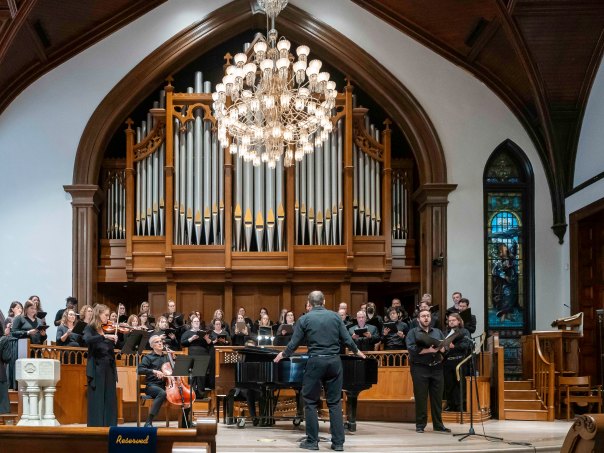
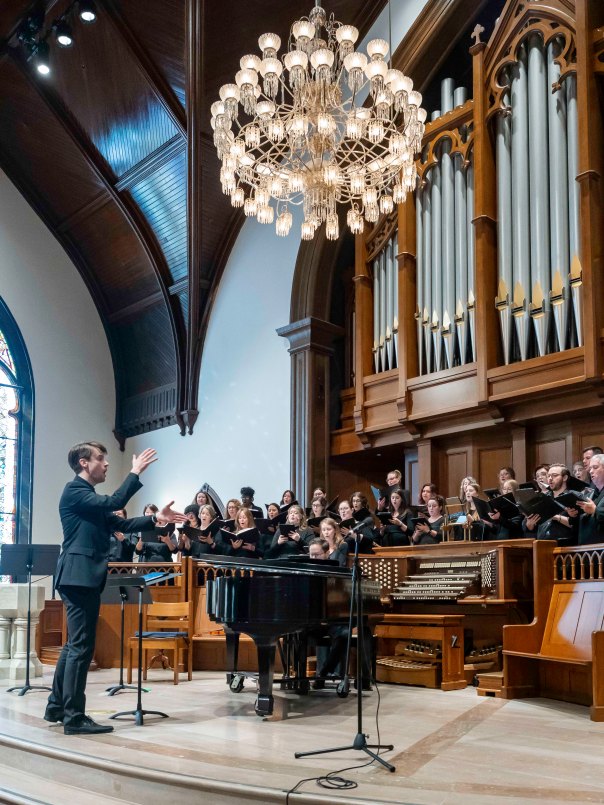
May 17, 2025, Charlotte, NC – Noted singer, conductor, and educator Helen Kemp (1918-2015) was most concerned with the musical training and development of children through children’s choirs when she coined her beloved mantra, “Body, mind, spirit, voice. It takes the whole person to sing and rejoice.” But in times of widespread warfare, terrorism, societal fracturing, and political upheaval, the Charlotte Master Chorale aptly adopted these words to subtitle its final concert for the 2024-25 season. Their “Wholeness” concert, conducted by Kenney Potter and Philip Biedenbender, affirmed the First Presbyterian Church of Charlotte as a place of healing, harmony, and communal gathering.
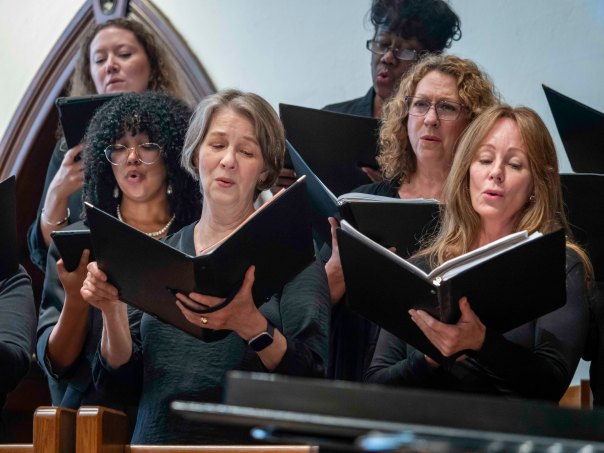
With Alex Berko’s Sacred Place as the centerpiece of the program, ecumenical engagement became the most salient feature of Wholeness for me. Between Shabbat morning services at Temple Israel of Charlotte and a Charlotte Symphony concert at dusk with works by Jewish composers Bernstein and Copland topping the marquee, Wholeness – and especially Sacred Places – proved to be a surprisingly perfect bridge. Berko’s six-part service is modeled on Jewish liturgy, with four of the six sections bearing the Hebrew title of a foundational prayer. These core elements of this prayerful suite were framed by an identical opening and closing prayer, excerpted from Wendell Berry’s 1966 poem, “The Porch Over the River.”

The prayers became a distillation of the poem, where Berry’s porch was the most benign human intrusion upon the primeval serenity of nature at a wooded riverfront. As for the Jewish service, texts chosen by Berko were only obliquely connected to the original Hebrew – actual connection in the instance of “Amidah” vestigially retained only in the composer’s introductory note. The music echoes the transition in Berko’s chosen texts from the hushed tranquility of Berry’s riverscape to John Muir’s evocations of majesty and glory in his eloquent description of Yosemite. It was originally sent to Theodore Roosevelt, urging the president to preserve this magnificent temple of nature. Only the connection between text and the literal meaning of “Amidah,” mostly a silent prayer said while standing, remained obscure.
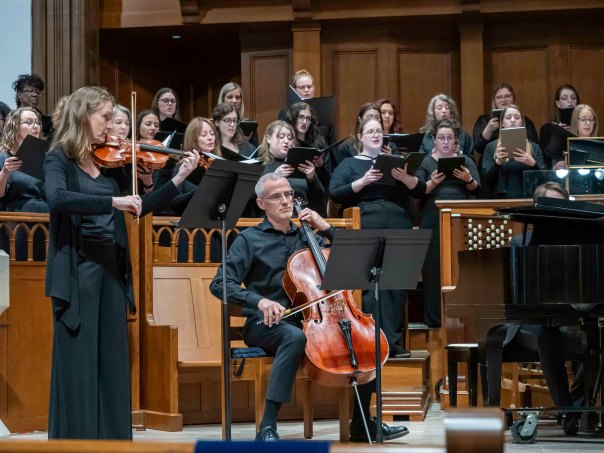
Musically ranging from solo vocals to grand choral proclamations – accompanied by violinist Sarah Case and cellist Peter Case, with Biedenbender at the keyboard – the “Amidah” was only slightly eclipsed by the ensuing “Shema,” which superbly referenced the cornerstone of all Jewish prayer. Orthodox Jews will have the words of the “Shema” on all their doorposts and say them at least two times daily, if not three, biblically enjoining Israelites to listen and hear that the Lord is their god and the Lord is one. For this pivotal section, Berko chose William Stafford’s 1961 poem, “In Response to a Question: ‘What Does the Earth Say?’” Unlike the voice of the Lord, thundering from the peak of Mount Sinai and proclaimed by Moses to the people below, Stafford strains to hear what the earth says. Presumably, the poet has divined its message: “The earth says have a place, be what that place requires…” So again, Berko’s music roars and whispers.

Text for the “Mi Shebeirach” had a smidge of Hebrew in it, but contrary to Berko’s belief, it was not a translation of the actual prayer. Instead, it was taken verbatim from a setting that Debbie Friedman had written for the prayer in 1993, using the English she had interspersed with the original Hebrew. The Friedman version has amazing popularity, widely replacing the original “Mi Shebeirach” prayer across the English-speaking world, so Berko’s mistake is not unusual. Nor is it the worst.
A drama that was judged for the 2013 Jewish Plays Project, The Man in the Sukkah, presumed that the song, with its mishmash of Hebrew and English, was sung by persecuted Jews during the days of the Holocaust. When Berko’s setting reached the brief Hebrew phrase in Friedman’s lyric – “Bless those in need of healing with r’fuah sh’leimah” – the section, which had been more like recitative until this point, swelled with melody and feeling. The section that followed, “Kaddish,” retreated briefly toward the quietude of “Closing Prayer” with a snippet from Rabidranath Tagore’s Stray Birds (No. 273). It was good to have the delayed final words, “at the margin of starry silence,” printed out in the program booklet for the sake of clarity – and to fully savor the music’s sublimity.

Although the other nine pieces on the program didn’t benefit from the favor of being printed out – or credited, when the lyricist was not the composer – they were all worthy of the Wholeness theme. None of them were at all too brief, cute, or at all bouncy. The closest to rejoicing was Reginal Wright’s “We Are the Music Makers.” Less facile and more propulsive was the Adam and Matt Podd arrangement of “How Can I Keep from Singing,” with touches of melancholy throughout, especially in its concluding decrescendo.

The most intimate and solemn of the short works was Don Macdonald’s “When the Earth Stands Still,” with lyrics by the composer that merited inclusion alongside Berko’s texts. But the most remarkable piece of the afternoon was arguably Craig Hella Johnson’s beauteous, slightly sugary “Psalm of Life,” set to one of Mattie J.T. Stepanik’s Heartsongs. Before succumbing to a rare form of muscular dystrophy at the age of 13, the astonishing prodigy appeared on TV with Larry King, Oprah Winfrey, with former president Jimmy Carter on Good Morning America, and on New York Times bestseller lists on multiple occasions with his books of poetry and essays. Like all the other composers and writers behind the Wholeness concert, I’d never been acquainted with Stepanik before. He was a revelation to me among revelations.

COVID Kindred Behind the Scenes of Local Singles

Preview: Local Singles at The Arts Factory

By Perry Tannenbaum

Once you’ve scaled the summit and staged the legendary Sunset Boulevard at Booth Playhouse with a 40-piece orchestra – the pinnacle of Andrew Lloyd Webber’s achievement, or at least the K2 rivaling the Everest of Phantom –you might think that QC Concerts founder Zachary Tarlton would ask himself how can I top this? But when Tarlton formed his company in 2020, the Q stood for Quarantine, and the modest aim was to keep musical theatre going online via Instagram when actual theatergoing wasn’t possible.

So pianist/actor/musical director Tarlton can think small, no matter how wildly Queen City Concerts has grown and overachieved in less than four years. His idea of following up Sunset Boulevard is to take us from the macabre Hollywood mansion of movie icon Norma Desmond to a room at a Pittsburgh YMCA where Nancy and Richard host weekly therapy sessions that struggle to attract lovelorn clientele. That’s the main HQ for Local Singles (down the hall from Hot Local Singles), the new musical by Nick Navari.

Never heard of Navari? You are forgiven. While Lloyd Webber has been bringing hit musicals to Broadway since 1971, Navari is counting on his first Off-Broadway production to open in January 2025.

That’s the allure for Tarlton and his loyal QC Concerts fanatics: being in on a new creation from a new talent as the new organism develops. Instead of begging publishers and Broadway legends for the rights to produce their masterworks – or in the case of Parade, the stirring piece by Jason Robert Brown and Alfred Uhry, going through the ordeal of having those rights suddenly snatched away – Tarlton had the less stressful experience of Navari coming to him.

Flashing back to the summer of 2022, when QC Concerts was readying to begin its second season with the regional premiere of Kinky Boots, Tarlton recalls Navari reaching out.

“He had somehow found us on Instagram and, through the power of social media, followed along with what we were doing,” Tarlton confides. “Then he reached out to me, presented his whole kind of sales pitch for the musical.”

And why not? Backed by a grant from the National Endowment of the Arts, Navari wrote the music, the lyrics, the script, and the six-piece orchestrations for Local Singles. Then he directed the stage premiere at the New Hazlett Theater in 2021 as well as the cast album and a pro-shot film version. Musicians in the promo video for the world premiere jammed the score in surgical face masks, and the first production of Local Singles in front of a live audience didn’t happen until February 2022 at the Lamp Theater in Irwin, PA. Actors caught on-camera in rehearsals for that production were still sporting N-95s.

That second premiere was midway through QC’s opening season, a mere five months before Kinky Boots gave notice that Tarlton had his eye on blockbuster productions like Titanic, Angels in America, and Sunset Boulevard. The prevailing Tick, Tick… Boom! template of Tarlton’s opening seasonmust have seemed rightdown Navari’s alley.

So while Tarlton was navigating beyond his comfort zone with his first company, taking his quarantine concept live, Navari was venturing beyond writing, directing and performing into the wild frontiers of publicity and promotion, hawking his own work. You could say they were kindred COVID spirits. Accidental entrepreneurs.

Nor are they averse to doctoring their creations. By the time Sunset Boulevard dazzled at the Booth, Tarlton had totally discarded QC’s script-in-hand format in favor of a workshop concept with costumes, lighting, barebones, scenery and onstage orchestra. Meanwhile, Navari has not been idle. After the Pittsburgh premiere and the cast album, one of Navari’s numerous videos proclaims that he has written five new songs and added a character to Local Singles.

You don’t need to go far in the playscript to see a difference. By the second scene – and the second track of the cast album – the script and Spotify diverge. The version we will get at the Arts Factory this weekend will be the closest yet to the Off-Broadway edition slated to open at Players Theatre in Greenwich Village for a five-week engagement next January.

“He’s made a few more changes for our production,” Tarlton reveals. “So I know that he’s excited to have this chance to get it in front of another audience just to see what still may need to be tweaked and changed before it goes to New York.”

When we first see them, Richard and Nancy have been life companions for nine years, not exactly flush with success. Not only are they competing with the Hot Singles group down the hall, they are tied into a six-year deal for this cursed time-slot for another 42 months. The group seems to have been founded in order to help their friend Jack, a good-hearted paranoid mess.

We don’t meet them right away, likely because we need to be prepared for Jack’s eccentricities and for Nancy’s arsenal of therapy tools – including pairs of yellow rubber gloves, a bubble gun, a portable park bench (with an important plaque), and Morgan. In rehearsal photos, she is portrayed by a piece of hard-sided rolling luggage and the head of a mop. But she may evolve – or devolve – before performances begin at the Arts Factory later this week.

A couple of messy breakup scenes pave our way to the Y.

“So the show opens with Penny, who has just discovered that she is pregnant,” Tarlton explains. “Then we meet Wes and then Wes’s ex-girlfriend. There’s a great [new] song where she’s, like, throwing all these clothes out of the apartment. It’s the whole breakdown moment. It’s lovely.”

And it’s fair to say both Penny and Wes are hurting.

Then we travel into the support group,” says Tarlton. “Over the course of the first act, we find how Wes and then Penny makes their way into the group, one of them on purpose, one of them by accident. And then basically it tracks their continual journey with the group where they both end up continuing to come back week after week, getting to know each other more, getting to be a part of each other’s lives.”

The musical’s through-path is the support group bonding with Penny along the journey of her pregnancy. Navari tosses in some goofy detours, including overtures to Morgan and Jack’s daring adventure with his personalized park bench.

“There’s kind of a big twist at the end of act one with Jack as he’s trying to put himself out there and meet the person of his dreams.”

One advantage of turning down Local Singles for QC’s second season would be Tarlton’s ability to increase prep time for its upcoming run. Hitching onto the CharlotteShout Festival last April gave QC the opportunity to preview Season Three in a revue-style concert – and for Tarlton and director Kel Wright to cast all the younger roles. By the time Titanic was staged in the fall of 2022, Wright and all four of the younger players had already worked with QC: Mary Beth Ritter would sing the preggy Penny; Patrick Stepp would be Wes, our leading man; the versatile Lamar Davis would be the pitiful Jack; and Hannah Risser would belt and bellow The Ex, the key cameo.

Thinking big had allowed Tarlton to test-drive a multitude of singers and musicians.

But what about the adults in the room? Those decisions weren’t cinched until last fall in the weeks following the Sunset Boulevard run at the Booth – when Wright and Tarlton saw Nicia and Charlie Carla on Eastway Drive at VisArt Video in a deathless PaperHouse Theatre production of Vampire Lesbians of Sodom.

Turns out that Wright and Tarlton wished to emphasize the acting skills of their therapist partners, especially the zany Nancy, and the Carlas fit the bill perfectly. So let’s forget that we can’t remember the last time Nicia performed in a musical!

“I am super excited that we’re getting to work with Nicia on the show,” Tarlton gushes. “Just the acting presence she brings to the role of Nancy is astounding. We crack up in rehearsal every day – just her line delivery and the way she handles all these moments is perfection. The stuff that Nancy sings in the show is definitely very much still that talk thingy vibe, and she is owning it and comfortable with it.”

Sitting at the keyboard as music director, Tarlton will have a prime vantage point as the Carlas and their castmates work their magic. Maybe a few in the audience will recognize the vestiges of COVID as the musicians play along. The show is scored for keyboard, guitar (Daniel Hight), bass (Ben Stewart), drums (Mike Charlton), violin (Nikki Redman), and cello (Peter Case).

No winds and no brass. Remember those days?

Navari himself plays piano, guitar, and “a few other instruments,” Tarlton reports, explaining the composer’s facility in handling the chamber-sized orchestrations.

He savors the flavor of the strings. “It adds a little mix of more classical string music,” Tarlton observes, “with your very contemporary rock band feel of a traditional kind of modern contemporary, musical theater, off-Broadway sound.”

The idea is for this kooky Y therapy to go beyond the little support group and become contagious. For us.