Tag Archives: music

Ryan Clicks with the Master Chorale in a Walloping CSO Debut

Review: A German Requiem at Belk Theater

By Perry Tannenbaum
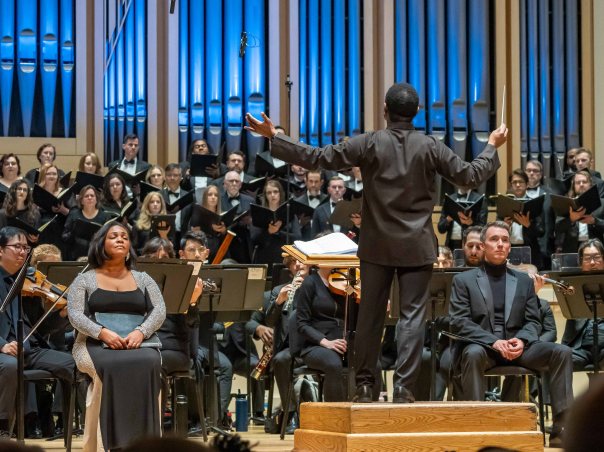
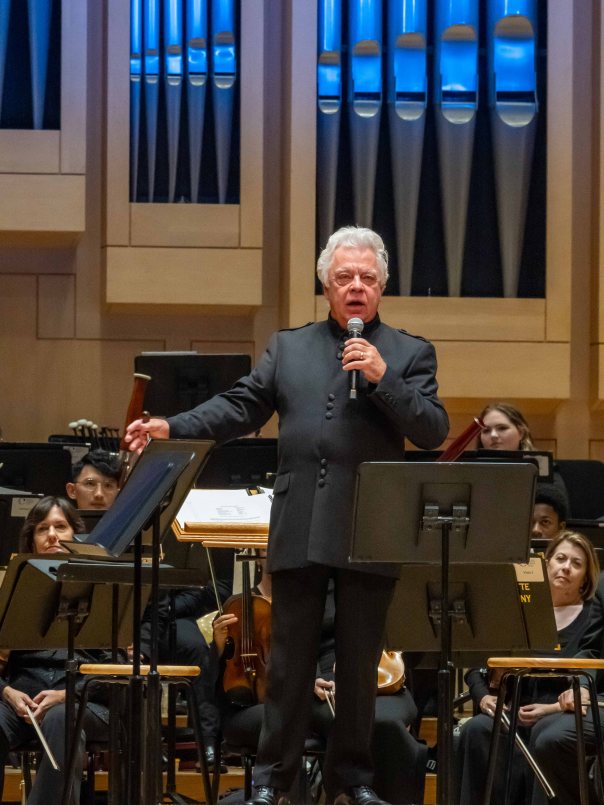
November 22, 2024, Charlotte, NC – In Kwamé Ryan’s first full season as the new music director of Charlotte Symphony, we aren’t getting to see him perform as much as we would hope, but when we do see him onstage at Knight Theater or Belk Theater, he always appears to be overjoyed to be here. Ryan was absolutely beaming as he took the Belk’s centerstage for the first time as CSO’s leader – and he certainly didn’t wear out his warm welcome, delivering a walloping performance of Johannes Brahms’ Ein deutches Requiem. Even before Ryan’s arrival, the new season has proven to be adventurous and diverse in its programming, showcasing fresh repertoire and youthful guest soloists.

Subscribers can judge for themselves whether Ryan’s outré intro to his debut program, coupling the Brahms with Latvian composer Pēteris Vasks’ Musica Dolorosa, was a sign of confidence or a symptom of nervousness. Whether or not my recollection can be trusted, Ryan’s scripted intro was unprecedented. Some intros we may have seen in the past could be dismissed as gratuitous – or countenanced as witty fluff. Here, Ryan’s intro was necessary, for we needed to be prepped for how the program would be delivered: without a pause between the music of the two composers. That would also be fairly unique. Our new maestro was crafting an experience.

Indeed, Ryan’s preface was necessary for another reason. Vasks’ piece flowed into the Brahms so smoothly it was as if they were written in collaboration and in the same key. Outside that merging point, the two pieces were quite different in the ways that they dealt with death. Responding to his sister’s untimely death, Vasks voiced his personal despair and compounded his feelings with grieving for his nation, still subject to Soviet rule when the Dolorosa premiered in 1984. Written for string orchestra, the mood of the opening section of Dolorosa may put you in mind of Barber’s Adagio. But the Vasks elegy eventually transcends the sameness and the hypnotic monotony of Barber’s dolor with louder and more piercing pain.

As the lower strings tap and strum percussively, Vasks gradually quickens the pace and turns up the volume as the beat becomes more insistent and dramatic. Once the dynamics peak, the strings, now smoothed out with a cessation of the percussion, become even more disturbing, tossing away pleasant tonality in a disciplined cacophony of fearsome chaos. The slashing lower strings, however, hadn’t been vanquished. They punctuated this harshness and dissonance at its height, seemingly puncturing it, for the noise homogenized into the sound of a diminishing wind or a siren receding into the distance – clearing the way for the quietest and most memorable episode in the Dolorosa. Principal cellist Jonathan Lewis, echoing the opening bars, played an eloquent lament from his downstage seat, accompanied only by the low mysterious hum – like a bass clarinet or a contrabassoon – emanating from upstage, hidden from my sight. The higher strings now took up the cello’s increasingly bold cry and built it to raw anguish.

The slightly hushed and abrupt ending of the Dolorosa nicely conformed with Ryan’s concept, and it dispensed with the shuffling of chairs usually necessary for the transition to full orchestra with winds, brass, and drums. Nor were the troops of the Charlotte Master Chorale obliged to parade in from the wings and settle into their perches above the Symphony. That honor was reserved for the guest vocalists, soprano Janai Brugger and baritone Alexander Birch Elliott, gracefully delayed until well after the transition between the Dolorosa and A German Requiem. The Brahms is not new to the CSO, last given by Christopher Warren-Green almost exactly 10 years ago – after his predecessor, Christof Perick, had presented it (already for the second time this century) in 2005.

With its consoling attitude, the Requiem is not at all a bad fit for the holiday season. You’re likely to recognize more than a couple of verses from the Brahms, conveniently projected in supertitles, as German translations of verses from Handel’s Messiah, the most beloved musical birthday celebration that we have. Most notably, you’ll get an Oktoberfest taste of “The trumpet shall sound.” Maybe sitting down in the orchestra, as opposed to the Grand Tier Circle, accounted for the heightened thunder of Ryan’s rendition, but Symphony somehow sounded crisper. The sudden sforzandos struck like a punch to the jaw, yet Ryan kept the ensemble under strict control, never threatening to overwhelm the hall with volume, emphatically relishing the work’s percussive moments.

Both Brugger and Elliott shone in their debuts. There was a noticeable Renee Fleming-like milkiness and sheen to Brugger’s voice, most appropriate for the motherly comfort she delivered in “Ihr habt nun Traurigkeit (You now have sorrow).” Elliott was even more impressive in his larger workload, a more pleading “Herr, lehre doch mich (Lord, teach me),” bolstered by a lusty Chorale response, before he delved into the “trumpet shall sound” mystery and affirmation of “Denn wir haben hie keine bleibende Statt (For here we have no everlasting city).” Belatedly, Music Chorale artistic director Kenney Potter was summoned onstage to share the credit for his singers’ brilliance and verve. He was absolutely beaming with delight.

Photos by Perry Tannenbaum

Charismatic Parnther Justifies Shostakovich’s Top Billing at the Knight

Review: Charlotte Symphony Presents Shostakovich and Mendelssohn

By Perry Tannenbaum

November 8, 2024, Charlotte, NC – Hailing from Norfolk, VA – and perhaps the Sith Order of the Galactic Empire – guest conductor Anthony Parnther has brought a big James Earl Jones voice to Knight Theater and an even bigger personality. He instantly engaged Charlotte Symphony subscribers with a lengthy intro to the first piece of the evening, Samuel Coleridge-Taylor’s Ballade in A Minor (1898). Amid some insightful observations on the Black Britisher’s talents and his fin de siècle milieu, Parnther threw in some shtick that drew attention to his mighty larynx, looking askance at what appeared to be a perfectly fine microphone and coming to the mic’s rescue with his “opera voice” and, a bit later, with his “Shakespeare voice.”

In short, he dared to educate us and did a damn good job of it. The performance was just as brash, though occasionally too loud for the hall. There was gravitas in the opening measures sweeping into a zingy elan. Violins excelled in the midsection of the work with some very tender section playing, and the piece built nicely to an anthemic climax, reminding me of Jean Sibelius’s less-neglected symphonic masterworks. North Carolinians can point with pride to the best recorded version available on Spotify or Apple Music, featuring the Royal Liverpool Phil directed by Grant Llewellyn, who has given so much to The Old North State. Beyond that, Parnther could tell us very confidently that Black composers, according to the latest tallies, account for only 2.5% of programming among America’s top orchestras, knowing that we were quite entitled to feeling superior in the wake of hosting Sphinx Virtuosi a month ago – in a mostly Black and Hispanic program.

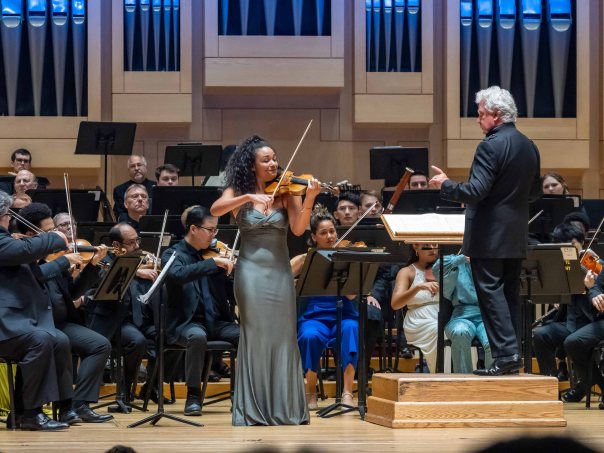
Sphinx’s visit turned out to be a gift that kept on giving, for the guest soloist playing Mendelssohn’s Violin Concerto in E minor, 16-year-old Amaryn Olmeda, was a first-prize winner – and audience fave – at the 24th Annual Sphinx Competition and toured with the Virtuosi two years ago. While I wouldn’t wish to compare Olmeda’s performance to my favorite recordings; including those by David Oistrakh, Yehudi Menuhin, and even Itzhak Perlman (who gave a live rendition at Belk Theater in 2019); there was certainly beauty aplenty in Olmeda’s account, with virtuosity to spare. But Symphony concertmaster Calin Lupanu attacked the infectious Allegro opening more fiercely in 2021, bowing with bolder panache when he played the piece online with Christopher Warren-Green at the podium. After a simple and lovely transition from principal bassoonist AJ Neubert, Olmeda was at her best in the middle Andante movement, freeing Parnther and the CSO to give her more robust support.

Olmeda relaxed and reveled more in the closing Allegretto-Allegro than she had in the previous outer movement, so Parnther and the CSO could be more assertive in their support, but true brilliance seeemed still beyond her at this tender age. Nonetheless, the audience joined me in giving Olmeda a standing O, perhaps sharing my feeling that we should pay her forward. Although attendance at the Knight was strikingly sparse, the young violinist was beaming. With a nicely articulated Bach solo, she returned our appreciation with an encore. Instinct tells me that the ripple of applause from the audience as intermission ended was in response to Olmeda joining them.

The young prodigy could not be faulted for the disappointing turnout, for the Sphinx Virtuosi had triumphed at Symphony’s annual gala last month. More likely, it was Shostakovich, topping the bill with his Symphony No. 9, who was the culprit on a beautiful autumn evening. Yet here was where Parnther and the CSO were at their best. The Norfolk native was pointedly suggestive in his introductory remarks, but mostly objective in his lengthy explorations – cuing us on what to look for in each of the five movements rather than telling us what to make of it. Thorough but never boring or academic, not at all show-offy or self-indulgent. Truly helpful.

The performance was spectacular, brilliantly contoured to the hall with fine evocative details, fully justifying Parnther’s enthusiastic intro. Which instrumentalist shone brightest in the opening Allegro was a tossup between Lupanu and piccolo stalwart Erinn Frechette, but principal trombonist John Bartlett stole all the scenes, emphatically partitioning the many episodes and injecting Shosty’s comedy with just two oompah notes. From that lighthearted opening – antithetical to what all Ninth Symphonies should be in the wake of Beethoven’s behemoth – we plunged into the depths and dolor of the Moderato, the lengthiest movement in this lapidary stunner. Principal clarinetist Taylor Marino, bolstered by section mate Samuel Sparrow, set the doleful tone of this sharply contrasting movement (again antithetical to the triumphal music Soviet Premier Joseph Stalin expected in 1945), achingly extended by two other principal winds, flutist Victor Wang and Neubert. Dreary strings increased the profundity of this oppressed lament, with Marino returning to soar above it in near-manic anguish.

It’s easy to lose your place after this unforgettable pairing of light and dark movements because the last three are played without pause, steadily increasing in intensity until a steady locomotion of victorious woodwinds are prodded into accelerating by the pulsations of the lower strings. These, in turn, triggered and excited the violins. Blaring brass then drove the journey into complete madness – and off the rails. Adding to the overwhelming bite of this sonic climax, the slashing, plucking, and sawing of the bowstrings across the stage added vivid visual drama.

Photos by Perry Tannenbaum
With a Riddling Program, Sphinx Virtuosi Youthfully Inspire Symphony’s Gala

Review: Sphinx Virtuosi @ Charlotte Symphony’s Annual Gala

By Perry Tannenbaum

October 9, 2024, Charlotte, NC – It’s always encouraging when an annual gala at least partially sheds its patrician aura of black ties, ball gowns, and champagne toasts. So I heartily applauded Charlotte Symphony’s musical director emeritus Christopher Warren-Green when, instead of mentioning crass sums of moneys raised or needed, he notified us that a part of tonight’s proceeds would be sent to those in dire straits in Western North Carolina in the wake of Hurricane Helene. In an even more unexpected gesture, the evening’s guests, Sphinx Virtuosi, announced that they would linger in Charlotte to play an additional concert on Friday at Charlotte Preparatory School – free if you bring a Hurricane Helene contribution.

They all worked well, together and apart, in gifting the gala audience at Belk Theater with a fine show, though not exactly what was initially planned. Or even what was listed in the printed program. Instead, a series of changes to the program were announced by email before and after the program went to press. Even then, a couple of new wrinkles emerged after the lineup seemed to be settled in the last inbox update on September 19. Maybe the plutocrats who dined and toasted earlier at the pre-concert cocktail and dinner sessions got a heads-up.

As a result of the first alteration, changing the title of LA-based composer Levi Taylor’s from American Forms to Daydreaming (A Fantasy on Scott Joplin), the opening segment of the concert became an explicitly extended tribute to Joplin. Actually, the Overture from Joplin’s only surviving opera, Treemonisha (1911), was nearly as new as Taylor’s offering and similar in length. The orchestration chosen by Warren-Green, arranged by Jannina Norpoth with Jessie Montgomery (a Sphinx Medal of Excellence winner in 2020), was premiered last year in Toronto as part of a “reimagining” of Joplin’s opera, so it didn’t quite sound like any of the handful of versions that Spotify can offer. Principal clarinetist Taylor Marino was brilliant playing the catchy recurring theme, an instrumental assignment that Norpoth reaffirms, but principal trumpeter Alex Wilborn’s spot struck me as a lively improvement upon Norpoth’s predecessors.

In a shorter, no-intermission program, it was nice to have a proper mood-setter leading into Taylor’s premiere – and Sphinx Virtuosi’s entrance – rather than a genial throwaway aperitif. Paradoxically, the Joplin overture, aimed for an opera house, was not as raggy as Taylor’s new work, an homage to the Joplin music we’re most familiar with. Personably introduced by cellist Lindsey Sharpe, the piece had an engaging solo spot for principal cellist Tommy Mesa and a refreshing jauntiness. Amazing how much more highbrow and classical the Joplin idiom sounds when you ditch the piano so justifiably associated with the “King of Ragtime.” Taylor took a well-deserved, enthusiastically applauded bow when concertmaster Alex Gonzalez pointed him out in the audience.

Sphinx’s outreach to Helene victims is quite natural when you consider its DNA. Conceived in Ann Arbor at the University of Michigan in 1997, Sphinx quickly became an important of young Black and Latino talent with its annual junior and senior competitions, open to musicians up to age 26, and its Performance Academy, a competitive boot camp, where faculty members include Norpoth, Gonzalez, and second violinist Rainel Joubert – who would play in the Delights and Dances string quartet when the Michael Abels composition, commissioned by Sphinx, had its Charlotte premiere.

The full ensemble departed – all too briefly – as Warren-Green and CSO delivered a more familiar Leonard Bernstein overture to his opera, Candide. If Sphinx had lingered offstage longer, the CSO performance might have been more prudently paced. Dynamics were OK, but when piece started off too swiftly, there was little room for Symphony to speed up when the piece thundered and thrust to its climax. The whole acceleration plus crescendo effect, so exciting in multiple Rossini overtures, was never even a possibility, surely the nadir of Warren-Green’s work with CSO as far back as I can remember.

Then the listed world premiere of Curtis Stewart’s Drill went AWOL, along with guest percussionist Britton-René Collins. This surprise was less of a disaster than the lackluster Bernstein, for the Sphinx Virtuosi returned instead with Samuel Coleridge-Taylor’s Allegro Moderato, the opening movement from his Four Novelleten (1903) for string orchestra. So many of Coleridge-Taylor’s principal works have yet to be recorded that it’s probable that this excavation, listed as Op. 59 in Wikipedia, has yet to get a hearing outside of Sphinx’s orbit – another gladdening example of the ensemble’s vital and generous outreach.

All the remaining works were glorious, throwing the Bernstein blooper far into our rearview mirrors. It helped a little to know your Vivaldi when Sphinx moved upstage to merge with the CSO as tango king Astor Piazzola’s “Verano Porteño (Buenos Aires Summer)” movement from his Four Seasons of Buenos Aires filled the stage with violinist Adé Williams as guest soloist. For those who saw Aisslinn Nosky playing the complete Vivaldi at the Charlotte Bach Festival, the Piazzola Four Seasons evoked some pleasant nostalgia, especially since the Festival Orchestra, like the Virtuosi, often performs without a conductor.

Williams, a winner of the Sphinx Junior Division back in 2012, still played with youthful vitality and joy. Both Symphony and Warren-Green were obviously fond of her playing, her swooping glisses, and the tango twists Piazzola brought to his baroque inspiration. Controversial in Argentina for his modifications of the trad tango – cab drivers often turned him away! – this summer piece was popular enough for Piazzola to draw encouragement for him to complete his seasonal cycle. The Belk audience responded favorably as well, with their first standing O of the evening.

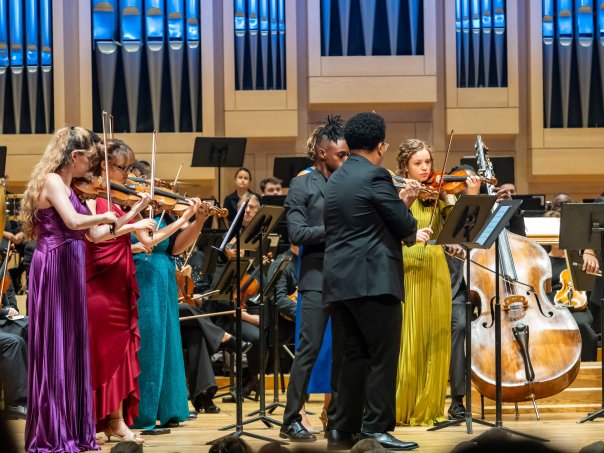
The Abels piece was an even longer, grander gatherum, with the string quartet arriving upstage where Williams had just stood. Joubert and CSO principal second violin were to Warren-Green’s left opposite CSO principal viola Benjamin Geller and cellist Gabriel Cabezas, the Sphinx Medal of Excellence winner in 2016. The Delights were rather delicate before the composer, who famously co-wrote the acclaimed Omar with Rhiannon Giddens, gradually ramped up to the Dances.Cabezas was more than able to eloquently launch Abel’s slow-building piece, which tacked leftward after his engaging solo with additional solo spots for the rest of the quartet members.

Nor was Abels in any hurry to layer on the orchestra, for their first contributions were background pizzicatos behind the full quartet before they picked up their bows. The piece is no less than the title work on a 2013 album recorded by the Harlem Quartet and the Chicago Sinfonietta conducted by Mei-Ann Chen. Definitely worth a listen if you missed the gala – and Abels’ Global Warming leads off the Sphinx Virtuosi’s recent Songs of Our Times release, their first album. Some rousing fiddling embroidered the loud and lively climax of Delights & Dances, easily the most epic piece of the night, programmed in exactly the right spot.

Mexican composer Arturo Márquez’s Conga del Fuego Nuevo (1996) was no less appropriately placed in the encore slot, starting up white-hot and danceable without lowering its flame. Fully recovered from his Bernstein misadventure, Warren-Green not only led the combined ensembles zestfully, he exhibited some winsome showmanship of his own, not only bidding Wilborn to stand up for his solos on muted and unmuted trumpet, but also commanding the winds and the brass to rise when moments came. How can a piece we’ve never heard before sound so familiar? Maybe via discreet borrowing and insistent repetition. No matter, CSO’s jolly encore became a curtain call at the same time – and a wonderful welcome to the 2024-25 season. Hopefully, the Coleridge-Taylor and the Abels were previews of the next Sphinx recording.

Photos by Perry Tannenbaum

“Beyond the Surface” Amazes and Parties-Down

Review: Beyond the Surface at McBride-Bonnefoux Center

By Perry Tannenbaum

The new Charlotte Ballet season is off to a blazing beginning. Presenting Beyond the Surface at the McBride-Bonnefoux Center for Dance through October 26, the troupe looked fresher and younger than ever. But the choreography was far, far younger: two world premiere hatchlings that emerged from their shells last Thursday from Omar Román de Jesús and Mthuthuzeli November, and a third Charlotte Ballet commission by Jennifer Archibald that had its premiere less than two years ago in the same studio.

On that auspicious occasion, Archibald’s fledgling was at the top of the Innovative Works program, sparking hopes that the pieces that followed would reach the same high level. This year, HdrM is nestled in the middle of the program – and my 2023 hopes were already realized again in 2024 with the premiere of De Jesús’s Balúm.

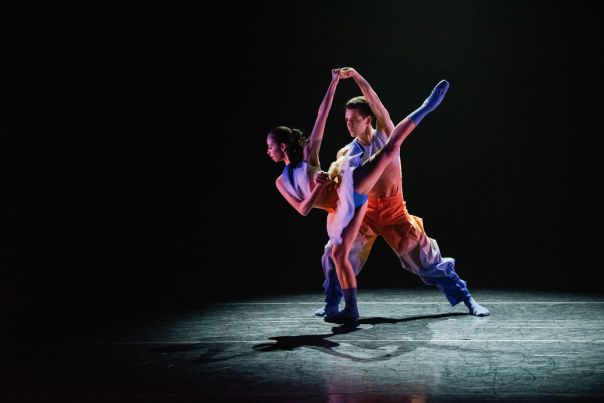
Yes, the first dance of the night easily merited a climactic spot in any evening of premieres: beautiful, complex, mysterious, symbolic, intricate, moving, epic, and surreal. Music by OKRAA, Ola de Luz, was relentlessly propulsive, with random noises at random intervals littered around the main core, a minimalist loop with a harp-like timbre. Once that core cleared the noisy interference, like a spiraling starship navigating through a belt of asteroids, a sudden hypnotic calm and spaciousness prevailed – and the wonder of this dance multiplied, lending it an uncanny glow.

De Jesús has indicated that he is exploring our interactions with the air that engulfs us, from the moment we are born until we take our last breaths. Or maybe that emergence from the noise field near the beginning of the piece is an expulsion from the womb, our birth after a pre-natal prelude. The Puertorriqueño choreographer also has a hand in scenic design and Branimira Ivanova’s costume designs, for she has some specific prompts to execute in fashioning the dancers’ outfits and props.

The most notable of these are black: Two umbrellas that conjure up the surrealism of René Magritte and the fearfully magnificent ambiguity worn by Rees Launer. One of the umbrellas starts upstage center, held by one of the dancers seated on a bench, and it gets passed from dancer to dancer during the action, frequently cycling back to its starting position. The other is held stolidly by a woman on a side bench who resolutely faces away from the action until the stunningly gorgeous denouement – when we get to see the air!

At various moments when Launer grips our attention, we can have different conjectures about what his stern character represents. A raging fire-and-brimstone preacher? a demon? a witch? the Angel of Death? Launer will be a member of two of the three ensembles that get to present Balúm during its current 16-performance run. Another standout in the opening weekend’s seven-member ensemble, Maurice Mouzon Jr., will be in all the performances of this piece.

The liquefied movement of the dancers – along with some robotic intertwining – was juxtaposed with no-less-idiomatic lifts that were more horizontal than vertical. Like chapter markers at the end of episodes, the ensemble would gather and swirl around the stage in an evocative oval parade. Autumn leaves swirling in the wind. Often two or three subgroups performed simultaneously before an ensemble swirl would resolve the dissonance.

What amazed me most was that synchronized entrances and overlapping actions were so precise when there were seemingly no musical cues to give the dancers a toehold. If you’ve heard music by Philip Glass, you know that minimalism is not particularly danceable music. Musicians playing it and maestros conducting it must concentrate intently on the score to keep their bearings amid the repetitiveness. I’m still gobsmacked by how this Charlotte Ballet team pulled this off.

Following Balúm, a piece so untethered from every aspect of its music except for OKRAA’s tempo, Archibald’s HdrM struck me from an altered perspective. Archibald’s ability to mesh expressive movement to a soundtrack of musical compositions by Ludwig Ronquist, Heilung, and Federico Albanese stood out more boldly than ever after the more abstract and surreal De Jesús piece – though these intimate bonds in HdrM could be broken by abrupt mechanical disconnects from the score.

Two other conflicting factors came into play. Most welcome was the opportunity to see the Canadian-born choreographer’s work reprised by three of the eight dancers who performed at the 2023 premiere, Raven Barkley, Luke Csordas, and Shaina Wire. The piece looked more natural and “lived-in” twenty months later, so its internal contrasts were sharper and its sensual moments more relaxed. Barkley, in particular, stood forth dramatically, as sensual, captivating, and devastating as we’ve ever seen her. Nor can you fail to notice the ‘do.

Here, more than in any other dance of the evening, the ensemble bought into the “Unfiltered” theme of CharBallet’s 2024-25 season with their spirited, lyrical work. My only worry was off the dance floor and in the program booklet, where Archibald’s useful explanatory remarks where no longer in print. There in 2023, she was concerned with environmental psychology and posed a pointed question: “Is there a social responsibility to humanize architecture?”

Just asking that question helps us to connect with Archibald’s struggling language of movement. It also hints at the likelihood that Kerri Martinsen’s drab costumes are intended as institutional, such as clothing worn in hospitals, prisons, or mental wards. Aside from the contrast between lithe and mechanical movement, HdrM holds our gaze with a nice balance of ensemble, individual, and pair segments that flow naturally into one another.

Like many finales we’ve seen before from CharBallet, November’s Vibes and Variations is the most celebratory and carefree piece of the night. After last year’s From Africa With Love, it’s also the second consecutive November premiere to kick off a season at the McBride-Bonnefoux Center. Where Africa was surprisingly serene and monochromatic, preoccupied with mauve-colored ostriches from his South African homeland and their exquisite fragility, Vibes seems to wander westward to South America, to samba, tango, and carnivale.

Ivanova’s costumes burst with pastel cotton-candy colors and outré pleating, what my late mom in her saltiest Yiddish would call ongepochket, crassly over-decorated. The bulges on the men’s costumes give them seahorse legs and the frilly women look like spinning tops in a color scheme that matches the men’s harlequin-like rigs. The music starts off rather quietly with Gaby Moreno singing the first vocal on the program, her cover of “Cucurrucucu Paloma” over a simple acoustic guitar accompaniment, smoldering with bossa nova intimacy and sadness.

Things intensify as the 15-person ensemble digs into the Bang on a Can All-Stars’ version of David Lang’s strangely percussive – and minimalist – “cheating, lying, stealing.” But the most intense partying launches when we arrive at beatmaker Jamie xx and MC Moose performing the brash, irresistibly mindless “Gosh.” Catching my eye most compellingly were Csordas and Fuki Takahashi, each of whom will be in two of the three rotating ensembles performing November’s piece throughout its current run.

If I have to predict who will land the title role in Carmen next spring when artistic director Alejandro Cerrudo and CharBallet unveil their Vegas-showgirl update, my guesses would be Takahashi or Barkley. Since that Charlotte premiere will be running for two weekends, both temptresses could take turns at it.

Bearde Crosses the Border With Ziad to Sublimity

Review: Jazz @ Theatree Bechtler with Nicolas Bearde

By Perry Tannenbaum

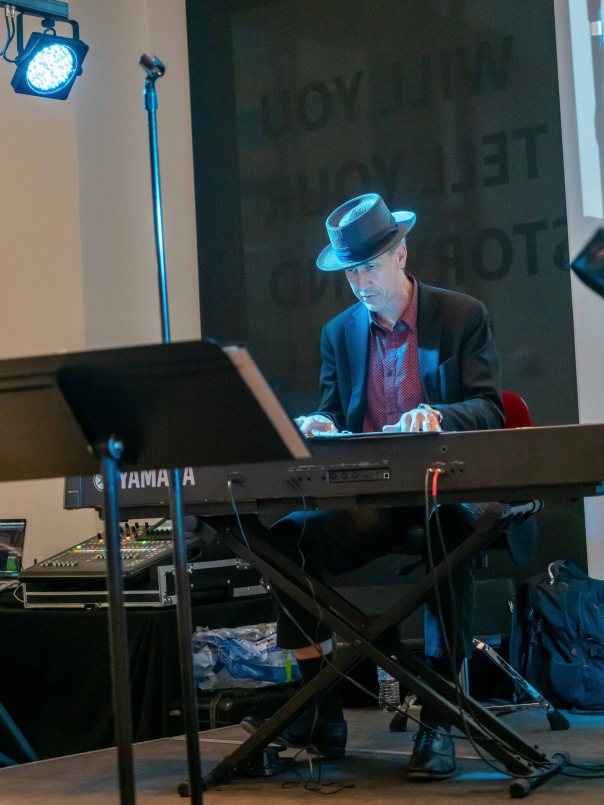
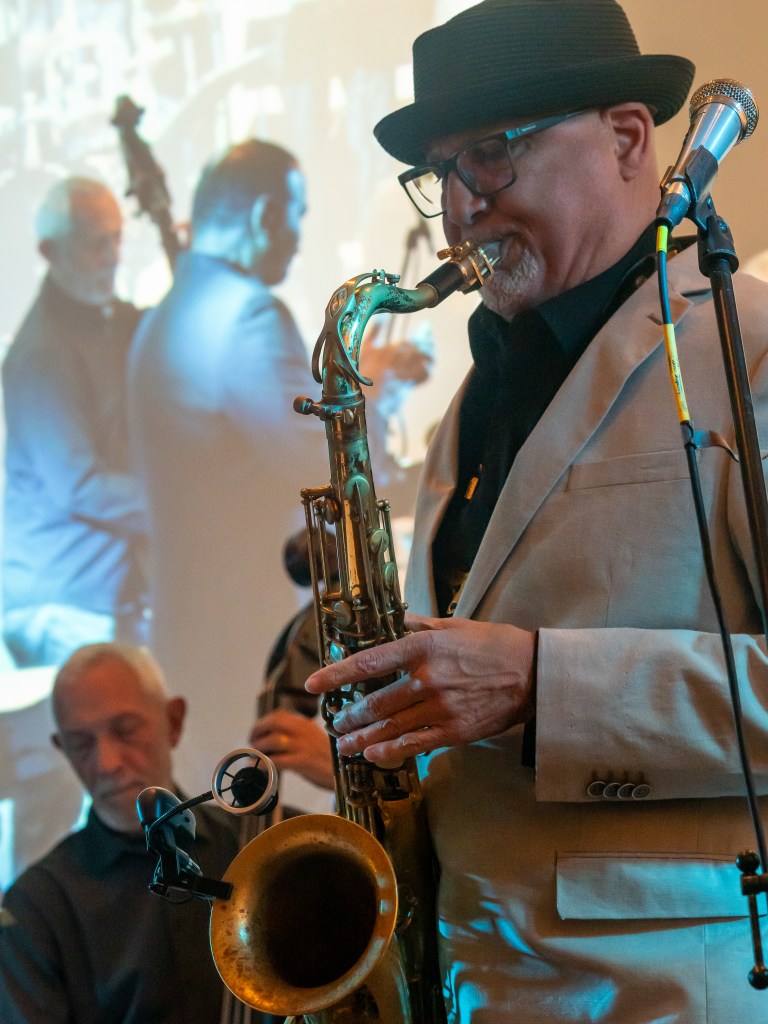
October 4, 2024, Charlotte, NC – As a listener and a sometime vocalist, my feeling is that a jazz singer backed by a piano trio can only verge on the sublime. Until a horn is added – saxophone, trumpet, or clarinet parlaying and intertwining with the vocalist – the divine nectar never quite sparkles with maximum effervescence. So it’s always a joy when the Jazz at the Bechtler series hosts a guest vocalist, for the leader of the house band, Ziad Rabie, always carries a tenor and soprano sax with him to fortify the artillery. Before Nicolas Bearde’s appearance on Friday, I hadn’t been to one of these bacchanals since Nnenna Freelon guested in May 2022, so I was behind the curve in terms of how the experience in the Bechtler Museum of Modern Arts lobby has been enhanced.

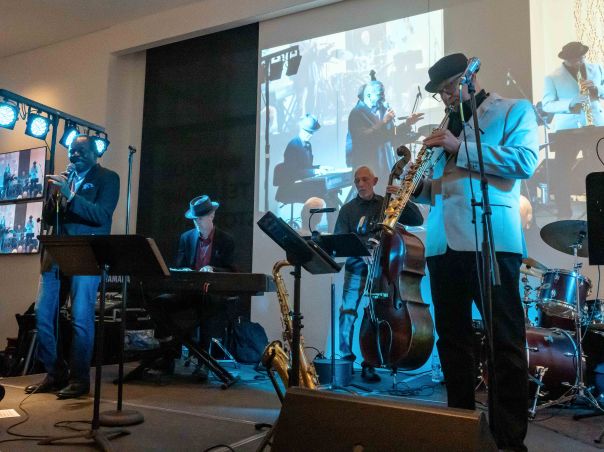
Perhaps influenced by Middle C Jazz over on Brevard Street, the Bechtler bandstand is now framed by large video monitors displaying a live feed of the concert – that is also projected as a larger-then-life backdrop upstage of the players. The effect of the live pastel projections is electrifying, especially if your sightline differs radically from the camera’s, and the projected images are helpful if your view of one of the musicians is obscured. A music stand downstage blocked my view of drummer Rick Dior sitting behind Rabie, but when I stood up briefly to snap a photo of him, I discovered that a second music stand right at his drum kit was still blocking my view. Luckily, the live feed up above him was available to us when he took a solo.

Bearde last sang in Charlotte at the tenth anniversary celebration of the Bechtler series staged at the adjoining Knight Theater in January 2022. That was my gateway to his discography, which certainly reinforced my notion that he agreed with me on jamming with a horn. There were plenty of Nat King Cole tracks online that were delightful to discover from his recent album on Spotify, along with a few Johnny Hartman gems on past recordings. He’s been around long enough, since before the turn of the millennium, to have accumulated two Spotify artist listings that do not overlap – and he still sounded like he’s at the top of his game. The two saxophonists who have played on Bearde’s last two albums, Eric Alexander and Vincent Herring, are both self-recommending – and they both supplied a sheaf of candidates for seamless transport to the Bechtler lobby and Ziad’s capable hands.

So did two of the songs Bearde sang in 2022, his own “Falling in Love Again” and Abbey Lincoln’s “Living Room,” both of which were reprised in more extended versions. The baritone began his set with the same song that began his 2016 album, Invitation,Burton Lane and Alan Jay Lerner’s “Come Back to Me.” Where Herring had inserted his alto, Ziad now blazed with his soprano sax, with extra space in the arrangement set aside for pianist Noel Freidline’s ruminations – all with the speed and verve of the lyric’s “turn the highway to dust, break the law if you must” spirit.

With “That Sunday, That Summer,” Bearde brought us the first of two tracks selected from his Nat Cole tribute album, both of which, not at all coincidentally, featuring Alexander on tenor sax. Bearde’s way with the song is jazzier than Cole’s 1963 saccharine hit – with its lush strings, full chorus, and glinting triangle – but I can’t say I like all the added syncopation he brings to the table. Best of the covers, to me, is a Sarah Vaughan version not to be found on Spotify. That revelation is online exclusively at Apple Music on her Jimmy Rowles Quintet album from 1974.

Bearde was entirely in his groove thereafter, beginning with his cha-cha inflected Burt Bacharach hit, “Close to You,” with some fine solos by both Ziad and Freidline – and a wonderful breakaway into 4/4 tempo in the middle of the vocal reprise – with some extra Beard/Ziad jamming afterwards. Lincoln’s “Living Room” was beautifully embroidered the second time around with an introductory Freidline fantasia intro from his electric keyboard and a regal solo from bassist Ron Brendle after Ziad’s tenor sax proclamation. Most unexpected and exciting was a new song, “Si Vous Saviez,” written by Rabie with Jennifer Shea. If you’ve heard John Coltrane’s Ballads album, you can begin to imagine the lovely sound of Ziad’s creamy, buttery intro on tenor sax, and Bearde took to the longish tune like he was seriously considering recording it on his next album.

The rest of the set included songs that Bearde has already taken to the studio, starting with the moody title tune from the Invitation release, which saw a fine intro and later solo from Ziad and, notwithstanding the comparatively mellow mood, a fine chunk of work from Dior on the solo I screened. Plucked from his Nat Cole tribute, “Thou Swell” actually began life as part of Rodgers & Hart’s A Connecticut Yankee in 1927, where its archaic language was perfectly apt. Both Ziad and Freidline contributed zippy, palate cleansing solos that readied us for the finale.

Once again it was “Falling in Love Again,” with Bearde elucidating on his composition at greater length before performing it this time. Further engaging us, he encouraged us in the audience to clap out the rhythm as Freidline, chided all through concert for his snazzy (and Sinatra-like) chapeau, pounded out a genial piano intro. Everybody was in great spirits by this point, and Ziad gave us one more reason to applaud with his screaming tenor sax.

Photos by Perry Tannenbaum