Tag Archives: Michael Abels

With a Riddling Program, Sphinx Virtuosi Youthfully Inspire Symphony’s Gala

Review: Sphinx Virtuosi @ Charlotte Symphony’s Annual Gala

By Perry Tannenbaum
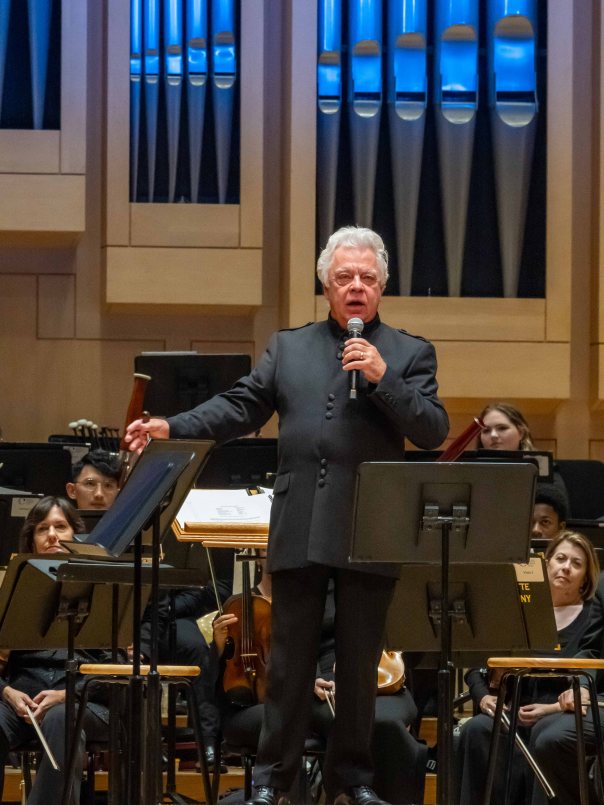
October 9, 2024, Charlotte, NC – It’s always encouraging when an annual gala at least partially sheds its patrician aura of black ties, ball gowns, and champagne toasts. So I heartily applauded Charlotte Symphony’s musical director emeritus Christopher Warren-Green when, instead of mentioning crass sums of moneys raised or needed, he notified us that a part of tonight’s proceeds would be sent to those in dire straits in Western North Carolina in the wake of Hurricane Helene. In an even more unexpected gesture, the evening’s guests, Sphinx Virtuosi, announced that they would linger in Charlotte to play an additional concert on Friday at Charlotte Preparatory School – free if you bring a Hurricane Helene contribution.

They all worked well, together and apart, in gifting the gala audience at Belk Theater with a fine show, though not exactly what was initially planned. Or even what was listed in the printed program. Instead, a series of changes to the program were announced by email before and after the program went to press. Even then, a couple of new wrinkles emerged after the lineup seemed to be settled in the last inbox update on September 19. Maybe the plutocrats who dined and toasted earlier at the pre-concert cocktail and dinner sessions got a heads-up.

As a result of the first alteration, changing the title of LA-based composer Levi Taylor’s from American Forms to Daydreaming (A Fantasy on Scott Joplin), the opening segment of the concert became an explicitly extended tribute to Joplin. Actually, the Overture from Joplin’s only surviving opera, Treemonisha (1911), was nearly as new as Taylor’s offering and similar in length. The orchestration chosen by Warren-Green, arranged by Jannina Norpoth with Jessie Montgomery (a Sphinx Medal of Excellence winner in 2020), was premiered last year in Toronto as part of a “reimagining” of Joplin’s opera, so it didn’t quite sound like any of the handful of versions that Spotify can offer. Principal clarinetist Taylor Marino was brilliant playing the catchy recurring theme, an instrumental assignment that Norpoth reaffirms, but principal trumpeter Alex Wilborn’s spot struck me as a lively improvement upon Norpoth’s predecessors.

In a shorter, no-intermission program, it was nice to have a proper mood-setter leading into Taylor’s premiere – and Sphinx Virtuosi’s entrance – rather than a genial throwaway aperitif. Paradoxically, the Joplin overture, aimed for an opera house, was not as raggy as Taylor’s new work, an homage to the Joplin music we’re most familiar with. Personably introduced by cellist Lindsey Sharpe, the piece had an engaging solo spot for principal cellist Tommy Mesa and a refreshing jauntiness. Amazing how much more highbrow and classical the Joplin idiom sounds when you ditch the piano so justifiably associated with the “King of Ragtime.” Taylor took a well-deserved, enthusiastically applauded bow when concertmaster Alex Gonzalez pointed him out in the audience.

Sphinx’s outreach to Helene victims is quite natural when you consider its DNA. Conceived in Ann Arbor at the University of Michigan in 1997, Sphinx quickly became an important of young Black and Latino talent with its annual junior and senior competitions, open to musicians up to age 26, and its Performance Academy, a competitive boot camp, where faculty members include Norpoth, Gonzalez, and second violinist Rainel Joubert – who would play in the Delights and Dances string quartet when the Michael Abels composition, commissioned by Sphinx, had its Charlotte premiere.

The full ensemble departed – all too briefly – as Warren-Green and CSO delivered a more familiar Leonard Bernstein overture to his opera, Candide. If Sphinx had lingered offstage longer, the CSO performance might have been more prudently paced. Dynamics were OK, but when piece started off too swiftly, there was little room for Symphony to speed up when the piece thundered and thrust to its climax. The whole acceleration plus crescendo effect, so exciting in multiple Rossini overtures, was never even a possibility, surely the nadir of Warren-Green’s work with CSO as far back as I can remember.

Then the listed world premiere of Curtis Stewart’s Drill went AWOL, along with guest percussionist Britton-René Collins. This surprise was less of a disaster than the lackluster Bernstein, for the Sphinx Virtuosi returned instead with Samuel Coleridge-Taylor’s Allegro Moderato, the opening movement from his Four Novelleten (1903) for string orchestra. So many of Coleridge-Taylor’s principal works have yet to be recorded that it’s probable that this excavation, listed as Op. 59 in Wikipedia, has yet to get a hearing outside of Sphinx’s orbit – another gladdening example of the ensemble’s vital and generous outreach.

All the remaining works were glorious, throwing the Bernstein blooper far into our rearview mirrors. It helped a little to know your Vivaldi when Sphinx moved upstage to merge with the CSO as tango king Astor Piazzola’s “Verano Porteño (Buenos Aires Summer)” movement from his Four Seasons of Buenos Aires filled the stage with violinist Adé Williams as guest soloist. For those who saw Aisslinn Nosky playing the complete Vivaldi at the Charlotte Bach Festival, the Piazzola Four Seasons evoked some pleasant nostalgia, especially since the Festival Orchestra, like the Virtuosi, often performs without a conductor.
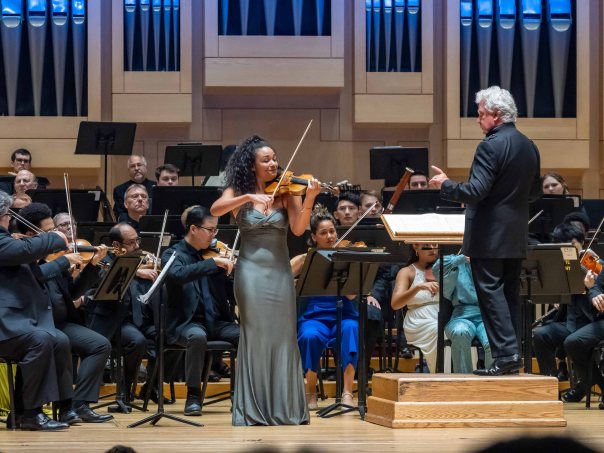
Williams, a winner of the Sphinx Junior Division back in 2012, still played with youthful vitality and joy. Both Symphony and Warren-Green were obviously fond of her playing, her swooping glisses, and the tango twists Piazzola brought to his baroque inspiration. Controversial in Argentina for his modifications of the trad tango – cab drivers often turned him away! – this summer piece was popular enough for Piazzola to draw encouragement for him to complete his seasonal cycle. The Belk audience responded favorably as well, with their first standing O of the evening.

The Abels piece was an even longer, grander gatherum, with the string quartet arriving upstage where Williams had just stood. Joubert and CSO principal second violin were to Warren-Green’s left opposite CSO principal viola Benjamin Geller and cellist Gabriel Cabezas, the Sphinx Medal of Excellence winner in 2016. The Delights were rather delicate before the composer, who famously co-wrote the acclaimed Omar with Rhiannon Giddens, gradually ramped up to the Dances.Cabezas was more than able to eloquently launch Abel’s slow-building piece, which tacked leftward after his engaging solo with additional solo spots for the rest of the quartet members.
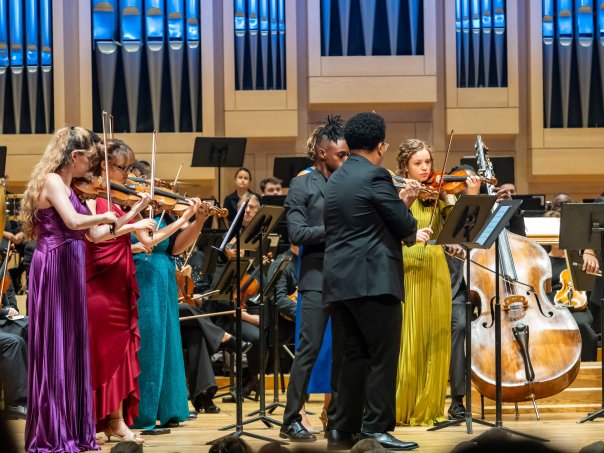
Nor was Abels in any hurry to layer on the orchestra, for their first contributions were background pizzicatos behind the full quartet before they picked up their bows. The piece is no less than the title work on a 2013 album recorded by the Harlem Quartet and the Chicago Sinfonietta conducted by Mei-Ann Chen. Definitely worth a listen if you missed the gala – and Abels’ Global Warming leads off the Sphinx Virtuosi’s recent Songs of Our Times release, their first album. Some rousing fiddling embroidered the loud and lively climax of Delights & Dances, easily the most epic piece of the night, programmed in exactly the right spot.

Mexican composer Arturo Márquez’s Conga del Fuego Nuevo (1996) was no less appropriately placed in the encore slot, starting up white-hot and danceable without lowering its flame. Fully recovered from his Bernstein misadventure, Warren-Green not only led the combined ensembles zestfully, he exhibited some winsome showmanship of his own, not only bidding Wilborn to stand up for his solos on muted and unmuted trumpet, but also commanding the winds and the brass to rise when moments came. How can a piece we’ve never heard before sound so familiar? Maybe via discreet borrowing and insistent repetition. No matter, CSO’s jolly encore became a curtain call at the same time – and a wonderful welcome to the 2024-25 season. Hopefully, the Coleridge-Taylor and the Abels were previews of the next Sphinx recording.

Photos by Perry Tannenbaum

Black Lives Really Do Matter in Spoleto’s Stirring Counter-Crusade

Review: Opera, Chamber, and Orchestral Music @ Spoleto Festival USA

By Perry Tannenbaum

Dive In by Leigh Webber leighwebber.com

Recognition of the #BlackLivesMatter Movement and the We See You White American Theatre manifesto (issued by a coalition of BIPOC artists in 2020) were certainly on Nigel Redden’s mind when he decided that the 2021 Spoleto Festival USA would be his last as general director. White and long-tenured at the Charleston arts fest, Redden saw himself personifying what needed to be changed, not merely in American theatre but across the nation’s arts.

Yet that wasn’t to say that Spoleto was backward in infusing diversity into its programming or in embracing contemporary, cutting-edge work in its presentations of music, theatre, and dance – which made Redden’s swan song, at a Festival that constricted and hamstrung by Covid-19, all the more poignant. But all Redden’s work was not truly done, even after he officially stepped down last October, for there was one grand project of his that had yet to be completed. Spoleto’s commission of Omar, the much-anticipated new opera by Rhiannon Giddens and Michael Abels would at last be unveiled after being shelved for two years.Dive In by Leigh Webber leighwebber.com

Based on the slim autobiography of Omar Ibn Said, the only known narrative by an American slave written in Arabic, Giddens’ new work was appropriately co-commissioned by the University of North Carolina, for Omar’s servitude began in Charleston before he escaped to a more benign slaveholder up in Fayetteville, NC. Rather than letting this world premiere stand as an isolated testament to Redden’s legacy – or a belated rebuke targeting the infamous Muslim ban of 2017 – incoming general director Mena Mark Hanna has emphatically made Omar the tone-setting centerpiece of his first Spoleto.

Predictably enough, Giddens and Abels sat for a public interview with Martha Teichner on the afternoon following the premiere, just a few hours before she and her husband, Francesco Turrissi, appeared in an outdoor concert at Cistern Yard. Five days after the world premiere at Sottile Theatre, the principal singers from Omar and the choir resurfaced at Charleston Gaillard Center for a “Lift Every Voice” concert, further affirming Black Lives. But that theme, as well as Ibn Said’s African origins and Islamic faith, suffused the Festival’s programming more deeply than that.2022~Spoleto-142

In the jazz sector, for example, two African artists were featured with their ensembles at the Cistern on successive night after Giddens’ concert, Senegalese singer Youssou N’Dour and his orchestra followed by South African pianist Nduduzo Makhatini and his quartet. More importantly, saxophonist Ravi Coltrane, three years after participating in a Geri Allen tribute, paid homage to his distinguished mom, harpist/organist/composer Alice Coltrane and her 1971 Universal Consciousness album, a spiritual landmark that defined Indocentric jazz, laced with flavorings of Africa, India, Egypt, and the Holy Land.Dive In by Leigh Webber leighwebber.com

Unholy Wars was another Spoleto commission, with tenor Karim Sulayman as its lead creator, furthering the pro-Muslim thrust of the Festival’s opera lineup. Taking up Claudio Monteverdi’s Il combattimento di Tancredi e Clorinda, the 1624 opera that extracted its tragic love story from Torquato Tasso’s epic Jerusalem Delivered, Sulayman boldly flipped the First Crusade narrative. Sulayman, a first-generation American born in Chicago to Lebanese immigrants, conceived a counter-Crusade, attempting to render vocal compositions by Monteverdi, Handel, and others through the perspective of those defamed and marginalized by the prevailing white Western narrative.Dive In by Leigh Webber leighwebber.com

Portraying the narrator, Sulayman chiefly championed the warrior woman Clorinda – who needed to be white-skinned and convert to Christianity for 17th century Europe to see her as worthy of Tancredi, the valiant Christian knight who mistakenly slayed his beloved in combat. Soprano Raha Mirzadegan as Clorinda outshone bass baritone John Taylor Ward’s portrayal of Tancredi, while dancer Coral Dolphin, devising her moves with choreographer Ebony Williams, upstaged them both. We could conclude, in stage director Kevin Newberry’s scheme of things, that Dolphin’s dancing silently represented the Black beauty that Clorinda was never allowed to be.

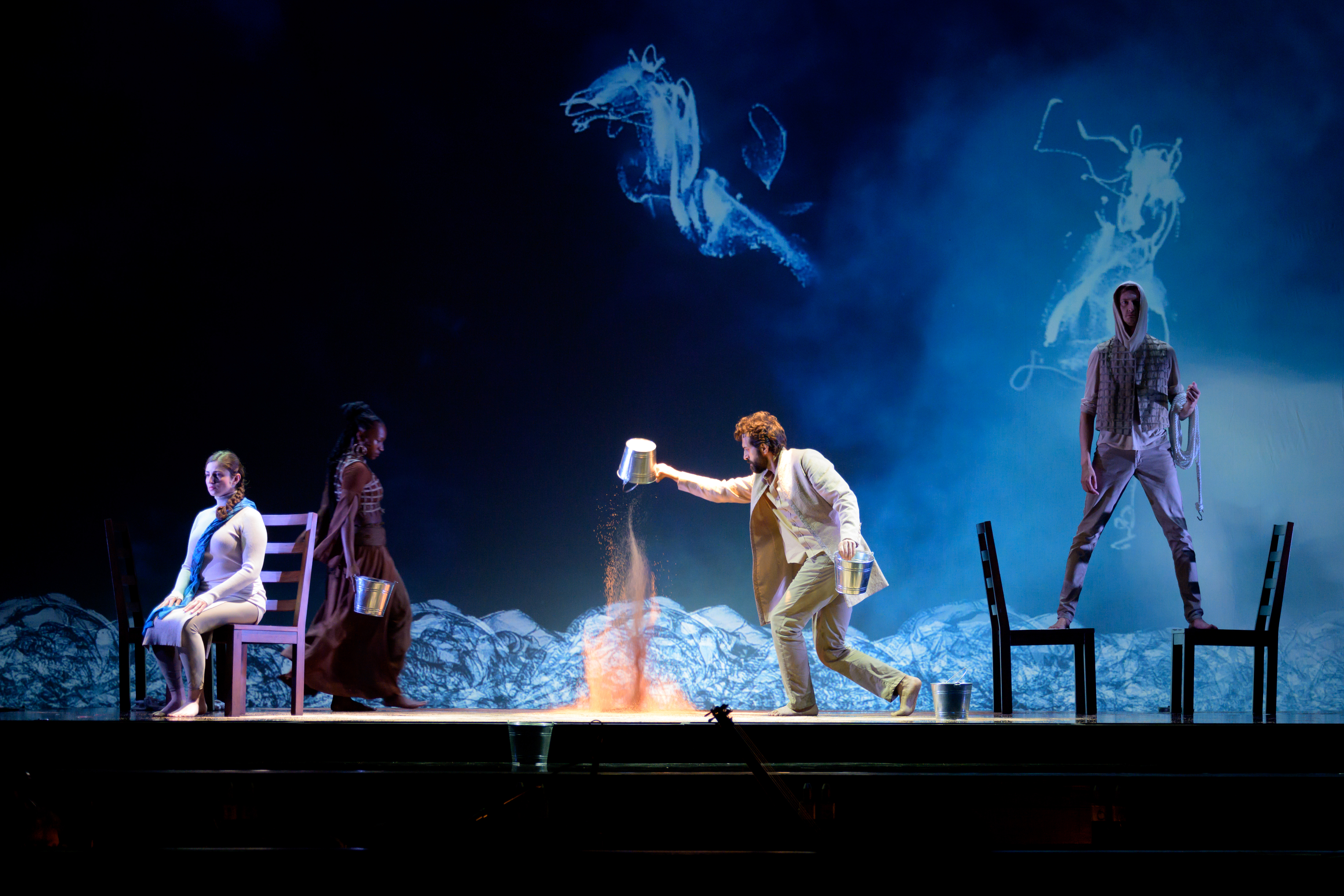
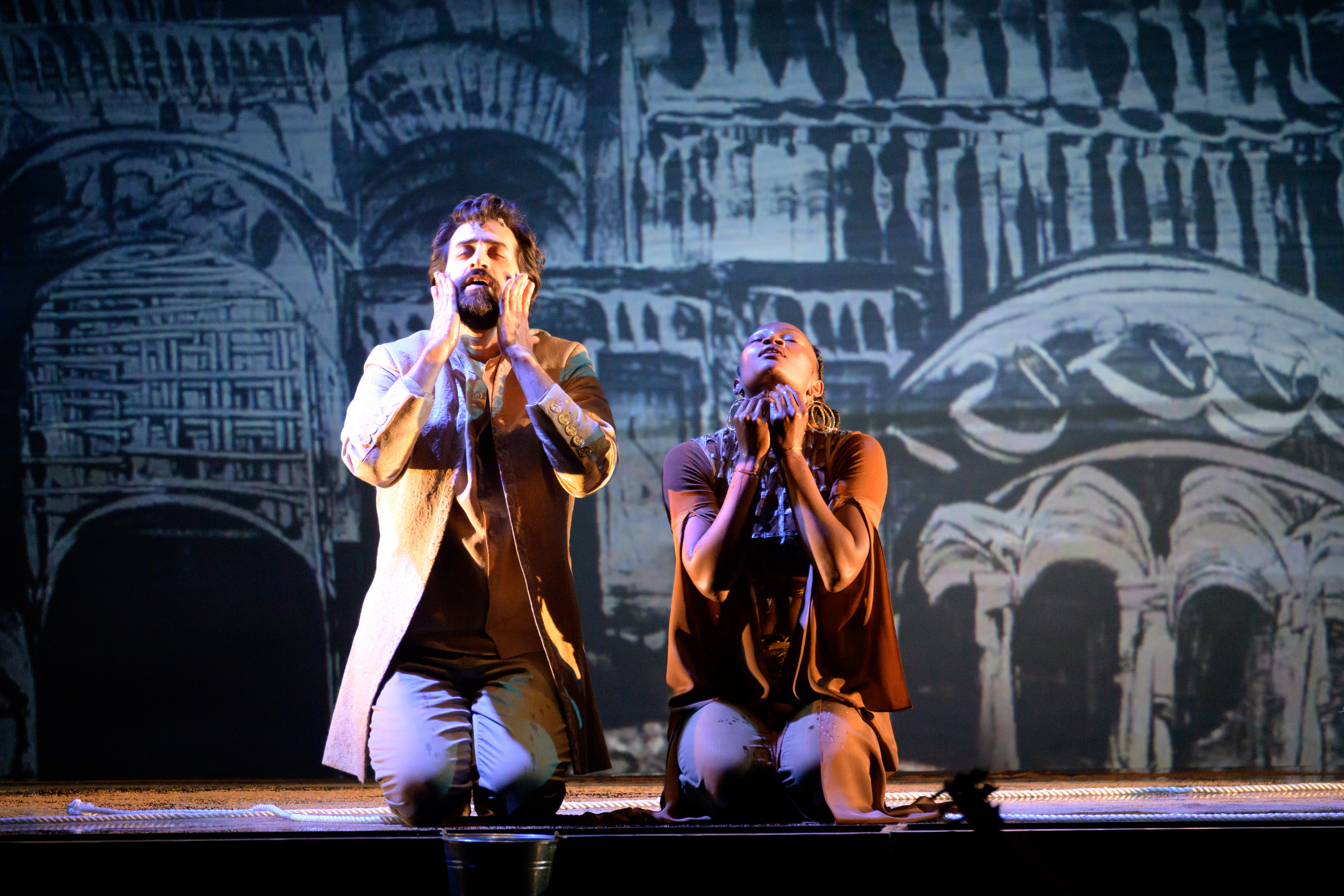
Known for directing such cutting-edge operas as Doubt, Fellow Travelers, and The (R)evolution of Steve Jobs, Newberry had no qualms about creating huge disconnects between his actors’ actions and the Italian they sang. Costume designer David C. Woolard was similarly liberated in attiring them, evoking Lawrence of Arabia more readily than Richard the Lion-Hearted. Water, sand, heavy rope, and four simple chairs supplanted onstage scenery at Dock Stage Theater, but Michael Commendatore’s steady stream of animated projection designs, coupled with the production’s supertitles, more than compensated for the sparseness onstage, keeping us awash in sensory overload. If you tried to keep pace with the supertitles on high, sometimes barely legible, you could easily be distracted from the action below.

Consulting your program booklet to determine what was being sung by which composer would only have compounded your confusion. Best to listen, look, and enjoy. For if this sensory-rich spectacle – laden with mysterious sand and water ceremony – strayed far from fulfilling Sulayman’s intentions, the music, the voices, and the dance yielded constant pleasure, wonder, and delight.Dive In by Leigh Webber leighwebber.com

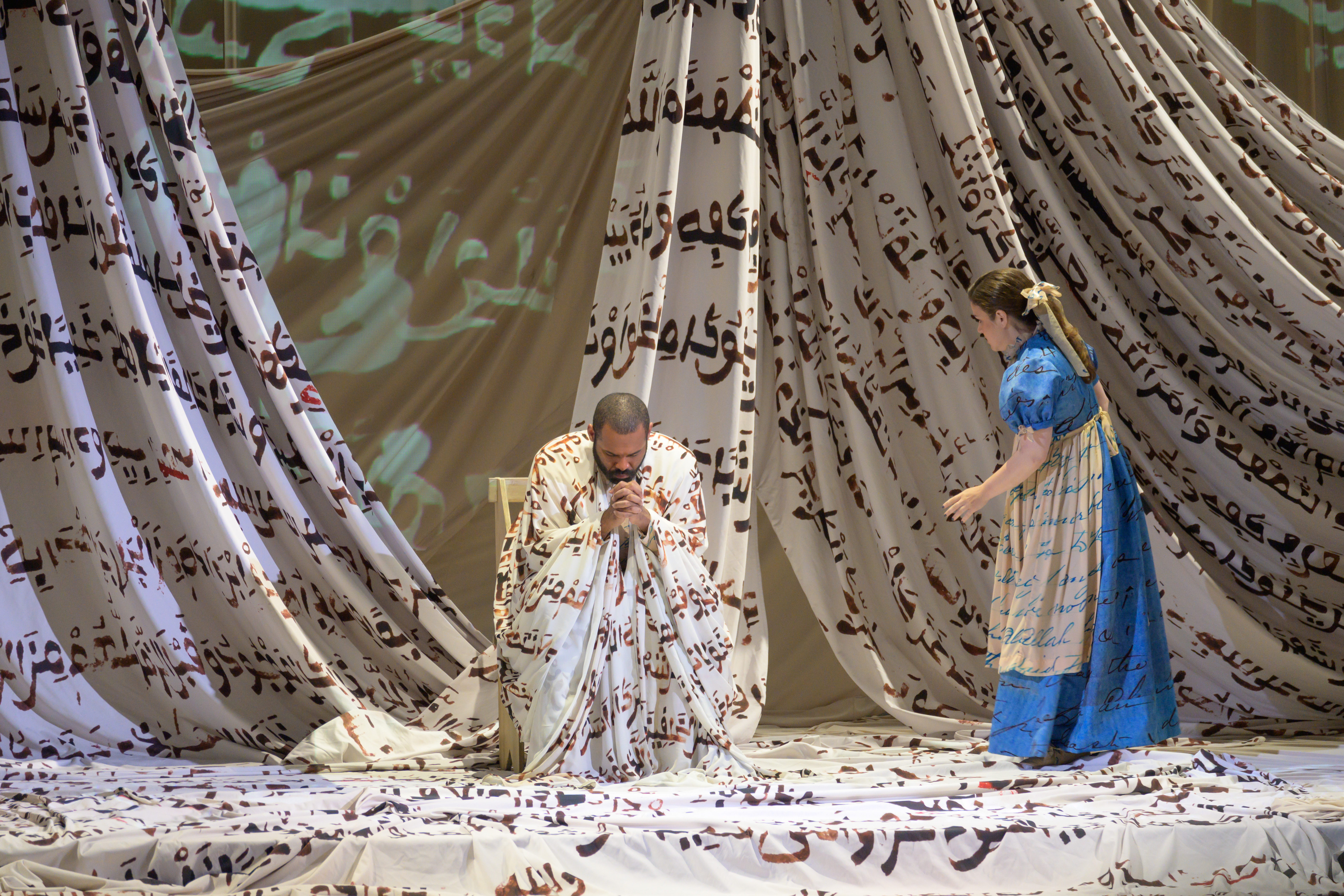
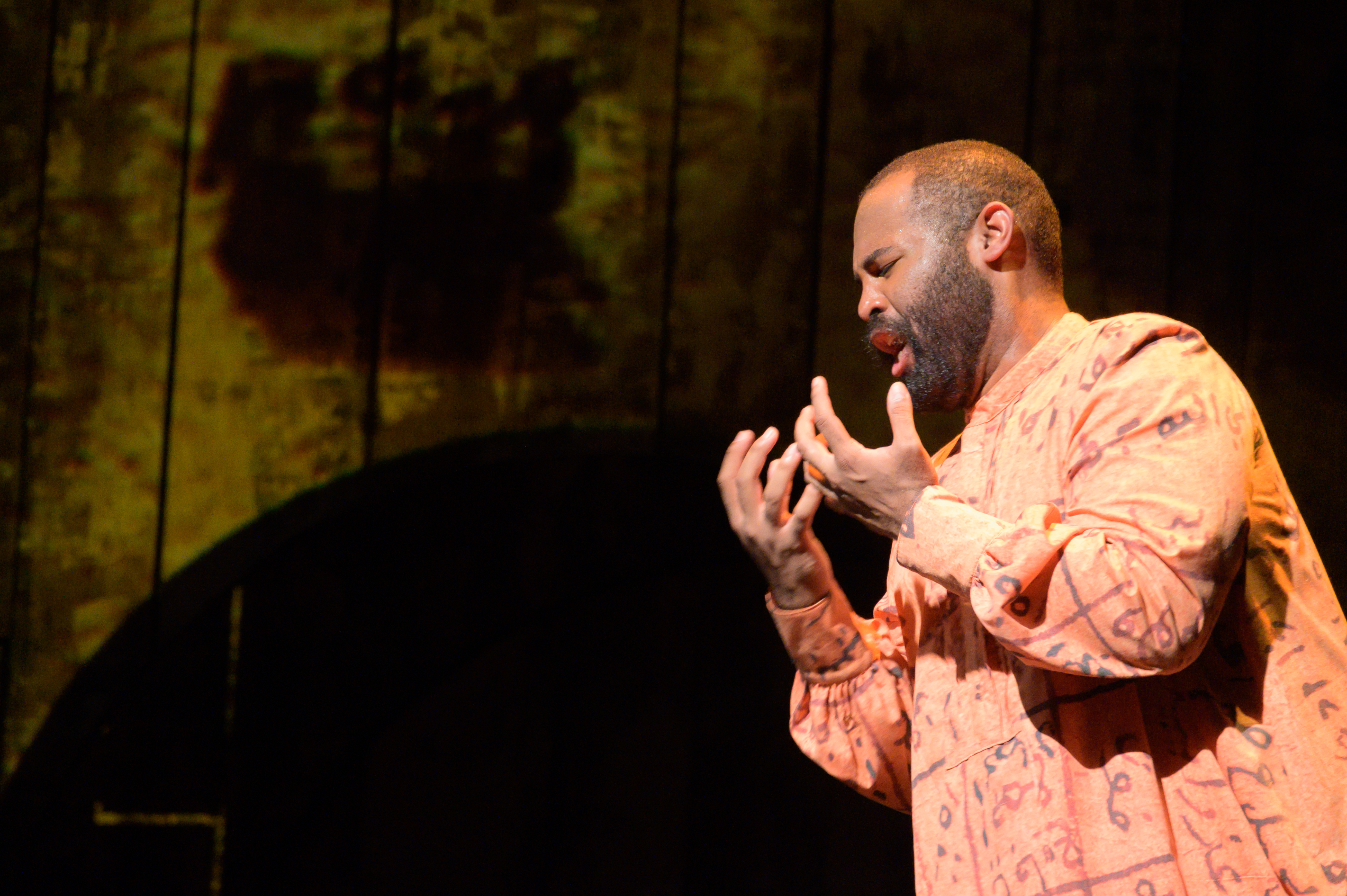
More touted and deliciously marketable, Giddens’ Omar proved to be more treasurable and on-task, providing tenor Jamez McCorkle with a career-making opportunity in the title role. Directing this stunning world premiere, director Kaneza Schall is laser-focused on the most pivotal event in Said’s life in America when, imprisoned in Fayetteville, he is released from jail and purchased by a benign master because of he has – miraculously, in the eyes of local yokels – written in Arabic script on the walls of his cell.

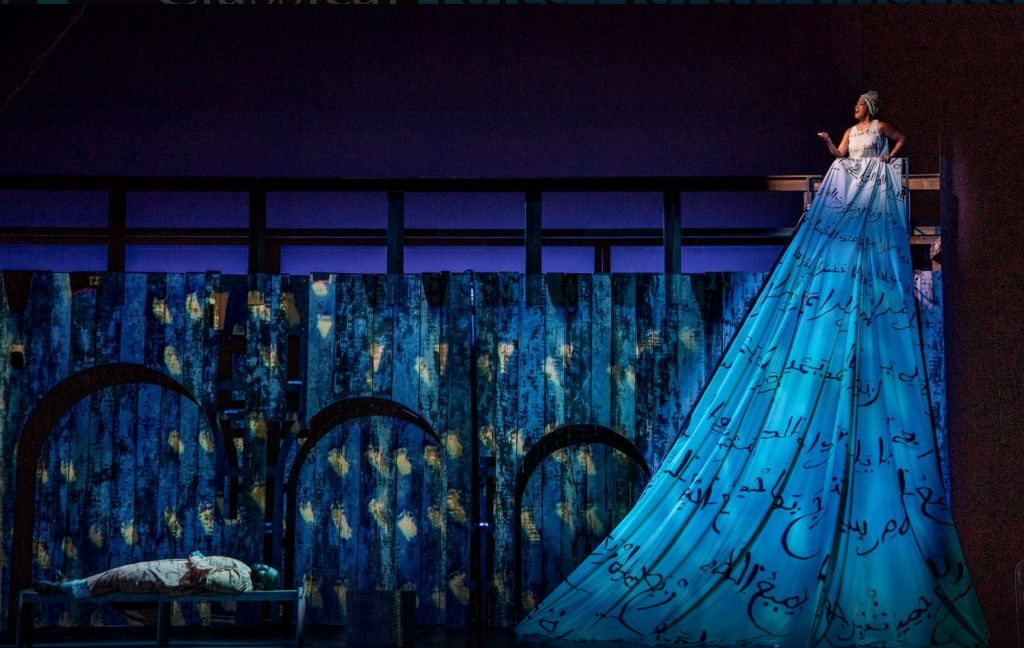
Written and printed language, from the floor upwards to the Sottile’s fly loft, is everywhere in Schall’s concept: dominant in Amy Rubin’s set, Joshua Higgason’s video, even permeating the costumes by April Hickman and Micheline Russell-Brown. If you ever believed the libelous presumption that Africans were all brought to America bereft of any literacy, maintained in their pristine backwardness by their benevolent masters, Schall’s vision of Omar was here to brashly disabuse you.Dive In by Leigh Webber leighwebber.com

And if you were under the impression that Africans came ashore in Charleston without any coherent Abrahamic religion, their poor souls yearning to be redeemed by the beneficence of Christianity, Giddens labored lovingly to enlighten you, the beauty and spirituality of her score enhanced by Abels’ deft orchestrations. As a librettist, Giddens could have benefited from some discreet assistance – and the challenge of scoring somebody else’s text. Melodious and religious as it is, Omar could stand to be a more dramatic opera, and as a librettist, Giddens could have usefully been more detailed.

Stressing Said’s spirituality, Giddens neglects his intellect, never referencing the range of his studies or the full spectrum of his manuscripts. Nor is there a full fleshing-out of why Said was imprisoned in Fayetteville or how it could be that Major General James Owen could take him home without returning the fugitive slave to his previous master, described in The Autobiography as “a small, weak, and wicked man, called Johnson, a complete infidel, who had no fear of God at all.”Screenshot 2022-06-27 at 16-55-14 Spoleto Opera Honors An Extraordinary Slave Whose Life Mattered Classical Voice North America

The embellishments that Giddens gives us are all gorgeous. Owen’s daughter, Eliza, has a beautiful aria sung by Rebecca Jo Loeb, entreating her dignified dad to see the providence in Omar’s coming to their city. Further mentoring our hero, soprano Laquita Mitchell was Julie, a fellow slave in Fayetteville who will vividly remember her previous meeting with Omar at a Charleston slave auction. More majestically, mezzo-soprano Cheryse McLeod Lewis is a recurring presence as Omar’s mother, Fatima. Long after she is slain by the marauders who enslave Omar, she comes back to her son in a dream, warning him that Johnson is fast approaching to murder him. Mitchell and Lewis subsequently team up to urge Omar to write his story, a summit meeting with McCorkle that is the clear musical – and emotional – high point of the evening.

Plum roles also go to baritone Malcolm MacKenzie, who gets to sing both of Omar’s masters, the cruel and godless Johnson before intermission and the benign, bible-toting Owen afterwards. The question of whether Said sincerely converts from Islam to Christianity is pointedly left open. Notwithstanding his utter triumph, we probably have not seen the full magnificence that McCorkle can bring to Omar, for he was hobbled in the opening performances, wearing a therapeutic boot over his left ankle that I, for one, didn’t notice until he resurfaced as the highlight of the “Lift Every Voice” concert, bringing down the house with a powerful “His Eye is on the Sparrow.”Dive In by Leigh Webber leighwebber.com

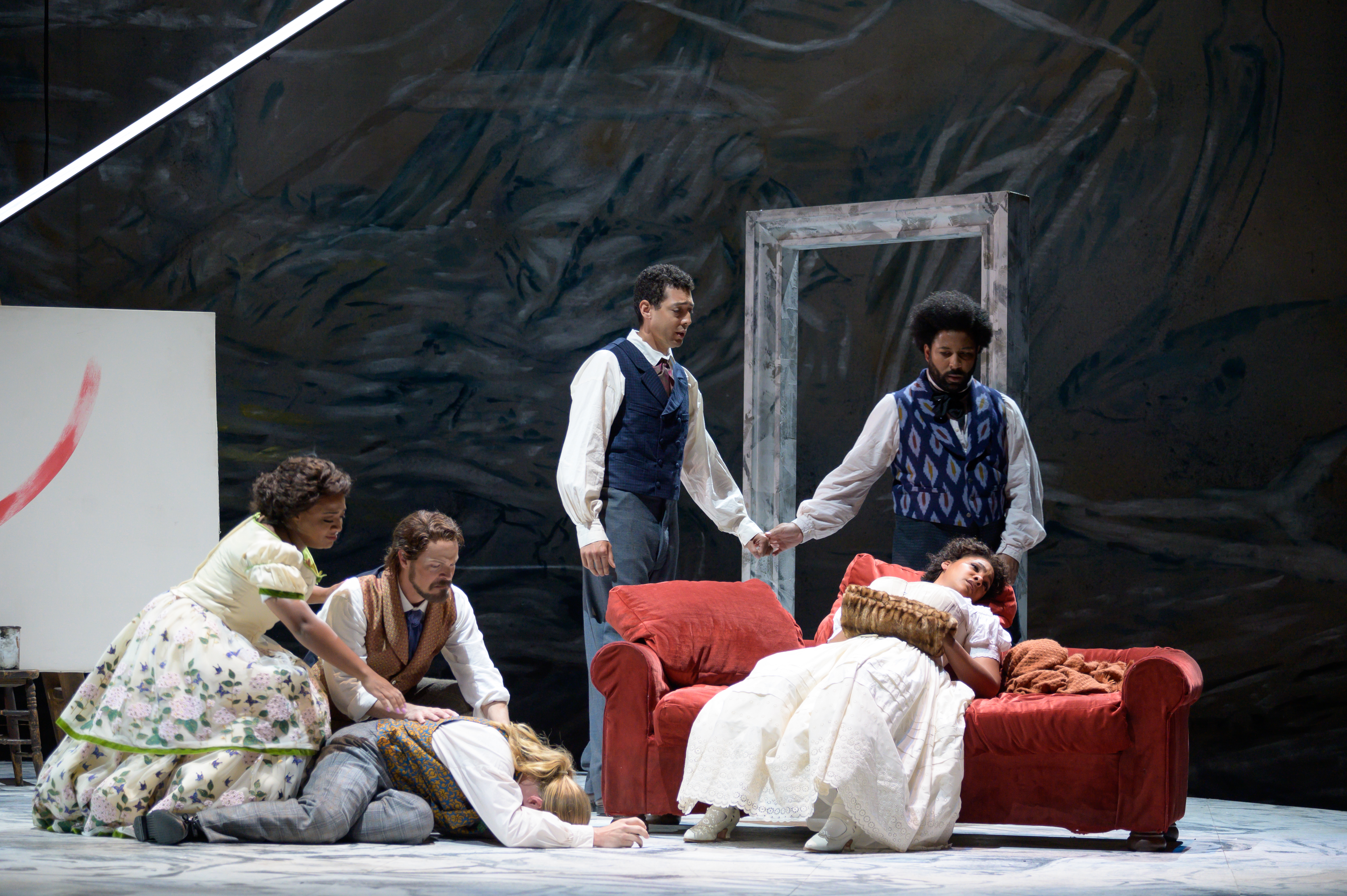
Scanning the remainder of Spoleto’s classical offerings, I’m tempted to linger in the operatic realm, for Yuval Sharon’s upside-down reimagining of La bohème at Gaillard Center, despite its time-saving cuts to Act 2, completely overcame my misgivings about seeing Puccini’s four acts staged in reverse order. Yet there were more flooring innovations, debuts, and premieres elsewhere.52126095047_f231ab5e32_o

Program III of the chamber music series epitomized how the lunchtime concerts have evolved at Dock Street Theater under violinist and host Geoff Nuttall’s stewardship. Baritone saxophonist Steven Banks brought a composition of his, “As I Am,” for his debut, a winsome duet with pianist Pedja Muzijevic. Renowned composer Osvaldo Golijov, a longtime collaborator with Nuttall’s St. Lawrence Quartet, was on hand to introduce his Ever Yours octet, which neatly followed a performance of the work that inspired him, Franz Joseph Haydn’s String Quartet, op. 76 no. 2.

2022~Spoleto-238.jpg

Upstaging all of these guys was the smashing debut of recorder virtuoso Tabea Debus, playing three different instruments – often two simultaneously – on German composer Moritz Eggert’s Auer Atem for three recorders and one player. Equally outré and modernistic, More or Less for pre-recorded and live violin was a new composition by Mark Applebaum, customized for Livia Sohn (Nuttall’s spouse) while she was recuperating from a hand injury that only allowed her to play with two fingers on her left hand. If it weren’t bizarre enough to see Sohn on the Dock Street stage facing a mounted bookshelf speaker, the prankish Applebaum was on hand to drape the speaker in a loud yellow wig after the performance was done.

On the orchestral front, two works at different concerts wowed me. Capping a program at Gaillard which had featured works by György Ligeti and Edmund Thornton Jenkins, John Kennedy conducted Aiōn, an extraordinary three-movement work by Icelandic composer Anna Thorvaldsdottir. Hatching a soundworld that could be massively placid, deafeningly chaotic, weirdly unearthly, or awesome with oceanic majesty, Aiōn decisively quashed my urge to slip away to The Cistern for Coltrane and his luminous harpist, Brandee Younger. We were forced to arrive a full 30 minutes after that religious rite began.2022~Spoleto-260

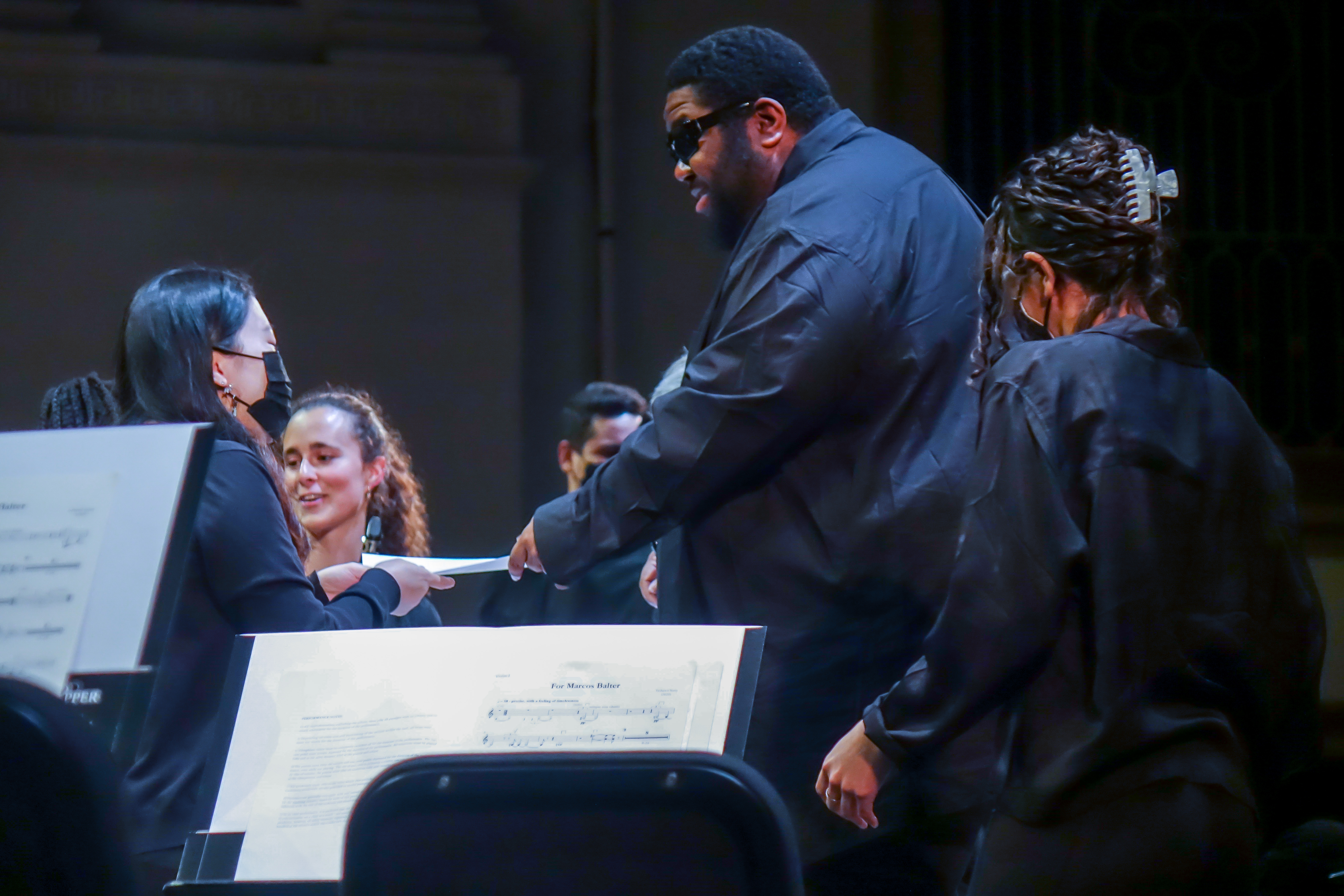
My final event before saying goodbye to Spoleto 2022 treated me to sights I’d never seen before. On an all-Tyshawn Sorey program, Sorey ascended to the podium at Sottile Theatre and took us all to a pioneering borderland between composition and improvisation that he titled Autoschiadisms. Instead of a baton, Sorey brandished a sharpie beating time, sheets of typing paper with written prompts, or simply his bare hands making signals. Sometimes Sorey simply allowed the Spoleto Festival USA Orchestra (splendid as usual) to run on autopilot while he huddled over his score, writing new prompts with his sharpie on blank pages before holding them high.2022~Spoleto-273

And the music was as wonderful as it was exciting, clearly an advance upon the other compositions on the bill, For Roscoe Mitchell and For Marcos Balter, conducted respectively by Kennedy and Kellen Gray. In the surreal aftermath of his triumphant premiere, Sorey had reason to linger onstage during a good chunk of the intermission. Musicians from the Orchestra swarmed him, waiting patiently for Sorey to autograph the sheets of paper that the composer had just used to lead them. The ink was barely dry where the MacArthur Genius of 2017 was obliged to write some more.