Review: The Poetry of Music at St. Peter’s Episcopal Church
By Perry Tannenbaum

March 22, 2025, Charlotte, NC – You can’t say that 7th Street Concerts isn’t daring – or eclectic. Just within the past four weeks, the series has presented music ranging from the 12th to the 21st centuries, Hildegard van Bingen to Sky Macklay, with a heavy dose of Baroque writing in between. The two programs were staged just above street level in the St. Peter’s Episcopal Church sanctuary and then upstairs in the meeting hall. If that range weren’t sufficient, the latest concert featuring The Poiesis Quartet layered on spoken word by Charlotte’s poet laureate, Junious “Jay” Ward: four poems written specially for this “Poetry of Music” event.

The back-and-forth between the outré string quartet and the 2019 International Slam champ worked better than the average churchgoer would have hoped or believed. At times, the spoken word was a welcome counterbalance when the mod string compositions grew chaotic, cacophonous, or weird, for Jay’s modes were predominantly cosmic and engaged, without any lapses in lucidity. At other times, when the music grew quiet, dreary, or repetitive, it suddenly dovetailed handsomely with Jay’s rhythms and musings as a background.
It’s hard enough nowadays to discourage symphony subscribers from applauding between movements of a large orchestral work, and the corporate smiles that appear on musicians’ faces during these unexpected intervals only compound their awkwardness. “Sure, we love it when you applaud!” the performers seem to be saying through clenched teeth. So it’s been praiseworthy, both at Spoleto Festival USA and now here in Charlotte, to see musicians and conductors leaning into the idea that there shouldn’t be any applause until the end of a piece, a cluster of pieces, or the end of a concert. We can all stay in the moment longer and go home sooner.

Speaking on behalf of the quartet, cellist Drew Dansby made the request while making his acknowledgements and introductions. The pieces, about 41 minutes in length on their Spotify counterparts, would be played without any significant pauses – and without any notice about how Jay’s four poems would be wedged in. As a latecomer who had missed two-thirds of 7th Street artistic director Kristin Olson’s welcoming remarks, I may have been more disoriented than the punctual ticketholders when Poiesis readied themselves for the third movement Scherzo of Béla Bartók’s String Quartet No. 5 (if for no other reason than the printed program said it would be Quartet No. 3).
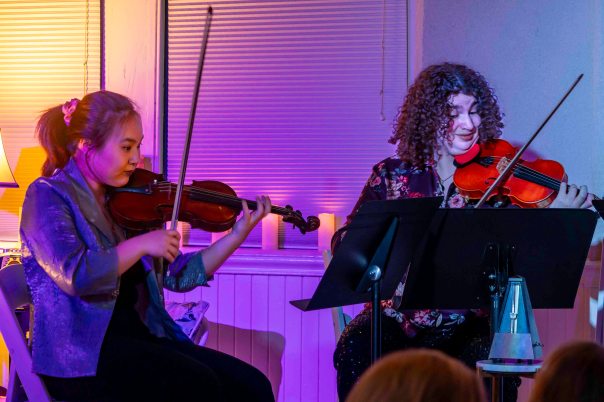
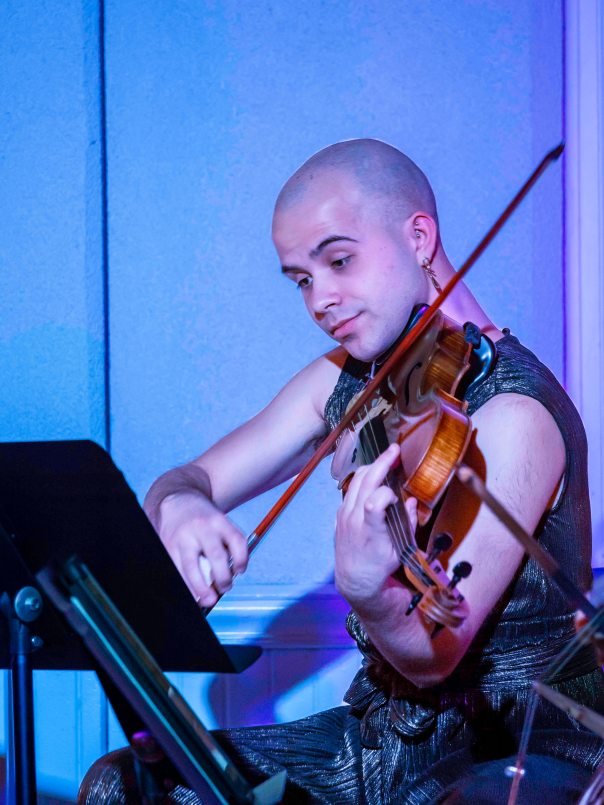
Was Jay even in the house as he began reading “Stunted,” his first poem? Lurking behind my left shoulder in the corner of the hall, outside my line of sight, he began behind a music stand holding a mic. Coming to me via a loudspeaker, his voice sounded pre-recorded! There was plenty to distract us onstage, for Poiesis doesn’t merely sport BIPOC credentials: more than a dash of gender fluidity greeted our eyes, along with assorted piercings. The first violinist’s long hair and attire, for starters, initially made Max Ball’s gender a mystery. Not to worry, Ball switched chairs at least twice with Sarah Ying Ma during the course of the program, so both genders earned first violin laurels during the evening. Choices in attire – and pronouns, if you read the program booklet – underscored the freewheeling fluidity.
Bartók (1881-1945) had completed five of his six string quartets before Dmitri Shostakovich had completed his first, so he is undoubtedly the wellspring for the modern rep. The Tokyo Quartet recording of the complete string quartets has been my favorite for over four decades. Since vinyl and cassette dubs. In the meanwhile, I’ve heard spirited live accounts by the St. Lawrence Quartet at Spoleto Festival USA and by the Emerson Quartet at Aspen, the latter a two-night marathon of the complete cycle. So it was rather astonishing to hear Poiesis’ confidence as they attacked the difficulties of the Scherzo and savor their maturity in intertwining its acerbic lines and sustaining its odd Bulgarian rhythms. Later that night, it was quite astonishing to come home and read that the Poiesis violist, Jasper de Boor, was currently a student of Ayane Kozasa, a mainstay at Spoleto and a member of the revered Kronos Quartet.
The entire quartet was playing at that high level before veering off into terra incognita – four works, two complete quartets and two excerpts by composers who were all unfamiliar to me. The excerpted composers, Joe Hisaishi (1950- ) and Winston-Salem native Coleridge-Taylor Perkinson (1932-2004), were my most egregious oversights. To those in the audience who were new to the Bartók string quartet soundworld, Hisaishi’s “Phosphorescent Sea,” the second movement of his String Quartet No. 1, was no less enticing. A printed illustration of M.C. Escher’s woodcut (sadly, not the correct illustration) added further allure to the evocative piece. Sonorous harmonies evoked the oceanic calm and its immanent magic until Ball pierced through on first violin with harmonics that conjured up the bioluminescence, sounding at times more like a flute than a stringed instrument over the plucked chords of Dansby’s cello.
Perkinson’s “Calvary” quartet, built on the traditional African-American spiritual of the same name, was easily the most soulful piece of the evening – and among the pair that were most uplifting. Like “Only Black,” which had been interwoven with Hisaishi’s “Sea,” Jay’s “All the Colors” was less topical and street-smart than “Stunted” but more serious, meditative, and profound. The quiescent second movement Adagio from “Calvary,” with its moody dialogue between De Boor’s viola and Dansby’s cello, provided the most appropriate platform for Jay to be seated onstage at the center of the Poiesis Quartet. Better yet, after Ying Ma soared above the viola and the cello – with a part that could almost have been scored for a second viola – the piece comes to a complete halt, accommodating the poet perfectly.
In Many Many Cadences by Sky Macklay (1988- ), a screechy scherzo that yields grudgingly to a dyspeptic drone from the lower strings before all four members get hyper, was undoubtably the best piece on the program for Jay not to write a poem for. Described by the composer as “lonely, disjunct ends-of-phrases [that] eventually congeal and transform into new kinds of phrases and sound objects,” her best-known piece – the opener on Spektral Quartet’s Grammy-nominated Serious Business album – is militantly modern. Yet Ma and Ball were obviously having a merry time helping Macklay “stretch the listeners’ perception of cadences” until De Boor and Dansby could join the party. It would have been a hoot to hear this spray of sound cells and objects down in the sanctuary!
After Jay joined Poiesis onstage for the “Calvary” excerpt, it seemed like we were headed for an anticlimax as the poet left the stage and began circling the hall as the ensemble launched into their finale, String Quartet No. 2 by Eleanor Alberga (1949- ), the longest piece of the evening. With its many varied episodes, gorgeously stitched together, Alberga’s piece abundantly merited its length and earned our extended delight. Teeming with prickly sonorities and folksy rhythms, Alberga’s quartet perfectly bookended the program with Bartók’s.
Theatrically, it also solved the problem of how to follow Jay’s onstage powwow with Poiesis. “Growth” may not have been loftier than “Only Black” and “All the Colors,” but it was certainly more speechy and oracular. Jay recited rather than read this last poem, adding to his spontaneity and flexibility. He walked slowly toward the stage from our left when we heard his voice again, able to look across the audience as he declaimed. Most of us likely assumed he would join the musicians onstage as before. Instead, he backed away down the center aisle that split the audience while the music soared and slowed, reaching an equally unexpected pinnacle. Backlit by the stage lights, there was a bright aura around Jay as he raised his voice, before Poiesis concluded with a final frenetic flourish. It was a uniquely magical moment, as if the poet were giving the musicians his benediction.
“Look! Here you are, the impossible, tall in the midst of chaos— a rose, a bloom of color broken beautiful against a morning sun.”

 Art on My Sleeve