Tag Archives: Matthew Lopez

A Near-Sellout Crowd Proves “Some Like It Hot” Has Staying Power

Review: Some Like It Hot at Belk Theater

By Perry Tannenbaum
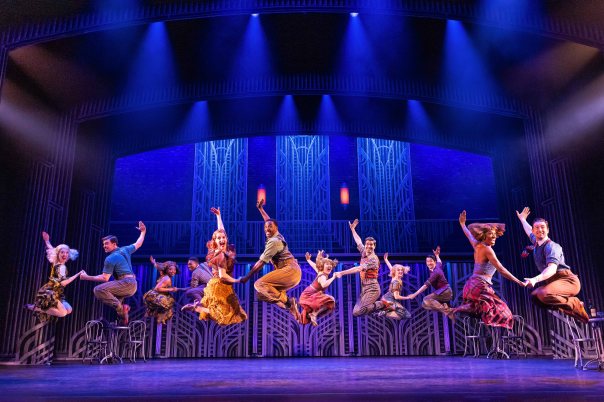
More than a decade before Cabaret, Tootsie, Victor Victoria, The Birdcage, and Kinky Boots pushed harder and harder against Hollywood’s crossdressing taboo, Billy Wilder’s SOME LIKE IT HOT smashed through in 1959. This was a deliciously adult film, and with Marilyn Monroe and Tony Curtis as the leads, deliriously appealing to hordes of teens who cherished the stars as their heartthrobs and hormone stirrers. Because of the sleeping cars and backstage dressing rooms tightly woven into singer Sugar Kane’s roving lifestyle, there was an extra edge of voyeurism for Marilyn to innocently exploit in close quarters.

True to its outlaw spirit, the story yanked us back to the days of Prohibition, legendary mobsters, and big band jazz – the speakeasy trinity. Any other kind of music in a musical adaptation of this comedy would be a turn-off for me. Listening to the sound of violins in the overture of Sugar, the first Broadway musical adaptation of Wilder’s screenplay, with music by Jule Styne and orchestrations by Phil Lang, my ears recoiled and my gorge rose as soon as the strings got involved with tremolos and sugary transitions.

No cocktails, please. Even Sugar drank hard liquor in the film. From a flask she stashed in her stocking.

Though many will question the liberties Matthew Lopez and Amber Ruffin take with Wilder’s storyline, they follow a more natural path with Marc Shaiman’s jazzier 2022 score than their 1972 predecessors. Predictably, as the current touring version confirms, they choose a more progressive PC path as well.

As soon as Sugar follows her boss, Sweet Sue, into the spotlight at Belk Theater, movie mavens and dilettantes will surely notice her radical Lopez/Ruffin makeover: Sugar isn’t lily white like the players in Wilder’s cast. Or dumb. Or objectified.

Now Marilyn wasn’t so dumb that she would pass up the chance to seduce a millionaire (it’s in the background checking that she faltered), but director/choreographer Casey Nicholaw has his leading lady, Leandra Ellis-Gaston, easing off a little when she presses that pedal. There are plenty of other places in this yarn where the comedy can be broadened.

The guys that Wilder’s risqué trailer called Marilyn’s “bosom buddies” get some subtler remodeling. Jerry still plays bass like Jack Lemmon, but he and bandleader Sue are now Black musicians. No less important, Tavis Kordell is going to take more readily to drag than his ‘50s counterpart, with a more profound and nuanced appreciation of womanhood than even Dustin Hoffman achieved as the more cerebral Tootsie. After a while, Jerry feels like he is Daphne, a transition that Kordell, a non-binary Raeford native and a UNC-Greensboro grad, is pleasingly at home with.

As Curtis did, Joe still blows the saxophone before and after he crossdresses, transforms into Josephine, and joins Sweet Sue and her Society Syncopators Band. But since Christian Borle was nearly 50 when he opened on Broadway in the role, the former Black Stache (Peter and the Starcatcher)and rockstar Shakespeare (Something Rotten!) was repeatedly chided for being old. So unlike the suave matinee idol of the film, when Matt Loehr whips off his blonde wig and reverts from Josephine to Joe, his hair is more salt than pepper.

Ranging further from the original, both Josephine and Daphne double their showbiz talents as an amazing tapdance duo – so the oldster has drawn a high-energy role. If Loehr is at pains to keep in step with Kordell and Ellis-Gaston, his huffing and puffing can only augment the comedy. Somewhat fiendishly, Nicholaw delights in giving all three leads a workout, even embracing the absurdity that all the Syncopators can become ace tapdancers – along with the waiters and bellmen they meet on the way.

Of course, when the tap duo is in disguise, they dance in high heels.

Momentum for the story – and the guys’ motivation to sequester themselves in drag – pushes from Chicago, where mobster Spats Columbo initially hires Jerry and Joe to perform. The production saves on scenery and props by keeping Spats’s killings indoors while arming him and his henchmen with pistols instead of machine guns. But Scott Pask’s scenery economies go too far.

Evidently, Pask never received the memo that all touring shows playing the Belk must be able to hit audiences in the eye with the production logo from a distance of 50 yards. Some Like It Hot not only lacks a logo on its faux curtain and proscenium, it’s missing any trace of color! Worse, the stage-filling motif is recycled over and over in various scenes, occasionally acquiring the hues of purple and turquoise. With the aid of smart bulbs, a quartet of chandeliers also reappears over and over during the band’s odyssey, as if they are stowaways on their voyage.

Hotel rooms, ballrooms, Spats’s office, and Osgood’s millionaire yacht are even more cheaply evoked. They do succeed in making Gregg Barnes’s costume designs look even more resplendent in relief, enhancing their Tony Award-winning aura.
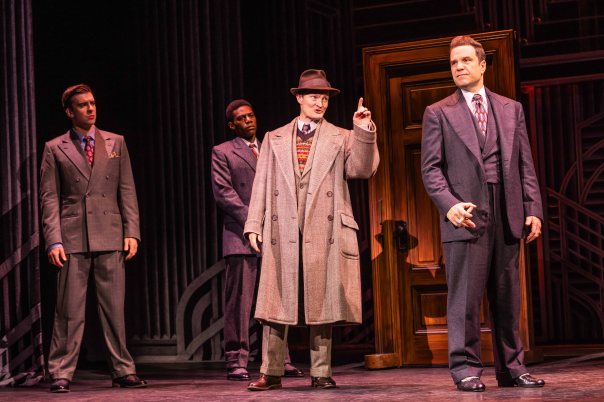
Pity poor Devon Goffman as Spats – too resplendent! If the gangleader could only be more raffish and déclassé, Lopez and Ruffin might have armed him with a larger gang and Shaiman might have begrudged him a song. Goffman draws a disappointingly clean-shaven and corporate image, too seldom onstage to tighten the dramatic tension.

Nicholaw doesn’t seem to mind the void at all. Instead, he feasts on the show’s two big chases, choreographing them for their comedic flavor while evoking one of the most beloved trademarks of silent film. Ironically, we witness much of the touring Some Like It Hot as if it were a silent film because the sound at the Belk is as muffled and foggy as ever. We’d love Tarra Conner Jones as the irascible and ebullient Sweet Sue so much more if we could decipher what she’s belting so lustily. We can be thankful, too, when Ellis-Gaston gets to vamping, for her body communicates to us more completely than her larynx.

Only Edward Juvier consistently pierces through the sonic fog as the millionaire Osgood in his screwball pursuit of Daphne. Gather round him, fellow cast members, and let him preach unto ye the gospel of enunciation.

Ultimately, Lopez and Ruffin succeed in elevating the resolution between Joe and Jerry, diversifying the love match between Joe and Sugar, and crafting a more evolved relationship between Jerry and Osgood. Shaiman had the more formidable task in concocting his score, which is probably why his Some Like It Hot often feels so effortful onstage. They’re all striving so hard to create what the film so naturally was in the first place: a road musical with cherrypicked hits for Marilyn Monroe to croon, including “Runnin’ Wild,” “I Wanna Be Loved by You,” and “I’m Thru With Love.”

You can stream the original soundtrack online and judge for yourself. With a little extra diligence, you can search out Marilyn’s rare single recording of “Some Like It Hot” and see how it measures up to Shaiman’s title song, written with lyricist Scott Wittman. Pretty well, I’d say.

Sometimes Predictable, “The Legend of Georgia McBride” Is a Raunchy, Rockin’ Delight

Review:  The Legend of Georgia McBride

By Perry Tannenbaum

While there may be “Good Rockin’ Tonight” when Elvis impersonator Casey steps up to the microphone at Cleo’s Club down in the Florida Panhandle, there isn’t a big hunk o’ love emanating from the audience. On some nights, there isn’t even an audience, except for Eddie, the super low-key club owner. As we begin Matthew Lopez’s The Legend of Georgia McBride with a bumbling, subdued curtain speech from Eddie, we’re keenly aware that both Casey and his boss are in sore need of makeovers. Our sympathies are mostly invested in Casey in this lip-syncing comedy presented by Actor’s Theatre of Charlotte. He’s younger, and the odds are against him, especially when Casey’s wife Jo informs him that his paycheck from Cleo’s has bounced once again, and they’re behind on the rent. No big surprises on the next complications that Lopez serves up to Jo and Casey’s dismay: Casey has just shelled out considerable dough on a new Elvis jumpsuit, Jo’s home pregnancy kit has just tested positive, and Eddie has been trying to work up the nerve to fire his headliner.

Seedy comedy and outré musicals have become the irreverent essence of the Actor’s Theatre brand. With Lizzie in August revisiting the sensational Lizzie Borden murders to a live heavy metal groove and now with this Georgia McBride jukeboxer, ATC has launched its 30th season – and their first full season as resident company at Queens University – by playing solidly to their strengths. Chip Decker’s set design is hardly wider than those we routinely saw at Actor’s in its old Stonewall Street location, with three distinct spaces side by side. Jo and Casey’s living room and kitchen flanks the Cleo’s proscenium on one side with the club’s dressing room on the other. What the Hadley Theater at Queens also allows is a nice thrust stage performing space where the entire cast can eventually perform Sister Sledge’s “We Are Family” for their curtain calls.

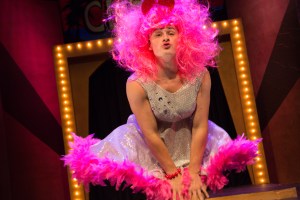
Yes, as Lopez’s title telegraphs, that’s where we’re heading. Obeying what his ledger is telling him rather than his own personal inclinations, Eddie brings in a pair of drag queens to strut his stage. Casey can stay on if he’ll tend bar, take it or leave it. Symptomatic of his sunny passivity, Casey takes it rather than daring to blaze his own trail. The new gals, Tracy Mills and Anorexia Nervosa are both more diva-like in standing up for themselves. From the moment they enter the dressing room, you expect that at least one of them will go Bette Davis on us and proclaim, “What a dump!” Rexy is the more temperamental and imperious of the two – when he isn’t so drunk that he can’t stand up. One night, when Rexy cannot be revived – let alone hoisted upon his roller skates – Casey is called on to fill in. Either he dresses up as Edith Piaf, or Eddie really will fire him.

This setup for The Legend offers more than merely the bawdiness of drag. We get to enjoy bad drag and bad lip-syncing as Casey wrestles with a bra, pantyhose, and the French language for the first time in his life. Prodded to forge his own identity in dragdom, Casey swivels his new Georgia McBride persona away from the drag trinity of Judy Garland, Piaf, and Liza Minelli. Cutting up his Elvis jumpsuit to fit his newly bolstered tush, the freshly inspired Casey adds female rockers to the customary Broadway-cabaret drag spectrum, including Connie Francis, Madonna, and numerous others beyond my ken. But even when Cleo’s begins to prosper, the sunny go-with-the-flow Casey still doesn’t have the guts to tell Jo about the transformation that has changed his fortunes. Warning: some very predictable scenes ensue between Casey and Jo.

Under the astute direction of Billy Ensley, Georgia McBride transcends this hackneyed marital turmoil with a cavalcade of winsome and hilarious performances on the Cleo’s stage. They are the springboard for tacky, butch, and saccharine creations from costume designer Carrie Cranford ranging from Nazi leather to Busby Berkeley chiffon. The inspired choreographer goes inexplicably uncredited – but I suspect some needless modesty from Ensley himself, a preeminent triple threat back in his acting days.

Judging from reviews of past productions, I’m confident that Lopez left plenty of latitude in his script for characterizations and song selections. If history is a judge, Elvis can drag either country or rock into drag, and both Eddie and Jo can be more loud, nasty and assertive than they were here. I cannot remember when James K. Flynn was funnier than he was on opening night, inconspicuously evolving from a terse mumbling rube to a glittering ebullient emcee – and beyond. Nor did Juanita B. Green rub me wrong as Jo, improbably remaining slightly adorable even when she threw her husband out. I got the idea that only a preternaturally compliant soul like Casey’s would comply.

Ensley’s casting choices for his drag queens are just as brilliant, especially since two of the three are making their debuts with the company. Over the years, Ryan Stamey has conspired on many of ATC’s wildest musicals as an actor, music director, and instrumentalist, so it wasn’t at all surprising to see him making a grand entrance as Rexy in full diva mode, on heels high enough to require a dismount. Stamey actually did multiple dismounts from those heels, doubling as Casey’s put-upon landlord, Jason, and executing bodacious changes in makeup and costumes. As Rexy, he strengthened the impact of Casey’s climactic crisis with his confessional monologue on what he has suffered to pursue his art form, a topic that Lopez should have explored more deeply. I also suspect that Stamey had a hand in formulating the eclectic playlist. I just wished that Rexy had performed more of those drag numbers.

With his elegant serenity and his razor-sharp zingers, Paul Reeves Leopard’s performance as Tracy reminded me of Coco Peru and Charles Busch, two supreme queens I’ve been fortunate enough to see live. In the midst of Casey’s crisis, he also gets a nice moment of truth at Tracy’s front door, answering Casey’s pathetic apologies and entreaties with makeup, dress, and wig discarded for the night – bathrobe-and-hairnet deglamorized, with all his steely maturity on display. Everybody seemed stronger and more mature than Casey, thanks to the sunny optimism and gentle humility Sean Riehm brought to the role. Anybody, man or woman, would let him be his or her teddy bear! Physically, Riehm is well-sculpted but not intimidating, with legs that can inspire a woman’s jealousy. Riehm’s lithe movements underscore the logic of the Elvis-to-Georgia transition: in and out of the jumpsuit, those swiveling hips are very much a part of his job description. Another warning: if you sit in the front row at the Hadley, you are a prime target for a lap dance from a drag queen. Mine was a first for me, the most memorable moment of a fun evening. You won’t be able to experience that when Jim Parsons plays Tracy in the upcoming Fox 2000 film.