Tag Archives: Matt Postle

Shakespeare, Airplanes, and Jazz in CP’s “Twelfth Night”

Review: Twelfth Night at the Parr Center

By Perry Tannenbaum
Shakespeare’s best comedies are bursting with multiple plots, and two of the most perfect – A Midsummer Night’s Dream and Twelfth Night – are the most dizzying and delightful. It is quite likely that the latter, later work was first performed on Twelfth Night of 1601 to celebrate the newborn century on January 5 (with a singing clown suggestively named Feste). Yet time, scholarship, and heavy-handed dramaturgy have tended to darken many modern-day productions.

That’s why the current Central Piedmont Theatre version at the Parr Center, adapted and directed by Elizabeth Sickerman, is so refreshing. Twelfth Night has at least four main plots: Viola’s separation and reunion with her twin brother Sebastian, Duke Orsino’s unrequited love for the widowed Countess Olivia (seconded by Sir Andrew Aguecheek), Viola’s crush on Orsino while disguised as his manservant, and the wicked prank concocted by Aguecheek, Sir Toby Belch, Feste, and Maria to send Olivia’s ambitious and party-pooping steward, Malvolio, to the madhouse.
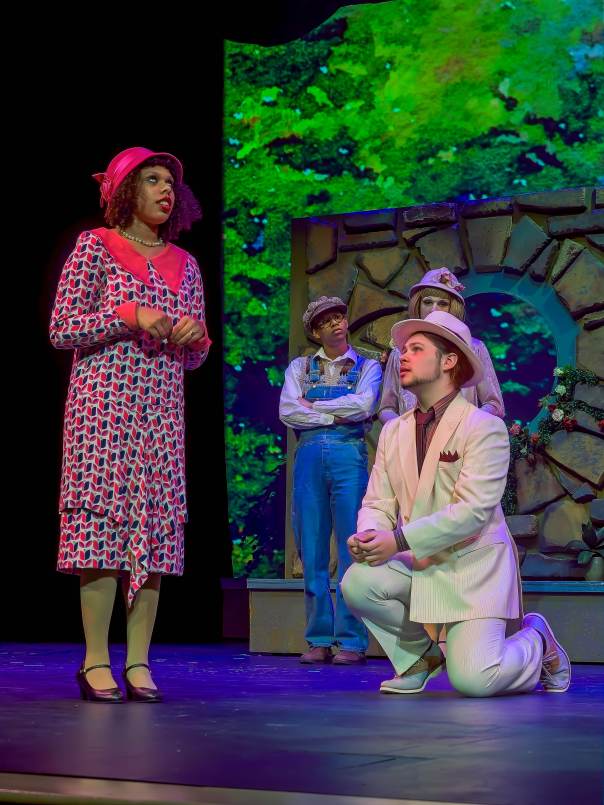
Of these, the most dominant plot should be the Viola-Orsino mess, for it sprouts so many delicious complications. Acting as Caesario, Orsino’s servant, Viola is dispatched to to Countess Olivia’s manor to plead on behalf of the Duke – only to have the Countess fall in love with her. Olivia’s inclinations toward Viola/Caesario not only enflame Orsino’s jealousy, they also lead to an absurd duel with fellow coward Sir Andrew. Meanwhile, she encounters Sebastian’s close friend, Antonio, who puts all his money in Viola’s care, mistaking her for her twin. You can easily imagine what happens when Sir Andrew makes the same mistake.

Ultimately, the mistaken identities reach the giddy point where Olivia cannot recognize her own husband just hours after their marriage. Ah, a honeymoon to remember.
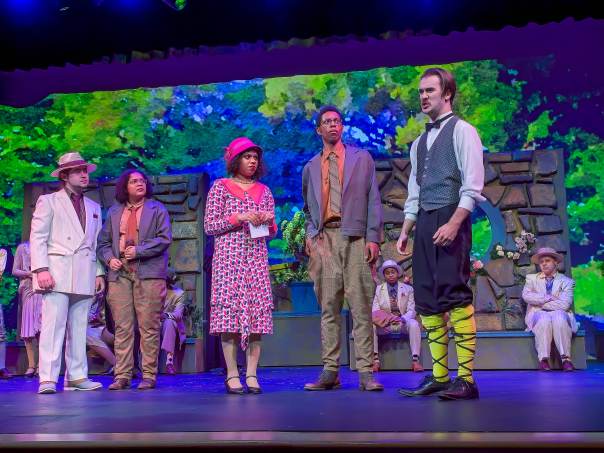
So to tip the balance toward empathizing with Malvolio, simply because he is incidentally berated as “a kind of puritan,” is rather perverse. Elsewhere, I’ve seen the steward outfitted with a Puritan’s hat. Far more stupidly, I’ve heard a theatre sage say Malvolio was modeled on Lord Protector Oliver Cromwell, born in 1599. Thomas Cromwell, Earl of Essex (1485-1540), instrumental in the English Reformation, is a more feasible candidate. Sickerman not only discards such nonsense, she transports the action from ancient Illyria, at the heel of Italy’s boot, to a coastal town immersed in the Jazz Age.

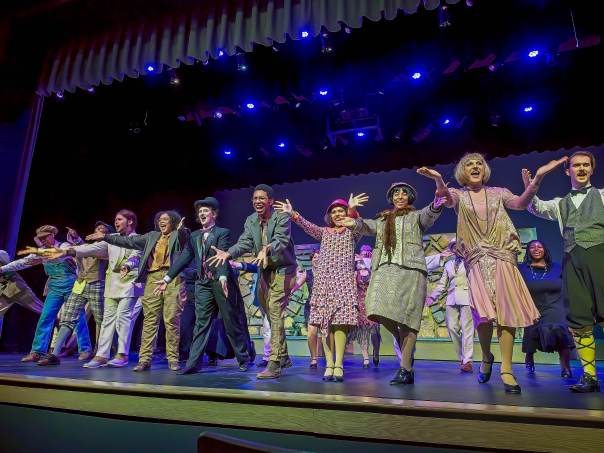
Costume designer Emily McCurdy certainly goes with the Roaring 20’s flow. Orsino and Olivia could easily pass for the recently reprised Gatsby and Daisy Buchanan on Broadway, surrounded by flappers and jazzy gallants galore. The moving pieces and projections of Jennifer O’Kelly’s scenery, more evocative of summer than winter, have enough classic detailing for Viola to sit at the foot of an Ionian pillar when describing herself sitting like “Patience on a monument.”

Nor does the music veer from the vintage of Prohibition days. Montavious Blocker has choice cuts of Duke Ellington and Sidney Bechet in his soundtrack, and just a few bars of music arranger Matt Postle’s chart for “Come Away, Death,” transformed from a lover’s lament into a jivey jump tune, are enough to conclusively vanquish melancholy, injecting Feste’s song for the lovesick Orsino with catchy mischief. The debris downstage suggests an Amelia Earhart plane crash rather than Shakespeare’s original shipwreck, and Charles Lindbergh could have inspired Sebastian and Viola’s matching outfits. Except for the tacky slacks.

If you’ve seen Twelfth Night before, Sickerman cordially adds to the Bard’s dizzying layers of identity, cutting some expositional text and casting females in key roles. Not one of them is a Chickspeare alum. Saskia Lewis as Feste, Rhianon Chandler as Antonio, and Kameal Brown as the recklessly unknighted Dame Toby Belch are all QC newcomers to me. If only Aryana Mitchell, portraying Viola, had an identical twin sister to take on Sebastian!
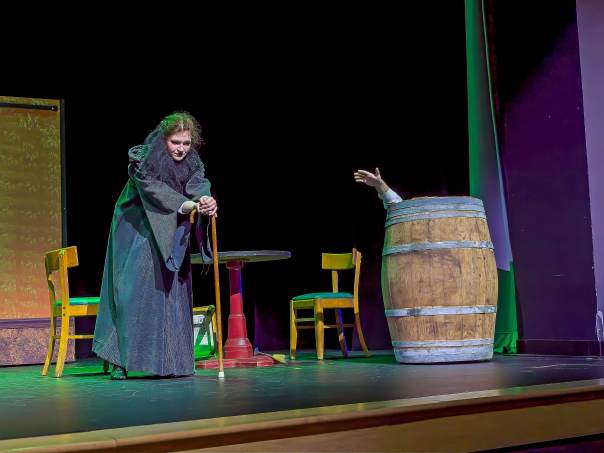
We are centuries away from the Protestant Reformation or the English Restoration, although Sickerman seems to beach the sibs closer to the Pilgrims’ beloved Plymouth Rock than to the Adriatic coast. Such oceanic distancing frees Malvolio from a dungeon of scorn when Central Piedmont’s plotters and nobles plunk their preening steward into a humble barrel to punish his prudery.

He isn’t the clown among the comical group, but Sickerman allows Truman Grant as Malvolio to loosen up, so that his usual rigidity is now almost elegance, mockable now as uppity pretense. Another sign of Sickerman’s lighthearted touch: her pick for the incredulous Sebastian is Timothy Snyder, who is at least a foot taller than his “twin.”
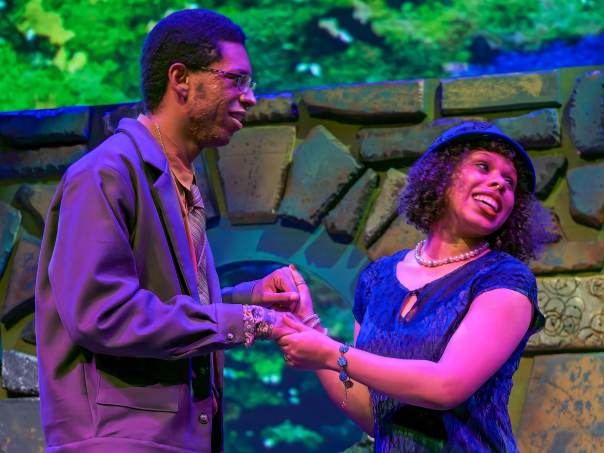
The disparity was so great, that I didn’t catch on at first. Brown’s outfit as Dame Toby, more like Miss Marple than a Falstaffian drunkard, compounded my early confusion, making me feel like newbie to the comedy while I got oriented. Struggling to remember a single instance when the euthanized CPCC Summer Theatre ever presented such a challenging comedy, I stumbled upon another reason why this excellent production was so refreshing.

All the cast was youthful, like the summer college grads who swarmed to Charlotte during CP summers to launch their pro careers. Not one old-timer in the bunch!

As a result of coping with all the period, costume, and gender changes, my disorientation was dispelled at the same time that I was learning to trust the youngbloods performing at CP’s New Theater, which has thankfully replaced panoramic Pease Auditorium but lamentably failed to showcase nearly as much CP talent. The mental training wheels that I had doled out to all these student efforts quickly flew away.

But along with a lightened, more secular and decadent Malvolio, there was newfound pleasure in the other creatures onstage who no longer needed to orbit around the self-absorbed steward. The Malvolio miasma that I’d felt since my first encounter with Twelfth Night in a college Shakespeare seminar, taught by a professor victimized by the prevailing obsession with the “puritan,” finally evaporated.

Twelfth Night, or What You Will has always been an awesome comedy for me. Now it was fun. I’d barely appreciated the bounty of fascinating character sketches that the Bard serves up here.

Now Viola is the patient, softspoken eye of the storm, and Mitchell is keenly sensitive, alternately anguished and bemused by all the passion and folly that surround her. Mitchell’s discreet takes, shared with us, make her a sort of co-emcee with Feste, though Sickerman asks too many eyerolls from her. Fitz Fitzpatrick is only slightly over-the-top with the lovesick gushings of Orsino, chiming well with a lounging Duke or a mob boss. Yes, that sleek robe has a Godfather aura before we see Fitz in the Gatsby threads.

As Olivia, Arianna Zappley does not yield at all to Fitzpatrick in regal dopiness. The two are as perfect a matching pair as the twins, made for each other, yet both are insanely lucky to land one of the sibs. Rounding out the symmetry of the two couples as Sebastian is the disproportioned Snyder, who does manage to nearly equal the calm of his diminutive twin – even though the Illyrians mistake him for her over and over. Playing Sebastian’s closest friend, the wrongly arrested Antonio, Chandler helps the prisoner to emerge as a neat counterweight to Malvolio, who is rightfully chastised for his presumption, though the penalty is too harsh.

There’s a little more slapstick flavor to the motley crew who bedevil Malvolio – and a bit more spice. Evelyn Ovall as Olivia’s waiting-gentlewoman Marie, who forges her mistress’s handwriting in the billet-doux that entraps the detested steward, is destined to marry Brown as Dame Toby. I’d like to think Ellington and his orchestra would have consented to play at the wedding reception, but I’m not sure.

Dopiest of the conspirators and clearly the least self-aware is Salim Muhammad as Sir Andrew, usually exiting with an absurdly military goosestep. In his challenge to Caesario/Viola, Muhammad now dons boxing gloves instead grabbing a sword, magnifying his ineffectuality with his effeminate pawing as he briefly combats the well-matched Mitchell.

Lewis effortlessly steals nearly every scene she appears in as Feste, convincing me along the way that this clown was intended to upstage all others. Not only does Feste sing lyrically and wittily – compared to the other lovers who barely stammer their effusions – she proves to be a better actress than the leading lady, Viola. Visiting Malvolio at the mouth of a barrel he believes is dark hell, Feste gives bravura performances as Sir Topas, a parson supposedly sent to determine how mad this lunatic is, interspersed with imitations of a sincere jester. Lewis cackles and coos this cruel vaudeville as bewitchingly as she swings death, ranging further than anyone else.

Photos by Perry Tannenbaum

Cerrudo Is Boldly Breaking Boundaries – at the CharBallet Studio and in the Lobby

Review: Breaking Boundaries at McBride-Bonnefoux Center for Dance

By Perry Tannenbaum

With a lineup that has repeatedly included Fall Works, Spring Works, Innovative Works, and Nutcracker over recent seasons, it isn’t too harsh to say that Charlotte Ballet’s programming could stand a refresh – or at the very least, a more dynamic approach to its marketing. They’ve been pouring mostly new wine into those old bottles in recent years, bit an aroma of predictability was beginning to seep in.

Now in his second year as artistic director – and fielding the first full season he has chosen himself – Alejandro Cerrudo is starting to shake things up. “Works” must not have been working, for Cerrudo has banished all three from CharBallet’s 2023-24 lineup.

Starting out the season at the McBride-Bonnefoux Center for Dance instead of waiting until winter, Cerrudo is setting the tone with Breaking Boundaries, running through October 28. It’s more than a name change: Cerrudo is innovating how the Center’s studio and lobby spaces are used. Partnering with Middle C Jazz and the Charlotte Art League, he’s also extending intermission and making it a more integral part of the experience. Afterwards, assigned seating goes away.

For that reason and others, the world premiere of Mthuthuthzeli November’s From Africa With Love is actually the more conventional choreography now on display at the McBride-Bonnefoux. That is not at all to discount or belittle the beauty, deep emotional resonance, and cohesiveness of November’s artistry, including his costume design and musical composition.

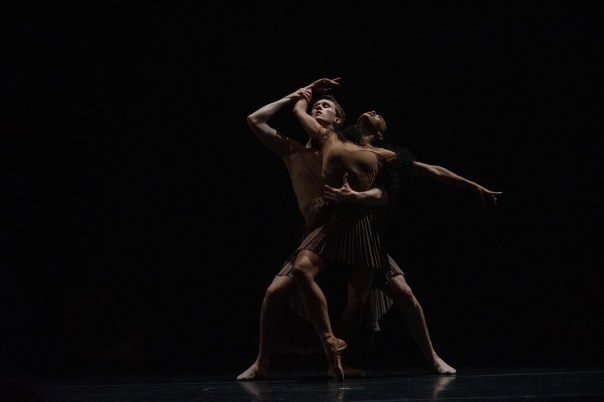
Nor should you think that less of an assault on boundaries implies none. What we might expect From Africa are eye-popping colors, primitive revelry, jungle cats, or savannah beasts, syncopated with intensive drumming. What inspires the South African-born choreographer and costume designer instead are mauve-colored ostriches from his native land that CharBallet’s dancers’ grace will have you associating with flamingoes. First the women dance quietly into the intimately-lit studio space with their matching mauve skirts and leotards, almost floating across the floor.

Mildly surprising, the men join in shortly afterwards wearing similar outfits, their skirts destined to serve as their plumage in the final tableau. Initially, they are different from the women but the same, whether we view them as human or animal. November pointedly freezes the ensemble for a moment or two in a formation without symmetry or geometry, so we behold their randomness, diversity, and harmony like a vast meadow teeming with life, peacefully grazing, somehow safe from predators. Lighting design by Aaron Muhl adds mystery and magic.

A couple of tracks, “Ibuyile l’Africa (Africa Is Back)” and “Qhawe (Hero),” from South African cellist Abel Selaocoe’s debut Where Is Home album, animate most of the movement and define its range once the full ensemble gathers. There is ethereal solemnity when the tempos are halting; while singing, exultation, and defiant guttural exhortation drive the quickened choreography over a pulsating drumbeat and handclaps. Seamlessly, our attention narrows to a single couple, Evelyn Robinson, more consistently at the center, and Luke Csordas, who will lift his partner several times but remain the only dancer who briefly leaps into the air. Three other duos rotate during the 15-performance run.

Earthbound, with a seething impulse to soar, From Africa With Love is haunting. It’s impossible for me to be sure whether November views its lively yet fragile beauty as emerging or fading.

You will need to abandon your seat – and the McBride-Bonnefoux studio – during intermission. You will also be asked to change your seat when you return and give some thought to the question of whether you wish to sit in the front row. My wife Sue, the tender-hearted Tannenbaum, was concerned that the elderly and disabled who normally populate the front row would be displaced, forced to climb stairs to reach the rows behind them.

My faith in Charlotte Ballet was not shaken. Or to put it another way, I was not at all worried. After intermission, my faith was vindicated. Not only were there greatly expanded opportunities to grab a front-row seat, the other natural option, to return to our original seats, was eliminated. They were gone.

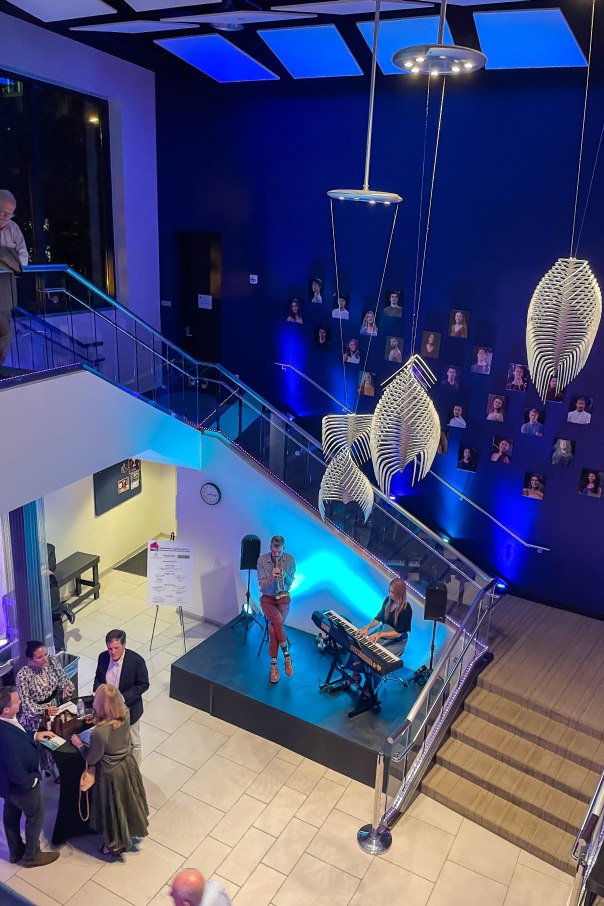
While this exciting transformation was happening behind closed doors, Patt and Sara, alias trumpeter Matt Postle and keyboardist Jess Borgnis, nestled into the Center for Dance lobby in front of the stylish staircase, framed by rows of purple lights as they played. Past the headshots of the CharBallet dancers, at the top of the staircase, we could look down at the cool jazz duo from the balcony or appreciate the artworks mounted on the walls behind us.

Sadly, my heartlessness extends beyond the elderly and physically challenged to the artists representing the Art League and the jazz duo. Other than enjoying the art and the music or noting that all was quite good, I observed an intermission of my own from reviewing and whipped out an iPhone to help me document the stylish ambiance. No other local company even strives to match the hospitality at the McBride-Bonnefoux, and only the Music @ St. Alban’s series up in Davidson seems to have stumbled upon similar possibilities of desserts and extra entertainment for all their patrons.

Yet the fullest impact of Breaking Boundaries was undoubtedly reserved for after intermission. The grandstand where our seats had been was now collapsed into the rear wall. Instead of one front row facing the studio performing space, there were now four rows of benches boxing it in. We made a beeline for a bench with a back rest, noticing along the way that there were spaces marked “Reserved”: our first hint.

It wasn’t long before the 15 dancers performing Ohad Naharin’s Kamuyot, dressed in loud woolen plaid skirts and slacks, settled into those designated spaces. By this time, the reason for the front-row caution was clear enough. If you don’t mind being invited to join the dancers on the floor – or you don’t mind turning down such an invitation – you’re OK. Otherwise, second row. Those who experienced second-row remorse could remedy their plight with a little extra exertion when the time came, capturing a dancer’s attention and an invite.

Even translated from the Hebrew as “Quantities,” Naharin’s title didn’t offer much of a clue to what might follow. There were no song titles in the program, but the list of 22 composers and artists, ranging from John Tavener and L. V. Beethoven to Lou Reed and The Ventures, broadly hinted at a bumpy ride. Indeed, the delight of unpredictability was sustained throughout the piece as single dancers or couples from all four sides of the stage took their turns on the floor and returned to their places. From the randomness of the order of dancers seizing the spotlight and yielding it, a certain inevitability set in if we were noticing who hadn’t yet risen and performed.

From then on Kamuyot was more of an ensemble piece. Distilled from previous works, Naharin aimed this work specifically at young audiences and, logically enough, created it for The Young Ensemble of the company he founded in Tel Aviv, Batsheva. The work has been staged across Israel in school gymnasiums, so the work aligns more closely with the studio space than most of the choreography we have previously seen staged at the McBride-Bonnefoux. On the other hand, staging the work at night in front of an adult audience alters Naharin’s calculus and the whole atmosphere of the dance.

Instead of encouraging kids to get involved with dance and experience its joys, Kamuyot now stretches out its hands to adults and old-timers to bridge the gap between themselves and their youth. With a soundtrack that ranges from the opening bars of Beethoven’s Kreutzer Sonata to The Ventures’ “Theme Song from Hawaii Five-O,” Naharin’s lively, kaleidoscopic work encourages traffic in both directions, for nothing is dumbed-down for his intended family audiences, ages 6 and up.

When dancers stand silently in front of you, or when they beckon you to join them on the floor, you know exactly what Cerrudo meant when he named this rousing season-opening program Breaking Boundaries. I would rate my own performance, when I answered the dancers’ calls, as rather wretched – but I surrendered my objectivity and the ability to even view the entire spectacle as soon as I entered it. What I gained in exchange for those losses was the full flavor of the experience.

I invite you to try it, and to bring a child along with you.

David Lail’s Jazz Quintet Celebrate the Goliaths of Tenor Sax

2020~David Lail~7

Review:   The David Lail Jazz Quintet, Live at the Crown

By Perry Tannenbaum

My last memories of the NoDa district of Charlotte, when theatre still thrived there and gentrification was still in progress, are vividly stamped by the obstruction that bisected 36th Street about a block west of North Davidson Street. This was the ongoing construction of light rail, envisioned as salvation for theatre companies producing in NoDa until Carolina Actors Studio Theatre was shut down in 2014 by its less-than-visionary board of directors.

Fringe theatre companies are more comfortable these days in Plaza Midwood, but a new online JazzArts Charlotte series is supplying me with fresh incentive to revisit NoDa once we’re all clear of current pandemic restrictions. Presenters Ocie and Lonnie Davis have launched a new series, Live at the Crown, that has an intimate clubby feel, devoid of the glitzy studio vibe of The Playroom, where Bechtler Museum is streaming its jazz series, and more to the liking of cellar dwellers.

Crown Station, as its name implies, will be accessible for its indoor events by motor and light-rail transit once Governor Cooper sounds the all-clear. Meanwhile, my first exposure to the Crown via the David Lail Quintet put me in mind of the Village Vanguard with its unassuming ambiance. Three cameras were deployed for the Facebook Live webcast, none of which changed position or zoomed in when musicians soloed. Combined with Chromecast, the stream produced fairly sharp video, particularly when pianist Phillip Howe soloed.

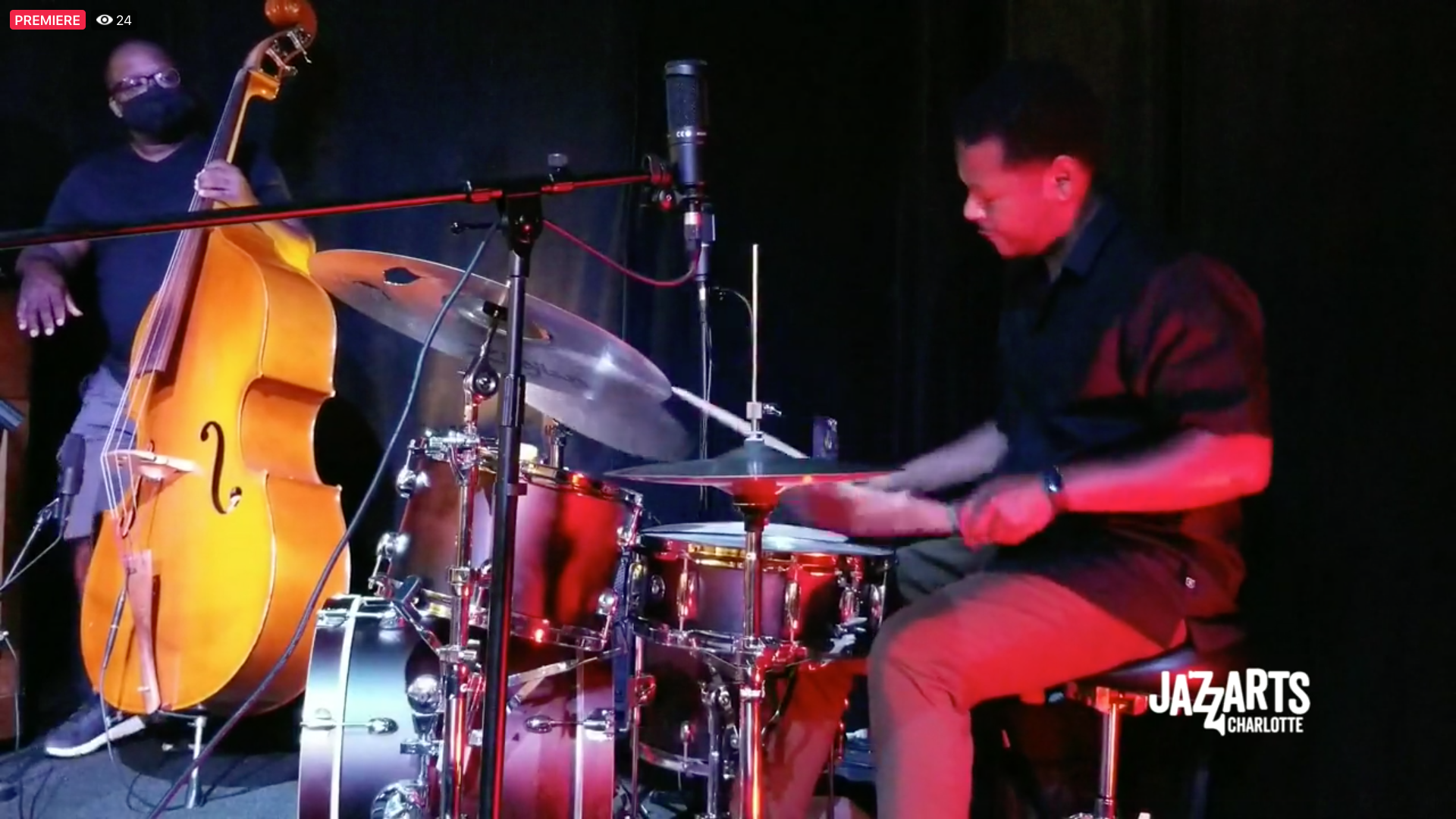
On the audio feed (pumped into Boston Acoustic speakers via Bluetooth and a Yamaha receiver), Lail on tenor sax, Matt Postle playing trumpet, and Ocie Davis behind the drumkit were the best served. Howe could have benefited from a smidge more amplification at his open-front upright, and bassist Vince Rivers was woefully undermiked on his first solo, but evidence of on-the-fly audio engineering could be detected during Rivers’ subsequent solo, and he was a satisfying part of the mix afterwards. On a couple of occasions, Lail’s hand mic didn’t seem to be switched on during his introductions, but this problem seemed to have been remedied in post-production when I watched the set a second time.

After Davis’s welcoming remarks, Lail’s program emerged as an homage to his tenor sax heroes – Wayne Shorter, Joe Farrell, Stan Getz, and Joe Henderson. Discriminating listeners may have descried John Coltrane and Dexter Gordon among the leader’s unmentioned influences. The emphasis for the first three selections was on Shorter, Coltrane’s successor in the Miles Davis Quintet, in compositions written during the 1960s – before Shorter became a foundational member of Weather Report and better known for his work on soprano sax.

2020~David Lail~5

“Armageddon,” the opening tune, was first recorded on Shorter’s Night Dreamer album, his 1964 debut on the legendary Blue Note label. This composition surely has the hard-bop flavor that Blue Note is famous for, but Lail’s solo, like Shorter’s before him, was marked by the surge and wail of Coltrane and Gordon. Postle proved to an effective counterpart, cooler and less frenetic in his trumpet solo. Howe was even cooler, soft enough for us to savor the support from Davis more keenly before Rivers had his muffled spot. Davis took over briefly and effectively before the horns reprised the melody.

“Night Dreamer” brought forth an even more blazing solo from Lail, with Postle and Howe sounding comparatively meek in his wake, but it was reassuring to hear the swing from Rivers’ bass as his solo gathered steam. Once again, the tenor and the trumpet returned with the outchorus, but this time, Lail reserved a slice of the replay for himself.

My strongest misgivings of the evening assailed me when Lail announced “Nefertiti” as his next number, a Shorter composition that first appeared as the title tune on a Miles Davis release in 1968. On both the Davis album and Herbie Hancock’s subsequent V.S.O.P. recording, the arrangement became a tedious repetition of the same slow-paced riff played by the horns, with all the excitement passed down to the piano and drums’ accompaniment. Lail and Postle both triumphantly proved that you can improvise on this composition without compromising its lazy, luxurious pace, and despite being granted scant time in this arrangement, Howe also distinguished himself with his thoughtful work.

There are certainly more obvious launchpads for a tribute to Joe Farrell than “500 Miles High,” a Chick Corea tune that first appeared on Return to Forever’s Light as a Feather album in 1973, where Farrell appeared as a guest artist playing flute, soprano sax, and tenor. The texture of that cut – with a Flora Purim vocal, Corea playing electric piano, and no trumpet at all – was very different from the sound that the Lail Qunitet brought to the Crown. Maybe that’s why the performances on “500 Miles High” were even more impressive than those on “Nefertiti.”

Postle opened the soloing, more brash and confident than he had been when comparisons might be made with trumpeters Lee Morgan or Miles on the original recordings. Lail had a more individual sound here as well when he followed – and a well-defined story to tell, building his solo beautifully and not entirely discarding his Trane-like wail. Not at all obligated to sound like an electronic Corea, Howe sounded more like Hancock or early McCoy Tyner as he worked up a lather.

Tyner is the common denominator who bridged Lail’s early segment of Shorter compositions with the final two paying tribute to Henderson, for Tyner was a sideman on Shorter’s Night Dreamer and on Henderson’s Inner Urge. After those stellar 1964 albums, Henderson guested on another Blue Note gem in 1967, The Real McCoy, from which Lail covered one of Tyner’s most celebrated compositions, “Passion Dance.” Once again, Postle took the first solo, still frisky and brash but now punching in a style that might bring Dizzy Gillespie to mind. Lail roared again in his Coltrane comfort zone, but it was Howe who surprised most. Inevitably, he must have been thinking of Tyner’s rich and heavy left hand, but the chords he played were different and his right-hand treble was funkier, reminding me more of Dave McKenna’s hard-driving swing. In a foretaste of fireworks yet to come, Davis asserted himself in a fine bashing solo.

Before a snippet of Shorter’s “Footprints” faded us out, the closer was a Henderson original, “Isotope.” It would have been interesting to hear Lail and Howe hook up on the melody as Henderson and Tyner did on Inner Urge, but instead Lail remained formulaic, introducing the catchy tune in unison with Postle. The trumpeter began the soloing again, poised and authoritative, and the leader was nearly as inspired as he had been in “500 Miles,” clearly having fun and dropping a snatch of Coltrane’s “Bessie’s Blues” as he signed off.

Howe was also in a frolicsome mood as he soloed, and the camera caught Davis acknowledging that he was up next. Here Lail’s arrangement was more in line with Henderson’s when the tenor sax traded four-bar volleys with Davis, but Lail also admitted Postle and Howe to his trading-fours party. Two rounds of Davis pounding his answers to trumpet, tenor, and piano led us back to Henderson’s genial melody. Taking up his microphone and thanking us for virtually being there, Davis had plenty to be pleased with.