Review: Dett & Bernstein at the Cain and Gambrell Centers
By Perry Tannenbaum

September 28 and 30, 2023, Cornelius and Charlotte, NC – Historically, a collaboration between Charlotte Symphony and the Charlotte Master Chorale is far from a groundbreaking event, since the two organizations had been joined for a while before breaking apart when Symphony absorbed the original Oratorio Singers of Charlotte after many years of proud collaboration. But when the rebranded Master Chorale not only partners with Symphony but also with two additional choirs, the Queens University Chamber Singers and The University Chorale of UNC Charlotte, something special must be brewing. Bring in five guest solo vocalists and expectations rise to Mahlerian proportions. That wasn’t the kind of extravaganza that the longtime collaborators had in mind, however, when they conceived their Dett & Bernstein program and reached out so dramatically.
Less intimidating, the event at Gambrell Center, on the Queens University campus, was a welcoming epic of diversity and inclusivity. For all the ensembles never gathered grandly together in symphony-of-a-thousand fashion. R. Nathaniel Dett rightfully headlined the bill, for The Ordering of Moses (1937) is more than double the length of Leonard Bernstein’s Chichester Psalms (1965) and armed with more vocal soloists and instrumental artillery. In something of a tune-up for the Gambrell event, the Master Chorale and Symphony had performed both of the headliner pieces at the new Cain Center in Cornelius two nights earlier. Neither of the University ensembles made the trip up I-77 to Cornelius, but tenor Jason Dungee, who would sing the title role in Dett’s oratorio, is also director of UNCC Chorale, so a couple of his prize students mysteriously appeared as two of the four adult solo singers in Chichester Psalms, obviously smuggled onto the tour bus.
Losing out on seeing the full University choirs, missing the opportunity to hear the gems by Adolphus Hailstork and Margaret Bonds that kicked off the Saturday program at Gambrell, the Cain Center still had the honor of hosting the North Carolina premiere of The Ordering of Moses. Commissioned by the May Festival Chorus, who premiered the piece in Cincinnati, the piece triumphed in front of the festival audience, but its live national NBC radio broadcast was abruptly snatched from the airwaves about 40 minutes into the performance, clearly a craven cave-in to a few racist listeners. Righting this wrong, if not the subsequent neglect of Dett’s oratorio, Moses was revived by the Cincinnati May Festival in 2014 and given a Carnegie Hall premiere a few days afterward – adorned with a live broadcast by WQXR that was not aborted.

As the Bridge recording of that concert demonstrated, the revival conducted by James Conlon was well-deserved. Hearing the live performance with Chorale artistic director Kenney Potter conducting the Charlotte Symphony was a very different experience from the sonorous broadcast version on the Bridge label, longtime champions of American composers. From the start, the work of Symphony’s assistant principal cellist Allison Drenkow stood out more boldly in relief, yielding a better grasp of how Dett structured his piece, for there are cello solos strewn throughout the piece, acting as friendly bookmarks, that she gorgeously performed with gossamer tone. Nor were the vocal soloists less than the equals of their Carnegie Hall counterparts, mezzo Sarah Brauer bringing wondrous elan to The Voice of Israel, soprano Anne O’Byrne fortifying Miriam in her biblical song and in duets with brother Moses with her fervor, and bass-baritone Marques Jerrell Ruff thundering The Word and afterward The Voice of God – with rumbling timpani quaking the earth around him.

In his introductory remarks during a pre-show segment, Dr. Marques L.A. Garrett had us looking out for the core of Dett’s music, the two themes of “Go Down, Moses.” The famous refrain theme peeps in behind a veil of different melodies, most notably the keening “When Israel was in Egypt land” theme before the full chorus breaks forth – after a vocal trio from Brauer, O’Byrne, and Ruff followed by a swirl of cellos and a bassoon – with the fortissimo command, further developed with fugal filigree. Yes, Ruff’s Voice of God is a tough act to follow, but who knew that Dungee, rising from his seat with the aid of a cane, had such a piercing, rafter-cracking tenor voice to answer the Almighty’s call? The dialogue between God and Moses was a thrilling highlight, enough for me to justify attending the second North Carolina performance as well as the first.
Fresh rewards awaited me at the Gambrell that lived up to my expectations. The Master Chorale is a large chorus, too large to share the Cain Center stage with Symphony, so they doubly split on both sides of the audience on two levels of the building. Gambrell Center has a more commodious hall and stage, but only one side level for deploying the choristers, so the Master Chorale waited to make their appearance while the two University choirs gathered on opposite sides of the audience, spilling onto short flights of stairs the led up from the orchestra to the sloped exit aisles. To our right, Dundee led the UNC Charlotte ensemble in two songs by Hailstork (b. 1941). Crucifixion or not, “My Lord, What a Moanin’” had a grace and energy worthy of a program finale or an encore. The hushed and reverent “Blessed Is the Man” was written as a gift specially for Dungee, who chose Hailstork as the subject of his doctoral dissertation, and the tenor’s fondness for the piece suffused his choir’s performance.
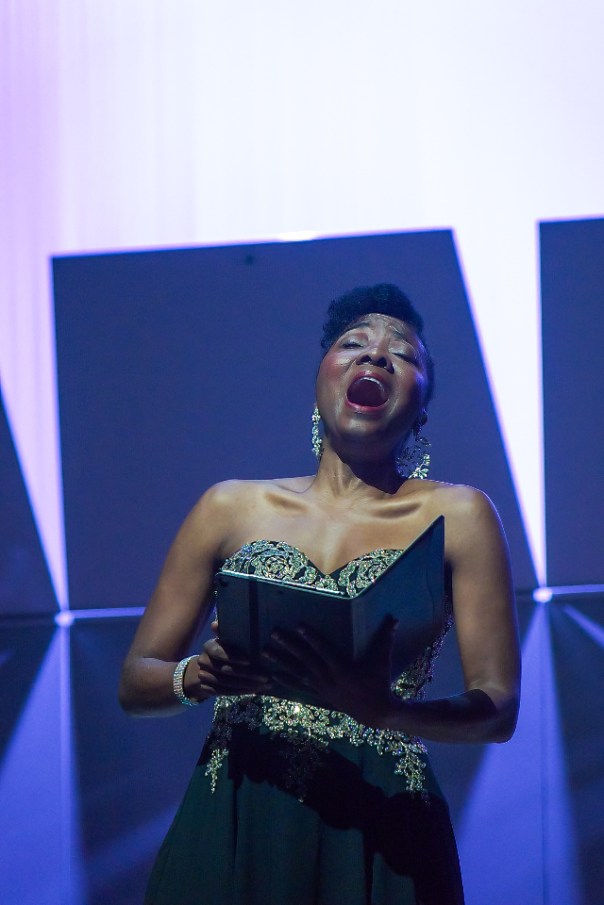
Not to be outdone by her UNC Charlotte colleague, soprano Sequina DuBose has had a song cycle written by Maria Thompson Corley for her recent Blurred Lines: 21st Century Hybrid Vocal Works recording on the Albany label, reviewed at this site earlier this year. You could say she crossed the line when she appeared as a guest soloist with the Queens U Chamber Singers in excerpts from Credo by Margaret Bonds (1913-1972) – if there were a rivalry between the two schools rather than hospitality and fellowship. Set to a prose poem by W. E. B. Du Bois, the posthumous Credo was premiered by Zubin Mehta and the LA Symphony shortly after Bonds’ death but not recorded until earlier this year on a magnificent Avie Records release by the Dessoff Choirs and Orchestra.
Presented at Gambrell with a spare piano accompaniment, the performance was admirable for its promptness, but it gave only a hint of the work’s full grandeur when heard unabridged with a full orchestra behind it. At Gambrell, pianist Brenda Fernandez provided all the accompaniment. The complete work, now that it has conquered with a brief foretaste, should be on top of Charlotte Symphony’s short list of new and newly-discovered pieces to be programmed at their Uptown venues.
Nor was DuBose to be outdone in her rendition of the second song in the six-song suite, “Especially Do I Believe in the Negro Race.” If you’ve heard her luminous performance of “Summertime” in two extended runs of Porgy and Bess in Charlotte, most recently with Opera Carolina back in January, or her Elvira in Don Giovanni, you won’t be surprised to learn that the smoothness of her tone and the clarity of her diction far eclipse what you might hear on Spotify in the world premiere recording.
Recordings do have an influence on repertoire selection, which may be why I’ve never heard Charlotte Symphony perform Chichester Psalms before – and why I haven’t heard a performance of Bernstein’s paean to peace in the Queen City since 2009, when Carolina Voices’ Festival Singers brought a slimmed-down version of the work to Temple Beth El for a Yom HaShoah commemoration, accompanied by piano, percussion, and harp. Marin Alsop’s version of the work on Naxos with the Bournemouth Symphony and Chorus is only slightly less wretched than Bernstein’s own version on DGG with the Israel Philharmonic and the Vienna Boys Choir.

Both of their engineering teams failed them miserably in the pivotal middle movement, where Bernstein juxtaposes the incandescent Psalm 23, “The Lord Is My Shepherd,” sung by a boy soprano, with the angry Psalm 2, sung by the Master Chorale in a sudden crescendo. The Hebrew text is probably most familiar to us via the powerful aria in Handel’s Messiah,“Why do the nations rage so furiously together, and why do the people imagine a vain thing?”
To replicate the dynamic range so easily rendered at the Cain and Gambrell Centers, you’ll need to turn your volume knob to the one or two o’clock position to make out the boy soprano faintly in the outer sections of this movement – and hurriedly turn back to the 11 o’clock position for the midsection to avoid waking your wife and neighbors when the full chorus unleashes their fury. Even sitting at the front end of these halls, I never felt assaulted by the fortissimos: acoustic balances and clarity were always tight. It was a joy to hear Calvin Potter singing the soprano part so clearly, stealing nervous glances at his dad on the podium as he awaited his cues. The boy was nearly perfection on the Hebrew until his unfortunate gaffe in the final line, mispronouncing the penultimate word at both performances.

Immediate consolation gushed forth after the Potter lad departed, for the final Chichester section, set to the warm and placid Psalm 131 with a sprinkling of 133, is preceded by a gorgeous orchestral lament that brought out Symphony’s best playing of the night. The transition between these last two Psalms was also treasurable, a lovely cello quartet. A wonderful vocal quartet – including those two UNC Charlotte imports – led into the final sublime fadeout, dominated by the women’s treble. Again: the last minute of Chichester Psalms was divine in live performance, but turn your hi-fi volume past 12 o’clock at home.

 Art on My Sleeve