Tag Archives: Marlene Ballena

CP’s Connor Series Signs Off With Two Powerhouse Piano Quintets

By Perry Tannenbaum

September 17, 2023, Charlotte, NC – Even before the Connor Chamber Music series began six years ago at Tate Hall, Catherine and Wilton Connor were among the strongest advocates of chamber music in the Metrolina area. They had previously helped to give the St. Peter’s Chamber Music series extra reach beyond Uptown church by hosting Living Room Concerts in their Myers Park home. Furthermore, they had opened their doors to violinist Rosemary Furniss and her chamber trio when her husband, Christopher Warren-Green, was the Charlotte Symphony’s music director.

So it was bittersweet to hear Mr. Connor announce that the latest concert on the Central Piedmont Community College campus, showcasing piano quintets by Béla Bartók and Antonín Dvořák, would be their last. Connor hastened to console us, hyping the recent and future concerts of Chamber Music for All, led by Charlotte Symphony concertmaster Calin Lupanu. And in fact, the program we were soon to hear had already been performed a week earlier at the Lancaster Cultural Arts Center, the climactic event of the inaugural Historic Lancaster Music Festival. Future CM4A concerts are already scheduled there, at Sedgefield United Methodist Church, and at the Steinway Piano Gallery.

Not nearly as renowned, recorded, or as frequently performed as his six string quartets, Bartók’s Piano Quintet in C Major is one of the composer’s earliest works, written in 1903-4, a mere 17 years after Dvořák’s quintet was premiered and 35 years before his own final string quartet. Often in its outer movements, the opening Andante and the concluding Poco Vivace, the music has an anthemic openness that you might expect from a 19th-century piece written in the shadows of Liszt, Strauss, and Brahms, before Bartók leaned more toward folk music and modernistic experimentation.
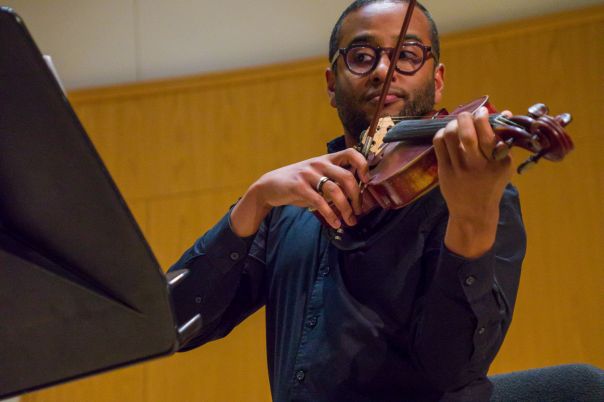
At the keyboard, Phillip Bush resisted the temptation of steering the joyousness of the piano part into stentorian jubilation, resulting in more ensemble cohesiveness and more contemplative edge. Lupanu could stay more within himself to match Bush’s fire without ever flattening the peaks and valleys of the volatile music where Bartók abruptly changed tempos and dynamics. Marcus Pyle, who had inched onto our radar earlier this year as a preview speaker for Opera Carolina’s production of Porgy and Bess, impressed almost instantly on viola with his lush tone and sleek double-bowing.

The inner movements, a Vivace-Scherzando followed by an Adagio, are more forward-looking. The Scherzando did not lack for quirkiness, but Bush could have been more provocative and eccentric in the second movement. With cellist Marlene Ballena and second violinist Monica Boboc making valuable contributions, the quartet sounds were dominant in the Adagio, though the 2019 Alpha Classics recording, captured live at the Lockenhaus Chamber Festival, dares to be more raucous and astringent. When Lupanu’s quintet surrendered more fully to the closing Vivace, they delivered more of its fire and madness.

Competition among recordings of the Dvořák Piano Quintet No. 2 in A Major not only increases exponentially compared with the sparse field of Bartók recordings, so does the name recognition of the pianists, violinists, and string quartets who have entered the fray. On the other hand, the musicians onstage at Tate Hall must have had so many more opportunities to glean master classes from this immense discography – and likely more opportunities to rehearse and perform this perennial favorite before bringing it to CPCC. The electricity and sound quality of live performance, the familiarity of the audience with the piece – particularly when it settled into the dreamy Dumka movement after the rousing Allegro opener – brought the Connor concert experience into gratifyingly close alignment with the best CDs available.
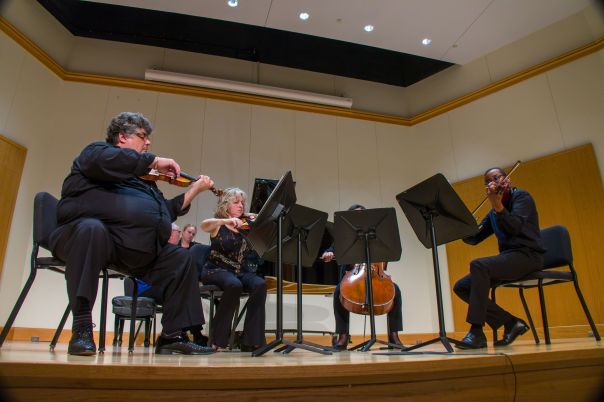
Bush played with confident élan, pliant and at ease navigating the tempo shifts of the opening movement, charming and lyrical in the gorgeously pianistic Andante passages that make the Dumka so memorable, and unbridled with the onset of the folksy interludes. Lupanu also played with loose and spontaneous abandon, slashing boldly with his bow at the quick tempos and delicately caressing the strings in the lovely soft passages. Ballena shone most with her cello as she introduced the first theme of the Allegro, and Pyle was equally convincing introducing the second. Everybody seemed to be having a jolly time as the sober ending of the Dumka gave way to the penultimate Scherzo. Lupanu and Bush mischievously frolicked on the left side of the Tate stage, answered to humorous effect by Ballena and Pyle with their suave mellowness.

Boboc had her most memorable spot in the Allegro Finale when we jumped away from the spirited interplay between Bush and Lupanu into a fugal section where Ballena and Pyle also got a taste. There were also harmonious sections that reminded me of the uniqueness of Dvořák’s string quartets. Yet it was Bush who was most dominant at the concert’s climax, trilling and ding-a-linging merrily before he ramped up the speed and intensity toward the very end. Obviously relishing the encounter, Lupanu matched him note for note as they raced to the precipice.

Lupanu and Friends Feed off Audience Energy in Return to Live Performance

Review: Connor Chamber Series at Tate Hall

 By Perry Tannenbaum

2021~Connor Chamber Concert-5

While orchestral performances have sadly languished during the COVID pandemic, recently reviving in Charlotte and elsewhere in prudent baby steps, chamber music has flourished in online productions. Back on Memorial Day weekend, while the youth choir and orchestra remained sidelined for a second consecutive season at Spoleto Festival USA, chamber music restarted at Dock Street Theatre in Charleston, running a full slate of programming and replaying edited versions on YouTube. Not surprisingly, it has been principals of the Charlotte Symphony Orchestra, cellist Alan Black and concertmaster Calin Lupanu, who have most dramatically stepped forward to fill the void, each of them spearheading a series of chamber music concerts while the larger ensemble remained mute or muted. More encouraging, then, for those of us who love the intimacy and verve of chamber music, is that neither of these initiatives is in retreat now that audiences are vaccinated.

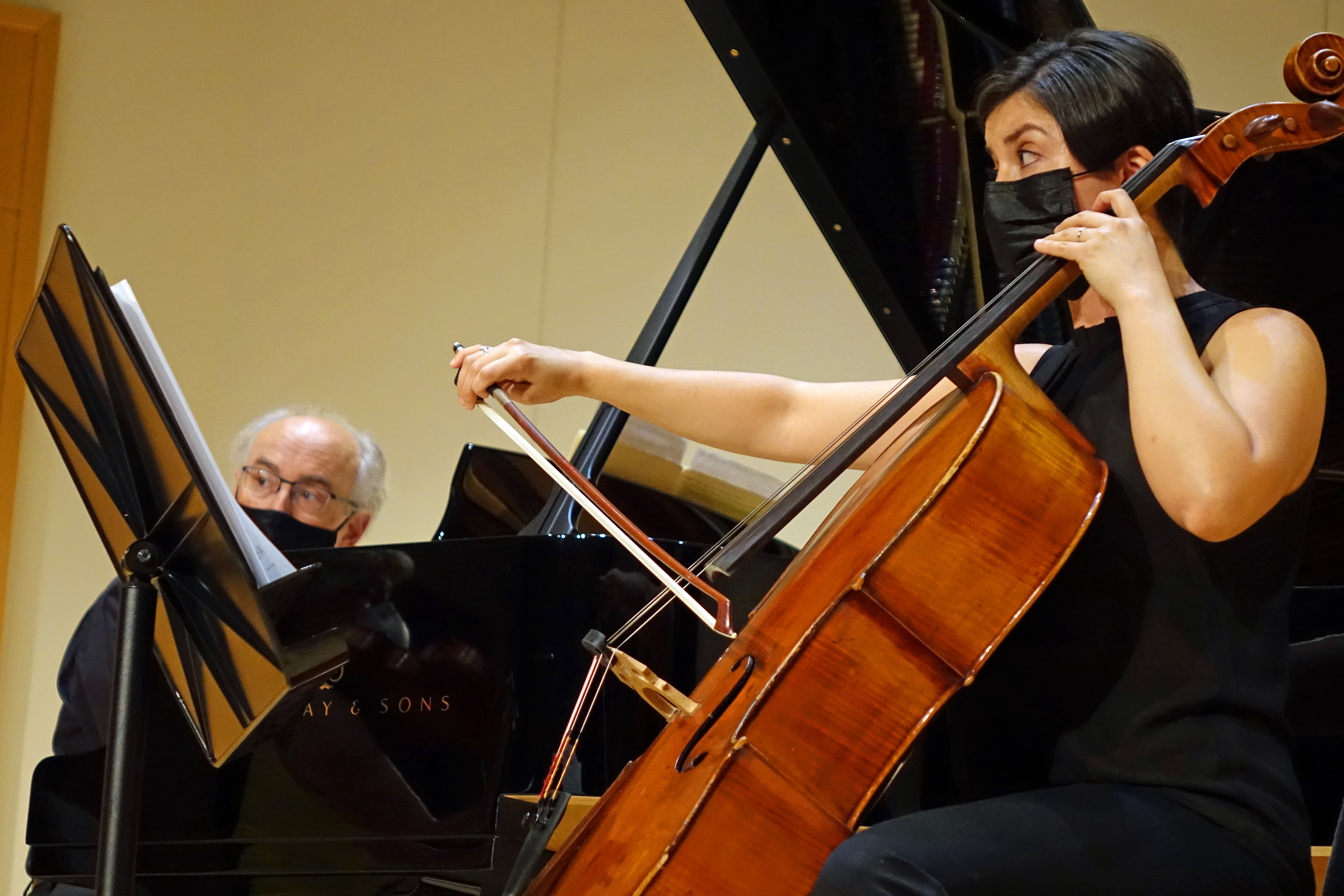
Thanks to the Connor Chamber Series, Lupanu could be seen at Tate Hall on the Central Piedmont Community campus while Symphony is returning to full strength, its mainstage classics series slated to launch at Knight Theater on October 15. Lupanu hosted the concert of works by Brahms and Anton Arensky, starting off together with Phillip Bush at the piano playing the Brahms Scherzo movement from the F-A-E Sonata, which was originally premiered by pianist Clara Schumann and violinist Joseph Joachim, for whom the piece was written in 1853. After this lively opening, Lupanu yielded the violin part for the Arensky Piano Trio No. 1, replaced by fellow Symphony musicians Monica Boboc and cellist Marlene Ballena. Lupanu returned after intermission – inserted to give Bush a rest, he jested – for the finale, the Brahms Piano Trio No. 1, written just a year after his Scherzo.

2021~Connor Chamber Concert-1

The Tate immediately proved hospitable to Lupanu’s violin in the Brahms Scherzo, which also drew movements by Robert Schumann and his pupil, Albert Dietrich. On the other hand, the treble breathed more freely from the Steinway than the bass end of its keyboard, perhaps because of its nearness to the upstage wall. The music, Lupanu’s placement downstage, and the excitement of playing chamber music for a live audience after 18 months of performing for mics and cameras (if at all) were all good reasons for the violinist to excel more than usual. Coming out and masking up, seeing the masked musicians onstage taking up their share of the pandemic risk and responsibility, the audience was also primed to be exceptionally receptive. Lupanu may have seen the enthusiasm in the audience’s eyes as he looked out on us, but he couldn’t help feeling the free, propulsive spirit of Bush behind him, very much inside the music, spurring him on to be better and better.

Arensky’s trio has been on my radar ever since pianist Yefim Bronfman headlined a Sony recording of the piece over 25 years ago (paired with an even more electrifying Tchaikovsky trio), so it was not surprising to see Bush assert more leadership. Yet both of the string players acquitted themselves admirably in each of the D minor’s four movements. A beautiful violin melody from Boboc at the top of the opening Allegro moderato was echoed in more abbreviated form by Ballena’s cello, yet it was likely that hearing Ballena’s cello so much more clearly in live performance put me in mind of Dvorak’s chamber pieces. Boboc captured the lightness of the ensuing Scherzo, but it was Ballena who became the prime advocate when that movement slowed to its more luxuriant Meno mosso tempo.


2021~Connor Chamber Concert-3

Bush’s sound, at times downright impressionistic, was the most distinctive element in the elegiac Adagio. Yet Boboc was also disarming, playing low enough on her violin to be mistaken for a cello if you weren’t watching. Not to be outdone, Ballena played even lower when we arrived at her spot. It was in the Allegro finale that Arensky finally matched the turbulence we had heard from Brahms. Bush assaulted the Steinway with a barrage of three-chord phrases while the strings stirred up the heat. Then he turned down the volume and the tempo in a poignant passage of four-note phases. Now it was the strings’ turn to dominate, Boboc and Ballena vying in eloquence as they demonstrated how lyrical and affecting those same phrases could be that Bush had played so feverishly.

Looking at the attentiveness of Bush and Ballena throughout the Brahms B Major trio, we could assume that Lupanu held the reins, yet there was admirable parity between the parts. Ballena’s cello sang out introducing the theme of the opening Allegro brio, and she had a transporting spot in the penultimate Adagio. Bush was pre-eminent in setting the tone, restless amid the shifting tempos of the opening movement, dreamy in his intro to the Adagio before the strings interceded with their sacramental harmonies, but most mischievous in the even-numbered movements. The second-movement Scherzo suddenly pivoted from a beguiling waltz tempo to a manic chromatic outburst that presaged Shostakovich, up in the treble where the Steinway fared best, and the grandeur he imparted to the Allegro con brio finale was star-spangled American. For Lupanu to dominate amid these exploits from his partners, projecting the joy of the Scherzo and the triumph of the Finale, was quite impressive.

No Joke: Al Fresco Continues in a Modern Vein With “Romance of the Viola”

Review: Al Fresco concert under COVID

By Perry Tannenbaum

On the day of the latest Al Fresco concert, Charlotte Symphony had good news and bad news. Getting ready to set a YouTube reminder for my Chromecast hookup to the 7:30 webcast, I was encouraged to discover – on the Al Fresco webpage – that the Wednesday night series had been extended through at least July 29. Unfortunately, that good news may have been an outgrowth of the bad news announced earlier in the day: Symphony had canceled their Three-Week Summer Festival, slated to begin on August 7. All of the Festival events – a finely judged assortment that included Beethoven’s “Pastoral,” The Best of James Bond, Peter and the Wolf, On Tap at the Triple C brewery, Raiders of the Lost Ark, and a free community concert – had been scheduled at indoor venues, running afoul of public assembly restrictions mandated in Raleigh and still in effect. It was merciful that Al Fresco concerts are pre-recorded, for host Alan Black and his “Romance of the Viola” guest musicians would have certainly been downcast if they were giving a live performance in the wake of this daunting setback.

As the latest program began in Black’s bosky backyard, with the CSO principal cellist in conversation with violist Kirsten Swanson, the series’ subtitle, “changing venues for changing times,” more than ever seemed to evoke an escape from Charlotte’s barren cultural climate under COVID siege, a welcome oasis in the musical wasteland. Adding to the freshness, Swanson and Black were discussing a pair of composers few Symphony subscribers had come across, Kjell Marcussen (1952-   ) and Rebecca Clarke (1886-1979).

Black admitted discovering Marcussen a mere three weeks earlier while combing the internet – and, presumably, streaming services – in search of music written for the unique viola-cello instrumental combo. As a cursory YouTube search will confirm, the Norwegian composer does favor viola among orchestral instruments. Black could easily have found Marcussen’s “Berceuse” there, for it’s the first video that comes up in a Google search for the composer, but the composition also pops up readily on Spotify in a 2017 album, Dedications, recorded by the same Duo Oktava musicians, violist Povilas Syrrist-Gelgota and cellist Toril Syrrist-Gelgota. In solo compositions, Marcussen gravitates toward his own preferred instrument, the guitar, so it’s not at all surprising that guitarist Anders Clemens Øien shares the spotlight on the CD.

After watching Swanson and Black perform the “Berceuse,” I must say that I found the Oktava video stuffy and pretentious by comparison, and I’m only finding a new way to praise Bob Rydel’s audio engineering when I say that the sound at this Al Fresco concert was richer and more detailed than either the YouTube video or the CD (available on Apple Music as well as Spotify). Black gets a rich dark tone when he moves to the forefront in the exposition of this morose lullaby, but he’s more varied in his dynamics – and the pace is quicker, cutting more than 25 seconds off the Oktava’s fastest performance. The real difference maker, though, is Swanson when she takes the lead in the concluding half of the work with her lighter tone, making for a far more poignant experience than the Norwegian duo can muster. To be fair, I should say that I’ve been captivated – and perhaps swayed – by the open-air informality of the Al Fresco format, which certainly accentuated the élan of Black’s approach.

I have no record of hearing or reviewing Clarke’s music before March 2019 at the Savannah Music Festival, where chamber music host Daniel Hope reprised the composer’s Dumka, a piece the famed violinist had played on a Naxos recording of Clarke’s music. That estimable album, recorded in 2007, showcased Clarke’s most famous work, her Viola Sonata – played by violist Philip Dukes. As you may know, Dukes would have succeeded Hope as the chamber music director at Savannah Music Festival this year if the 17-day event hadn’t been canceled. Black and Swanson discussed Viola Sonata in the context of Clarke’s stature among her contemporaries. Clarke herself was a world-class violist (and violinist), and she submitted her chef d’oeuvre to a 1919 competition sponsored by Elizabeth Sprague Coolidge at the Berkshire Festival. Ernest Bloch and Paul Hindemith were also among the 72 entries, Swanson noted. Depending on which account you read, Clarke either tied Bloch for the Coolidge Prize until Coolidge bumped her down to second place, or she took the runner-up spot outright.

The piece that Swanson and Black would play, “Lullaby,” was more modest in its aspirations than the brooding, turbulent, three-movement Sonata – its epic first movement is marked Impetuoso! – but this more abbreviated work probably dates from the same period, in 1918. Black was quick to point out the piece’s accidental relevance to today, written during the Spanish Flu pandemic, and though Swanson remarked on how such periods of confinement often prove fertile for creativity, this “Lullaby” had an unmistakably mournful sound, not unlike Samuel Barber’s more funereal “Adagio,” with a similar peak before taking a breath for the last third of the piece. As beautiful as the playing is, from Black in particular, this duo’s interpretation lacks the contours you’ll find on the excellent Centaur recording of this work, where both cellist Moisés Molina and violist Kenneth Martinson assert themselves more forcefully and emotionally.

With Ernst von Dohnányi (1877-1960) taking us back to the brink of the modernity with his 1902 Serenade in C Major for string trio, Al Fresco completed its second consecutive concert of music written entirely since the dawn of the 20th century. Both Swanson and Black lauded the solos Dohnányi had written for viola at the outset of the Romanza second movement and toward the end of the theme-and-variations fourth movement. Submitting his regrets for sitting out the trio, Black was replaced onstage by cellist Marlene Ballena and associate concertmaster Joseph Meyer.

I found this performance more likable, in the early movements and in the Rondo Finale, than on my 2003 Naxos CD with members of the Spectrum Concerts Berlin, where the players sounded too slick and harmonious after hearing the fresher, livelier Charlotte trio. The Symphony musicians skipped over the middle Scherzo movement and didn’t find nearly as much emotion in the Tema con variazioni because their pacing and dynamics were more monochromatic. Yet in the passages extolled by our host and Swanson in their conversation, the violist lived up to the hype. Even so, it can be said that Swanson’s softly accompanied solo in the Romanza, about 75 seconds in length, became a launchpad when Meyer entered with his violin, picked up the pace, turned up the volume, and soared. Between Swanson’s best bits in the Tema con Variazioni, Ballena had her finest moments. Rydel’s engineering also merits special praise here, for the entire trio is subtly encased in a warm concert hall ambiance.

With the cancellation of Charlotte Symphony’s Three-Week Summer Festival, extension of this Al Fresco series was obviously a logical move. But it should be remarked that, with the cancellation of six upcoming programs, and with no orchestral programming on the near horizon, more of Symphony musicians’ energies can be devoted to future Al Fresco concerts. In their sound and musicianship, they can’t get much better, but in their scope, we can certainly anticipate bigger things to come. If there’s anything to carry away from Al Fresco – and carry over to CSO programming when it returns to our familiar concert halls – it’s the notion that repertoire isn’t merely a balancing act between what the public craves and what Symphony’s maestro longs to present. As we’ve already seen, Symphony’s musicians also have some entertaining and rewarding ideas.