Tag Archives: Lynn Nottage

“Clyde’s” Serves Up a Delicious Seize-the-Food Message

Review: BNS Presents Clyde’s at the Parr Center

By Perry Tannenbaum

September 13, 2024, Charlotte, NC – Over a lazy Duke Ellington piano riff that becomes indelible almost as soon as you hear it, John Coltrane layers on the melody of “In a Sentimental Mood,” recorded 62 Septembers ago. Although we’re in a kitchen at a truck stop that doesn’t look nearly that old, somewhere along the highway in Berks County PA, it’s a fitting intro to the new BNS production of Clyde’s. Along with the mean and sassy owner of this diner, Clyde, we meet her star employee, the zen-like Montrellous, also described by two-time Pulitzer Prize winning playwright Lynn Nottage as “the John Coltrane of sandwich making.”

Nottage’s newest comedy-drama originally premiered in Minneapolis as Floyd’s in 2019, less than a full year before George Floyd was killed by local police – so it was prudent to change the title before the Broadway opening in 2021. Yet a police state haze still hovers over the action, since all the employees at Clyde’s are ex-convicts or parolees, including the owner. She’s not a criminal now, but something or someone has clearly hardened her. Montrellous believes that Clyde’s could be a smashing success if it served up extraordinary sandwiches. She wants to stick to basics, lay low, keep a low profile, and lower her costs on the ingredients her drones drop between two slices of bread.
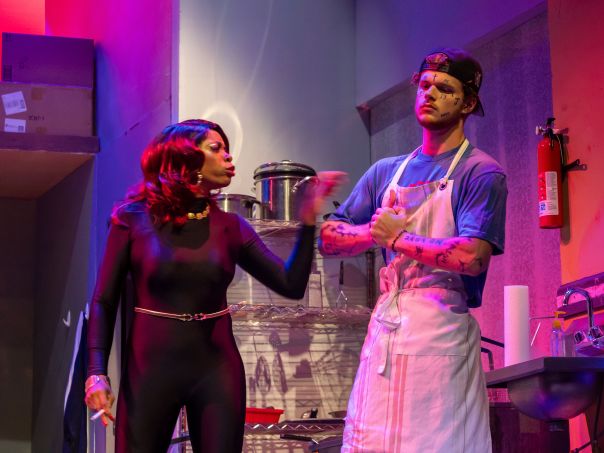
Limiting ourselves on food analogies, let’s say Clyde is one tough cookie, tightly wound to match the tight-fitting outfits costume designer Aneesah Taylor has tailored for her. You do not smile around Clyde, Montrellous warns newbie Jason, a recent parolee. He doesn’t listen. To his distress, he will learn the hard way that Clyde is the Captain Bligh or Queeg aboard this ship. Ah, but there is deeper wickedness to this boss: there is a Jezebel gene in her DNA, for Clyde is a toxic temptress. On a couple of occasions, the owner’s forays into her kitchen reminded me of Curley’s luscious wife sashaying among the farmhands in John Steinbeck’s Of Mice and Men.

The mice here mostly get to play when the boss isn’t peeping through the pickup station, hanging a barely legible order on a little carousel, and banging a bell. Director Dee Abdullah has her kitchen staff reveling in those moments when they aren’t wrapped up in a food prep frenzy. transforms the place. For him, sandwich making should never be drudgery. It is more like a mission, a calling, a crusade, an artform…or a lifelong quest for the perfect sandwich. Suffering and anger can seep into the food you make.

This ministry is not for Montrellous exclusively. When the pace in the kitchen slackens, all four workers lean over their prep stations and take turns chanting the ingredients of sandwiches never built before, swooning collectively over their imaginary deliciousness. In these moments, the kitchen is more like a studio or a writers’ room as the creators brainstorm ideas. And when the coast is really clear, Montrellous reaches into a low cabinet upstage center and extracts his latest masterwork, placing it reverently in the exact middle of the three prep stations. Since James Dukes’ lighting design accentuates the gleam of the Saran wrap around Montrellous’ newborn brainchild, the radiance turns Clyde’s kitchen into a holy temple of sorts. Epicures looking at the three stations centerstage at the Parr Center can be excused if they’re reminded of the Last Supper by Jennifer O’Kelly’s set design.

With this sacred imagery in mind, it’s hardly surprising that Montrellous’s precepts begin to transcend food preparation as we get to know more about him and about Clyde, Jason, slicer-and-dicer Letitia, and the man with the pans at the stove, Rafael. As much as Montrellous wants to convince Clyde to be more enterprising and adventurous – and less dogmatic and stingy – the adoring and adorable Rafael wants Letitia, forever stressed by her infant and her ex, to just give him and chance. Really, this romantic subplot occupies more space and time than the overarching struggle between Clyde and Montrellous, so we don’t think we’re watching supporting players when we see Lisandro D. Caceres-Zelaya in action as Rafael propositioning and wooing Toi Aquila R.J. as Letitia.

“Not enough salt, the flavor doesn’t come out; too much salt, it’s inedible,” Montrellous pronounces. Both women, taught by their past experiences, fend off new ideas and intimacies, fearing all because they’ve had too much before. Both are skeptical that being asked out could be motivated by any other reason than sexual exploitation, whether tender or forceful. Fortifying her resistance to anything Montrellous creates, Dominica Ivey as Clyde turns down every simple invitation to give it a taste. She wields her ever-present cigarette like a dagger, and her every exit is a devastating kiss-off, somewhat comical because she’s so decisive. You begin to wonder whether Ivy has any empathy for her ex-cons: maybe Clyde hires them because they can be bought cheaply.

To be sure, Ivy can string any male along in her wanton mode, but it’s Aquila as Letitia who gives off the most bi-polar vibes. When she isn’t sullenly brooding or crazily hacking lettuce as if she were Lizzie Borden, Aquila is shaking some fine booty and boogeying, reminding us of the charisma she radiated as Eartha Kitt last September. We have no difficulty understanding what Rafael sees in her, and Caceres-Zelaya lights up the stage with his sunny energy, evoking for me the irrepressible verve of Usnavy in Lin Manuel Miranda’s In the Heights.

When he isn’t presiding over the sacrament of sandwich making – and his apostles’ efforts to reach his lofty level – Zach Humphrey as Montrellous is largely a peacemaker. He intervenes with calm authority when Clyde and Jason come close to blows, and he’s a guiding light for both Letitia and Rafael as they gravitate toward one another. “Trust your ingredients,” he sagely says more than once. Everyone is different. People’s possibilities are as infinite as the varieties of sandwiches you can imagine.

Making his professional debut, Anthony Lonzo as Jason presents special challenges that audience members might struggle with, for the tats on his face and spew barbarity and hatred. Onstage, the tats are chiefly repellent to Latitia, but since Jason doesn’t speak much at first, we also need to delve beyond skin depth to grasp what he’s all about. Nottage gives each of the kitchen workers a juicy monologue to reveal what’s inside and in their rearview mirrors, and we’ll likely remember Lonzo’s nearly as vividly as Humphrey’s. But an unspoken maxim sprung to mind as Duke’s lighting finally sanctified Clyde in her memorable epiphany. It’s a wonderful little saying from the Psalms of David that I first learned from a book title by Denise Levertov: O Taste And See. At times the lesson is merely culinary. But ultimately, the message is experiential, about adopting an empirical attitude instead of hardening our prejudices. Above all, it’s an injunction to fully live our lives.

Photos by Perry Tannenbaum

“MJ”: About as Close to Jax as We Can Get

Review: MJ The Musical at Belk Theater

By Perry Tannenbaum

Whether it was his skin, his sunglasses, his surgeries, or his sleepovers, Michael Jackson always gave his fans – and his detractors – plenty to think about aside from his music and his iconic videos. Even if you tried to maintain ignorance or indifference, there were just too many of him to ignore. He seemed to be everywhere, all the time, always visibly troubled and in flux. The loudest soft-spoken person we’ve known: the most grandiose hermit, progressively weirder and more deformed as the years went by.

So in condensing the King of Pop’s life and art into the 150-minute MJ The Musical, without plunging into inconvenient truths that might revoke her “Special Arrangement with the Estate of Michael Jackson,” script writer Lynn Nottage had to look very, very carefully for a place where she could begin – and a place where she could discreetly and dramatically end. A two-time Pulitzer Prize winner (Ruined and Sweat), Nottage knows her way around the theater, so she chooses wisely and safely.

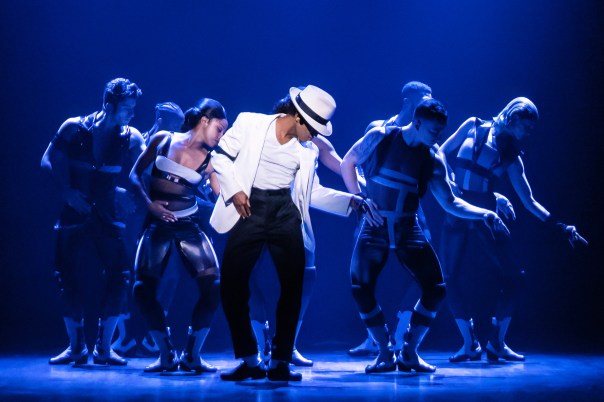
Approaching its 700th performance in its current Broadway run after premiering in late 2021, the touring version has been spreading the moonwalk, the cocked hat, and the glove across our land since the beginning of August. Rounding into its second week at Belk Theater, there’s no question whether this production is a crowdpleaser. Whether or not Nottage has made storytelling mistakes or sugarcoated the facts of Jackson’s life, there’s more than enough hot smokin’ talent onstage to incinerate such nitpicking concerns in white-hot flames.

We begin in an LA rehearsal hall, where Michael, his backups, his line dancers, his handlers, and a small band are gearing for their upcoming Dangerous tour in 1992, following up MJ’s latest smash album and trying to live up to expectations created by his past glories – Off the Wall, Bad, and, greatest of all, Thriller. Ultimately, after much discussion and consternation about how MJ can uniquely open his stage show, Nottage spirals slightly ahead to the opening moments of the Dangerous tour for our ending.

By this time, there’s more than ample inventory from the Jackson 5, the Jacksons, and MJ’s solo album catalog to fuel a four-hour musical – with additional detours into the Isley Brothers, James Brown, Olatunji, and Richard Rodgers – if Broadway producers had thought those were in vogue. There’s also enough weird MJ and cosmetically altered MJ swirling around in people’s minds for media to assail the King of Pop with troubling questions and pry into his past 25+ years as boy wonder and superstar to find out what makes him tick.

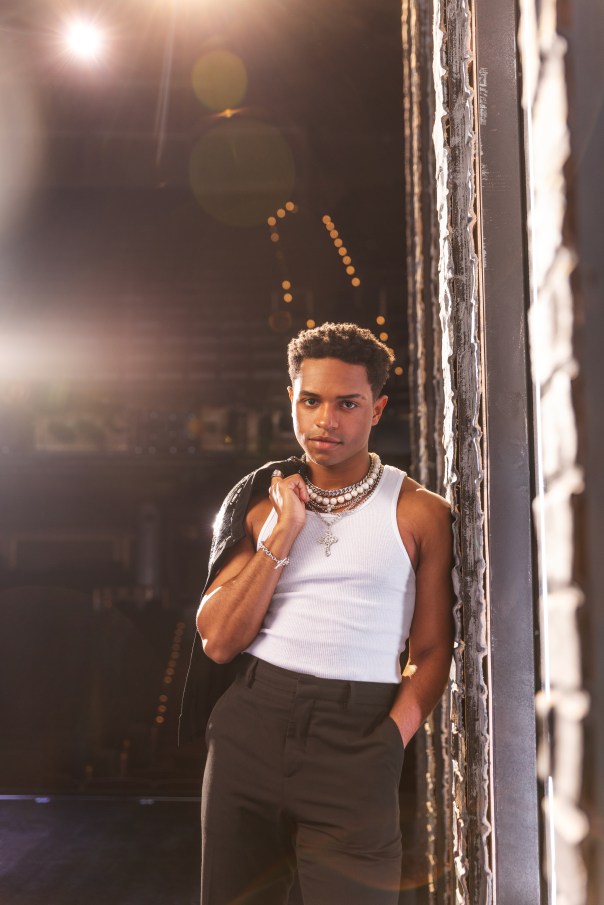
As soon as Roman Banks struts into this artsy loft, he begins flipping those legitimate questions into annoyances, for we can see that the silky moves are all there before he’s halfway through performing “Beat It,” meshed with a vocal that transcends impersonation. Musicians onstage are fortified by a dozen more lurking in the orchestra, adding heft to the opening number, and the dancers are Fosse sleek and Broadway tight. This is what came to see.

So we can empathize with MJ when Rachel and Alejandro, a TV reporter and her cameraman, walk into the busy room, hoping to get an in-depth interview and a behind-the-scenes scoop. Speaking with that preternatural softness of a singer saving his voice for his next performance, MJ yields to the eager cubs – but only on the condition that they keep it strictly about the music. Banks manages to suffuse that softness with a winsome sweetness.

Nottage doesn’t lavish much of her MacArthur genius into Alejandro, enabling Da’Von Moody to pour a smidge of his own personality into a generic, slightly geeky fanboy. There’s a modicum of humor because Rachel, not MJ, is his boss. Here Nottage gives us some texture, bringing us an opportunistic fan-tagonist in Rachel – pushing back over and over against MJ’s restrictions, pesky, persistent, and sometimes annoying. Stepping into this crucial role on press night last Friday from deep in the list of Swing players, Ayla Stackhouse added a touch of wicked allure to Rachel.

A wisp of seduction was in the air. As a result, Banks’ continued softness and firmness may have gained fresh strength. Yet when MJ kept saying no, he seemed to be veering toward maybe.

This sensation, that we were meeting the real MJ in person as Banks shuttled between guarded and candid moments, can be partially credited to the tech crew now at the Belk. MJ often speaks the gospel of detail and perfection, but this crew fulfills it. Over the last couple of Broadway Lights seasons, I’ve become so accustomed and resigned to the sound not being right on opening night at the Belk before Act 2, if at all, that I’ve lately tolerated the problem without comment.

Maybe that’s why Press Night for this two-week run was put on hold for two performances. On ordinary opening nights, you could expect Belk’s audio crew to turn MJ’s softspoken dialogue into the sound of microwaving popcorn. This time, everything was dialed in perfectly for the critics. Moments when I might be holding my breath, bracing for sonic gremlins to afflict MJ, were simply breathtaking.

All night long, the show maneuvered deftly, revealing subtle new merits. Timeshifts between the ‘90s rehearsal loft and the eye-popping ‘60s charm of the Jackson 5, juxtaposed with the abusive Jackson household and Michael’s taskmaster dad, could become somewhat disorienting as the retrospective took off. Part of what Nottage and director/choreographer Christopher Wheeldon are trying to accomplish is steering the narrative smoothly between songs in the Jackson catalog without the storytelling stalling and landing us at a gimmicky concert.

By the time we get our bearings in Act 2, about 23-25 hits into the 40-song list of musical numbers, we realize that anybody portraying MJ is pumping out too much energy onstage, singing and dancing, for him not to be whisked off to the wings for some rest. Giving Banks some breathers is also part of the navigation calculus. No less than three Michaels were onstage between 8:00 and 10:45 at the Belk, Banks as MJ, newcomer Jacobi Kai as Middle Michael, and Josiah Benson as Little Michael, timesharing the role on tour with Ethan Joseph.

If Banks amazed me, getting every signature move and vocal intonation of MJ, moonwalking through everyday life, Benson as the Afro-coiffed Little Michael left me gob-smacked. Maybe the Jackson Estate’s worries were misdirected: who knew that the roles of MJ and Little Michael could be cast so successfully, both on Broadway and on tour simultaneously? Little Michael’s timbre had always seemed to come from a once-in-a lifetime voice since that “ABC” moment when I first heard it. Not anymore.

What could have set MJ apart from the performers portraying him at various stages of development were his songwriting gifts and inspirations, never really explored in Nottage’s book. Likely, that would have rendered the show more intimate and even more Michael-centric. We get a fairly broad tapestry instead, including glimpses of singers Jackie Wilson and James Brown, along with the ballroom grace of Fred Astaire.

The supporting cast is very fine. Devin Bowles and swing-understudy Rajané Katurah were worthiest of mention as Little Michael’s parents, Joseph and Katherine, fleshing out their marital discords. Both make good on the vocal solos carved out for them. Bowles time travels as much as Banks, portraying MJ’s stage manager, Rob, throughout the contentious rehearsal scenes. Dancers, even when supposedly driven in rehearsals to smooth out imperfections, are exemplary, living up to Wheeldon’s strict demands. Is MJ pushing his dancers too hard to reach perfection – because Dad pushed him so relentlessly? We don’t miss the emotional turmoil lurking inside this connection.

Nottage is sufficiently fascinated by the intricacies of putting a show together that she not only reveals the micro levels of drilling the synchronicity of dance routines and sweating details. She also has Michael, Rachel, Rob, and Dave – MJ’s on-edge beancounter, excellently portrayed by Matt Loehr – discussing the larger concerns, namely the architecture, pacing, and budgeting of a show.

That helps us to swallow all the action in the drab rehearsal loft before the delayed gratification of seeing the all-out “Thriller” extravaganza deep into Act 2. A whole show of such MTV-like spectacles would have cost zillions, too mind-boggling to pack onto the biggest moving van known to man. An armada of trucks and set builders would need to be deployed for a full evening of such fantastical wonder.

In many ways, Nottage and Wheeldon deliver as much as we can expect of Michael Jackson’s life and artistry onstage without surrendering the rights to the music. I’d like to think that Nottage, dealing with the Jackson Estate’s constraints, saw herself as resembling her own persistent Rachel character during the process, pushing the envelope further and further, inch by inch, as far as it could be stretched. Perhaps her Pulitzer pedigree helped Nottage to make more territorial gains and bring us closer to the real MJ than The Estate was truly comfortable with when her work began.

Warehouse PAC’s “Sweat” Deploys Stellar Cast on Stellar Script

Review: Sweat at Spirit Square

By Perry Tannenbaum

)1001

Not at all liberal or intellectual, nor with aspirations toward witty stylishness or trendiness, Lynn Nottage’s Sweat is a brutal and humbling lesson in empathy. Very humbling for clueless liberals and intellectuals who never got why blue collar and union workers jumped out of the pockets of the Democratic Party at the turn of the 21st century – turning our history and politics into a train wreck.

Premiered at the Oregon Shakespeare Festival in 2015, before opening at The Public Theatre in November 2016 and transferring to Broadway the following March, Nottage’s working-class drama, which won a second Pulitzer Prize for the playwright in 2017, seemed to break out when it would resonate loudest with 2016 presidential politics and issues. By that time, NAFTA (the North American Free Trade Agreement), ratified more than two decades earlier in 1993, was swept into a whirlwind of xenophobic issues that included illegal immigrants, Mexican gang rapists, manufacturing jobs shipped overseas, immigration reform, and a border wall.

Nottage mostly takes us back to 2000, when the reality of NAFTA was impacting on steelworkers in Reading, Pennsylvania. The authenticity of her lunch-pail portrayals comes by dint of personal interviews that Nottage conducted in Reading with Kate Whoriskey, who would ultimately direct the Oregon premiere, over a two-year period beginning in 2011. Subjects of these interviews included many factory workers who had been locked out of a steel tubing manufacturing plant for 93 weeks.

IMG_3998

Two such plants figure in Nottage’s portrait of Reading. One of them has previously crushed Brucie and his fellow union members, so he’s already a pitiful druggie when the action begins. Another plant, where his son Chris and his estranged wife Cynthia still work, will soon follow suit, further dividing Brucie’s family and the other regulars who gather at a rundown bar where Stan serves up drinks and downtrodden Oscar mops up.

Directing the Warehouse Performing Arts Center production at Duke Energy Theater in Spirit Square, a month after its debut run in Cornelius, Michael Connor deftly contextualizes the action. Where Nottage’s script calls for “News of the day” sound montages, we’re repeatedly reminded – amid mentions of Allen Iverson, the Philly 76ers, and troublemaking Iraq – that this is the election year of the pivotal Bush-Gore showdown.

Yet Nottage isn’t exclusively focused on the fallout from NAFTA, nor is Brucie the only foreshadowing of how her story will develop. The preamble to the explosive action of 2000 is the opening scene, where Chris and his friend Jason meet separately in 2008 with Evan, their parole officer. As we gradually become aware that the fallout from NAFTA will deal yet another blow to Reading, we also realize that the chums will do something violent to earn their serious prison time.

We also learn in the preamble how different and antagonistic Jason and Chris have become, for Jason sports white supremacist tattoos on his face from his prison years while Chris grasps a bible in his left hand. Jason is the powder keg we keep our eyes on in the unfolding flashback scenes, but it isn’t too long before we realize that his emerging racism is a family hand-me-down from Tracey, his mom.

The rifts between these black and white families develop along separate tracks. When Olstead’s posts a notice that they have an opening for a new supervisor, Tracey’s kneejerk reaction is to spurn the idea of crossing over to management, but Cynthia tells Stan that she intends to apply, feeling that she has earned a promotion by virtue of all the years of hard work she has put on the floor.

Tracey certainly vies with her son Jason as the most toxic person in town. When she loses out to Cynthia on the promotion after she also applies, she attributes her friend’s success to affirmative action and the tax breaks she presumes Olstead’s receives for hiring a minority. She also refuses to help Oscar come on board at the company, viewing him as a foreigner. Of Puerto Rican ancestry but born in Reading, Oscar eventually signs on as a scab when Olstead’s locks Tracey, Jason, Chris, and their union out. They send Cynthia out to post the lockout notice, further roiling tensions around the plant – and at the bar.

So the ills of Reading aren’t confined to corporate greed. Xenophobia and racism are also on the scene, bringing latent Trumpism into bloom. The balance of Nottage’s analysis extends to the depth and pluminess of the parts she doles out. Warehouse artistic director Marla Brown only slightly dilutes Tracey’s toxicity, leaving room for a hint of mid-America wholesomeness and nicely gauging Nottage’s rounded assessment. For the arc of her disintegration starts at a merry, drunken celebration of her 45th birthday in the first flashback scene.

Tanya McClellan, off my radar for far too long, shows everyone what she can do with the opportunity to branch out from comedy roles into drama, for she does more than her share to flavor the friendship – and later, the complex antagonism – between Cynthia and Tracey. Before serving as a barometer for Tracey’s disintegration, there’s a marital confrontation with Brucie where Cynthia fills out our picture of how far he has fallen. McClellan’s mix of vulnerability and dignity is just right in both situations.

Never on an even keel like the other characters here, Brucie is as challenging as Tracey, for he’d flatten to two dimensions in the hands of an actor who couldn’t deliver several levels of desperation. In his scattered scenes, including one with a majestic monologue and another where he proves not to be the sponge we thought he was, Dominic Weaver is so very real and unforgettable.

Matt Webster as Stan and Justin Thomas as Oscar seem equally detached from the main plotlines – until they aren’t. While still on the periphery, both have eloquent moments. Webster excels when Stan describes life in a company as successive generations of the same family toiling at the same plant for successive lifetimes, with no solid hopes of advancement, no real appreciation from management, and instantly disposable. After about an hourlong immersion in that dreary reality, Thomas gets to shock us a little by telling us what it’s like as a Hispanic to live a lifetime as the hydrant of all these self-pitying underdogs, even if you’re born in the US like Oscar.

If you’ve already gathered that there are no weak links in this Warehouse production, you won’t be surprised to learn that I was impressed by both our protagonists, Maxwell Greger as Jason and Drue Allen as Chris, though Nottage shunts her leads to the wings for long stretches while plant politics take center stage. From the black eye we see on Greger in the preamble, augmenting the three tats on the other side of his face, we know quickly that that Jason is always coiled for action. Even when those markers disappear in the flashback scenes, Greger has a chiseled James Dean intentness in the set of his jaw, an unfocused discontent that portends trouble.

Allen, in his portrayal of Chris, underscores what irks Jason and his mom most deeply: like Cynthia, who craves a promotion, Chris wants to better himself by going to college. There’s a relatively calm purposefulness to his demeanor, firm but without rigid righteousness, as he deals with his broken dad and his beggary. And we come to see through Allen’s eyes that when a broken justice system unjustly incarcerates you because of your color, taking up the bible isn’t the worst way to cope.

IMG_4024

As Evan, Ron McClelland has that seen-it-all confidence of a parole officer who knows the ploys and dodges of hardened criminals, yet beneath his tough exterior, this copper seems earnestly engaged with even Jason’s rehabilitation. Becca Worthington rounds out the cast as Jessie, a third musketeer with Cynthia and Tracey at the outset when they’re still chums. Arguably, she serves as a white counterpart to Brucie: no matter how sloshed she gets hanging out at the bar until last call, she cleans up and punctually punches in at the plant at 6:00 or 7:00 the next morning.

The presence of McClelland and Worthington in such minor roles is just another earmark of this high-quality Warehouse PAC production. It also testifies to the attractions of working with such a stellar cast on such a stellar and timely script.