Review: The Play That Goes Wrong at Theatre Charlotte
By Perry Tannenbaum
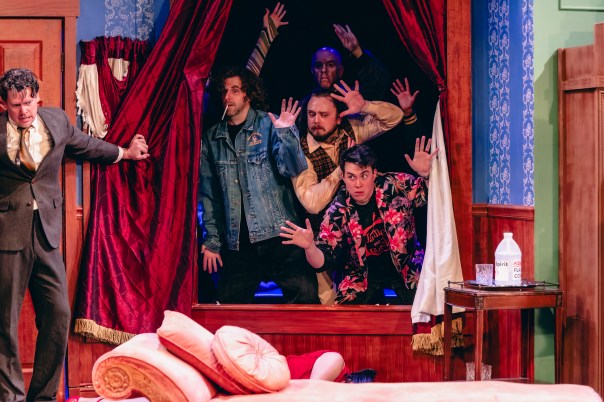
Every time Inspector Carter declares his determination to solve “The Murder at Haversham Manor,” lights at Theatre Charlotte suddenly turn a lurid red to triple-underline the melodrama. This may be the only technical element that consistently goes right in The Play That Goes Wrong, now running – and decomposing before our very eyes –through February 23.
The mantelpiece over the fireplace in Charles Haversham’s study remains a work-in-progress long after the master is murdered. The painting above the mantle – clearly the wrong painting – doesn’t stay where it belongs, and a pesky door stubbornly resists efforts to unlock it when it isn’t wandering off its hinges. In similar disrepair, we may count the phone, the intercom, the elevator leading up to the second-floor office, and the walls themselves.
It is a precisely flimsy set, lovingly put together by Theatre Charlotte artistic director Chris Timmons, so precisely flimsy that it must conform to approximate dimensions to accommodate the cast. So active that the set predictably won the Tony and Drama Desk Awards for best scenic design in its 2017 Broadway debut. Like Michael Frayn’s famed Noises Off, another British play-within-a-play that goes comically wrong and wronger – but on a stage that revolves a full 180ᵒ – the set is like a machine. It could be packaged like an Ikea kit.
Written by Henry Lewis, Jonathan Sayer & Henry Shields, The Play That Goes Wrong nestles more naturally at the Old Queens Road Barn than at Knight Theater, where the national tour touched down in the QC six Novembers ago. The basic concept is that a small-time community theatre, perennially understaffed and underfunded, has suddenly received a grant that will finally enable it to present a full-fledged production.
No longer will Chekhov’s classic Three Sisters be reduced to Two Sisters at the Cornley University Drama Society. Nor will Lloyd Webber’s resplendent Cats be shrunk to Cat. It’s the birth of a new era!
But unfortunately, the new era hasn’t ushered in an influx of fresh acting talent and technical know-how. Dennis struggles with her lines and usually mispronounces the tough words written on her hands. Jonathan repeatedly re-enters the action before he’s supposed to. Sandra has an unfortunate knack of being in the wrong place at the wrong time; and her understudy, Annie, after subbing for Sandra when she’s knocked unconscious, reads terribly. Yet she refuses to yield back her role when Sandra revives.
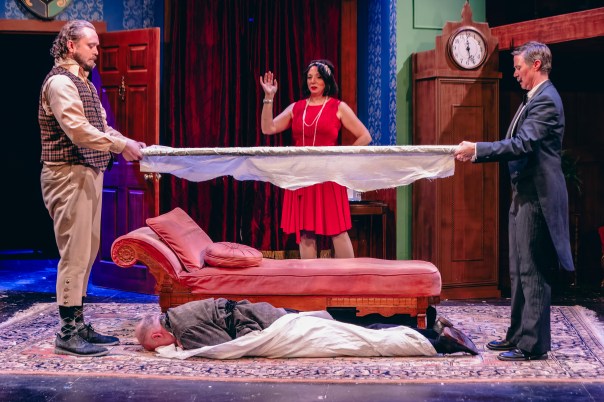
Props aren’t reliably placed in their assigned locations by the incompetent crew. When they are properly placed or deployed, like the stretcher needed to carry the corpse through the finicky front door, they may not function properly. The Duran Duran CD, sought after by lighting-and-sound man Trevor before the play begins, will turn up inconveniently onstage deep into Act 2.
Which reminds me: even though those redlight cues are absolutely reliable, the portentous sound cues accompanying them are not.
Tonya Bludsworth directs all this carefully calibrated chaos with an able assistant director, Brian Lafontaine. Together, they and Brandon Samples as Chris bring out a key point that didn’t strike home for me as forcefully when I saw the touring version in 2019. Chris not only plays the plum role of Inspector Carter in The Murder at Haversham Manor, but he also serves as the stage director, prop maker, box office manager, and PR rep – totally responsible for this catastrophe, and obviously overstretched.
On the smaller Theatre Charlotte stage, Samples is closer to us and we can focus on him more sharply than if his flop sweat were dripping down at Knight Theater. Makes a difference when one protagonist seems to be especially invested in the worsening outcome, valiantly trying to cover up the metastasizing miscues, and gaping at the sheer scale of his own mismanagement and incompetence.
For me, Sample’s visible struggles – from his nervous shit-faced grins on up to his hissy fits – made Chris a little more poignant for me. Here is a man who cares so much about theatre, and he’s watching all his multiple shortfalls in artistry and management implode so spectacularly. We can feel for the rest of this woeful team, but not nearly as much.

Lee Thomas earns a distant second place in our sympathies just for the physical punishment he takes as Charles Haversham, the stepped-on, sat-on, and mishandled murder victim. Or for the dismal ratio of abuse absorbed to dialogue delivered. When he finally does speak, maybe for the first time at Theatre Charlotte since 2020, it is as an actor of mind-boggling incompetence, eclipsing nearly all of his castmates. Thomas is rather good at looking quietly embarrassed, confused, and discombobulated.
Jenn Grabenstetter as Sandra starts off in a sympathetic slot, cast as Florence Colleymore, the murder victim’s bride-to-be. Our empathy for her slackens when we learn that Charles’s brother, Cecil Haversham, is Florence’s true love. Or when we see how stylized Sandra is as a performer. Or when she skips ahead one line, answering Inspector Carter’s questions before he asks them. But we feel for her – a little bit, anyway – when the front door flattens her and her castmates prop her up inside a clock. When Florence revives, she has to battle Annie to reclaim her role with some fine screwball fight choreography by Allison Collins.
The character arc for Rachel Mackall as Annie is even more transformational, for her Florence starts off in a near-catatonic monotone until she does the first of her pratfalls, scattering the pages of her script and maybe dislodging a contact lens. That raises Annie’s energy level, leading to the subsequent miracle where, battling Grabenstetter for the spotlight, she suddenly has her lines memorized while becoming a vicious gladiator.
More WWWF-style action would not have been amiss, but there’s still plenty.

Like Selsdon in Noises Off, Dennis’s prime reason for existing in The Play That Goes Wrong is to roundly muck things up. Lewis, Sayer & Shields seem to be indicating that he’s inept, miscast, or over-the-hill. What the hell, Bludsworth casts a woman in the role, the venerable Andrea King, who may have actually portrayed more women on QC stages than men and describes herself like a cute puppy for sale in the digital playbill.
With so much incompetence surrounding the Haversham Murder production, it’s a bit cruel to arraign her as the sole culprit for substituting turpentine when a decanter of adult beverage is served to guests at the Manor. Or it is when that happens for the first time. It’s on her when the screwup is repeated, sparking a prolonged series of spit-takes because she has also forgotten a line that would propel the action forward instead of casting it into a never-ending loop.
King maintains a cheery insouciance no matter what kind of havoc she causes, enabling Cody Robinson as Robert to become king of the spit takes as the bride-to-be’s brother, Thomas Colleymore. With a preternatural Joe Belushi energy, Robinson demonstrates that Robert’s distaste for “White Spirit” can actually increase with each sip! When we think Robinson’s frustration and rage have peaked or even exceeded expectations, he still turns it up a couple of notches.
Adam Peal as Robert and Roman Michael Lawrence as Trevor fill out the roster of actors implicated in the murdering of The Murder at Habersham Manor. Robert is not only amateurish but also a carefree hambone, so naturally Chris gives him two roles to botch. Initially, Peal appears as Cecil Haversham, Charles’s scheming brother and Florence’s true love. But there’s more to butcher when Robert resurfaces as Arthur the gardener, laying on some eyewitness evidence.

Did I mention that Trevor, after losing track of his Duran Duran treasures, must abandon his functions as lighting and soundman when Annie, replacing Sandra, is also stricken? That script-scattering pratfall was just the beginning of her misadventures. While Lawrence has already shown us – and will continue to show us – how badly Trevor performs at his chosen specialties, we can brace ourselves for his slaughter of Florence Colleymore, postponed only by his reluctance to play the role.
On my second viewing, it was possible to pay more attention to the convoluted mystery plot by “Susie H. K. Brideswell.” Now I can confidently proclaim that Habersham Manor is a masterpiece of implausibility. Doesn’t work at all.
Woefully, Theatre Charlotte doesn’t seem to have experienced a financial windfall that parallels Cornley University’s. That would have enabled them to append a faux playbill for the Habersham Manor production to the conventional Play That Goes Wrong program. Then we could learn the last names of the players and the Habersham roles they play with less fuss and bother. A few tidbits about the players also enriched the experience of the touring production.
Apparently, when the playwrights founded their Goes Wrong franchise (Peter Pan and The Nativity are among the spin-offs), they must have been focused on crafting three of the roles for themselves to perform in London and Broadway – and meshing with Nigel Hook, their mad genius set designer. So they didn’t insist that their faux playbill must be printed to accompany the show.
That lack of detailing serves to emphasize where The Play That Goes Wrong doesn’t measure up to Noises Off! Frayn’s work fleshes out relationships between the actors onstage when they’re backstage and, with its first-act rehearsal scene, gives us a more vivid idea of how the play-within-a-play is intended to go. For that reason, despite all the hilarity that Lewis, Sayer & Shields deliver, I’d hesitate to recommend The Play That Goes Wrong to anyone who is new to theatre – or hasn’t experienced a play that goes right.
But for sheer fun in frightening times, this show is welcome medicine for everyone else. TikTok & Friends may have brought nostalgia for America’s Home Videos to a screeching halt, but this latest romp at the Queens Road Barn revives the special pleasure – and laughter – of similar train wrecks large and small running right at us, non-stop, on a live stage.
Joe Turner’s Come and Gone, directed by Corlis Hayes, last came and went at Central Piedmont Community College in 2015. Back then, the production demonstrated how ill-suited even a renovated Pease Auditorium was for the best of August Wilson’s dramas. Panoramic Pease has now been demolished, so it will be interesting to see Hayes come back again to the CP campus, along with Jonavan Adams reprising his role as Herald – at a real theater in the fledgling Parr Center. Dominic Weaver, also in the mix ten years back, gets a juicier role this time as Bynum, the conjuring root doctor.
Turner, the second play in Wilson’s decade-by-decade traversal of the 20th century, The Pittsburgh Cycle, is set at a Pittsburgh boarding house in 1911. Rather than hinting at WW1 later in the decade, the drama hearkens back to slavery, the Civil War, and their aftermath, both glorious and sad.
“Every character has a story, and every story has a song,” says Hayes. “The play explores African American identity, healing from trauma, and the power of community and self-discovery. More significantly the play is an examination of Black people in transition during The Great Migration.”
This weekend only!



 Art on My Sleeve