Tag Archives: Lana Gordon

“Hadestown” Makes a Merry, Satiric Tragedy

Review: Hadestown at Belk Theater
By Perry Tannenbaum

The last time HADESTOWN sauntered into town with its jazzy swagger was almost exactly 18 months ago, Election Day 2022. Perfect timing. When Matthew Patrick Quinn as King Hades brought down the Act 1 curtain with “Why We Build the Wall,” the thrust was so hideously Donald-like that two MAGA maniacs sitting in front of us, clearly offended, huffed out of Belk Theater and didn’t return after intermission.

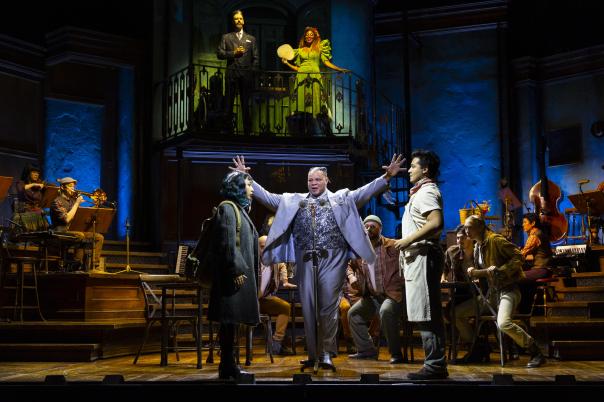
Well, Quinn and his tectonic shelf-shaking bass baritone voice are back in the title role – the chief reason why my wife Sue would return to see Hadestown a third time if he and the Anaïs Mitchell musical should come back yet again. Yeah, he is that good. And even though The Wall is a bit in the rearview mirror as a national topic of conversation, the satanic aura of Hades still adheres to the corrupt kingpin of the GOP.
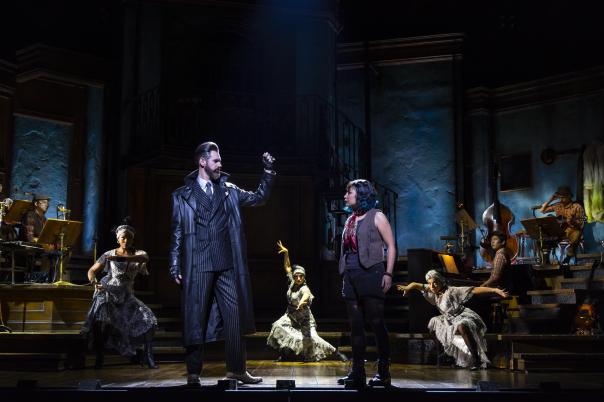
Maybe in a different way this time. More than Hades’ striking xenophobia, a strange attitude for a king of Hell, my lingering distaste was for the god’s rabble-rousing dictatorial strut. #MeToo was probably past its fullest bloom in 2022, though it still weighed on the elections, but in 2024, I couldn’t help paying closer attention to Hades’ “Hey, Little Songbird” propositioning of Eurydice.

When she eventually followed the slick monarch to the Netherworld and climbed the stairs to his boudoir, where she would sign away her soul behind closed doors… Yeah, Eurydice’s slow assenting ascent turned my thoughts northward to Stormy Daniels testifying in a Manhattan courtroom earlier that day in the hush money trial. Another little songbird.
To dwell on how deeply Hadestown resonates with the American political scene is to ignore that it first workshopped in New York before the master of Trump Tower declared his candidacy. It also disrespects how well Mitchell retold the story before it developed its adhesive powers. We see Quinn as Hades soon enough, but he doesn’t assert himself until he becomes impatient for Persephone’s annual return to the underworld after she has brought on spring and summer here above.

Until then, Lana Gordon as Persephone and Will Mann as our host/narrator Hermes are the prime charismatics. Next to their flamboyance, Orpheus and Eurydice are rather tame, despite J. Antonio Rodriguez’s pure high tenor and Amaya Braganza’s street-urchin perkiness. Musically, Mitchell lavishes her best invention on Hades and Orpheus, which makes sense since Orpheus has always represented the power of music while Hades, alias Pluto, has always stood for mindless greed.
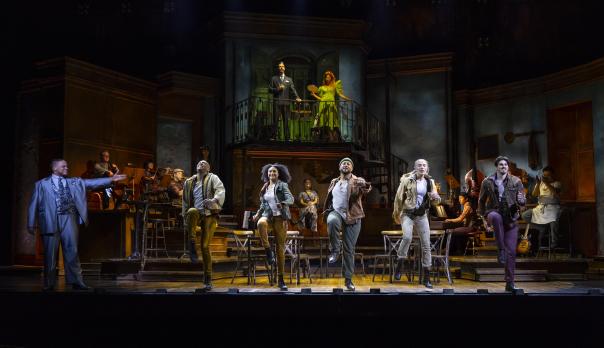
Gordon and Mann are expected to light up the stage with their outsized personalities, their pizzaz, and eye-popping color – costume designer Michael Krass’s best – chief reasons why Hadestown rolls along so grandly, backed up less brashly by Braganza’s kooky charm and Rodriguez’s botanical magic.

But Mitchell’s book is also provocative, darkly portraying the world above as stricken by an apocalyptic nuclear winter or irreversible climate change, needing Orpheus’s musical magic to set things right and Eurydice to supply him with inspiration and encouragement to finish his cosmic song. The core of this world-changing song, appropriately enough, is wordless. Mitchell gives us a nice touch of the universal here.

Mitchell herself was the original Eurydice when her show first surfaced in New England in 2007. For me, that explains the most annoying, least enduring traits of Hadestown: its devout unpretentiousness and its dogged determination never to proceed too far without undercutting itself and reminding us that this is merely theatre. We’re having a party, y’all! Have a drink!

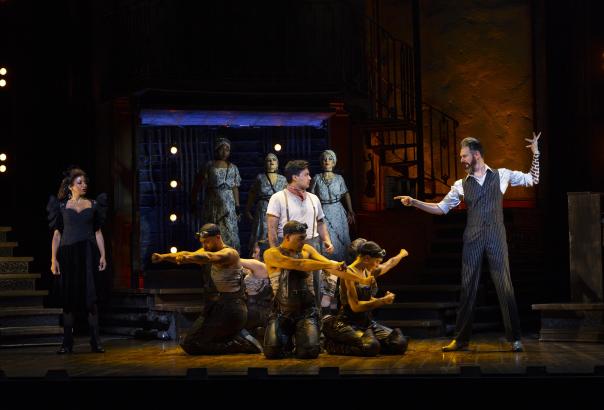
All the musicians are perennially onstage with the actors, particularly the ponytailed Emily Frederickson, who occasionally sashays among the cast with her trombone when called upon for her tastiest licks. For backup vocals, three more angels are engaged as the Fates – Marla Loussaint, Lizzie Markson, and Hannah Schreer – all of whom pick up various instruments during the evening. Could we have Orpheus trudging out of Hades, a fearful but trusting Eurydice behind him, without being tracked by a backup group?

Mitchell and director/developer Rachel Chavkin apparently didn’t think so. Maybe they’ve never experienced Christof Glück’s Orfeo ed Euridice at the Met’s Lincoln Center production, where the legendary newlyweds walk up a long, steep, irregular staircase splayed against the upstage wall, carrying torches to light up the tunnel.

Or perhaps they had seen that opera and realized that youngsters in the audience, not knowing how Vergil and Ovid told the tale, would be bummed by the tragedy if Glück hadn’t appended a happy ending. The whole evening seems cushioned by Chavkin and Mitchell’s worry that they might lose a key demographic along the way if the seriousness of the tragedy remained undiluted by mirth, merriment, and David Neuman’s most festive choreography.

Not to worry, when the Fates take their toll, the hearty, genial, and avuncular Hermes will be there to console Orpheus and all his bummed fans. Along with a big brassy jazz band. Raise another glass!

“Hadestown” Serves Up a Jazzy, Godly Nectar

Review: Hadestown at Blumenthal PAC

 By Perry Tannenbaum

2296_Hadestown North American Tour 2022_photo by T Charles Erickson

In Blumenthal Performing Arts’ Encore playbill, the distance between Anaïs Mitchell, who created the music, lyrics, and script of HADESTOWN, and Rachel Chavkin, who developed and directed Mitchell’s creation, is a scant three-and-a-quarter inches. Inside that space are the neatly typeset names of 42 actors, designers, and organizations who have helped bring their vision, the 2019 Tony Award winner for Best Musical, so vividly, raucously, and meaningfully to life.

You get the idea that, in crafting and concepting this marvelous retelling of the Orpheus-and-Eurydice myth, Mitchell and Chavkin became even closer than those 82+ millimeters. Together they have created a work that is slick and glitzy, yet we find primal and profound truths amid the razzle-dazzle.

Those truths can sting, particularly when we descend into the dark underworld ruled by Hades and his abducted queen, Persephone. While Mitchell and Chavkin discard the #MeToo aspect of the royals’ union, reimagining them as formerly true lovers, they point up King Hades’ inclinations toward greed, exploitation, oppression, and mindless acquisition, layering on prejudice and xenophobia for good measure.

So when Matthew Patrick Quinn as Hades brought down the curtain on the first act with “Why We Build the Wall,” written years before The Donald took up politics, the satire bit hard enough for the MAGA morons seated in front of us to get up in a mighty huff at intermission, never to return. Yet this concept of Hades, casually linking his excesses to global warming and climate change, isn’t really an absurd overreach. Why shouldn’t Mitchell and Chavkin portray him as the vilest of plutocrats, when Pluto is actually Hades’ most familiar alias?

And plutocracy is where we’re at.

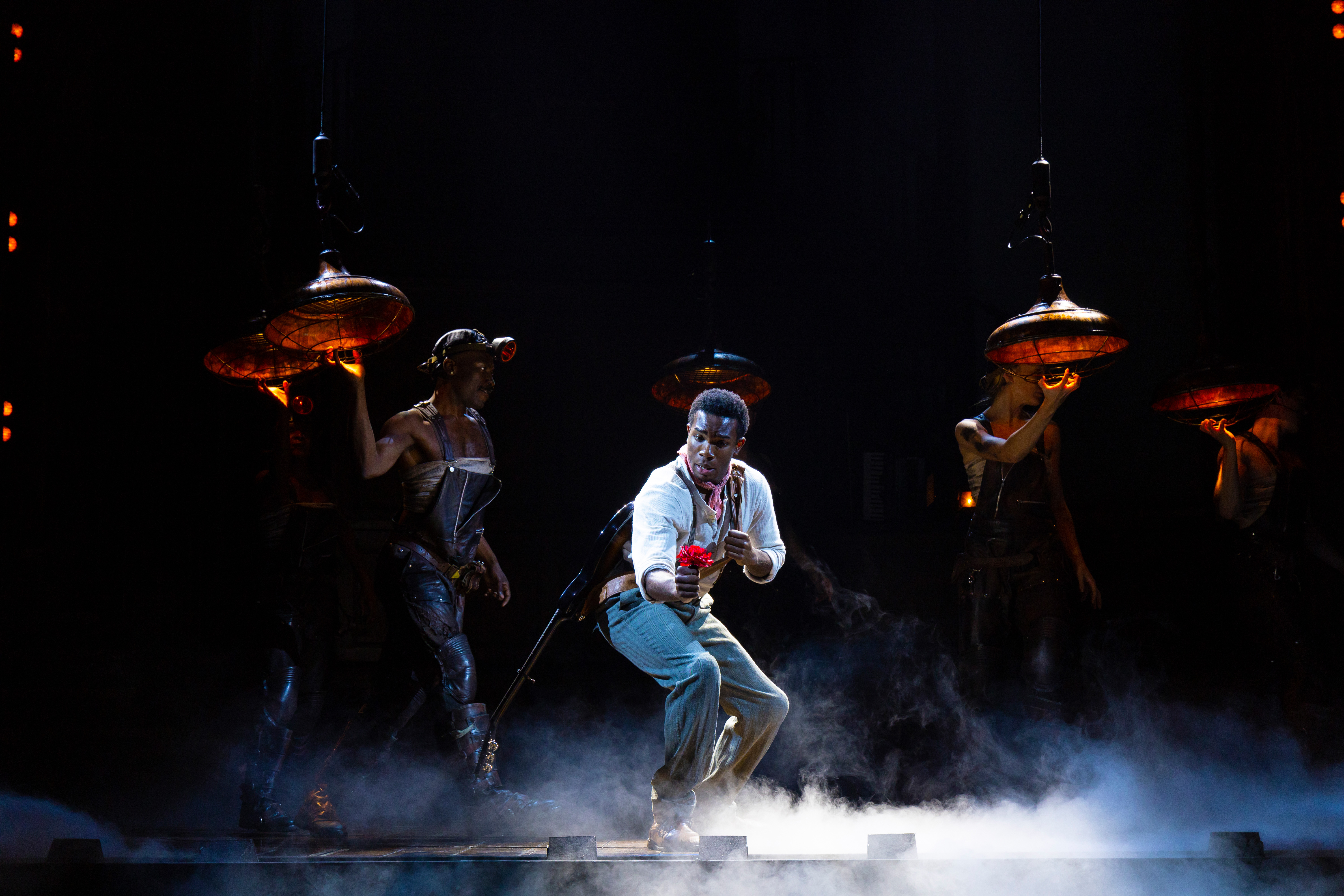
Mitchell enriches her devilish brew with a score steeped in the decadence of New Orleans jazz, repeatedly underlined by a doo-wop trio of Fates whose only moral failing is going along with the flow. These stylish female backups are ultimately more successful in getting into the impoverished Eurydice’s head than Orpheus, who is preoccupied with finishing the song he believes will restore springtime to the world. Quinn’s basso sleaziness is given a robber baron vibe with an infectiously chugging railroad line running directly to his realm, and the combination of Rachel Hauck’s scenery and Michael Krauss’s costumes makes our dystopian world seem nearly as nocturnal as the netherworld.2022_(from top left clockwise) Matthew Patrick Quinn, Maria-Christina Oliveras, Chibueze Ihuoma, Nathan Lee Graham, Hannah Whitley and company in the Hadestown North American Tour 2022_photo by T Charles Erickson

Presiding over the action and gleefully shattering the fourth wall again and again, Nathan Lee Graham as Hermes keeps us from forgetting – graceful and gliding charmer that he is – the artifice and theatricality of all we see. At the same time, he is frequently seconding the ethereal voice of Chibueze Ihuoma as Orpheus, asserting the power of music in changing our world by envisioning a better one, reminding us how music and language intertwine in the ancient ritual of storytelling.

Singing has always been key in preserving our world and our heritage. Musical narrative, after all, isn’t a recent discovery championed by Verdi, Jerome Kern, Rodgers & Hammerstein, and Lin-Manuel Miranda. It dates back to King David’s psalter, anonymous campfire bards, Orpheus’ legendary lyre, and the Homeric Hymns, where the story of Hades and Persephone was originally told. By design, three of the pivotal songs Orpheus sings are grouped as a series of epics.

Potentially, as we find here, songs have magic. Consequence. “The Wedding Song,” a beguiling duet early in Act 1 where Orpheus responds to a sequence of challenges from Eurydice, is as memorable as Hades’ sardonic affirmation of walls. “Epic I” from Orpheus, the embryonic song he is working on, is enough to establish his magical power and win Eurydice’s belief in him. Doesn’t last when Hades comes personally calling with his saucy come-hither, “Hey, Little Songbird.”2260_Chibueze Ihuoma in the Hadestown North American Tour 2022_photo by T Charles Erickson

But Orpheus is able to march into hell for a heavenly cause (a recurring theme in world literature and religion, it would seem) when he melts Hades’ heart with his completed “Epic III” after intermission, transporting the steely King back to his tender courting days and reconciling him with Persephone. It’s here that the Fates get into Hades’ head as effectively as they had gotten into Eurydice’s earlier, so that the King of the Underworld attaches one pesky condition that prevents Eurydice’s release into Orpheus’ care from being unconditional.

Ihuoma’s naivete and spontaneity turn the moment when he succumbs to sudden heartbreaking tragedy, beautifully staged as everything freezes into silence. The essence of that heartbreak registers so poignantly in Hannah Whitley’s eyes as Eurydice, so achingly close to restoration, almost clearing the threshold of the railroad car that must now take her irrevocably down. All of Belk Theater and all of creation seem disappointed in that moment, even the lively and cynical Fates (Dominique Kempf, Belén Moyano, and Nyla Watson).

Paradoxically, when all stops for a precious few heartbeats, we may realize most keenly that the working relationship between Chavkin and choreographer David Neumann has been as close and precisely calibrated as the relationship between the director and Mitchell. Indeed, our director, composer, and choreographer are involved in perhaps the most delicious conspiracy of all in HADESTOWN, those precisely chosen beats when an unseen centerstage circle suddenly begins to revolve or abruptly halt.

Most of the players, particularly the drones who make up the Workers Chorus, are swept round and round by the wheel. Others like Hades and Orpheus walk at the precise pace that makes them seem like they’re stationary as they move, floating on air. Then the wheel stops, and on they go, like clockwork. Or since the subplot of Persephone’s arrangement with Hades is a mythic explanation of the cycle of the seasons, the circular motion we see is clockwork.2282_Matthew Patrick Quinn, Chibueze Ihuoma, and Maria-Christina Oliveras in the Hadestown North American Tour 2022_photo by T Charles Erickson

As fine as the Fates are in moving about the stage, sometimes while wielding musical instruments, our eyes are most intently riveted to the lithe movements – and eye-popping costumes – of Graham as Hermes and Lana Gordon as Persephone, bringer of springtime and wicked beverage. Graham and Gordon are both electrifying performers, so it’s rather amazing when Quinn, after brooding quietly in the background for most of the first act, instantly proves himself their equal.

Together, they are the spice, the heady godly nectar that helps us savor the purity and fragility of the mere humans, Eurydice and Orpheus, all the more.