Tag Archives: Lamar Davis

“Hit the Wall” Reminds Us of the Continuing Relevance of the Stonewall Riots

Review: Hit the Wall at The Arts Factory

By Perry Tannenbaum

August 19, 2023, Charlotte, NC – On the eve of the annual Charlotte Pride Festival & Parade, a series of LGBTQ+ events spread across the city in the coming week, Queen City Concerts has chosen a perfect moment to commemorate the Stonewall Riots of 1969, a watershed moment for gay liberation and empowerment. Best known for their resourceful reductions of big musicals to a more bare-bones concert format, Queen City has previously shattered their own template with a fine script-in-hand production of Tony Kushner’s Angels in America, Parts 1 and 2.

Three months later, after a return to form with Diana: The Musical late last month, the company has shown us that Angels wasn’t a fluke, staging the local premiere of Ike Holter’s Hit the Wall, a 2012 play with music that premiered in Holter’s hometown of Chicago before director Eric Hoff restaged his original Steppenwolf Garage production with a New York cast. That Off-Broadway production opened in the spring of 2013 at the Barrow Street Theater, not far from Christopher Park in Greenwich Village, where much of the original action went down.

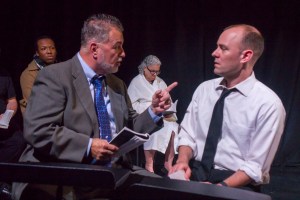
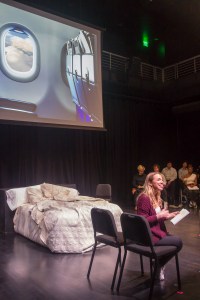
Directing this concert version at The Arts Factory, J. Christopher Brown isn’t quite as resourceful or ambitious as he was with Angels in utilizing projections and costumes. Scenery and props are also less lavish, and there are no stage directions at all read aloud. With a rowdy rock trio roaring from one corner of the black box space, the experience remained richly visceral, though our awareness of where we are or who is speaking was sometimes delayed. We get an abbreviated staircase for the proverbial sidewalk stoop, where the “Snap Queen Team” of Tano and Mika hang out, and a couple of chairs occasionally appear.

Projections could have transported us inside the Stonewall Inn gay bar, but we only get the exterior, and a lamppost or a park bench could have transported us to Christopher Park more emphatically. It doesn’t take long to get the gist after scenes at these locations begin, but who is telling us in the opening tableau that “The reports of what happened next are not exactly clear”? Without a simple cop’s uniform on actor Nick Southwick, it takes a long while before we know how to digest this declaration.

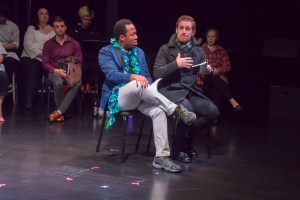
Of course, a long while in a production that zipped through Holter’s script in less than 90 minutes wasn’t uncomfortably long. What Christopher continued to do extremely well was cut down on key moments when actors read from their scripts. For most of the production, actors were off-book and the booklets they clutched served as reminders of their cues rather than reading material. We were aware of the scripts onstage, but the flow of the action and the actors’ lively energy grabbed nearly all our attention. If anything, the occasional peep at a script reminded us how quickly and thoroughly this cast had mastered its essence with just a few rehearsals.

We should also understand that the sanctification of Stonewall over the past 54 years has partly happened as myth rushed in to fill in a vacuum of determined facts. It’s interesting to see the strategies Holter used to recreate Stonewall, chiefly by inventing a compacted community of fictionalized gay, lesbian, queer, and crossdressing people, from the neighborhood and from elsewhere, who gather at The Stonewall, owned by the mob but catering to this eight-person crowd.

As the Snap Queen Team, Lamar Davis as Mika and Zelena Sierra as Tano have attitudes, sometimes confrontational, about anyone who passes by. When Zachary Parham arrives as the queer Newbie, the Queens are not at all welcoming. But Holter’s style of hostility isn’t mean-streets raw or even ‘60s bohemian. Combats and putdowns come at us in the form of rap rhymes and poetry slams.

Aj White, arriving in high heels and a low-cut dress as Carson, is too much for the Snap Queens to handle despite his grieving over the recent death of Judy Garland. Yet he is visibly floored by the advances of lanky Neifert Enrique as the self-confident, draft-dodging, pot-smoking Cliff, a fatalistic drifter who assumes he will be dumped into the Viet Nam War the next time he is picked up in a raid. None of these core characters appear ripe for radicalization, though the tough Carson and roving slickster Cliff have agreed to meet at The Stonewall. Eric Martinez as the arrogant A-Gay further convinces us of the submissiveness that bonds the Newbie and the Queens. The Harvard grad lords it over all three.

Two catalysts for change are deftly stirred into the mix. Shaniya Simmons as Peg will combine with Carson in fomenting the police brutality at The Stonewall, and Valerie Thames as Roberta, an activist perpetually straining to draw a crowd, will finally be gifted with a galvanizing cause. Besides Southwick as the Cop, friction comes from Iris DeWitt as Madeline, a character who morphs from a concerned citizen to a disapproving sister. Music blasted by guitarist Daniel Hight, bassist Harley, and drummer Paul Fisher was most appropriate when we convened at The Stonewall and the bulk of our cast began to party.

Ironically, the music was most effective when it suddenly stopped as police commands triggered the raid. The music vibe and the slam poetry styling were shattered simultaneously. Soon we were in the ladies’ room watching the grim brutality. A little less riveting – but perhaps more emotionally fraught – was the climactic confrontation between the sisters after the raid.

Reports of what happened afterwards are unclear, but we do adjourn to the sidewalk stoop where the main point impacts the Queens who sit on it: there’s no turning back. Paired with Angels within three points, Hit the Wall reminds us that Kushner’s epic ended with a similar takeaway. The feeling that both dramas remain timely urgently underscores the fact that the Pride movement has more work to do.

“Angels” and QC Concerts Are Aiming High

Preview: Angels in America at the Georgia Tucker Fine Arts Hall

By Perry Tannenbaum

AIA Rehearsal Photo 1.6

We’ve had historic productions of Tony Kushner’s Angels in America here before, most famously the Charlotte Rep bombshell of 1996, which blew up into a culture-war disgrace that shamed the Queen City nationwide. Rep’s greatest hit – in attendance and critical esteem – sowed the festering seeds of the regional company’s eventual demise in 2005.

Nor did Carolina Actors Studio Theatre (CAST) have any better success in 2014 when, following in Rep’s footsteps, they also staged both Part 1 and Part 2 of Angels: Kushner’s Millennium Approaches, which won the Tony Award for Best Play and the Pulitzer Prize for Drama in 1993; and Perestroika, which repeated for the 1994 Tony, Drama Desk, and Olivier awards in 1994. After just one more production, CAST folded.2023~Georgia Tucker Center-07

By even contemplating an Angels revival, QC Concerts and music director/founder Zachary Tarlton are obviously tempting fate. More than that, they’re smashing their own musical template and flouting the company’s brand – by airlifting their upcoming production to Matthews and the new Georgia Tucker Fine Arts Hall.

QC Concerts has happened by accident, beginning like Angels with the onset of an unheard-of disease. In Tarlton’s case, the plague was COVID-19 rather than HIV AIDS.

The company started small. Smack in the middle of preparing to spearhead an Actor’s Theatre of Charlotte fundraiser at Middle C Jazz, Tarlton was faced with the suddenness of the pandemic shutdown and the uncertainty of what would follow. He didn’t want to sit around idly by his keyboard.

“So I launched kind of an online streaming platform,” Tarlton recalls. “We were then known as QC Quarantine Concerts – a bit of a play on words. What we did was we modeled ourselves after a program in New York that Seth Rudetsky [and his husband, James Wesley] from Sirius XM started called Stars in the House, where he was running these broadcasts at the same time that shows would have been running.”

Thursdays through Sundays, for a 10-week run extending from mid-March through June of 2020, Tarlton’s piano room became a streamcasting studio. To create these mini-concerts, Theatre Charlotte’s go-to music director networked with Matthews Playhouse, Davidson Community Players, and Children’s Theatre of Charlotte, as well as Actor’s Theatre.

Tracks recorded in the Tarlton piano room also went beyond the QC to contacts who became singing collaborators in Chicago, New York, and musical performers who had been left in the lurch by stalled national tours.

“It was a good opportunity to kind of bring the arts together at a time when that was not really possible and people were kind of starving for the arts. And it gave us a chance to really get to know and meet and work with a lot of really, really wonderful people.”

That sweet taste of collaboration – and that newly-forged network of musical artists – seemed like a shame to waste. When live theatre began to return late in the summer of 2021, Tarlton dropped the Quarantine from his brand, fired up his network, and launched the live programming of QC Concerts, season one. Angels will mark the end of season two, detouring from a cavalcade of musicals that has included Titanic, Kinky Boots, Head Over Heels, and Cruel Intentions.

Season three scheduling was unveiled last month, and the all-musical lineup will include Diana The Musical, Hit the Wall, Local Singles, Merrily We Roll Along, Parade, and Sunset Boulevard. Late in July, the season kicks off with Diana at Free Will Craft + Vine, a favorite NoDa haunt where Tarlton staged Kinky Boots. The season reaches its pinnacle in November, when Sunset Boulevard opens Uptown at Booth Playhouse – backed by a 40-piece orchestra.

The emphasis, except when Angels are flown in, is always on the music.

“We do concert stage productions of shows,” Tarlton explains. “So we do them with the full orchestra, whatever the complement is that the show is written for. A lot of our musicians are Symphony subs that play all the Broadway national tours, and their schedules fill up super quickly. So to get those folks willing to come on board and play Titanic [boasting a 22-piece orchestra] for one weekend with two rehearsals is astounding.”

Dramatic presentation continues to evolve, though Tarlton has no plans to move beyond the concert format. In the beginning, it was a fairly straightforward reading-stage layout, with the singers at music stands behind a row of mics and the orchestra lurking upstage. At Free Will in NoDa, they built a drag-show style runway and the audience surrounded the players.

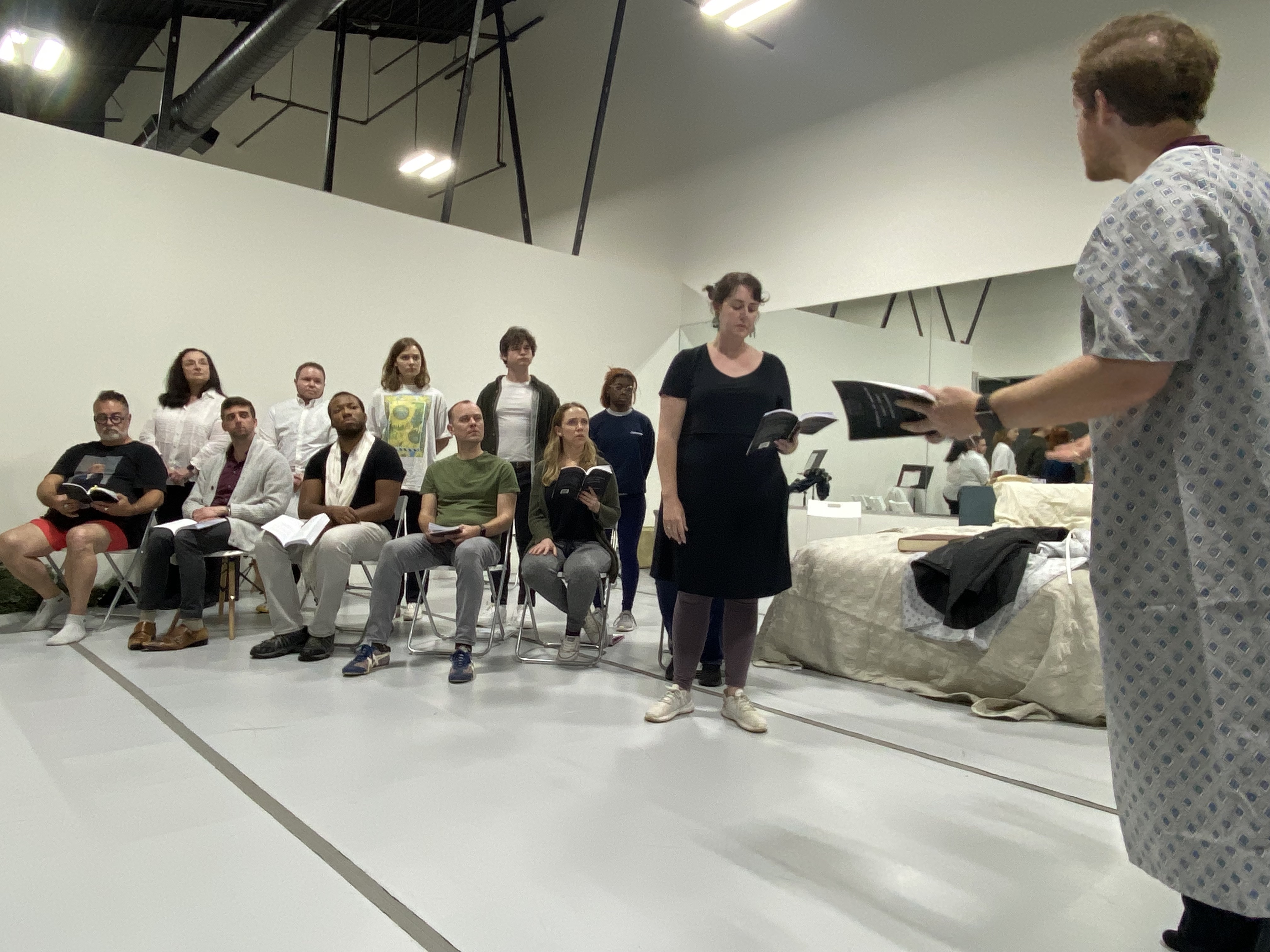
Prodded by imaginative guest directors, Tarlton kept pushing the envelope, adding light costumes, some props, and moving his leading men and women away from their scripts for the key musical numbers. While guest director J. Christopher Brown won’t be crashing ceilings or flying angels when QC Concerts travels to the Georgia Tucker, he will be using projections and sound design to clarify the narrative and amp up the key moments.

That will put the traditional reading-stage setup on steroids. Written for an eight-person ensemble, Angels could be expected to add on a narrator for the script-in-hand format to read the scene settings and stage directions. Brown is expanding his cast to 18, using multiple narrators and cutting down on actors playing two or more roles. There are 21 roles in Millennium Approaches and 25 in the stupendous Perestroika.AIA Rehearsal Photo 1.5

Only one cast member doesn’t double, the actor who portrays protagonist Prior Walter. It’s an epic role that single-handedly justifies Kushner’s audacious Angels subtitle, A Gay Fantasia on National Themes. Not the kind of role you plunge into if you’re accustomed to singing “The Surrey With the Fringe on Top” or “Marian the Librarian.”AIA Rehearsal Photo 1.7

Casts from previous QC Concerts productions fill only four of the 18 slots for the company’s first nonmusical foray. Most notorious among these usual suspects will be Beau Stroupe as Roy Cohn, the demonic counterpart of the angelic Prior. Both of these powerhouse characters are AIDS victims, and another QC mainstay, Lamar Davis as Belize, is the link between the two – he’s the registered nurse who cares for the hospitalized Cohn, and he’s Prior’s prior lover.

The other major roles came from outside QC’s musical circle, a daring outreach since Brown didn’t bring a wealth of local experience to the table.

“It was 100% a leap into the void,” Tarlton admits. “I hoped that [Angels] was a title that would catch people’s eyes and they’d be like, ‘I might never get the chance to do this again.’ Foundational to the work we do is that idea of creating a home for everybody and really doing a lot of diverse work to challenge the way we think about and view the world. We’re not a company with a 95-year history – I’m totally out there to push the envelope and to bring something new and exciting and fresh, and if it makes people mad, it makes people mad. If people love it, people love it.”

Tarlton’s zest for challenging himself evidently goes beyond founding a theatre company unlike any we’ve seen before in Charlotte. Although he hadn’t appeared onstage since he was “in college a million years ago,” he auditioned for Angels after telling Brown not to use him if he sucked.AIA Rehearsal Photo 1.2

He’ll be playing Louis Ironson, the self-pitying nebbish and seducer who connects Prior with a third plotline. Too weak to stand by Prior in his AIDS sufferings, he abandons him in favor of his Mormon co-worker, Joe Pitt, luring him away from his religious principles and from his flaky, pill-popping wife, Harper Pitt. While Angels on high are recruiting Prior to redeem America, Harper is taking flight to a narcotic dreamworld and Roy Cohn is haunted by the ghost of Ethel Rosenberg. Enter Hannah Pitt, flying in from Salt Lake City to save her dear son Joe from the mortal sin of sodomy.

Yeah, it’s a lot.

Additionally, Tarlton is glad that two married couples, neither of whom have appeared with QC before – or at Theatre Charlotte – have become core players in Concerts’ Angels.AIA Rehearsal Photo 1.4

Rachel and Brandon Dawson, both faculty members at Winthrop University, are making their Charlotte debuts, Rachel as the confused, jilted, and somewhat spacey Harper and Brandon as our gay visionary Prior Walter. The scene they will have together is among the most incredible of the entire epic. Scott and Robin Tynes-Miller, on the other hand, have been mainstays on the Charlotte theatre scene for the last decade, ever since Robin founded Three Bone Theatre in 2013.AIA Rehearsal Photo 1.1

She is also the one solid link between the current QC Concerts Angels and the CAST production, shifting from the role of Harper Pitt in 2014 to the more elevated role The Angel. Rehearsal photos repeatedly depict Robin rising above ground level, even if she doesn’t fly. Scott figures to be more earthbound as the straight-arrow Joe Pitt.

While Actor’s Theatre of Charlotte provided the platform for QC Quarantine’s launch at their website, Theatre Charlotte deserves credit as the more significant source of inspiration for Tarlton’s unique enterprise – and its true birthplace. At about the same time that Tynes-Miller was piloting her first Three Bone production in 2013, the old Queens Road barn began hosting a series of annual fundraising concerts, Grand Nights for Singing, showcasing showtunes.

Tarlton was a fixture at the keyboard for these concerts. That’s where he started to become the only theaterperson in Charlotte to be connected with two different Tony Kushner works. Instead of the customary medley format, focusing on a particular era (like pre-1965) and highlights from a signature show (like Funny Girl), Tarlton approached executive director Ron Law with the idea of doing a full show.

So on February 26, 2016, the new concert musical concept took wing in the lobby of Theatre Charlotte with Caroline, or Change – music by Jeanine Tesori, book and lyrics by Kushner.

Caroline, or Change was one of those shows that I just felt like it was the right time, the right group of people in Charlotte to be able to pull something like that off. It was an incredible experience,” Tarlton says.

He caught the return of that musical to Broadway in 2021 as well as the Nathan Lane Angels in 2018. Taking his first leaps away from musicals with Angels – as a producer and as an actor – was pretty much a no-brainer.

“There’s no better show to do than something that means so much to me and the community.”

Georgia Tucker Fine Arts Hall, July 13th, 2021Publicity photos for the Georgia Tucker Fine Arts Hall are delicious, showing a 145-seat black box with ample projection and soundbooth resources for a knockout Angels. As the new fringe theatre movement continues to gain momentum around town, the Tucker becomes another tempting place for it to hang out.

The runs of QC Concerts’ shows remain tantalizingly short, a limitation Tarlton hopes to address in the coming years. This week’s Angels run, four performances from May 18-21, offer only two opportunities for us to see both parts of Kushner’s masterwork. Then it’s gone.

For Tarlton, that ephemerality is part of QC Concerts’ attraction. Like New York City Encores or the Broadway Center Stage Program at Kennedy Center in DC, the concept might be stretched to a full week. Maybe the sweet spot for ticket sales, publicity, reviews, and word-of-mouth will be found in that discreet degree of expansion.

“The idea is that these shows live and breathe in one specific moment in time,” Tarlton insists. “Our goal is to become a fully professional company in the next five years so we’re able to kind of pay everybody along the way.”