Review: Charlotte Symphony Plays Ravel’s Piano Concerto
By Perry Tannenbaum
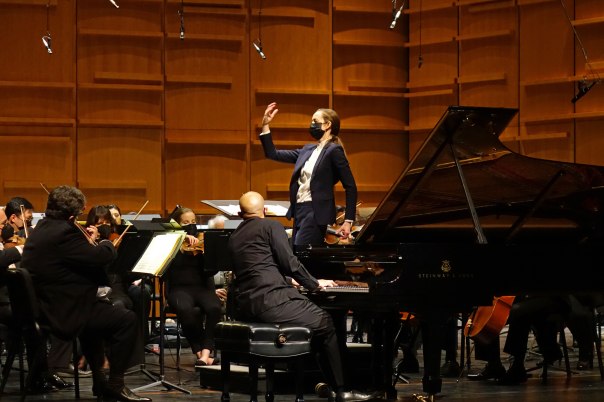
January 28, 2022, Charlotte, NC – You could arguably call it a facelift. After Charlotte Symphony’s powerful performance of Mahler’s somber, morbid, mercurial, epic, and sometimes phantasmagorical Ninth Symphony, almost everything seemed changed two weeks later. A new conductor was onstage, Australia-born maestra Jessica Cottis, making her Queen City debut. All six guest artists were making their debuts in Symphony’s Classics Series, and even the site of their musicmaking was different, moving southward from Belk Theater at the Blumenthal PAC to Knight Theater at Levine Avenue of the Arts. Most transformative was the music, a kaleidoscopic multinational program connected by a distinct American thread.
The headliner on the program was Maurice Ravel’s Piano Concerto, last performed by Symphony in 2013 when the wondrous Pascal Rogé made his Belk Theater debut at the keyboard. Jesse Montgomery’s folksy, bluegrass-flavored Strum preceded the main event, when Canadian pianist Stewart Goodyear seated himself at the Steinway. Cottis had plenty more excitement in store for us after intermission, plunging into Igor Stravinsky’s Circus Polka, for a Young Elephant – actually written at choreographer George Balanchine’s request in 1942 for Ringling Brothers Barnum & Bailey’s massive troupe of not-yet-controversial young elephants. Uncannily, another Balanchine commission rounded out the program, Kurt Weill’s The Seven Deadly Sins (1932) with lyrics by Bertold Brecht – obviously written for people rather than pachyderms.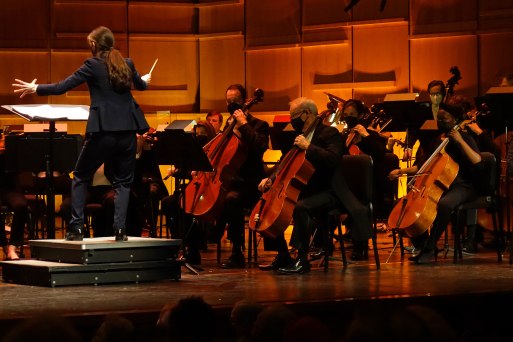
Nearly a year ago, Montgomery’s Starburst aptly keynoted a program that showcased Mozart’s Eine Kleine Nachtmusik (“A Little Night Music”). Longer and decidedly sunnier, Strum set the tone for CSO’s American evening as perfectly as the title readied us for a work written exclusively for strings. Reading Montgomery’s program notes, chronicling the various incarnations of the piece, we get the sense of experiencing its evolution as it unfolds, for it bounces around among three principal string players before beginning its breathtaking ascent to full power and beauty. Laying out the first pizzicatos, violist Benjamin Geller was soon joined by cellist Alan Black, strumming and then bowing. But it was concertmaster Calin Ovidiu Lupanu’s treacherous entrance that truly ignited the fray, triggering Montgomery’s ricochet effects and banjo-like strumming.
Honestly, the performance by CSO became a more massive, lovelier, and less ferocious thing than the studio version by the Catalyst Quartet on Montgomery’s 2015 Strum CD. With a full string orchestra came more majesty when the main melodies were revealed – and extra bite when the piece ended with a collective pizzicato. Nor are “folksy” and “bluegrass” any less flattering in describing Montgomery’s music here than they are in describing many of Aaron Copland’s signature works.
From the first time I saw him in 2017, playing all of Beethoven’s piano sonatas in a single day at Savannah Music Festival, Goodyear stamped himself in my mind as a prodigious talent. Prior to those three three-hour immersions, Goodyear’s distillation of Tchaikovsky’s The Nutcracker, on his 2015 solo CD, had clued me in. The soloist starts at a disadvantage in the Ravel Piano Concerto, having to follow the famed whipcrack that launches the opening Allegramente. Not to worry, Goodyear showed his mastery of the bluesy and jazzy licks of the movement soon afterwards, and harpist Andrea Mumm Trammell had a lovely interlude.
Inspired by Mozart’s Clarinet Quintet, Ravel’s middle movement drew absolutely mesmerizing lyricism from Goodyear, with English hornist Terry Maskin as stellar behind him as he was for Rogé. Yet everyone on the Knight stage seemed most inspired by the concluding Presto. Goodyear unleashed dazzling intensity and bravura, never easing up on the tempo, and the ensemble didn’t merely keep up: they seemed to be prodding their guest to play faster. Turbulence from the winds, brass, and percussion made the climax even more exhilarating.
Apparently, music for dancing elephant isn’t classified as ballet, since it doesn’t appear on The Robert Craft Edition of The Ballets on the notoriously completist Naxos label. Yet Stravinsky never disavowed his Balanchine bagatelle, conducting “Circus Polka” among his voluminous recordings of his own works, where it clocked in at a modest 3:27 on Columbia. Why this rambunctious crowdpleaser isn’t played more often as a concert appetizer is beyond me. While Cottis and the Symphony may have been a tad helter-skelter where Ravel called for more élan, they were marvelously attuned to Igor’s riotous absurdities, his brassy bombast, and the celebratory glee of his wild, galumphing jamboree. It seemed to start in mid-parade before the dainty spots hilariously evoked the pachyderm pixies.
The zaniness had hardly begun. Bass-baritone Reginald Powell, dressed in a flowery kitchen apron in order to portray the mother of our tempted/temptress heroine, led a barbershop quartet across the stage, sitting down at the end of their march behind a bank of microphones. Strange accessories for a classical concert. So Seven Deadly Sins was classical with a three-penny Kurt Weill twist. Nor was this an opera, though a cabaret table and some props were set in place before our chanteuse, soprano Lindsay Kesselman as Anna I + II, made her/their noire-ish entrance in a spymaster trench coat.
More than a hint of decadent vaudeville came with her, since each of the nine sections of Weill’s confection was heralded by an old-timey placard placed onto an easel. Prologue, Epilogue, Greed, and the gang were all embroidered with an apt skull-and-crossbones motif. Sad to say, much of this flavorful creativity was outweighed by Charlotte Symphony’s failure to provide supertitle projections once Anna I + II began vocalizing with her/their Family. A few audience members down with us in the orchestra section had the temerity to fire up their cellphones, where they had previously downloaded Symphony’s digital program, so they could follow along.
Not the best experience when you’re trying to keep up with columns of German and English on your iPhone while there is also action onstage to follow. The magnitude of this blunder would only be compounded if you returned home, flipped through the digital program, and discovered that the translation was written by life partners W.H. Auden & Chester Kallman, esteemed poets and librettists in their own rights – they worked on Stravinsky operas! Not only does their Deadly Sins translation rhyme, the syllable counts of every line meticulously match Brecht’s text. Learning that all five vocalists had North Carolina roots – and afterwards listening on Spotify to a recording with the Auden-Kallman lyrics – only deepened my incredulity.
Everyone at Knight Theater, singers and audience alike, could have been so comfortable, and all Brecht’s wit, irony, and satire could have been so clear!
Stepping up to one of mics, Cottis was helpful in her introductory remarks in laying out Brecht’s storyline, which is basically Anna’s odyssey across seven American cities on a mission to sustain her family back home in Louisiana, encountering one of the deadlies in each locale. Ideally, the Balanchine concept is fulfilled when Anna I is the soprano and Anna II is a sublime dancer. Part of the comedy that got lost when Kesselman was both Annas was in the lopsidedness of the dialogue between them. Anna II has very little to say.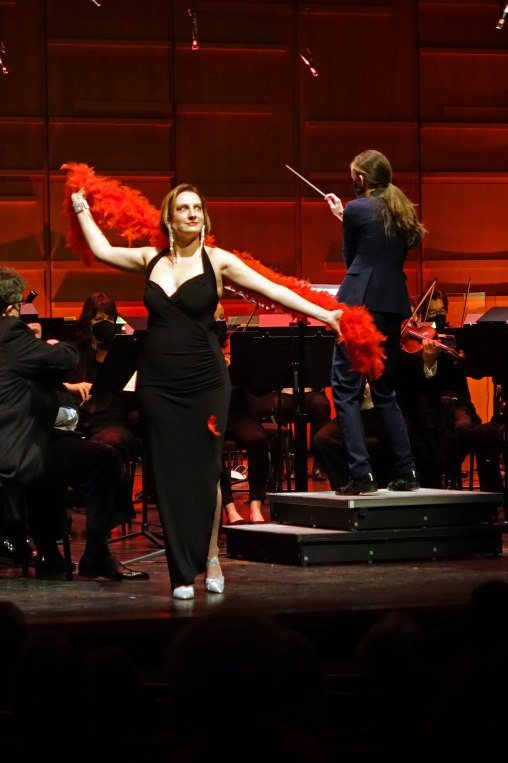
The staging helped this decadent Weill bauble to upstage Ravel’s merriment – or at least prevented it from being an anticlimax. Kesselman soon peeled off her trench coat, revealing an evening dress as the Family’s Sloth along the Mississippi River transitioned to Pride as Anna II took a job in Memphis as a cabaret dancer. Anna added a flaming red boa encountering Wrath in LA, and an uncredited lighting designer made a similarly lurid choice illuminating the Knight’s acoustic shell. Purple became apropos for Gluttony in Philly, a lighter pinkish red presided over Lust in Boston, and a dark golden hue settled in over Baltimore when she battled Greed. So I had to think that nobody wanted to offend New York during the Great Depression.
Need we say that when Anna’s journeying ended with Envy in San Fran, where Kesselman made her final grand entrance as a rich celeb, totally soused and brandishing a nearly empty bottle of vodka, that the stage was flooded in a deep dark green? Didn’t think so.
A wonderful ending to a melodious, fun-filled, and dance-filled evening. Even without dancers. Facelift and uplift.
Originally published on 1/30 at CVNC.org




 Art on My Sleeve