Tag Archives: Kerri Martinsen

“Beyond the Surface” Amazes and Parties-Down

Review: Beyond the Surface at McBride-Bonnefoux Center

By Perry Tannenbaum

The new Charlotte Ballet season is off to a blazing beginning. Presenting Beyond the Surface at the McBride-Bonnefoux Center for Dance through October 26, the troupe looked fresher and younger than ever. But the choreography was far, far younger: two world premiere hatchlings that emerged from their shells last Thursday from Omar Román de Jesús and Mthuthuzeli November, and a third Charlotte Ballet commission by Jennifer Archibald that had its premiere less than two years ago in the same studio.

On that auspicious occasion, Archibald’s fledgling was at the top of the Innovative Works program, sparking hopes that the pieces that followed would reach the same high level. This year, HdrM is nestled in the middle of the program – and my 2023 hopes were already realized again in 2024 with the premiere of De Jesús’s Balúm.

Yes, the first dance of the night easily merited a climactic spot in any evening of premieres: beautiful, complex, mysterious, symbolic, intricate, moving, epic, and surreal. Music by OKRAA, Ola de Luz, was relentlessly propulsive, with random noises at random intervals littered around the main core, a minimalist loop with a harp-like timbre. Once that core cleared the noisy interference, like a spiraling starship navigating through a belt of asteroids, a sudden hypnotic calm and spaciousness prevailed – and the wonder of this dance multiplied, lending it an uncanny glow.

De Jesús has indicated that he is exploring our interactions with the air that engulfs us, from the moment we are born until we take our last breaths. Or maybe that emergence from the noise field near the beginning of the piece is an expulsion from the womb, our birth after a pre-natal prelude. The Puertorriqueño choreographer also has a hand in scenic design and Branimira Ivanova’s costume designs, for she has some specific prompts to execute in fashioning the dancers’ outfits and props.

The most notable of these are black: Two umbrellas that conjure up the surrealism of René Magritte and the fearfully magnificent ambiguity worn by Rees Launer. One of the umbrellas starts upstage center, held by one of the dancers seated on a bench, and it gets passed from dancer to dancer during the action, frequently cycling back to its starting position. The other is held stolidly by a woman on a side bench who resolutely faces away from the action until the stunningly gorgeous denouement – when we get to see the air!

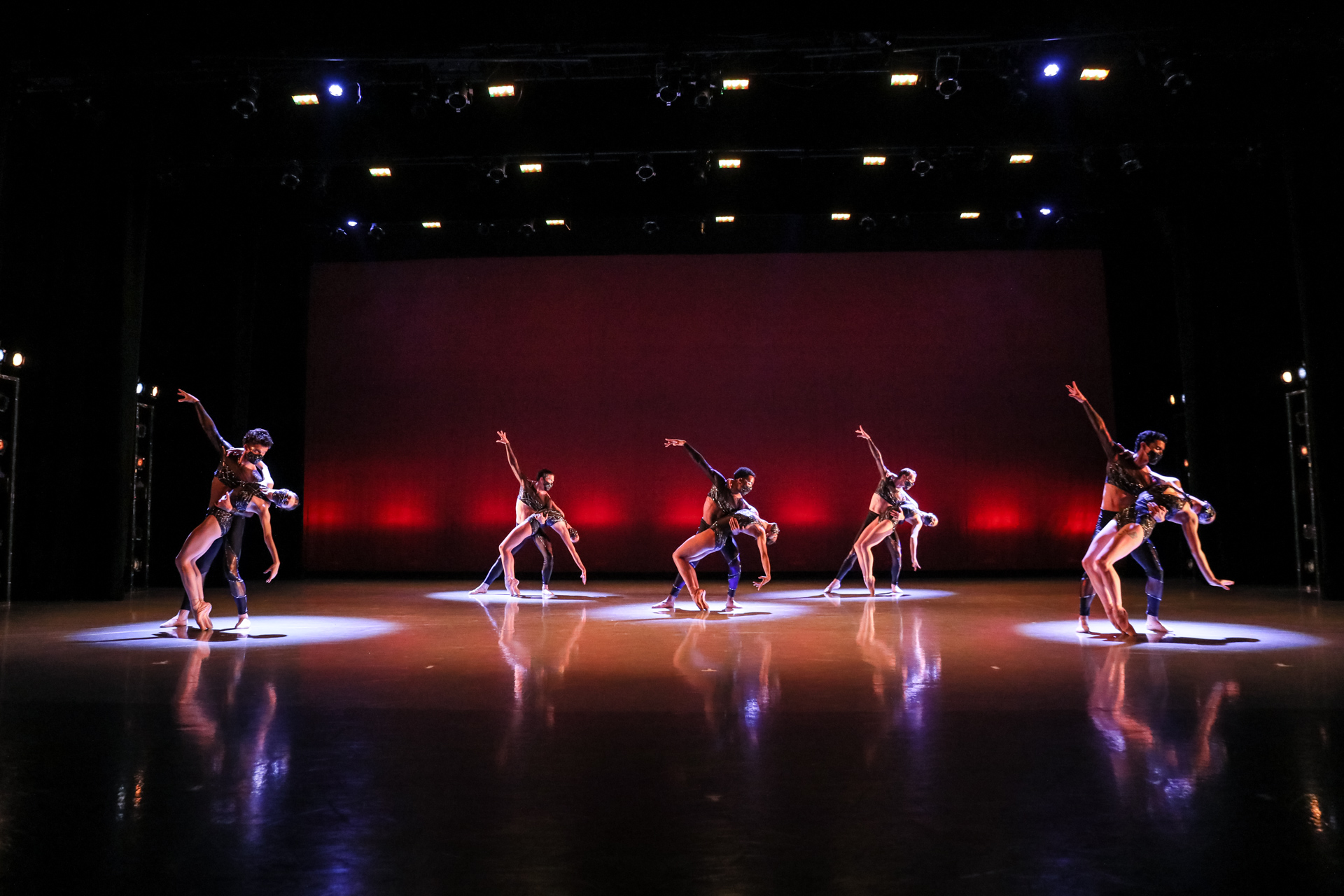
At various moments when Launer grips our attention, we can have different conjectures about what his stern character represents. A raging fire-and-brimstone preacher? a demon? a witch? the Angel of Death? Launer will be a member of two of the three ensembles that get to present Balúm during its current 16-performance run. Another standout in the opening weekend’s seven-member ensemble, Maurice Mouzon Jr., will be in all the performances of this piece.

The liquefied movement of the dancers – along with some robotic intertwining – was juxtaposed with no-less-idiomatic lifts that were more horizontal than vertical. Like chapter markers at the end of episodes, the ensemble would gather and swirl around the stage in an evocative oval parade. Autumn leaves swirling in the wind. Often two or three subgroups performed simultaneously before an ensemble swirl would resolve the dissonance.

What amazed me most was that synchronized entrances and overlapping actions were so precise when there were seemingly no musical cues to give the dancers a toehold. If you’ve heard music by Philip Glass, you know that minimalism is not particularly danceable music. Musicians playing it and maestros conducting it must concentrate intently on the score to keep their bearings amid the repetitiveness. I’m still gobsmacked by how this Charlotte Ballet team pulled this off.

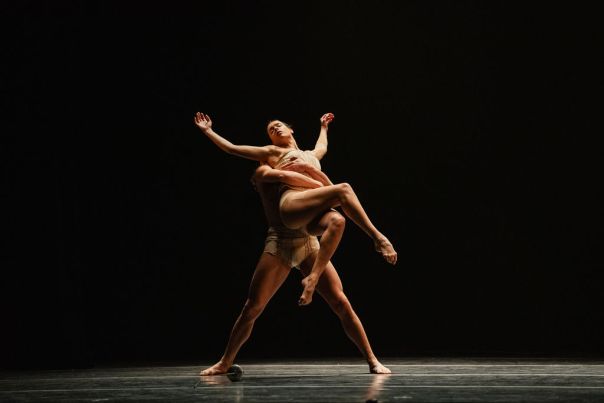
Following Balúm, a piece so untethered from every aspect of its music except for OKRAA’s tempo, Archibald’s HdrM struck me from an altered perspective. Archibald’s ability to mesh expressive movement to a soundtrack of musical compositions by Ludwig Ronquist, Heilung, and Federico Albanese stood out more boldly than ever after the more abstract and surreal De Jesús piece – though these intimate bonds in HdrM could be broken by abrupt mechanical disconnects from the score.

Two other conflicting factors came into play. Most welcome was the opportunity to see the Canadian-born choreographer’s work reprised by three of the eight dancers who performed at the 2023 premiere, Raven Barkley, Luke Csordas, and Shaina Wire. The piece looked more natural and “lived-in” twenty months later, so its internal contrasts were sharper and its sensual moments more relaxed. Barkley, in particular, stood forth dramatically, as sensual, captivating, and devastating as we’ve ever seen her. Nor can you fail to notice the ‘do.

Here, more than in any other dance of the evening, the ensemble bought into the “Unfiltered” theme of CharBallet’s 2024-25 season with their spirited, lyrical work. My only worry was off the dance floor and in the program booklet, where Archibald’s useful explanatory remarks where no longer in print. There in 2023, she was concerned with environmental psychology and posed a pointed question: “Is there a social responsibility to humanize architecture?”

Just asking that question helps us to connect with Archibald’s struggling language of movement. It also hints at the likelihood that Kerri Martinsen’s drab costumes are intended as institutional, such as clothing worn in hospitals, prisons, or mental wards. Aside from the contrast between lithe and mechanical movement, HdrM holds our gaze with a nice balance of ensemble, individual, and pair segments that flow naturally into one another.

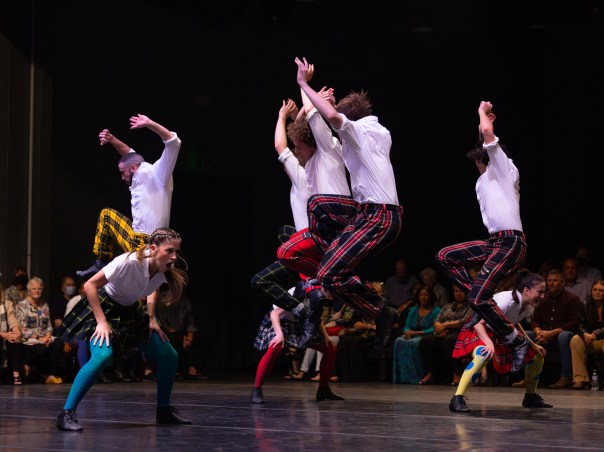
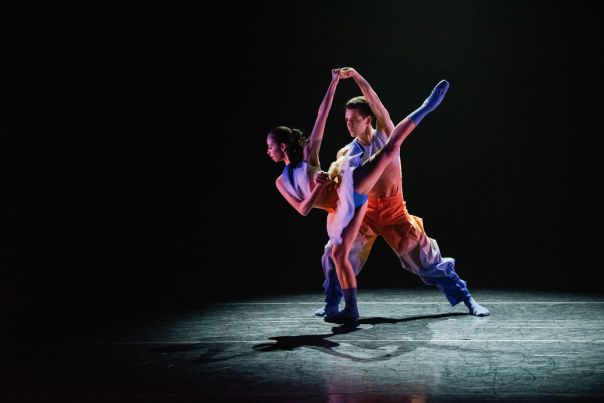
Like many finales we’ve seen before from CharBallet, November’s Vibes and Variations is the most celebratory and carefree piece of the night. After last year’s From Africa With Love, it’s also the second consecutive November premiere to kick off a season at the McBride-Bonnefoux Center. Where Africa was surprisingly serene and monochromatic, preoccupied with mauve-colored ostriches from his South African homeland and their exquisite fragility, Vibes seems to wander westward to South America, to samba, tango, and carnivale.

Ivanova’s costumes burst with pastel cotton-candy colors and outré pleating, what my late mom in her saltiest Yiddish would call ongepochket, crassly over-decorated. The bulges on the men’s costumes give them seahorse legs and the frilly women look like spinning tops in a color scheme that matches the men’s harlequin-like rigs. The music starts off rather quietly with Gaby Moreno singing the first vocal on the program, her cover of “Cucurrucucu Paloma” over a simple acoustic guitar accompaniment, smoldering with bossa nova intimacy and sadness.

Things intensify as the 15-person ensemble digs into the Bang on a Can All-Stars’ version of David Lang’s strangely percussive – and minimalist – “cheating, lying, stealing.” But the most intense partying launches when we arrive at beatmaker Jamie xx and MC Moose performing the brash, irresistibly mindless “Gosh.” Catching my eye most compellingly were Csordas and Fuki Takahashi, each of whom will be in two of the three rotating ensembles performing November’s piece throughout its current run.

If I have to predict who will land the title role in Carmen next spring when artistic director Alejandro Cerrudo and CharBallet unveil their Vegas-showgirl update, my guesses would be Takahashi or Barkley. Since that Charlotte premiere will be running for two weekends, both temptresses could take turns at it.

The Full Cerrudo Experience Is a Hit in Come to Life

Review: Charlotte Ballet’s Come to Life at Knight Theater

By Perry Tannenbaum

March 7, 2024, Charlotte, NC – Midway through his second full season as artistic director, we can now say that Alejandro Cerrudo has stamped Charlotte Ballet as his company. The corps looks fresh, peopled with more newbies we’re getting to know than trusted heirlooms who have long since proven their mettle. The choreography on their current Come To Life program at Knight Theater – Cerrudo’s Little mortal jump, Jiří Kylián’s Petite Mort, and the world premiere of Penny Saunders’ Beat the Clock – is beguilingly adventurous. Wow factor? Check.

For those of you who remember the 1950s, yes, Beat the Clock exhumes the classic TV game show hosted by the preternaturally vacuous Bud Collyer and sponsored by Sylvania. So at first, it wasn’t at all apparent that Saunders was targeting gender roles in those ancient days. But while the jackpot money was still flying gloriously above the dancers portraying the announcer, the host, the contestants, and the amped audience, we were cinematically fade-dissolving into a different scene as the shower of bills hit the ground.

This was a panel discussion where three women discussed the provocative question of whether housewives could benefit from additional education. Though it’s a godsend for the choreography, the discussion got heated, which may frustrate a few feminists in the audience. What frustrated me, however, was that Saunders’ sound design wasn’t as clearly audible for the panelists as it was for the archival gameshow track.

As the panelists’ hubbub subsided at stage right, there were a few moments of split screen as Michael Korsch’s lighting intensified at stage left for a briefer husband-and-wife scene, where both of the marrieds ended up feeling ignored and unvalued. Is this why we won the war? Sometimes, it felt this way. This brief microcosm gave way to two concluding community scenes, the first spotlighting the women and the finale embracing the entire 14-person ensemble.

Kerri Martinsen’s costume design had something to say about conformity in the outfits sported by the gameshow contestants and audience, later giving way to assorted nondescript outfits. Similarly, Maurice Mouzon Jr. as the announcer and James Kopecky as the host wore uniform outfits – with glittery silver blazers, to hell with historical accuracy. Back then, the em in emcee stood emphatically for master of ceremonies, so I suspected that Saunders and Martinsen were double-underlining their point.

After the first intermission, the repertoire flipped from cinematic to theatrical, with costume designer Joke Visser adorning Kylián’s men with gilt-edged cavalier attire that fit tightly and, for his women, the stiffest possible dresses. Suffice it to say that you’ve probably never seen women move laterally across the stage as these ladies in black do. Nor can it be doubted that these ladies – or their dresses – are the little deaths implied by Kylián’s Petite Mort title. Scored with slow movements from Mozart’s 21st and 23rd Piano Concertos, Mort both celebrates and lovingly skewers classic elegance – with a beautiful set of pas de deuxs between the ensemble segments and a couple of breathtaking transitions that require some nifty undercover choreography of their own.

The most eye-catching pairings among the six couples, for me, were Kopecky and Samantha Riester along with Raven Barkley and Rees Launer. Your mileage may vary, especially if you’re witnessing Charlotte Ballet for the first time, and the six couples will change from performance to performance (only Reister and Kopecky are constants, and they will be swapping out dances and partners). Just try not to gag on the relentless grace and symmetry.

If Kylián’s piece was a wry and perfect gem, then Cerrudo’s Little mortal jump, premiered by Hubbard Street Dance back in 2012, impacted like a coolly calculated over-the-top extravaganza. Korsch italicized the spectacle with his lighting design, principally when he aimed his beams at the audience and when he illuminated rows of vanity bulbs on cue. Branimira Ivanova’s costumes arguably upstaged Korsch’s lighting and Cerrudo’s choreography, literally stopping the show and putting two of Charlotte Ballet’s dancers in suspended animation, pinned to the scenery. Well before that, it was apparent that Cerrudo’s scenic design – massive movable boxes about as high as a school locker – was an integral part of his choreography. The movements of these huge boxes made transitions between scenes a constant source of excitement and surprise.

Ten pieces on Cerrudo’s playlist, listed alphabetically rather than sequentially in the program booklet, add to the kaleidoscopic swirl of his scenario and the giddy, stagey energy of the dancers. So his magical moment of suspended animation stands all the more dramatically apart from the hectic electricity that bookends this utterly unique pas de deux. Cerrudo’s piece, longer than the others, fit in well with them, maybe even eclipsing them a little. More comfortable in his leading role, his welcoming remarks were confident, for his invitation to support CharBallet’s 2024-25 season would soon be buttressed with a stunning program. The buzz in the house seemed to indicate that Cerrudo is winning over fervent new fans in his audience and onstage. As one ticketholder summarized, leaving the elevator that descends into the nearby parking garage: “Holy cow.”

Charlotte Ballet’s “Peter Pan”: An Intriguing Hybrid With Provocative Possibilities

Review: Peter Pan at Knight Theater

By Perry Tannenbaum

DSC_6711

We don’t grow up with the various incarnations of James M. Barrie’s Peter Pan as much as we used to. The aged Mary Martin musical is no longer resuscitated every year, the Disney animation has been relegated to a fairy-dust sprinkling for their theme park promotions, and I honestly can’t remember the last time I saw an ad for the peanut butter. And gosh, wasn’t there once a popcorn? Not a kernel remains in all of Googledom.

Yet the young flying prince of Neverland is still a powerful presence. Whether in touring musicals, glittery ballets, the original stage version, or that bizarre Broadway offshoot, Peter and the Starcatcher, the eternally young green sprite has visited our Metrolina stages at least 15 times during the new millennium. And tomorrow, Disney’s refresh, Peter and Wendy, starts to stream in your home if you’re subscribed.

Renaissance or evolution? The amended title begins to tell the direction of the Disney+ refresh. Meanwhile at Knight Theater, Charlotte Ballet unveiled their new Peter Pan, choreographed by Christopher Stuart. Building upon the previous version choreographed by Jean-Pierre Bonnefoux in 2004 for Peter’s centenary, Stuart has retained Howard Jones’s set design and most of A. Christina Giannini’s costume designs.

The jolly pastiche of Rossini favorites that Bonnefoux leaned on for his score, with gossamer drizzles of Respighi, is replaced by a full-length ballet score by Stephen Warbeck, best known for his Billy Elliott and Shakespeare in Love film scores. In exchange for the one step backward in his scenario, restoring the traditional resurrect of Tinker Bell, Stuart took the evolution of Barrie’s story a couple of steps forward toward political correctness.

Was such evolution necessary? When Mary Martin first flew in from Neverland on the wings of Moose Charlap and Jule Styne’s music, she turned Peter into a female action hero, smoked the peace pipe with Tiger Lily and her tribe, and depended on the Darling women across the generations. Not that these were radical changes, either, since Nina Boucicault (daughter of the famed playwright Dion) originated the title role in 1904.DSC_6648

So with respect to women and Native Americans, termed Indians back in 1954, Peter Pan easily passed for progressive in my eyes. But in recent touring versions and in the Bonnefoux remake, you could see these sore points addressed. Styne’s “Ugg-a-Wugg,” with its Comden and Green lyric, remained in all the Broadway revivals through 1999, but has been discreetly reworked or dropped in recent tours. Bonnefoux turned the Indians into Incas in 2004, and when he brought his version back in 2013 with the new sets and costumes, Captain Hook’s pirate crew were equally divided between men and swashbuckling S&M women.

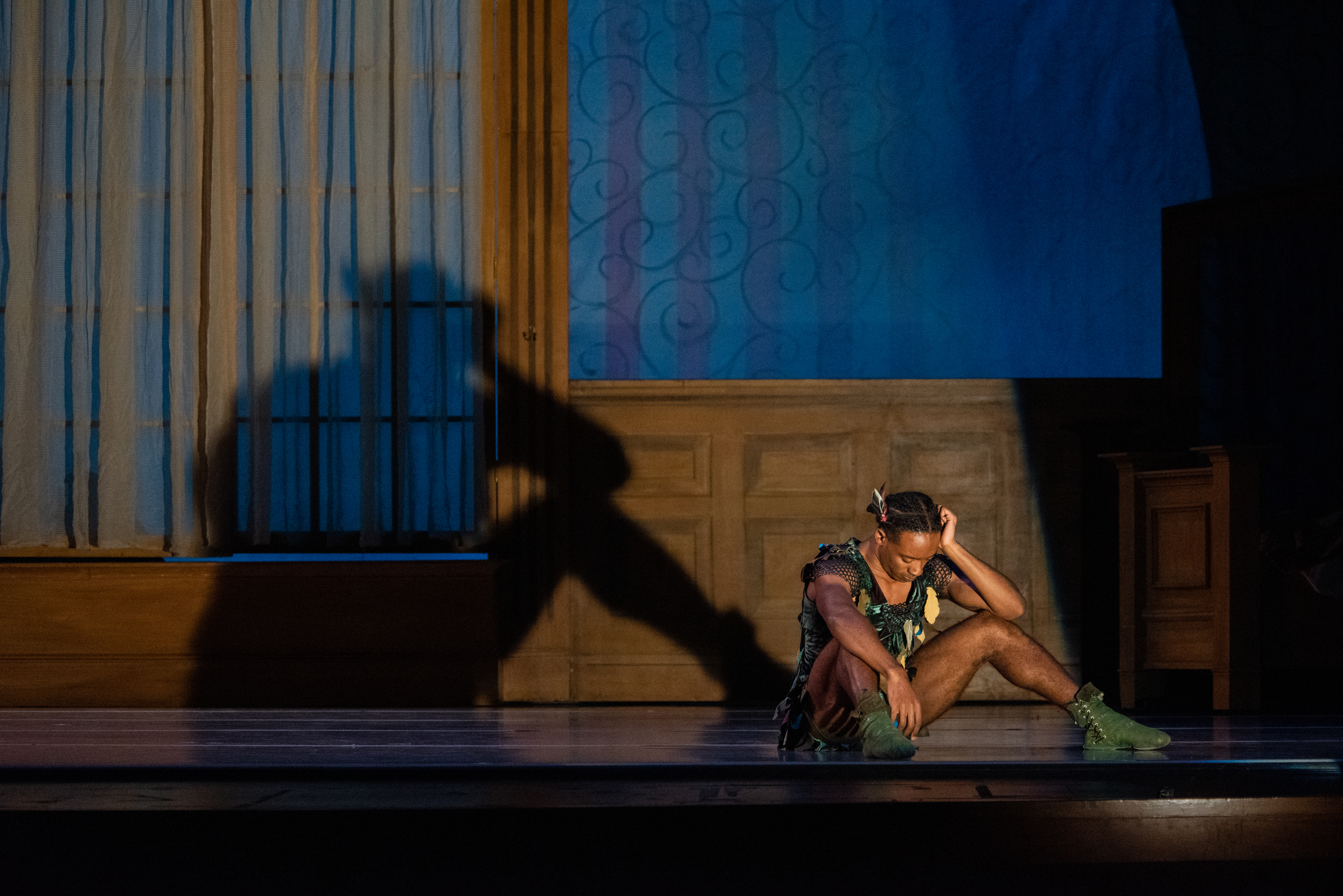
Stuart’s Tiger Lily, gracefully danced by Raven Barkley, is now a fighting flower. Thanks to new costumes by Kerri Martinsen, Tiger’s all-female militia are now billed as the Lillies of Neverland. While the Lost Boys haven’t changed their name (or costumes), half are now girls. The feminine swarm is augmented by a dozen female butterflies, but there are now a few more gigs for boys. Following in the wake of the funky Crocodile that Bonnefoux reconceived, a new gaggle of Little Crocodiles added microscopically to Pierce Gallagher’s menace at the premiere.Peter Pan

A quarter of this reptilian dozen are boys, so I’m guessing that the gender breakdown among the younglings parallels enrollment at the Charlotte Ballet school. The pre-recorded music, the hand-me-down costumes and sets, and especially the profusion of child labor – all of these economies make perfect sense. But did Stuart really think it would fly with a 2023 audience if Peter, Wendy, and the Darling bros didn’t fly?

Surely there were mommies and daddies out there in Knight Theater who had promised that Peter and Wendy would fly. Hell, there were adults out there counting on it. I couldn’t think of a single reason, not even a politically correct or environmentally responsible reason, why they didn’t fly. Flying by Foy is on strike, they missed their flight, or their train was derailed. Try those.DSC_6332

If nothing else, the gaps and hybrid aspects of the new Peter emphatically indicate that it is a production in flux, ready for new twists, new replacement parts, upgrades, and embellishments in years to come. To Stuart’s credit, he tinkers brilliantly with Tinker Bell, impishly danced by Isabella Franco at the premiere. The new opening scene, at the newly-discovered Darling Orphanage, shows her stealing a newborn from its cradle and whisking it off to Neverland.

In the ensuing scene, when the curtain goes up, Tink is more jealous of Wendy than usual, a resentment and hostility that will carry over to Neverland – where Peter, the little babe she has raised, must eventually put her in time-out! A delicious moment. Michael Darling and John Darling, danced by Tyler Diggs and Lorenzo Dunton, also get more development than I usually note before Peter’s arrival. Their mom and dad, Sarah Lapointe and James Kopecky, were admirably contoured as well. Kopecky showed a little achiness after dancing with his sons, yet Lapointe regally summoned him for another spin or two on the floor.DSC_6024

Both Sarah Hayes Harkins and Maurice Mouzon Jr. were youth and joy from the moment they met, but their start was a bit awkward in the Darlings’ bedroom compared to their outdoor adventures in Neverland. Aside from the no-fly-zone reveal we had to overcome, Stuart needs to clean up the sequence and the lighting of Peter’s lost and found shadow. He seems to have his shadow quite dramatically soon after he comes in, but then he inexplicably loses it.

There are usually two scenarios to choose from. The musical has Peter returning in search of a shadow left behind an indeterminate time ago. In other tellings, he might fly away from Wendy in a huff only to realize that his pesky shadow has stuck on the supersized window sill when he left. Stuart and lighting designer Jennifer Propst have to be on the same page with these niggling details.DSC_5944

Up in sunny Neverland, it all goes so beautifully. As always, Franco as Tink has taken the shortcut, arrives before all the others, and instigates the shooting down of our airborne Wendy by one of the Lost Boys. With a slingshot, not a bow and arrow.

For a flower, Barkley does seem to have a lot of fight in her, so her kidnapping by Ben Ingel as Captain Hook remains a satisfying battle. In his rescue of Tiger Lilly, Peter is wounded by Hook, proving that the pirate is a worthy foe. But don’t expect Ingel to be as fearsome as Jude Law will be on Disney+. He retains some of the comical blood that Bonnefoux infused into previous Hooks, lurking and skulking across the stage when he isn’t prancing merrily or fleeing in terror from the cheerfully chomping Croc.

There’s plenty of lovely, charming, and colorful mayhem as the nearly poisoned Peter rescues Wendy, the Darling bros, and the Lost Boys. Joy is abundant in the homecoming, and Stuart tacks on the cherishable postscript when Peter returns a generation later for Wendy. Four little girls will get to play the touching part of Jane during the 12-show run, one more than any other role.

Now aside from a phone call to Foy, Stuart and company might consider returning to that Darling Orphanage they’ve left dangling for future editions. In Barrie’s novelization, one of the Lost Boys, adopted by the Darlings, becomes a titled lord and another becomes a judge. The least Stuart and CharBallet could do is bring them home.

Charlotte Ballet Takes Us Back to the Future in Rousing and Meaningful “Innovative 1970”

Review: Innovative 1970 at Center for Dance

By Perry Tannenbaum

Innov1970 gypsy moths photo by Jeff Cravotta

February 4, 2022, Charlotte, NC – Distorted by delay, the title of Charlotte Ballet’s latest program sounds more like an oxymoron than ever. Innovative 1970 was originally designed to celebrate the company’s 50th anniversary, but COVID intervened in all our lives so that the official celebration couldn’t be staged until October 2021, already 51 years after the original troupe was formed in Winston-Salem as the North Carolina Dance Theatre. That commemoration included an electrifying revival of The Rite of Spring by Salvatore Aiello, who brought NCDT to Charlotte in 1990. Following that program, the company more predictably reprised The Nutcracker for the holidays, choreographed by Jean-Pierre Bonnefoux, who succeeded Aiello as NCDT’s artistic director in 1996 and rebranded the troupe in 2014.

The durably titled Innovative 1970 is thus the first program of all-new pieces since Charlotte Ballet returned to live performances this season and the first to return dancers and subscribers to the Patricia McBride and Jean-Pierre Bonnefoux Center for Dance, doubly appropriate because 1970 was adopted as the creative trigger for all three newly commissioned pieces on the program, choreographed by Andrés Trezevant, Rena Butler, and Ja’ Malik.

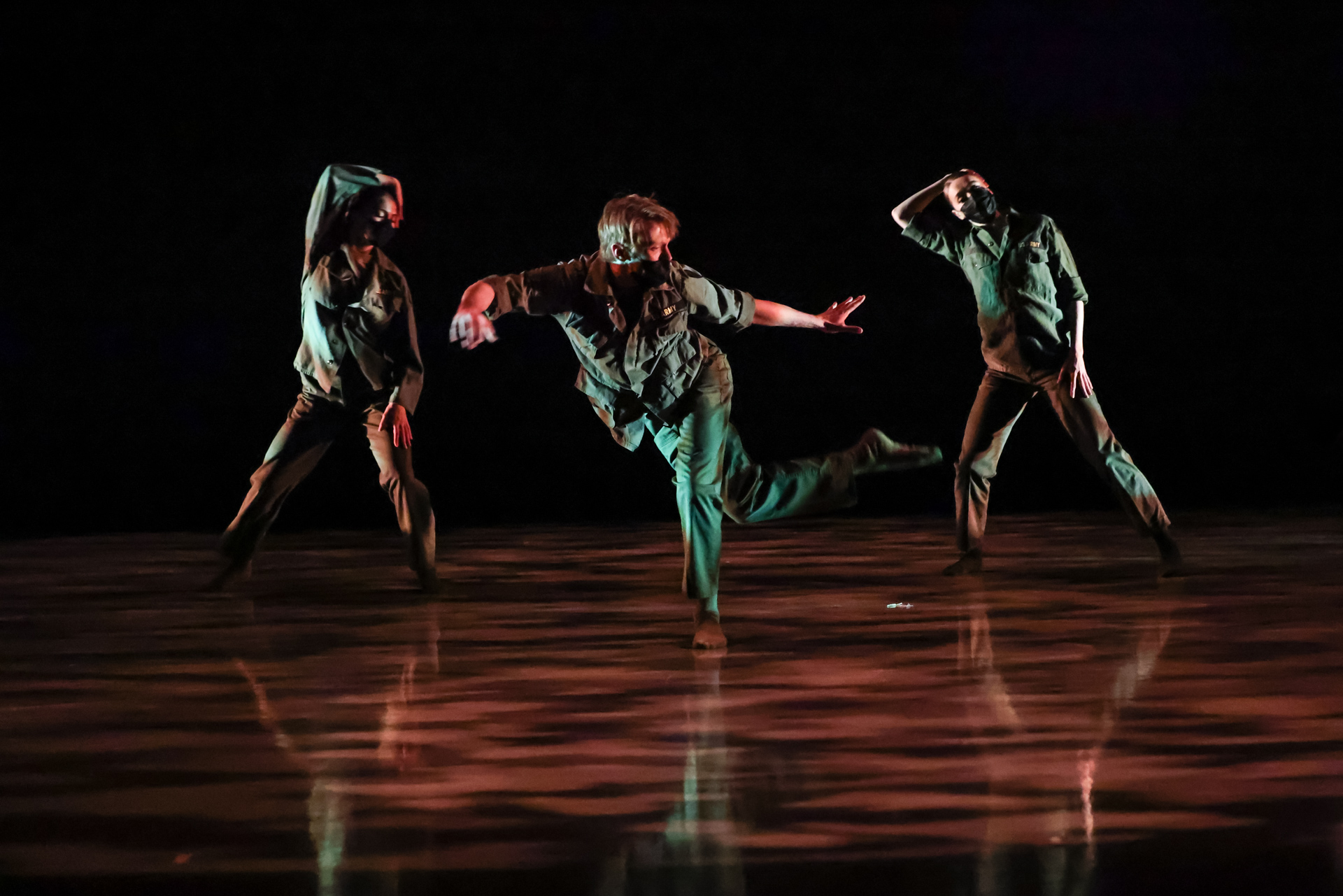
Innov1970 What was it for Photo by Jeff CravottaAppropriate to its Vietnam War theming, Trezevant’s “What Was It For?” arrived for its premiere as a partial amputee, for the beginning of the scenario in the printed program, where war protesters make houses out of draft cards, is MIA – along with the conspicuous absence of Elton John’s “Bennie and the Jets (1974).” What remained thrust us into middle of warfare, Julie Ballard’s lighting design turning the floor of the Center for Dance’s black box into camo splotches of green and gray, while a house of cards lingered downstage, now a cryptic relic of the original concept. A quaint portable radio was spotlit near the opposite wing, likely another leftover, but it remained functional, emitting only white noise as five male dancers, dressed as soldiers, populated the stage, simulating scenes of combat, capture, escape, and rescue.

We were clearly – and perhaps angrily – back home, when Maurice Mouzon Jr. subsequently performed a dashing solo to Nina Simone’s “Backlash Blues (1967).” The two women in this piece, Sarah Lapointe and Anna Mains, arrived onstage as healers while the scene brightened somewhat. Now the returning soldiers – Colby Foss, Ben Ingel, James Kopecky, and Rees Launer – were presumably in hospitals and rehab, dealing with mental and physical trauma in the grim aftermath of a futile war. I suspect that the house of draft cards was intended to fall at the end, but it remained standing.

Innov1970 Subliminal Tsunami photo by Jeff Cravotta

Subliminal Tsunami by Rena Butler, with original music by Daniel J. Hoffman, was a more acerbic and satirical piece that took 1970 as a checkpoint on the state of women’s rights and horizons, compared with where they are today. Recorded voices of Gloria Steinem, Nikki Giovanni, and ABC News anchor Marlene Sanders were in the colloquium, intermingled with recorded voices of seven Charlotte Ballet dancers delivering their own personal accounts. Sharply contrasting with this dignified discussion was what we saw onstage, five women dancers coldly confined by Ballard’s lighting into five squares. The stiffness of Lapointe, Raven Barkley, Isabella Franco, Sarah Hayes Harkins, and Amelia Sturt-Dilley, dressed in matching costumes by Kerri Martinsen, clearly identified them as a collection of Barbie dolls, handled dutifully by four men – Foss, Ingel, Launer, and David Preciado.

Only occasionally did the voices compete with the dancers for attention as the piece proceeded, giving the dancers more latitude for movement. No doubting that the black box’s sound system sorely needs an overhaul, OK for rehearsals but not suitable for prime time. It was still a bit stinging to listen to the cautions against following your impulses issued to young girls contemplating a future of homemaking. Lamentably, the pace of progress for women has been mostly subliminal, not at all a tsunami, though cumulatively we have evolved substantially since 1970, and more progress can be perceived if we look back to when women gained the right to vote 50 years earlier. While I was bothered to see the dancers still masked in 2022, Butler had an ingenious way of coping with the situation: Big smiley, lipsticked mouths on Martinsen’s matching flesh-colored masks were clearly and effectively part of the women’s design.Innov1970 gypsy moths 2 photo by Jeff Cravotta

After the traumas of war and the indignities of gender inequality, it was refreshing to return after a second intermission to gypsy moths, Ja’ Malik’s joyous celebration of funk rockers LaBelle and their frequent collaborator Laura Nyro. A teeming cast of five men and five women, all in spangled masks, converged on the floor for “Met Him on a Sunday,” Nyro’s 1971 cover of a song introduced by The Shirelles thirteen years earlier, and “Come Into My Life,” introduced on LaBelle’s Chameleon album in 1976. “Gypsy Moths,” introduced on the same LaBelle album, paired the company into five couples Emily Porter with Kopecky, Harkins with Humberto Ramazinna, Shaina Wire with Josh Hall, Emerson Dayton with Preciado, and Barkley with Mouzon.

It wasn’t until the ensuing three songs that it became clear that Barkley and Mouzon were the alpha couple of Malik’s piece, for Barkley was obviously the lead in “The Wind” and Mouzon was unquestionably the alpha male in “Going on a Holiday,” both backed by the full cast. Neither of these ensemble segments was as special or memorable as Malik’s seething setting of “Been on a Train,” the whole stage cleared for a slithering Barkley-Mouzon pas de deux. “Desiree,” taken from Nyro’s 1971 Gonna Take a Miracle album was only slightly anticlimactic, a glittery showcase for the other four women, and “What Can I Do for You” was a stirring finale for the entire cast, so infectious that it roused rounds of rhythmic clapping from the audience. The ovation when the spectacularly dressed Malik joined the dancers onstage was even more raucous.

Originally published on 2/5 at CVNC.org