Tag Archives: Justin Peoples

Dialing Up the Almighty in Memphis

Review: The Mountaintop at Theatre Charlotte

by Perry Tannenbaum

A stage with a particularly authentic – or imaginative – set design is a good start for a director who wishes to immerse you in the world of a play. Yet few productions surround you with the theatre experience, making you feel outside your own world and inside theirs. Sleep No More was dedicated to achieving this mission with a Macbeth makeover up in Manhattan’s Chelsea district at a spooky hotel, where I saw it in 2015. So was Then She Fell the following night in Brooklyn, where I was plunged into the imagination – and mental illness – of Lewis Carroll.

In Charlotte, such efforts have been comparatively infrequent, but not unknown: Chickspeare’s Fefu and Her Friends on Cullman Avenue in 2001, numerous “environmental” productions by Carolina Actor’s Studio Theatre (CAST) in their days on Clement Avenue, and Matt Cosper’s legendary Bohemian Grove of 2014 that was staged god-knows-where – you had to agree to be kidnapped in a van by The Machine at the Actor’s Theatre parking lot to attend.

They do make an impression, these hyper-immersive presentations.

Cut to the legendary Queens Road Barn for the latest Queen City experiment in environmental staging. Yes, that’s Theatre Charlotte – in Myers Park! – on the cutting edge with its new production of Katori Hall’s The Mountaintop. Directed by the ageless Corlis Hayes and designed by Chris Timmons – with a nine-person “Lobby Transformation” team – this is the first fully-staged drama my wife Sue and I have seen in the 501 Queens Road lobby since the spare and forlorn Waiting for GODot in 2007.

Together with invaluable help from David Gallo, set designer for the 2011 Broadway production, and props designer Brodie Jasch from Fayetteville’s Theatre Squared, Dr. Hayes and her production team aim to take us back to the Lorraine Motel in Memphis on the night of April 3, 1968. Rev. Martin Luther King, Jr., returns from the Mason Temple, where he has just delivered his eerily prophetic “I’ve Been to the Mountaintop” speech.

Every detail of the last room occupied by MLK has been replicated with meticulous authenticity – night tables and their contents, lamps, the chair and its fabric next to the window, the window curtains, the bed coverings – all the way down to the upside-down zero on the door to Room 306. With walls within walls, you must enter through this door to get your first view of the new theatre space in the lobby created for this production. Only the ceiling remains unaltered, with its fans and extinguished holiday lights. Explanations are appended in the digital program for those details which couldn’t be ascertained and those that would have conflicted with Hall’s script.

Since there is no intermission and all the usual concession outposts have been whisked away, they have thoughtfully made “Room Service” available to ticketholders via a QR code. In more ways than one, we are treated like kings at The Lorraine. Fun fact: the fateful motel was actually named after the hit 1928 song, “Sweet Lorraine,” popularized by jazz artists Teddy Wilson and Nat “King” Cole.

For all of Dr. Hayes’s reverent devotion to getting the look and feel of The Lorraine recreated as faithfully as she can, we soon see that it isn’t a shrine. Hayes is equally bent on getting to the heart of Hall’s pointedly irreverent drama. Hall provides ample time for solemnity and anguish at the end, but until then, she wants us to see the soon-to-be-martyred icon as a man, not a god, and not even as a holy man. The real Martin – or as God likes to call him, Michael – had his foibles, vices, and infidelities.

And notwithstanding the resounding valedictory declarations of the Memphis speech we’ve heard over and over – “So I’m happy, tonight. I’m not worried about anything. I’m not fearing any man” – Hall insists on reminding us that King did have worries and fears.

All obeisance to King’s saintly aura is swiftly discarded almost as soon as we see Justin Peoples taking on the role, before he walks through the audience to take a pee. Not only is he unkempt after his oratorical exertions and his walk through the rain, he has largely dropped his dignified public persona, at ease if not quite relaxed. Though he diligently examines his room’s rotary phone to make sure it isn’t bugged, we can hear that he has switched from formal to casual mode as soon as he speaks. It’s with an unmistakably Southern accent!

Immediately disarming. Neither the touring production by the famed Penumbra Theatre of Minneapolis that ran at Booth Playhouse in 2014, nor the homegrown Actor’s Theatre run of 2018 at Queens University, directed by April Jones, had quite the same spontaneous or undignified impact. The smallness of the lobby space at the Queens Road Barn certainly helps in establishing a closer intimacy with King and a sharper look at his vulnerabilities.

Maybe that folksy drawl would have been even more impactful if Peoples had held back on it until MLK had dialed room service after normal closing hours. The arrival of LeShea Stukes as the fetching Camae, a housemaid moonlighting as King’s waitress, would have been a good moment for Peoples to turn on the Southern charm. But for those of us who have seen The Mountaintop before, Stukes brings with her more than Camae’s sensual allure, more than her extra Pall Malls to satisfy King’s chain-smoking, and more than her working-class sass.
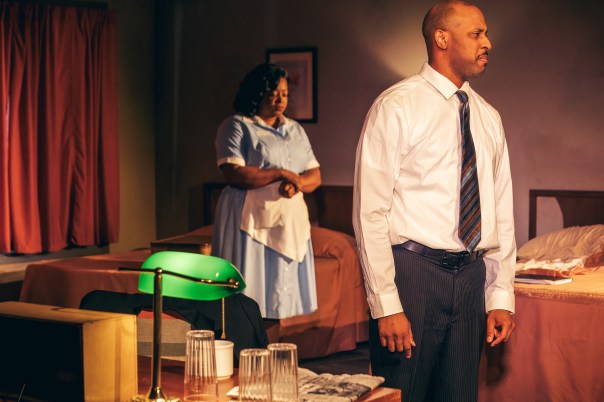
She now gives us solemn glances from behind King’s back, fully aware of the gravity of her true mission before she discloses it, morphing from pursued damsel to admonishing paramour to chum to messenger of God. None of these fresh wrinkles quite accounts for the marvelous voodoo or the juju that Hayes, Peoples, and Stukes have conjured up in creating the playful, poignant, and profound chemistry of this Camae and MLK.

Lighting designer Jennifer O’Kelly gently signals those moments when Camae might be contemplating why she’s there, foreshadowing the AV extravaganza that will accompany Stukes’ final mountaintop revelations. She will almost be speaking in tongues when we reach this visionary summit.
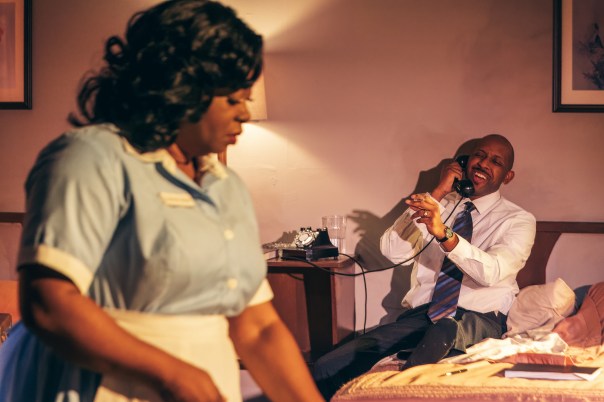
There’s little theology here, for when King dials up the Almighty, pleading his case for more time on this turbulent planet, she hangs up on him. Yet there just may be some deep dialectic in Hall’s scheme that narrows the gap that we might feel between God’s biblical judgment upon Moses at Mount Nebo and the judgment upon Martin in Memphis.

Moses was given a precise catalog of his greatest sins. Maybe in an afterlife he learned not to shatter any holy tablets or assault a boulder without God’s approval. But what was the great sin that deprived MLK of the Promised Land that awaited his people? The answer never comes explicitly in the play, but King’s sins – though relatively petty until we consider possible adultery – are graven in its marrow.

In an age when not a day goes by without yielding fresh images, outrages, and crimes committed by a lying orange buffoon, we might find ourselves shocked to be shoved towards such traditional moral moorings. Some of these values were written long ago in our marrow. Leading a people may still require adhering to a higher standard in God’s job description, not flouting the laws and proprieties that apply to everyone else.

Peoples and Stukes, with plenty of finely judged assistance, have found a way to make The Mountaintop more poignant, relatable, and human. Hall’s work becomes more touching, meaningful, and necessary each time I see it.

“A Soldier’s Play Recalls” the Brink of a New Era

Review: A Soldier’s Play at The Gettys Center

By Perry Tannenbaum

KKK, segregation, and Jim Crow are all in the air as Charles Fuller’s A Soldier’s Play unfolds in 1944 at Fort Neal, a fictitious army base in Louisiana. Yet there are beacons of hope, personified by the Black privates, the corporals, and the busted sergeant we see in a humble barracks. Broadway Lights subscribers saw a deluxe revival of the 1982 Pulitzer Prize winner at Knight Theater back in January, and the current Free Reign Theater reprise down in Rock Hill – not Rural Hill, that was Free Reign’s HQ last summer – only reaffirms the script’s stature as a classic.

Fuller captures these Black military men on the brink. Any day now, these eager recruits are hoping to be deployed across the Atlantic, where they can prove themselves on the battlefield fighting the Nazis. On the home front, we learn that this platoon of baseball players, culled from the Negro Leagues, has a chance to play the New York Yankees if their team can maintain its undefeated record through the rest of the season.

Not a far-fetched dream! Just three seasons into the future, Jackie Robinson will make his breakthrough MLB debut with the Brooklyn Dodgers, win Rookie of the Year honors, pop champagne with his white teammates as he celebrates his first National League pennant, and become the first Black athlete to play in the World Series – against the New York Yankees.

Fuller accurately fine tunes his soldiers’ aspirations, but he drops a bombshell into this Deep South outpost that is equally shocking to the Black scrubs and the white officers on base. When the ballclub’s manager, Tech Sergeant Vernon C. Waters, is murdered in the middle of the night, presumably by local racists, the feds in DC send Captain Richard Davenport to investigate.

DC or not DC, Davenport is a Black lawyer. How is he going to be able to point a finger at a gang of KKK knights, dragons, or wizards and proclaim “Arrest these men!” within the borders of Louisiana? It’s as if a DC thinktank had come up with the surest way for Waters’ murderers not to be prosecuted for their crime.

Nobody on base has ever seen a Black man like this before. Captain Charles Taylor, Waters’ former commanding officer, admits his discomfort in accepting Davenport as an equal. He’s also a bit flustered by the stranger’s cool and orders him to remove those glasses, forgetting that Davenport outranks him. Adams enjoys his teaching moment with a nice nonchalance as Tim Huffman seethes, finely calibrating Taylor’s redneck tendencies with his West Point pedigree.

Whether or not they can sense the Robinson breakthrough on the horizon – or grasp the MLK dream 19 years before he proclaims it – the Black ballplaying soldiers also show that there’s a learning curve for them in dealing with Davenport’s intelligence, competence, professionalism, and objectivity. Flustered, flummoxed, or wary, the corporals and privates quickly show that they are no less thrown by this Davenport phenomenon than Taylor.

And of course, they share Taylor’s skepticism about Davenport’s ability to charge a KKK-grade racist with any crime in Louisiana and make it stick.

Everybody, then, is taken aback as Davenport ignores race altogether, seeking to interrogate both Black soldiers and white officers in search of the facts, and allowing those facts – rather than easy presumptions – to lead him to the truth. Only the busted sergeant, Andrew Roberts as Private James Wilkie, seems to realize that Davenport is seeking evidence to form his opinion of who the murderer or murderers might be rather simply bolstering the opinion he already had.

Davenport is paying attention when Wilkie upsets the KKK hypothesis with a telling observation that Fuller cleverly assigns to the one man at Fort Neal who has lost his stripes. Roberts gives us a messy mix of servility and seething resentment as Wilkie’s complex layers unfold. It was Waters, after all, who busted Wilkie, so the former sergeant will become a prime suspect in the instant that the Klan is cleared of suspicion.

Not only does Wilkie open the door to new possibilities of viewing Waters’ murder, he also opens a window into the deep tensions that lurk beneath the graceful, flawless façade of the invincible team. In flashbacks triggered by Davenport’s ongoing interrogations, we soon see that Waters’ mix of servility and resentment was far more toxic than his subordinate’s. An unforgettable debasement of a Black man at the hands of white officers that Waters witnessed in France during World War I ignited a lifelong secret crusade against the “Geechies” that he despises, Southerners whom he sees as tarnishing the image of his race and hampering their progress.

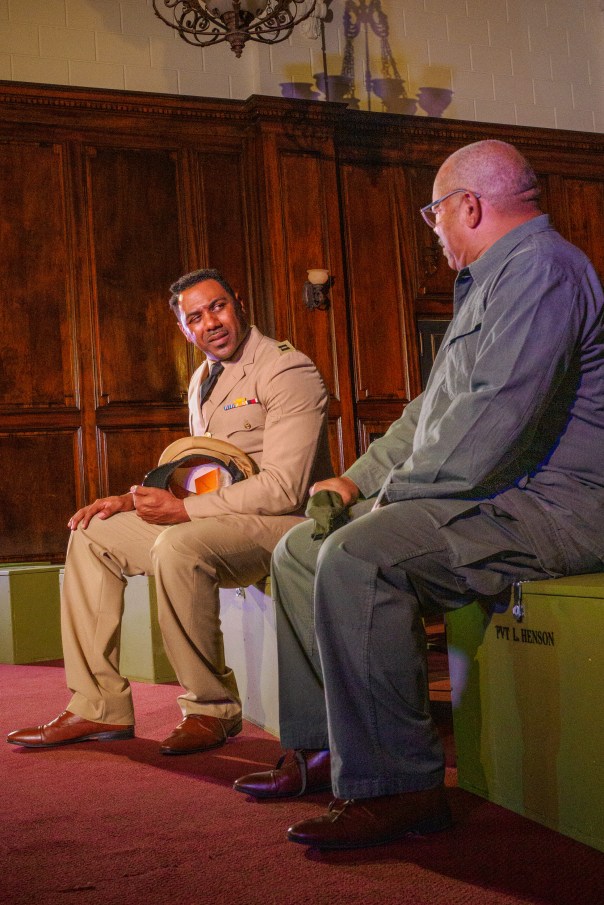
It is an absolute mania, and even the best player on the team, Private CJ Memphis, does not escape Waters’ lethal prejudice. The chin-to-chin confrontation between Justin Peoples as Waters and Dominic Weaver as Memphis, modeled after the Claggart-Budd climax in Herman Melville’s Billy Budd, Foretopman, is more electric than any of the Davenport-Taylor faceoffs. In the sequel to the Waters-Memphis climax in the barracks, a jailhouse stunner where Waters berates and gloats over his latest victim, Memphis achieves a tragic stature when Weaver proceeds to channel Billy Budd’s Christ-like attributes.

Under Dr. Corlis Hayes’s beautifully judged direction, the deep Billy Budd conflict regains its dominance over the Davenport-Taylor sparring. The touring production, unlike the previous New York productions and the 1984 film adaptation, tilted our attention away from Waters toward Broadway star Norm Lewis, who took over the Davenport role on the road. Yet we still see quite vividly that the new man on base is the future.

Shining more light upon Waters’ diabolical obsession, Hayes and Peoples let us see that, in some ways, A Soldier’s Play is like a Perry Mason mystery. So many soldiers on his team detest Waters that almost every one is a legitimate suspect. Davenport’s main weapon is cross-examination – in Captain Taylor’s office, his own hastily-outfitted domain, or in front of the soldiers’ bunk beds and foot lockers.

Weaver’s performance as CJ, like a genial Willie Mays with a guitar, further focuses on the enormity of Waters’ crime. Memphis isn’t the only player who has tangled with his racist tech sergeant. PFC Melvin Peterson, a Northerner like Waters, is more offended than anyone by the sergeant’s bigotry, and Devin Clark, who shone so brightly as Brutus in Free Reign’s Julius Caesar last year, is more than up to capturing Peterson’s rage, which leads to a fight with Waters. His antagonism lingers on, flaring up again when CJ is baited by Waters and jailed.

Suspects abound, in the barracks and among the white officers. As Lieutenant Byrd, David Hensley’s defiance and antagonism toward Davenport, when he has the effrontery to question him, nicely contrasts with Hugh Loomis’s subdued pragmatism as Captain Wilcox, who realizes that his pal’s hot-headedness may have already landed them both in hot water. Hayes also has a welcome urge to expand the light and relaxed interludes Fuller built into his play, importing blues singer Big Mary from Fuller’s screen adaption, and offering Shar Marlin a chance to give us a sassy respite from the all-male action with her cameo. Nice touch.

Having seen numerous Jackie Robinson biopics and dramas over the years, we can see some pragmatism in Waters’ disciplined philosophy to the extent that it mirrors the template that the future Hall of Fame second baseman fit into when he made his debut on the big MLB stage – supplemented by some pointed advice. Waters keeps his feelings bottled up in the company of superior officers, eradicates rusticity and superstition from his actions and speech, maintains a sober low profile, and waits patiently for these quiet concessions to win him favor and advance his career.

There’s a constant tension between that approach and the tacks taken by Memphis and Peterson. Memphis likes being liked, displaying his talents, being himself, and letting his natural gifts take him where they may. Even if he does lack education and polish, Memphis is respectful, outgoing, and good, though we have to factor in the large portions of female adoration he attracts. Clark gets to be more pugnacious and far more fiercely intelligent, despising bigotry in any form, even if it comes from Waters, a superior whose orders he should obey. He will stand up strong for his beliefs at all times, even if it means taking a licking.

But the real deal, Jackie-wise, is Davenport. Adams amalgamates all the best of Waters’ calculated patience and Peterson’s egalitarian principles, with the ability to turn on some of CJ’s natural charm. Before the soldiers have shipped off to Europe, eager to prove themselves in World War II’s European theatre, Davenport is a fully-evolved marvel that people in Louisiana readily recognize and value. As we saw in the spit-and-polish version presented at Knight Theater, Adams also chafes a little at the relentless saluting and military barking that comes from Hayes’s drilling, aided by two military consultants who keep all the soldiers coming to attention.

After much seasoning and resourceful survival, Davenport arrives fully polished, ready for primetime and postwar America. He may not have the fire of Malcolm X or the towering eloquence of MLK, but we can imagine Davenport as a worthy ally for either of those pathfinders.