Tag Archives: Jonathan Lewis

Ryan Clicks with the Master Chorale in a Walloping CSO Debut

Review: A German Requiem at Belk Theater

By Perry Tannenbaum
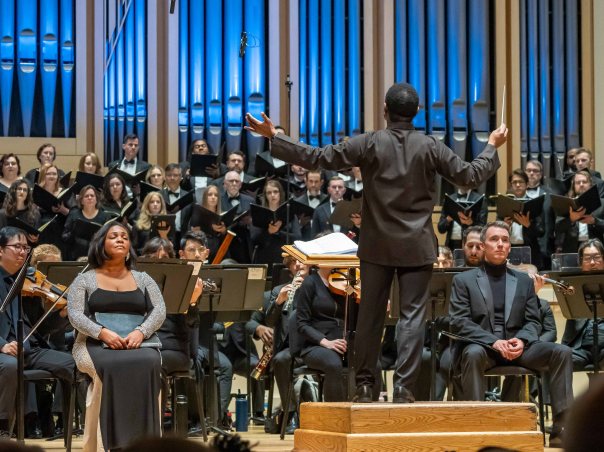
November 22, 2024, Charlotte, NC – In Kwamé Ryan’s first full season as the new music director of Charlotte Symphony, we aren’t getting to see him perform as much as we would hope, but when we do see him onstage at Knight Theater or Belk Theater, he always appears to be overjoyed to be here. Ryan was absolutely beaming as he took the Belk’s centerstage for the first time as CSO’s leader – and he certainly didn’t wear out his warm welcome, delivering a walloping performance of Johannes Brahms’ Ein deutches Requiem. Even before Ryan’s arrival, the new season has proven to be adventurous and diverse in its programming, showcasing fresh repertoire and youthful guest soloists.

Subscribers can judge for themselves whether Ryan’s outré intro to his debut program, coupling the Brahms with Latvian composer Pēteris Vasks’ Musica Dolorosa, was a sign of confidence or a symptom of nervousness. Whether or not my recollection can be trusted, Ryan’s scripted intro was unprecedented. Some intros we may have seen in the past could be dismissed as gratuitous – or countenanced as witty fluff. Here, Ryan’s intro was necessary, for we needed to be prepped for how the program would be delivered: without a pause between the music of the two composers. That would also be fairly unique. Our new maestro was crafting an experience.

Indeed, Ryan’s preface was necessary for another reason. Vasks’ piece flowed into the Brahms so smoothly it was as if they were written in collaboration and in the same key. Outside that merging point, the two pieces were quite different in the ways that they dealt with death. Responding to his sister’s untimely death, Vasks voiced his personal despair and compounded his feelings with grieving for his nation, still subject to Soviet rule when the Dolorosa premiered in 1984. Written for string orchestra, the mood of the opening section of Dolorosa may put you in mind of Barber’s Adagio. But the Vasks elegy eventually transcends the sameness and the hypnotic monotony of Barber’s dolor with louder and more piercing pain.

As the lower strings tap and strum percussively, Vasks gradually quickens the pace and turns up the volume as the beat becomes more insistent and dramatic. Once the dynamics peak, the strings, now smoothed out with a cessation of the percussion, become even more disturbing, tossing away pleasant tonality in a disciplined cacophony of fearsome chaos. The slashing lower strings, however, hadn’t been vanquished. They punctuated this harshness and dissonance at its height, seemingly puncturing it, for the noise homogenized into the sound of a diminishing wind or a siren receding into the distance – clearing the way for the quietest and most memorable episode in the Dolorosa. Principal cellist Jonathan Lewis, echoing the opening bars, played an eloquent lament from his downstage seat, accompanied only by the low mysterious hum – like a bass clarinet or a contrabassoon – emanating from upstage, hidden from my sight. The higher strings now took up the cello’s increasingly bold cry and built it to raw anguish.

The slightly hushed and abrupt ending of the Dolorosa nicely conformed with Ryan’s concept, and it dispensed with the shuffling of chairs usually necessary for the transition to full orchestra with winds, brass, and drums. Nor were the troops of the Charlotte Master Chorale obliged to parade in from the wings and settle into their perches above the Symphony. That honor was reserved for the guest vocalists, soprano Janai Brugger and baritone Alexander Birch Elliott, gracefully delayed until well after the transition between the Dolorosa and A German Requiem. The Brahms is not new to the CSO, last given by Christopher Warren-Green almost exactly 10 years ago – after his predecessor, Christof Perick, had presented it (already for the second time this century) in 2005.

With its consoling attitude, the Requiem is not at all a bad fit for the holiday season. You’re likely to recognize more than a couple of verses from the Brahms, conveniently projected in supertitles, as German translations of verses from Handel’s Messiah, the most beloved musical birthday celebration that we have. Most notably, you’ll get an Oktoberfest taste of “The trumpet shall sound.” Maybe sitting down in the orchestra, as opposed to the Grand Tier Circle, accounted for the heightened thunder of Ryan’s rendition, but Symphony somehow sounded crisper. The sudden sforzandos struck like a punch to the jaw, yet Ryan kept the ensemble under strict control, never threatening to overwhelm the hall with volume, emphatically relishing the work’s percussive moments.

Both Brugger and Elliott shone in their debuts. There was a noticeable Renee Fleming-like milkiness and sheen to Brugger’s voice, most appropriate for the motherly comfort she delivered in “Ihr habt nun Traurigkeit (You now have sorrow).” Elliott was even more impressive in his larger workload, a more pleading “Herr, lehre doch mich (Lord, teach me),” bolstered by a lusty Chorale response, before he delved into the “trumpet shall sound” mystery and affirmation of “Denn wir haben hie keine bleibende Statt (For here we have no everlasting city).” Belatedly, Music Chorale artistic director Kenney Potter was summoned onstage to share the credit for his singers’ brilliance and verve. He was absolutely beaming with delight.

Photos by Perry Tannenbaum

Charlotte Symphony Heralds the New Year in All-American Style

Review: Koh Plays Mazzoli at Knight Theater

By Perry Tannenbaum

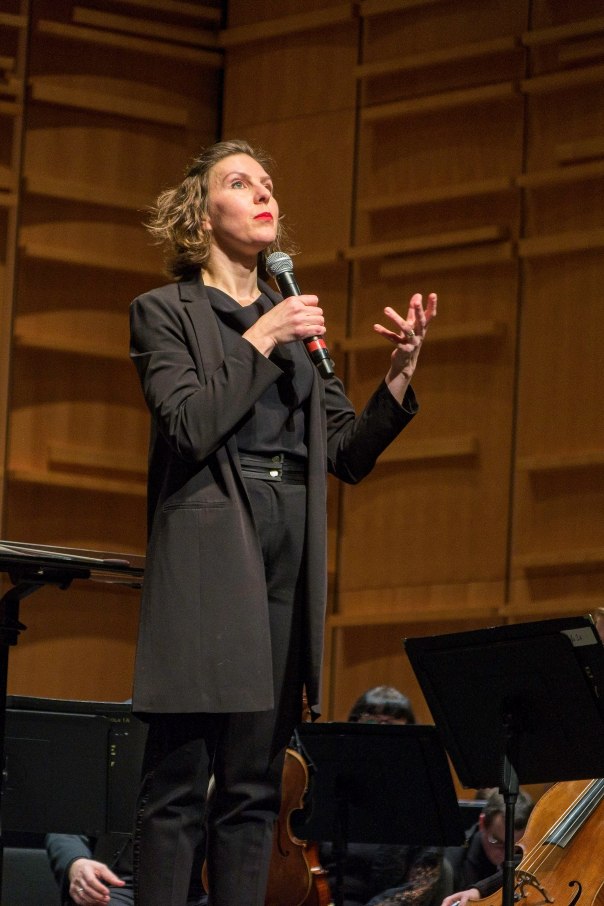
January 19, 2024, Charlotte, NC – Just a little more than a year after Kwamé Ryan guest directed an all-American program at Belk Theater featuring violinist Bella Hristova, Charlotte Symphony (after naming Ryan as the music director designate for 2024-25) greeted guest conductor Lidiya Yankovskaya to the Knight Theater podium, with violinist Jennifer Koh making her debut in another all-American program. This year’s explosion of Americana came four days after MLK’s birthday instead of two days before. The Adams-Korngold-Copland program of 20th century pieces could be counted as a bold advance in 2023, but the current offerings, with two 21st century compositions by American women, Jennifer Higdon and Missy Mazzoli, getting equal playing time with the 20th century composers, Samuel Barber and Aaron Copland, is arguably even more diverse and inclusive.

Distilled from Higdon’s opera, Cold Mountain, of 2015, and co-commissioned by Charlotte Symphony, the new Cold Mountain Suite could credibly be categorized as a concerto for orchestra by virtue of its length, variety, and profusion of solo instrumental passages. Like many opera suites you may have heard, Cold Mountain takes a serpentine route through the score rather than a sequential path, using the opening of Act 2 and the close of Act 1 as its bookends in repackaging eight snippets from the score.

On my first hearing, I could distinguish seven distinct sections and some fine soloing not only from string principals – cellist Jonathan Lewis, violist Benjamin Geller, second violinist Oliver Kot, and associate concertmaster Joseph Meyer – but especially from acting principal oboist Erica Cice and principal trombonist John Bartlett. The most memorable section of the piece was the “Storm Music” with its swirling strings and the atonal whistling of the high winds, but the ending, launched by the reunion scene between Ada and Inman was authentically stirring, with soaring work by principal trumpeter Alex Wilborn heralding the closing crescendos.

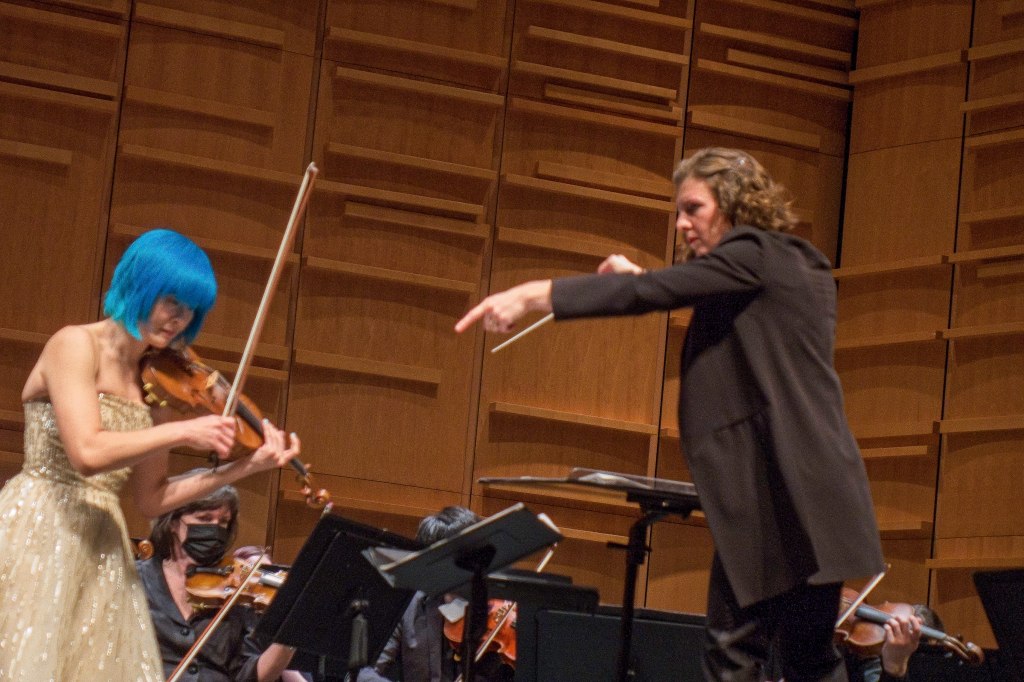
Since Mazzoli’s Procession Violin Concerto was commissioned by Koh, the music remained in-house until intermission. Notwithstanding her outré blue hair, Koh is actually a few years older than the composer, with a recording career extends more than 25 years. The former Chicago prodigy still plays with a youthful zest and a frenetic edginess – but not immediately in “Procession in a Spiral,” the opening section that unfolds slowly in a keening treble and increases its tension about 3/4 of the way into the section. The thinnest ethereal note from Koh’s violin bridges the gap into the unexpectedly calm beginning of “St. Vitus,” but the onset of intensity comes sooner here, still without the manic speed we might have expected from this title. The weepiest of the sections, “O My Soul,” has the most sustained of Koh’s thin harmonics and she hangs out with the flute and piccolo before breaking into more neurotic bowing.

A nice orchestral swell transitioned us to “Bone to Bone, Blood to Blood,” the most dramatic section, spiced with a series of whipcracks and a sprinkle of percussion. Jollity never prevailed in this rather somber concerto, nor was there an Allegro. “Procession Ascending” began rather unexpectedly for a finale with some lovely solo work from principal bassoonist Joseph Merchant, dramatizing how high Koh would need to ascend on her violin. If I were Koh, I’d pay Mazzoli a few more bucks to extend her struggles to take flight, blocked by the cellos and the double basses. She seems to clear this viny undergrowth too soon and too easily for the music to reach its full dramatic intensity, but I loved how briefly her freedom lasts and how cruelly it ends.

While there is a fine Baltimore Symphony account of Barber’s Second Essay for Orchestra in my collection, I cannot confirm ever hearing the piece performed live, though it was scheduled for a Symphony concert in April 2008. Hard to imagine that I snubbed it in my review, though Dvorak’s New World, ballet excerpts from Mozart’s Idomeneo, and Barber’s Violin Concerto were also on the bill. The music really is sumptuous, with oboe and clarinet illuminating the opening, viola mixing into additional oboe action later on, and some tasty propulsive percussion triggering its climax. It came across as a fresh and welcome discovery for me.

Of course, Copland’s Billy the Kid Ballet Music was the most familiar nugget on the program, revived at the Knight after an absence of less than four years. We’ve all been through a lot since February 2019, so I suspect more of the mournfulness of Copland’s “Introduction: The Open Prairie” and more of the fleeting, elegiac pathos of the penultimate “Billy’s Death” will land on listeners. Merriment is similarly magnified, with the clopping woodblocks of “Street in a Frontier Town” and even more heartily in the marching band energy, fueled by the woodwinds, of the gala “Celebration (after Billy’s Capture).” For the youngest buckaroos, the warring timpani and snare drum tattoos of “Gun Battle” will likely be the hugest delight.

Parameswaran Delights With Eclectic Mix of Moderns

Review: Sibelius No. 5 with the Charlotte Symphony

 By Perry Tannenbaum

2023~Sibelius 5-14

Maybe subscribers to Charlotte Symphony’s Classical Series aren’t as invested in choosing a successor to music director Christopher Warren-Green as I had presumed, or maybe the weather was too darn wintry for the wusses. Whatever the cause, the audience that came to see guest conductor Vinay Parameswaran perform a program that included music by Gabriella Smith, Benjamin Britten, and Jean Sibelius – while launching CSO’s celebration with a fine example of William Grant Still’s artistry – didn’t come close to filling Knight Theater to capacity.

Nor could anyone who looked over the stalwarts who braved the Arctic cold have called us diverse.

Could be that we’re complacent, self-satisfied, and spoiled. After hosting a musician as renowned and prestigious as Warren-Green, we may have forgotten that the candidates parading before us, seeking to impress in order to land a job offer, might just need to be sufficiently impressed by us to accept.

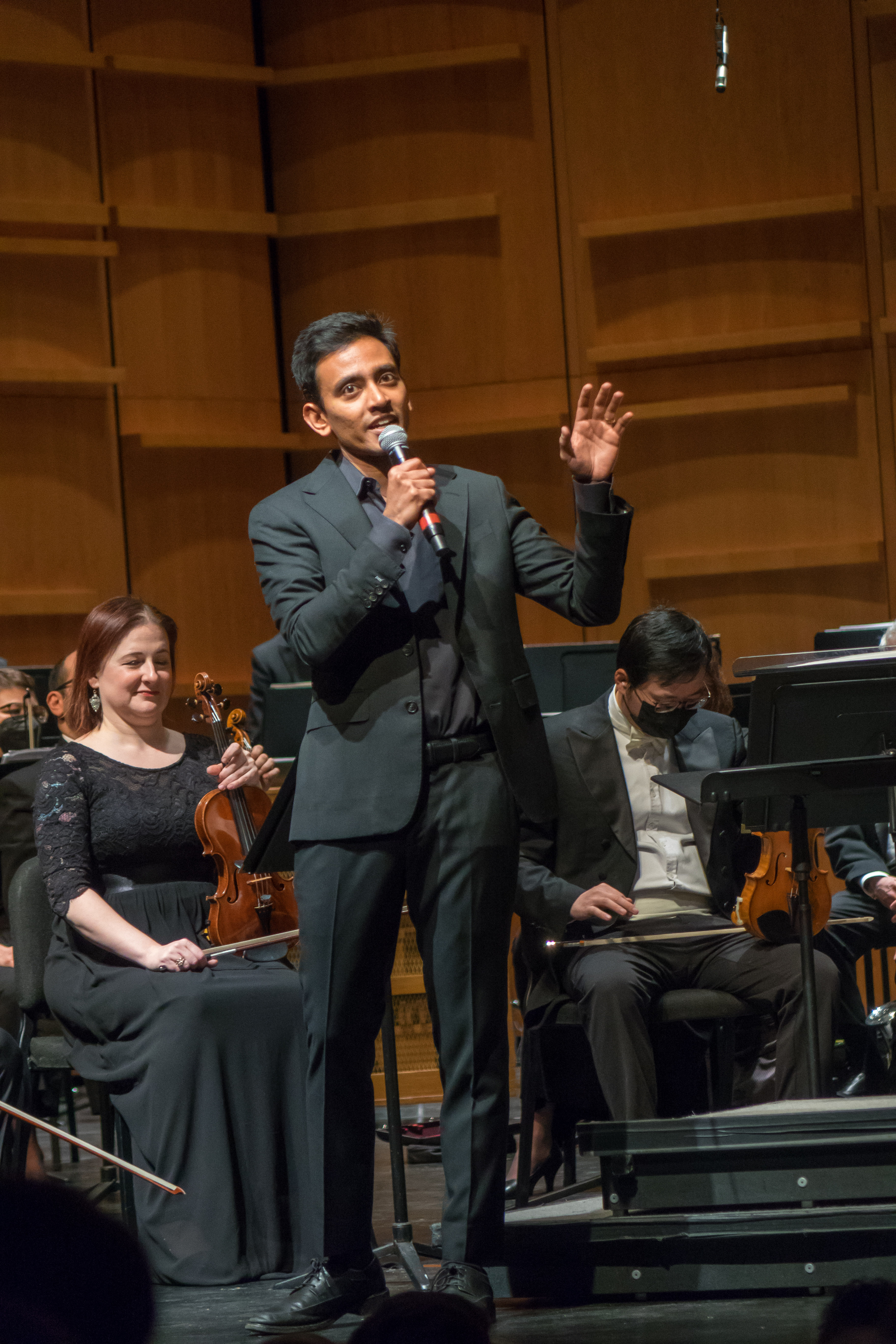
So it was interesting to watch how Parameswaran reacted when he looked out at the crowd, pocked with empty seats, and met us for the first time in his Charlotte debut. A rather sober look on his face abruptly turned to shock, surprise, and gladness as he heard our outsized enthusiasm.2023~Sibelius 5-02

He was rather charming, then, when he picked up the mic at the podium and described Smith’s piece, Field Guide, along with the works that followed. Any misgivings that concertgoers who stayed away could have harbored about his foreign-sounding name would have been instantly dispelled by the ease with which he spoke and the ease with which we understood – even if it was outré for him to describe Arthur Rimbaud’s Les Illuminations, the text for Britten’s song cycle, as “nonsensical.” I could hardly believe my ears.

Fortunately, the boldness of the San Francisco Bay Area native didn’t end there. He and the orchestra dug into Field Guide with gusto. Or tapped in, for the lower string players tattooed a sustained ostinato at the beginning of this pictorial voyage, delivering the sounds of insects, birds, animals, and swirling waters that Smith had recorded in the field and given new orchestral color. Cacophony was also mixed with the woodland stealth, and a look at the digital program booklet confirmed, in stray passages reminiscent of Debussy’s La Mer, that Smith had also taken her recording equipment to the ocean and under the sea.2023~Sibelius 5-24

Surreal, visionary, and hallucinatory though they might be, Rimbaud’s landmark prose poems are neither indecipherable nor dated. Canadian soprano Alexandra Smither, also making her Queen City debut, was evidently eager to share the wonder and variety of Britten’s settings, though she seemed as taken aback and gratified by our lusty greeting as Parameswaran had been. To fully savor the rightness of the music and the subtly crafted lucidity of Britten’s discreetly edited text, you’ll want to download the digital program booklet (via QR code) and follow along on your smartphone.

They do ask that you turn down the brightness of your screen as you’re reading the English translations of the French. Savor the irony as you reduce the illumination for Illuminations.

Our CSO thinned out during the transition from Smith to Britten, for the song cycle was written for strings and voice – with its intimacy compounded when concertmaster Calin Lupanu and principal cellist Jonathan Lewis play solos. Taking for a refrain a line of Rimbaud’s “Parade,” which concludes with “I alone have the key to this savage parade,” Britten turns his entire cycle into a savage parade – or as Duke University professor Wallace Fowlie translated it, “this wild circus.”

“Parade” doesn’t actually occur until the penultimate song in the 10-part suite, and both Smither and Parameswaran fully savored its climactic orchestral exuberance, appropriately rendered in marching tempo. Unlike Rimbaud’s masterpiece, which ends by scaling to a blasphemous pinnacle in “Genie,” Britten goes from “Parade” to a devastatingly subdued “Départ” (Departure), perhaps expressing empathy for the tragic gay poet. The effect was more powerful because Smither and the CSO had partnered in mostly uptempo songs until then. Excitement had been fairly intense from the beginning, when tremolos from the lower strings flowed into the first vocal scoring of Britten’s surreal refrain in “Fanfare,” taken by Smither at an infectious poco presto tempo with all her characterful ebullience.

Okay, so I’ll confess that I had slept as soundly as anybody on William Grant Still until Parameswaran brought him brashly to us. We’re catching up with him comfortably ahead of the centennial of Still’s ascension to the title of “Dean of African American Composers,” when he was the first black composer to have his work performed by the New York Philharmonic in 1930. The Naxos label and Apple Music are fairly woke to Still, woker than my first Spotify searches could confirm, though I found the same recording of Poem for Orchestra – by the renowned Fort Smith Symphony – at both streaming services.

With a helter-skelter cacophonous opening, Symphony and Parameswaran were far bolder and more modern than their Fort Smith counterparts as the full ensemble returned after intermission. Even when the CSO settled down and we could see the Brahms-and-Gershwin bloodlines of Still’s composition, with occasional soured passages paralleling Shostakovich’s wartime works, the music sounded more vibrant and contemporary. After that startling first onslaught, I very much liked what I heard.

There’s also plenty more for us to experience live after dipping into the streaming goodies we can sample. Still wrote at least four more symphonies after the NY Phil breakthrough, a fairly copious amount of piano and chamber music, and numerous memorable elegies, including one for “The Colored Soldiers Who Died for Democracy” and a “Threnody for Jean Sibelius.”

Following the Poem for Orchestra with Sibelius’ most admired and recorded symphony didn’t sound random, either. Last played at Belk Theater by the CSO and Warren-Green in the spring of 2015, the brassy Tempo molto moderato opening movement made itself immediately welcome, cresting with a grandeur that almost brought me to tears. The delicacy of the Andante middle movement, beginning with waves of pizzicatos and morphing convincingly into an Allegretto scherzo, was also brilliantly calibrated.

Perhaps because those pizzicatos sound so much more vivid in live performance than on recording, the deficiencies of the closing Allegro molto – Misterioso were more apparent compared to the CDs in my library, including the definitive 1997 interpretation by Osmo Vänskä. Parameswaran didn’t push the pace as thrillingly to start the movement, so the big tune from the brass didn’t arrive as majestically in repose. But the orchestra delivered amply on the restless, mysterious aftermath, and the six hammering whomps at the end, half of them spiked with timpani, satisfied everyone.

–Photos by Perry Tannenbaum