Review: Whispers, Echoes, Voices at Knight Theater
By Perry Tannenbaum

October 30, 2025, Charlotte, NC – Over and over again, as I drove home after opening night of Charlotte Ballet’s Whispers, Echoes, Voices – capped by the world premiere of resident choreographer Mthuthuzeli November’s As I Am, I found myself asking, “What Did I Just See?” That is not an unusual question for me to ask after a stellar evening of modern dance, for the art is usually abstract and chameleonic in the extreme, but on the eve of Halloween, the urgency of the question felt compounded. Exponentially.
Sitting in the fifth row, near many young people who were experiencing such vibrant abstractions for the first time, I couldn’t help but hear their exclamations and enthusiasms during the two intermissions that punctuated the program. “Amazing!!” was the most repeated outcry but not the only one, and the cumulative enthusiasm was at a you’ve-got-to-come-see-this pitch I rarely hear. But beyond the fevered response and what had caused it – for the standing ovation after November’s triumph was instant, electric, and virtually unanimous – there was a fundamental question that was not abstract. At the climax of As I Am, when a deluge rained down on soloist Maurice Mouzon Jr., out of the sky and into an opening at the top of the moody cave designed by Celia Castaldo, what had I seen? Literally.
At first blush, it seemed obvious that it was water. It looked like water, it glowed like water, it photographed like water, and it bounced like water. But as Mouzon’s primitive countrymen returned to the cave and helped him off the ground, evidence mounted quickly that it had been something else. Mouzon’s back was newly caked with the stuff and had to be wiped off. None of the barefoot ensemble of ten dancers sloshed or slipped on the stage afterwards, including the vatic priestess in her reindeer crown, and when we rose to applaud all this mystic magnificence, the stage was completely dry, without a single drainage hole in sight. Since a deluge of sand would be dangerous to the performers – and us! – my conclusion, confirmed by CharBallet the next day, was that we had seen rice.
What we had also seen, no question, was the premiere of Charlotte Ballet’s most exciting and primal original since Salvatore Aiello’s Rite of Spring.True, November’s companion soundtrack, which he composed, did not rival Stravinsky, but it was no less evocative… and obviously, more of a piece with the choreography. Here were the whispers and voices referenced by the program’s title, with plenty of pulsing and primitive percussion layered on.
After reading a review of the dress rehearsal performance, two further questions arose in my mind. How many people in the audience, contrary to the evidence before their eyes, had gone home thinking they had seen water onstage at the Knight? Was that more than the number of people who, not scrutinizing the program, didn’t realize that tonight the ensemble for As I Am was all-male, and that two of three remaining performances will be all-female? Costumes in CharBallet’s publicity photos confirms what they’ll miss. In all, four soloists will dance November’s new work, including Raven Barkley, Remi Okamoto, and the opening night priestess, Isaac Aoki.
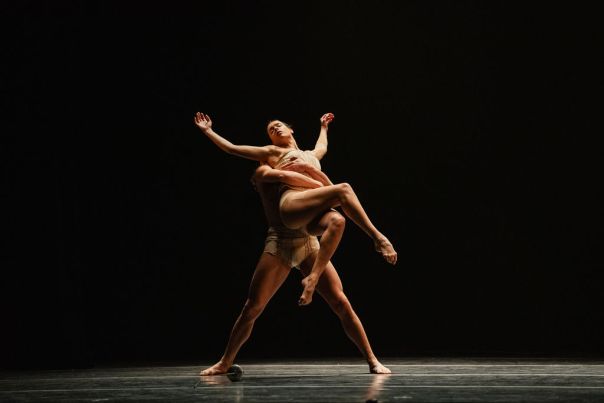
The evening began far more elegantly and wittily with a reprise of Jiří Kylián’s Petite Mort, an international staple premiered by Nederlands Dans in 1991 and unveiled at the Knight in March 2024. It’s good to keep in mind that Kylian’s piece is more about what the title implies, “the ecstasy of sexual intercourse,” than about the two slow movements from famed Mozart piano concertos, No. 23 and No. 21 (Elvira Madigan), he sets to dance in a series of ensembles and six pas de deux. There’s a definite uptick in the quality of what we see this time at the Knight, only partially because Kylián’s explanatory notes are printed in the program beneath the credits, cluing us in to the sensuality at the core of the choreographer’s concept and the precise satire he intends with the sabers wielded by the men.
You knew that sabres were sharp and pointy, but did you realize that, by accurately kicking their handles, they will roll around the floor in a perfect circle? Mastering that trick along with the close brushes that the blades, straight or curved, make with the females onstage during Petite Mort – these can account for a bit of fear and hesitancy among all the dancers. So another reason the revival scores better than the initial thrust two seasons ago is that the dancers are handling the hardware with more confidence and élan. A complete delight this time around, with all its suggestive episodes more sensuously sketched.
In the middle of the two rousing spectacles, Crystal Pite’s dimly lit Solo Echo, set to cello sonatas by Brahms, stood out in quiescent relief. Or it did during its early moments. Flakier stuff came down in the darkness as Pite’s piece began, partially illuminated by a vertical rack of lights from the wings. That horizontal lighting, designed by Tom Visser, gradually descended from the flyloft, stopping in midair just above the dancers’ heads. Slow-paced choreography, frequently for just a couple of the seven dancers, dressed drably in costumes by Joke Visser and the choreographer, added to the hypnotic spell. Confession: I briefly fought the impulse to doze off during this monochromatic dreariness.
But then the pace quickened and Pite deployed her complete ensemble in more feverish action – while the whole upstage brightened into a skyscape depicting a glorious snowy night. More importantly, Pite’s echo concept crystallized as six of the seven tightly intertwined, one on top of another, in a vertically mirroring pose above the recumbent Mouzon, once again garnering special attention. In this blizzard, the ensemble might split apart slowly like the folds of an accordion. Or they might break apart, scurry around chaotically, and make wretched attempts to form a moving circle. Often, however, one of the dancers stood isolated from the ensemble. He or she could be viewed as an outsider, but also as the solo mind generating the echoes.




 Art on My Sleeve