Tag Archives: John Bartlett

Charismatic Parnther Justifies Shostakovich’s Top Billing at the Knight

Review: Charlotte Symphony Presents Shostakovich and Mendelssohn

By Perry Tannenbaum

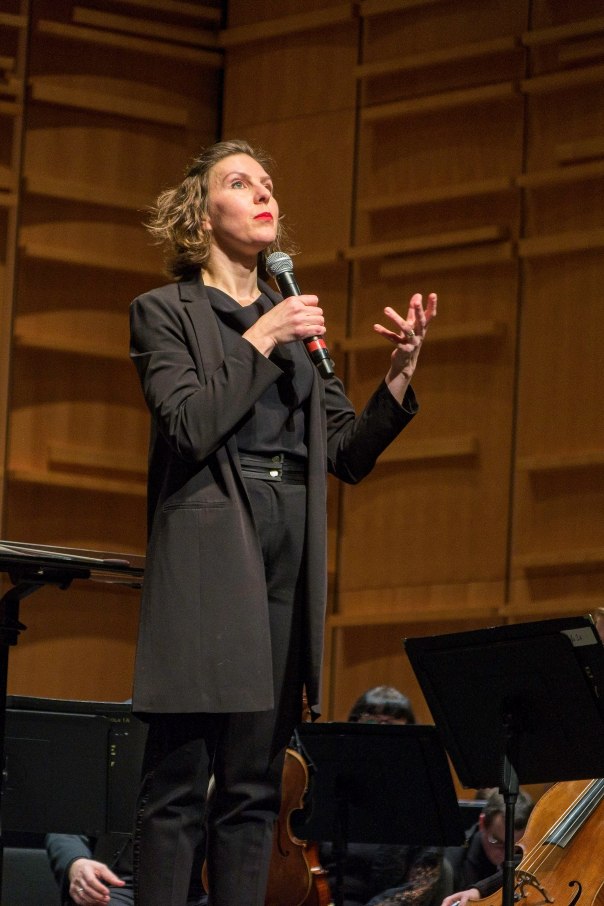
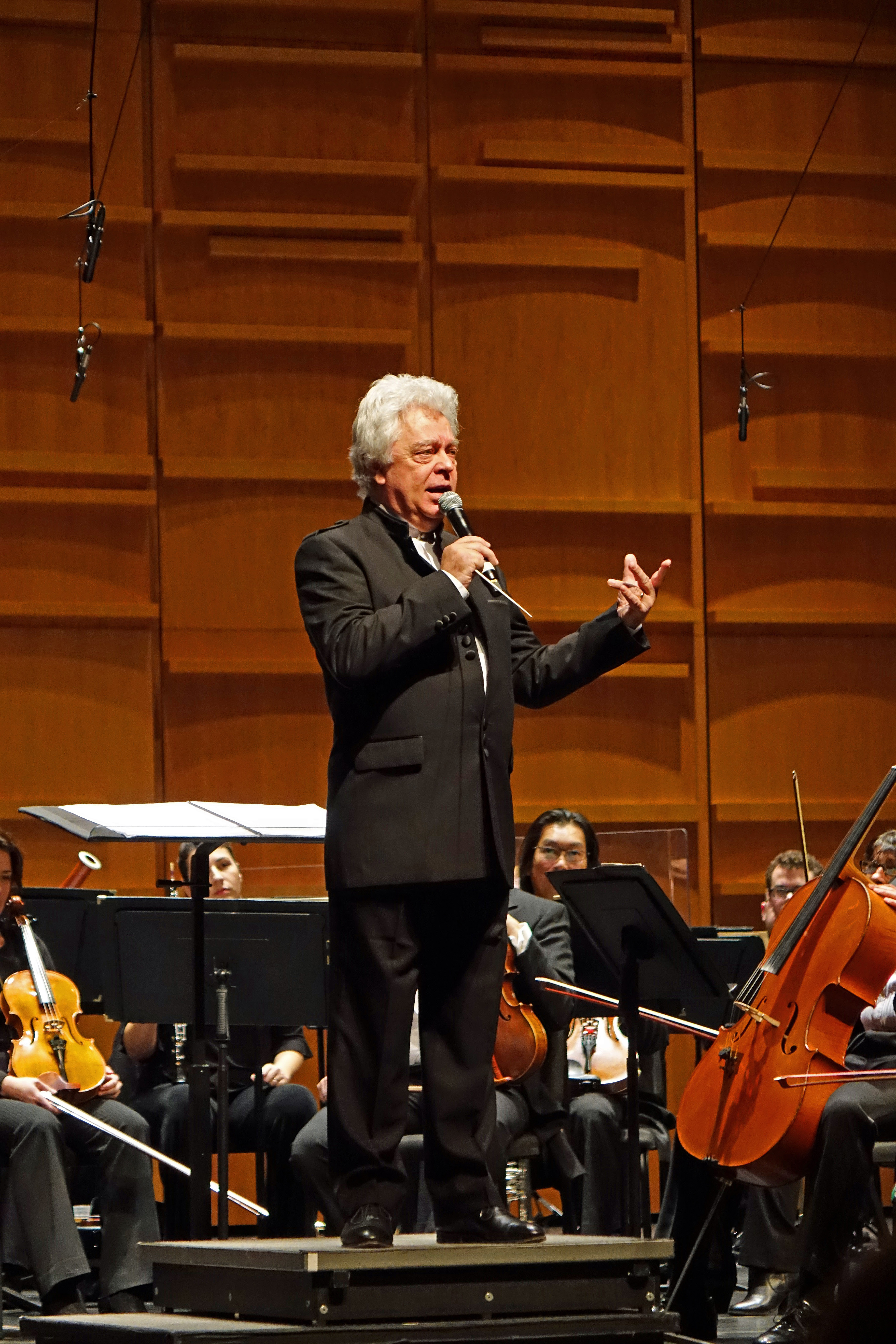
November 8, 2024, Charlotte, NC – Hailing from Norfolk, VA – and perhaps the Sith Order of the Galactic Empire – guest conductor Anthony Parnther has brought a big James Earl Jones voice to Knight Theater and an even bigger personality. He instantly engaged Charlotte Symphony subscribers with a lengthy intro to the first piece of the evening, Samuel Coleridge-Taylor’s Ballade in A Minor (1898). Amid some insightful observations on the Black Britisher’s talents and his fin de siècle milieu, Parnther threw in some shtick that drew attention to his mighty larynx, looking askance at what appeared to be a perfectly fine microphone and coming to the mic’s rescue with his “opera voice” and, a bit later, with his “Shakespeare voice.”

In short, he dared to educate us and did a damn good job of it. The performance was just as brash, though occasionally too loud for the hall. There was gravitas in the opening measures sweeping into a zingy elan. Violins excelled in the midsection of the work with some very tender section playing, and the piece built nicely to an anthemic climax, reminding me of Jean Sibelius’s less-neglected symphonic masterworks. North Carolinians can point with pride to the best recorded version available on Spotify or Apple Music, featuring the Royal Liverpool Phil directed by Grant Llewellyn, who has given so much to The Old North State. Beyond that, Parnther could tell us very confidently that Black composers, according to the latest tallies, account for only 2.5% of programming among America’s top orchestras, knowing that we were quite entitled to feeling superior in the wake of hosting Sphinx Virtuosi a month ago – in a mostly Black and Hispanic program.

Sphinx’s visit turned out to be a gift that kept on giving, for the guest soloist playing Mendelssohn’s Violin Concerto in E minor, 16-year-old Amaryn Olmeda, was a first-prize winner – and audience fave – at the 24th Annual Sphinx Competition and toured with the Virtuosi two years ago. While I wouldn’t wish to compare Olmeda’s performance to my favorite recordings; including those by David Oistrakh, Yehudi Menuhin, and even Itzhak Perlman (who gave a live rendition at Belk Theater in 2019); there was certainly beauty aplenty in Olmeda’s account, with virtuosity to spare. But Symphony concertmaster Calin Lupanu attacked the infectious Allegro opening more fiercely in 2021, bowing with bolder panache when he played the piece online with Christopher Warren-Green at the podium. After a simple and lovely transition from principal bassoonist AJ Neubert, Olmeda was at her best in the middle Andante movement, freeing Parnther and the CSO to give her more robust support.

Olmeda relaxed and reveled more in the closing Allegretto-Allegro than she had in the previous outer movement, so Parnther and the CSO could be more assertive in their support, but true brilliance seeemed still beyond her at this tender age. Nonetheless, the audience joined me in giving Olmeda a standing O, perhaps sharing my feeling that we should pay her forward. Although attendance at the Knight was strikingly sparse, the young violinist was beaming. With a nicely articulated Bach solo, she returned our appreciation with an encore. Instinct tells me that the ripple of applause from the audience as intermission ended was in response to Olmeda joining them.

The young prodigy could not be faulted for the disappointing turnout, for the Sphinx Virtuosi had triumphed at Symphony’s annual gala last month. More likely, it was Shostakovich, topping the bill with his Symphony No. 9, who was the culprit on a beautiful autumn evening. Yet here was where Parnther and the CSO were at their best. The Norfolk native was pointedly suggestive in his introductory remarks, but mostly objective in his lengthy explorations – cuing us on what to look for in each of the five movements rather than telling us what to make of it. Thorough but never boring or academic, not at all show-offy or self-indulgent. Truly helpful.

The performance was spectacular, brilliantly contoured to the hall with fine evocative details, fully justifying Parnther’s enthusiastic intro. Which instrumentalist shone brightest in the opening Allegro was a tossup between Lupanu and piccolo stalwart Erinn Frechette, but principal trombonist John Bartlett stole all the scenes, emphatically partitioning the many episodes and injecting Shosty’s comedy with just two oompah notes. From that lighthearted opening – antithetical to what all Ninth Symphonies should be in the wake of Beethoven’s behemoth – we plunged into the depths and dolor of the Moderato, the lengthiest movement in this lapidary stunner. Principal clarinetist Taylor Marino, bolstered by section mate Samuel Sparrow, set the doleful tone of this sharply contrasting movement (again antithetical to the triumphal music Soviet Premier Joseph Stalin expected in 1945), achingly extended by two other principal winds, flutist Victor Wang and Neubert. Dreary strings increased the profundity of this oppressed lament, with Marino returning to soar above it in near-manic anguish.

It’s easy to lose your place after this unforgettable pairing of light and dark movements because the last three are played without pause, steadily increasing in intensity until a steady locomotion of victorious woodwinds are prodded into accelerating by the pulsations of the lower strings. These, in turn, triggered and excited the violins. Blaring brass then drove the journey into complete madness – and off the rails. Adding to the overwhelming bite of this sonic climax, the slashing, plucking, and sawing of the bowstrings across the stage added vivid visual drama.

Photos by Perry Tannenbaum

Charlotte Symphony Heralds the New Year in All-American Style

Review: Koh Plays Mazzoli at Knight Theater

By Perry Tannenbaum

January 19, 2024, Charlotte, NC – Just a little more than a year after Kwamé Ryan guest directed an all-American program at Belk Theater featuring violinist Bella Hristova, Charlotte Symphony (after naming Ryan as the music director designate for 2024-25) greeted guest conductor Lidiya Yankovskaya to the Knight Theater podium, with violinist Jennifer Koh making her debut in another all-American program. This year’s explosion of Americana came four days after MLK’s birthday instead of two days before. The Adams-Korngold-Copland program of 20th century pieces could be counted as a bold advance in 2023, but the current offerings, with two 21st century compositions by American women, Jennifer Higdon and Missy Mazzoli, getting equal playing time with the 20th century composers, Samuel Barber and Aaron Copland, is arguably even more diverse and inclusive.

Distilled from Higdon’s opera, Cold Mountain, of 2015, and co-commissioned by Charlotte Symphony, the new Cold Mountain Suite could credibly be categorized as a concerto for orchestra by virtue of its length, variety, and profusion of solo instrumental passages. Like many opera suites you may have heard, Cold Mountain takes a serpentine route through the score rather than a sequential path, using the opening of Act 2 and the close of Act 1 as its bookends in repackaging eight snippets from the score.

On my first hearing, I could distinguish seven distinct sections and some fine soloing not only from string principals – cellist Jonathan Lewis, violist Benjamin Geller, second violinist Oliver Kot, and associate concertmaster Joseph Meyer – but especially from acting principal oboist Erica Cice and principal trombonist John Bartlett. The most memorable section of the piece was the “Storm Music” with its swirling strings and the atonal whistling of the high winds, but the ending, launched by the reunion scene between Ada and Inman was authentically stirring, with soaring work by principal trumpeter Alex Wilborn heralding the closing crescendos.

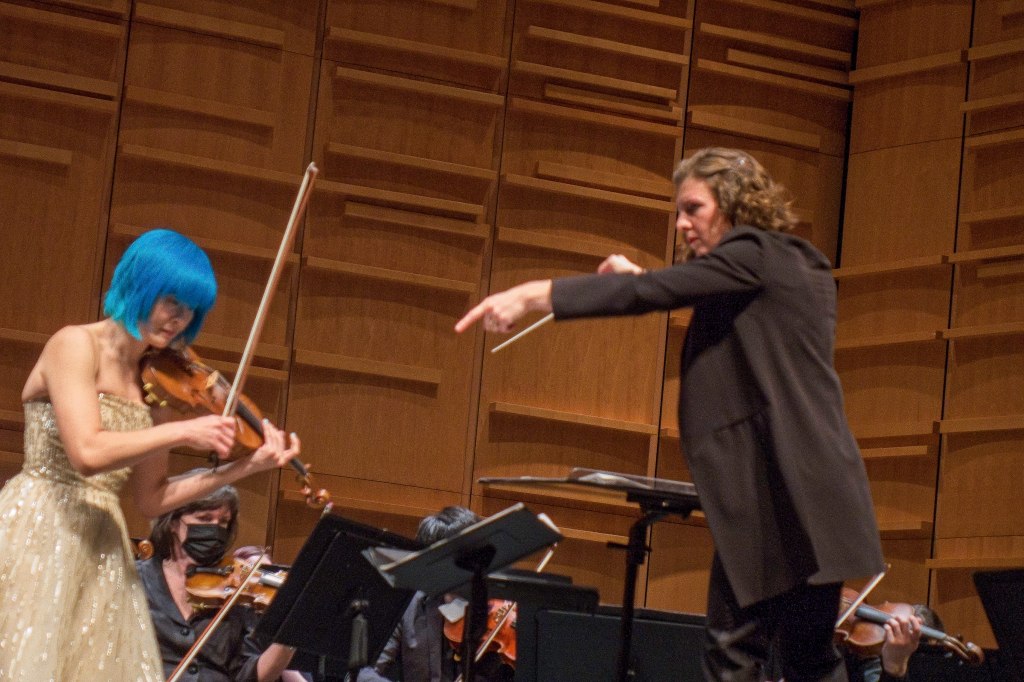
Since Mazzoli’s Procession Violin Concerto was commissioned by Koh, the music remained in-house until intermission. Notwithstanding her outré blue hair, Koh is actually a few years older than the composer, with a recording career extends more than 25 years. The former Chicago prodigy still plays with a youthful zest and a frenetic edginess – but not immediately in “Procession in a Spiral,” the opening section that unfolds slowly in a keening treble and increases its tension about 3/4 of the way into the section. The thinnest ethereal note from Koh’s violin bridges the gap into the unexpectedly calm beginning of “St. Vitus,” but the onset of intensity comes sooner here, still without the manic speed we might have expected from this title. The weepiest of the sections, “O My Soul,” has the most sustained of Koh’s thin harmonics and she hangs out with the flute and piccolo before breaking into more neurotic bowing.

A nice orchestral swell transitioned us to “Bone to Bone, Blood to Blood,” the most dramatic section, spiced with a series of whipcracks and a sprinkle of percussion. Jollity never prevailed in this rather somber concerto, nor was there an Allegro. “Procession Ascending” began rather unexpectedly for a finale with some lovely solo work from principal bassoonist Joseph Merchant, dramatizing how high Koh would need to ascend on her violin. If I were Koh, I’d pay Mazzoli a few more bucks to extend her struggles to take flight, blocked by the cellos and the double basses. She seems to clear this viny undergrowth too soon and too easily for the music to reach its full dramatic intensity, but I loved how briefly her freedom lasts and how cruelly it ends.

While there is a fine Baltimore Symphony account of Barber’s Second Essay for Orchestra in my collection, I cannot confirm ever hearing the piece performed live, though it was scheduled for a Symphony concert in April 2008. Hard to imagine that I snubbed it in my review, though Dvorak’s New World, ballet excerpts from Mozart’s Idomeneo, and Barber’s Violin Concerto were also on the bill. The music really is sumptuous, with oboe and clarinet illuminating the opening, viola mixing into additional oboe action later on, and some tasty propulsive percussion triggering its climax. It came across as a fresh and welcome discovery for me.

Of course, Copland’s Billy the Kid Ballet Music was the most familiar nugget on the program, revived at the Knight after an absence of less than four years. We’ve all been through a lot since February 2019, so I suspect more of the mournfulness of Copland’s “Introduction: The Open Prairie” and more of the fleeting, elegiac pathos of the penultimate “Billy’s Death” will land on listeners. Merriment is similarly magnified, with the clopping woodblocks of “Street in a Frontier Town” and even more heartily in the marching band energy, fueled by the woodwinds, of the gala “Celebration (after Billy’s Capture).” For the youngest buckaroos, the warring timpani and snare drum tattoos of “Gun Battle” will likely be the hugest delight.

Barefoot in Carnegie Hall, Conqueror at the Knight

2020~Beethoven's Emperor-11

Review: Charlotte Symphony and Conrad Tao Perform Beethoven’s “Emperor” Concerto

By Perry Tannenbaum

Celebrations of Ludwig van Beethoven don’t really need to lean on a convenient excuse. Just before celebrations broke out worldwide on January 1, 2020, commemorating the great composer’s 250th birthday, New York City’s WQXR played out 2019 with their traditional New Year’s Eve countdown of their audience’s top 100 favorites, culminating in a marathon tribute to Beethoven. Not only did Beethoven’s “Choral” Symphony No. 9 take the top spot yet again at the flagship classical FM station, six works by Beethoven were in WQXR’s top 10, including the top three. Charlotte Symphony certainly wasn’t standing in back of the line of orchestras poised for celebration as the new decade began.

Returning to Knight Theater from a tour of Southeast Asia with the London Chamber Orchestra, maestro Christopher Warren-Green capped the first full week of 2020 with a double-dose of the birthday boy’s compositions, the “Leonore Overture No. 3” and the “Emperor” Concerto No. 5, which finished No. 10 in the latest WQXR popularity poll. In between, we heard the Symphony No. 7 in C by Jean Sibelius, perhaps the first time that the Finnish composer’s final symphony has been performed in Charlotte. Pianist and composer Conrad Tao made his Charlotte debut with the orchestra.

We don’t have too many instances of rewrites among Beethoven’s published works, but his lone opera, Fidelio, and its overture are prominent exceptions. The three Leonore overtures (plus a “Fidelio Overture”!) testify that Beethoven not only fussed over the music for his opera, he also fussed over the title. Leonore, Creatures of Prometheus, and Coriolan are the overtures most favored as fillers on CD collections of the symphonies, and Warren-Green programmed Coriolan in an all-Beethoven concert in 2012. As far back as I can trace, this is the first time Symphony has separated the “Leonore Overture” from Fidelio, but our musicians likely recalled rehearsing it for an opera-in-concert version conducted by Christof Perick in 2004 and when Opera Carolina offered us a fully-staged Fidelio in 2015.

2020~Beethoven's Emperor-14

Musicians were perhaps too amped-up for the celebration as the Overture kicked off the concert. The opening sforzando over a timpani beat and the mysterious fadeaway that follows that burst were beautifully played. Woodwinds blended effectively and the flutes had a wonderful rapport before forebodings of the big tune rippled through the lower strings. But the crisp delivery and sleekly calibrated dynamics we have come to expect from this orchestra were missing on the first pass through the main theme, and there was no room left to dramatically turn up the volume later when the big tune repeated twice more. Thankfully, the ensemble steadied immediately afterwards – for the entire evening – sharpening their focus. Winds and horns remained tightly knit, principal flutist Victor Wang continued to charm, and principal trumpeter Alex Wilborn, deployed deep in the balcony, brought us forlorn pathos before concertmaster Calin Lupanu, playing fervidly, triggered the final galloping reprise and climax.

2020~Beethoven's Emperor-04

Other than interpolating how exhausted he still was after conducting the Leonore, Warren-Green was all about Sibelius when he picked up his mic for the first time in 2020, pointing out that the Finn was battling two illnesses as he wrote the piece over a 10-year stretch: depression and alcoholism. He also drew our attention to the trombone solos with insights gleaned from the original 1924 manuscript. The winds and strings, particularly the violins, drew a sweetness from the music that I hadn’t found on either of the CDs in my collection, and there were definite hints in the darkest passages, where the violins played low in their range, of the illnesses that afflicted the composer – and possible promptings for the way Shostakovich would register WW2 in his symphonies. Only the flow and the full grandeur of my Ashkenazy recording with the London Philharmonia were missing in Warren-Green’s reading. As for principal trombonist John Bartlett, the orchestral wreath surrounding his contributions – along with the embroidery Sibelius weaves with the winds – might cause you to overlook his unquestionable excellence.

No such danger threatened Tao as he emerged in his colorful attire. Only later admitting that he had begun the new year by packing negligently and forgetting his formal attire, Tao attacked his opening cadenzas with swashbuckling panache, and his phrasing proved to be no less audacious and individual than his attire and attack. Clearly, Tao has heard this soaring masterwork in his own way – but without perversely differing with traditional interpretations or seeking to draw undue attention away from the composer. Warren-Green and the orchestra responded vigorously to the young soloist, as much in the forefront of the epic opening Allegro movement as the piano. Of course, Tao impressed us more in the softer passages than the accompaniment here, but Symphony was certainly an equal partner in the magical Adagio that followed. The upper strings, delicately supported by pizzicatos from the lower strings, solemnly and lyrically cleared the way for Tao’s ethereal entrance – with a clarity that I’ve never heard on a recording. A bit of subtlety and nuance eluded Tao here and there in his phrasing, but Warren-Green and his ensemble remained marvelously simpatico in sustaining the sublimity.

For those of us who love this piece, Tao’s way with the ingenious transition between the Adagio and the Rondo finale likely sparked the most controversy and admiration. He certainly took his time, not playing the ending quite as softly as the usual pianissimos I’ve heard, but the sforzando burst to launch the concluding movement still had a satisfying snap and éclat. Symphony was as zestful as ever in its response, and Tao parleyed a playfulness and a muscular power we had not seen from him earlier, conclusively proving he could punish a keyboard.

Two more Beethoven masterworks, his Missa Solemnis and “Pastoral” Symphony, highlight the remainder of the 2019-20 mainstage classics series, the latter to be led by JoAnn Falletta. Symphony certainly had the appeal of their Tao program nicely gauged, scheduling an extra Sunday matinee after the usual pair of performances. Of course, Tao may have been kidding us when he spoke of forgetting his formalwear. In his enthusiastic New York Times review of Tao’s Carnegie Hall debut back in November, critic Anthony Tommasini couldn’t help noting that the pianist was clad in black slacks, a black jacket, a black T-shirt… and barefoot!

Mozart Requiem Clashes With Sunny Salieri Symphony

Review: Charlotte Symphony “Mozart and Salieri”

By Perry Tannenbaum

It’s been 40 years since Peter Shaffer’s Amadeus vilified, ridiculed, defamed, and demonized Mozart’s less-gifted contemporary, Antonio Salieri, presenting the prolific composer and conductor as Wolfgang’s fiendish murderer. Shaffer wasn’t the first to riff on this unfounded smear, for the great Russian poet Alexander Pushkin peddled it in Mozart and Salieri, his 1830 verse play.

Although he omitted his villain’s name from his title, Shaffer has proven equally bountiful to both composers, humanizing Mozart and bringing fresh life to Salieri’s name. Ian McKellan won a Tony Award as Salieri in the 1980 Broadway production and F. Murray Abraham repeated the triumph in the 1984 Miloš Forman film, winning the Oscar over Tom Hulce, who was a runner-up playing the title role.

So it’s altogether fitting that Salieri’s 1775 Symphony in D “Il giorno onamstico,” likely marking the Italian’s Belk Theater and Charlotte Symphony debuts, should be in the shadow of Mozart’s Requiem. During the composition of this work, which remained unfinished at his death, it was Mozart who first voiced the suspicion that he was being poisoned and that his mysteriously commissioned Requiem was diabolically planned for his own funeral.

Mozart later scoffed at his own poisoning paranoia, and the Requiem wasn’t premiered until late 1793, two years after his death, completed by his student, Franz Xaver Süssmyer. But the baseless murder accusation affixed itself to Salieri. And why not take advantage of Shaffer’s preposterous mythologizing if it draws more people to the music? Symphony was only too glad to borrow the indelible Amadeus poster art for this concert’s prepublicity. “Poor Salieri!” said Charlotte Symphony music director Christopher Warren-Green, upon picking up a hand mic to introduce Antonio’s piece.

That was after a reprise of Nkeiru Okoye’s “Charlotte Mecklenburg,” which received its world premiere last September, kicking off the current season. The encore was triply justified: the piece was originally performed one night only at a special opening night gala and not part of the season’s subscription, we’re still celebrating the 250th anniversary of the city’s incorporation, and the piece – commissioned by Symphony – is non-threatening to traditionalists and worth a second hearing.

It was easier for me to ascertain on my second go-round that the opening theme, very much in the Aaron Copland manner of evoking Appalachia and the American heartland, was something that Okoye would circle back to near the end of her historical portrait. What came in between statements of her “Queen City Hymn” was more daring and original. There was urban bustle and cacophony mixed with a mountain lilt, snatches of a Scottish fiddle tune and a post-Civil War protest song, and an unexpected glance southward.

A brief marimba concerto popped up, then a muted trumpet and a cool samba beat. Okoye’s objective of portraying the city’s multiethnicity was more successfully reached than her objective of depicting our racial tensions. The codetta, beautifully played by harpist Andrea Mumm Trammell, expressed hopes for the future residing in the innocence of our children. Or that was Okoye’s stated intent. For an affirmation, it was notably faint.

Not at all saturnine like Salieri’s stage and screen image, his Symphony in D was sunny and cheerful from the outset, the opening Allegro launched with a lively flourish of horns and winds. Both of the middle movements offered opportunities for principal bassoonist Olivia Oh. The charming Larghetto remained summery in spite of its weepy violins, and the Minuet alternated attractively between mellow and anthemic themes. Warren-Green vigorously pushed the pace of the closing Allegretto, lightly carried forward by the strings when the winds weren’t adding body and zest.

When the entire orchestra joined together toward the end of “The Name Day,” the music briefly grew joyous and grand. It was almost as if Salieri was apologizing for this outburst when the strings alone crept around stealthily in staccato phrases, but the whole orchestra came back for a crisp, good-humored finish.

Warren-Green’s programming effectively flipped the Hulce-Abraham characters we remember from Hollywood’s Amadeus, assigning all the frivolity to Salieri, but he didn’t mess with the awesome impression of Mozart’s Requiem that lingers after we have seen the film. Unlike some of the Mozart performances we’ve seen before from Warren-Green and his predecessor, Christof Perick, a robust assembly of musicians, guest soloists, and the Charlotte Symphony Chorus filled the Belk stage.

If the occasionally fierce reading that emerged from this formidable congress didn’t totally accord with Mozart’s accepting intentions, there was no doubting its power. The “Dies irae” rang out impressively, taut with terror, and the “Tuba mirum” was a fine spotlight for all four guest vocalists, particularly bass Adam Lau, smoothly accompanied by principal trombonist John Bartlett before giving way to tenor Isaiah Bell. Having already distinguished herself in the soprano section of the opening “Requiem aeternum” segment with the Chorus, Margot Rood floated in gracefully over mezzo Sofia Selowsky toward the end of the “Tuba.”

Overshadowed here somewhat, Selowsky had better opportunities further along in the mass, leading off the “Recordare” and “Benedictus” sections when all the solo vocalists stood up again. Still it was Rood who shone brightest, drawing the opening moments of the concluding “Lux aeterna” and sprinkling her loveliness all over before the music grew grander and fugal with the full ensemble joining in.

The orchestra made its presence known most emphatically when the brass and timpani underscored the most dramatic choral moments. Aside from the whiplash “Dies irae,” there was ringing majesty at the start of the “Rex tremendae” that contrasted affectingly with the hushed women when we reached the “salve me” pleas. Symphony Chorus showed more finesse in the “Lacrimosa,” beginning softly over the orchestra’s keening strings, with some satisfying crescendos preceding the satisfying “Amen.”

Warren-Green and chorus director Kenney Potter may have been thinking more of Buckingham Palace than a church when they prepared Symphony Chorus for the climactic “Sanctus.” Both the orchestra and the choir suffused the repeated holies with a pomp and fervor of “God Save the Queen” proportions. Or maybe they had Westminster Abbey in mind. Warren-Green has played that joint as well.

Warren-Green’s Reading of Mahler’s “Resurrection” Stamps It as an Instant Favorite

Review:  Mahler’s “Resurrection” Symphony No. 2

By Perry Tannenbaum

We’ve had quite a week in and around Charlotte for jubilant choral symphonies, first with A Sea Symphony up in Davidson and now with Mahler’s stirring “Resurrection” capping Charlotte Symphony’s 85th season. Turnout at Belk Theater for the grand work was robust, especially when the many latecomers were seated after the opening Allegro maestoso. Of course, the stage was heavily populated as well, the presence of the Charlotte Symphony Chorus pushing the musicians downstage and a sizeable contingent of freelance musicians further cramping their space – extra percussion, extra woodwinds, extra brass, second harp, second timpani, and lurking somewhere offstage, four more French horns. Mezzo-soprano Maya Lahyani made her entrance halfway into the third movement for the fourth movement “Urlicht (Primal Light)” alto solo, and soprano Kathleen Kim entered during the final Scherzo to join in singing Mahler’s setting of Friedrich Klopstock’s “Auferstehungslied (Resurrection Song).”

Beyond the executive decisions to beef up the orchestra and enable the horn players to follow his baton (presumably with a video installation), music director Christopher Warren-Green was artistically faultless in managing the pacing, the dynamics, and the overarching structure of Mahler’s music. There was plenty of muscle from the double basses in the opening bars, burrowing their way toward the dazzling entrance of the brass, who were as powerful and incisive as I’ve ever heard them. The winds worked well with the brass once the basses faded, and there was lovely work from the oboes, the upper strings, and – with the only imperfections of the night – the onstage horns. Percussion during the climactic explosion was thrilling, yet the strings retained a soft, kinetic excitement in the sudden hush afterwards.

Maybe the only questionable call Warren-Green made all evening was heeding Mahler’s call for a five-minute pause between the first two movements. The break was a welcome spot after more than 20 minutes of music to finally seat those patient latecomers (watching a performance on the big screens in the lobbies is far from ideal). But the audience treated the interval like an intermission, applauding what they had already heard and, in some instances, rushing for the exits for assorted urgencies. Mahler and Warren-Green undoubtedly thought the pause was a time for reflection, a grace period to accommodate the changing mood of the second Andante moderato movement, rather than an applause cue. If Warren-Green is rethinking the pause idea after its first trial, he certainly didn’t need to question whether his orchestra communicated the contrast that followed. The opening episode was suave and urbane, radically different from the thunderous and heart-rending Allegro that had preceded, until we reached a percolating section that could remind listeners of the vivace second movement of Beethoven’s “Choral” Symphony No. 9 – not andante at all. Principal flutist Victor Wang sounded ebullient over pizzicato strings, and principal harpist Andrea Mumm provided a nice sheen over another delicate ending.

The whirling motion of the third movement could lull listeners into thinking that Mahler was revisiting the waltzing “Un Bal” movement of Berlioz’ Symphonie fantastique, but there are sudden outbreaks of brass that give this “In calm, flowing motion” movement more jagged edges. Charlotte Symphony’s brasses were undeniably forceful but never overdone, and the brassy blends in the tranquil section of this movement were outstanding. Distant horns camping out backstage until their moment were as fine as the visible players, coming into view after the last big explosion of the movement – and a pair of beautifully articulated solo spots from principal trombonist John Bartlett and principal trumpeter Richard Harris.

I could assemble a fairly lengthy list of so-so mezzos who have sung with the Charlotte Symphony over the past 25 years, but I wouldn’t include the Israeli-born Lahyani on that list. From her first sweet exclamations, “O red rose!” and “Man lies in greatest need,” there was no doubting the purity and control of this voice, perfectly pointed in a hopeful, yearning direction. Beautiful fills by principal oboist Hollis Ulaky, concertmaster Calin Lupanu, and – in the faceoff between the singer and a heavenly angel – principal flutist Wang added to the delight.

Before we reach the dazzling resurrection light of the final Scherzo, there is a tumultuous instrumental drama that is longer than the previous two movements combined. A long crescendo of portentous percussion flowed naturally into the first volley of brass. Amid the general turmoil that followed, the French horn quartet departed once more with a percussionist. Sadly, these offstage voices would be more audible than a tubular bell that was misstruck by an errant mallet about three feet above all the other instruments. But the other onstage percussion during the hushed middle of the movement, a soft bass drum tattoo under the hidden horns, was absolutely spellbinding, and the piccolo filigree from Erinn Frechette was beguiling.

Entrances by the Symphony Chorus and soprano Kim were nothing short of magical, swelling up out of thin air with their wakening affirmation: “Rise again, yes, you will rise again, My dust after a short rest!” For the last sublime six minutes or so, the voices and instruments grew in strength, conviction, and triumph until all were jubilant together, cresting with a burst of brass, cymbals, a gong, and – no misfiring this time – repeated poundings of the tubular bell. It isn’t easy to shoulder aside the various Beethoven masterworks that comprise the core of Charlotte subscribers’ favorite symphonies, but with this milestone performance from Warren-Green and his musicians, Mahler’s “Resurrection” has clearly broken through to claim its place alongside the Beethoven hegemony. The spontaneity and fervor of the standing, cheering ovation that showered down on the singers, the musicians, and the directors – including Chorus director Kenney Potter – stamped this concert as one that will be talked about and remembered for a long time.