Review: Charlotte Symphony Plays Kabalevsky’s Cello Concerto No. 1
By Perry Tannenbaum
 February 25, 2022, Charlotte, NC – Theatre and music critics can be lulled into complacency – mixed with boredom – when called upon to review Shakespeare’s As You Like It or Tchaikovsky’s Nutcracker beyond the seventh time. So it’s gladdening and stimulating to see how recent social, political, and public upheavals have affected local programming in the Queen City. Though it constantly calculates years ahead, Charlotte Symphony has not been the slowest to react and evolve. Not at all: in the past four weeks, I’ve been compelled to remember the names of new guest soloists and conductors – and to read up on composers whose works I was hearing at Knight Theater and Belk Theater for the first time. When American composer John Corigliano is the best-known composer at a Symphony program in the Belk, you know we’ve wandered off the beaten path.
Apple Music and Spotify are both aware of Chilean-Italian guest conductor Paolo Bortolameolli and Mexican composer Gabriela Ortiz, but neither of their giant streaming catalogues contains the first piece that Bortolameolli performed with Symphony, Ortiz’s Téenek – Invenciones de Territorio. Obviously, our guest would need to have an inside track on this composition. As associate conductor of the Los Angeles Philharmonic, he did, for the LA Phil commissioned the piece and it was premiered under the baton of Gustavo Dudamel in 2017. The piece, divided into three sections, had glimmering textures and lively rhythms from south of the border, with celesta, tubular bells, and harp coming in the wake of the piece’s biggest climax and some mellow work from principal oboist Hollis Ulaky along the way.
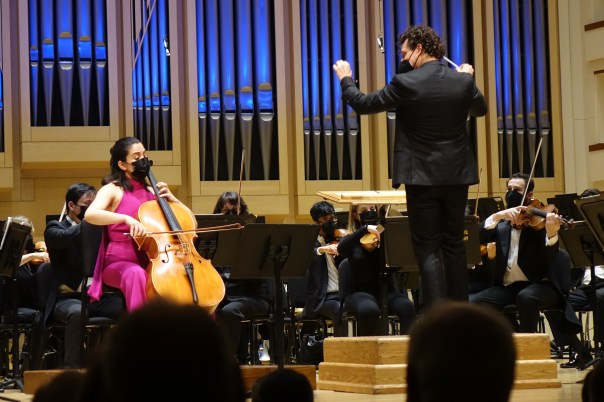
I was still struggling with the spelling of Russian composer Dmitri Kabalevsky’s last name in my driveway as I was tallying my mileage and parking in my expense app after the concert – and berating myself for forgetting his first. The deluge of new data I needed to process was happily compounded by an auspicious debut of Christine Lamprea, who soloed on the marquee piece, Kabalevsky’s Cello Concerto No. 1. Lamprea established another appealing trend, the second consecutive female soloist to clutter the Belk stage with a music stand and a musical score. That’s a byproduct of presenting a piece that the guest artist hasn’t played over and over around the country and the globe. Among the half dozen recordings that I tracked down, the best-known soloist to have played Kabalevsky’s Op. 49 is Yo-Yo Ma (Raphael Wallfisch, however, has recorded Concerto No.2, Op. 77), whose performance vies with Daniil Shafran’s, conducted by Kabalevky himself, as the definitive account.
In a very personable intro to the evening’s program, Bortolameolli hinted that we might find an undercurrent of cynicism and sarcasm akin to Shostakovich beneath the sunny surface of Kabalevsky’s 1948 work – maybe a bit of a stretch, since the composer was widely recognized as an establishment figure from the days of Stalin onwards, serving behind the scenes and on-the-air with Soviet Radio, eventually becoming a leading Soviet musical ambassador in his travels abroad. Perhaps there was some empathy for Ukraine impinging on Bortolameolli’s objectivity? In keeping with Communist suspicions of radical modernist innovations, Kabalevsky hardly delivered any portentous jolts in his G minor concerto, nor did Lamprea, playing quite eloquently, seem to be on a quest for anything subversive in her interpretation. Over a marching beat of pizzicatos, her playing in the opening Allegro was rich and ardent, finishing the movement with a light and beguiling pizzicato cadenza.
Nor did I detect any sardonic undercurrents in the ensuing Largo, molto espressivo, Kabalevsky’s tribute to the Soviet casualties of the World Wars. While there was more heart on Ma’s sleeve in the lyrical moments of this movement – and more daring hushed quietude on his CD in his lamenting cadenza – Lamprea was altogether earnest in her grieving, very affecting. Principal hornist Byron Johns certainly heightened the solemnity and sublimity of this movement backing up Lamprea. In the concluding Allegretto, the Colombian-American cellist convinced me that Kabalevky (1904-87) had written his Concerto after hearing Tchaikovsky’s Rococo Variations rather than before. The theme and variations, based on a Russian folk melody, have no less melodic appeal, even if they aren’t as technically demanding, and Lamprea brought out the kinship of the variations more clearly than any other version I’ve heard.
You’ll be very entertained by Bortolameolli’s pocket sized intro to Corigliano’s Symphony No. 1, timely again because it was written in 1988 in response to the AIDS epidemic and the toll it took on artists and friends he knew. But for a fuller analysis and exploration, you don’t want to miss the composer’s own introduction in the digital program booklet. No need for me to add more than this single word to that comprehensive, episodic description: LOUD!! In order to nearly replicate the 92dB reading I saw on my Apple Watch at the peak of the opening movement, Apologue: Of Rage and Remembrance, I had to turn my home stereo volume knob close to the 12 o’clock position, playing the landmark Chicago Symphony/Daniel Barenboim CD. At that point, my Apple Watch registered 90dB. At the same time, I activated the Sound Meter app on my iPhone for a more credible reading and recorded a max of 111.1dB.
Yes, it was louder at Belk Theater in Row J than that. “Behind the orchestra,” we read in Corigliano’s notes, “five trumpets are placed with the first trumpet in the center; fanning outwards around the orchestra are six French horns (three on each side), four trombones (two on each side), and, finally, one tuba on each end of the semicircle of brass.” No doubt my wife Sue and I were more comfy with the Remembrance episodes of this movement than the spasmodic blares of the Rage that the composer marked as “Ferocious.” In the more nostalgic moments, we heard an offstage piano playing Leopold Godowsky’s transcription of Isaac Albeniz’s Tango, with more piano – and pleasantly intensified orchestra – closing out the movement.
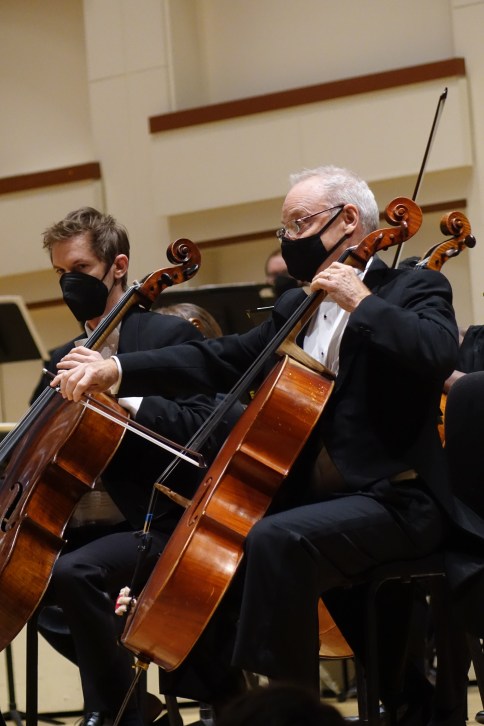 We weren’t exactly danced around the hall in the ensuing Tarentella, for as Bortolameolli pointed out, the root word of this Italian dance is actually tarantula, and the dance was believed to cure victims of that spider’s bite from a rare form of dementia. So the composer had a schizophrenic and hallucinatory soundscape in mind, relentlessly accelerating into insanity. Most consoling and welcome, then, was the penultimate Chaconne movement, “Giulio’s Song,” written in memory of a friend who was an amateur cellist and inspired by tape recordings of improvisations Giulio and the composer played together. Principal cellist Alan Black was unforgettably showcased here, playing five lovely notes before a pause, then seven notes before another, before finally released into the song. Enhancing the loveliness, cellist Jeremy Lamb eventually joined in a soulful duet. Corigliano’s concluding Epilogue was a capsulized recap of the previous movements of his Symphony, hearkening back to its opening and shining a spotlight once again on Black, who played the last sustained note, tapering off into silence.
It was an A, like the grade I would give for the entire concert. Kudos as well to the audience, who greeted all this new rep, especially the Corigliano, with enthusiasm and gusto.
Originally published on 2/27 at CVNC.org


 Art on My Sleeve