Tag Archives: Jennifer O’Kelly

“Electricidad” Electra-fies!!

Review: Three Bone Theatre’s Electricidad at The Arts Factory

By Perry Tannenbaum

Maybe by now we’re numbed to the truth. You know how it is: 30 dead, 57,000 acres burned, 18,000 homes and buildings burned to the ground, and 200,000 people evacuated. Not enough problems already in California? Let’s call in masked men from ICE and the National Guard!!

The upheavals out West are almost enough to deflect our attention away from the all-important Jeffrey Epstein files. Los Angeles is on fire! And we shrug it off.

From what I’ve seen so far in Three Bone Theatre’s first two installments of The Greek Trilogy by Luis Alfaro, Mojada: A Medea in Los Angeles last August and Electricidad now, the plan is to keep the flames burning high and out of control from beginning to end. At peak visceral heat.

Alfaro grew up as a queer Chicano in LA and came of age before Rodney King and the infamous 1992 riots. Electricidad was actually the playwright’s first dip into Sophocles in 2003, six years after he won the MacArthur “Genius” Fellowship. So you might expect this youngest Greek modernization to be Alfaro’s angriest, fieriest, and most rebellious.

You would be right, but watch out: so far, Electricidad is also the funniest.

That can be a problem for director Glynnis O’Donoghue and her powerhouse cast at the intimate JCSU Arts Factory on West Trade. When Electricidad, Alfaro’s reincarnation of Sophocles’ Electra, describes her chola quarter of the LA barrio as the recognized pharmacy of the area, I was able to hear the air-quotes that surround the playwright’s text and laughed out loud.

Portraying the title princess, Melissa Lozada seemed a bit surprised and perturbed at the laughter. But her father, the venerated Agamenón (“El Auggie”), whose corpse lies enshrined in the front yard of Electricidad’s home, was the drug lord of the barrio. Her kingdom, which she plans to somehow usurp from her murderous mother, Clemencia, is built on drugs and community “protection.”

Or as one of the gossipy local Greek Chorus members puts it, “We don’t dial the 911 no more.”

More than in last year’s Mojada, the pretensions of our protagonists are repeatedly mocked and deflated. Ifigenia, E’s younger sister, is now a born-again Christian because she discovered that the meals served at her convent are far better than those she got in jail. Having taken over her abusive husband’s kingdom, Clemencia wants to sell rather than rule. She has Century 21 on speed dial and hopes to move to Pasa-fucking-dena.

In place of the ancient Greek gods, we have the modern monoliths: Target, Sears, 7-Eleven, Payless, and Oprah. Agamenón’s grieving mother, Abuela, exemplifies the warrior chola pride handed down through the generations, boasting that she pulled off her first shoplifting exploits from her baby carriage.

Brooding and vengeful, Electricidad stands apart from her family, even in her religiosity. You won’t find her praying to Jesus or the Blessed Virgin. To her, Auggie’s corpse is a sacred object, defiled by Forest Lawn, which would allow her father’s body to lie in state overnight with nobody watching.

She and Abuela whisked the body to the front yard, where she stands vigil, a squatter on her own property. E prays to her father’s spirit and talks to it, occasionally lifting her prayers to the severed head of ancient Aztec daughter Coyolxuahqui, better known as the moon.

No, Electricidad doesn’t think her devoted vigil, her seething rage, or any of her impassioned ravings are funny. Nor is she looking for a good laugh, even if her fanatical love for her father may be more than a little pathological. So Lozada’s glaring, combustible intensity is Electra, whether it’s Sophocles’, Hugo von Hofmannsthal’s, Jean Giraudoux’s, Jean Paul Sartre’s, or Eugene O’Neill’s. The laxity and corruption that surround her only increase Electricidad’s saturnine glow.

And a supremely hopeless mourning it is, for the bloody vengeance she is craving is unseemly for a woman – and Electicidad is as faithful to the old cholo ways as she is to her papá.She doesn’t realize that her brother Orestes, after being exiled to Las Vegas, where dear Clemencia ordered a hit on him, is still alive. His mentor, Niño, has thwarted the hit and is carrying on with his mission to toughen the kid up so he can take over the House of Atridas and continue in the king’s footsteps.

Although Jennifer O’Kelly’s lurid set design and projections combine with Madison King’s lighting to give the impression that LA’s el barrio is ablaze 24-7, the Arts Factory space is too limited to back up the idea that Clemencia’s check from Century 21 will be a huge fortune. It is Isabel Gonzalez as Clemencia who makes the House of Atridas formidable in a towering performance to savor every moment she’s onstage.

Even in the opening scene, as the speechless Electricidad dominates our attention sitting next to the shrine she has fashioned from Agamenón’s shrouded remains, Gonzalez lurks restlessly in the shadows in the corner of the room, a dynamo of nervous energy. The arrogance and majesty only emerge later when she paces the front room, caged in her own castle, chain-smoking, and unable to purge the terror squatting in her front yard.

Coming out to confront her sleek, gimlet-eyed daughter, Clemencia has a robust arsenal of tactics, from sweet cajoling and bribery to fierce, defiant, threatening, screaming, thundering rage. What a pair! For in retelling the fall of the House of Atreus, Alfaro has not only resurrected Agamemnon’s sacrificed daughter, Iphigenia, but he has also blotted out Aegisthus – Clytemnestra’s lover, protector, and partner in crime, ruler of Argos while the original Auggie was out of town, winning the Trojan War.

For feminists and progressives, Clemencia is unquestionably the strongest Clytemnestra of all that have been presented onstage since Aeschylus fathered the Greek rep that has survived the ages. When Gonzalez faces off against Lozada, as she did last week at the VIP dress rehearsal, we can also crown Alfaro’s Clemencia as the best of the Clytemnestras conceived for stage or opera (Hofmannsthal’s script became the libretto for Richard Strauss’s Elektra).

She certainly stands on higher moral ground than any of her predecessors, and if you hadn’t recognized Gonzalez as the diva of Hispanic actors in the QC until now, your mind will likely be changed by this hot gem. Lozada’s “Electra-fying” debut will stamp the Venezuelan spitfire no less convincingly as this year’s most exciting QC newcomer. Yes, there is spitting in el barrio.
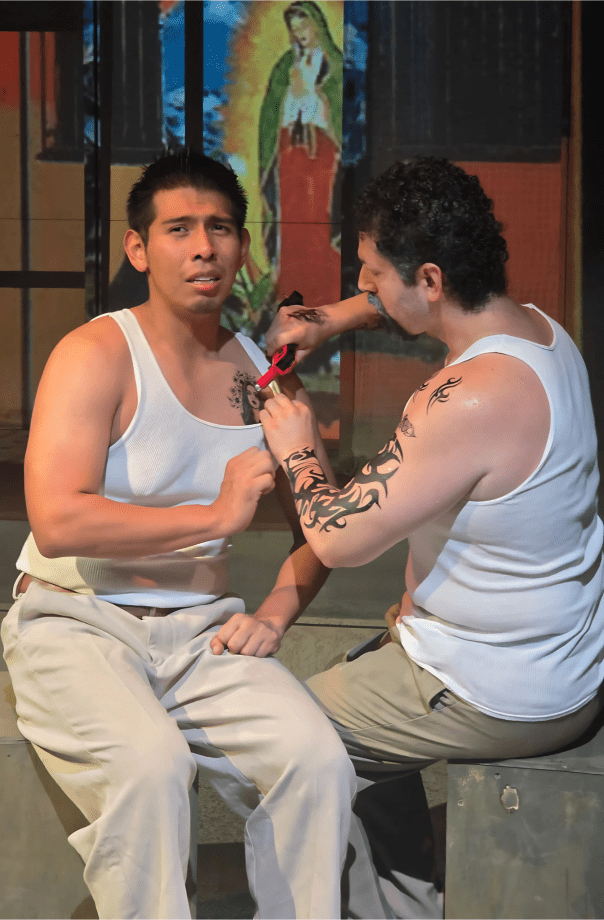
Just don’t overlook the quieter, nuanced magnificence of Eduardo Sanchez in capturing Orestes’ mix of innocence, steely nobility, and self-doubt – prodded along by Luis Medina’s sometimes proud, sometimes slightly exasperated Niño patiently punching and tattooing his pupil into manhood. Sanchez is more than soft enough when we first encounter him to justify his skepticism about filling his father’s shoes and wearing his crown.

Matricide?!? That’s a terrifying prospect when he returns from Vegas to LA and learns what’s what. Even Mom understands his hesitance, calling him “My most sensitive one.”

O’Donoghue was still tinkering with pacing on the night we attended. Too fast and you can miss Alfaro’s choicest quips, especially with Mariana Corrales, Allison Graham, and Marcella Pansini as the Chicano chorus of street sweepers, not the best players in the lineup. Slow it down, and the comedy threatens to take over.

But when it comes to the key moment, that spark-gap instant when Orestes becomes who he was destined to be, O’Donoghue nails it with hardly a single prompt from Alfaro’s script. It’s a kind of magic, a key superpower Alfaro also preserves from ancient times for his Medea in Mojada.

As Orestes returns to Clemencia’s living room, where mamá is smoking and watching TV, she begins chanting: “Find the courage. Find the rage. Find the darkness.” This chant becomes a background incantation as Celemencia deals with the shocking reunion and Orestes copes with the enormity of his mission.

Until Electricidad screams out. It’s as if the live-wire transformer decreed by Alfaro at the top of his script, humming and crackling in the background all evening long, bursts into flame. As if Electricidad is triggering Orestes’ actions by remote control.

There’s only scant proof for my theory about O’Donoghue’s concept. Aside from The Penguins’ “Earth Angel,” specified by name in the playscript, sound designer Neifert Enrique inserts Santana’s “Black Magic Woman” as a perfect foreshadowing. You did not live the ‘70s if you don’t know it.

The pesky and complaisant sister usually assigned to irritate Electra is most often named Chrysothemis, so Michelle Medina Villalon is drawing a fairly thankless role as Ifigenia. But Alfaro perks her up a bit as Ifi really is iffy to the core, trying to get her elder sister and her mom to make peace, let bygones be bygones, and trying out Christianity as an alternative to whatever kept landing her in jail. Still sporting vivid tattoos from her past, Ifi carries around a little statue of the Blessed Virgin as a security object: to pray to, to purify her living, and maybe to mark her territory if she decides to move back permanently.

Villalon also carries around a distinctively blank and traumatized look about her – maybe a prophecy of what Orestes and Electricidad will soon become. The earth here seems to be so scorched that both the sanitation department and the police stay clear. There’s no more likelihood that the siblings will face legal consequences for their crime than Clemencia faced for hers.

As one of the street sweeper gossips tells us, this is the wild, wild ouest. The only repercussions to assail the Atridas family for all their crimes are inward – the pains of guilt, regret, and that mark that has branded our species since the days of Cain. Drugs? Expelled from the equation.

Abuela remembers the good old days, reminiscing with Niño briefly upon his return before luring him to her place. With Banu Villadares embodying the tough and pragmatic Abuela, who didn’t weep at her son’s funeral because it would mar her makeup, we can understand why she is the only person on the planet who can make Electricidad laugh. Or momentarily rescue her from her own darkness.

You just gotta love her indomitable sass. Especially in a world that’s on fire.

“Clyde’s” Serves Up a Delicious Seize-the-Food Message

Review: BNS Presents Clyde’s at the Parr Center

By Perry Tannenbaum

September 13, 2024, Charlotte, NC – Over a lazy Duke Ellington piano riff that becomes indelible almost as soon as you hear it, John Coltrane layers on the melody of “In a Sentimental Mood,” recorded 62 Septembers ago. Although we’re in a kitchen at a truck stop that doesn’t look nearly that old, somewhere along the highway in Berks County PA, it’s a fitting intro to the new BNS production of Clyde’s. Along with the mean and sassy owner of this diner, Clyde, we meet her star employee, the zen-like Montrellous, also described by two-time Pulitzer Prize winning playwright Lynn Nottage as “the John Coltrane of sandwich making.”

Nottage’s newest comedy-drama originally premiered in Minneapolis as Floyd’s in 2019, less than a full year before George Floyd was killed by local police – so it was prudent to change the title before the Broadway opening in 2021. Yet a police state haze still hovers over the action, since all the employees at Clyde’s are ex-convicts or parolees, including the owner. She’s not a criminal now, but something or someone has clearly hardened her. Montrellous believes that Clyde’s could be a smashing success if it served up extraordinary sandwiches. She wants to stick to basics, lay low, keep a low profile, and lower her costs on the ingredients her drones drop between two slices of bread.

Limiting ourselves on food analogies, let’s say Clyde is one tough cookie, tightly wound to match the tight-fitting outfits costume designer Aneesah Taylor has tailored for her. You do not smile around Clyde, Montrellous warns newbie Jason, a recent parolee. He doesn’t listen. To his distress, he will learn the hard way that Clyde is the Captain Bligh or Queeg aboard this ship. Ah, but there is deeper wickedness to this boss: there is a Jezebel gene in her DNA, for Clyde is a toxic temptress. On a couple of occasions, the owner’s forays into her kitchen reminded me of Curley’s luscious wife sashaying among the farmhands in John Steinbeck’s Of Mice and Men.

The mice here mostly get to play when the boss isn’t peeping through the pickup station, hanging a barely legible order on a little carousel, and banging a bell. Director Dee Abdullah has her kitchen staff reveling in those moments when they aren’t wrapped up in a food prep frenzy. transforms the place. For him, sandwich making should never be drudgery. It is more like a mission, a calling, a crusade, an artform…or a lifelong quest for the perfect sandwich. Suffering and anger can seep into the food you make.

This ministry is not for Montrellous exclusively. When the pace in the kitchen slackens, all four workers lean over their prep stations and take turns chanting the ingredients of sandwiches never built before, swooning collectively over their imaginary deliciousness. In these moments, the kitchen is more like a studio or a writers’ room as the creators brainstorm ideas. And when the coast is really clear, Montrellous reaches into a low cabinet upstage center and extracts his latest masterwork, placing it reverently in the exact middle of the three prep stations. Since James Dukes’ lighting design accentuates the gleam of the Saran wrap around Montrellous’ newborn brainchild, the radiance turns Clyde’s kitchen into a holy temple of sorts. Epicures looking at the three stations centerstage at the Parr Center can be excused if they’re reminded of the Last Supper by Jennifer O’Kelly’s set design.

With this sacred imagery in mind, it’s hardly surprising that Montrellous’s precepts begin to transcend food preparation as we get to know more about him and about Clyde, Jason, slicer-and-dicer Letitia, and the man with the pans at the stove, Rafael. As much as Montrellous wants to convince Clyde to be more enterprising and adventurous – and less dogmatic and stingy – the adoring and adorable Rafael wants Letitia, forever stressed by her infant and her ex, to just give him and chance. Really, this romantic subplot occupies more space and time than the overarching struggle between Clyde and Montrellous, so we don’t think we’re watching supporting players when we see Lisandro D. Caceres-Zelaya in action as Rafael propositioning and wooing Toi Aquila R.J. as Letitia.

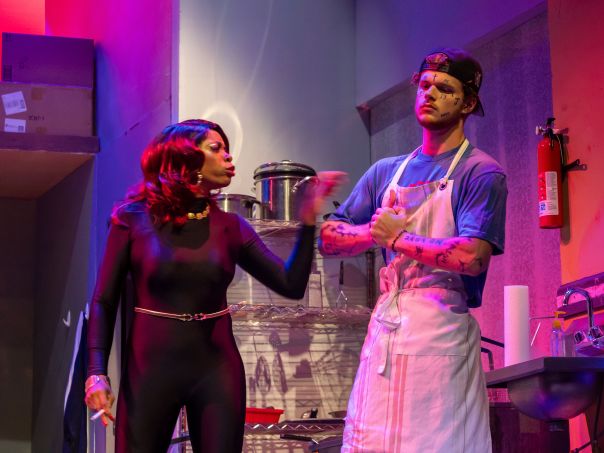
“Not enough salt, the flavor doesn’t come out; too much salt, it’s inedible,” Montrellous pronounces. Both women, taught by their past experiences, fend off new ideas and intimacies, fearing all because they’ve had too much before. Both are skeptical that being asked out could be motivated by any other reason than sexual exploitation, whether tender or forceful. Fortifying her resistance to anything Montrellous creates, Dominica Ivey as Clyde turns down every simple invitation to give it a taste. She wields her ever-present cigarette like a dagger, and her every exit is a devastating kiss-off, somewhat comical because she’s so decisive. You begin to wonder whether Ivy has any empathy for her ex-cons: maybe Clyde hires them because they can be bought cheaply.

To be sure, Ivy can string any male along in her wanton mode, but it’s Aquila as Letitia who gives off the most bi-polar vibes. When she isn’t sullenly brooding or crazily hacking lettuce as if she were Lizzie Borden, Aquila is shaking some fine booty and boogeying, reminding us of the charisma she radiated as Eartha Kitt last September. We have no difficulty understanding what Rafael sees in her, and Caceres-Zelaya lights up the stage with his sunny energy, evoking for me the irrepressible verve of Usnavy in Lin Manuel Miranda’s In the Heights.

When he isn’t presiding over the sacrament of sandwich making – and his apostles’ efforts to reach his lofty level – Zach Humphrey as Montrellous is largely a peacemaker. He intervenes with calm authority when Clyde and Jason come close to blows, and he’s a guiding light for both Letitia and Rafael as they gravitate toward one another. “Trust your ingredients,” he sagely says more than once. Everyone is different. People’s possibilities are as infinite as the varieties of sandwiches you can imagine.

Making his professional debut, Anthony Lonzo as Jason presents special challenges that audience members might struggle with, for the tats on his face and spew barbarity and hatred. Onstage, the tats are chiefly repellent to Latitia, but since Jason doesn’t speak much at first, we also need to delve beyond skin depth to grasp what he’s all about. Nottage gives each of the kitchen workers a juicy monologue to reveal what’s inside and in their rearview mirrors, and we’ll likely remember Lonzo’s nearly as vividly as Humphrey’s. But an unspoken maxim sprung to mind as Duke’s lighting finally sanctified Clyde in her memorable epiphany. It’s a wonderful little saying from the Psalms of David that I first learned from a book title by Denise Levertov: O Taste And See. At times the lesson is merely culinary. But ultimately, the message is experiential, about adopting an empirical attitude instead of hardening our prejudices. Above all, it’s an injunction to fully live our lives.

Photos by Perry Tannenbaum

Shakespeare, Airplanes, and Jazz in CP’s “Twelfth Night”

Review: Twelfth Night at the Parr Center

By Perry Tannenbaum

Shakespeare’s best comedies are bursting with multiple plots, and two of the most perfect – A Midsummer Night’s Dream and Twelfth Night – are the most dizzying and delightful. It is quite likely that the latter, later work was first performed on Twelfth Night of 1601 to celebrate the newborn century on January 5 (with a singing clown suggestively named Feste). Yet time, scholarship, and heavy-handed dramaturgy have tended to darken many modern-day productions.

That’s why the current Central Piedmont Theatre version at the Parr Center, adapted and directed by Elizabeth Sickerman, is so refreshing. Twelfth Night has at least four main plots: Viola’s separation and reunion with her twin brother Sebastian, Duke Orsino’s unrequited love for the widowed Countess Olivia (seconded by Sir Andrew Aguecheek), Viola’s crush on Orsino while disguised as his manservant, and the wicked prank concocted by Aguecheek, Sir Toby Belch, Feste, and Maria to send Olivia’s ambitious and party-pooping steward, Malvolio, to the madhouse.

Of these, the most dominant plot should be the Viola-Orsino mess, for it sprouts so many delicious complications. Acting as Caesario, Orsino’s servant, Viola is dispatched to to Countess Olivia’s manor to plead on behalf of the Duke – only to have the Countess fall in love with her. Olivia’s inclinations toward Viola/Caesario not only enflame Orsino’s jealousy, they also lead to an absurd duel with fellow coward Sir Andrew. Meanwhile, she encounters Sebastian’s close friend, Antonio, who puts all his money in Viola’s care, mistaking her for her twin. You can easily imagine what happens when Sir Andrew makes the same mistake.

Ultimately, the mistaken identities reach the giddy point where Olivia cannot recognize her own husband just hours after their marriage. Ah, a honeymoon to remember.

So to tip the balance toward empathizing with Malvolio, simply because he is incidentally berated as “a kind of puritan,” is rather perverse. Elsewhere, I’ve seen the steward outfitted with a Puritan’s hat. Far more stupidly, I’ve heard a theatre sage say Malvolio was modeled on Lord Protector Oliver Cromwell, born in 1599. Thomas Cromwell, Earl of Essex (1485-1540), instrumental in the English Reformation, is a more feasible candidate. Sickerman not only discards such nonsense, she transports the action from ancient Illyria, at the heel of Italy’s boot, to a coastal town immersed in the Jazz Age.

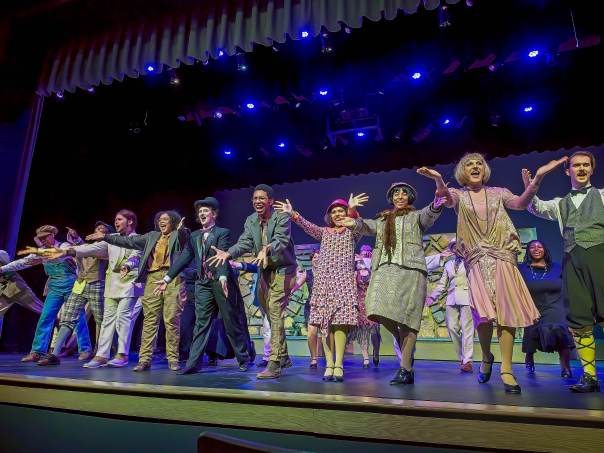
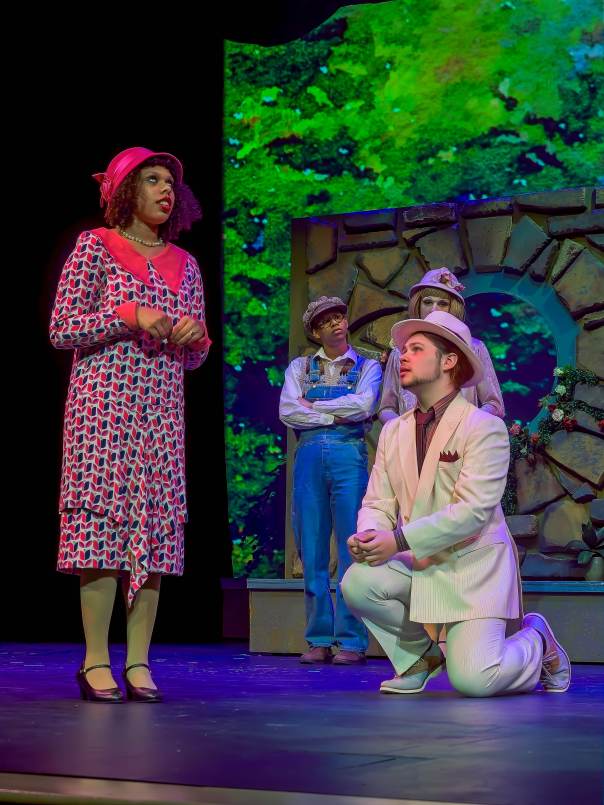
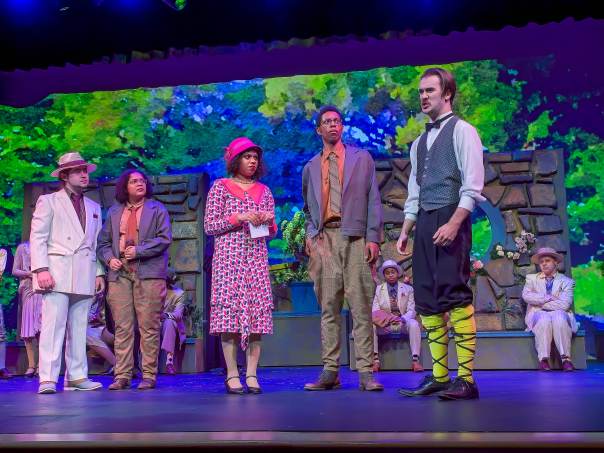
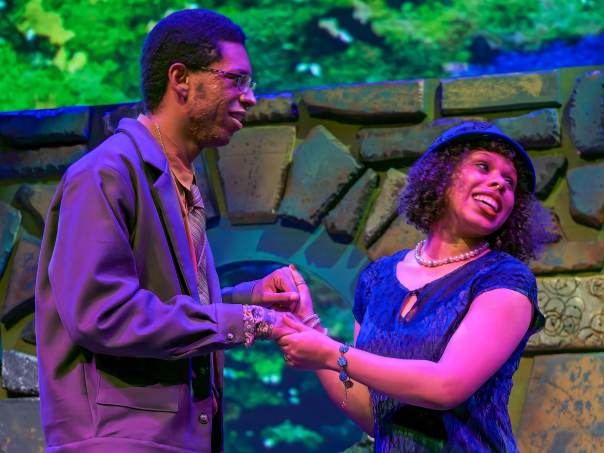
Costume designer Emily McCurdy certainly goes with the Roaring 20’s flow. Orsino and Olivia could easily pass for the recently reprised Gatsby and Daisy Buchanan on Broadway, surrounded by flappers and jazzy gallants galore. The moving pieces and projections of Jennifer O’Kelly’s scenery, more evocative of summer than winter, have enough classic detailing for Viola to sit at the foot of an Ionian pillar when describing herself sitting like “Patience on a monument.”

Nor does the music veer from the vintage of Prohibition days. Montavious Blocker has choice cuts of Duke Ellington and Sidney Bechet in his soundtrack, and just a few bars of music arranger Matt Postle’s chart for “Come Away, Death,” transformed from a lover’s lament into a jivey jump tune, are enough to conclusively vanquish melancholy, injecting Feste’s song for the lovesick Orsino with catchy mischief. The debris downstage suggests an Amelia Earhart plane crash rather than Shakespeare’s original shipwreck, and Charles Lindbergh could have inspired Sebastian and Viola’s matching outfits. Except for the tacky slacks.

If you’ve seen Twelfth Night before, Sickerman cordially adds to the Bard’s dizzying layers of identity, cutting some expositional text and casting females in key roles. Not one of them is a Chickspeare alum. Saskia Lewis as Feste, Rhianon Chandler as Antonio, and Kameal Brown as the recklessly unknighted Dame Toby Belch are all QC newcomers to me. If only Aryana Mitchell, portraying Viola, had an identical twin sister to take on Sebastian!

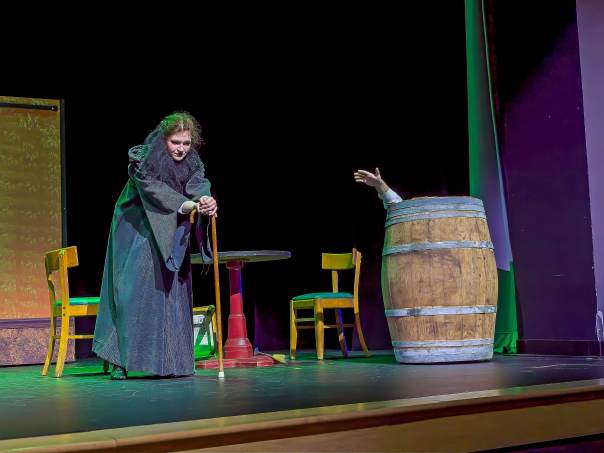
We are centuries away from the Protestant Reformation or the English Restoration, although Sickerman seems to beach the sibs closer to the Pilgrims’ beloved Plymouth Rock than to the Adriatic coast. Such oceanic distancing frees Malvolio from a dungeon of scorn when Central Piedmont’s plotters and nobles plunk their preening steward into a humble barrel to punish his prudery.

He isn’t the clown among the comical group, but Sickerman allows Truman Grant as Malvolio to loosen up, so that his usual rigidity is now almost elegance, mockable now as uppity pretense. Another sign of Sickerman’s lighthearted touch: her pick for the incredulous Sebastian is Timothy Snyder, who is at least a foot taller than his “twin.”

The disparity was so great, that I didn’t catch on at first. Brown’s outfit as Dame Toby, more like Miss Marple than a Falstaffian drunkard, compounded my early confusion, making me feel like newbie to the comedy while I got oriented. Struggling to remember a single instance when the euthanized CPCC Summer Theatre ever presented such a challenging comedy, I stumbled upon another reason why this excellent production was so refreshing.

All the cast was youthful, like the summer college grads who swarmed to Charlotte during CP summers to launch their pro careers. Not one old-timer in the bunch!

As a result of coping with all the period, costume, and gender changes, my disorientation was dispelled at the same time that I was learning to trust the youngbloods performing at CP’s New Theater, which has thankfully replaced panoramic Pease Auditorium but lamentably failed to showcase nearly as much CP talent. The mental training wheels that I had doled out to all these student efforts quickly flew away.

But along with a lightened, more secular and decadent Malvolio, there was newfound pleasure in the other creatures onstage who no longer needed to orbit around the self-absorbed steward. The Malvolio miasma that I’d felt since my first encounter with Twelfth Night in a college Shakespeare seminar, taught by a professor victimized by the prevailing obsession with the “puritan,” finally evaporated.

Twelfth Night, or What You Will has always been an awesome comedy for me. Now it was fun. I’d barely appreciated the bounty of fascinating character sketches that the Bard serves up here.

Now Viola is the patient, softspoken eye of the storm, and Mitchell is keenly sensitive, alternately anguished and bemused by all the passion and folly that surround her. Mitchell’s discreet takes, shared with us, make her a sort of co-emcee with Feste, though Sickerman asks too many eyerolls from her. Fitz Fitzpatrick is only slightly over-the-top with the lovesick gushings of Orsino, chiming well with a lounging Duke or a mob boss. Yes, that sleek robe has a Godfather aura before we see Fitz in the Gatsby threads.

As Olivia, Arianna Zappley does not yield at all to Fitzpatrick in regal dopiness. The two are as perfect a matching pair as the twins, made for each other, yet both are insanely lucky to land one of the sibs. Rounding out the symmetry of the two couples as Sebastian is the disproportioned Snyder, who does manage to nearly equal the calm of his diminutive twin – even though the Illyrians mistake him for her over and over. Playing Sebastian’s closest friend, the wrongly arrested Antonio, Chandler helps the prisoner to emerge as a neat counterweight to Malvolio, who is rightfully chastised for his presumption, though the penalty is too harsh.

There’s a little more slapstick flavor to the motley crew who bedevil Malvolio – and a bit more spice. Evelyn Ovall as Olivia’s waiting-gentlewoman Marie, who forges her mistress’s handwriting in the billet-doux that entraps the detested steward, is destined to marry Brown as Dame Toby. I’d like to think Ellington and his orchestra would have consented to play at the wedding reception, but I’m not sure.

Dopiest of the conspirators and clearly the least self-aware is Salim Muhammad as Sir Andrew, usually exiting with an absurdly military goosestep. In his challenge to Caesario/Viola, Muhammad now dons boxing gloves instead grabbing a sword, magnifying his ineffectuality with his effeminate pawing as he briefly combats the well-matched Mitchell.

Lewis effortlessly steals nearly every scene she appears in as Feste, convincing me along the way that this clown was intended to upstage all others. Not only does Feste sing lyrically and wittily – compared to the other lovers who barely stammer their effusions – she proves to be a better actress than the leading lady, Viola. Visiting Malvolio at the mouth of a barrel he believes is dark hell, Feste gives bravura performances as Sir Topas, a parson supposedly sent to determine how mad this lunatic is, interspersed with imitations of a sincere jester. Lewis cackles and coos this cruel vaudeville as bewitchingly as she swings death, ranging further than anyone else.

Photos by Perry Tannenbaum

Dialing Up the Almighty in Memphis

Review: The Mountaintop at Theatre Charlotte

by Perry Tannenbaum

A stage with a particularly authentic – or imaginative – set design is a good start for a director who wishes to immerse you in the world of a play. Yet few productions surround you with the theatre experience, making you feel outside your own world and inside theirs. Sleep No More was dedicated to achieving this mission with a Macbeth makeover up in Manhattan’s Chelsea district at a spooky hotel, where I saw it in 2015. So was Then She Fell the following night in Brooklyn, where I was plunged into the imagination – and mental illness – of Lewis Carroll.

In Charlotte, such efforts have been comparatively infrequent, but not unknown: Chickspeare’s Fefu and Her Friends on Cullman Avenue in 2001, numerous “environmental” productions by Carolina Actor’s Studio Theatre (CAST) in their days on Clement Avenue, and Matt Cosper’s legendary Bohemian Grove of 2014 that was staged god-knows-where – you had to agree to be kidnapped in a van by The Machine at the Actor’s Theatre parking lot to attend.

They do make an impression, these hyper-immersive presentations.

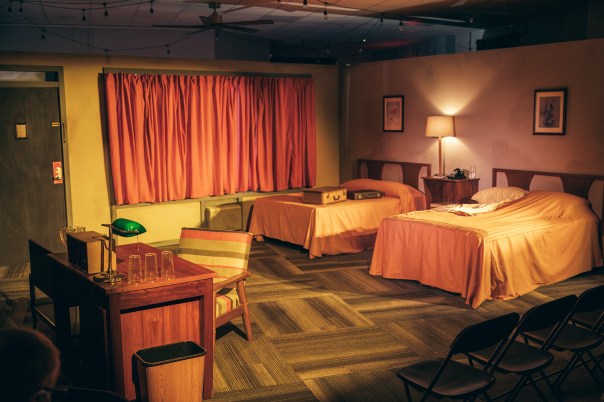
Cut to the legendary Queens Road Barn for the latest Queen City experiment in environmental staging. Yes, that’s Theatre Charlotte – in Myers Park! – on the cutting edge with its new production of Katori Hall’s The Mountaintop. Directed by the ageless Corlis Hayes and designed by Chris Timmons – with a nine-person “Lobby Transformation” team – this is the first fully-staged drama my wife Sue and I have seen in the 501 Queens Road lobby since the spare and forlorn Waiting for GODot in 2007.

Together with invaluable help from David Gallo, set designer for the 2011 Broadway production, and props designer Brodie Jasch from Fayetteville’s Theatre Squared, Dr. Hayes and her production team aim to take us back to the Lorraine Motel in Memphis on the night of April 3, 1968. Rev. Martin Luther King, Jr., returns from the Mason Temple, where he has just delivered his eerily prophetic “I’ve Been to the Mountaintop” speech.

Every detail of the last room occupied by MLK has been replicated with meticulous authenticity – night tables and their contents, lamps, the chair and its fabric next to the window, the window curtains, the bed coverings – all the way down to the upside-down zero on the door to Room 306. With walls within walls, you must enter through this door to get your first view of the new theatre space in the lobby created for this production. Only the ceiling remains unaltered, with its fans and extinguished holiday lights. Explanations are appended in the digital program for those details which couldn’t be ascertained and those that would have conflicted with Hall’s script.

Since there is no intermission and all the usual concession outposts have been whisked away, they have thoughtfully made “Room Service” available to ticketholders via a QR code. In more ways than one, we are treated like kings at The Lorraine. Fun fact: the fateful motel was actually named after the hit 1928 song, “Sweet Lorraine,” popularized by jazz artists Teddy Wilson and Nat “King” Cole.

For all of Dr. Hayes’s reverent devotion to getting the look and feel of The Lorraine recreated as faithfully as she can, we soon see that it isn’t a shrine. Hayes is equally bent on getting to the heart of Hall’s pointedly irreverent drama. Hall provides ample time for solemnity and anguish at the end, but until then, she wants us to see the soon-to-be-martyred icon as a man, not a god, and not even as a holy man. The real Martin – or as God likes to call him, Michael – had his foibles, vices, and infidelities.

And notwithstanding the resounding valedictory declarations of the Memphis speech we’ve heard over and over – “So I’m happy, tonight. I’m not worried about anything. I’m not fearing any man” – Hall insists on reminding us that King did have worries and fears.

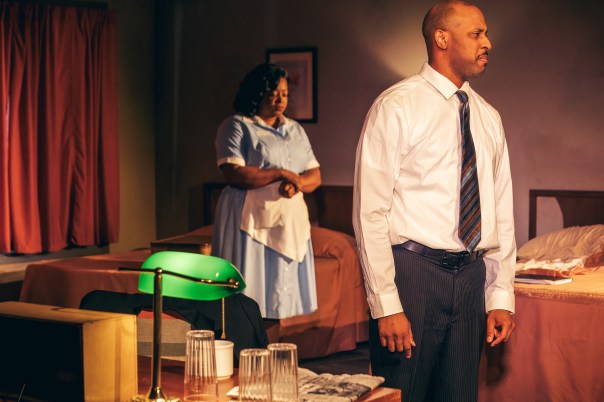
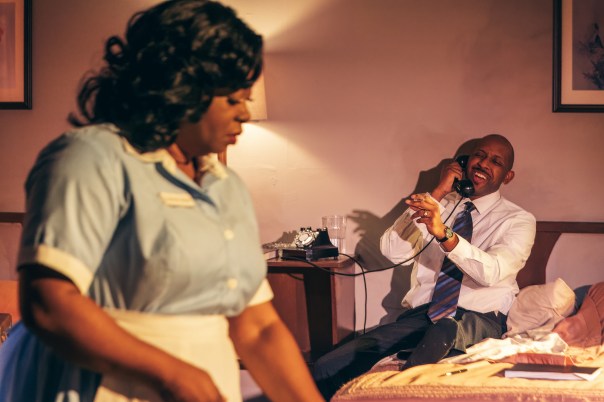
All obeisance to King’s saintly aura is swiftly discarded almost as soon as we see Justin Peoples taking on the role, before he walks through the audience to take a pee. Not only is he unkempt after his oratorical exertions and his walk through the rain, he has largely dropped his dignified public persona, at ease if not quite relaxed. Though he diligently examines his room’s rotary phone to make sure it isn’t bugged, we can hear that he has switched from formal to casual mode as soon as he speaks. It’s with an unmistakably Southern accent!

Immediately disarming. Neither the touring production by the famed Penumbra Theatre of Minneapolis that ran at Booth Playhouse in 2014, nor the homegrown Actor’s Theatre run of 2018 at Queens University, directed by April Jones, had quite the same spontaneous or undignified impact. The smallness of the lobby space at the Queens Road Barn certainly helps in establishing a closer intimacy with King and a sharper look at his vulnerabilities.

Maybe that folksy drawl would have been even more impactful if Peoples had held back on it until MLK had dialed room service after normal closing hours. The arrival of LeShea Stukes as the fetching Camae, a housemaid moonlighting as King’s waitress, would have been a good moment for Peoples to turn on the Southern charm. But for those of us who have seen The Mountaintop before, Stukes brings with her more than Camae’s sensual allure, more than her extra Pall Malls to satisfy King’s chain-smoking, and more than her working-class sass.

She now gives us solemn glances from behind King’s back, fully aware of the gravity of her true mission before she discloses it, morphing from pursued damsel to admonishing paramour to chum to messenger of God. None of these fresh wrinkles quite accounts for the marvelous voodoo or the juju that Hayes, Peoples, and Stukes have conjured up in creating the playful, poignant, and profound chemistry of this Camae and MLK.

Lighting designer Jennifer O’Kelly gently signals those moments when Camae might be contemplating why she’s there, foreshadowing the AV extravaganza that will accompany Stukes’ final mountaintop revelations. She will almost be speaking in tongues when we reach this visionary summit.

There’s little theology here, for when King dials up the Almighty, pleading his case for more time on this turbulent planet, she hangs up on him. Yet there just may be some deep dialectic in Hall’s scheme that narrows the gap that we might feel between God’s biblical judgment upon Moses at Mount Nebo and the judgment upon Martin in Memphis.

Moses was given a precise catalog of his greatest sins. Maybe in an afterlife he learned not to shatter any holy tablets or assault a boulder without God’s approval. But what was the great sin that deprived MLK of the Promised Land that awaited his people? The answer never comes explicitly in the play, but King’s sins – though relatively petty until we consider possible adultery – are graven in its marrow.

In an age when not a day goes by without yielding fresh images, outrages, and crimes committed by a lying orange buffoon, we might find ourselves shocked to be shoved towards such traditional moral moorings. Some of these values were written long ago in our marrow. Leading a people may still require adhering to a higher standard in God’s job description, not flouting the laws and proprieties that apply to everyone else.

Peoples and Stukes, with plenty of finely judged assistance, have found a way to make The Mountaintop more poignant, relatable, and human. Hall’s work becomes more touching, meaningful, and necessary each time I see it.